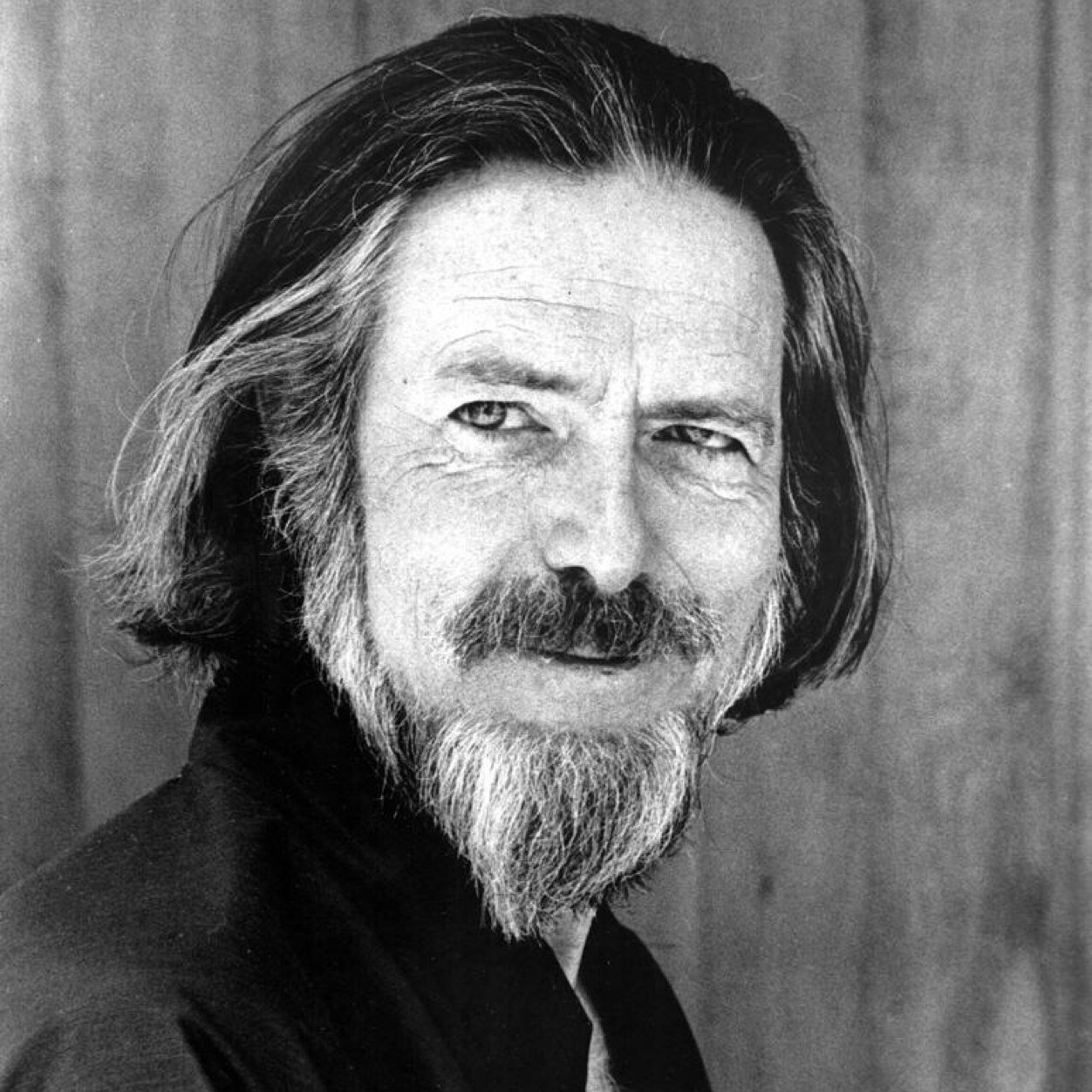
Alan Watts – The Trickster Guru?

The Trickster Guru

by Alan Watts

I have often thought of writing a novel, similar to Thomas Mann’s “Confessions of Felix Krull,” which would be the life story of a charlatan making out as a master guru – either initiated in Tibet or appearing as the reincarnation of Nagarjuna, Padmasambhava, or some other great historical sage of the Orient. It would be a romantic and glamorous tale, flavored with the scent of pines in Himalayan valleys, with garden courtyards in obscure parts of Alexandria, with mountain temples in Japan, and with secretive meetings and initiations in country houses adjoining Paris, New York, and Los Angeles. It would also raise some rather unexpected philosophical questions as to the relations between genuine mysticism and stage magic. But I have neither the patience nor the skill to be a novelist, and thus can do no more than sketch the idea for some more gifted author.

The attractions of being a trickster guru are many. There is power and there is wealth, and still more the satisfactions of being an actor without need for a stage, who turns “real life” into a drama. It is not, furthermore, an illegal undertaking such as selling shares in non-existent corporations, impersonating a doctor, or falsifying checks. There are no recognized and official qualifications for being a guru, though now that some universities are offering courses in meditation and Kundalini Yoga it may soon be necessary to be a member of the U.S. Fraternity of Gurus. But a really fine trickster would get around all that by the one-upmanship of inventing an entirely new discipline outside and beyond all known forms of esoteric teaching.

It must be understood from the start that the trickster guru fills a real need and performs a genuine public service. Millions of people are searching desperately for a true father-Magician, especially at a time when the clergy and the psychiatrists are making rather a poor show, and do not seem to have the courage of their convictions or of their fantasies. Perhaps they have lost nerve through too high a valuation of the virtue of honesty – as if a painter felt bound to give his landscapes the fidelity of photographs. To fulfil his compassionate vocation, the trickster guru must above all have nerve. He must also be quite well-read in mystical and occult literature, both that which is historically authentic and sound in scholarship, and that which is somewhat questionable – such as the writings of H.P. Blavatsky, P.D. Ouspensky, and Aleister Crowley. It doesn’t do to be caught out on details now known to a wide public.

After such preparatory studies, the first step is to frequent those circles where gurus are especially sought, such as the various cult groups which pursue oriental religions or peculiar forms of psychotherapy, or simply the intellectual and artistic milieux of any great city. Be somewhat quiet and solitary. Never ask questions, but occasionally add a point – quite briefly – to what some speaker has said. Volunteer no information about your personal life, but occasionally indulge in a little absent-minded name-dropping to suggest that you have travelled widely and spent time in Turkestan. Evade close questioning by giving the impression that mere travel is a small matter hardly worth discussing, and that your real interests lie on much deeper levels.

Such behavior will soon provoke people into asking your advice. Don’t come right out with it, but suggest that the question is rather deep and ought to be discussed at length in some quiet place. Make an appointment at a congenial restaurant or cafe – not at your home, unless you have an impressive library and no evidence of being tied down with a family. At first, answer nothing, but without direct questioning, draw the person out to enlarge on his problem and listen with your eyes closed – not as if sleeping, but as if attending to the deep inner vibrations of his thoughts. Conclude the interview with a slightly veiled command to perform some rather odd exercise, such as humming a sound and then suddenly stopping. Carefully instruct the person to be aware of the slightest decision to stop before actually stopping, and indicate that the point is to be able to stop without any prior decision. Make a further appointment for a report on progress.

To carry this through, you must work out a whole series of unusual exercises, both psychological and physical. Some must be rather difficult tricks which can actually be accomplished, to give your student the sense of real progress.

Others must be virtually impossible – such as to think of the words yes and no at the same instant, repeatedly for five minutes, or with a pencil in each hand, to try to hit the opposite hand – which is equally trying to defend itself and hit the other. Don’t give all your students the same exercises but, because people love to be types, sort them into groups according to their astrological sun signs or according to your own private classifications, which must be given such odd names as grubers, jongers, milers, and trovers.

A judidous use of hypnosis – avoiding all the common tricks of hand-raising, staring at lights, or saying “Relax. Relax, while I count up to ten” will produce pleasant changes of feeling and the impression of attaining higher states of consciousness.

First, describe such a stage quite vividly – say, the sense of walking on air – and then have your students walk around barefooted trying not to make the slightest sound and yet giving their whole weight to the floor. Imply that the floor will soon feel like a cushion, then like water, and finally like air. Indicate a little later that there is reason to believe that something of this kind is the initial stage of levitation.

Next, be sure to have about thirty or forty different stages of progress worked out, giving them numbers, and suggest that there are still some extremely high stages beyond those numbered which can only be understood by those who have reached twenty-eight – so no point in discussing them now. After the walking-on-air gambit, try for instance having them push out hard with their arms as if some overwhelming force were pulling them. Reverse the procedure. This leads quickly to the feeling that one is not doing what one is doing and doing what one is not doing. Tell them to stay in this state while going about everyday business.

After a while let it be known that you have a rather special and peculiar background – as when some student asks, “Where did you get all this?” Well, you just picked up a thing or two in Turkestan, or “I’m quite a bit older than I look,” or say that “Reincarnation is entirely unlike what people suppose it to be.” Later, let on that you are in some way connected with an extremely select in-group. Don’t brashly claim anything. Your students will soon do that for you, and, when one hits on the fantasy that pleases you most, say, “I see you are just touching stage eighteen.”

There are two schools of thought about asking for money for your services. One is to have fees just like a doctor, because people are embarrassed if they do not know just what is expected of them. The other, used by the real high-powered tricksters, is to do everything free with, however, the understanding that each student has been personally selected for his or her innate capacity for the work (call it that), and thus be careful not to admit anyone without first putting them through some sort of hazing. Monetary contributions will soon be offered. Otherwise, charge rather heavily, making it dear that the work is worth infinitely more to oneself and to others than, say, expensive surgery or a new home. Imply that you give most of it away to mysterious beneficiaries.

As soon as you can afford to wangle it, get hold of a country house as an ashram or spiritual retreat, and put students to work on all the menial tasks. Insist on some special diet, but do not follow it yourself. Indeed, you should cultivate small vices, such as smoking, mild boozing, or, if you are very careful, sleeping with the ladies, to suggest that your stage of evolution is so high that such things do not affect you, or that only by such means can you remain in contact with ordinary mundane consciousness.

On the one hand, you yourself must be utterly free from any form of religious or parapsychological superstition, lest some other trickster should outplay you. On the other hand, you must eventually come to believe in your own hoax, because this will give you ten times more nerve. This can be done through religionizing total skepticism to the point of basic incredulity about everything – even science. After all, this is in line with the Hindu-Buddhist position that the whole universe is an illusion, and you need not worry about whether the Absolute is real or unreal, eternal or non-eternal, because every idea of it that you could form would, in comparison with living it up in the present, be horribly boring. Furthermore, you should convince yourself that the Absolute is precisely the same as illusion, and thus not be in the least ashamed of being greedy or anxious or depressed. Make it dear that we are ultimately God, but that you know it. If you are challenged to perform wonders, point out that everything is already a fabulous wonder, and to do something bizarre would be to go against your own most perfect scheme of things. On the other hand, when funny coincidences turn up, look knowing and show no surprise, especially when any student has good fortune or recovers from sickness. It will promptly be attributed to your powers, and you may be astonished to find that your very touch becomes healing, because people really believe in you. When it doesn’t work, you should sigh gently about lack of faith, or explain that this particular sickness is a very important working out of Karma which will have to be reckoned with some day, so why not now.

The reputation for supernormal powers is self-reinforcing, and as it builds up you can get more daring, such that you will have the whole power of mass self-deception working for you. But always remember that a good guru plays it cool and maintains a certain aloofness, especially from those sharpies of the press and TV whose game is to expose just about everyone as a fraud. Always insist, like the finest restaurants, that your clientele is exclusive. The very highest “society” does not deign to be listed in the Social Register.

As time goes on, allow it more and more to be understood that you are in constant touch with other centers of work. Disappear from time to time by taking trips abroad, and come back looking more mysterious than ever. You can easily find someone in India or Syria to do duty as your colleague, and take a small and select group of students on a journey which includes a brief interview with this Personage. He can talk any kind of nonsense, while you do the “translating.” When travelling with students, avoid any obvious assistance from regular agencies, and let it appear that your secret fraternity has arranged everything in advance.

Now a trickster guru is certainly an illusionist, but one might ask “What else is art?” If the universe is nothing but a vast Rorschach blot upon which we project our collective measures and interpretations, and if past and future has no real existence, an illusionist is simply a creative artist who changes the collective interpretation of life, and even improves on it. Reality is mostly what a people or a culture conceives it to be. Money, worthless in itself, depends entirely on collective faith for its value. The past is held against you only because others believe in it, and the future seems important only because we have conned ourselves into the notion that surviving for a long time, with painstaking care, is preferable to surviving for a short time with no responsibility and lots of thrills. It is really a matter of changing fashion.

Perhaps, then, a trickster may be one who actually liberates people from their more masochistic participations in the collective illusion, on the homeopathic principle of “The hair of the dog that bit you. ” Even genuine gurus set their disciples impossible psychological exercises to demonstrate the unreality of the ego, and it could be argued that they too, are unwitting tricksters, raised as they have been in cultures without disillusioning benefits of “scientific knowledge,” which, as ecologists note, isn’t working out too well. Perhaps it all boils down to the ancient belief that God himself is a trickster, eternally fooling himself by the power of maya into the sensation that he is a human being, a cat, or an insect, since no art can be accomplished which does not set itself certain rules and limitations. A fully infinite and boundless God would have no limitations, and thus no way of manifesting power or love. Omnipotence must therefore include the power of self-restriction – to the point of forgetting that it is restricting itself and thus making limitations seem real. It could be that genuine students and gurus are on the side of being fooled, whereas the phony gurus are the foolers – and one must make one’s choice.

I am proposing this problem as a kind of Zen koan, like “Beyond positive and negative, what is reality?” How will you avoid being either a fool or a fooler? How will you get rid of the ego-illusion without either trying or not trying? If you need God’s grace to be saved, how will you get the grace to get grace? Who will answer these questions if yourself is itself an illusion? Man’s extremity is God’s opportunity.

The cock crows in the evening;
At midnight, the brilliant sun.
And there have also been such effective mother-magicians as Mary Baker Eddy, Helena Blavatsky, Aimee Semple McPherson, Annie Besant, and Alice Bailey.

© Alan Watts (1915 – 1973) The Essential Alan Watts, Celestial Arts (1974)

alan_watts

Alan Watts: Out of Your Mind – Essential Listening from the Alan Watts Audio Archives

Schopenhauer

“In India our religions will never take root. The ancient wisdom of the human race will not be displaced by what happened in Galilee. On the contrary, Indian philosophy streams back to Europe, and will produce a fundamental change in our knowledge and thought.”

– Arthur Schopenhauer

the-world-as-will-and-representation

Full Book (PDF): The World as Will and Representation – Volume I – Volume II

Full Book (PDF): On the Basis of Morality

Schopenhauer’s Thought

A key focus of Schopenhauer was his investigation of individual motivation. Before Schopenhauer, Hegel had popularized the concept of Zeitgeist, the idea that society consisted of a collective consciousness that moved in a distinct direction, dictating the actions of its members. Schopenhauer, a reader of both Kant and Hegel, criticized their logical optimism and the belief that individual morality could be determined by society and reason. Schopenhauer believed that humans were motivated by only their own basic desires, or Wille zum Leben (“Will to Live”), which directed all of mankind.

For Schopenhauer, human desire was futile, illogical, directionless, and, by extension, so was all human action in the world. Einstein paraphrased his views as follows: “Man can indeed do what he wants, but he cannot will what he wants.” In this sense, he adhered to the Fichtean principle of idealism: “The world is for a subject.” This idealism so presented, immediately commits it to an ethical attitude, unlike the purely epistemological concerns of Descartes and Berkeley. To Schopenhauer, the Will is a blind force that controls not only the actions of individual, intelligent agents, but ultimately all observable phenomena—an evil to be terminated via mankind’s duties: asceticism and chastity. He is credited with one of the most famous opening lines of philosophy: “The world is my representation.” Will, for Schopenhauer, is what Kant called the “thing-in-itself”. Friedrich Nietzsche was greatly influenced by this idea of Will, although he eventually rejected it.

For Schopenhauer, human desiring, “willing”, and craving cause suffering or pain. A temporary way to escape this pain is through aesthetic contemplation (a method comparable to Zapffe’s “Sublimation“). Aesthetic contemplation allows one to escape this pain—albeit temporarily—because it stops one perceiving the world as mere presentation. Instead, one no longer perceives the world as an object of perception (therefore as subject to the Principle of Sufficient Grounds; time, space and causality) from which one is separated; rather one becomes one with that perception: “one can thus no longer separate the perceiver from the perception” (The World as Will and Representation, section 34). From this immersion with the world one no longer views oneself as an individual who suffers in the world due to one’s individual will but, rather, becomes a “subject of cognition” to a perception that is “Pure, will-less, timeless” (section 34) where the essence, “ideas”, of the world are shown. Art is the practical consequence of this brief aesthetic contemplation as it attempts to depict one’s immersion with the world, thus tries to depict the essence/pure ideas of the world. Music, for Schopenhauer, was the purest form of art because it was the one that depicted the will itself without it appearing as subject to the Principle of Sufficient Grounds, therefore as an individual object. According to Daniel Albright, “Schopenhauer thought that music was the only art that did not merely copy ideas, but actually embodied the will itself”.

He deemed music a timeless, universal language comprehended everywhere, that can imbue global enthusiasm, if in possession of a significant melody.

Will as Noumenon

Schopenhauer accepted Kant’s double-aspect of the universe—the phenomenal (world of experience) and the noumenal (the true world, independent of experience). Some commentators suggest that Schopenhauer claimed that the noumenon, or thing-in-itself, was the basis for Schopenhauer’s concept of the will. Other commentators suggest that Schopenhauer considered will to be only a subset of the “thing-in-itself” class, namely that which we can most directly experience.

Schopenhauer’s identification of the Kantian noumenon (i.e., the actually existing entity) with what he termed “will” deserves some explanation. The noumenon was what Kant called the Ding an sich (the Thing in Itself), the reality that is the foundation of our sensory and mental representations of an external world. In Kantian terms, those sensory and mental representations are mere phenomena. Schopenhauer departed from Kant in his description of the relationship between the phenomenon and the noumenon. According to Kant, things-in-themselves ground the phenomenal representations in our minds; Schopenhauer, on the other hand, believed that phenomena and noumena are two different sides of the same coin. Noumena do not cause phenomena, but rather phenomena are simply the way by which our minds perceive the noumena, according to the principle of sufficient reason.

Schopenhauer’s second major departure from Kant’s epistemology concerns the body. Kant’s philosophy was formulated as a response to the radical philosophical skepticism of David Hume, who claimed that causality could not be observed empirically. Schopenhauer begins by arguing that Kant’s demarcation between external objects, knowable only as phenomena, and the Thing in Itself of noumenon, contains a significant omission. There is, in fact, one physical object we know more intimately than we know any object of sense perception: our own body.

We know our human bodies have boundaries and occupy space, the same way other objects known only through our named senses do. Though we seldom think of our body as a physical object, we know even before reflection that it shares some of an object’s properties. We understand that a watermelon cannot successfully occupy the same space as an oncoming truck; we know that if we tried to repeat the experiment with our own body, we would obtain similar results—we know this even if we do not understand the physics involved.

We know that our consciousness inhabits a physical body, similar to other physical objects only known as phenomena. Yet our consciousness is not commensurate with our body. Most of us possess the power of voluntary motion. We usually are not aware of the breathing of our lungs or the beating of our heart unless somehow our attention is called to them. Our ability to control either is limited. Our kidneys command our attention on their schedule rather than one we choose. Few of us have any idea what our liver is doing right now, though this organ is as needful as lungs, heart, or kidneys. The conscious mind is the servant, not the master, of these and other organs. These organs have an agenda the conscious mind did not choose, and over which it has limited power.

When Schopenhauer identifies the noumenon with the desires, needs, and impulses in us that we name “will”, what he is saying is that we participate in the reality of an otherwise unachievable world outside the mind through will. We cannot prove that our mental picture of an outside world corresponds with a reality by reasoning; through will, we know—without thinking—that the world can stimulate us. We suffer fear, or desire: these states arise involuntarily; they arise prior to reflection; they arise even when the conscious mind would prefer to hold them at bay. The rational mind is, for Schopenhauer, a leaf borne along in a stream of pre-reflective and largely unconscious emotion. That stream is will, and through will, if not through logic, we can participate in the underlying reality beyond mere phenomena. It is for this reason that Schopenhauer identifies the noumenon with what we call our will.

In his criticism of Kant, Schopenhauer claimed that sensation and understanding are separate and distinct abilities. Yet, for Kant, an object is known through each of them. Kant wrote: “[T]here are two stems of human knowledge … namely, sensibility and understanding, objects being given by the former [sensibility] and thought by the latter [understanding].” Schopenhauer disagreed. He asserted that mere sense impressions, not objects, are given by sensibility. According to Schopenhauer, objects are intuitively perceived by understanding and are discursively thought by reason (Kant had claimed that (1) the understanding thinks objects through concepts and that (2) reason seeks the unconditioned or ultimate answer to “why?”). Schopenhauer said that Kant’s mistake regarding perception resulted in all of the obscurity and difficult confusion that is exhibited in the Transcendental Analytic section of his critique.

Lastly, Schopenhauer departed from Kant in how he interpreted the Platonic ideas. In The World as Will and Representation Schopenhauer explicitly stated:

…Kant used the word [Idea] wrongly as well as illegitimately, although Plato had already taken possession of it, and used it most appropriately.

Instead Schopenhauer relied upon the Neoplatonist interpretation of the biographer Diogenes Laërtius from Lives and Opinions of Eminent Philosophers. In reference to Plato’s Ideas, Schopenhauer quotes Laërtius verbatim in an explanatory footnote.

Diogenes Laërtius (III, 12): Plato teaches that the Ideas exist in nature, so to speak, as patterns or prototypes, and that the remainder of things only resemble them, and exist as their copies.

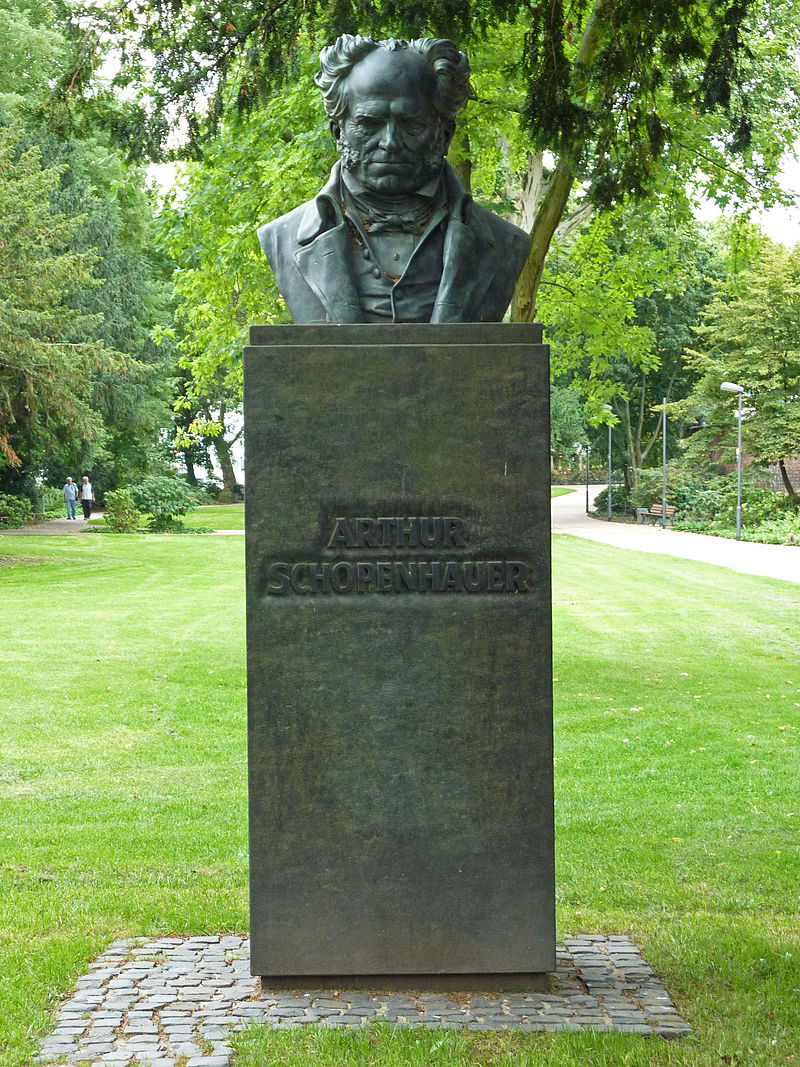
schopenhauer_statue

Moral Theory

Schopenhauer’s moral theory proposed that only compassion can drive moral acts. According to Schopenhauer, compassion alone is the good of the object of the acts, that is, they cannot be inspired by either the prospect of personal utility or the feeling of duty. Mankind can also be guided by egoism and malice. Egotistic acts are those guided by self-interest, desire for pleasure or happiness. Schopenhauer believed most of our deeds belong to this class. Acts of malice are different from egotistic acts. As in the case of acts of compassion, these do not target personal utility. Their aim is to cause damage to others, independently of personal gains. He believed, like Swami Vivekananda in the unity of all with one-self and also believed that ego is the origin of pain and conflicts, that reduction of ego frames the moral principles.

Even though Schopenhauer ended his treatise on the freedom of human will with the postulate of everyone’s responsibility for their character and, consequently, acts—the responsibility following from one’s being the Will as noumenon (from which also all the characters and creations come)—he considered his views incompatible with theism, on grounds of fatalism and, more generally, responsibility for evil. In Schopenhauer’s philosophy the dogmas of Christianity lose their significance, and the “Last Judgment” is no longer preceded by anything—”The world is itself the Last Judgment on it.” Whereas God, if he existed, would be evil.

He named a force within man that he felt took invariable precedence over reason: the Will to Live or Will to Life (Wille zum Leben), defined as an inherent drive within human beings, and indeed all creatures, to stay alive; a force that inveigles us into reproducing.

Schopenhauer refused to conceive of love as either trifling or accidental, but rather understood it as an immensely powerful force that lay unseen within man’s psyche and dramatically shaped the world:

The ultimate aim of all love affairs … is more important than all other aims in man’s life; and therefore it is quite worthy of the profound seriousness with which everyone pursues it. What is decided by it is nothing less than the composition of the next generation.

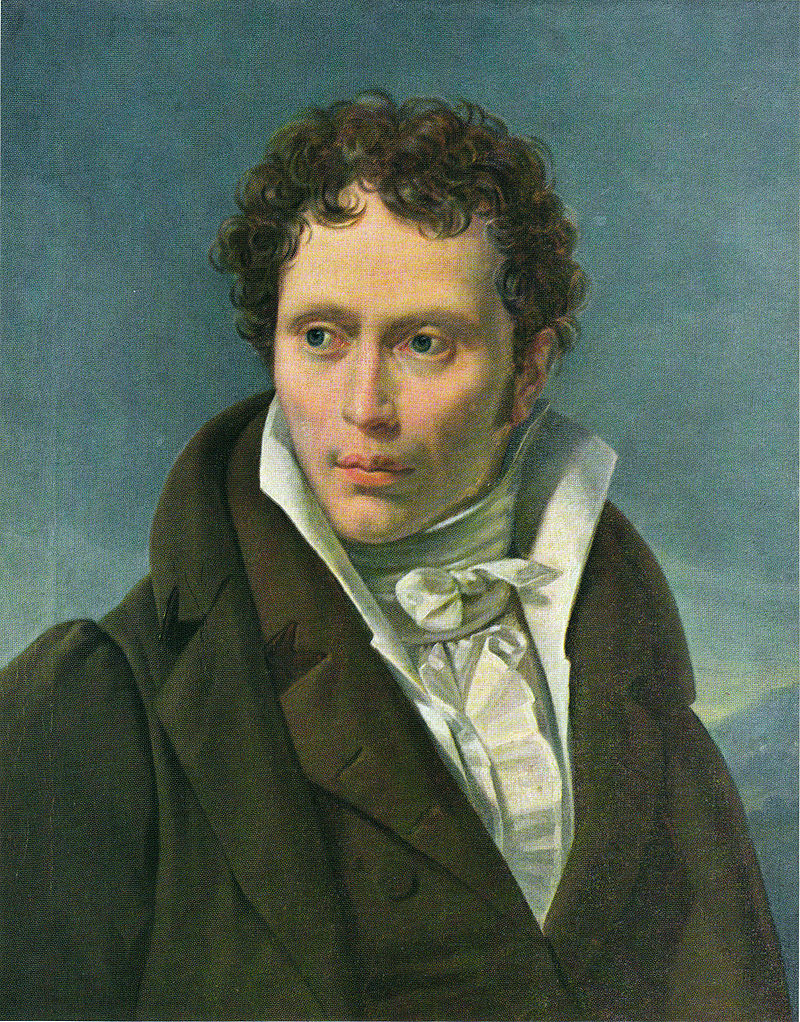
young_schopenhauer

Influence of Eastern Thought

Schopenhauer read the Latin translation of the ancient Hindu texts, The Upanishads, which French writer Anquetil du Perron had translated from the Persian translation of Prince Dara Shikoh entitled Sirre-Akbar (“The Great Secret”). He was so impressed by their philosophy that he called them “the production of the highest human wisdom”, and believed they contained superhuman concepts. The Upanishads was a great source of inspiration to Schopenhauer. Writing about them, he said:

It is the most satisfying and elevating reading (with the exception of the original text) which is possible in the world; it has been the solace of my life and will be the solace of my death.

It is well known that the book Oupnekhat (Upanishad) always lay open on his table, and he invariably studied it before sleeping at night. He called the opening up of Sanskrit literature “the greatest gift of our century”, and predicted that the philosophy and knowledge of the Upanishads would become the cherished faith of the West.

Schopenhauer was first introduced to the 1802 Latin Upanishad translation through Friedrich Majer. They met during the winter of 1813–1814 in Weimar at the home of Schopenhauer’s mother according to the biographer Safranski. Majer was a follower of Herder, and an early Indologist. Schopenhauer did not begin a serious study of the Indic texts, however, until the summer of 1814. Sansfranski maintains that between 1815 and 1817, Schopenhauer had another important cross-pollination with Indian thought in Dresden. This was through his neighbor of two years, Karl Christian Friedrich Krause. Krause was then a minor and rather unorthodox philosopher who attempted to mix his own ideas with that of ancient Indian wisdom. Krause had also mastered Sanskrit, unlike Schopenhauer, and the two developed a professional relationship. It was from Krause that Schopenhauer learned meditation and received the closest thing to expert advice concerning Indian thought.

Most noticeable, in the case of Schopenhauer’s work, was the significance of the Chandogya Upanishad, whose Mahavakya, Tat Tvam Asi is mentioned throughout The World as Will and Representation.

Schopenhauer noted a correspondence between his doctrines and the Four Noble Truths of Buddhism. Similarities centered on the principles that life involves suffering, that suffering is caused by desire (taṇhā), and that the extinction of desire leads to liberation. Thus three of the four “truths of the Buddha” correspond to Schopenhauer’s doctrine of the will. In Buddhism, however, while greed and lust are always unskillful, desire is ethically variable – it can be skillful, unskillful, or neutral.

For Schopenhauer, Will had ontological primacy over the intellect; in other words, desire is understood to be prior to thought. Schopenhauer felt this was similar to notions of puruṣārtha or goals of life in Vedānta Hinduism.

In Schopenhauer’s philosophy, denial of the will is attained by either:

  • personal experience of an extremely great suffering that leads to loss of the will to live; or
  • knowledge of the essential nature of life in the world through observation of the suffering of other people.

However, Buddhist nirvāṇa is not equivalent to the condition that Schopenhauer described as denial of the will. Nirvāṇa is not the extinguishing of the person as some Western scholars have thought, but only the “extinguishing” (the literal meaning of nirvana) of the flames of greed, hatred, and delusion that assail a person’s character. Occult historian Joscelyn Godwin (1945– ) stated, “It was Buddhism that inspired the philosophy of Arthur Schopenhauer, and, through him, attracted Richard Wagner. This Orientalism reflected the struggle of the German Romantics, in the words of Leon Poliakov, to “free themselves from Judeo-Christian fetters”. In contradistinction to Godwin’s claim that Buddhism inspired Schopenhauer, the philosopher himself made the following statement in his discussion of religions:

If I wished to take the results of my philosophy as the standard of truth, I should have to concede to Buddhism pre-eminence over the others. In any case, it must be a pleasure to me to see my doctrine in such close agreement with a religion that the majority of men on earth hold as their own, for this numbers far more followers than any other. And this agreement must be yet the more pleasing to me, inasmuch as in my philosophizing I have certainly not been under its influence. For up till 1818, when my work appeared, there was to be found in Europe only a very few accounts of Buddhism.

Buddhist philosopher Nishitani Keiji, however, sought to distance Buddhism from Schopenhauer. While Schopenhauer’s philosophy may sound rather mystical in such a summary, his methodology was resolutely empirical, rather than speculative or transcendental:

Philosophy … is a science, and as such has no articles of faith; accordingly, in it nothing can be assumed as existing except what is either positively given empirically, or demonstrated through indubitable conclusions.

Also note:

This actual world of what is knowable, in which we are and which is in us, remains both the material and the limit of our consideration.

The argument that Buddhism affected Schopenhauer’s philosophy more than any other Dharmic faith loses more credence when viewed in light of the fact that Schopenhauer did not begin a serious study of Buddhism until after the publication of The World as Will and Representation in 1818. Scholars have started to revise earlier views about Schopenhauer’s discovery of Buddhism. Proof of early interest and influence, however, appears in Schopenhauer’s 1815/16 notes (transcribed and translated by Urs App) about Buddhism. They are included in a recent case study that traces Schopenhauer’s interest in Buddhism and documents its influence. Other scholarly work questions how similar Schopenhauer’s philosophy actually is to Buddhism.

Schopenhauer said he was influenced by the Upanishads, Immanuel Kant and Plato. References to Eastern philosophy and religion appear frequently in his writing. As noted above, he appreciated the teachings of the Buddha and even called himself a Buddhist. He said that his philosophy could not have been conceived before these teachings were available.

Concerning the Upanishads and Vedas, he writes in The World as Will and Representation:

If the reader has also received the benefit of the Vedas, the access to which by means of the Upanishads is in my eyes the greatest privilege which this still young century (1818) may claim before all previous centuries, if then the reader, I say, has received his initiation in primeval Indian wisdom, and received it with an open heart, he will be prepared in the very best way for hearing what I have to tell him. It will not sound to him strange, as to many others, much less disagreeable; for I might, if it did not sound conceited, contend that every one of the detached statements which constitute the Upanishads, may be deduced as a necessary result from the fundamental thoughts which I have to enunciate, though those deductions themselves are by no means to be found there.

Among Schopenhauer’s other influences were: Shakespeare, Jean-Jacques Rousseau, John Locke, Thomas Reid, Baruch Spinoza, Matthias Claudius, George Berkeley, David Hume, and René Descartes.

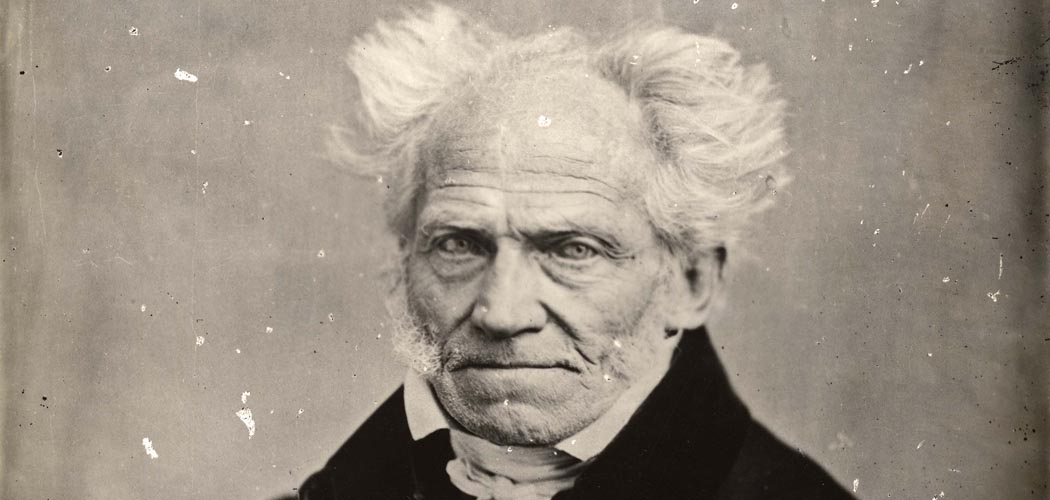
schopenhauer

Schopenhauer’s Influence

Schopenhauer has had a massive influence upon later thinkers, though more so in the arts (especially literature and music) and psychology than in philosophy. His popularity peaked in the early twentieth century, especially during the Modernist era, and waned somewhat thereafter. Nevertheless, a number of recent publications have reinterpreted and modernised the study of Schopenhauer. His theory is also being explored by some modern philosophers as a precursor to evolutionary theory and modern evolutionary psychology.

Russian writer and philosopher Leo Tolstoy was greatly influenced by Schopenhauer. After reading Schopenhauer’s The World as Will and Representation, Tolstoy gradually became converted to the ascetic morality upheld in that work as the proper spiritual path for the upper classes: “Do you know what this summer has meant for me? Constant raptures over Schopenhauer and a whole series of spiritual delights which I’ve never experienced before. … no student has ever studied so much on his course, and learned so much, as I have this summer”

Richard Wagner, writing in his autobiography, remembered his first impression that Schopenhauer left on him (when he read The World as Will and Representation):

Schopenhauer’s book was never completely out of my mind, and by the following summer I had studied it from cover to cover four times. It had a radical influence on my whole life.

Wagner also commented on that “serious mood, which was trying to find ecstatic expression” created by Schopenhauer inspired the conception of Tristan und Isolde.

Friedrich Nietzsche owed the awakening of his philosophical interest to reading The World as Will and Representation and admitted that he was one of the few philosophers that he respected, dedicating to him his essay Schopenhauer als Erzieher one of his Untimely Meditations.

Jorge Luis Borges remarked that the reason he had never attempted to write a systematic account of his world view, despite his penchant for philosophy and metaphysics in particular, was because Schopenhauer had already written it for him.

As a teenager, Ludwig Wittgenstein adopted Schopenhauer’s epistemological idealism. However, after his study of the philosophy of mathematics, he rejected epistemological idealism for Gottlob Frege’s conceptual realism. In later years, Wittgenstein was highly dismissive of Schopenhauer, describing him as an ultimately shallow thinker: “Schopenhauer has quite a crude mind… where real depth starts, his comes to an end.”

The philosopher Gilbert Ryle read Schopenhauer’s works as a student, but later largely forgot them, only to unwittingly recycle ideas from Schopenhauer in his The Concept of Mind (1949).


Further Study

Arthur Schopenhauer (SEP)

Arthur Schopenhauer (IEP)

Schopenhauer’s Works (Project Gutenberg)

Schopenhauer’s Works (Wikisource)

The Psychology of Video Games

Getting-Gamers-Large

Getting Gamers: The Psychology of Video Games and Their Impact on the People who Play Them

Video games are big business. They can be addicting. They are available almost anywhere you go and are appealing to people of all ages. They can eat up our time, cost us money, even kill our relationships. But it’s not all bad! This book will show that rather than being a waste of time, video games can help us develop skills, make friends, succeed at work, form good habits, and be happy. Taking the time to learn what’s happening in our heads as we play and shop allows us to approach games and gaming communities on our own terms and get more out of them.

With sales in the tens of billions of dollars each year, just about everybody is playing some kind of video game whether it’s on a console, a computer, a web browser, or a phone. Much of the medium’s success is built on careful (though sometimes unwitting) adherence to basic principles of psychology. This is something that’s becoming even more important as games become more social, interactive, and sophisticated. This book offers something unique to the millions of people who play or design games: how to use an understanding of psychology to be a better part of their gaming communities, to avoid being manipulated when they shop and play, and to get the most enjoyment out of playing games. With examples from the games themselves, Jamie Madigan offers a fuller understanding of the impact of games on our psychology and the influence of psychology on our games.

About the Author

Jamie Madigan, PhD, has become an expert on the psychology of video games and seeks to popularize understanding of how various aspects of psychology can be used to understand why games are made how they are and why their players behave as they do. Madigan has written extensively on the subject for various magazines, websites, blogs, and his own site at www.psychologyofgames.com. He has also consulted with game development companies and talked at conferences about how game developers can incorporate psychology principles into game design and how players can understand how it affects their play. Finally, he has appeared as an expert on the psychology of video games in dozens of print, radio, and web outlets such as The Washington Post, the Chicago Tribune, BBC Radio 5, the BBC, The Guardian, and more. He is a lifelong gamer.

Herd Mentality

In his heart every man knows quite well that, being unique, he will be in the world only once and that no imaginable chance will for a second time gather together into a unity so strangely variegated an assortment as he is: he knows it but he hides it like a bad conscience—why? From fear of his neighbor, who demands conventionality and cloaks himself with it. But what is it that constrains the individual to fear his neighbor, to think and act like a member of a herd, and to have no joy in himself? Modesty, perhaps, in a few rare cases. With the great majority it is indolence, inertia. … Men are even lazier than they are timid, and fear most of all the inconveniences with which unconditional honesty and nakedness would burden them. Artists alone hate this sluggish promenading in borrowed fashions and appropriated opinions and they reveal everyone’s secret bad conscience, the law that every man is a unique miracle.

Parliamentarianism—that is, public permission to choose between five basic political opinions—flatters and wins the favor of all those who would like to seem independent and individual, as if they fought for their opinions. Ultimately, however, it is indifferent whether the herd is commanded to have one opinion or to have five. Whoever deviates from the five public opinions and stands apart will always have the whole herd against him.

No shepherd and one herd! Everybody wants the same, everybody is the same: whoever feels different goes voluntarily into a madhouse. The individual has always had to struggle to keep from being overwhelmed by the tribe. If you try it, you will be lonely often, and sometimes frightened. But no price is too high to pay for the privilege of owning yourself.

There are horrible people who, instead of solving a problem, tangle it up and make it harder to solve for anyone who wants to deal with it. Whoever does not know how to hit the nail on the head should be asked not to hit it at all. The surest way to corrupt a youth is to instruct him to hold in higher esteem those who think alike than those who think differently.

If you have a virtue and she is your virtue, then you have her in common with nobody. But you want to call her by her name and pet her … and behold, now you have her in common with the people and have become one of the herd with your virtue. You would do better to say “Inexpressible and nameless is that which gives my soul agony and sweetness.”… May your virtue be too exalted for the familiarity of names, and if you must speak of her, do not be ashamed to stammer.

– Friedrich Nietzsche


Obama Accepts Nomination On Final Day Of Democratic National Convention

What is Enlightenment?

Enlightenment is man’s emergence from his self-imposed immaturity. Immaturity is the inability to use one’s understanding without guidance from another. This immaturity is self-imposed when its cause lies not in lack of understanding, but in lack of resolve and courage to use it without guidance from another. Sapere Aude! [dare to know] “Have courage to use your own understanding!”–that is the motto of enlightenment.

Laziness and cowardice are the reasons why so great a proportion of men, long after nature has released them from alien guidance (natura-liter maiorennes), nonetheless gladly remain in lifelong immaturity, and why it is so easy for others to establish themselves as their guardians. It is so easy to be immature. If I have a book to serve as my understanding, a pastor to serve as my conscience, a physician to determine my diet for me, and so on, I need not exert myself at all. I need not think, if only I can pay: others will readily undertake the irksome work for me. The guardians who have so benevolently taken over the supervision of men have carefully seen to it that the far greatest part of them (including the entire fair sex) regard taking the step to maturity as very dangerous, not to mention difficult. Having first made their domestic livestock dumb, and having carefully made sure that these docile creatures will not take a single step without the go-cart to which they are harnessed, these guardians then show them the danger that threatens them, should they attempt to walk alone. Now this danger is not actually so great, for after falling a few times they would in the end certainly learn to walk; but an example of this kind makes men timid and usually frightens them out of all further attempts.

Thus, it is difficult for any individual man to work himself out of the immaturity that has all but become his nature. He has even become fond of this state and for the time being is actually incapable of using his own understanding, for no one has ever allowed him to attempt it. Rules and formulas, those mechanical aids to the rational use, or rather misuse, of his natural gifts, are the shackles of a permanent immaturity. Whoever threw them off would still make only an uncertain leap over the smallest ditch, since he is unaccustomed to this kind of free movement. Consequently, only a few have succeeded, by cultivating their own minds, in freeing themselves from immaturity and pursuing a secure course.

But that the public should enlighten itself is more likely; indeed, if it is only allowed freedom, enlightenment is almost inevitable. For even among the entrenched guardians of the great masses a few will always think for themselves, a few who, after having themselves thrown off the yoke of immaturity, will spread the spirit of a rational appreciation for both their own worth and for each person’s calling to think for himself. But it should be particularly noted that if a public that was first placed in this yoke by the guardians is suitably aroused by some of those who are altogether incapable of enlightenment, it may force the guardians themselves to remain under the yoke–so pernicious is it to instill prejudices, for they finally take revenge upon their originators, or on their descendants. Thus a public can only attain enlightenment slowly. Perhaps a revolution can overthrow autocratic despotism and profiteering or power-grabbing oppression, but it can never truly reform a manner of thinking; instead, new prejudices, just like the old ones they replace, will serve as a leash for the great unthinking mass.

Nothing is required for this enlightenment, however, except freedom; and the freedom in question is the least harmful of all, namely, the freedom to use reason publicly in all matters. But on all sides I hear: “Do not argue!” The officer says, “Do not argue, drill!” The tax man says, “Do not argue, pay!” The pastor says, “Do not argue, believe!” (Only one ruler in the World says, “Argue as much as you want and about what you want, but obey!”) In this we have examples of pervasive restrictions on freedom. But which restriction hinders enlightenment and which does not, but instead actually advances it? I reply: The public use of one’s reason must always be free, and it alone can bring about enlightenment among mankind; the private use of reason may, however, often be very narrowly restricted, without otherwise hindering the progress of enlightenment. By the public use of one’s own reason I understand the use that anyone as a scholar makes of reason before the entire literate world. I call the private use of reason that which a person may make in a civic post or office that has been entrusted to him. Now in many affairs conducted in the interests of a community, a certain mechanism is required by means of which some of its members must conduct themselves in an entirely passive manner so that through an artificial unanimity the government may guide them toward public ends, or at least prevent them from destroying such ends. Here one certainly must not argue, instead one must obey. However, insofar as this part of the machine also regards himself as a member of the community as a whole, or even of the world community, and as a consequence addresses the public in the role of a scholar, in the proper sense of that term, he can most certainly argue, without thereby harming the affairs for which as a passive member he is partly responsible. Thus it would be disastrous if an officer on duty who was given a command by his superior were to question the appropriateness or utility of the order. He must obey.

But as a scholar he cannot be justly constrained from making comments about errors in military service, or from placing them before the public for its judgment. The citizen cannot refuse to pay the taxes imposed on him; indeed, impertinent criticism of such levies, when they should be paid by him, can be punished as a scandal (since it can lead to widespread insubordination). But the same person does not act contrary to civic duty when, as a scholar, he publicly expresses his thoughts regarding the impropriety or even injustice of such taxes. Likewise a pastor is bound to instruct his catecumens and congregation in accordance with the symbol of the church he serves, for he was appointed on that condition. But as a scholar he has complete freedom, indeed even the calling, to impart to the public all of his carefully considered and well-intentioned thoughts concerning mistaken aspects of that symbol, as well as his suggestions for the better arrangement of religious and church matters. Nothing in this can weigh on his conscience. What he teaches in consequence of his office as a servant of the church he sets out as something with regard to which he has no discretion to teach in accord with his own lights; rather, he offers it under the direction and in the name of another. He will say, “Our church teaches this or that and these are the demonstrations it uses.” He thereby extracts for his congregation all practical uses from precepts to which he would not himself subscribe with complete conviction, but whose presentation he can nonetheless undertake, since it is not entirely impossible that truth lies hidden in them, and, in any case, nothing contrary to the very nature of religion is to be found in them. If he believed he could find anything of the latter sort in them, he could not in good conscience serve in his position; he would have to resign. Thus an appointed teacher’s use of his reason for the sake of his congregation is merely private, because, however large the congregation is, this use is always only domestic; in this regard, as a priest, he is not free and cannot be such because he is acting under instructions from someone else. By contrast, the cleric–as a scholar who speaks through his writings to the public as such, i.e., the world–enjoys in this public use of reason an unrestricted freedom to use his own rational capacities and to speak his own mind. For that the (spiritual) guardians of a people should themselves be immature is an absurdity that would insure the perpetuation of absurdities.

But would a society of pastors, perhaps a church assembly or venerable presbytery (as those among the Dutch call themselves), not be justified in binding itself by oath to a certain unalterable symbol in order to secure a constant guardianship over each of its members and through them over the people, and this for all time: I say that this is wholly impossible. Such a contract, whose intention is to preclude forever all further enlightenment of the human race, is absolutely null and void, even if it should be ratified by the supreme power, by parliaments, and by the most solemn peace treaties. One age cannot bind itself, and thus conspire, to place a succeeding one in a condition whereby it would be impossible for the later age to expand its knowledge (particularly where it is so very important), to rid itself of errors,and generally to increase its enlightenment. That would be a crime against human nature, whose essential destiny lies precisely in such progress; subsequent generations are thus completely justified in dismissing such agreements as unauthorized and criminal. The criterion of everything that can be agreed upon as a law by a people lies in this question: Can a people impose such a law on itself? Now it might be possible, in anticipation of a better state of affairs, to introduce a provisional order for a specific, short time, all the while giving all citizens, especially clergy, in their role as scholars, the freedom to comment publicly, i.e., in writing, on the present institution’s shortcomings. The provisional order might last until insight into the nature of these matters had become so widespread and obvious that the combined (if not unanimous) voices of the populace could propose to the crown that it take under its protection those congregations that, in accord with their newly gained insight, had organized themselves under altered religious institutions, but without interfering with those wishing to allow matters to remain as before. However, it is absolutely forbidden that they unite into a religious organization that nobody may for the duration of a man’s lifetime publicly question, for so do-ing would deny, render fruitless, and make detrimental to succeeding generations an era in man’s progress toward improvement. A man may put off enlightenment with regard to what he ought to know, though only for a short time and for his own person; but to renounce it for himself, or, even more, for subsequent generations, is to violate and trample man’s divine rights underfoot. And what a people may not decree for itself may still less be imposed on it by a monarch, for his lawgiving authority rests on his unification of the people’s collective will in his own. If he only sees to it that all genuine or purported improvement is consonant with civil order, he can allow his subjects to do what they find necessary to their spiritual well-being, which is not his affair. However, he must prevent anyone from forcibly interfering with another’s working as best he can to determine and promote his well-being. It detracts from his own majesty when he interferes in these matters, since the writings in which his subjects attempt to clarify their insights lend value to his conception of governance. This holds whether he acts from his own highest insight–whereby he calls upon himself the reproach, “Caesar non eat supra grammaticos.”‘–as well as, indeed even more, when he despoils his highest authority by supporting the spiritual despotism of some tyrants in his state over his other subjects.

If it is now asked, “Do we presently live in an enlightened age?” the answer is, “No, but we do live in an age of enlightenment.” As matters now stand, a great deal is still lacking in order for men as a whole to be, or even to put themselves into a position to be able without external guidance to apply understanding confidently to religious issues. But we do have clear indications that the way is now being opened for men to proceed freely in this direction and that the obstacles to general enlightenment–to their release from their self-imposed immaturity–are gradually diminishing. In this regard, this age is the age of enlightenment, the century of Frederick.

A prince who does not find it beneath him to say that he takes it to be his duty to prescribe nothing, but rather to allow men complete freedom in religious matters–who thereby renounces the arrogant title of tolerance–is himself enlightened and deserves to be praised by a grateful present and by posterity as the first, at least where the government is concerned, to release the human race from immaturity and to leave everyone free to use his own reason in all matters of conscience. Under his rule, venerable pastors, in their role as scholars and without prejudice to their official duties, may freely and openly set out for the world’s scrutiny their judgments and views, even where these occasionally differ from the accepted symbol. Still greater freedom is afforded to those who are not restricted by an official post. This spirit of freedom is expanding even where it must struggle against the external obstacles of governments that misunderstand their own function. Such governments are illuminated by the example that the existence of freedom need not give cause for the least concern regarding public order and harmony in the commonwealth. If only they refrain from inventing artifices to keep themselves in it, men will gradually raise themselves from barbarism.

I have focused on religious matters in setting out my main point concerning enlightenment, i.e., man’s emergence from self-imposed immaturity, first because our rulers have no interest in assuming the role of their subjects’ guardians with respect to the arts and sciences, and secondly because that form of immaturity is both the most pernicious and disgraceful of all. But the manner of thinking of a head of state who favors religious enlightenment goes even further, for he realizes that there is no danger to his legislation in allowing his subjects to use reason publicly and to set before the world their thoughts concerning better formulations of his laws, even if this involves frank criticism of legislation currently in effect. We have before us a shining example, with respect to which no monarch surpasses the one whom we honor.

But only a ruler who is himself enlightened and has no dread of shadows, yet who likewise has a well-disciplined, numerous army to guarantee public peace, can say what no republic may dare, namely: “Argue as much as you want and about what you want, but obey!” Here as elsewhere, when things are considered in broad perspective, a strange, unexpected pattern in human affairs reveals itself, one in which almost everything is paradoxical. A greater degree of civil freedom seems advantageous to a people’s spiritual freedom; yet the former established impassable boundaries for the latter; conversely, a lesser degree of civil freedom provides enough room for all fully to expand their abilities. Thus, once nature has removed the hard shell from this kernel for which she has most fondly cared, namely, the inclination to and vocation for free thinking, the kernel gradually reacts on a people’s mentality (whereby they become increasingly able to act freely), and it finally even influences the principles of government, which finds that it can profit by treating men, who are now more than machines, in accord with their dignity.

– Immanuel Kant


lakewood-church-houstontx-040

The Crowd is Untruth

There is a view of life which holds that where the crowd is, the truth is also, that it is a need in truth itself, that it must have the crowd on its side. There is another view of life; which holds that wherever the crowd is, there is untruth, so that, for a moment to carry the matter out to its farthest conclusion, even if every individual possessed the truth in private, yet if they came together into a crowd (so that “the crowd” received any decisive, voting, noisy, audible importance), untruth would at once be let in.

For “the crowd” is untruth. Eternally, godly, christianly what Paul says is valid: “only one receives the prize,” [I Cor. 9:24] not by way of comparison, for in the comparison “the others” are still present. That is to say, everyone can be that one, with God’s help – but only one receives the prize; again, that is to say, everyone should cautiously have dealings with “the others,” and essentially only talk with God and with himself – for only one receives the prize; again, that is to say, the human being is in kinship with, or to be a human is to be in kinship with the divinity. The worldly, temporal, busy, socially-friendly person says this: “How unreasonable, that only one should receive the prize, it is far more probable that several combined receive the prize; and if we become many, then it becomes more certain and also easier for each individually.” Certainly, it is far more probable; and it is also true in relation to all earthly and sensuous prizes; and it becomes the only truth, if it is allowed to rule, for this point of view abolishes both God and the eternal and “the human being’s” kinship with the divinity; it abolishes it or changes it into a fable, and sets the modern (as a matter of fact, the old heathen) in its place, so that to be a human being is like being a specimen which belongs to a race gifted with reason, so that the race, the species, is higher than the individual, or so that there are only specimens, not individuals. But the eternal, which vaults high over the temporal, quiet as the night sky, and God in heaven, who from this exalted state of bliss, without becoming the least bit dizzy, looks out over these innumerable millions and knows each single individual; he, the great examiner, he says: only one receives the prize; that is to say, everyone can receive it, and everyone ought to become this by oneself, but only one receives the prize. Where the crowd is, therefore, or where a decisive importance is attached to the fact that there is a crowd, there no one is working, living, and striving for the highest end, but only for this or that earthly end; since the eternal, the decisive, can only be worked for where there is one; and to become this by oneself, which all can do, is to will to allow God to help you – “the crowd” is untruth.

A crowd – not this or that, one now living or long dead, a crowd of the lowly or of nobles, of rich or poor, etc., but in its very concept – is untruth, since a crowd either renders the single individual wholly unrepentant and irresponsible, or weakens his responsibility by making it a fraction of his decision. Observe, there was not a single soldier who dared lay a hand on Caius Marius; this was the truth. But given three or four women with the consciousness or idea of being a crowd, with a certain hope in the possibility that no one could definitely say who it was or who started it: then they had the courage for it; what untruth! The untruth is first that it is “the crowd,” which does either what only the single individual in the crowd does, or in every case what each single individual does. For a crowd is an abstraction, which does not have hands; each single individual, on the other hand, normally has two hands, and when he, as a single individual, lays his two hands on Caius Marius, then it is the two hands of this single individual, not after all his neighbor’s, even less – the crowd’s, which has no hands. In the next place, the untruth is that the crowd had “the courage” for it, since never at any time was even the most cowardly of all single individuals so cowardly, as the crowd always is. For every single individual who escapes into the crowd, and thus flees in cowardice from being a single individual (who either had the courage to lay his hand on Caius Marius, or the courage to admit that he did not have it), contributes his share of cowardice to “the cowardice,” which is: the crowd. Take the highest, think of Christ – and the whole human race, all human beings, which were ever born and ever will be born; the situation is the single individual, as an individual, in solitary surroundings alone with him; as a single individual he walks up to him and spits on him: the human being has never been born and never will be, who would have the courage or the impudence for it; this is the truth. But since they remain in a crowd, they have the courage for it – what frightening untruth.

The crowd is untruth. There is therefore no one who has more contempt for what it is to be a human being than those who make it their profession to lead the crowd. Let someone, some individual human being, certainly, approach such a person, what does he care about him; that is much too small a thing; he proudly sends him away; there must be at least a hundred. And if there are thousands, then he bends before the crowd, he bows and scrapes; what untruth! No, when there is an individual human being, then one should express the truth by respecting what it is to be a human being; and if perhaps, as one cruelly says, it was a poor, needy human being, then especially should one invite him into the best room, and if one has several voices, he should use the kindest and friendliest; that is the truth. When on the other hand it was an assembly of thousands or more, and “the truth” became the object of balloting, then especially one should godfearingly – if one prefers not to repeat in silence the Our Father: deliver us from evil – one should godfearingly express, that a crowd, as the court of last resort, ethically and religiously, is the untruth, whereas it is eternally true, that everyone can be the one. This is the truth.

The crowd is untruth. Therefore was Christ crucified, because he, even though he addressed himself to all, would not have to do with the crowd, because he would not in any way let a crowd help him, because he in this respect absolutely pushed away, would not found a party, or allow balloting, but would be what he was, the truth, which relates itself to the single individual. And therefore everyone who in truth will serve the truth, is eo ipso in some way or other a martyr; if it were possible that a human being in his mother’s womb could make a decision to will to serve “the truth” in truth, so he also is eo ipso a martyr, however his martyrdom comes about, even while in his mother’s womb. For to win a crowd is not so great a trick; one only needs some talent, a certain dose of untruth and a little acquaintance with the human passions. But no witness for the truth – alas, and every human being, you and I, should be one – dares have dealings with a crowd. The witness for the truth – who naturally will have nothing to do with politics, and to the utmost of his ability is careful not to be confused with a politician – the godfearing work of the witness to the truth is to have dealings with all, if possible, but always individually, to talk with each privately, on the streets and lanes – to split up the crowd, or to talk to it, not to form a crowd, but so that one or another individual might go home from the assembly and become a single individual. “A crowd,” on the other hand, when it is treated as the court of last resort in relation to “the truth,” its judgment as the judgment, is detested by the witness to the truth, more than a virtuous young woman detests the dance hall. And they who address the “crowd” as the court of last resort, he considers to be instruments of untruth. For to repeat: that which in politics and similar domains has its validity, sometimes wholly, sometimes in part, becomes untruth, when it is transferred to the intellectual, spiritual, and religious domains. And at the risk of a possibly exaggerated caution, I add just this: by “truth” I always understand “eternal truth.” But politics and the like has nothing to do with “eternal truth.” A politics, which in the real sense of “eternal truth” made a serious effort to bring “eternal truth” into real life, would in the same second show itself to be in the highest degree the most “impolitic” thing imaginable.

The crowd is untruth. And I could weep, in every case I can learn to long for the eternal, whenever I think about our age’s misery, even compared with the ancient world’s greatest misery, in that the daily press and anonymity make our age even more insane with help from “the public,” which is really an abstraction, which makes a claim to be the court of last resort in relation to “the truth”; for assemblies which make this claim surely do not take place. That an anonymous person, with help from the press, day in and day out can speak however he pleases (even with respect to the intellectual, the ethical, the religious), things which he perhaps did not in the least have the courage to say personally in a particular situation; every time he opens up his gullet – one cannot call it a mouth – he can all at once address himself to thousands upon thousands; he can get ten thousand times ten thousand to repeat after him – and no one has to answer for it; in ancient times the relatively unrepentant crowd was the almighty, but now there is the absolutely unrepentant thing: No One, an anonymous person: the Author, an anonymous person: the Public, sometimes even anonymous subscribers, therefore: No One. No One! God in heaven, such states even call themselves Christian states. One cannot say that, again with the help of the press, “the truth” can overcome the lie and the error. O, you who say this, ask yourself: Do you dare to claim that human beings, in a crowd, are just as quick to reach for truth, which is not always palatable, as for untruth, which is always deliciously prepared, when in addition this must be combined with an admission that one has let oneself be deceived! Or do you dare to claim that “the truth” is just as quick to let itself be understood as is untruth, which requires no previous knowledge, no schooling, no discipline, no abstinence, no self-denial, no honest self-concern, no patient labor! No, “the truth,” which detests this untruth, the only goal of which is to desire its increase, is not so quick on its feet. Firstly, it cannot work through the fantastical, which is the untruth; its communicator is only a single individual. And its communication relates itself once again to the single individual; for in this view of life the single individual is precisely the truth. The truth can neither be communicated nor be received without being as it were before the eyes of God, nor without God’s help, nor without God being involved as the middle term, since he is the truth. It can therefore only be communicated by and received by “the single individual,” which, for that matter, every single human being who lives could be: this is the determination of the truth in contrast to the abstract, the fantastical, impersonal, “the crowd” – “the public,” which excludes God as the middle term (for the personal God cannot be the middle term in an impersonal relation), and also thereby the truth, for God is the truth and its middle term.

And to honor every individual human being, unconditionally every human being, that is the truth and fear of God and love of “the neighbor”; but ethico-religiously viewed, to recognize “the crowd” as the court of last resort in relation to “the truth,” that is to deny God and cannot possibly be to love “the neighbor.” And “the neighbor” is the absolutely true expression for human equality; if everyone in truth loved the neighbor as himself, then would perfect human equality be unconditionally attained; every one who in truth loves the neighbor, expresses unconditional human equality; every one who is really aware (even if he admits, like I, that his effort is weak and imperfect) that the task is to love the neighbor, he is also aware of what human equality is. But never have I read in the Holy Scriptures this command: You shall love the crowd; even less: You shall, ethico-religiously, recognize in the crowd the court of last resort in relation to “the truth.” It is clear that to love the neighbor is self-denial, that to love the crowd or to act as if one loved it, to make it the court of last resort for “the truth,” that is the way to truly gain power, the way to all sorts of temporal and worldly advantage – yet it is untruth; for the crowd is untruth.

But he who acknowledges this view, which is seldom presented (for it often happens, that a man believes that the crowd is in untruth, but when it, the crowd, merely accepts his opinion en masse, then everything is all right), he admits to himself that he is the weak and powerless one; how would a single individual be able to stand against the many, who have the power! And he could not then want to get the crowd on his side to carry through the view that the crowd, ethico-religiously, as the court of last resort, is untruth; that would be to mock himself. But although this view was from the first an admission of weakness and powerlessness, and since it seems therefore so uninviting, and is therefore heard so seldom: yet it has the good feature, that it is fair, that it offends no one, not a single one, that it does not distinguish between persons, not a single one. A crowd is indeed made up of single individuals; it must therefore be in everyone’s power to become what he is, a single individual; no one is prevented from being a single individual, no one, unless he prevents himself by becoming many. To become a crowd, to gather a crowd around oneself, is on the contrary to distinguish life from life; even the most well-meaning one who talks about that, can easily offend a single individual. But it is the crowd which has power, influence, reputation, and domination – this is the distinction of life from life, which tyrannically overlooks the single individual as the weak and powerless one, in a temporal-worldly way overlooks the eternal truth: the single individual.

– Søren Kierkegaard


anonymous-internet-turkey-protest

For the amoral herd that fears boredom above all else, everything becomes entertainment. Sex and sport, politics and the arts are transformed into entertainment. … Nothing is immune from the demand that boredom be relieved (but without personal involvement, for mass society is a spectator society).

– Merold Westphal

Meditation & The Dark Night

Seven Ways Meditation Can Actually Change the Brain


Meditation Helps Preserve the Aging Brain

Last week, a study from UCLA found that long-term meditators had better-preserved brains than non-meditators as they aged. Participants who’d been meditating for an average of 20 years had more grey matter volume throughout the brain — although older meditators still had some volume loss compared to younger meditators, it wasn’t as pronounced as the non-meditators. “We expected rather small and distinct effects located in some of the regions that had previously been associated with meditating,” said study author Florian Kurth. “Instead, what we actually observed was a widespread effect of meditation that encompassed regions throughout the entire brain.”

Meditation Reduces Activity in the Brain’s “Me Center”

One of the most interesting studies in the last few years, carried out at Yale University, found that mindfulness meditation decreases activity in the default mode network (DMN), the brain network responsible for mind-wandering and self-referential thoughts – a.k.a., “monkey mind.” The DMN is “on” or active when we’re not thinking about anything in particular, when our minds are just wandering from thought to thought. Since mind-wandering is typically associated with being less happy, ruminating, and worrying about the past and future, it’s the goal for many people to dial it down. Several studies have shown that meditation, though its quieting effect on the DMN, appears to do just this. And even when the mind does start to wander, because of the new connections that form, meditators are better at snapping back out of it.

Its Effects Rival Antidepressants for Depression, Anxiety

A review study last year at Johns Hopkins looked at the relationship between mindfulness meditation and its ability to reduce symptoms of depression, anxiety, and pain. Researcher Madhav Goyal and his team found that the effect size of meditation was moderate, at 0.3. If this sounds low, keep in mind that the effect size for antidepressants is also 0.3, which makes the effect of meditation sound pretty good. Meditation is, after all an active form of brain training. “A lot of people have this idea that meditation means sitting down and doing nothing,” says Goyal. “But that’s not true. Meditation is an active training of the mind to increase awareness, and different meditation programs approach this in different ways.” Meditation isn’t a magic bullet for depression, as no treatment is, but it’s one of the tools that may help manage symptoms.

Meditation May Lead to Volume Changes in Key Areas of the Brain

In 2011, Sara Lazar and her team at Harvard found that mindfulness meditation can actually change the structure of the brain: Eight weeks of Mindfulness-Based Stress Reduction (MBSR) was found to increase cortical thickness in the hippocampus, which governs learning and memory, and in certain areas of the brain that play roles in emotion regulation and self-referential processing. There were also decreases in brain cell volume in the amygdala, which is responsible for fear, anxiety, and stress – and these changes matched the participants’ self-reports of their stress levels, indicating that meditation not only changes the brain, but it changes our subjective perception and feelings as well. In fact, a follow-up study by Lazar’s team found that after meditation training, changes in brain areas linked to mood and arousal were also linked to improvements in how participants said they felt — i.e., their psychological well-being. So for anyone who says that activated blobs in the brain don’t necessarily mean anything, our subjective experience – improved mood and well-being – does indeed seem to be shifted through meditation as well.

Just a Few Days of Training Improves Concentration and Attention 

Having problems concentrating isn’t just a kid thing – it affects millions of grown-ups as well, with an ADD diagnosis or not. Interestingly but not surprisingly, one of the central benefits of meditation is that it improves attention and concentration: One recent study found that just a couple of weeks of meditation training helped people’s focus and memory during the verbal reasoning section of the GRE. In fact, the increase in score was equivalent to 16 percentile points, which is nothing to sneeze at. Since the strong focus of attention (on an object, idea, or activity) is one of the central aims of meditation, it’s not so surprising that meditation should help people’s cognitive skills on the job, too – but it’s nice to have science confirm it. And everyone can use a little extra assistance on standardized tests.

Meditation Reduces Anxiety — and Social Anxiety

A lot of people start meditating for its benefits in stress reduction, and there’s lots of good evidence to support this rationale. There’s a whole newer sub-genre of meditation, mentioned earlier, called Mindfulness-Based Stress Reduction (MBSR), developed by Jon Kabat-Zinn at the University of Massachusetts’ Center for Mindfulness (now available all over the country), that aims to reduce a person’s stress level, physically and mentally. Studies have shown its benefits in reducing anxiety, even years after the initial 8-week course. Research has also shown that mindfulness meditation, in contrast to attending to the breath only, can reduce anxiety – and that these changes seem to be mediated through the brain regions associated with those self-referential (“me-centered”) thoughts. Mindfulness meditation has also been shown to help people with social anxiety disorder: a Stanford University team found that MBSR brought about changes in brain regions involved in attention, as well as relief from symptoms of social anxiety.

Meditation Can Help with Addiction

A growing number of studies has shown that, given its effects on the self-control regions of the brain, meditation can be very effective in helping people recover from various types of addiction. One study, for example, pitted mindfulness training against the American Lung Association’s freedom from smoking (FFS) program, and found that people who learned mindfulness were many times more likely to have quit smoking by the end of the training, and at 17 weeks follow-up, than those in the conventional treatment. This may be because meditation helps people “decouple” the state of craving from the act of smoking, so the one doesn’t always have to lead to the other, but rather you fully experience and ride out the “wave” of craving, until it passes. Other research has found that mindfulness training, mindfulness-based cognitive therapy (MBCT), and mindfulness-based relapse prevention (MBRP) can be helpful in treating other forms of addiction.

Short Meditation Breaks Can Help Kids in School

For developing brains, meditation has as much as or perhaps even more promise than it has for adults. There’s been increasing interest from educators and researchers in bringing meditation and yoga to school kids, who are dealing with the usual stressors inside school, and oftentimes additional stress and trauma outside school. Some schools have starting implementing meditation into their daily schedules, and with good effect: One district in San Francisco started a twice daily meditation program in some of its high-risk schools – and saw suspensions decrease, and GPAs and attendance increase. Studies have confirmed the cognitive and emotional benefits of meditation for schoolchildren, but more work will probably need to be done before it gains more widespread acceptance.

Worth a Try?

Meditation is not a panacea, but there’s certainly a lot of evidence that it may do some good for those who practice it regularly. Everyone from Anderson Cooper and congressman Tim Ryan to companies like Google GOOGL -1.17% and Apple AAPL +0.38% and Target TGT +0.76% are integrating meditation into their schedules. And its benefits seem to be felt after a relatively short amount of practice. Some researchers have cautioned that meditation can lead to ill effects under certain circumstances (known as the “dark night” phenomenon), but for most people – especially if you have a good teacher – meditation is beneficial, rather than harmful. It’s certainly worth a shot: If you have a few minutes in the morning or evening (or both), rather than turning on your phone or going online, see what happens if you try quieting down your mind, or at least paying attention to your thoughts and letting them go without reacting to them. If the research is right, just a few minutes of meditation may make a big difference.

Source: Forbes

Buddhist Meditation and the Dark Night

dark-night

© Pelt69 | Dreamstime Stock Photos

By Barbara O’Brien – Buddhism Expert

The Power of Meditation

Although meditation has been marketed in the West as a kind of relaxation technique, that is actually not what it is in a spiritual context. Buddhists meditate to wake up (see enlightenment). The traditional Buddhist meditation practices are powerful techniques developed over millennia that can reveal to us who we really are and how we are connected to the rest of the cosmos throughout space and time.

Stress reduction is just a side effect.

Indeed, as a spiritual practice meditation is sometimes anything but relaxing. The traditional practices have a way of reaching deep into the psyche and bringing dark and painful things about ourselves into awareness. For a person seeking enlightenment this is considered necessary; for someone just trying to de-stress, maybe not.

These deep psychological effects have been well documented for centuries, although the old commentaries may not describe them in terms a western psychologist would recognize. A skilled dharma teacher knows how to guide students through these experiences. Unfortunately, there’s still a shortage of skilled dharma teachers in the West.

The Dark Night Project

You can find many articles on the Web about the Dark Night Project, run by a psychology professor named Dr. Willoughby Britton (see, for example, an article on The Atlantic website by Tomas Rocha, “The Dark Knight of the Soul“). Britton runs a kind of refuge for people recovering from bad meditation experiences and is also working to “document, analyze, and publicize accounts of the adverse effects of contemplative practices,” the article says.

As a long-time Zen student there is nothing in this or other articles about the Dark Night Project that particularly surprises me. Indeed, many of the experiences described are common ones Zen teachers explicitly warn about and which in a monastic setting would be recognized and worked through. But through a combination of improper preparation and incompetent or no guidance, people’s lives actually were wrecked.

What Can Go Wrong?

First, let’s be clear that in a spiritual practice, an  unpleasant experience is not necessarily bad, and a blissful one is not necessarily good. My first Zen teacher used to refer to meditative bliss as “the cave of hell,” for example, because people want to stay there forever and feel let down when the bliss fades. All passing mental states, including bliss, are dukkha.

At the same time, mystics of many religious traditions have described the not-at-all blissful “dark night of the soul” experience and recognized it was a necessary phase of their particular spiritual journey, not something to be avoided.

But sometimes painful meditation experiences are harmful. A lot of damage can be done when people are pushed into deep states of meditative absorption before they are ready for example. In a proper monastic setting students get one-on-one time with a teacher who knows them and their particular spiritual challenges personally. Meditation practices may be prescribed for the student, like medicine, that are appropriate for his or her stage of development.

Unfortunately, in a lot of western retreat experiences everyone gets the same instruction with little or no individual guidance. And if everyone is being pushed into having some satori-palooza, ready or not, this is dangerous. Whatever is clanking about in your id needs to be properly processed, and this can take time.

Visions, Pits of Emptiness and Dukkha Nanas

It’s also common for meditation to cause hallucinations of all sorts, especially during retreats. In Japanese Zen hallucinations are called makyo, or “devil’s cave” — even if the hallucinations are pretty — and students are forewarned to not attach importance to them. A student plagued by visions and other sensory misfirings may be making an effort but not focusing correctly.

The “pit of emptiness” is something Zen students fall into occasionally. This is hard to explain, but it is usually described as a one-sided experience of sunyata in which there is just nothing, and the student remains stuck there. Such an experience is considered to be a serious spiritual sickness that must be worked through with great care. This is not something likely to happen to a casual mediator or a beginner student.

A nana is a mental phenomenon. It is also used to mean something like “insight knowledge.” The early Pali scriptures describe many “nanas” or insights, pleasant and unpleasant, one passes through on the way to enlightenment. The several “dukkha nanas” are insights into misery, but we can’t stop being miserable until we thoroughly understand misery. Passing through a dukkha nana stage is a kind of dark night of the soul.

Particularly if you are recovering from a recent severe trauma or a deep clinical depression, for example, meditation may feel too raw and intense, like rubbing sandpaper on a wound. If that’s the case, stop, and take it up again when you’re feeling better. Don’t push it just because someone else says it’s good for you.

I hope this discussion does not deter you from meditating but rather helps you make more sensible meditation choices. I think it’s important to maintain a distinction between mindfulness therapy and mindfulness or other meditations as spiritual practice. I don’t recommend intensive retreats unless you are prepared to commit to a spiritual practice, for example. Be clear which one you are doing. And if you are working with a teacher or therapist, which is highly recommended, make sure that person is clear which one you are doing also.

Source: Buddhism.about.com

We Know So Little About So Much

I find it very interesting that even with the exponential growth in knowledge that we have witnessed from ancient times through the industrial age to the digital age, there still remains so much that is simply unknown to us. I have no doubt that the human spirit will in time conquer each and every question that it poses to itself. The following is a list of unsolved problems in various fields of scientific and philosophical inquiry. Aside from the solutions being interesting in themselves and offering the opportunity of contributing to our collective history, some of these problems even offer monetary incentives for proven solutions. So go ahead and tackle one!

We know very little, and yet it is astonishing that we know so much, and still more astonishing that so little knowledge can give us so much power.

– Bertrand Russell

Unsolved Problems in Artificial Intelligence

In the field of artificial intelligence, the most difficult problems are informally known as AI-complete or AI-hard, implying that the difficulty of these computational problems is equivalent to that of solving the central artificial intelligence problem—making computers as intelligent as people, or strong AI.[1] To call a problem AI-complete reflects an attitude that it would not be solved by a simple specific algorithm.

AI-complete problems are hypothesised to include computer vision, natural language understanding, and dealing with unexpected circumstances while solving any real world problem.[2]

Currently, AI-complete problems cannot be solved with modern computer technology alone, but would also require human computation. This property can be useful, for instance to test for the presence of humans as with CAPTCHAs, and for computer security to circumvent brute-force attacks.[3][4]

History

The term was coined by Fanya Montalvo by analogy with NP-complete and NP-hard in complexity theory, which formally describes the most famous class of difficult problems.[5] Early uses of the term are in Erik Mueller’s 1987 Ph.D. dissertation[6] and in Eric Raymond‘s 1991 Jargon File.[7]

AI-complete problems

AI-complete problems are hypothesised to include:

Machine translation

Main article: Machine translation

To translate accurately, a machine must be able to understand the text. It must be able to follow the author’s argument, so it must have some ability to reason. It must have extensive world knowledge so that it knows what is being discussed — it must at least be familiar with all the same commonsense facts that the average human translator knows. Some of this knowledge is in the form of facts that can be explicitly represented, but some knowledge is unconscious and closely tied to the human body: for example, the machine may need to understand how an ocean makes one feel to accurately translate a specific metaphor in the text. It must also model the authors’ goals, intentions, and emotional states to accurately reproduce them in a new language. In short, the machine is required to have wide variety of human intellectual skills, including reason, commonsense knowledge and the intuitions that underlie motion and manipulation, perception, and social intelligence.Machine translation, therefore, is believed to be AI-complete: it may require strong AI to be done as well as humans can do it.

Software brittleness

Main article: Software brittleness

Current AI systems can solve very simple restricted versions of AI-complete problems, but never in their full generality. When AI researchers attempt to “scale up” their systems to handle more complicated, real world situations, the programs tend to become excessively brittle without commonsense knowledge or a rudimentary understanding of the situation: they fail as unexpected circumstances outside of its original problem context begin to appear. When human beings are dealing with new situations in the world, they are helped immensely by the fact that they know what to expect: they know what all things around them are, why they are there, what they are likely to do and so on. They can recognize unusual situations and adjust accordingly. A machine without strong AI has no other skills to fall back on.[8]

Formalization

Computational complexity theory deals with the relative computational difficulty of computable functions. By definition it does not cover problems whose solution is unknown or has not been characterised formally. Since many AI problems have no formalisation yet, conventional complexity theory does not allow the definition of AI-completeness.

To address this problem, a complexity theory for AI has been proposed.[9] It is based on a model of computation that splits the computational burden between a computer and a human: one part is solved by computer and the other part solved by human. This is formalised by a human-assisted Turing machine. The formalisation defines algorithm complexity, problem complexity and reducibility which in turn allows equivalence classes to be defined.

The complexity of executing an algorithm with a human-assisted Turing machine is given by a pair \langle\Phi_{H},\Phi_{M}\rangle, where the first element represents the complexity of the human’s part and the second element is the complexity of the machine’s part.

Results

The complexity of solving the following problems with a human-assisted Turing machine is:[9]

  • Optical character recognition for printed text: \langle O(1), poly(n) \rangle
  • Turing test:
    • for an n-sentence conversation where the oracle remembers the conversation history (persistent oracle): \langle O(n), O(n) \rangle
    • for an n-sentence conversation where the conversation history must be retransmitted: \langle O(n), O(n^2) \rangle
    • for an n-sentence conversation where the conversation history must be retransmitted and the person takes linear time to read the query: \langle O(n^2), O(n^2) \rangle
  • ESP game: \langle O(n), O(n) \rangle
  • Image labelling (based on the Arthur–Merlin protocol): \langle O(n), O(n) \rangle
  • Image classification: human only: \langle O(n), O(n) \rangle , and with less reliance on the human: \langle O(\log n), O(n \log n) \rangle .

See also

References

  1. Jump up^ Shapiro, Stuart C. (1992). Artificial Intelligence In Stuart C. Shapiro (Ed.), Encyclopedia of Artificial Intelligence (Second Edition, pp. 54–57). New York: John Wiley. (Section 4 is on “AI-Complete Tasks”.)
  2. Jump up^ Roman V. Yampolskiy. Turing Test as a Defining Feature of AI-Completeness . In Artificial Intelligence, Evolutionary Computation and Metaheuristics (AIECM) –In the footsteps of Alan Turing. Xin-She Yang (Ed.). pp. 3-17. (Chapter 1). Springer, London. 2013. http://cecs.louisville.edu/ry/TuringTestasaDefiningFeature04270003.pdf
  3. Jump up^ Luis von Ahn, Manuel Blum, Nicholas Hopper, and John Langford. CAPTCHA: Using Hard AI Problems for Security. In Proceedings of Eurocrypt, Vol. 2656 (2003), pp. 294-311.
  4. Jump up^ Bergmair, Richard (January 7, 2006). “Natural Language Steganography and an “AI-complete” Security Primitive”. CiteSeerX: 10.1.1.105.129. (unpublished?)
  5. Jump up^ Mallery, John C. (1988), “Thinking About Foreign Policy: Finding an Appropriate Role for Artificially Intelligent Computers”, The 1988 Annual Meeting of the International Studies Association., St. Louis, MO.
  6. Jump up^ Mueller, Erik T. (1987, March). Daydreaming and Computation (Technical Report CSD-870017) Ph.D. dissertation, University of California, Los Angeles. (“Daydreaming is but one more AI-complete problem: if we could solve any one artificial intelligence problem, we could solve all the others”, p. 302)
  7. Jump up^ Raymond, Eric S. (1991, March 22). Jargon File Version 2.8.1 (Definition of “AI-complete” first added to jargon file.)
  8. Jump up^ Lenat, Douglas; Guha, R. V. (1989), Building Large Knowledge-Based Systems, Addison-Wesley, pp. 1–5
  9. ^ Jump up to:a b Dafna Shahaf and Eyal Amir (2007) Towards a theory of AI completeness. Commonsense 2007, 8th International Symposium on Logical Formalizations of Commonsense Reasoning.

Unsolved Problems in Biology

Adaptation At present there is no theoretical model for how adaptation occurs that is close to being complete. Mathematical models of evolution (e.g. within population genetics) describe how the process of natural selection influences the frequency of already-existing gene variants based on their relative fitnesses. Only a small amount of theory treats the problem of modelling the generation of new variants through mutation, in terms of either the fitnesses or phenotypic forms they confer.
Alkaloids The function of these substances in living organisms which produce them is not known[1]
Arthropod head problem A long-standing zoological dispute concerning the segmental composition of the heads of the various arthropod groups, and how they are evolutionarily related to each other.
Basking shark Only the right ovary in this fish appears to function, the reason is unknown.
Biological aging There are a number of hypotheses why senescence occurs including those that it is programmed by gene expression changes and that it is the accumulative damage of biological processes.
Blue Whale There is not much data on the sexuality of the biggest animal ever.[2]
Botany/Plants What is the exact evolutionary history of flowers and their blossoms?
Butterfly migration How do the descendants of Monarch butterfly all over Canada and the US eventually, after migrating for several generations, manage to return to a few relatively small overwintering spots?
Cambrian explosion What is the cause of the apparent rapid diversification of multicellular animal life around the beginning of the Cambrian, resulting in the emergence of almost all modern animal phyla?
Consciousness What is the brain basis of subjective experience, cognition, wakefulness, alertness, arousal, and attention? Is there a “hard problem of consciousness“? If so, how is it solved? What, if any, is the function of consciousness?[3][4]
Evolution of sex What selective advantages drove the development of sexual reproduction, and how did it develop?[5]
Extraterrestrial life Might life which does not originate from planet Earth also have developed on other planets? Might this life be intelligent?
Gall wasp It is largely unknown how these insects induce gall formation in plants; chemical, mechanical, and viral triggers have been discussed.
Glycogen body The function of this structure is not known.
Golgi apparatus In cell theory, what is the exact transport mechanism by which proteins travel through the Golgi apparatus?
Hammerhead shark The reason for their distinctive and unusual head structure is not known.
Homing (biology) A satisfactory explanation for the neurobiological mechanisms that allow Homing, has yet to be found.
Korarchaeota Their metabolic processes are so far unclear.
Latitudinal diversity gradient Why does biodiversity increase when going from the poles towards the equator?
Loricifera There are at least 100 species of this phylum that are yet to be described, but none of them is known to be present in the fossil record.
Origin of life Exactly how and when did life on Earth originate? Which, if any, of the many hypotheses is correct?
Paradox of the plankton The high diversity of phytoplankton seems to violate the competitive exclusion principle.

References

  1. Jump up^ Aniszewski, p. 142
  2. Jump up^ Articleworld.org Blue Whale
  3. Jump up^ Sejnowski, Terrence J.; Hemmen, J. L. van (2006). 23 problems in systems neuroscience (PDF). Oxford [Oxfordshire]: Oxford University Press. ISBN 0-19-514822-3.
  4. Jump up^ Tononi, G; Koch, C. (2015). “Consciousness: Here, there and everywhere?” (PDF). Philosophical Transactions of the Royal Society London B.
  5. Jump up^ Thomas N. Sherratt, David M. Wilkinson. Big questions in ecology and evolution. Oxford University Press US, 2009. ISBN 978-0-19-954861-3

Unsolved Problems in Chemistry

Unsolved problems in chemistry tend to be questions of the kind “Can we make X chemical compound?”, “Can we analyse it?”, “Can we purify it?” and are commonly solved rather quickly, but may just as well require considerable efforts to be solved. However, there are also some questions with deeper implications. This article tends to deal with the areas that are the center of new scientific research in chemistry. Problems in chemistry are considered unsolved when an expert in the field considers it unsolved or when several experts in the field disagree about a solution to a problem.

Physical chemistry problems

Organic chemistry problems

In addition to these, it is noteworthy that many mechanisms proposed for catalytic processes are poorly understood[which?] and often fail to explain all relevant phenomena.[citation needed]

Biochemistry problems

  • Enzyme kinetics: Why do some enzymes exhibit faster-than-diffusion kinetics?[8]
  • Protein folding problem: Is it possible to predict the secondary, tertiary and quaternary structure of a polypeptide sequence based solely on the sequence and environmental information? Inverse protein-folding problem: Is it possible to design a polypeptide sequence which will adopt a given structure under certain environmental conditions?[5][9] This has been achieved for several small globular proteins in recent years.[10]
  • RNA folding problem: Is it possible to accurately predict the secondary, tertiary and quaternary structure of a polyribonucleic acid sequence based on its sequence and environment?
  • What are the chemical origins of life? How did non-living chemical compounds generate self-replicating, complex life forms?
  • Protein design: Is it possible to design highly active enzymes de novo for any desired reaction?[11]
  • Biosynthesis: Can desired molecules, natural products or otherwise, be produced in high yield through biosynthetic pathway manipulation?[12]

References

  1. ^ Jump up to:a b c The Future of Post-Human Chemistry: A Preface to a New Theory of Substances …, de Peter Baofu, page 285
  2. Jump up^ The problem may actually occur at approximately Element 173, given the finite extension of nuclear-charge distribution.[citation needed] See the article on Extension of the periodic table beyond the seventh period, and the article section Relativistic effects of Atomic orbital.
  3. Jump up^ Duffie, John A. (August 2006). Solar Engineering of Thermal Processes. Wiley-Interscience. p. 928. ISBN 978-0-471-69867-8.
  4. Jump up^ Brabec, Christoph; Vladimir Dyakonov; Jürgen Parisi; Niyazi Serdar Sarıçiftçi (March 2006). Organic Photovoltaics: Concepts and Realization. Springer. p. 300. ISBN 978-3-540-00405-9.
  5. ^ Jump up to:a b “So much more to know”. Science 309 (5731): 78–102. July 2005. doi:10.1126/science.309.5731.78b. PMID 15994524.
  6. Jump up^ S. Narayan, J. Muldoon, M.G. Finn, V.V. Fokin, H.C. Kolb, K.B. Sharpless,2005, “On Water: Unique Reactivity of Organic Compounds in Aqueous Suspension,” Angew. Chem. Int. Ed. 21:3157, see [onlinelibrary.wiley.com/doi/10.1002/anie.200462883/full]. accessed 15 December 2015.
  7. Jump up^ Fredrik von Kieseritzky, 2013, “What is the true nature of gold-sulfur bonds?”, see [1], accessed 15 December 2014.
  8. Jump up^ Hsieh M, Brenowitz M (August 1997). “Comparison of the DNA association kinetics of the Lac repressor tetramer, its dimeric mutant LacIadi, and the native dimeric Gal repressor”. J. Biol. Chem. 272 (35): 22092–6. doi:10.1074/jbc.272.35.22092. PMID 9268351.
  9. Jump up^ King, Jonathan (2007). “MIT OpenCourseWare – 7.88J / 5.48J / 7.24J / 10.543J Protein Folding Problem, Fall 2007 Lecture Notes – 1”. MIT OpenCourseWare. RetrievedJune 22, 2013.
  10. Jump up^ Dill KA; et al. (June 2008). “The Protein Folding Problem”. Annu Rev Biophys 37: 289–316. doi:10.1146/annurev.biophys.37.092707.153558. PMID 9268351.
  11. Jump up^ http://depts.washington.edu/bakerpg/drupal/node/465
  12. Jump up^ http://www.nature.com/nature/journal/v488/n7411/full/nature11478.html

External links

Unsolved Problems in Computer Science

This article is a list of unsolved problems in computer science. A problem in computer science is considered unsolved when an expert in the field (i.e, a computer scientist) considers it unsolved or when several experts in the field disagree about a solution to a problem.

Computational complexity

Algorithms

Programming language theory

Other problems

External links

Unsolved Problems in Economics

This is a list of some of the major unsolved problems, puzzles, or questions in neoclassical economics. Some of these are theoretical in origin and some of them concern the inability of orthodox economic theory to explain an empirical observation.

Behavioral economics

Main article: Behavioral economics
  • Revealed preference: Does Revealed Preference theory truly reveal consumer preference when the consumer is able to afford all of the available options? For example, if a consumer is confronted with three goods and they can afford to purchase all three (A, B, and C) and they choose to first purchase A, then C, and then B – does this suggest that the consumer preference for the goods is A > C > B? The debate rests on the fact that since the consumer can afford all three goods and does not need to make a preferential decision, does the order of consumption reflect any preference?[1]
  • Tâtonnement: The act of tâtonnement plays a key role in the formulation of general equilibrium theory. The claim is that if an initial contract does not lead to an equilibrium, it is ended and new contracts are formulated. If the initial contract is not called off, it will likely lead to a different set of prices, depending on the degree of error in the original process. The question is whether successive re-contracting continues with the parties forgetting the previously planned positions taken or whether the parties engage in a form of tâtonnement to achieve optimality.[1] See also Hill climbing and Walrasian auction.
  • Unified Models of Human Biases: Neoclassical economics has concentrated on the development of models that reflect an idealized economic agent, sometimes referred to as Homo economicus, as a way of studying economics. In the period spanning the 1970s to the 1990s, research began to emerge that suggested that people were subject to cognitive biases such as the framing effect, loss aversion, the gambler’s fallacy, confirmation bias, and many others. Further, these effects could produce anomalies such as herd behavior or momentum investing inconsistent with economic models that did not incorporate human psychological limitations.[2] While some models have begun to include bounded rationality and risk aversion, such as Prospect Theory, there still remains to be seen a unified model that can make useful predictions that incorporates the entirety of cognitive biases and rational limitations in most humans.[3] Further, there even exists debate as to whether it is necessary to incorporate such psychological limitations into economic models. While some economists insist they are necessary to fully appreciate the complexity of the market, others still contend that a model that incorporates human biases is either unrealistic or question its usefulness arguing that a model that doesn’t approximate agents as being perfectly rational, with the possibility of minimal exceptions, is unlikely to be successful.[3][4]

Financial economics

Main article: Financial economics
  • Equity premium puzzle: The equity premium puzzle is thought to be one of the most important outstanding questions in neoclassical economics.[5] It is founded on the basis that over the last one hundred years or so the average real return to stocks in the US has been substantially higher than that of bonds. The puzzle lies in the explaining the causes behind this equity premium. While there are a number of different theories regarding the puzzle, there still exists no definitive agreement on its cause.[6]
  • Dividend puzzle: The dividend puzzle is the empirically observed phenomenon that companies that pay dividends tend to be rewarded by investors with highervaluations. At present, there is no explanation widely accepted by economists.[7][8][9] The Modigliani-Miller theorem suggests that the puzzle can (only) be explained by some combination of taxes, bankruptcy costs, market inefficiency (including that due to investor psychology), and asymmetric information.
  • Improved Black–Scholes and Binomial Options Pricing models: The Black–Scholes model and the more general binomial options pricing models are a collection of equations that seek to model and price equity and call options. While the models are widely used, they have many significant limitations.[10] Chief among them are the model’s inability to account for historical market movements[11] and their frequent overpricing of options, with the overpricing increasing with the time to maturity.[12] The development of a model that can properly account for the pricing of call options on an asset with stochastic volatility is considered an open problem in financial economics.[12]
  • Problems with the American option: Is there a closed form for American put options? Is there a forward partial differential equation for the American Option in a local volatility model?

International economics

  • Home bias in trade puzzle: The home bias in trade puzzle is an empirical observation that even when factors such as economic size of trading partners and the distance between them are considered, trade between regions within a given country is substantially greater than trade between regions in different countries, even when there are no substantial legal barriers. There is currently no framework to explain this observation.[13][14]
  • Equity home bias puzzle: This puzzle concerns the observation that individuals and institutions in many countries only hold modest amounts of foreign equity, despite the ability for vast diversification of their portfolios in the global economy.[13] While some explanations do exist, such as that local individuals and firms have greater access to information about local firms and economic conditions, these explanations are not accepted by the majority of economists and have been mostly refuted.[15]
  • Backus-Kehoe-Kydland puzzle: The Backus-Kehoe-Kydland consumption correlation puzzle is the empirical observation that consumption is much less correlated across countries than output.[13] Standard economic theory suggests that country-specific output risks should be collective and domestic consumption growth should not depend strongly on country-specific income shocks. Thus, we should not see the observation that consumption is much less correlated across countries than output; and yet we do.[16][17]
  • Feldstein-Horioka puzzle: The Feldstein-Horioka puzzle originates from an article in the 1980s that found that among OECD countries, averages of long-term national savings rates are highly correlated with similar averages of domestic investment rates. Standard economic theory suggests that in relatively open international financial markets, the savings of any country would flow to countries with the most productive investment opportunities; hence, saving rates and domestic investment rates would be uncorrelated, contrary to the empirical evidence suggested by Martin Feldstein and Charles Horioka. While numerous articles regarding the puzzle have been published, none of the explanations put forth have adequate empirical support.[13]
  • PPP Puzzle: The PPP puzzle, considered one of the two real exchange rate puzzles, concerns the observation that real exchange rates are both more volatileand more persistent than most models would suggest. The only clear way to understand this volatility would be to assign substantial roles to monetary and financial shocks. However, if shocks play such a large role the challenge becomes finding what source, if one even exists, of nominal rigidity that could be so persistent to explain the long-term prolonged nature of real exchange rate deviations.[13]
  • The Exchange Rate Disconnect Puzzle: The exchange rate disconnect puzzle, also one of the so-called real exchange rate puzzles, concerns the weak short-term feedback link between exchange rates and the rest of the economy. In most economies, the exchange rate is the most important relative price, so it is surprising, and thus far unexplained entirely, that the correlations are not stronger.[13]

References

  1. ^ Jump up to:a b Oskar Morgenstern (1972). “Thirteen critical points in contemporary economic theory”. Journal of Economic Literature 10: 1163–1189. JSTOR 2721542.
  2. Jump up^ “Foundations of Behavioral and Experimental Economics: Daniel Kahneman and Vernon Smith” (PDF) (Press release). The Royal Swedish Academy of Sciences. 17 December 2002.
  3. ^ Jump up to:a b Machina, Mark (1987). “Choice under Uncertainty: Problems Solved and Unsolved” (PDF). Journal of Economic Perspectives 1 (1): 121–154. doi:10.1257/jep.1.1.121.
  4. Jump up^ Krugman, Paul (2 September 2009), “How Did Economists Get It So Wrong?”, The New York Times
  5. Jump up^ “Has Barro solved the equity premium puzzle?”. New Economist weblog. 2005-09-29.
  6. Jump up^ Narayana R. Kocherlakota (March 1996). “The Equity Premium: It’s Still a Puzzle” (PDF). Journal of Economic Literature 34: 42–71.
  7. Jump up^ Borges, Maria Rosa (July 2008), Is The Dividend Puzzle Solved ? (PDF)
  8. Jump up^ Prast, Henriette (March 2004), Investor psychology: a behavioral explanation of six finance puzzles (PDF)
  9. Jump up^ Bernheim, B. Douglas (1991). “Tax Policy and the Dividend Puzzle”. RAND Journal of Economics 22 (4): 455–476. doi:10.2307/2600982.
  10. Jump up^ http://www.wilmott.com/blogs/paul/index.cfm/2008/4/29/Science-in-Finance-IX-In-defence-of-Black-Scholes-and-Merton
  11. Jump up^ Baggett, L. Scott; Thompson, James; Williams, Edward; Wojciechowski, William (October 2006). “Nobels for nonsense”. Journal of Post Keynesian Economics 29 (1): 3–18.doi:10.2753/pke0160-3477290101.
  12. ^ Jump up to:a b Hull, John; White, Alan (June 1987). “The Pricing of Options on Assets with Stochastic Volatilities”. Journal of Finance 42 (2): 281–300. doi:10.1111/j.1540-6261.1987.tb02568.x.
  13. ^ Jump up to:a b c d e f Obstfeld, Maurice; Rogoff, Kenneth (2000), “The Six Major Puzzles in International Macroeconomics: Is There a Common Cause?”, in Bernanke, Ben; Rogoff, Kenneth, NBER Macroeconomics Annual 2000 15, The MIT Press, pp. 339–390, ISBN 0-262-02503-5
  14. Jump up^ Edmond, Chris, Note 8a from course 316–632 “International Monetary Economics” (PDF) (Handout)
  15. Jump up^ Van Nieuwerburgh, Stijn; Veldkamp, Laura (July 2005). “Information Immobility and the Home Bias Puzzle”. NYU Working Paper. FIN-04-026. ssrn 1294476.
  16. Jump up^ Backus, David K.; Kehoe, Patrick J.; Kydland, Finn E. (1992), “International Real Business Cycles”, Journal of Political Economy 100: 745–775, doi:10.1086/261838
  17. Jump up^ Backus, David K.; Kehoe, Patrick J.; Kydland, Finn E. (1995), “International Business Cycles: Theory and Evidence”, in Cooley, Tom, Frontiers of Business Cycle Research,Princeton University Press, ISBN 0-691-04323-X

Further reading

Unsolved Problems in Geoscience

This article discusses currently unsolved problems in geoscience.

The early Earth and the solar system

  • How did Earth and other planets form? Were planets formed in situ? Or are orbital changes relatively frequent? What determined the different deep layering of the solar planets?[1]
  • Was there ever a collision of the Earth with another planet Theia, giving birth to our satellite?[2] There is compelling evidence, such as measures of a shorter duration of the Earth’s rotation and lunar month in the past, pointing to a Moon much closer to Earth during the early stages of the Solar System.[3]
  • What is the long-term heat balance of Earth? How did its internal temperature decay since it formed by accretion of chondrites? How abundant are radiogenic elements in the interior? Did a “faint young Sun” ever warm a “snowball Earth“? [4][5]
  • What made plate tectonics a dominant process only on Earth?[6] How did the planet cool down before plate tectonics?[7] Was the Earth’s crust formed during the early stages of its evolution or is it the result of a gradual distillation of the mantle that continues today along with crustal recycling? Is the crust still growing or does its recycling compensate for crust formation at mid-ocean ridges and other volcanic areas?

Topography and environment

  • Can the now widely available topographic data be used to derive past tectonic and climatic conditions (in the multi-million year scale)? Do we know enough about the erosion and transport processes? Does the stocasticity of meteorological and tectonic events reflect in the landscape? How much has life contributed to shape the Earth’s surface?
  • Can classical geomorphological concepts such as peneplanation or retrogressive erosion be quantitatively understood? Old mountain ranges such as the Appalachian or the Urals seem to retain relief for >108 years, while subglacial fluvial valleys under Antarctica are preserved under moving ice of kilometric thickness since the Neogene. What controls the time-scale of topographic decay?[8]
  • What are the erosion and transport laws governing the evolution of the Earth’s Surface?[Willenbring et al., Geology, 2013] Rivers transport sediment particles that are at the same time the tools for erosion but also the shield protecting the bedrock. How important is this double role of sediment for the evolution of landscapes?[9][10]
  • How resilient is the ocean to chemical perturbations?
  • What caused the huge salt deposition in the Mediterranean known as the Messinian salinity crisis? Was the Mediterranean truly desiccated? What were the effects on climate and biology, and what can we learn from extreme salt giants like this? How were the normal marine conditions reestablished?[11][12][13][14]
  • There are several places where water does drain or has drained underground, but the destination is unknown. One example is “the Devil’s Kettle” in Minnesota, a pothole which swallows half of the Brule River.[15]

External links

References

  1. Jump up^ McKinnon, W. B. (12 April 2012). “The Strangest Terrestrial Planet”. Science 336 (6078): 162–163. doi:10.1126/science.1220825.
  2. Jump up^ Canup, R. M. (17 October 2012). “Forming a Moon with an Earth-like Composition via a Giant Impact”. Science 338 (6110): 1052–1055. doi:10.1126/science.1226073.
  3. Jump up^ George, Williams (1991). “Upper Proterozoic Tidal Rhythmites, South Australia: Sedimentary Features, Deposition, and Implications for the Earth’s Paleorotation”. Clastic Tidal Sedimentology – Memoir 16, 1991 (CSPG Special Publications): 161–177. Retrieved 3 March 2015.
  4. Jump up^ Wired: Was the Earth a migratory planet?
  5. Jump up^ Marty, B.; Zimmermann, L.; Pujol, M.; Burgess, R.; Philippot, P. (19 September 2013). “Nitrogen Isotopic Composition and Density of the Archean Atmosphere”. Science 342(6154): 101–104. doi:10.1126/science.1240971.
  6. Jump up^ Martin, Paula; Hunen, Jeroen van; Parman, Stephen; Davidson, Jon (1 March 2008). “Why does plate tectonics occur only on Earth?” (PDF). Physics Education 43 (2): 144–150. doi:10.1088/0031-9120/43/2/002. Retrieved 3 March 2015.
  7. Jump up^ Moore, William B.; Webb, A. Alexander G. (25 September 2013). “Heat-pipe Earth”. Nature 501 (7468): 501–505. doi:10.1038/nature12473. Retrieved 3 March 2015.
  8. Jump up^ Egholm, David L.; Knudsen, Mads F.; Sandiford, Mike (26 June 2013). “Lifespan of mountain ranges scaled by feedbacks between landsliding and erosion by rivers”. Nature498 (7455): 475–478. doi:10.1038/nature12218.
  9. Jump up^ Sklar, Leonard S.; Dietrich, William E. (2001). “Sediment and rock strength controls on river incision into bedrock” (PDF). Geology 29 (12): 1087. doi:10.1130/0091-7613(2001)029<1087:SARSCO>2.0.CO;2. Retrieved 3 March 2015. (effect description and tools)
  10. Jump up^ Cowie, Patience A.; Whittaker, Alexander C.; Attal, Mikaël; Roberts, Gerald; Tucker, Greg E.; Ganas, Athanassios (2008). “New constraints on sediment-flux–dependent river incision: Implications for extracting tectonic signals from river profiles” (PDF). Geology 36 (7): 535. doi:10.1130/G24681A.1. Retrieved 3 March 2015.(field example)
  11. Jump up^ Garcia-Castellanos, D.; Villaseñor, A. (14 December 2011). “Messinian salinity crisis regulated by competing tectonics and erosion at the Gibraltar arc”. Nature 480 (7377): 359–363. doi:10.1038/nature10651. PMID 22170684. Retrieved 3 March 2015. Author Publications Link
  12. Jump up^ Hsü, Kenneth J. (1987). The Mediterranean was a desert : a voyage of the Glomar Challenger (First Princeton paperback printing ed.). Princeton, N.J.: Princeton University Press. ISBN 978-0691024066.
  13. Jump up^ Clauzon, Georges; Suc, Jean-Pierre; Gautier, François; Berger, André; Loutre, Marie-France (1996). “Alternate interpretation of the Messinian salinity crisis: Controversy resolved?”. Geology 24 (4): 363. doi:10.1130/0091-7613(1996)024<0363:AIOTMS>2.3.CO;2.
  14. Jump up^ Krijgsman, W.; Hilgen, F. J.; Raffi, I.; Sierro, F. J.; Wilson, D. S. (12 August 1999). “Chronology, causes and progression of the Messinian salinity crisis”. Nature 400 (6745): 652–655. doi:10.1038/23231.
  15. Jump up^ http://www.mnn.com/earth-matters/wilderness-resources/stories/7-bizarre-places-on-earth-where-water-disappears

Unsolved Problems in Information Theory

This article lists some unsolved problems in information theory which are separated into source coding and channel coding. There are also related unsolved problems[1] in philosophy.

Channel coding

  • Capacity of a network:[2] The capacity of a general wireless network is not known. There are some specific cases for which the capacity is known, such as theAWGN channel and fading channel.
  • Capacity of the broadcast channel:[3][4] The capacity of the broadcast channel, or the case in which a single transmitter is sending information to many receivers is unknown in general, though it is known for several specific cases.
  • Capacity of the interference channel (Two User): The capacity of the interference channel, in the case where there are two transmitter and receiver pairs that interfere among each other, is unknown in general. Capacity is known in special cases: strong interference regime, injective-deterministic. Capacity is known in approximate sense or with in a gap for: injective-semi-deterministic, additive white Gaussian noise with per block power constraint.
  • Capacity of the two-way channel.[5][6] The capacity of the two-way channel (a channel in which information is sent in both directions simultaneously) is unknown.
  • The capacity of Aloha:[7] The ALOHAnet used a very simple access scheme for which the capacity is still unknown, though it is known in a few special cases.
  • Quantum capacity: The capacity of a quantum channel is in general not known.[8]

There are many other unsolved problems in coding theory:[9] and in other areas.[10][11]

Source coding

Distributed source coding: The best way to compress multiple correlated information sources that do not communicate with each other is not known.

References

  1. Jump up^ Adriaans, Pieter. “Open Problems in the Study of Information and Computation”. Retrieved 21 June 2013.
  2. Jump up^ Cover, Thomas. Elements of Information Theory. Wiley-Interscience. ISBN 978-0471062592.
  3. Jump up^ Cover, Thomas (Oct 1998). “Comments on Broadcast Channels”. IEEE Trans Inf Theory 44 (6): 2524.
  4. Jump up^ Sridharan, Arvind. “Broadcast Channels” (PDF). Notre Dame. Retrieved 6 July 2014.
  5. Jump up^ Shannon, Claude (1961). “Two-way communication channels”. Proc Fourth Berkeley sump on Mathematical Statistics and Probability 1: 611.
  6. Jump up^ meeuwissen, Erik (16 Aug 1998). “The Origin of Two-Way Channels”. Proc ISIT I: 185.
  7. Jump up^ Medard, Muriel (March 2004). “Capacity of Time-Slotted ALOHA Packetized Multiple-Access Systems Over the AWGN Channel” (PDF). EEE Transactions on Wireless COMMUNICATIONS 3 (2). Retrieved 11 July 2014.
  8. Jump up^ Shor, Peter (2000). “Quantum Information Theory: Results and Open Problems” (PDF). Geom. Funct. Anal.: 816–838.
  9. Jump up^ David Joyner; Jon-Lark Kim (2010). Selected Unsolved Problems in Coding Theory. New York: Springer.
  10. Jump up^ Longo, Giuseppe (1975). Information theory: new trends and open problems.
  11. Jump up^ Tse, David (1996). “It’s Easier to Approximate” (PDF). Information Theory Society Newsletter. Retrieved 26 June 2013.

Unsolved Problems in Linguistics

Some of the issues below are commonly recognized as unsolved problems; i.e. it is generally agreed that no solution is known. Others may be described as controversies; i.e. although there is no common agreement about the answer, there are established schools of thought that believe they have a correct answer.

Concepts

  • Is there a universal definition of word?
  • Is there a universal definition of sentence?
  • Are there any universal grammatical categories?
  • Can the elements contained in words (morphemes) and the elements contained in sentences (syntactic constituents) be shown to follow the same principles?
  • How are domains for phonological processes related to syntactic structure? Do prosodic domains deviate fromsyntactic constituent structure?
  • Is it possible to formally delineate languages from each other? That is to say, is it possible to use linguistic (rather than social) criteria to draw a clear boundary between two closely related languages with a dialect continuumbetween their respective standard forms (e.g. Occitan and Catalan)?
  • How does grammaticalization function?
  • What constitutes grammatically correct language, as viewed by native speakers of that particular language, i.e. the problem of gradient well-formedness)?
  • How do creole languages emerge?
  • How does lexical substitution function given the potentially limitless number of different contexts, the limits of one’s knowledge and the limits of one’s understanding and usage of language?
  • How do idiolects and dialects emerge? Are there any common patterns in their development? Can they be quantitatively and qualitatively measured at all and if so, how?

Philosophy of language

Languages

Psycholinguistics

  • Language emergence:
  • Language acquisition:
    • Controversy: infant language acquisition / first language acquisition. How are infants able to learn language? One line of debate is between two points of view: that of psychological nativism, i.e., the language ability is somehow “hardwired” in the human brain, and that of the “tabula rasa“ or blank slate, i.e., language is acquired due to brain’s interaction with environment. Another formulation of this controversy is “nature versus nurture“.
    • Is the human ability to use syntax based on innate mental structures or is syntactic speech the function of intelligence and interaction with other humans? The question is closely related to those of language emergence and acquisition.
    • The language acquisition device: How localized is language in the brain? Is there a particular area in the brain responsible for the development of language abilities or is it only partially localized?
    • What fundamental reasons explain why ultimate attainment in second language acquisition is typically some way short of the native speaker‘s ability, with learners varying widely in performance?
    • What are the optimal ways to achieve successful second-language acquisition?
    • Animals and language: How much language (e.g. syntax) can animals be taught to use? How much of animal communication can be said to have the same properties as human language (e.g. syntax)?
    • What role does linguistic intuition play, how is it formed and how does it function? Is it closely linked to exposure to a unique set of different experiences and their contexts throughout one’s personal life?

Sociolinguistics

Main article: Sociolinguistics

Computational linguistics

  • Is perfect computational word-sense disambiguation attainable by using software? If yes, how and why? If no, why? (This presupposes the solution to the unsolved problems in the other areas of linguistics as a basis.)
  • Is accurate computational word-sense induction feasible? If yes, how and why? If not, why?

Lexicology and lexicography

Main articles: Lexicology and lexicography

Translation

References

  1. Jump up^ Givon, Talmy; Bertram F. Malle (2002). The Evolution of Language Out of Pre-language. John Benjamins. ISBN 1-58811-237-3.
  2. Jump up^ Deacon, Terrence (1997). The Symbolic Species: The Co-evolution of Language and the Brain. W.W. Norton. ISBN 0-571-17396-9.
  3. Jump up^ MacNeilage, Peter, 2008. The Origin of Speech. Oxford: Oxford University Press.
  4. Jump up^ Botha, R. and C. Knight (eds) 2009. The Cradle of Language. Oxford: Oxford University Press.
  5. Jump up^ Dor, D., C. Knight & J. Lewis (eds), 2014. The Social Origins of Language. Oxford: Oxford University Press.
  6. ^ Jump up to:a b Lewis, M. Paul, ed. (2009). Ethnologue: Languages of the World (16 ed.). Dallas: SIL International. ISBN 1-55671-216-2.
  7. Jump up^ “Simulated Evolution of Language: a Review of the Field”, Journal of Artificial Societies and Social Simulation vol. 5, no. 2
  8. Jump up^ Robert Spence, “A Functional Approach to Translation Studies. New systemic linguistic challenges in empirically informed didactics”, 2004, ISBN 3-89825-777-0, thesis. A pdf file

Unsolved Problems in Mathematics

Since the Renaissance, every century has seen the solution of more mathematical problems than the century before, and yet many mathematical problems, both major and minor, still elude solution.[1]

An unsolved problem in mathematics does not refer to the kind of problem found as an exercise in a textbook, but rather to the answer to a major question or a general method that provides a solution to an entire class of problems. Prizes are often awarded for the solution to a long-standing problem, and lists of unsolved problems receive considerable attention. This article reiterates the list of Millennium Prize Problems of unsolved problems in mathematics (includes problems ofphysics and computer science) as of August 2015, and lists further unsolved problems in algebra, additive and algebraic number theories, analysis, combinatorics,algebraic, discrete and Euclidean geometries, dynamical systems, partial differential equations, and graph, group, model, number, set and Ramsey theories, as well as miscellaneous unsolved problems. A list of problems solved since 1995 also appears, alongside some sources, general and specific, for the stated problems.

Lists of unsolved problems in mathematics

Over the course of time, several lists of unsolved mathematical problems have appeared. The following is a listing of those lists.

List Number of problems Proposed by Proposed in
Hilbert’s problems 23 David Hilbert 1900
Landau’s problems 4 Edmund Landau 1912
Taniyama’s problems[2] 36 Yutaka Taniyama 1955
Thurston’s 24 questions[3][4] 24 William Thurston 1982
Smale’s problems 18 Stephen Smale 1998
Millennium Prize problems 7 Clay Mathematics Institute 2000
Unsolved Problems in Mathematics for the 21st Century[5] 22 Jair Minoro Abe, Shotaro Tanaka 2001
DARPA’s math challenges[6][7] 23 DARPA 2007

Millennium Prize Problems

Of the original seven Millennium Prize Problems set by the Clay Mathematics Institute, six have yet to be solved, as of 2016:[8]

The seventh problem, the Poincaré conjecture, has been solved.[9] The smooth four-dimensional Poincaré conjecture—that is, whether a four-dimensional topological sphere can have two or more inequivalent smooth structures—is still unsolved.[10]

Unsolved problems

Additive number theory

Algebra

Algebraic geometry

Algebraic number theory

Analysis

Combinatorics

Discrete geometry

Euclidean geometry

Dynamical systems

Graph theory

Group theory

Model theory

  • Vaught’s conjecture
  • The Cherlin–Zilber conjecture: A simple group whose first-order theory is stable in \aleph_0 is a simple algebraic group over an algebraically closed field.
  • The Main Gap conjecture, e.g. for uncountable first order theories, for AECs, and for \aleph_1-saturated models of a countable theory.[22]
  • Determine the structure of Keisler’s order[23][24]
  • The stable field conjecture: every infinite field with a stable first-order theory is separably closed.
  • Is the theory of the field of Laurent series over \mathbb{Z}_p decidable? of the field of polynomials over \mathbb{C}?
  • (BMTO) Is the Borel monadic theory of the real order decidable? (MTWO) Is the monadic theory of well-ordering consistently decidable?[25]
  • The Stable Forking Conjecture for simple theories[26]
  • For which number fields does Hilbert’s tenth problem hold?
  • Assume K is the class of models of a countable first order theory omitting countably many types. If K has a model of cardinality \aleph_{\omega_1} does it have a model of cardinality continuum?[27]
  • Shelah’s eventual Categority conjecture: For every cardinal \lambda there exists a cardinal \mu(\lambda) such that If an AEC K with LS(K)<= \lambda is categorical in a cardinal above \mu(\lambda) then it is categorical in all cardinals above \mu(\lambda).[22][28]
  • Shelah’s categoricity conjecture for L_{\omega_1,\omega}: If a sentence is categorical above the Hanf number then it is categorical in all cardinals above the Hanf number.[22]
  • Is there a logic L which satisfies both the Beth property and ?-interpolation, is compact but does not satisfy the interpolation property?[29]
  • If the class of atomic models of a complete first order theory is categorical in the \aleph_n, is it categorical in every cardinal?[30][31]
  • Is every infinite, minimal field of characteristic zero algebraically closed? (minimal = no proper elementary substructure)
  • Kueker’s conjecture[32]
  • Does there exist an o-minimal first order theory with a trans-exponential (rapid growth) function?
  • Lachlan’s decision problem
  • Does a finitely presented homogeneous structure for a finite relational language have finitely many reducts?
  • Do the Henson graphs have the finite model property? (e.g. triangle-free graphs)
  • The universality problem for C-free graphs: For which finite sets C of graphs does the class of C-free countable graphs have a universal member under strong embeddings?[33]
  • The universality spectrum problem: Is there a first-order theory whose universality spectrum is minimum?[34]

Number theory (general)

Number theory (prime numbers)

Partial differential equations

Ramsey theory

Set theory

Other

Problems solved since 1995

References

  1. Jump up^ Eves, An Introduction to the History of Mathematics 6th Edition, Thomson, 1990,ISBN 978-0-03-029558-4.
  2. Jump up^ Shimura, G. (1989). “Yutaka Taniyama and his time”. Bulletin of the London Mathematical Society 21 (2): 186–196. doi:10.1112/blms/21.2.186.
  3. Jump up^ http://www.uni-regensburg.de/Fakultaeten/nat_Fak_I/friedl/papers/dmv_091514.pdf
  4. Jump up^ THREE DIMENSIONAL MANIFOLDS, KLEINIAN GROUPS AND HYPERBOLIC GEOMETRY
  5. Jump up^ Abe, Jair Minoro; Tanaka, Shotaro (2001). Unsolved Problems in Mathematics for the 21st Century. IOS Press. ISBN 9051994907.
  6. Jump up^ “DARPA invests in math”. CNN. 2008-10-14. Archived from the original on 2009-03-04. Retrieved 2013-01-14.
  7. Jump up^ “Broad Agency Announcement (BAA 07-68) for Defense Sciences Office (DSO)”. DARPA. 2007-09-10. Archived from the original on 2012-10-01. Retrieved 2013-06-25.
  8. Jump up^ “Millennium Problems”.
  9. Jump up^ “Poincaré Conjecture”. Clay Mathematics Institute. Archived from the originalon 2013-12-15.
  10. Jump up^ “Smooth 4-dimensional Poincare conjecture”.
  11. Jump up^ For background on the numbers that are the focus of this problem, see articles by Eric W. Weisstein, on pi ([1]), e ([2]), Khinchin’s Constant ([3]), irrational numbers ([4]), transcendental numbers ([5]), and irrationality measures ([6]) at Wolfram MathWorld, all articles accessed 15 December 2014.
  12. Jump up^ Michel Waldschmidt, 2008, “An introduction to irrationality and transcendence methods,” at The University of Arizona The Southwest Center for Arithmetic Geometry 2008 Arizona Winter School, March 15–19, 2008 (Special Functions and Transcendence), see [7], accessed 15 December 2014.
  13. Jump up^ John Albert, posting date unknown, “Some unsolved problems in number theory” [from Victor Klee & Stan Wagon, “Old and New Unsolved Problems in Plane Geometry and Number Theory”], in University of Oklahoma Math 4513 course materials, see [8], accessed 15 December 2014.
  14. Jump up^ Solution to the Counterfeit Coin Problem and its Generalization
  15. Jump up^ Socolar, Joshua E. S.; Taylor, Joan M. (2012), “Forcing nonperiodicity with a single tile”, The Mathematical Intelligencer 34 (1): 18–28, arXiv:1009.1419,doi:10.1007/s00283-011-9255-y, MR 2902144
  16. Jump up^ Matschke, Benjamin (2014), “A survey on the square peg problem”, Notices of the American Mathematical Society 61 (4): 346–253, doi:10.1090/noti1100
  17. Jump up^ Norwood, Rick; Poole, George; Laidacker, Michael (1992), “The worm problem of Leo Moser”, Discrete and Computational Geometry 7 (2): 153–162,doi:10.1007/BF02187832, MR 1139077
  18. Jump up^ Wagner, Neal R. (1976), “The Sofa Problem” (PDF), The American Mathematical Monthly 83 (3): 188–189, doi:10.2307/2977022,JSTOR 2977022
  19. Jump up^ Demaine, Erik D.; O’Rourke, Joseph (2007), “Chapter 22. Edge Unfolding of Polyhedra”, Geometric Folding Algorithms: Linkages, Origami, Polyhedra, Cambridge University Press, pp. 306–338
  20. Jump up^ Bellos, Alex (11 August 2015), “Attack on the pentagon results in discovery of new mathematical tile”, The Guardian
  21. Jump up^ Kari, Jarkko (2009), “Structure of reversible cellular automata”, Unconventional Computation: 8th International Conference, UC 2009, Ponta Delgada, Portugal, September 7ÔÇô11, 2009, Proceedings, Lecture Notes in Computer Science 5715, Springer, p. 6, doi:10.1007/978-3-642-03745-0_5
  22. ^ Jump up to:a b c Shelah S, Classification Theory, North-Holland, 1990
  23. Jump up^ Keisler, HJ, “Ultraproducts which are not saturated.” J. Symb Logic 32 (1967) 23—46.
  24. Jump up^ Malliaris M, Shelah S, “A dividing line in simple unstable theories.”http://arxiv.org/abs/1208.2140
  25. Jump up^ Gurevich, Yuri, “Monadic Second-Order Theories,” in J. Barwise, S. Feferman, eds., Model-Theoretic Logics (New York: Springer-Verlag, 1985), 479–506.
  26. Jump up^ Peretz, Assaf, “Geometry of forking in simple theories.” J. Symbolic Logic Volume 71, Issue 1 (2006), 347–359.
  27. Jump up^ Shelah, Saharon (1999). “Borel sets with large squares”. Fundamenta Mathematicae 159 (1): 1–50. arXiv:math/9802134.
  28. Jump up^ Shelah, Saharon (2009). Classification theory for abstract elementary classes. College Publications. ISBN 978-1-904987-71-0.
  29. Jump up^ Makowsky J, “Compactness, embeddings and definability,” in Model-Theoretic Logics, eds Barwise and Feferman, Springer 1985 pps. 645–715.
  30. Jump up^ Baldwin, John T. (July 24, 2009). Categoricity (PDF). American Mathematical Society. ISBN 978-0821848937. Retrieved February 20, 2014.
  31. Jump up^ Shelah, Saharon. “Introduction to classification theory for abstract elementary classes”.
  32. Jump up^ Hrushovski, Ehud, “Kueker’s conjecture for stable theories.” Journal of Symbolic Logic Vol. 54, No. 1 (Mar., 1989), pp. 207–220.
  33. Jump up^ Cherlin, G.; Shelah, S. (May 2007). “Universal graphs with a forbidden subtree”.Journal of Combinatorial Theory, Series B 97 (3): 293–333. arXiv:math/0512218.doi:10.1016/j.jctb.2006.05.008.
  34. Jump up^ Džamonja, Mirna, “Club guessing and the universal models.” On PCF, ed. M. Foreman, (Banff, Alberta, 2004).
  35. Jump up^ “Are the Digits of Pi Random? Berkeley Lab Researcher May Hold Key”.
  36. Jump up^ Ribenboim, P. (2006). Die Welt der Primzahlen (in German) (2nd ed.). Springer. pp. 242–243. doi:10.1007/978-3-642-18079-8. ISBN 978-3-642-18078-1.
  37. Jump up^ Dobson, J. B. (June 2012) [2011], On Lerch’s formula for the Fermat quotient, p. 15, arXiv:1103.3907
  38. Jump up^ Barros, Manuel (1997), “General Helices and a Theorem of Lancret”, American Mathematical Society 125: 1503–1509, JSTOR 2162098
  39. Jump up^ http://arxiv.org/pdf/1605.00723v1.pdf
  40. Jump up^ Bourgain, Jean; Ciprian, Demeter; Larry, Guth (2015). “Proof of the main conjecture in Vinogradov’s Mean Value Theorem for degrees higher than three”.Annals of Mathematics.
  41. Jump up^ http://arxiv.org/pdf/1509.05363v5.pdf
  42. Jump up^ Proof of the umbral moonshine conjecture – Springer
  43. Jump up^ http://arxiv.org/pdf/1406.6534v10.pdf
  44. Jump up^ Helfgott, Harald A. (2013). “Major arcs for Goldbach’s theorem”.arXiv:1305.2897 [math.NT].
  45. Jump up^ Helfgott, Harald A. (2012). “Minor arcs for Goldbach’s problem”.arXiv:1205.5252 [math.NT].
  46. Jump up^ Helfgott, Harald A. (2013). “The ternary Goldbach conjecture is true”.arXiv:1312.7748 [math.NT].
  47. Jump up^ Casazza, Peter G.; Fickus, Matthew; Tremain, Janet C.; Weber, Eric (2006). Han, Deguang; Jorgensen, Palle E. T.; Larson, David Royal, eds. “The Kadison-Singer problem in mathematics and engineering: A detailed account”.Contemporary Mathematics. Large Deviations for Additive Functionals of Markov Chains: The 25th Great Plains Operator Theory Symposium, June 7–12, 2005, University of Central Florida, Florida (American Mathematical Society.) 414: 299–355. doi:10.1090/conm/414/07820. ISBN 978-0-8218-3923-2. Retrieved 24 April2015.
  48. Jump up^ Mackenzie, Dana. “Kadison–Singer Problem Solved” (PDF). SIAM News(January/February 2014) (Society for Industrial and Applied Mathematics). Retrieved 24 April 2015.
  49. Jump up^ http://arxiv.org/pdf/1204.2810v1.pdf
  50. Jump up^ http://www.math.jhu.edu/~js/Math646/brendle.lawson.pdf
  51. Jump up^ Marques, Fernando C.; Neves, André (2013). “Min-max theory and the Willmore conjecture”. Annals of Mathematics. arXiv:1202.6036.doi:10.4007/annals.2014.179.2.6.
  52. Jump up^ http://arxiv.org/pdf/1101.1330v4.pdf
  53. Jump up^ http://www.math.uiuc.edu/~mineyev/math/art/submult-shnc.pdf
  54. Jump up^ http://annals.math.princeton.edu/wp-content/uploads/annals-v174-n1-p11-p.pdf
  55. Jump up^ https://www.uni-due.de/~bm0032/publ/BlochKato.pdf
  56. Jump up^ page 359
  57. Jump up^ “motivic cohomology – Milnor-Bloch-Kato conjecture implies the Beilinson-Lichtenbaum conjecture – MathOverflow”.
  58. Jump up^ http://arxiv.org/pdf/1011.4105v3.pdf
  59. Jump up^ https://www.researchgate.net/profile/Juan_Souto3/publication/228365532_Non-realizability_and_ending_laminations_Proof_of_the_Density_Conjecture/links/541d85a10cf2218008d1d2e5.pdf
  60. Jump up^ Santos, Franciscos (2012). “A counterexample to the Hirsch conjecture”. Annals of Mathematics (Princeton University and Institute for Advanced Study) 176 (1): 383–412. doi:10.4007/annals.2012.176.1.7.
  61. Jump up^ Ziegler, Günter M. (2012). “Who solved the Hirsch conjecture?”. Documenta Mathematica. Extra Volume “Optimization Stories”: 75–85.
  62. Jump up^ “Generalized Sidon sets”.
  63. Jump up^ http://arxiv.org/pdf/0909.2360v3.pdf
  64. Jump up^ http://arxiv.org/pdf/0906.1612v2.pdf
  65. Jump up^ http://arxiv.org/pdf/0910.5501v5.pdf
  66. Jump up^ http://www.csie.ntu.edu.tw/~hil/bib/ChalopinG09.pdf
  67. Jump up^ http://arxiv.org/pdf/0809.4040.pdf
  68. ^ Jump up to:a b “Prize for Resolution of the Poincaré Conjecture Awarded to Dr. Grigoriy Perelman” (PDF) (Press release). Clay Mathematics Institute. March 18, 2010. Retrieved November 13, 2015. The Clay Mathematics Institute hereby awards the Millennium Prize for resolution of the Poincaré conjecture to Grigoriy Perelman.
  69. Jump up^ Khare, Chandrashekhar; Wintenberger, Jean-Pierre (2009), “Serre’s modularity conjecture (I)”, Inventiones Mathematicae 178 (3): 485–504, doi:10.1007/s00222-009-0205-7
  70. Jump up^ Khare, Chandrashekhar; Wintenberger, Jean-Pierre (2009), “Serre’s modularity conjecture (II)”, Inventiones Mathematicae 178 (3): 505–586, doi:10.1007/s00222-009-0206-6
  71. Jump up^ “2011 Cole Prize in Number Theory” (PDF). Notices of the AMS (Providence, Rhode Island, United States: American Mathematical Society) 58 (4): 610–611.ISSN 1088-9477. OCLC 34550461.
  72. Jump up^ http://www.ww.amc12.org/sites/default/files/pdf/pubs/SquaringThePlane.pdf
  73. Jump up^ http://arxiv.org/pdf/math/0509397.pdf
  74. Jump up^ Seigel-Itzkovich, Judy (2008-02-08). “Russian immigrant solves math puzzle”. The Jerusalem Post. Retrieved 2015-11-12.
  75. Jump up^ http://homepages.warwick.ac.uk/~masgak/papers/bhb-angel.pdf
  76. Jump up^ http://home.broadpark.no/~oddvark/angel/Angel.pdf
  77. Jump up^ http://homepages.warwick.ac.uk/~masibe/angel-mathe.pdf
  78. Jump up^ http://www.cs.bu.edu/~gacs/papers/angel.pdf
  79. Jump up^ http://www.ams.org/journals/proc/2005-133-09/S0002-9939-05-07752-X/S0002-9939-05-07752-X.pdf
  80. Jump up^ “Fields Medal – Ngô Bảo Châu”. International Congress of Mathematicians 2010. ICM. 19 August 2010. Retrieved 2015-11-12. Ngô Bảo Châu is being awarded the 2010 Fields Medal for his proof of the Fundamental Lemma in the theory of automorphic forms through the introduction of new algebro-geometric methods.
  81. Jump up^ http://arxiv.org/pdf/math/0405568v1.pdf
  82. Jump up^ “Graph Theory”.
  83. Jump up^ Chung, Fan; Greene, Curtis; Hutchinson, Joan (April 2015). “Herbert S. Wilf (1931–2012)” (PDF). Notices of the AMS (Providence, Rhode Island, United States: American Mathematical Society) 62 (4): 358. ISSN 1088-9477.OCLC 34550461. The conjecture was finally given an exceptionally elegant proof by A. Marcus and G. Tardos in 2004.
  84. Jump up^ “Bombieri and Tao Receive King Faisal Prize” (PDF). Notices of the AMS(Providence, Rhode Island, United States: American Mathematical Society) 57 (5): 642–643. May 2010. ISSN 1088-9477. OCLC 34550461. Working with Ben Green, he proved there are arbitrarily long arithmetic progressions of prime numbers—a result now known as the Green–Tao theorem.
  85. Jump up^ http://arxiv.org/pdf/math/0412006v2.pdf
  86. Jump up^ Green, Ben (2004), “The Cameron–Erdős conjecture”, The Bulletin of the London Mathematical Society 36 (6): 769–778, arXiv:math.NT/0304058,doi:10.1112/S0024609304003650, MR 2083752
  87. Jump up^ “News from 2007”. American Mathematical Society. AMS. 31 December 2007. Retrieved 2015-11-13. The 2007 prize also recognizes Green for “his many outstanding results including his resolution of the Cameron-Erdős conjecture…”
  88. Jump up^http://archive.numdam.org/ARCHIVE/PMIHES/PMIHES_2003__98_/PMIHES_2003__98__1_0/PMIHES_2003__98__1_0.pdf
  89. Jump up^ “Kemnitz’ conjecture revisited”.
  90. Jump up^ http://www.ams.org/journals/jams/2004-17-01/S0894-0347-03-00440-5/S0894-0347-03-00440-5.pdf
  91. Jump up^ http://annals.math.princeton.edu/wp-content/uploads/annals-v158-n1-p04.pdf
  92. Jump up^ “The strong perfect graph theorem”.
  93. Jump up^ http://www.emis.de/journals/BAG/vol.43/no.1/b43h1haa.pdf
  94. Jump up^ Knight, R. W. (2002), The Vaught Conjecture: A Counterexample, manuscript
  95. Jump up^ http://www.ugr.es/~ritore/preprints/0406017.pdf
  96. Jump up^ Metsänkylä, Tauno (5 September 2003). “Catalan’s conjecture: another old diophantine problem solved” (PDF). Bulletin of the American Mathematical Society (American Mathematical Society) 41 (1): 43–57. ISSN 0273-0979. The conjecture, which dates back to 1844, was recently proven by the Swiss mathematician Preda Mihăilescu.
  97. Jump up^ http://www.ams.org/journals/jams/2001-14-04/S0894-0347-01-00373-3/S0894-0347-01-00373-3.pdf
  98. Jump up^ http://junon.u-3mrs.fr/monniaux/AHLMT02.pdf
  99. Jump up^ http://arxiv.org/pdf/math/0102150v4.pdf
  100. Jump up^ Breuil, Christophe; Conrad, Brian; Diamond, Fred; Taylor, Richard (2001), “On the modularity of elliptic curves over Q: wild 3-adic exercises”, Journal of the American Mathematical Society 14 (4): 843–939, doi:10.1090/S0894-0347-01-00370-8, ISSN 0894-0347, MR 1839918
  101. Jump up^ http://www.ams.org/journals/mcom/2001-70-234/S0025-5718-00-01178-9/S0025-5718-00-01178-9.pdf
  102. Jump up^ http://intlpress.com/site/pub/files/_fulltext/journals/sdg/2002/0007/0001/SDG-2002-0007-0001-a001.pdf
  103. Jump up^ Croot, Ernest S., III (2000), Unit Fractions, Ph.D. thesis, University of Georgia, Athens. Croot, Ernest S., III (2003), “On a coloring conjecture about unit fractions”,Annals of Mathematics 157 (2): 545–556, arXiv:math.NT/0311421,doi:10.4007/annals.2003.157.545
  104. Jump up^ http://arxiv.org/pdf/math/9906042v2.pdf
  105. Jump up^ http://arxiv.org/pdf/math/9906212v2.pdf
  106. Jump up^ Ullmo, E. (1998), “Positivité et Discrétion des Points Algébriques des Courbes”, Annals of Mathematics 147 (1): 167–179, doi:10.2307/120987, Zbl 0934.14013
  107. Jump up^ Zhang, S.-W. (1998), “Equidistribution of small points on abelian varieties”, Annals of Mathematics 147 (1): 159–165, doi:10.2307/120986
  108. Jump up^ Lafforgue, Laurent (1998), “Chtoucas de Drinfeld et applications” [Drinfel'd shtukas and applications], Documenta Mathematica (in French) II: 563–570,ISSN 1431-0635, MR 1648105
  109. Jump up^ http://arxiv.org/pdf/1501.02155.pdf
  110. Jump up^ http://arxiv.org/pdf/math/9811079v3.pdf
  111. Jump up^ Norio Iwase (1 November 1998). “Ganea’s Conjecture on Lusternik-Schnirelmann Category”. ResearchGate.
  112. Jump up^ Merel, Loïc (1996). “Bornes pour la torsion des courbes elliptiques sur les corps de nombres” [Bounds for the torsion of elliptic curves over number fields]. Inventiones Mathematicae (in French) 124 (1): 437–449. doi:10.1007/s002220050059. MR 1369424
  113. Jump up^https://www.researchgate.net/profile/Zhibo_Chen/publication/220188021_Harary’s_conjectures_on_integral_sum_graphs/links/5422b2490cf290c9e3aac7fe.pdf
  114. Jump up^ Wiles, Andrew (1995). “Modular elliptic curves and Fermat’s Last Theorem”(PDF). Annals of Mathematics (Annals of Mathematics) 141 (3): 443–551.doi:10.2307/2118559. JSTOR 2118559. OCLC 37032255.
  115. Jump up^ Taylor R, Wiles A (1995). “Ring theoretic properties of certain Hecke algebras”.Annals of Mathematics (Annals of Mathematics) 141 (3): 553–572.doi:10.2307/2118560. JSTOR 2118560. OCLC 37032255.

Further reading

Books discussing recently solved problems[dated info]

Books discussing unsolved problems

  • Fan Chung; Graham, Ron (1999). Erdos on Graphs: His Legacy of Unsolved Problems. AK Peters. ISBN 1-56881-111-X.
  • Croft, Hallard T.; Falconer, Kenneth J.; Guy, Richard K. (1994). Unsolved Problems in Geometry. Springer. ISBN 0-387-97506-3.
  • Guy, Richard K. (2004). Unsolved Problems in Number Theory. Springer. ISBN 0-387-20860-7.
  • Klee, Victor; Wagon, Stan (1996). Old and New Unsolved Problems in Plane Geometry and Number Theory. The Mathematical Association of America. ISBN 0-88385-315-9.
  • Du Sautoy, Marcus (2003). The Music of the Primes: Searching to Solve the Greatest Mystery in Mathematics. Harper Collins. ISBN 0-06-093558-8.
  • Derbyshire, John (2003). Prime Obsession: Bernhard Riemann and the Greatest Unsolved Problem in Mathematics. Joseph Henry Press. ISBN 0-309-08549-7.
  • Devlin, Keith (2006). The Millennium Problems – The Seven Greatest Unsolved* Mathematical Puzzles Of Our Time. Barnes & Noble. ISBN 978-0-7607-8659-8.
  • Blondel, Vincent D.; Megrestski, Alexandre (2004). Unsolved problems in mathematical systems and control theory. Princeton University Press. ISBN 0-691-11748-9.
  • Lizhen Ji, [various]; Yat-Sun Poon, Shing-Tung Yau (2013). Open Problems and Surveys of Contemporary Mathematics (volume 6 in the Surveys in Modern Mathematics series) (Surveys of Modern Mathematics). International Press of Boston. ISBN 1-571-46278-3.
  • Waldschmidt, Michel (2004). “Open Diophantine Problems” (PDF). Moscow Mathematical Journal 4 (1): 245–305. ISSN 1609-3321. Zbl 1066.11030.
  • Mazurov, V. D.; Khukhro, E. I. (1 Jun 2015). “Unsolved Problems in Group Theory. The Kourovka Notebook. No. 18 (English version)”. arXiv:1401.0300v6.
  • Derbyshire, John (2003). Prime Obsession. The Joseph Henry Press. ISBN 0-309-08549-7.

External links

Unsolved Problems in Medicine

This article lists currently unsolved problems in medicine.

Problems or unknown causes for diseases

(Note: Current diseases being researched for cures are not on this list e.g. Cancer, due to usually using available knowledge of the causes and epidemiology to manage symptoms, having treatments already available for that ailment or find a cure through their based epidemiological vectors.)

Unsolved Problems in Neuroscience

There are yet unsolved problems in neuroscience, although some of these problems have evidence supporting a hypothesized solution, and the field is rapidly evolving. These problems include:

References

  1. Jump up^ Sejnowski, Terrence J.; Hemmen, J. L. van (2006). 23 problems in systems neuroscience (PDF). Oxford [Oxfordshire]: Oxford University Press. ISBN 0-19-514822-3.
  2. Jump up^ Tononi, G; Koch, C. (2015). “Consciousness: Here, there and everywhere?” (PDF). Philosophical Transactions of the Royal Society London B.
  3. Jump up^ University of Copenhagen (24 January 2007). “Thinking With The Spinal Cord?”. ScienceDaily. Retrieved 25 May 2016.
  4. Jump up^ A Database Of All Things Brainy

External links

Unsolved Problems in Philosophy

This is a list of some of the major unsolved problems in philosophy. Clearly, unsolved philosophical problems exist in the lay sense (e.g. “What is the meaning of life?“, “Where did we come from?“, “What is reality?“, etc.). However, professional philosophers generally accord serious philosophical problems specific names or questions, which indicate a particular method of attack or line of reasoning. As a result, broad and untenable topics become manageable. It would therefore be beyond the scope of this article to categorize “life” (and similar vague categories) as an unsolved philosophical problem.

Aesthetics

Essentialism

Main article: Essentialism

In art, essentialism is the idea that each medium has its own particular strengths and weaknesses, contingent on its mode of communication. A chase scene, for example, may be appropriate for motion pictures, but poorly realized in poetry, because the essential components of the poetic medium are ill suited to convey the information of a chase scene. This idea may be further refined, and it may be said that the haiku is a poor vehicle for describing a lover’s affection, as opposed to the sonnet. Essentialism is attractive to artists, because it not only delineates the role of art and media, but also prescribes a method for evaluating art (quality correlates to the degree of organic form). However, considerable criticism has been leveled at essentialism, which has been unable to formally define organic form or for that matter, medium. What, after all, is the medium of poetry? If it is language, how is this distinct from the medium of prose fiction? Is the distinction really a distinction in medium or genre? Questions about organic form, its definition, and its role in art remain controversial. Generally, working artists accept some form of the concept of organic form, whereas philosophers have tended to regard it as vague and irrelevant.

Art objects

This problem originally arose from the practice rather than theory of art. Marcel Duchamp, in the 20th century, challenged conventional notions of what “art” is, placing ordinary objects in galleries to prove that the context rather than content of an art piece determines what art is. In music, John Cage followed up on Duchamp’s ideas, asserting that the term “music” applied simply to the sounds heard within a fixed interval of time.

While it is easy to dismiss these assertions, further investigation[who?] shows that Duchamp and Cage are not so easily disproved. For example, if a pianist plays aChopin etude, but his finger slips missing one note, is it still the Chopin etude or a new piece of music entirely? Most people would agree that it is still a Chopin etude (albeit with a missing note), which brings into play the Sorites paradox, mentioned below. If one accepts that this is not a fundamentally changed work of music, however, is one implicitly agreeing with Cage that it is merely the duration and context of musical performance, rather than the precise content, which determines what music is? Hence, the question is what the criteria for art objects are and whether these criteria are entirely context-dependent.

Epistemology

Epistemological problems are concerned with the nature, scope and limitations of knowledge. Epistemology may also be described as the study of knowledge.

Gettier problem

Main article: Gettier problem

Plato suggests, in his Theaetetus (210a) and Meno (97a–98b), that “knowledge” may be defined as justified true belief. For over two millennia, this definition of knowledge has been reinforced and accepted by subsequent philosophers. An item of information’s justifiability, truth, and belief have been seen as the necessary and sufficient conditions for knowledge.

In 1963, however, Edmund Gettier published an article in the periodical Analysis entitled “Is Justified True Belief Knowledge?”, offering instances of justified true belief that do not conform to the generally understood meaning of “knowledge.” Gettier’s examples hinged on instances of epistemic luck: cases where a person appears to have sound evidence for a proposition, and that proposition is in fact true, but the apparent evidence is not causally related to the proposition’s truth.

In response to Gettier’s article, numerous philosophers[who?] have offered modified criteria for “knowledge.” There is no general consensus to adopt any of the modified definitions yet proposed.

Problem of the criterion

Overlooking for a moment the complications posed by Gettier problems, philosophy has essentially continued to operate on the principle that knowledge is justified true belief. The obvious question that this definition entails is how one can know whether one’s justification is sound. One must therefore provide a justification for the justification. That justification itself requires justification, and the questioning continues interminably.

The conclusion is that no one can truly have knowledge of anything, since it is, due to this infinite regression, impossible to satisfy the justification element. In practice, this has caused little concern to philosophers, since the demarcation between a reasonably exhaustive investigation and superfluous investigation is usually clear.

Others argue for forms of coherentist systems, e.g. Susan Haack. Recent work by Peter D. Klein[1] views knowledge as essentially defeasible. Therefore, an infinite regress is unproblematic, since any known fact may be overthrown on sufficiently in depth investigation.

Molyneux problem

Main article: Molyneux’s problem

The Molyneux problem dates back to the following question posed by William Molyneux to John Locke in the 17th century: if a man born blind, and able to distinguish by touch between a cube and a globe, were made to see, could he now tell by sight which was the cube and which the globe, before he touched them? The problem raises fundamental issues in epistemology and the philosophy of mind, and was widely discussed after Locke included it in the second edition of hisEssay Concerning Human Understanding.[2]

A similar problem was also addressed earlier in the 12th century by Ibn Tufail (Abubacer), in his philosophical novel, Hayy ibn Yaqdhan (Philosophus Autodidactus). His version of the problem, however, dealt mainly with colors rather than shapes.[3][4]

Modern science may now have the tools necessary to test this problem in controlled environments. The resolution of this problem is in some sense provided by the study of human subjects who gain vision after extended congenital blindness. One such subject took approximately a year to recognize most household objects purely by sight.[citation needed] This indicates that this may no longer be an unsolved problem in philosophy.

Münchhausen trilemma

The Münchhausen trilemma, also called Agrippa‘s trilemma, purports that it is impossible to prove any certain truth even in fields such as logic and mathematics. According to this argument, the proof of any theory rests either on circular reasoning, infinite regress, or unproven axioms.

Qualia

See also: Distinguishing blue from green in language

The question hinges on whether color is a product of the mind or an inherent property of objects. While most philosophers will agree that color assignment corresponds to spectra of light frequencies, it is not at all clear whether the particular psychological phenomena of color are imposed on these visual signals by the mind, or whether such qualia are somehow naturally associated with their noumena. Another way to look at this question is to assume two people (“Fred” and “George” for the sake of convenience) see colors differently. That is, when Fred sees the sky, his mind interprets this light signal as blue. He calls the sky “blue.” However, when George sees the sky, his mind assigns green to that light frequency. If Fred were able to step into George’s mind, he would be amazed that George saw green skies. However, George has learned to associate the word “blue” with what his mind sees as green, and so he calls the sky “blue”, because for him the color green has the name “blue.” The question is whether blue must be blue for all people, or whether the perception of that particular color is assigned by the mind.

This extends to all areas of the physical reality, where the outside world we perceive is merely a representation of what is impressed upon the senses. The objects we see are in truth wave-emitting (or reflecting) objects which the brain shows to the conscious self in various forms and colors. Whether the colors and forms experienced perfectly match between person to person, may never be known. That people can communicate accurately shows that the order and proportionality in which experience is interpreted is generally reliable. Thus one’s reality is, at least, compatible to another person’s in terms of structure and ratio.

Ethics

Moral luck

Main article: Moral luck

The problem of moral luck is that some people are born into, live within, and experience circumstances that seem to change their moral culpability when all other factors remain the same.

For instance, a case of circumstantial moral luck: a poor person is born into a poor family, and has no other way to feed himself so he steals his food. Another person, born into a very wealthy family, does very little but has ample food and does not need to steal to get it. Should the poor person be more morally blameworthy than the rich person? After all, it is not his fault that he was born into such circumstances, but a matter of “luck”.

A related case is resultant moral luck. For instance, two persons behave in a morally culpable way, such as driving carelessly, but end up producing unequal amounts of harm: one strikes a pedestrian and kills him, while the other does not. That one driver caused a death and the other did not is no part of the drivers’ intentional actions; yet most observers would likely ascribe greater blame to the driver who killed (compare consequentialism and choice).

The fundamental question of moral luck is how our moral responsibility is changed by factors over which we have no control.

Moral knowledge

Are moral facts possible, what do they consist in, and how do we come to know them? Rightness and wrongness seem strange kinds of entities, and different from the usual properties of things in the world, such as wetness, being red, or solidity. Richmond Campbell[5] has outlined these kinds of issues in his encyclopedia article Moral Epistemology.

In particular, he considers three alternative explanations of moral facts as: theological, (supernatural, the commands of God); non-natural (based on intuitions); or simply natural properties (such as leading to pleasure or to happiness). There are cogent arguments against each of these alternative accounts, he claims, and there has not been any fourth alternative proposed. So the existence of moral knowledge and moral facts remains dubious and in need of further investigation. But moral knowledge supposedly already plays an important part in our everyday thinking, in our legal systems and criminal investigations.

Philosophy of mathematics

Mathematical objects

What are numbers, sets, groups, points, etc.? Are they real objects or are they simply relationships that necessarily exist in all structures? Although many disparate views exist regarding what a mathematical object is, the discussion may be roughly partitioned into two opposing schools of thought: platonism, which asserts that mathematical objects are real, and formalism, which asserts that mathematical objects are merely formal constructions. This dispute may be better understood when considering specific examples, such as the “continuum hypothesis“. The continuum hypothesis has been proven independent of the ZF axioms of set theory, so according to that system, the proposition can neither be proven true nor proven false. A formalist would therefore say that the continuum hypothesis is neither true nor false, unless you further refine the context of the question. A platonist, however, would assert that there either does or does not exist a transfinite set with acardinality less than the continuum but greater than any countable set.[citation needed] So, regardless of whether it has been proven unprovable, the platonist would argue that an answer nonetheless does exist.

Metaphysics

Sorites paradox

Main article: Sorites paradox

Otherwise known as the “paradox of the heap”, the question regards how one defines a “thing.” Is a bale of hay still a bale of hay if you remove one straw? If so, is it still a bale of hay if you remove another straw? If you continue this way, you will eventually deplete the entire bale of hay, and the question is: at what point is it no longer a bale of hay? While this may initially seem like a superficial problem, it penetrates to fundamental issues regarding how we define objects. This is similar toTheseus’ paradox and the Continuum fallacy.

Counterfactuals

A counterfactual is a statement that follows this form: “If Joseph Swan had not invented the modern incandescent light bulb, then someone else would have invented it anyway.” People use counterfactuals every day; however, its analysis is not so clear. Swan, after all, did invent the modern incandescent light bulb, so how can the statement be true, if it is impossible to examine its correspondence to reality? (See correspondence theory of truth.) Similar statements have the form, “If you don’t eat your meat, then you can’t have any pudding.” This is another clear if-then statement, which is not verifiable (assuming the addressee did eat his/her meat). Two proposed analyses have resulted from this question. First, some philosophers assert that background information is assumed when stating and interpreting counterfactual conditionals. In the case of the Swan statement, certain trends in the history of technology, the utility of artificial light, and the discovery of electricity may all provide evidence for a logically sound argument. However, other philosophers assert that a modal “possible world” theory offers a more accurate description of counterfactual conditionals. According to this analysis, in the Swan example one would consider the closest possible world to the real world in whichSwan did not create the modern incandescent light bulb. When a counterfactual is used as an argument to justify an illegal act, it is known as the dirty hands argument. For example, “if I didn’t sell him drugs then someone else would have, and those drugs might not have been cut or more harmful.”

Material implication

Main article: Material conditional

People have a pretty clear idea what if-then means. In formal logic however, material implication defines if-then, which is not consistent with the common understanding of conditionals. In formal logic, the statement “If today is Saturday, then 1+1=2” is true. However, ‘1+1=2’ is true regardless of the content of the antecedent; a causal or meaningful relation is not required. The statement as a whole must be true, because 1+1=2 cannot be false. (If it could, then on a given Saturday, so could the statement). Formal logic has shown itself extremely useful in formalizing argumentation, philosophical reasoning, and mathematics. The discrepancy between material implication and the general conception of conditionals however is a topic of intense investigation: whether it is an inadequacy in formal logic, an ambiguity of ordinary language, or as championed by H.P. Grice, that no discrepancy exists.

Philosophy of mind

Mind–body problem

The mind–body problem is the problem of determining the relationship between the human body and the human mind. Philosophical positions on this question are generally predicated on either a reduction of one to the other, or a belief in the discrete coexistence of both. This problem is usually exemplified by Descartes, who championed a dualistic picture. The problem therein is to establish how the mind and body communicate in a dualistic framework. Neurobiology and emergencehave further complicated the problem by allowing the material functions of the mind to be a representation of some further aspect emerging from the mechanistic properties of the brain. The brain essentially stops generating conscious thought during deep sleep; the ability to restore such a pattern remains a mystery to science and is a subject of current research (see also neurophilosophy).

Cognition and AI

This problem actually defines a field, however its pursuits are specific and easily stated. Firstly, what are the criteria for intelligence? What are the necessary components for defining consciousness? Secondly, how can an outside observer test for these criteria? The “Turing Test” is often cited as a prototypical test of consciousness, although it is almost universally regarded as insufficient. It involves a conversation between a sentient being and a machine, and if the being can’t tell he is talking to a machine, it is considered intelligent. A well trained machine, however, could theoretically “parrot” its way through the test. This raises the corollary question of whether it is possible to artificially create consciousness (usually in the context of computers or machines), and of how to tell a well trained mimic from a sentient entity.

Important thought in this area includes most notably: John Searle‘s Chinese Room, Hubert Dreyfus‘ non-cognitivist critique, as well as Hilary Putnam‘s work onFunctionalism.

A related field is the ethics of artificial intelligence, which addresses such problems as the existence of moral personhood of AIs, the possibility of moral obligationsto AIs (for instance, the right of a possibly sentient computer system to not be turned off), and the question of making AIs that behave ethically towards humans and others.

Hard problem of consciousness

The hard problem of consciousness is the question of what consciousness is and why we have consciousness as opposed to being philosophical zombies. The adjective “hard” is to contrast with the “easy” consciousness problems, which seek to explain the mechanisms of consciousness (“why” versus “how,” or final causeversus efficient cause). The hard problem of consciousness is questioning whether all beings undergo an experience of consciousness rather than questioning the neurological makeup of beings.

Philosophy of science

Problem of induction

Main article: Problem of induction

Intuitively, it seems to be the case that we know certain things with absolute, complete, utter, unshakable certainty. For example, if you travel to the Arctic and touch an iceberg, you know that it would feel cold. These things that we know from experience are known through induction. The problem of induction in short; (1) any inductive statement (like the sun will rise tomorrow) can only be deductively shown if one assumes that nature is uniform. (2) the only way to show that nature is uniform is by using induction. Thus induction cannot be justified deductively.

Demarcation problem

Main article: Demarcation problem

‘The problem of demarcation’ is an expression introduced by Karl Popper to refer to ‘the problem of finding a criterion which would enable us to distinguish between the empirical sciences on the one hand, and mathematics and logic as well as “metaphysical” systems on the other’. Popper attributes this problem to Kant. Although Popper mentions mathematics and logic, other writers focus on distinguishing science from metaphysics and pseudo-science.

Some, including Popper, raise the problem because of an intellectual desire to clarify this distinction.[citation needed] Logical positivists had, in addition, a social and intellectual agenda to discredit non-scientific disciplines.[citation needed]

Realism

Main article: Scientific realism

Does a world independent of human beliefs and representations exist? Is such a world empirically accessible, or would such a world be forever beyond the bounds of human sense and hence unknowable? Can human activity and agency change the objective structure of the world? These questions continue to receive much attention in the philosophy of science. A clear “yes” to the first question is a hallmark of the scientific realism perspective. Philosophers such as Bas van Fraassenhave important and interesting answers to the second question. In addition to the realism vs. empiricism axis of debate, there is a realism vs. social constructivismaxis which heats many academic passions. With respect to the third question, Paul Boghossian‘s “Fear of Knowledge: Against Relativism and Constructivism”. Oxford University Press. 2006. is a powerful critique of social constructivism, for instance. Ian Hacking’s The Social Construction of What? (Harvard UP, 2000) constitutes a more moderate critique of constructivism, which usefully disambiguates confusing polysemy of the term “constructivism.”

See also

References

  1. Jump up^ Klein, P. D., “Human Knowledge and the Infinite Progress of Reasoning,” Philosophical Studies, 134. 1, 2007, 1-17.
  2. Jump up^ Locke, John. An Essay Concerning Human Understanding, Book 2, Chapter 9.

    “I shall here insert a problem of that very ingenious and studious promoter of real knowledge, the learned and worthy Mr. Molyneux, which he was pleased to send me in a letter some months since; and it is this:—”Suppose a man born blind, and now adult, and taught by his touch to distinguish between a cube and a sphere of the same metal, and nighly of the same bigness, so as to tell, when he felt one and the other, which is the cube, which the sphere. Suppose then the cube and sphere placed on a table, and the blind man be made to see: quaere, whether by his sight, before he touched them, he could now distinguish and tell which is the globe, which the cube?” To which the acute and judicious proposer answers, “Not. For, though he has obtained the experience of how a globe, how a cube affects his touch, yet he has not yet obtained the experience, that what affects his touch so or so, must affect his sight so or so; or that a protuberant angle in the cube, that pressed his hand unequally, shall appear to his eye as it does in the cube.”—I agree with this thinking gentleman, whom I am proud to call my friend, in his answer to this problem; and am of opinion that the blind man, at first sight, would not be able with certainty to say which was the globe, which the cube, whilst he only saw them; though he could unerringly name them by his touch, and certainly distinguish them by the difference of their figures felt. This I have set down, and leave with my reader, as an occasion for him to consider how much he may be beholden to experience, improvement, and acquired notions, where he thinks he had not the least use of, or help from them. And the rather, because this observing gentleman further adds, that “having, upon the occasion of my book, proposed this to divers very ingenious men, he hardly ever met with one that at first gave the answer to it which he thinks true, till by hearing his reasons they were convinced.”

  3. Jump up^ Muhammad ibn Abd al-Malik Ibn Tufayl and Léon Gauthier (1981), Risalat Hayy ibn Yaqzan, p. 5, Editions de la Méditerranée.

    “If you want a comparison that will make you clearly grasp the difference between the perception, such as it is understood by that sect [the Sufis] and the perception as others understand it, imagine a person born blind, endowed however with a happy natural temperament, with a lively and firm intelligence, a surememory, a straight sprite, who grew up from the time he was an infant in a city where he never stopped learning, by means of the senses he did dispose of, to know the inhabitants individually, the numerous species of beings, living as well as non-living, there, the streets and sidestreets, the houses, the steps, in such a manner as to be able to cross the city without a guide, and to recognize immediately those he met; the colors alone would not be known to him except by the names they bore, and by certain definitions that designated them. Suppose that he had arrived at this point and suddenly, his eyes were opened, he recovered his view, and he crosses the entire city, making a tour of it. He would find no object different from the idea he had made of it; he would encounter nothing he didn’t recognize, he would find the colors conformable to the descriptions of them that had been given to him; and in this there would only be two new important things for him, one the consequence of the other: a clarity, a greater brightness, and a great voluptuousness.”

  4. Jump up^ Lobel, Diana. A Sufi-Jewish Dialogue: Philosophy and Mysticism in Bahya Ibn Paquda’s Duties of the Heart, University of Pennsylvania Press, 2006, p.24. ISBN 0-8122-3953-9
  5. Jump up^ Campbell, Richmond, “Moral Epistemology”, The Stanford Encyclopedia of Philosophy (Spring 2014 Edition), Edward N. Zalta (ed.)

Unsolved Problems in Physics

Some of the major unsolved problems in physics are theoretical, meaning that existing theories seem incapable of explaining a certain observed phenomenon or experimental result. The others are experimental, meaning that there is a difficulty in creating an experiment to test a proposed theory or investigate a phenomenon in greater detail.

Unsolved problems by subfield

The following is a list of unsolved problems grouped into broad area of physics.[1]

General physics/quantum physics

Entropy (arrow of time)
Why did the universe have such low entropy in the past, resulting in the distinction between past and future and the second law of thermodynamics?[2] Why areCP violations observed in certain weak force decays, but not elsewhere? Are CP violations somehow a product of the Second Law of Thermodynamics, or are they a separate arrow of time? Are there exceptions to the principle of causality? Is there a single possible past? Is the present moment physically distinct from the past and future or is it merely an emergent property of consciousness? Why does time have a direction? What links the quantum arrow of time to the thermodynamic arrow?
Interpretation of quantum mechanics
How does the quantum description of reality, which includes elements such as the superposition of states and wavefunction collapse or quantum decoherence, give rise to the reality we perceive? Another way of stating this question regards the measurement problem: What constitutes a “measurement” which causes the wave function to collapse into a definite state? Unlike classical physical processes, some quantum mechanical processes (such as quantum teleportationarising from quantum entanglement) cannot be simultaneously “local”, “causal”, and “real”, but it is not obvious which of these properties must be sacrificed or if an attempt to describe quantum mechanical processes in these senses is a category error such that a proper understanding of quantum mechanics would render the question meaningless.
Grand Unification Theory (“Theory of everything“)
Is there a theory which explains the values of all fundamental physical constants?[2] Is the theory string theory? Is there a theory which explains why the gauge groups of the standard model are as they are, why observed spacetime has 3 spatial dimensions and 1 temporal dimension, and why all laws of physics are as they are? Do “fundamental physical constants” vary over time? Are any of the particles in the standard model of particle physics actually composite particles too tightly bound to observe as such at current experimental energies? Are there fundamental particles that have not yet been observed, and, if so, which ones are they and what are their properties? Are there unobserved fundamental forces implied by a theory that explains other unsolved problems in physics?
Yang–Mills theory
Given an arbitrary compact gauge group, does a non-trivial quantum Yang–Mills theory with a finite mass gap exist? This problem is also listed as one of theMillennium Prize Problems in mathematics.
Physical information
Are there physical phenomena, such as wave function collapse or black holes, which irrevocably destroy information about their prior states? How is quantum information stored as a state of a quantum system?
Dimensionless physical constant
At the present time, the values of the dimensionless physical constants cannot be calculated; they are determined only by physical measurement.[3][4] What is the minimum number of dimensionless physical constants from which all other dimensionless physical constants can be derived? Are dimensionful physical constants necessary at all?
Fine-tuned Universe
What explains why the fundamental physical constants are set in the narrow range that is necessary to support carbon-based life?

Cosmology and general relativity

Problem of time
How can time be reconciled with general relativity?
Cosmic inflation
Is the theory of cosmic inflation correct, and, if so, what are the details of this epoch? What is the hypothetical inflaton field giving rise to inflation? If inflation happened at one point, is it self-sustaining through inflation of quantum-mechanical fluctuations, and thus ongoing in some extremely distant place?[5]
Horizon problem
Why is the distant universe so homogeneous when the Big Bang theory seems to predict larger measurable anisotropies of the night sky than those observed? Cosmological inflation is generally accepted as the solution, but are other possible explanations such as a variable speed of light more appropriate?[6]
Future of the universe
Is the universe heading towards a Big Freeze, a Big Rip, a Big Crunch, or a Big Bounce? Or is it part of an infinitely recurring cyclic model?
Baryon asymmetry
Why is there far more matter than antimatter in the observable universe?
Cosmological constant problem
Why does the zero-point energy of the vacuum not cause a large cosmological constant? What cancels it out?[7]

Estimated distribution of dark matter and dark energy in the universe.

Dark matter
What is the identity of dark matter?[6] Is it a particle? Is it the lightest superpartner (LSP)? Do the phenomena attributed to dark matter point not to some form of matter but actually to an extension of gravity?
Dark energy
What is the cause of the observed accelerated expansion (de Sitter phase) of the Universe? Why is the energy density of the dark energy component of the same magnitude as the density of matter at present when the two evolve quite differently over time; could it be simply that we are observing at exactly the right time? Is dark energy a pure cosmological constant or are models of quintessence such as phantom energy applicable?
Dark flow
Is a non-spherically symmetric gravitational pull from outside the observable Universe responsible for some of the observed motion of large objects such as galactic clusters in the universe?
Ecliptic alignment of CMB anisotropy
Some large features of the microwave sky at distances of over 13 billion light years appear to be aligned with both the motion and orientation of the solar system. Is this due to systematic errors in processing, contamination of results by local effects, or an unexplained violation of the Copernican principle?
Shape of the Universe
What is the 3-manifold of comoving space, i.e. of a comoving spatial section of the Universe, informally called the “shape” of the Universe? Neither the curvature nor the topology is presently known, though the curvature is known to be “close” to zero on observable scales. The cosmic inflation hypothesis suggests that the shape of the Universe may be unmeasurable, but, since 2003, Jean-Pierre Luminet, et al., and other groups have suggested that the shape of the Universe may be the Poincaré dodecahedral space. Is the shape unmeasurable; the Poincaré space; or another 3-manifold?

Quantum gravity

Vacuum catastrophe
Why does the predicted mass of the quantum vacuum have little effect on the expansion of the universe?
Quantum gravity
Can quantum mechanics and general relativity be realized as a fully consistent theory (perhaps as a quantum field theory)?[8] Is spacetime fundamentally continuous or discrete? Would a consistent theory involve a force mediated by a hypothetical graviton, or be a product of a discrete structure of spacetime itself (as in loop quantum gravity)? Are there deviations from the predictions of general relativity at very small or very large scales or in other extreme circumstances that flow from a quantum gravity theory?
Black holes, black hole information paradox, and black hole radiation
Do black holes produce thermal radiation, as expected on theoretical grounds? Does this radiation contain information about their inner structure, as suggested by gauge–gravity duality, or not, as implied by Hawking‘s original calculation? If not, and black holes can evaporate away, what happens to the information stored in them (since quantum mechanics does not provide for the destruction of information)? Or does the radiation stop at some point leaving black hole remnants? Is there another way to probe their internal structure somehow, if such a structure even exists?
Extra dimensions
Does nature have more than four spacetime dimensions? If so, what is their size? Are dimensions a fundamental property of the universe or an emergent result of other physical laws? Can we experimentally observe evidence of higher spatial dimensions?
The cosmic censorship hypothesis and the chronology protection conjecture
Can singularities not hidden behind an event horizon, known as “naked singularities“, arise from realistic initial conditions, or is it possible to prove some version of the “cosmic censorship hypothesis” of Roger Penrose which proposes that this is impossible?[9] Similarly, will the closed timelike curves which arise in some solutions to the equations of general relativity (and which imply the possibility of backwards time travel) be ruled out by a theory of quantum gravity which unites general relativity with quantum mechanics, as suggested by the “chronology protection conjecture” of Stephen Hawking?
Locality
Are there non-local phenomena in quantum physics? If they exist, are non-local phenomena limited to the entanglement revealed in the violations of the Bell inequalities, or can information and conserved quantities also move in a non-local way? Under what circumstances are non-local phenomena observed? What does the existence or absence of non-local phenomena imply about the fundamental structure of spacetime? How does this relate to quantum entanglement? How does this elucidate the proper interpretation of the fundamental nature of quantum physics?

High-energy physics/particle physics

Higgs mechanism
Are the branching ratios of the Higgs boson decays consistent with the standard model? Is there only one type of Higgs boson?
Hierarchy problem
Why is gravity such a weak force? It becomes strong for particles only at the Planck scale, around 1019 GeV, much above the electroweak scale (100 GeV, the energy scale dominating physics at low energies). Why are these scales so different from each other? What prevents quantities at the electroweak scale, such as the Higgs boson mass, from getting quantum corrections on the order of the Planck scale? Is the solution supersymmetry, extra dimensions, or just anthropicfine-tuning?
Magnetic monopoles
Did particles that carry “magnetic charge” exist in some past, higher-energy epoch? If so, do any remain today? (Paul Dirac showed the existence of some types of magnetic monopoles would explain charge quantization.)[10]
Proton decay and spin crisis
Is the proton fundamentally stable? Or does it decay with a finite lifetime as predicted by some extensions to the standard model?[11] How do the quarks and gluons carry the spin of protons?[12]
Supersymmetry
Is spacetime supersymmetry realized at TeV scale? If so, what is the mechanism of supersymmetry breaking? Does supersymmetry stabilize the electroweak scale, preventing high quantum corrections? Does the lightest supersymmetric particle (LSP or Lightest Supersymmetric Particle) comprise dark matter?
Generations of matter
Why are there three generations of quarks and leptons? Is there a theory that can explain the masses of particular quarks and leptons in particular generations from first principles (a theory of Yukawa couplings)?[13]
Neutrino mass
What is the mass of neutrinos, whether they follow Dirac or Majorana statistics? Is mass hierarchy normal or inverted? Is the CP violating phase 0?[14][15][16]
Color confinement
Why has there never been measured a free quark or gluon, but only objects that are built out of them, such as mesons and baryons? How does this phenomenon emerge from QCD?
Strong CP problem and axions
Why is the strong nuclear interaction invariant to parity and charge conjugation? Is Peccei–Quinn theory the solution to this problem?
Anomalous magnetic dipole moment
Why is the experimentally measured value of the muon‘s anomalous magnetic dipole moment (“muon g−2”) significantly different from the theoretically predicted value of that physical constant?[17]
Proton size puzzle
What is the electric charge radius of the proton? How does it differ from gluonic charge?
Pentaquarks and other exotic hadrons
What combinations of quarks are possible? Why were pentaquarks so difficult to discover?[18] Are they a tightly-bound system of five elementary particles, or a more weakly-bound pairing of a baryon and a meson?[19]

Astronomy and astrophysics

Relativistic jet. The environment around theAGN where the relativistic plasma is collimated into jets which escape along the pole of thesupermassive black hole.

Astrophysical jet
Why do the accretion discs surrounding certain astronomical objects, such as the nuclei of active galaxies, emitrelativistic jets along their polar axes?[20] Why are there quasi-periodic oscillations in many accretion discs?[21]Why does the period of these oscillations scale as the inverse of the mass of the central object?[22] Why are there sometimes overtones, and why do these appear at different frequency ratios in different objects?[23]
Coronal heating problem
Why is the Sun’s corona (atmosphere layer) so much hotter than the Sun’s surface? Why is the magnetic reconnection effect many orders of magnitude faster than predicted by standard models?
Diffuse interstellar bands
What is responsible for the numerous interstellar absorption lines detected in astronomical spectra? Are they molecular in origin, and if so which molecules are responsible for them? How do they form?
Supermassive black holes
What is the origin of the M-sigma relation between supermassive black hole mass and galaxy velocity dispersion?[24] How did the most distant quasars grow their supermassive black holes up to 1010 solar masses so early in the history of the Universe?

Rotation curve of a typical spiral galaxy: predicted (A) and observed (B). Can the discrepancy between the curves be attributed to dark matter?
Kuiper cliff
Why does the number of objects in the Solar System’s Kuiper belt fall off rapidly and unexpectedly beyond a radius of 50 astronomical units?
Flyby anomaly
Why is the observed energy of satellites flying by Earth sometimes different by a minute amount from the value predicted by theory?
Galaxy rotation problem
Is dark matter responsible for differences in observed and theoretical speed of stars revolving around the center of galaxies, or is it something else?
Supernovae
What is the exact mechanism by which an implosion of a dying star becomes an explosion?
Ultra-high-energy cosmic ray
[6] Why is it that some cosmic rays appear to possess energies that are impossibly high,given that there are no sufficiently energetic cosmic ray sources near the Earth? Why is it that (apparently) some cosmic rays emitted by distant sources have energies above the Greisen–Zatsepin–Kuzmin limit?[2][6]
Rotation rate of Saturn
Why does the magnetosphere of Saturn exhibit a (slowly changing) periodicity close to that at which the planet’s clouds rotate? What is the true rotation rate of Saturn’s deep interior?[25]
Origin of magnetar magnetic field
What is the origin of magnetar magnetic field?
Large-scale anisotropy
Is the Universe at very large scales anisotropic, making the cosmological principle an invalid assumption? The number count and intensity dipole anisotropy in radio, NRAO VLA Sky Survey (NVSS) catalogue[26] is inconsistent with the local motion as derived from cosmic microwave background[27][28] and indicate an intrinsic dipole anisotropy. The same NVSS radio data also shows an intrinsic dipole in polarization density and degree of polarization[29] in the same direction as in number count and intensity. There are other several observation revealing large-scale anisotropy. The optical polarization from quasars shows polarization alignment over a very large scale of Gpc.[30][31][32] The cosmic-microwave-background data shows several features of anisotropy,[33][34][35][36] which are not consistent with the Big Bang model.
Space roar
Why is space roar six times louder than expected? What is the source of space roar?
Age–metallicity relation in the Galactic disk
Is there a universal age–metallicity relation (AMR) in the Galactic disk (both “thin” and “thick” parts of the disk)? Although in the local (primarily thin) disk of theMilky Way there is no evidence of a strong AMR,[37] a sample of 229 nearby “thick” disk stars has been used to investigate the existence of an age–metallicity relation in the Galactic thick disk, and indicate that there is an age–metallicity relation present in the thick disk.[38][39] Stellar ages from asteroseismology confirm the lack of any strong age-metallicity relation in the Galactic disc.[40]
The lithium problem
Why is there a discrepancy between the amount of lithium-7 predicted to be produced in Big Bang nucleosynthesis and the amount observed in very old stars?[41]
Solar wind interaction with comets
In 2007 the Ulysses spacecraft passed through the tail of comet C/2006 P1 (McNaught) and found surprising results concerning the interaction of the solar wind with the tail.
Ultraluminous pulsar
The ultraluminous X-ray source M82 X-2 was thought to be a black hole, but in October 2014 data from NASA’s space-based X-ray telescope NuStar indicated that M82 X-2 is a pulsar many times brighter than the Eddington limit.
The injection problem
Fermi acceleration is thought to be the primary mechanism that accelerates astrophysical particles to high energy. However, it is unclear what mechanism causes those particles to initially have energies high enough for Fermi acceleration to work on them.[42]
Fast radio bursts
Transient radio pulses lasting only a few milliseconds, from emission regions thought to be no larger than a few hundred kilometers, and estimated to occur several hundred times a day. While several theories have been proposed, there is no generally accepted explanation for them. They may come from cosmological distances, but there is no consensus on this, either.[citation needed]
Nature of KIC 8462852
What is the origin of unusual luminosity changes of this star?
Fermi paradox
Do extraterrestrial civilizations exist? If so, why we do not see them?
Nature of Wow! signal
Was that a real signal and, if so, what is the origin of it?[43]

Nuclear physics

The “island of stability” in the proton vs. neutron number plot for heavy nuclei.

Quantum chromodynamics
What are the phases of strongly interacting matter, and what roles do they play in the evolution of cosmos? What is the detailed partonic structure of the nucleons? What does QCD predict for the properties of strongly interacting matter? What determines the key features of QCD, and what is their relation to the nature of gravity and spacetime? Doglueballs exist? Do gluons acquire mass dynamically despite having a zero rest mass, within hadrons? Does QCD truly lack CP-violations? Do gluons saturate[disambiguation needed] when their occupation number is large? Do gluons form a dense system called Color Glass Condensate? What are the signatures and evidences for the Balitsky-Fadin-Kuarev-Lipatov, Balitsky-Kovchegov, Catani-Ciafaloni-Fiorani-Marchesini evolution equations?
Nuclei and nuclear astrophysics
What is the nature of the nuclear force that binds protons and neutrons into stable nuclei and rare isotopes? What is the origin of simple patterns[which?] in complex nuclei? What is the nature of exotic excitations in nuclei at the frontiers of stability and their role in stellar processes? What is the nature of neutron starsand dense nuclear matter? What is the origin of the elements in the cosmos? What are the nuclear reactions that drive stars and stellar explosions?
Plasma physics and fusion power
Fusion energy may potentially provide power from abundant resource (e.g. hydrogen) without the type of radioactive waste that fission energy currently produces. However, can ionized gases (plasma) be confined long enough and at a high enough temperature to create fusion power? What is the physical mechanism of the transition from Low to High confinement scenarios?[44]

Atomic, molecular and optical physics

Abraham–Minkowski controversy
What is the momentum of photons in optical media?

Condensed matter physics

A sample of a cupratesuperconductor (specifically BSCCO). The mechanism for superconductivity of these materials is unknown.

High-temperature superconductors
What is the mechanism that causes certain materials to exhibit superconductivity at temperatures much higher than around 25kelvin? Is it possible to make a material that is a superconductor at room temperature?[2]
Amorphous solids
What is the nature of the glass transition between a fluid or regular solid and a glassy phase? What are the physical processes giving rise to the general properties of glasses and the glass transition?[45][46]
Cryogenic electron emission
Why does the electron emission in the absence of light increase as the temperature of a photomultiplier is decreased?[47][48]
Sonoluminescence
What causes the emission of short bursts of light from imploding bubbles in a liquid when excited by sound?[49][50]
Turbulence
Is it possible to make a theoretical model to describe the statistics of a turbulent flow (in particular, its internal structures)?[2] Also, under what conditions do smooth solutions to the Navier–Stokes equations exist? This problem is also listed as one of the Millennium Prize Problems in mathematics.
Alfvénic turbulence
In the solar wind and the turbulence in solar flares, coronal mass ejections, and magnetospheric substorms are major unsolved problems in space plasma physics.[51]
Topological order
Is topological order stable at non-zero temperature? Equivalently, is it possible to have three-dimensional self-correcting quantum memory?[52]
Fractional Hall effect
What mechanism explains the existence of the  u=5/2 state in the fractional quantum Hall effect? Does it describe quasiparticles with non-Abelian fractional statistics?[citation needed]
Bose–Einstein condensation
How do we rigorously prove the existence of Bose–Einstein condensates for general interacting systems?[53]

Magnetoresistance in a  u=8/5 fractional quantum Hall state.

Liquid crystals
Can the nematic to smectic (A) phase transition in liquid crystal states be characterized as a universal phase transition?[54][55]
Semiconductor nanocrystals
What is the cause of the nonparabolicity of the energy-size dependence for the lowest optical absorption transition of quantum dots?[56]
Electronic band structure
Why can band gaps not be calculated accurately?

Biophysics

Stochasticity and robustness to noise in gene expression
How do genes govern our body, withstanding different external pressures and internal stochasticity? Certain models exist for genetic processes, but we are far from understanding the whole picture, in particular indevelopment where gene expression must be tightly regulated.
Quantitative study of the immune system
What are the quantitative properties of immune responses? What are the basic building blocks of immune system networks? What roles are played by stochasticity?
Homochirality
What is the origin of the preponderance of specific enantiomers in biochemical systems?

Problems solved in recent decades

Existence of gravitational wave (1916-2016)
On 11 February 2016, the Advanced LIGO team announced that they had directly detected gravitational waves from a pair of black holes merging,[57][58][59]which was also the first detection of a stellar binary black hole.
Perform a loophole-free Bell test experiment (1970[60]-2015)
In October 2015, scientists from the Kavli Institute of Nanoscience reported that the quantum nonlocality phenomenon is supported at the 96% confidence level based on a “loophole-free Bell test” study.[61][62] These results were confirmed by two studies with statistical significance over 5 standard deviations which were published in December 2015.[63][64]
Existence of pentaquarks (1964-2015)
In July 2015, the LHCb collaboration at CERN identified pentaquarks in the Λ_b^0 → J/ψ K⁻ p channel, which represents the decay of the bottom lambda baryon (Λ_b^0)into a J/ψ meson (J/ψ), a kaon (K?
)
and a proton (p). The results showed that sometimes, instead of decaying directly into mesons and baryons, the ?0
b
decayed via intermediate pentaquark states. The two states, named P+
c(4380)
and P+
c(4450)
, had individual statistical significances of 9 ? and 12 ?, respectively, and a combined significance of 15 ? — enough to claim a formal discovery. The two pentaquark states were both observed decaying strongly to J/ψp, hence must have a valence quark content of two up quarks, a down quark, a charm quark, and an anti-charm quark (uudcc), making them charmonium-pentaquarks.[65]
Photon underproduction crisis (2014-2015)
This problem was resolved by Khaire and Srianand.[66] They show that a factor 2 to 5 times large metagalactic photoionization rate can be easily obtained using updated quasar and galaxy observations. Recent observations of quasars indicate that the quasar contribution to ultraviolet photons is factor 2 large as compared to previous estimates. The revised galaxy contribution is also factor 3 higher. This together solves the crisis.
Existence of ball lightning (1638[67]-2014)
In January 2014, scientists from Northwest Normal University in Lanzhou, China, published the results of recordings made in July 2012 of the optical spectrum of what was thought to be natural ball lightning made during the study of ordinary cloud–ground lightning on China’s Qinghai Plateau.[68][69] At a distance of 900 m (3,000 ft), a total of 1.3 seconds of digital video of the ball lightning and its spectrum was made, from the formation of the ball lightning after the ordinary lightning struck the ground, up to the optical decay of the phenomenon. The recorded ball lightning is believed to be vaporized soil elements that then rapidly oxidizes in the atmosphere. The nature of the true theory is still not clear.[69]
Higgs boson and electroweak symmetry breaking (1963[70]-2012)
The mechanism responsible for breaking the electroweak gauge symmetry, giving mass to the W and Z bosons, was solved with the discovery of the Higgs boson of the Standard Model, with the expected couplings to the weak bosons. No evidence of a strong dynamics solution, as proposed by technicolor, has been observed.
Hipparcos anomaly (1997[71]-2012)
The actual distance to the Pleiades – the High Precision Parallax Collecting Satellite (Hipparcos) measured the parallax of the Pleiades and determined a distance of 385 light years. This was significantly different from other measurements made by means of actual to apparent brightness measurement or absolute magnitude. The anomaly was due to the use of a weighted mean when there is a correlation between distances and distance errors for stars in clusters. It is resolved by using an unweighted mean. There is no systematic bias in the Hipparcos data when it comes to star clusters.[72]
Faster-than-light neutrino anomaly (2011-2012)
In 2011, the OPERA experiment mistakenly observed neutrinos appearing to travel faster than light. On July 12, 2012 OPERA updated their paper by including the new sources of errors in their calculations. They found agreement of neutrino speed with the speed of light.[73]
Pioneer anomaly (1980-2012)
There was a deviation in the predicted accelerations of the Pioneer spacecraft as they left the Solar System.[2][6] It is believed that this is a result of previously unaccounted-for thermal recoil force.[74][75]
Long-duration gamma ray bursts (1993[76]-2003)
Long-duration bursts are associated with the deaths of massive stars in a specific kind of supernova-like event commonly referred to as a collapsar. However, there are also long-duration GRBs that show evidence against an associated supernova, such as the Swift event GRB 060614.
Solar neutrino problem (1968[77]-2001)
Solved by a new understanding of neutrino physics, requiring a modification of the Standard Model of particle physics—specifically, neutrino oscillation.
Create Bose–Einstein condensate (1924[78]-1995)
Composite bosons in the form of dilute atomic vapors were cooled to quantum degeneracy using the techniques of laser cooling and evaporative cooling.
Cosmic age problem (1920s-1990s)
The estimated age of the universe was around 3 to 8 billion years younger than estimates of the ages of the oldest stars in the Milky Way. Better estimates for the distances to the stars, and the recognition of the accelerating expansion of the universe, reconciled the age estimates.
Nature of quasars (1950s-1980s)
The nature of quasars was not understood for decades.[79] They are now accepted as a type of active galaxy where the enormous energy output results from matter falling into a massive black hole in the center of the galaxy.[80]

See also

References

  1. Jump up^ Ginzburg, Vitaly L. (2001). The physics of a lifetime : reflections on the problems and personalities of 20th century physics. Berlin: Springer. pp. 3–200.ISBN 9783540675341.
  2. ^ Jump up to:a b c d e f Baez, John C. (March 2006). “Open Questions in Physics”. Usenet Physics FAQ. University of California, Riverside: Department of Mathematics. Retrieved March 7, 2011.
  3. Jump up^ “Alcohol constrains physical constant in the early universe”. Phys Org. December 13, 2012. Retrieved 25 March 2015.
  4. Jump up^ Bagdonaite, J.; Jansen, P.; Henkel, C.; Bethlem, H. L.; Menten, K. M.; Ubachs, W. (13 December 2012). “A Stringent Limit on a Drifting Proton-to-Electron Mass Ratio from Alcohol in the Early Universe”. Science 339 (6115): 46–48.Bibcode:2013Sci…339…46B. doi:10.1126/science.1224898.
  5. Jump up^ Podolsky, Dmitry. “Top ten open problems in physics”. NEQNET. Archivedfrom the original on 22 October 2012. Retrieved 24 January 2013.
  6. ^ Jump up to:a b c d e Brooks, Michael (March 19, 2005). “13 Things That Do Not Make Sense”. New Scientist. Issue 2491. Retrieved March 7, 2011.
  7. Jump up^ Steinhardt, P. and Turok, N. (2006). “Why the Cosmological constant is so small and positive”. Science 312: 1180–1183. arXiv:astro-ph/0605173.Bibcode:2006Sci…312.1180S. doi:10.1126/science.1126231.
  8. Jump up^ Alan Sokal (July 22, 1996). “Don’t Pull the String Yet on Superstring Theory”.New York Times
  9. Jump up^ Joshi, Pankaj S. (January 2009). “Do Naked Singularities Break the Rules of Physics?”. Scientific American
  10. Jump up^ Dirac, Paul, “Quantised Singularities in the Electromagnetic Field“.Proceedings of the Royal Society A 133, 60 (1931).
  11. Jump up^ Li, Tianjun; Dimitri V. Nanopoulos; Joel W. Walker (2011). “Elements of F-ast Proton Decay”. Nuclear Physics B 846: 43–99. arXiv:1003.2570.Bibcode:2011NuPhB.846…43L. doi:10.1016/j.nuclphysb.2010.12.014.
  12. Jump up^ Hansson, Johan (2010). “The “Proton Spin Crisis” — a Quantum Query” (PDF).Progress in Physics 3. Retrieved 14 April 2012.
  13. Jump up^ A. Blumhofer, M. Hutter (1997). “Family Structure from Periodic Solutions of an Improved Gap Equation”. Nuclear Physics B484: 80–96.Bibcode:1997NuPhB.484…80B. doi:10.1016/S0550-3213(96)00644-X.
  14. Jump up^ “India-based Neutrino Observatory (INO)”. Tata Institute of Fundamental Research. Retrieved 14 April 2012.
  15. Jump up^ Smarandache, Vic; Florentin Smarandache (2007). “Thirty Unsolved Problems in the Physics of Elementary Particles” (PDF). Progress in Physics 4.Bibcode:2009APS..HAW.KD010C.
  16. Jump up^ Nakamura (Particle Data Group), K; et al. (2010). “2011 Review of Particle Physics”. J. Phys. G 37 (7A): 075021. Bibcode:2010JPhG…37g5021N.doi:10.1088/0954-3899/37/7A/075021.
  17. Jump up^ Thomas Blum; Achim Denig; Ivan Logashenko; Eduardo de Rafael; Lee Roberts, B.; Thomas Teubner; Graziano Venanzoni (2013). “The Muon (g-2) Theory Value: Present and Future”. arXiv:1311.2198 [hep-ph].
  18. Jump up^ H. Muir (2 July 2003). “Pentaquark discovery confounds sceptics”. New Scientist. Retrieved 2010-01-08.
  19. Jump up^ G. Amit (14 July 2015). “Pentaquark discovery at LHC shows long-sought new form of matter”. New Scientist. Retrieved 2015-07-14.
  20. Jump up^ Laing, R. A.; Bridle, A. H. (2013). “Systematic properties of decelerating relativistic jets in low-luminosity radio galaxies”. arXiv:1311.1015 [astro-ph.CO].
  21. Jump up^ Strohmayer, Tod E.; Mushotzky, Richard F. (20 March 2003). “Discovery of X-Ray Quasi-periodic Oscillations from an Ultraluminous X-Ray Source in M82: Evidence against Beaming”. The Astrophysical Journal 586 (1): L61–L64. arXiv:astro-ph/0303665. Bibcode:2003ApJ…586L..61S. doi:10.1086/374732.
  22. Jump up^ Titarchuk, Lev; Fiorito, Ralph (10 September 2004). “Spectral Index and Quasi-Periodic Oscillation Frequency Correlation in Black Hole Sources: Observational Evidence of Two Phases and Phase Transition in Black Holes” (PDF). The Astrophysical Journal 612 (2): 988–999. arXiv:astro-ph/0405360.Bibcode:2004ApJ…612..988T. doi:10.1086/422573. Retrieved 25 January2013.
  23. Jump up^ Shoji Kato (2012). “An Attempt to Describe Frequency Correlations among kHz QPOs and HBOs by Two-Armed Nearly Vertical Oscillations”. arXiv:1202.0121[astro-ph.HE].
  24. Jump up^ Ferrarese, Laura; Merritt, David (2000). “A Fundamental Relation between Supermassive Black Holes and their Host Galaxies”. The Astrophysical Journal 539: L9–L12. arXiv:astro-ph/0006053. Bibcode:2000ApJ…539L…9F.doi:10.1086/312838
  25. Jump up^ “Scientists Find That Saturn’s Rotation Period is a Puzzle”. NASA. June 28, 2004. Retrieved 2007-03-22.
  26. Jump up^ J J Condon, W D Cotton, E W Greisen, Q F Yin, R. A. Perley, G. B. Taylor, and J J Broderick.”The NRAO VLA Sky Survey”AJ, 115(5):1693-1716, May 1998.
  27. Jump up^ A. K. Singal. “Large Peculiar Motion of the Solar System from the Dipole Anisotropy in Sky Brightness due to Distant Radio Sources.”ApJL, 742:L23, December 2011.
  28. Jump up^ Prabhakar Tiwari, Rahul Kothari, Abhishek Naskar, Sharvari Nadkarni-Ghosh, Pankaj Jain. “Dipole anisotropy in sky brightness and source count distribution in radio NVSS data”.
  29. Jump up^ Prabhakar Tiwari and Pankaj Jain. “Dipole anisotropy in integrated linearly polarized flux density in NVSS data”.
  30. Jump up^ D. Hutsemékers “Evidence for very large-scale coherent orientations of quasar polarization vectors”A&A, 332:410-428, 1998.
  31. Jump up^ D. Hutsemékers and H. Lamy”Confirmation of the existence of coherent orientations of quasar polarization vectors on cosmological scales” A&A, 367(2):381-387, 2001.
  32. Jump up^ Pankaj Jain, Gaurav Narain, and S Sarala. “Large-scale alignment of optical polarizations from distant QSOs using coordinate-invariant statistics.”MNRAS, 347(2):394-402, 2004.
  33. Jump up^ Angélica de Oliveira-Costa, Max Tegmark, Matias Zaldarriaga, and Andrew Hamilton (2004). Significance of the largest scale cmb fluctuations in wmap. PhRvD, 69:063516.
  34. Jump up^ H.K. Eriksen, F.K. Hansen, A.J. Banday, K.M. Gorski, and P.B. Lilje. “Asymmetries in the Cosmic Microwave Background anisotropy field.”ApJ, 605:14–20, 2004.
  35. Jump up^ Pramoda Kumar Samal, Rajib Saha, Pankaj Jain, and John P. Ralston. “Testing Isotropy of Cosmic Microwave Background Radiation.”MNRAS, 385:1718, 2008.
  36. Jump up^ Pramoda Kumar Samal, Rajib Saha, Pankaj Jain, and John P. Ralston.”Signals of Statistical Anisotropy in WMAP Foreground-Cleaned Maps.”MNRAS, 396:511, 2009.
  37. Jump up^ Casagrande, L., et al. (2011) “New constraints on the chemical evolution of the solar neighbourhood and Galactic disc(s)“. Astronomy & Astrophysics, 2011, Volume 530, 138, 21 pp
  38. Jump up^ Bensby, T.; Feltzing, S.; Lundström, I. (July 2004). “A possible age-metallicity relation in the Galactic thick disk?”. Astronomy and Astrophysics 421 (3): 969–976.arXiv:astro-ph/0403591. Bibcode:2004A&A…421..969B. doi:10.1051/0004-6361:20035957.
  39. Jump up^ Gilmore, G.; Asiri, H.M. (00/2011). “Open Issues in the Evolution of the Galactic Disks“. Workshop on Gaia. Proceedings. Granada, ed. Navarro et al. 2011. Retrieved 2013-09-08.
  40. Jump up^ Casagrande, L., et al. (2016) “Measuring the vertical age structure of the Galactic disc using asteroseismology and SAGA“. MNRA, 2016, Volume 455, 987
  41. Jump up^ Brian D. Fields, The Primordial Lithium Problem
  42. Jump up^ André Balogh; Rudolf A. Treumann. “Physics of Collisionless Shocks: Space Plasma Shock Waves”. 2013. Section 7.4 “The Injection Problem”. p. 362.
  43. Jump up^ Futurism.com: “Tentatively finding even the most faint sign of extraterrestrial life would be the single most important discovery in the history of mankind, it could possibly help us find answers to the most existential mysteries of science(…)”
  44. Jump up^ F. Wagner (2007). “A quarter-century of H-mode studies”. Plasma Physics and Controlled Fusion 49: B1. Bibcode:2007PPCF…49….1W. doi:10.1088/0741-3335/49/12B/S01..
  45. Jump up^ Kenneth Chang (July 29, 2008). “The Nature of Glass Remains Anything but Clear”. The New York Times
  46. Jump up^ P.W. Anderson (1995). “Through the Glass Lightly”. Science 267 (5204): 1615.doi:10.1126/science.267.5204.1615-e. The deepest and most interesting unsolved problem in solid state theory is probably the theory of the nature of glass and the glass transition.
  47. Jump up^ Cryogenic electron emission phenomenon has no known physics explanation. Physorg.com. Retrieved on 2011-10-20.
  48. Jump up^ Meyer, H. O. (1 March 2010). “Spontaneous electron emission from a cold surface”. EPL (Europhysics Letters) 89 (5): 58001. doi:10.1209/0295-5075/89/58001.
  49. Jump up^ Storey, B. D.; Szeri, A. J. (8 July 2000). “Water vapour, sonoluminescence and sonochemistry”. Proceedings of the Royal Society A: Mathematical, Physical and Engineering Sciences 456 (1999): 1685–1709. doi:10.1098/rspa.2000.0582.
  50. Jump up^ Wu, C. C.; Roberts, P. H. (9 May 1994). “A Model of Sonoluminescence”.Proceedings of the Royal Society A: Mathematical, Physical and Engineering Sciences 445 (1924): 323–349. doi:10.1098/rspa.1994.0064.
  51. Jump up^ Goldstein, Melvyn L. (2001). “Major Unsolved Problems in Space Plasma Physics”. Astrophysics and Space Science 277 (1/2): 349–369.Bibcode:2001Ap&SS.277..349G. doi:10.1023/A:1012264131485.
  52. Jump up^ Yoshida, Beni (2011). “Feasibility of self-correcting quantum memory and thermal stability of topological order”. Annals of Physics 326 (10): 2566.arXiv:1103.1885. Bibcode:2011AnPhy.326.2566Y.doi:10.1016/j.aop.2011.06.001. Retrieved 8 April 2012.
  53. Jump up^ Schlein, Benjamin. “Graduate Seminar on Partial Differential Equations in the Sciences – Energy and Dynamics of Boson Systems”. Hausdorff Center for Mathematics. Retrieved 23 April 2012.
  54. Jump up^ Mukherjee, Prabir K. (1998). “Landau Theory of Nematic-Smectic-A Transition in a Liquid Crystal Mixture”. Molecular Crystals & Liquid Crystals 312: 157–164.doi:10.1080/10587259808042438. Retrieved 28 April 2012.
  55. Jump up^ A. Yethiraj, “Recent Experimental Developments at the Nematic to Smectic-A Liquid Crystal Phase Transition”, Thermotropic Liquid Crystals: Recent Advances, ed. A. Ramamoorthy, Springer 2007, chapter 8.
  56. Jump up^ Norris, David J. (2003). “The Problem Swept Under the Rug”. In Klimov, Victor.Electronic Structure in Semiconductors Nanocrystals: Optical Experiment (inSemiconductor and Metal Nanocrystals: Synthesis and Electronic and Optical Properties). CRC Press. p. 97. ISBN 9780203913260.
  57. Jump up^ Castelvecchi, Davide; Witze, Witze (February 11, 2016). “Einstein’s gravitational waves found at last”. Nature News. doi:10.1038/nature.2016.19361. Retrieved2016-02-11.
  58. Jump up^ B.?P. Abbott et al. (LIGO Scientific Collaboration and Virgo Collaboration) (2016).“Observation of Gravitational Waves from a Binary Black Hole Merger”. Physical Review Letters 116 (6). doi:10.1103/PhysRevLett.116.061102.
  59. Jump up^ “Gravitational waves detected 100 years after Einstein’s prediction | NSF – National Science Foundation”. www.nsf.gov. Retrieved 2016-02-11.
  60. Jump up^ Philip M. Pearle (1970), “Hidden-Variable Example Based upon Data Rejection”,Phys. Rev. D 2 (8): 1418–25, doi:10.1103/PhysRevD.2.1418
  61. Jump up^ Hensen, B.; et al. (21 October 2015). “Loophole-free Bell inequality violation using electron spins separated by 1.3 kilometres”. Nature 526: 682–686.doi:10.1038/nature15759. Retrieved 21 October 2015.
  62. Jump up^ Markoff, Jack (21 October 2015). “Sorry, Einstein. Quantum Study Suggests ‘Spooky Action’ Is Real.”. New York Times. Retrieved 21 October 2015.
  63. Jump up^ Giustina, M.; et al. (16 December 2015). “Significant-Loophole-Free Test of Bell’s Theorem with Entangled Photons”. Physical Review Letters 115: 250401.doi:10.1103/PhysRevLett.115.250401.
  64. Jump up^ Shalm, L. K.; et al. (16 December 2015). “Strong Loophole-Free Test of Local Realism”. Physical Review Letters 115: 250402.doi:10.1103/PhysRevLett.115.250402.
  65. Jump up^ R. Aaij et al. (LHCb collaboration) (2015). “Observation of J/ψp resonances consistent with pentaquark states in Λ_b^0 → J/ψ K⁻ p decays”. Physical Review Letters115 (7). arXiv:1507.03414. Bibcode:2015PhRvL.115g2001A.doi:10.1103/PhysRevLett.115.072001.
  66. Jump up^ Khaire and Srianand 2015, [1], MNRAS Letters,
  67. Jump up^ http://www.devonhistorysociety.org.uk/2009/10/widecombe-great-storm-1638.html
  68. Jump up^ Cen, Jianyong; Yuan, Ping; Xue, Simin (17 January 2014). “Observation of the Optical and Spectral Characteristics of Ball Lightning”. Physical Review Letters(American Physical Society) 112 (35001). Bibcode:2014PhRvL.112c5001C.doi:10.1103/PhysRevLett.112.035001. Retrieved 19 January 2014.
  69. ^ Jump up to:a b Ball, Philip (17 January 2014). “Focus: First Spectrum of Ball Lightning”.Focus (American Physical Society). Bibcode:2014PhyOJ…7….5B.doi:10.1103/Physics.7.5. Retrieved 19 January 2014.
  70. Jump up^ Higgs, Peter (2010-11-24). “My Life as a Boson” (PDF). Talk given by Peter Higgs at Kings College, London, Nov 24 2010, expanding on a paper originally presented in 2001. Retrieved 17 January 2013. – the original 2001 paper can be found at: Duff and Liu, ed. (2003) [year of publication]. 2001 A Spacetime Odyssey: Proceedings of the Inaugural Conference of the Michigan Center for Theoretical Physics, Michigan, USA, 21–25 May 2001. World Scientific. pp. 86–88. ISBN 9812382313. Retrieved 17 January 2013.
  71. Jump up^ http://adsabs.harvard.edu/full/1999A%26A…341L..71V
  72. Jump up^ Charles Francis; Erik Anderson (2012). “XHIP-II: Clusters and associations”.arXiv:1203.4945 [astro-ph.GA].
  73. Jump up^ OPERA collaboration (July 12, 2012). “Measurement of the neutrino velocity with the OPERA detector in the CNGS beam”. arXiv:1109.4897 [hep-ex].
  74. Jump up^ Turyshev, S.; Toth, V.; Kinsella, G.; Lee, S. C.; Lok, S.; Ellis, J. (2012). “Support for the Thermal Origin of the Pioneer Anomaly”. Physical Review Letters 108 (24): 241101. arXiv:1204.2507. Bibcode:2012PhRvL.108x1101T.doi:10.1103/PhysRevLett.108.241101. PMID 23004253.
  75. Jump up^ Overbye, Dennis (23 July 2012). “Mystery Tug on Spacecraft Is Einstein’s ‘I Told You So’”. The New York Times. Retrieved 24 January 2014.
  76. Jump up^ C. Kouveliotou et al. Identification of two classes of gamma-ray bursts. Astrophys.J., 413:L101–104, 1993.
  77. Jump up^ http://iopscience.iop.org/article/10.1086/305343/fulltext/
  78. Jump up^ http://www.lorentz.leidenuniv.nl/history/Einstein_archive/
  79. Jump up^ “The MKI and the discovery of Quasars”. Jodrell Bank Observatory. Retrieved2006-11-23.
  80. Jump up^ Hubble Surveys the “Homes” of Quasars Hubblesite News Archive, 1996-35

External links

Unsolved Problems in Statistics

There are many longstanding unsolved problems in mathematics for which a solution has still not yet been found. The unsolved problems in statistics are generally of a different flavor; according to John Tukey,[1] “difficulties in identifying problems have delayed statistics far more than difficulties in solving problems.” A list of “one or two open problems” (in fact 22 of them) was given by David Cox.[2]

Inference and testing

Experimental design

Problems of a more philosophical nature

Notes

  1. Jump up^ Tukey, John W. (1954). “Unsolved Problems of Experimental Statistics”. Journal of the American Statistical Association (Journal of the American Statistical Association, Vol. 49, No. 268) 49 (268): 706–731. doi:10.2307/2281535. JSTOR 2281535.
  2. Jump up^ Cox, D.R. (1984) “Present position and potential developments: Some personal views — Design of experiments and regression”, Journal of the Royal Statistical Society, Series A, 147 (2), 306–315
  3. Jump up^ Nabendu Pal, Wooi K. Lim (1997) “A note on second-order admissibility of the Graybill–Deal estimator of a common mean of several normal populations”, Journal of Statistical Planning and Inference, 63 (1), 71–78. doi:10.1016/S0378-3758(96)00202-9
  4. Jump up^ Fraser, D.A.S.; Rousseau, J. (2008) “Studentization and deriving accurate p-values”. Biometrika, 95 (1), 1—16. doi:10.1093/biomet/asm093
  5. Jump up^ Jordan, M. I. (2011). “What are the open problems in Bayesian statistics?” The ISBA Bulletin, 18(1).
  6. Jump up^ Zabell, S. L. (1992). “Predicting the unpredictable”. Synthese 90: 205. doi:10.1007/bf00485351.

References

  • Linnik, Jurii (1968). Statistical Problems with Nuisance Parameters. American Mathematical Society. ISBN 0-8218-1570-9.
  • Sawilowsky, Shlomo S. (2002). “Fermat, Schubert, Einstein, and Behrens–Fisher: The Probable Difference Between Two Means When ?1 ? ?2“, Journal of Modern Applied Statistical Methods, 1(2).

We feel that even if all possible scientific questions be answered, the problems of life have still not been touched at all. But of course there is then no question left, and just this is the answer.

– Wittgenstein

Why the Hell do you Blog?

Blogging: What It Is, What It’s Not, and Why We Even Bother

By Brad Waters – Psychology Today – Dec 18, 2012

I may be biased, but I think bloggers are a very brave lot. Knowing that anyone in the world with an Internet connection could potentially be watching as they share everything imaginable. Their political leanings, life philosophies, deepest depressions, and their intimate moments from sex to childbirth to mortality.

If you don’t know what blogging (“web log”) is all about, this one written by Darren Rowse, founder of the famed ProBlogger.com sums it up. While ProBlogger is a highly successful blog, you might wonder which is the most popular blog. As of this writing, Technorati currently calculates Huffington Post as #1 news blog. China’s Han Han is often considered the most read individual blogger in the world1, and certainly one of the most controversial.

So why do we publish our thoughts for all to see? Why not just keep a diary under the mattress? Most of us don’t start a blog thinking we can compete with the likes of Huffington Post, TMZ, or Perez Hilton.

I posed that question to prolific blogger and 13 time best-selling author Seth Godin. He has been dubbed “America’s Greatest Marketer” so he certainly knows what makes a blog tick: “I blog because I don’t really have a choice. The ideas in me insist on being shared, and this is the least painful way I can find to do it!”

He taps into a simple truth behind the very origins of blogging. Most people blog simply because they have something to say. And they make it public because there’s some part of them that wants to be heard. On some level we all want to be heard- it’s a basic human need. Whether or not a blog eventually returns financial gain, in most cases its primary function is to provide fulfillment for the blogger.

As readers, if we’re not seeing honesty or passion in their writing, we’re not going to stick around. A blog, by its very nature, ought to contain at least some of the following: a 1st person perspective, a bold assertion or opinion, a fresh take on an old idea, a personal connction with the reader, a colloqial tone, and a take away for its readership. By definition, a “blog” that only contains the cold dissertation of information or possesses no opinion or 1st person connection, is not a blog– it’s an article. At least that’s my opinion.

Neil Pasricha writes the award-winning blog 1000 Awesome Things that has been around since 2008 and is still going strong. His blog has earned two Webby awards– the top honor in the blogging world. 1000 Awesome Things succeeds because it contains all of the blog compontents I mentioned above.  Pasricha’s impetus for starting his blog stemmed from overwhelming stresses swirling around him. He explained to me in an earlier interview:

“Every time I opened a newspaper it was about melting ice caps, pirates in the ocean, and an economy about to blow up. And on top of that, I was in a marriage heading the wrong direction and my best friend was in a major depression. Before long, my wife came home from work and told me she didn’t love me anymore…and my best friend very sadly took his own life. With a black cloud over my head I just felt like I needed something positive in my life. Some way to remind myself of the good things, which seemed like they were hidden behind some heavy velvet curtain.2“

Pasricha never imagined his blog would garner 30 million hits—a result many bloggers dream about but very rarely attain. In 2010, BlogPulse estimated the blogosphere to contain 152 million blogs3. While most of those bloggers do not become rich and famous, millions of blogs do provide profit for their owners. Advertising and affiliate marketing are sources of income for blogs with even modest amounts of traffic, and it’s another top reason that bloggers blog. There is still a lot of money to be made for writers providing quality content.

Having been a blogger for several years, I can relate to both Pasricha and Godin. Fame and rich financial gain were not my motivation to start blogging. Good thing because I’ve attained neither! I blog to share information and challenge the status quo. It’s a way I can connect with a global audience that I would otherwise never get to reach. But I also blog for the creative outlet. I’ve opened up about my relationship, explored heated political topics, and even come out to my readers.

I’ve learned not to rant in my blogs because I’ve learned — the hard way — that rants are just one-sided agitatations that do little to further quality dialogue. I still find many blogs attempting to use the force of shock/anger/fear rather than the power of emotional intelligence and the carefully crafted word. Yet my blogs certainly do challenge popular opinion. My piece on mindfulness generated some disagreement, and my blog about living off-the-grid was picked up by a large and controversial conservative media outlet. Now that was unexpected!

Public blogging can be very anxiety-provoking at first — and also exhilerating — but when we do dare to express our honest opinion in a blog, I think we can be quite surprised at just how many like-minded or open-minded readers are glad that we did. With millions of blogs out there, people want that emotional connection.

I like to think we bloggers can change the world. But, in the end, like Seth Godin, I end up blogging so that my thoughts will leave me alone.

Here are some other reasons why people blog, can you think of more?

  • To maintain a routine- motivation and accountability
  • To hone the craft of writing
  • To air new and provocative ideas
  • To spread cutting-edge information or timely opinion
  • To connect with a like-minded community
  • To forward the tradition of storytelling
  • To build resume or clout
  • To express creativity
  • To find catharsis after a traumatic event
  • To attract web traffic to another endevour
  • To tap into the potential for money and/or fame
  • To rant or vent
  • To see our names in print – ego motivation
  • To change the world

What are your reasons for blogging? Join the conversation below.

Sources

1 http://latitude.blogs.nytimes.com/2012/01/26/blogger-han-han-controversy-on-democracy-in-china/

2 http://www.psychologytoday.com/blog/design-your-path/201104/1000-awesome-things-how-neil-pasricha-wrote-the-book-everyday-awesome

3 http://royal.pingdom.com/2011/01/12/internet-2010-in-numbers/

Brad Waters MSW, LCSW provides career-life coaching and consultation to clients internationally via phone and Skype. He helps people explore career direction and take action on career transitions. Brad holds a Master’s degree in social work from the University of Michigan and Master’s certification in Holistic Health Care from Western Michigan University. Brad is also a personal development writer whose books are available on Amazon and BradWatersMSW.com

Copyright, 2013 Brad Waters. This article may not be reproduced or published without permission from the author. If you share it, please give author credit and do not remove embedded links.

White Noise

What if there were a pill that cured the fear of death?

white noise

@Don DeLillo: My apologies for chopping your novel up, but I’ll try to get the point across in the sections I use. Great novel by the way.

@Everybody: Buy “White Noise” by Don DeLillo.


“Why can’t we be intelligent about death?” I said.

“It’s obvious.”

“It is?”

“Ivan Ilyich screamed for three days. That’s about as intelligent as we get. Tolstoy himself struggled to understand. He feared it terribly.”

“It’s almost as though our fear is what brings it on. If we could learn not to be afraid, we could live forever.”

“We talk ourselves into it. Is that what you mean?”

…

“Every death is premature…”

“Do you think it’s a sense of incompleteness that causes you the deepest regret? There are things you still hope to accomplish. Work to be done, intellectual challenges to be faced.”

“The deepest regret is death. The only thing to face is death. This is all I think about. There’s only one issue here. I want to live.”

…

“This is death. I don’t want it to tarry awhile so I can write a monograph. I want it to go away for seventy or eighty years.”

“Your status as a doomed man lends your words a certain prestige and authority. I like that. As the time nears, I think you’ll find that people will be eager to hear what you have to say. They will seek you out.”

“Are you saying this is a wonderful opportunity for me to win friends?”

“I’m saying you can’t let down the living by slipping into self-pity and despair. People will depend on you to be brave.”

…

“Do you believe love is stronger than death?”

“Not in a million years.”

“Good,” he said. “Nothing is stronger than death. Do you believe the only people who fear death are those who are afraid of life?”

“That’s crazy. Completely stupid.”

“Right. We all fear death to some extent.”

…

“Doesn’t our knowledge of death make life more precious?”

“What good is a preciousness based on fear and anxiety? It’s an anxious quivering thing.”

…

“There is no reason to believe life is more precious because it is fleeting. Here is a statement. A person has to be told he is going to die before he can begin to live life to the fullest. True or false?”

“False. Once your death is established, it becomes impossible to live a satisfying life.”

“Would you prefer to know the exact date and time of your death?”

“Absolutely not. It’s bad enough to fear the unknown. Faced with the unknown, we can pretend it isn’t there. Exact dates would drive many to suicide, if only to beat the system.”

…

“This is the whole point of technology. It creates an appetite for immortality on the one hand. It threatens universal extinction on the other. Technology is lust removed from nature.”

“It is?”

“It’s what we invented to conceal the terrible secret of our decaying bodies. But it’s also life, isn’t it? … Give yourself up to it, Jack. Believe in it… God’s own goodness.”

“I don’t think I want to see any doctors for a while, Murray, thanks.”

“In that case you can always get around death by concentrating on the life beyond.”

…

“Pick one you like.”

“But you make it sound like a convenient fantasy, the worst kind of self-delusion.”

…

“But I don’t have to believe? Don’t I have to feel in my heart that there is something, genuinely, beyond this life, out there, looming, in the dark?”

“What do you think the afterlife is, a body of facts just waiting to be uncovered?”

…

“I’ll tell you what the afterlife is. It’s a sweet and terribly touching idea. You can take it or leave it. In the meantime what you have to do is survive an assassination attempt. That would be an instant tonic. You would feel specially favored, you would grow in charisma.”

…

“Why  have you failed, Jack?”

“A confusion of means.”

“Correct. There are numerous ways to get around death. You tried to employ two of them at once. You stood out on the one hand and tried to hide on the other. What is the name we give to this attempt?”

“Dumb.”

…

“Why have I had this fear so long, so consistently?”

“It’s obvious. You don’t know how to repress. We’re all aware there’s no escape from death. How do we deal with this crushing knowledge? We repress, we disguise, we bury, we exclude. Some people do it better than others, that’s all.”

“How can I improve?”

“You can’t.”

…

“Do you think I’m somehow healthier because I don’t know how to repress? Is it possible that constant fear is the natural state of man…”

“But isn’t repression unnatural?”

“Fear is unnatural. Lightning and thunder are unnatural. Pain, death, reality, these are all unnatural. We can’t bear these things as they are. We know too much. So we resort to repression, compromise and disguise. This is how we survive the universe. This is the natural language of the species.”

…

“Why do I feel so good when I’m with Wilder? It’s not like being with the other kids,” I said.

“You sense his total ego, his freedom from limits.”

“In what way is he free from limits?”

“He doesn’t know he’s going to die. He doesn’t know death at all… How lucky he is. A cloud of unknowing, an omnipotent little person. The child is everything, the adult nothing. Think about it. A person’s entire life is the unraveling of this conflict. No wonder we’re bewildered, staggered, shattered.”

…

“We create beautiful and lasting things, build vast civilizations.”

“Gorgeous evasions,” he said. “Great escapes.”

…

“We have talked about ways to get around death,” he said… “There are other methods as well and I would like to talk about one such approach.”

We crossed the street.

“I believe, Jack, there are two kinds of people in the world. Killers and diers. Most of us are diers. We don’t have the disposition, the rage or whatever it takes to be a killer. We let death happen. We lie down and die. But think what it’s like to be a killer. Think how exciting it is, in theory, to kill a person in direct confrontation. If he dies, you cannot. To kill him is to gain life-credit. The more people you kill, the more credit you store up. It explains any number of massacres, wars, executions.”

…

“In theory, violence is a form of rebirth. The dier passively succumbs. The killer lives on.”

…

“Nothingness is staring you in the face. Utter and permanent oblivion. You will cease to be. To be, Jack. The dier accepts this and dies. The killer, in theory, attempts to defeat his own death by killing others. He buys time, he buys life…”

…

“To plot is to live,” he said… “We start our lives in chaos, in babble. As we surge up into the world, we try to devise a shape, a plan. There is dignity in this. Your whole life is a plot, a scheme, a diagram. It is a failed scheme but that’s not the point. To plot is to affirm life, to seek shape and control. Even after death, most particularly after death, the search continues. Burial rites are an attempt to complete the scheme, in ritual…”

…

“I only want to elicit truths you already possess, truths you’ve always known at some basic level.”

…

“How does a person say good-bye to himself? It’s a juicy existential dilemma.”

…

“Better you than me.”

…

REMEMBER. You cannot access your account unless your code is entered properly. Know your code. Reveal your code to no one. Only your code allows you to enter the system.

…

“How stupid these people were, coming into my office unarmed.”

…

“What is dark? It’s just another name for light.”

…

This must be how people escape the pull of the earth, the gravitational leaf-flutter that brings us hourly closer to dying. Simply stop obeying. Steal instead of buy, shoot intead of talk.

…

“You’re saying there is no death as we know it without the element of fear. People would adjust to it, accept its inevitability.”

…

“There will eventually be an effective medication, you’re saying. A remedy for fear.”

“Followed by a greater death. More effective, productwise. This is what the scientists don’t understand, scrubbing their smocks with Woolite…”

“Are you saying death adapts? It eludes our attempts to reason with it?”

…

[After some events that I would consider spoilers to the story…]

…

White noise everywhere… I continued to advance in consciousness… I knew for the first time what rain really was. I knew what wet was. I understood the neurochemistry of my brain, the meaning of my dreams (the waste material of premonitions [with deja vu being a physiological side effect of premonition in still-primitive man.]) Great stuff everywhere, racing through the room, racing slowly. A richness, a density. I believed everything. I was a Buddhist, a Jain, a Duck River Baptist… I saw things new… I saw beyond words… Is it better to commit evil and attempt to balance it with an exalted act than to live a resolutely neutral life?… This was the key to selflessness… Get past disgust. Forgive the foul body. Embrace it whole… My humanity soared…

It hadn’t occurred to me that a man’s attempts to redeem himself might prolong the elation he felt when he committed the crime he now sought to make up for.

…

Heaven was a partly cloudy place…

I said to my nun, “What does the Church say about heaven today? Is it still the old heaven, like that, in the sky?”

She turned to glance at the picture.

“Do you think we are stupid?” she asked.

…

“You would come in bleeding from the street and tell me six days it took to make a universe?”

“On the seventh He rested.”

“You would talk of angels? Here?”

“Of course here. Where else?”

I was frustrated and puzzled, close to shouting.

“Why not armies that would fight in the sky at the end of the world?”

“Why not? Why are you a nun anyway? Why do you have that picture on the wall?”

She drew back, her eyes filled with contemptuous pleasure.

“It is for others. Not for us.”

“But that’s ridiculous. What others?”

“All the others. The others who spend their lives believing that we still believe. It is our task in the world to believe things no one else takes seriously. To abandon such beliefs completely, the human race would die. This is why we are here. A tiny minority. To embody old things, old beliefs. The devil, the angels, heaven, hell. If we did not pretend to believe these things, the world would collapse.”

…

“You don’t believe in heaven? A nun?”

“If you don’t, why should I?”

“If you did, maybe I would.”

“If I did, you would not have to.”

…

“Your dedication is a pretense?”

“Our pretense is a dedication. Someone must appear to believe. Our lives are no less serious than if we professed real faith, real belief. As belief shrinks from the world, people find it more necessary than ever that someone believe. Wild-eyed men in caves. Nuns in black. Monks who do not speak. We are left to believe. Fools, children. Those who have abandoned belief must still believe in us. They are sure that they are right not to believe but they know belief must not fade completely. Hell is when no one believes. There must always be believers. Fools, idiots, those who hear voices, those who speak in tongues. We are your lunatics. We surrender our lives to make your nonbelief possible. You are sure that you are right but you don’t want everyone to think as you do. There is no truth without fools. We are your fools, your madwomen, rising at dawn to pray, lighting candles, asking statues for good health, long life.”

…

“Soon no more. You will lose your believers.”

…

“And nothing survives? Death is the end?”

“Do you want to know what I believe or what I pretend to believe?”

“I don’t want to hear this. This is terrible.”

“But true.”

…

The supermarket shelves have been rearranged… There is a sense of wandering now, an aimless and haunted mood, sweet-tempered people taken to the edge… But in the end it doesn’t matter what they see or think they see. The terminals are equipped with holographic scanners, which decode the binary secret of every item, infallibly. This is the language of waves and radiation, or how the dead speak to the living. And this is where we wait together, regardless of age, our carts stocked with brightly colored goods…

~ Excerpts from White Noise, a novel by Don DeLillo

—————————————-

“If God did not exist, then it would be necessary to invent him.”

– Voltaire


“May not religious optimism be too idyllic? Must all be saved? Is no price to be paid in the work for salvation? …

As a matter of fact countless human imaginations live in this moralistic and epic kind of a universe, and find its disseminated and strung-along successes sufficient for their rational needs…

The way of escape from evil on this system is not by preserving it in the whole as an element essential but ‘overcome.’

It is by dropping it out altogether, throwing it overboard and getting beyond it, helping to make a universe that shall forget its very place and name.”

– William James (GO USA! Destroy and create anew! Fnord.)

I Heart Huckabees

Existential Therapy

From Wikipedia, the free encyclopedia

Existential psychotherapy is a philosophical method of therapy that operates on the belief that inner conflict within a person is due to that individual’s confrontation with the givens of existence.[1] These givens, as noted by Irvin D. Yalom, are: the inevitability of death, freedom and its attendant responsibility, existential isolation (referring to Phenomenology), and finally meaninglessness. These four givens, also referred to as ultimate concerns, form the body of existential psychotherapy and compose the framework in which a therapist conceptualizes a client’s problem in order to develop a method of treatment. In the British School of Existential therapy (Cooper, 2003), these givens are seen as predictable tensions and paradoxes of the four dimensions of human existence, the physical, social, personal and spiritual realms, (Umwelt, Mitwelt, Eigenwelt and Uberwelt).

Contents

  • 1 Background
    • 1 Development in Britain
  • 2 Existential Therapy’s View of the Human Mind
  • 3 Psychological Dysfunction
  • 4 The Good Life
  • 5 Existential Therapy
  • 6 Four worlds
  • 7 See also
  • 8 References
  • 9 Further reading

Background

The philosophers who are especially pertinent to the development of existential psychotherapy are those whose work is directly aimed at making sense of human existence. But the philosophical movements that are of most importance and that have been directly responsible for the generation of existential therapy are phenomenology and existential philosophy.

The starting point of existential philosophy (see Warnock, 1970; Macquarrie, 1972; Mace, 1999; Van Deurzen and Kenward, 2005) can be traced back to the nineteenth century and the work of Kierkegaard and Nietzsche. Both were in conflict with the predominant ideologies of their time and committed to the exploration of reality as it can be experienced in a passionate and personal manner.

Kierkegaard (1813–55) protested vigorously against popular misunderstanding and abuse of Christian dogma and the so-called ‘objectivity’ of science (Kierkegaard, 1841, 1844). He thought that both were ways of avoiding the anxiety inherent in human existence. He had great contempt for the way in which life was being lived by those around him and believed that truth could ultimately only be discovered subjectively by the individual in action. What was most lacking was people’s courage to take the leap of faith and live with passion and commitment from the inward depth of existence. This involved a constant struggle between the finite and infinite aspects of our nature as part of the difficult task of creating a self and finding meaning. As Kierkegaard lived by his own word he was lonely and much ridiculed during his lifetime.

Nietzsche (1844–1900) took this philosophy of life a step further. His starting point was the notion that God is dead, that is, the idea of God was outmoded and limiting (Nietzsche, 1861, 1874, 1886) and that it is up to us to re-evaluate existence in light of this. He invited people to shake off the shackles of moral and societal constraint and to discover their free will in order to live according to their own desires, now the only maintainable law in his philosophy. He encouraged people to transcend the mores of civilization and choose their own standards. The important existential themes of freedom, choice, responsibility and courage are introduced for the first time.

While Kierkegaard and Nietzsche drew attention to the human issues that needed to be addressed, Husserl’s phenomenology (Husserl, 1960, 1962; Moran, 2000) provided the method to address them in a rigorous manner. He contended that natural sciences are based on the assumption that subject and object are separate and that this kind of dualism can only lead to error. He proposed a whole new mode of investigation and understanding of the world and our experience of it. Prejudice has to be put aside or ‘bracketed’, in order for us to meet the world afresh and discover what is absolutely fundamental and only directly available to us through intuition. If people want to grasp the essence of things, instead of explaining and analyzing them they have to learn to describe and understand them.

Heidegger (1889–1976) applied the phenomenological method to understanding the meaning of being (Heidegger, 1962, 1968). He argued that poetry and deep philosophical thinking can bring greater insight into what it means to be in the world than can be achieved through scientific knowledge. He explored human being in the world in a manner that revolutionizes classical ideas about the self and psychology. He recognized the importance of time, space, death and human relatedness. He also favoured hermeneutics, an old philosophical method of investigation, which is the art of interpretation. Unlike interpretation as practised in psychoanalysis (which consists of referring a person’s experience to a pre-established theoretical framework) this kind of interpretation seeks to understand how the person himself subjectively experiences something.

Sartre (1905–80) contributed many other strands of existential exploration, particularly in terms of emotions, imagination, and the person’s insertion into a social and political world. He became the father of existentialism, which was a philosophical trend with a limited life span[citation needed]. The philosophy of existence on the contrary is carried by a wide-ranging literature, which includes many other authors than the ones mentioned above. There is much to be learned from existential authors such as Karl Jaspers (1951, 1963), Paul Tillich, Martin Buber, and Hans-Georg Gadamer within the Germanic tradition and Albert Camus, Gabriel Marcel, Paul Ricoeur, Maurice Merleau-Ponty and Emmanuel Lévinas within the French tradition (see for instance Spiegelberg, 1972, Kearney, 1986 or van Deurzen-Smith, 1997).

From the start of this century some psychotherapists were, however, inspired by phenomenology and its possibilities for working with people. Ludwig Binswanger, in Switzerland, was the first to attempt to bring existential insights to his work with patients, in the Kreuzlingen sanatorium where he was a psychiatrist. Much of his work was translated into English during the 1940s and 1950s and, together with the immigration to the USA of Paul Tillich (Tillich, 1952) and others, this had a considerable impact on the popularization of existential ideas as a basis for therapy (Valle and King, 1978; Cooper, 2003). Rollo May played an important role in this, and his writing (1969, 1983; May et al., 1958) kept the existential influence alive in America, leading eventually to a specific formulation of therapy (Bugental, 1981; May and Yalom, 1985; Yalom, 1980). Humanistic psychology was directly influenced by these ideas.

In Europe existential ideas were combined with some psychoanalytic principles and a method of existential analysis was developed by Medard Boss (1957a, 1957b, 1979) in close co-operation with Heidegger. In Austria, Viktor Frankl developed an existential therapy called logotherapy (Frankl, 1964, 1967), which focused particularly on finding meaning. In France the ideas of Sartre (1956, 1962) and Merleau-Ponty (1962) and of a number of practitioners (Minkowski, 1970) were important and influential but no specific therapeutic method was developed from them.

Development in Britain

Britain became a fertile ground for the further development of the existential approach when R. D. Laing and David Cooper, often associated with the anti-psychiatry movement, took Sartre’s existential ideas as the basis for their work (Laing, 1960, 1961; Cooper, 1967; Laing and Cooper, 1964). Without developing a concrete method of therapy they critically reconsidered the notion of mental illness and its treatment. In the late 1960s they established an experimental therapeutic community at Kingsley Hall in the East End of London, where people could come to live through their madness without the usual medical treatment. They also founded the Philadelphia Association, an organization providing alternative living, therapy and therapeutic training from this perspective. The Philadelphia Association is still in existence today and is now committed to the exploration of the works of philosophers such as Wittgenstein, Derrida, Levinas and Foucault as well as the work of the French psychoanalyst Lacan. It also runs a number of small therapeutic households along these lines. The Arbours Association is another group that grew out of the Kingsley Hall experiment. Founded by Berke and Schatzman in the 1970s, it now runs a training programme in psychotherapy, a crisis centre and several therapeutic communities. The existential input in the Arbours has gradually been replaced with a more neo-Kleinian emphasis.

The impetus for further development of the existential approach in Britain has largely come from the development of a number of existentially based courses in academic institutions. This started with the programmes created by Emmy van Deurzen, initially at Antioch University in London and subsequently at Regent’s College, London and since then at the New School of Psychotherapy and Counselling, also in London. The latter is a purely existentially based training institute, which offers postgraduate degrees validated by the University of Sheffield and Middlesex University. In the last decades the existential approach has spread rapidly and has become a welcome alternative to established methods. There are now a number of other, mostly academic, centres in Britain that provide training in existential counselling and psychotherapy and a rapidly growing interest in the approach in the voluntary sector and in theNational Health Service.

British publications dealing with existential therapy include contributions by Jenner (de Koning and Jenner, 1982), Heaton (1988, 1994), Cohn (1994, 1997), Spinelli (1997), Cooper (1989, 2002), Eleftheriadou (1994), Lemma-Wright (1994), Du Plock (1997), Strasser and Strasser (1997), van Deurzen (1997, 1998, 2002); van Deurzen and Arnold-Baker (2005); van Deurzen and Kenward (2005). Other writers such as Lomas (1981) and Smail (1978, 1987, 1993) have published work relevant to the approach although not explicitly ‘existential’ in orientation.

The journal of the British Society for Phenomenology regularly publishes work on existential and phenomenological psychotherapy. An important development[citation needed] was that of the founding of the Society for Existential Analysis in 1988, initiated by van Deurzen. This society brings together psychotherapists, psychologists, psychiatrists, counsellors and philosophers working from an existential perspective. It offers regular fora for discussion and debate as well as major annual conferences. It publishes the Journal of the Society for Existential Analysis twice a year. It is also a member of the International Federation for Daseinsanalysis, which stimulates international exchange between representatives of the approach from around the world. An international Society for Existential Therapists also exists. It was founded in 2006 by Emmy van Deurzen and Digby Tantam, and is called the International Community of Existential Counsellors and Therapists (ICECAP).[2]

Existential Therapy’s View of the Human Mind

Existential therapy starts with the belief that although humans are essentially alone in the world, they long to be connected to others. People want to have meaning in one another’s lives, but ultimately they must come to realize that they cannot depend on others for validation, and with that realization they finally acknowledge and understand that they are fundamentally alone (Yalom, 1980). The result of this revelation is anxiety in the knowledge that our validation must come from within and not from others.

Psychological Dysfunction

In the existential view, there is no such thing as psychological dysfunction or being mentally ill.[citation needed] Every way of being is merely an expression of how one chooses to live one’s life. However, one may feel unable to come to terms with the anxiety of being alone in the world. If so, an existential psychotherapist can assist one in accepting these feelings rather than trying to change them as if there is something wrong. Everyone has the freedom to choose how they are going to be in life, however this may go unexercised because making changes is difficult; it may appear easier and safer not to make decisions that one will be responsible for. Many people will remain unaware of alternative choices in life for various societal reasons.

The Good Life

Existentialism suggests that it is possible for people to face the anxieties of life head-on and embrace the human condition of aloneness, to revel in the freedom to choose and take full responsibility for their choices. They courageously take the helm of their lives and steer in whatever direction they choose; they have the courage to be. One does not need to arrest feelings of meaninglessness, but can choose new meanings for their lives. By building, by loving, and by creating one is able to live life as one’s own adventure. One can accept one’s own mortality and overcome fear of death. Though the French author Albert Camus denied the specific label of existentialist, in his novel, L’Etranger, his main character Meursault, ends the novel by doing just this. He accepts his mortality and rejects the constrictions of society he previously placed on himself, leaving him unencumbered and free to live his life with an unclouded mind.[citation needed]

Existential Therapy

The existential psychotherapist is generally not concerned with the client’s past; instead, the emphasis is on the choices to be made in the present and future. The counselor and the client may reflect upon how the client has answered life’s questions in the past, but attention ultimately shifts to searching for a new and increased awareness in the present and enabling a new freedom and responsibility to act. The patient can then accept they are not special, and that their existence is simply coincidental, without destiny or fate. By accepting this, they can overcome their anxieties, and instead view life as moments in which they are fundamentally free.(The outline above is based on a strictly Sartrean perspective)

Four worlds

Existential thinkers seek to avoid restrictive models that categorize or label people. Instead they look for the universals that can be observed cross-culturally.[citation needed] There is no existential personality theory which divides humanity into types or reduces people to part components. Instead there is a description of the different levels of experience and existence with which people are inevitably confronted. The way in which a person is in the world at a particular stage can be charted on this general map of human existence (Binswanger, 1963; Yalom, 1980; van Deurzen, 1984). One can distinguish four basic dimensions of human existence: the physical, the social, the psychological and the spiritual. On each of these dimensions people encounter the world and shape their attitude out of their particular take on their experience. Their orientation towards the world defines their reality. The four dimensions are obviously interwoven and provide a complex four-dimensional force field for their existence. Individuals are stretched between a positive pole of what they aspire to on each dimension and a negative pole of what they fear.

Physical dimension

On the physical dimension (Umwelt) individuals relate to their environment and to the givens of the natural world around them. This includes their attitude to the body they have, to the concrete surroundings they find themselves in, to the climate and the weather, to objects and material possessions, to the bodies of other people, their own bodily needs, to health and illness and to their own mortality. The struggle on this dimension is, in general terms, between the search for domination over the elements and natural law (as in technology, or in sports) and the need to accept the limitations of natural boundaries (as in ecology or old age). While people generally aim for security on this dimension (through health and wealth), much of life brings a gradual disillusionment and realization that such security can only be temporary. Recognizing limitations can bring great release of tension.

Social dimension

On the social dimension (Mitwelt) individuals relate to others as they interact with the public world around them. This dimension includes their response to the culture they live in, as well as to the class and race they belong to (and also those they do not belong to). Attitudes here range from love to hate and from cooperation to competition. The dynamic contradictions can be understood in terms of acceptance versus rejection or belonging versus isolation. Some people prefer to withdraw from the world of others as much as possible. Others blindly chase public acceptance by going along with the rules and fashions of the moment. Otherwise they try to rise above these by becoming trendsetters themselves. By acquiring fame or other forms of power, individuals can attain dominance over others temporarily. Sooner or later, however, everyone is confronted with both failure and aloneness.

Psychological dimension

On the psychological dimension (Eigenwelt) individuals relate to themselves and in this way create a personal world. This dimension includes views about their own character, their past experience and their future possibilities. Contradictions here are often experienced in terms of personal strengths and weaknesses. People search for a sense of identity, a feeling of being substantial and having a self. But inevitably many events will confront them with evidence to the contrary and plunge them into a state of confusion or disintegration. Activity and passivity are an important polarity here. Self-affirmation and resolution go with the former and surrender and yielding with the latter. Facing the final dissolution of self that comes with personal loss and the facing of death might bring anxiety and confusion to many who have not yet given up their sense of self-importance.

Spiritual dimension

On the spiritual dimension (Überwelt) (van Deurzen, 1984) individuals relate to the unknown and thus create a sense of an ideal world, an ideology and a philosophical outlook. It is here that they find meaning by putting all the pieces of the puzzle together for themselves. For some people this is done by adhering to a religion or other prescriptive world view, for others it is about discovering or attributing meaning in a more secular or personal way. The contradictions that have to be faced on this dimension are often related to the tension between purpose and absurdity, hope and despair. People create their values in search of something that matters enough to live or die for, something that may even have ultimate and universal validity. Usually the aim is the conquest of a soul, or something that will substantially surpass mortality (as for instance in having contributed something valuable to humankind). Facing the void and the possibility of nothingness are the indispensable counterparts of this quest for the eternal.

See also

  • Gestalt Therapy
  • Existentialism
  • Viktor Frankl
  • Martin Heidegger
  • Søren Kierkegaard
  • D. Laing
  • Rollo May
  • Friedrich Nietzsche
  • Otto Rank
  • Jean-Paul Sartre
  • Irvin D. Yalom
  • Karl Jaspers
  • Martin Buber
  • Contextual therapy
  • Emmy van Deurzen
  • William Glasser
  • Philosophical Consultancy
  • Jan Hendrik van den Berg
  • Martti Olavi Siirala
  • Kirk J. Schneider

References

  1. ^ Yalom, I.(1980)Existential psychotherapy,New York: Basic Books (pg.9)
  2. ^ Template:Cite web www.icecap.org.uk

Further reading

  • Frankl, Viktor; Man’s Search for Meaning(rev. & updtd.); Pocket, 1997
  • Yalom, Irvin D.; Existential Psychotherapy; Basic Books, 1980
  • Cooper, Mick; Existential Therapies; Sage Publ., 2003
  • Spinelli, Ernesto; The Mirror and the Hammer: Challenging Orthodoxies in Therapeutic Thought; Sage Publ., 2002
  • Kierkegaard, Søren; The Concept of Dread and The Sickness Unto Death, Princeton University Press
  • Deurzen, E. van (2002) Existential Counselling and Psychotherapy in Practice, 2nd edition, London: Sage Publications.
  • ibid (1997) Everyday Mysteries: Existential Dimensions of Psychotherapy, London: Routledge. (2nd edition 2006)
  • ibid (1998) Paradox and Passion in Psychotherapy, Chichester: Wiley.
  • Deurzen, E. van, and Kenward, R. (2005) Dictionary of Existential Psychotherapy and Counseling, London: Sage Publications.
  • Deurzen, E. van and Arnold-Baker, C., eds. (2005) Existential Perspectives on Human Issues: a Handbook for Practice, London: Palgrave, Macmillan.
  • Glasser, William, Choice Theory
  • Willburg, Peter, “The Therapist as Listener: Martin Heidegger and the Missing Dimension of Counseling and Psychotherapy Training”[1]
  • Wilkes, R and Milton, M, (2006) Being an Existential Therapist: An IPA study of existential therapists’ experiences, Existential Analysis. Jan 2006
  • Milton , M., Charles, L., Judd, D., O’Brien, Tipney, A. and Turner, A . (2003) The Existential-Phenomenological Paradigm: The Importance for Integration, Existential Analysis
  • Judd, D. and Milton, M. (2001) Psychotherapy with Lesbian and Gay Clients: Existential-Phenomenological Contributions to Training, Lesbian and Gay Psychology Review, 2(1): 16-23
  • Corrie, S. and Milton, M . (2000) “The Relationship Between Existential-Phenomenological and Cognitive-Behavioural Therapies”, European Journal of Psychotherapy, Counseling and Health.
  • May, R. “The Discovery of Being: Writings in Existential Psychology”
  • May, R. “The Cry for Myth”
  • May, R. “Power and Innocence: A Search for the Sources of Violence”
  • May, R. “Man’s Search for Himself”
  • Milton, M (2000) “Is Existential Psychotherapy A Lesbian and Gay Affirmative Psychotherapy?” Journal of the Society for Existential Analysis,
  • Milton , M. and Judd, D. (1999) “The Dilemma that is Assessment”, Journal of the Society for Existential Analysis, 102-114.
  • Milton, M. (1999) “Depression and the Uncertainty of Identity: An existential-phenomenological exploration in just twelve sessions”, Changes: An International Journal of Psychology and Psychotherapy,
  • Milton, M (1997) “An Existential Approach to HIV Related Psychotherapy”, Journal of the Society for Existential Analysis, V8.1, 115-129
  • Milton, M (1994) “The Case for Existential Therapy in HIV Related Psychotherapy”, Counselling Psychology Quarterly, V7 (4). 367-374
  • Milton, M. (1994) “HIV Related Psychotherapy and Its Existential Concerns”, Counselling Psychology Review, V9 (4). 13-24
  • Milton, M (1993) “Existential Thought and Client Centred Therapy”, Counselling Psychology Quarterly, V6 (3). 239-248
  • Schneider, K.J. (2004). “Rediscovery of Awe: Splendor, Mystery, and the Fluid Center of Life.” St. Paul, MN: Paragon House.
  • Schneider, K.J. (2008). “Existential-integrative Psychotherapy: Guideposts to the Core of Practice.” New York: Routledge.
  • Schneider, K.J. (2009). “Awakening to Awe: Personal Stories of Profound Transformation.” Lanham, MD: Jason Aronson.
  • Schneider, K.J.,& Krug, O.T. (2010). “Existential-Humanistic Therapy.” Washington, DC: American Psychological Association Press.
  • Schneider, K.J. (2011). “Existential-Humanistic Therapies”. In S.B. Messer & Alan Gurman (Eds.), Essential Psychotherapies. (Third ed.). New York: Guilford.
  • Seidner, Stanley S. (June 10, 2009) “A Trojan Horse: Logotherapeutic Transcendence and its Secular Implications for Theology”. Mater Dei Institute. pp 10-12.
  • Tillich, Paul (1952). The Courage to Be. Yale University Press.
  • Wilberg, P. (2004) The Therapist as Listener – Martin Heidegger and the Missing Dimension of Counselling and Psychotherapy Training

. . . . .

Existential Psychotherapy

Wikibooks Article

Existential psychotherapy is the only established form of psychotherapy that is directly based in philosophy rather than in psychology. It was founded at the beginning of the century, on the one hand by the original work of Karl Jaspers in Germany, ( 1951, 1963, 1964) which itself influenced Heidegger’s thinking and on the other hand by the work of two Swiss psychiatrists, Ludwig Binswanger (1946, 1963) and Medard Boss (1957, 1962, 1979, 1988), who were in turn inspired by the work of Heidegger to create an alternative method of dealing with emotional and mental distress. All three turned from psychiatry to philosophy, in an attempt to understand the human predicament, paradoxes and conflicts of their patients. These early applications of existentialist philosophy to psychotherapy have been followed by a number of other and varied attempts, as for instance in the work of Frankl (1946, 1955, 1967), May (1958, 1969, 1983), Laing (1960, 1961, 1964, 1967), Szasz (1961, 1965, 1992) Yalom (1980, 1989), van Deurzen (1984, 1988, 19, 1997) and Längle A (1990, 2003, 2014), Längle S & Wurm CSE (2015).

There has however continued to be great diversity between these and other authors as no official or formal rendering of existential psychotherapy has ever been agreed. To confuse matters further existential principles have also been applied more indirectly to psychotherapy as part of the humanistic psychology movement, for instance in Person-centred and Gestalt approaches to psychotherapy, which often pride themselves in their existential origins. Personal-construct therapies also have a basis in the phenomenological approach and there are a number of psychoanalytic writers who take existential ideas into account as well. All of these approaches however tend to focus on the intra-personal dimensions of human existence and they have formulated psychological theories that do not allow the philosophical dimension to come to the fore or to be central. Radical existential psychotherapy focuses on the inter-personal and supra-personal dimensions, as it tries to capture and question people’s world-views. Such existential work aims at clarifying and understanding personal values and beliefs, making explicit what was previously implicit and unsaid. Its practice is primarily philosophical and seeks to enable a person to live more deliberately, more authentically and more purposefully, whilst accepting the limitations and contradictions of human existence. It has much in common with the newly developed practice of philosophical consultancy, which is just finding its feet in Germany, the Netherlands, Israel and the United States (Lahav 1995, Achenbach 1984, Hoogendijk 1991).

There continues to be a lack of systematic theorizing about existential psychotherapy and a lack of research to demonstrate the effectiveness of this kind of work. This is mostly because the existential approach resists formalisation and opposes the fabrication of a method that can be taught as a technique and followed automatically. Existential psychotherapy has to be reinvented and recreated by every therapist and with every new client. It is essentially about investigating human existence and the particular preoccupations of one individual and this has to be done without preconceptions or set ways of proceeding. There has to be complete openness to the individual situation and an attitude of wonder that will allow the specific circumstances and experiences to unfold in their own right. We can however distinguish a number of themes that will predictably emerge in this process. The following list of existential issues is a personal selection based on the compilation of the work of the major philosophers of existence. The order in which the issues are presented and discussed is based on my experience of teaching trainee psychotherapists some of the predictable patterns that emerge when clients in psychotherapy present their concerns and begin to examine their lives in a philosophical manner. Of course life is a great deal more complex than this list suggests and one can look at the same issues in many different ways. What follows is a brief description of my particular pathway towards clarity. It is important to remember that existential psychotherapists aim to assist their clients in finding their own.

EXISTENTIAL ISSUES

• Ontological description

The first thing to keep in mind when applying philosophy to psychotherapeutic practice is that when philosophers think about human living they do so not as anthropologists or psychologists. They do not primarily preoccupy themselves with concrete experiences, but they rather allow themselves to build theories about human living in an abstract sense. They are concerned to describe the ontological dimension of life and only secondarily come to the concrete experience of the individual. They try to pinpoint what it is that makes human living possible and difficult in the first place. Ontological descriptions are thus descriptions that tell us what the sine qua non of human existence is. They sketch out the conditions without which there would be no real human life. It is extremely useful to ask oneself what the basic foundations of human living are. Heidegger’s book Being and Time (Heidegger 1927) is just such an attempt at describing the essential being in the world of humans. His consideration of human beings as Dasein, or being-in-the-world, redefines questions of self and psychology as questions of living and philosophy. His sharp thinking about what makes human being possible provides a useful map of existence, which can certainly be argued with and revised, but which nevertheless asks important questions about people in general, allowing for a closer examination of the particular individual life afterwards. Of course there are many such possible maps and ontological theories to be found in philosophy. Existential philosophy is particularly focussed on the predictable dilemmas of human living that will be regularly encountered when doing psychotherapy.

• Meaning of life

According to Heidegger the most fundamental philosophical question is: ‘Why is there something rather than nothing?’ We do not actually know the answer to this question, but it remains a fundamental question to ask ourselves if we are going to be serious about examining human living from scratch. Clients ask themselves this question regularly and in particular they are unclear about the meaning of their own life. Philosophers show such questioning to be necessary in order to become a self-reflective human being. Doubts about the meaning of life are the beginning of all philosophy. Doubt and wonder enable us to rediscover the miracle of being. Children have not lost this ability to wonder and they ask the question ‘why’ at the most inopportune moments. Adults tend to wonder about the meaning of life particularly when things are difficult and no longer self-evident. Once upon a time the meaning of life was given by religion or by social rule. These days meaning is often looked at in a far more sceptical manner (see Tantam, this volume). It is therefore not surprising that people often find themselves in what we can be called a vacuum of meaning (Frankl 1946,1955). The experience of meaninglessness becomes a major problem in many people’s lives and it may lead to a number of concrete difficulties, which may look like personality problems or other forms of pathology. Psychotherapists, psychologists or psychiatrists often have considerable difficulties in recognizing the validity of philosophical questioning. They are reluctant to engage in theoretical discussions with clients and patients who are seemingly disturbed, but who actually may be in search of meaning. We can only engage in such discussions if we have been willing to question our own lives and can recognize that anxieties and doubts about meaning do not have to be equated with personal pathology or mental illness (Szasz 1961, 1965, 1992).

It is by no means easy to be truly available to help others in finding meaning in their lives when their existence is in crisis. The meaning of life is never given and can not be transmitted unless a person is willing to search for it independently. Phenomenologists recognized that meaning making is one of the defining characteristics of human consciousness. It could therefore be argued that the meaning of human living is to learn to give it meaning. In order to come to a position from which we can learn to give meaning we have to first come to a point of doubt and a realization of the lack of intrinsic meaning in our lives. Frankl (1946) spoke of three sources of meaning. Firstly through taking from the world what is there, learning to savour and appreciate what is already given to us, as in aesthetic enjoyment of nature or the pleasures of the senses. Secondly to give to the world and add new enjoyments to it through acts of our own creativity and by giving to others in this way as well. Thirdly by our attitudinal values, which could include suffering, when it is necessary to endure the harsh conditions we may be exposed to. If there is no alternative to our suffering, it is always possible to find an attitude of human dignity by enduring the hard labour, pain and disappointments, Frankl argues, even when we have to face up to extremes of torture and deprivation. Längle (2003) developed a system of four fundamental dimensions of existence which build ground for meaning. According to this structure of existence meaning as the fourth dimension is based on the three preceding dimensions of existence: accepting reality, relating to values and life, being oneself authentically.

• Existential anxiety

The experience of meaninglessness and the creation of meaning are closely related to the experience of Angst or existential anxiety. This occurs against the backdrop of the personal realization that I am ultimately alone in the world and that I have to contend with my mortality and other limitations, taking responsibility for myself in the face of endless challenges and confusions. This crisis of meaning was first described by Kierkegaard (1844, 1855), who thought that it was a great deal preferable to begin to feel anxious about life and question it, rather than to live in the despair of those who deny the need to think for themselves. Kierkegaard thought that human beings would only gradually become capable of such questioning. He believed that people are vegetative to start out with, not taking much notice of the meaning of anything at first. They then grow sentient as they are beginning to follow their senses and relate more intensely to the world. After this they grow conscious of the world around them and as they begin to form judgements about things, eventually they become knowing about some of what is. Out of knowing can grow self-knowing as we apply the ability to think and recognize, compare and judge for ourselves. Out of self-knowing can come a self-awareness that leads to autonomy and the ability to make choices and decisions for oneself. This process plunges us into Angst, or existential anxiety, likened by Kierkegaard to a dizziness of freedom. He thought that experiencing Angst was the sine qua non of us assuming our responsibility as individuals and that without it we could never come face to face with the demands our life makes on us.

Anxiety or Angst is a core concept in existential philosophy, which sees it as the basic ingredient of vitality. Learning to be anxious in the right way, i.e. not too much or too little is the key to living a reflective, meaningful human life. As Kierkegaard put it:

Whoever has learnt to be anxious in the right way has learnt the ultimate. (Kierkegaard 1844:155)

Anxiety has to be distinguished from fear. The former is a generalized feeling of Unheimlichkeit (Heidegger 1927), of not being at ease, or at home in one’s world, whereas the latter has a concrete object. It is anxiety that allows us to define ourselves as a separate person and to become responsive and responsible as well as aware and alert. Although we may become overwhelmed with anxiety, so that it becomes counterproductive, on the whole anxiety is to be seen as a positive breakthrough towards the goal of the fully lived human life.

• How are we to live our lives?

In this sense existential psychotherapy does not reassure people when they come to talk about the predicaments and conflicts in their lives. They are encouraged to consider their anxiety and their problems as a valid starting point for the work that has to be done. When people wonder what is wrong with their life it is tempting to treat such questioning as symptomatic of emotional problems, but existential psychotherapy sees it as an attempt at coming to grips with philosophical dilemmas. Most of us are all likely to encounter such dilemmas sooner or later and people should be assisted in getting clarity on how they want to live when such issues arise. People easily lose their sense of direction. Moral and ethical issues are increasingly obscure in the world we live in today. It may be helpful to turn to Nietzsche’s challenge (Nietzsche 1883) that we should re-value all values. He insisted that our thinking had gone astray and that much that people took for granted had to be reconsidered. He thought it crucial to consider afresh what a good human life consists of. In order to do so it is useful to turn to the map of human existence that can be pieced together from the writings of existential philosophers, so that we can find our way through the obstacles of human living without losing our bearings.

• Intentionality

The lynchpin of human existence is the concept of intentionality. It was Husserl’s phenomenology that established intentionality as its new foundation following Brentano’s original idea (Husserl 1900, 1913, 1929). Phenomenology posits that human consciousness is essentially transparent and in this sense is always and necessarily connected to a world. It is never independent and always has an object. As we are non-substantial, transparent, beings we cannot but reach out to a world. We are always in relation. Through us the world comes to light. We always, think, do, desire, imagine something. There always is some contents to our mind. It is possible to set aside our automatic ways of intending things and judging things and take heed of our tendency to do so. We can learn to be disciplined about our intentionality and through the phenomenological reduction question all the automatic judgements we normally take for granted. Husserl called this process ‘coming to things themselves’ and it is often referred to as the epoche. It consists of putting our usual assumptions about the world in brackets. This does not mean that we get rid of them or pretend they do not exist, but rather that we deal with them separately so that we can describe the situation, object of our attention or other person we are dealing with fairly and as it really is. To make oneself consistently query one’s assumptions about the world and reconsider it with a cleared attitude of openness is obviously extremely relevant to the practice of psychotherapy. What we find when we apply this manner of observing other people is that they themselves are always in a relationship of intentionality to the world they live in. It is their mode of being in the world that we need to turn to next.

• Lived world

Husserl spoke of the Lebenswelt, or lived world to describe the sort of universe that we live in. Everyone has their own perspective on the world, their own particular point of reference their own atmosphere and outlook. The lived world of the cat is obviously different to that of the dog or the bird for instance. When a cat comes into a room it may seek out cosy hiding places, while a dog may orientate himself by his sense of smell, looking for good spots to lift a leg on, whereas a bird might be focused on finding high places to perch on. The same room would seem a very different place to different people. In an even more complex manner they have a world of their own. This world determines where people go and what they want and do. Heidegger (1927) described the human world in quite a lot of detail, showing it to always have a horizon, a home ground and a foreign ground. We are always at a certain distance from things, although our relation to things might be determined by our intentional stance towards them more than by the actual space that separates us. When I run for the bus for instance, it seems closer to me than the ground that I run over. I see it as near and if it suddenly pulls out the severance that I experience and the sudden distance between me and the object of my desire may plunge me into confusion and disappointment. To describe the experiences of my world as completely as possible and without the usual assumption that I already know what I am describing leads to new insights into what human living entails.

• Situations

We discover immediately that people are always connected to the world in a number of concrete ways. Heidegger in this context spoke of our ‘thrownness’. He said that we are always thrown into a world that is already there to start with and into which we simply get inserted. It is important to recognize the factual situations that we are confronted with. We are part of a certain culture, a certain environment with a particular climate and history, a certain society and a specific situation. It is only within the givens of that situation that we can exercise our own choices. Sartre (1943) called this our facticity and he recognized that we can never release ourselves from this, even though we can choose our position in relation to it. In terms of psychotherapy it also means that it may be necessary to look at people’s problems in a structural way. Instead of seeing everything as the person’s personal, emotional or internal problem, problems can be seen as part of an overall situation. Context is crucial and has to be taken into account.

• Limit situations

Of all the situations in which we can find ourselves there are certain ones that are irrevocable. These situations have to be accepted. We cannot avoid them or overcome them: we have to learn to live with them. Heidegger emphasised the importance of death as a marker of our finite nature. Death in this sense is not to be taken as something happening to us at some point later, but as something that is relevant to us right now. The realities of our mortality and of our incompleteness have to be faced for us to become aware of and true to our nature, which is to be finite. Heidegger considered that the reality of our death is that it completes us. The recognition of the inevitability of death gives us a certainty that nothing else can give us. The fear in the face of death allows us to claim back our individuality, our authentic being, as we are inevitably alone in death and find ourselves much sobered and humbled by the knowledge of our mortality. Death, according to Heidegger:

amounts to the disclosedness of the fact that Dasein exists as thrown being towards its end. (Heidegger 1927:251)

In other words: death is part of me and to accept my living towards this end gives my life back to me in a new way.

Jaspers (1951, 1971) spoke of limit situations as those situations, which define our humanity. Sooner or later we inevitably come up against guilt, death, pain, suffering and failure. The philosophical take on this is that we should encourage people to come to terms with some of the inevitable conflicts and problems of living whilst also asking themselves how they can move forward in a new and desirable direction. Limit situations are what bring us in confrontation with ourselves in a decisive and fundamentally disturbing way. They evoke anxiety and therefore release us from our tendency to be untrue and evasive about ourselves and our lives.

• Self-deception

Sartre was particularly adamant that as human beings we try to pretend that we are solid and definite in the way that objects are. People do not like to face up to their fundamental nothingness and mortality. We think we can pretend to be like a stone or a solid thing, but in fact in doing so we are deceiving ourselves, reinventing ourselves in bad faith (Sartre 1943). To be in bad faith is an almost unavoidable state of play for human beings as we seem to find it particularly difficult to face up to the implications of our freedom as consciousness. One of the objectives of human living is to become increasingly aware of our ability to choose to live deliberately rather than by default and to diminish the extent to which we seek to tell ourselves false stories about ourselves. Sartre said that the only choice we do not have is not to choose because not to choose involves a choice as well.

In fact we are a freedom which chooses, but we do not choose to be free. (Sartre 1943:485)

The coward is fulfilling the project of cowardice, in the same way in which the hero is fulfilling the project of heroism. They can both either choose to take responsibility for their choice or pretend that it just happened to them and is not open to question.

Heidegger saw the existence of other people, with whom we are fallen into a world where the anonymous ‘They’ decides about our actions and our identity as the major obstacle to authenticity. He recognized, as Sartre did, that human beings are condemned to living inauthentically for much of the time, but that we should nevertheless aim to retrieve ourselves from inauthenticity. It is the anxiety of our possible death and our discovery that we are alone in the face of our own fate and destiny that allows us ultimately to take ourselves seriously and posit ourselves firmly, resolutely as individuals facing death.

• Time

This is when it also becomes possible to become more aware of the dimension of time, which is a crucial category of human living. It is always today and not tomorrow or yesterday. I am always no longer and not yet. We orientate ourselves in relation to the various ways in which we stand out in time. Our lives are a constant process of transformation that we cannot stop. Heidegger spoke of the three ec-stasies of time (Heidegger 1927:329), which are the ways in which we stand out in the past, in the present and in the future. We go back to ourselves in terms of remembering the past. We let ourselves be encountered by the world in the present and we reach out towards ourselves in the future. The past (Erbe) is the legacy we go forward with and which we can recollect in different ways. This means that we can re-present the past to ourselves in a new and creative manner. The present is our fate (Schiksal), which we have the task to live out as fully as possible, obviously drawing on the legacy of the past and making ourselves present to our own fate by facing our limitations rather than hiding away in inauthenticity. The future is our destiny (Geschick) and the destination that we choose for ourselves in relation to what is available to us. Our destination is thus created from our legacy and our fate. All of my actions are full of the awareness of my temporal change. There is decay and development around me. Life consists of movement, transformation and action. All of these are only possible in time. My existence is historic. It creates a story. How I create this story is of utmost importance. Existential psychotherapy is about retracing the story and reorienting a person in time.

• The fragile self

The way in which I tell my story is the way in which I create a self. Existential philosophy does not posit the notion of a fixed and determined self. There is no such thing as an essential solid self, only intentionality and being in the world. Sartre used to say that existence preceded essence. I come into the world first and exist and only after that do I create a self for myself out of my actions. The self is a window on the world and out of our living in time and standing out in the world we become what we are. Sartre went as far as to say that people were the sum of their actions. Therefore the choices we make are constitutive of the sort of person we become. We are constantly in the process of creating a self, yet when we try to capture this self, we realize it is as if we were trying to catch our shadow: it moves away from us and changes as we try to fix it. We cannot be a definitive something. Our stories change as we live and so we are changed too. As we saw before the only way in which we can believe in a self is by being in bad faith, i.e. by using self-deception. Any image we create of ourselves is in a sense a lie: it never tells the full story about who we are or could be. We have to re-create ourselves every day and to become aware of this is to become authentic and true to the self which isn’t one. We are thus doomed to feel a sense of incompleteness as life requires us to try ever harder to be equal to what we are capable of, even though we can never achieve it.

• Existential guilt

Most of us will therefore have a frequent sensation of unease with ourselves. The awareness that we are not true to our full human ability and that we live inauthentically will lead to the experience of existential guilt. In existential guilt we hear the voice of our conscience and this must be taken extremely seriously. We are not guilty because we have fallen short by other people’s standards or because we have behaved badly, but simply because we fall short as human beings. It is important to note that most existential philosophers assume that human living will inevitably expose us to falling short and therefore to feeling existential guilt. We are always indebted to life. We are always capable of being more alive, more open, more true to the potential of human consciousness than we actually are. We are therefore condemned to feel existential guilt, as we are condemned to feel existential anxiety; largely because we are, as Sartre said condemned to be free. Heidegger greatly valued the call of conscience which he believed to warn us of our existential guilt, thus bringing us back into confrontation with our human fate, allowing us to rediscover our authentic being.

The call is the call of care. Being guilty constitutes the Being to which we give the name of “care”. (Heidegger 1927:333)

To become authentic requires us to take into account our essential ways of existing and conduct ourselves accordingly. All of these modalities of existence, which Heidegger refers to as the existentialia are consequences of our intentional nature.

• Care

Our intentional nature, and the nature of our consciousness as the place where being comes to light, as Heidegger put it, makes us care. People are the custodians of Being because they are nothing in themselves but need to reflect something, in order to fully exist. As transparent entities human beings are therefore condemned to care. The world always matters to us and we have to take account of our care for the world, which manifests in lots of different ways. It is therefore not the question whether we care, but how. Care is not to be understood as a negative or a positive, but rather as the inevitable mode of our relating to a world that is of importance to us. Heidegger speaks of care as manifesting as our concern for things and our solicitude for people. But our care also manifests in some specific ways in which we are in the world and relate to it.

• Mood

The fact that the world always matters to us is evident in the way in which we are always in a mood. We cannot be separate from the world, but always respond to it in a particular state of mind. Heidegger (1927: 134) called this: Befindlichkeit, or the way in which I find myself. This state of mind is a response to the atmosphere created between the world, and me by my care for what is happening in it. Stimmung, or attunement, is the way in which I respond to the atmospheres, the way in which, like a musical instrument I am attuned in a particular way to the world around me. Through my resonance with the world I disclose the world in a particular way. My mood colours the world as it is also coloured by it. My own being is disclosed in my moods at the same time as it discloses the world. Moods are therefore invaluable indicators of what is happening between my world and me. We can never not be in a mood and we cannot just stop a mood. We can only get out of one mood by getting into another. Sartre elaborated on this idea of the central position of mood or mode of being by describing emotions as active rather than passive. He spoke of emotion as a kind of magic by which I alter the world and therefore myself in one blow (Sartre 1939).

• Understanding

As human beings we can respond to the world through our emotions, but we can also through our emotions and our ability to reflect on them come to grasp things in a new way. This new way of understanding (verstehen) is not just about human intelligence and the capacity for calculating things in the world. Heidegger makes the distinction between Vernunft (rational mind) and Verstand (understanding) which is our ability to see the whole of what is rather than analyse things with our mind (Heidegger 1927:144). Understanding discloses the potential of our being, as it shows us what we are capable of. In his later work he made the distinction between calculative thinking and meditative thinking (Heidegger 1954). He showed how important it was to learn to think again in this more encompassing meditative manner where we are open to the world and receive it with gratitude for what is, rather than trying to subject it to the analysis and manipulations that our calculative mind imposes. Heidegger suggests that we use Sicht, or vision to understand the world and our relation to it. Umsicht, or the vision of looking around one, applies to objects and we need to approach objects with the care of circumspection. We use Rucksicht, which suggests a kind of withholding, in relation to other people, which manifests as considerateness. Finally and perhaps most importantly we employ Durchsicht, or seeing through things in relation to ourselves. It is thus transparency that brings into being careful understanding of ourselves.

• Discourse

Language is an essential vehicle for understanding our modes of being. Heidegger speaks of discourse as the third essential mode of being (together with mood and understanding). Discourse is a broader concept than language and includes it. Although discourse is obviously linked to language it can also manifest as silence. We have to struggle to retrieve valuable discourse out of all the possible misuses of talking. Speech can turn to idle talk (Gerede rather than Rede). Discourse can flounder in curiosity, which is a moving across the surface of things, distracted by their novelty, as we collect and accumulate useless information. In this way we drown in existence and we go under in ambiguity. (Merleau Ponty 1945). Discourse is to be used carefully for it to become a valuable resource for the manifestation of being. In language or in silent thought we can capture and express ourselves in relation to life and begin to come to terms with our essential function of being the shepherds of being.

• Communication

The mastery of language makes human communication possible. However communication is a lot more complex than simple speech. Heidegger was aware that Mitsein, or being with others, was part of our essential nature. He also described people as at the mercy of the anonymous other who defines their being-in-the-world. Authentic being is only possible when we set ourselves aside from others. Sartre described our struggle with others as a desperate attempt at survival and at gaining a false sense of security. He saw human communication, which is by no means only about language as taking place either in a sadistic, a masochistic or an indifferent way. We can try to dominate the other or we can submit or withdraw from communication altogether. In sharp contrast to Sartre’s pessimistic view of human relations and human communication the philosopher Martin Buber (1923,1929) saw the possibility of a more positive way of human interaction. He distinguished between I-it and I-Thou modes of relating. He noted that the way we relate to others determines what kind of person we become. In the I-It mode of relating I treat the other as an object and become an object myself. In this mode I see the other only for part of what the other is capable of and at the same time become partial myself. In the I-Thou mode I relate to the other for all the other is capable of and I relate thus with my whole being as well. The I-Thou mode of relating has a spiritual dimension. Buber described the way in which we create a space between others and ourselves. In this space human communication becomes a reality. He called this space the in-between. True dialogue can be created in this space when we release our self-reserve and reach out to the other with our whole being.

Where un-reserve has ruled, even wordlessly, between men, the word of dialogue has happened sacramentally. (Buber 1929:3-4).

• Mastered irony

Kierkegaard believed that language should be used with what he calls mastered irony. This requires the ability to detach oneself sufficiently from one’s situation to be able to see oneself in some perspective. He claims that those who lack irony do not have even the beginning of a personal life. To have a personal life and be able to be objective about oneself and subjective about others is to Kierkegaard a primary objective.

Most men are subjective toward themselves and objective toward all others, frightfully objective sometimes-but the task is precisely to be objective toward oneself and subjective toward all others. (Kierkegaard 1967, IV 4542).

He distinguishes fanatics, who cling to certain beliefs and nihilists who deny all beliefs, but sees them both as lacking in courage. In mastered irony one questions one’s own beliefs while still being committed to them. As usual the challenge is to be able to live in the tension between opposites.

• Paradox

This idea that human living takes place in the tension between opposing forces is present throughout existential philosophy. Most obviously this is represented by Heidegger’s (1927) description of the tension between life and death, or by Sartre’s descriptions of the tension between being and nothingness, expressed in the tension between being-for-itself (the being of consciousness) and being-in-itself (the being of objects) (Sartre 1943). Kierkegaard for his part described this tension as one between the infinite and the finite. He claimed that one can get too much drawn into either the finite or the infinite and that the challenge of living is to maintain the right sort of tension between both. The person who is immersed in the finite gets caught up in the dangers of concrete living. The person who gets too immersed in the infinite is the dreamer, who merges with the universe and becomes either overwhelmed or terrified or depressed by it ending up feeling alienated from everyday reality. Kierkegaard thought it was important to be capable of modulating between the two extremes. Merleau Ponty was equally aware of the paradoxical nature of human living and he firmly believed that we have to live with what amounts to an essential ambiguity (Merleau Ponty 1945, 1968).

• The four dimensional force field

In this force field of opposites there are a number of different dimensions of experience. Systematic descriptions of human experience have outlined four dimensions. Heidegger spoke of the different dimensions as those of earth, world, man, and gods (Heidegger 1957). Binswanger (1946,1963) spoke of the Umwelt (environment), Mitwelt (world with others) and Eigenwelt (personal world), whilst a spiritual dimension (Uberwelt) is also implied in his work (van Deurzen-Smith 1984). In essence philosophers have recognized that human experience is multiple and complex and takes place on a number of different levels. Firstly there is our involvement in a physical world of objects, where we struggle between survival and death. Secondly there is our activity in a social world of other people, where we struggle with the contradictions between our need to belong and the possibility of our isolation. Thirdly there is a personal dimension where we grapple with the tension between integrity and disintegration. Finally there is a spiritual dimension where we seek to find meaning against the threat of meaninglessness. On each of these dimensions we have to learn to stand in the tension between opposites, discovering that we cannot have life without death, love without hate, identity without confusion, and wisdom without doubt. As Paul Tillich once said:

The courage of confidence takes the anxiety of fate as well as the anxiety of guilt into itself (Tillich 1952:163).

References

Binswanger, L. (1946) ‘The Existential Analysis school of thought’, in Existence, ed. May, R., Angel, E., Ellenberger, H.F., (1958) New York, Basic Books.
Binswanger, L. (1963) Being-in-the-World, transl. Needleman J. New York: Basic Books.
Boss M. (1988) Martin Heidegger’s Zollikon Seminars, in: Hoeller K. (ed.) Review of Existential Psychology and Psychiatry. Vol 16.
Boss, M. (1957) Psychoanalysis and Daseinsanalysis, transl. Lefebre J.B. New York: Basic Books.
Boss, M. (1962) ‘Anxiety, Guilt and Psychotherapeutic Liberation’ Review of Existential Psychology and Psychiatry, Vol 11, no.3, Sept.
Boss, M. (1979) Existential Foundations of Medicine and Psychology, New York, Jason Aronson.
Buber, M. (1923) I and Thou, Transl. Kaufman W., Edinburgh: T&T Clark, 1970.
Buber, M. (1929) Between Man and Man, Transl. Smith R.G., London: Kegan Paul, 1947.
Deurzen-Smith E. van (1988) Existential Counselling in Practice, London:Sage Publications.
Deurzen-Smith E. van (1997) Everyday Mysteries: Existential Dimensions of Psychotherapy, London: Routledge.
Deurzen-Smith E. van, (1992) in Dryden W. Hard-earned Lessons for Counselling in Action, London: Sage Publications.
Deurzen-Smith, E. van (1984) Existential therapy. In Dryden, W. (ed.) Individual Therapy in Britain. London: Harper and Row.
Frankl, V.E. (1946) Man’s Search for Meaning, London: Hodder and Stoughton, 1964.
Frankl, V.E. (1955) The Doctor and the Soul, New York: Knopf.
Frankl, V.E. (1967) Psychotherapy and Existentialism, Harmondsworth:Penguin.
Heidegger, M. (1927) Being and Time, Transl. Macquarrie J. and Robinson E.S., London: Harper and Row, 1962.
Heidegger, M. (1954, 1977) What is called Thinking?, trans. Scanlon J., The Hague, Martinus Nijhoff.
Heidegger, M. (1957) Vorträge und Aufsätze, Pfullingen, Neske.
Hoogendijk A. (1991) Spreekuur bij een Filosoof, Utrecht: Veen.
Husserl, E. (1900) Logical Investigations, Transl. Findlay J.N., London: Routledge.
Husserl, E. (1913) Ideas, Transl. Boyce Gibson, W.R., New York: Macmillan.
Husserl, E. (1929) Cartesian Meditations, The Hague: Nijhoff 1960.
Husserl, E. (1925, 1977) Phenomenological Psychology, trans. Scanlon J., The Hague, Nijhoff.
Jaspers, K. (1951 ) The Way to Wisdom: trans. Manheim R., New Haven:Yale University Press.
Jaspers, K. (1963) General Psychopathology, Chicago: Univ. of Chicago Press.
Jaspers, K. (1964) The Nature of Psychotherapy, Chicago: University of Chicago Press.
Jaspers, K. (1971) Philosophy of Existence, transl. Grabau R. F., Oxford: Blackwell.
Kierkegaard S. 1844 The Concept of Anxiety Transl. Thomte R., Princeton, Princeton University Press 1980.
Kierkegaard S. 1846 Concluding Unscientific Postscript Transl. Swenson D.F. and Lowrie W., Princeton, Princeton University Press, 1941.
Kierkegaard S. (1855), The Sickness unto Death, Trans. Lowrie W., Princeton, Princeton Univ. Press, 1941.
Kierkegaard, S. (1844, 1944) The Concept of Dread, trans. Lowrie W., Princeton, Princeton University Press.
Kierkegaard, S. (1841) The Concept of Irony, Bloomington:Indiana University Press 1965.
Kierkegaard,S. (1967) Journals and Papers, Bloomington: Indian Univ. Press.
Lahav R. and Venza Tillmanns M. da (1995) Essays on Philosophical Counselling, Lanham: Univ. Press of Maryland.
Laing R.D. (1960) The Divided Self London: Tavistock Publications.
Laing R.D. (1967) The Politics of Experience London: Tavistock Publications.
Laing, R.D. (1961) Self and Others. Harmondsworth: Penguin.
Laing, R.D. and Esterson, A. (1964) Sanity, Madness and the Family. Harmondsworth:Penguin.
Längle A (1990) Existential Analysis Psychotherapy. In: The Internat. Forum Logotherapy, Berkeley, 13, 1, 17-19.
Längle A (2003a) Special edition on Existential Analysis in: European Psychotherapy 4, 1.
Längle A (2003b) The Search for Meaning in Life and the Fundamental Existential Motivations. In: Psychotherapy in Australia, 10, 1, 22-27.
Längle S, Wurm CSE (2015) Living Your Own Life: Existential Analysis in Action. London: Karnac.
May, R., Angel, E., Ellenberger, H.F., (1958) Existence, New York: Basic Books.
May, R. (1969) Existential Psychology, New York: Random House.
May, R. (1983) The Discovery of Being, New York: Norton and Co.
Merleau Ponty, M. (1945) Phenomenology of Perception, Transl. Smith C., London: Routledge.
Merleau Ponty, M. (1964) Sense and Non-Sense, Transl. Dreyfus H. and Dreyfus P., Evanston:Northwestern Univ. Press.
Merleau Ponty, M. (1968) The Visible and the Invisible, Transl. Lingis A., Evanston: Northwestern Univ. Press.
Nietzsche F. (1886) Beyond Good and Evil. New York: Vintage, 1966.
Nietzsche F. (1887), On the Genealogy of Morals, Trans. Kaufman W. and Hollingdale R.J. New York: Vintage Books 1969.
Nietzsche F. (1888), Twilight of the Idols, Trans. Hollingdale R.J., Harmondsworth: Penguin 1969.
Nietzsche, F. (1878, 1986) Human All Too Human: A book for free spirits, trans. Hollingdale R.J., Cambridge: Cambridge University Press.
Nietzsche, F. (1881, 1987) Daybreak: Thoughts on the prejudices of morality, trans. Hollingdale R.J., Cambridge: Cambridge University Press.
Nietzsche, F. (1882, 1974) The Gay Science, trans. Kaufman W., New York: Vintage Books.
Nietzsche, F. (1883) Thus spoke Zarathustra, transl. Tille A., New York: Dutton 1933.
Nussbaum M.C. (1994) The Therapy of Desire: Theory and Practice in Hellenistic Ethics, Princeton : Princeton University Press.
Sartre J.P. (1943), Being and Nothingness: An Essay on Phenomenological Ontology, Trans. Barnes H., New York: Philosophical Library, 1956.
Sartre J.P. 1948 Anti-Semite and Jew, New York: Shocken Books.
Sartre, J.P. (1939, 1962) Sketch for a Theory of the Emotions, London: Methuen & Co.
Sartre, J.P. (1943b) No Exit, Transl. Gilbert S., New York: Knopf, 1947.
Szasz T.S. (1961) The Myth of Mental Illness, NewYork: Hoeber-Harper.
Szasz T.S. (1965) The Ethics of Psychoanalysis: The Theory and Method of Autonomous Psychotherapy, Syracuse, N.Y.: Syracuse University Press (1988).
Szasz T.S. (1992) Taking Dialogue as Therapyseriously. In: Journal of the Society for Existential Analysis, London: Vol 3.
Tillich P. (1952) The Courage to Be, Newhaven: Yale Univ. Press.
Tillich P. (1954) Love, Power and Justice, Oxford: Oxford University Press.
Vlastos G. (1991) Socrates: Ironist and Moral Philosopher, Cambridge: Cambridge Univ. Press.
Yalom, I. (1980) Existential Psychotherapy, New York: Basic Books.
Yalom, I. (1989) Love’s Executioner and Other Tales of Psychotherapy, London: Bloomsbury Publications.

Incomplete Thoughts (Formerly “Finish It”)

And one more special message to go,

And then I’m done, then I can go home.

Over the past two years or so I have “blogged” 160 notes on Facebook. Their contents range from trivial mundane matters to the deepest concern for the human condition. This final note is simply a collection of my unfinished and/or unelaborated notes and ideas. These notes have been primarily for my own edification and this will serve as a type of Nachlass, if you will. As for myself, I’ve reached the paradoxical point in the book of life that demands of the student, if the student has ascertained the essence of the teaching, to give the book away and choose to cease reading and begin living.

Free Spirit – In the deepest and most spiritual sense is existential liberation from mundane existence and morality. It is difficult to accept and become at peace with the real idea of your own mortality, but it is almost impossible to accept and become at peace with the real idea of your own existence. To embrace the absurd is to truly exist.

You are not your fucking Facebook! The internet is the death of spirit. Look around you! This is your life, and it’s ending one minute at a time. A thousand questions remain, but I smile and remain still, dancing in the moment and seeking only to live intentionally.

EDIT: I’ve recently had the good fortune of recovering some old essays of which I had thought were forever lost. I had penned them during a great transitional period in my life. If I no longer agree with the contents of these ancient relics, it doesn’t matter. They remain invaluable as part of my spiritual journey, if you will. Therefore, as a postscript, I will upload them and be finished.

Natural Theology and Classical Apologetics

Epistemology and the Metaphysics of the Soul

The History of an Error

That which has been is what will be,

That which is done is what will be done,

And there is nothing new under the sun.

Let go, or be dragged.

Sincerely,

Joshua Synon

… … …

Disclaimer: You enter the abyss at your own risk of life. Sanity is not guaranteed to follow.

Edit (5/7/2017): As this entire post was originally a Facebook Note, all of the links included will redirect through Facebook. I can’t be bothered to go through and fix them all.

LIST OF UNSOLVED PROBLEMS

https://www.causes.com/jsynon

– Existential Psychology

– Students for Sensible Drug Policy

– American Civil Liberties Union

– Libertarian Party

Click to view my discussions and debates on Christian Forums (2004-2010)

– This 5-6 year time span covers the gradual deterioration of my faith. It appears that I took part in 104 discussion threads with topics ranging from “evolution vs. creation” to “biblical prophecy” and much, much more. You may have to create an account to view this link. Only takes a minute, though. If the link is ever broken you can simply search for all posts by username: JSynon. This is one of my later threads and still makes me laugh when I read it: http://www.christianforums.com/t5724862/.

“Morality is the essence of all philosophy and all conscious actions for that matter. Kant and Sartre were correct in asserting that man acts to define man. Whenever anybody makes a claim to an objective truth or universal moral value they are actually saying: “This is how Isee things. This is how I want things to be!” In this way, all philosophical discourse is indeed merely autobiography and creation of values. Some people would call this a will to power, but call it what you will. Hence, my thesis: For anybody to attempt to invoke absolute moral values or objective truth claims on me is nothing other than a declaration of war against me.It is no longer an argument over what the truth is. The truth is created by the stronger party. It is by understanding this that you begin to understand what is truly meant by “God is dead.” Philosophy itself has died: metaphysics, ethics, and all. Truth and the will to truth are dead. The big lie of the priestly caste (dare I say the weak souls and slavish), the attribution of absolute value to – Truth, God, Form, Noumena, Being, Reality, the Good, the Perfect, the Infinite, the Unconditional and Absolute, the Unknown, the First Cause, ens realissimum– to control strong and healthy souls, will soon end.”

“To base our entire conventional system of time on the life of Jesus of Nazareth: is there a better way to undermine everything this man was?”

“To commit living myth and legend to lifeless script would be to imprison it and sound its death knell. Christ himself refused to compromise his authentic spirit by committing it to lifeless script, but instead he chose to live the very spirit of the Law and the Prophets. It is precisely in this living authenticity whereby Christ became equated with Divinity and the Holy Spirit. For so it is written – the Word became flesh and dwelt among us. Likewise, Buddha is also threefold nature.”

“Will I destroy myself by saving myself? Or will I save myself by destroying myself? Do not confuse spoken language and the written word with your own mind and your own existence. That is, do not believe that language represents reality. The word is not alive. Logic does not exist outside of thought. You are not what you think. The word is dead. Is this not also a significant part of the realization that God is dead? Is it not precisely madness and insanity to truly exist?”

“The faith of a child consists in trusting his parents moral imperatives as for his own good. When the child grows older he may or may not test these imperatives and if he does he will not only learn the reasoning behind them, but he will also surely suffer in some way from the learning. Likewise, it seems that the decadence found toward the end of every age necessitates a renewal of our faith in our collective parents – nature and ancestors. Only then may we again flourish in all our glory.”

“Numbing myself and shutting off my mind,

I walk a mile to work as another.”

– Joshua Synon

“Every belief, every considering something true is necessarily illusion because there is simply no true world.”

– Nietzsche

https://www.youtube.com/user/gbisadler

http://atheism.about.com/od/einsteingodreligion/tp/Einstein-s-Religious-Critiques.htm

http://monthlyreview.org/2009/05/01/why-socialism

http://en.wikipedia.org/wiki/Religious_views_of_Albert_Einstein

http://en.wikipedia.org/wiki/Paul_Tillich

Numinosity.

http://www.etymonline.com/

http://en.wikipedia.org/wiki/Linguistics

http://genealogyreligion.net/

The Philosophy Pages

Squashed Philosophers – Full Text Index
Spoiler Alert: You Do Not Exist

Psychedelics and religion.

Shamanism.

Native Indians.

Psychonauts.

Entheogens.

Marijuana.

Ayahuasca.

DMT and the pineal gland? (cf. Strassman and Descartes)

Peyote.

Near-death experience.

Panic disorder.

Mystical experience.

Opiates.

Modern “anti-depressants” and benzodiazepines.

Pharmaceutical business and psychiatry.

Why the Buddha does not recommend substances to force enlightenment: Attachment.

Erowid.org – “Earth Wisdom”

Multidisciplinary Association for Psychedelic Studies

http://listverse.com/2013/03/11/10-reasons-the-war-on-drugs-is-killing-you/

Benzodiazepines: How They Work & How to Withdraw

https://en.wikipedia.org/wiki/Corporate_personhood

War as business.

The Greek Olympics & the Roman Colosseum.

Monsanto.

Harvesting Justice

http://vulgarmorality.wordpress.com/2011/11/01/the-great-adventure/

Dionysian nature of music.

– Reconsidering Nietzsche: Six Questions for Julian Young

Redeeming Nietzsche – On the Piety of Unbelief by Giles Fraser

Vicious Circle by Pierre Klossowski

http://en.wikisource.org/wiki/Author:Friedrich_Nietzsche

http://www.thenietzschechannel.com/quotes/popular-quotes.htm

Nietzschean conspiracy.

– Regarding his insanity.

– Regarding the interpretation of his work.

– Regarding the colloquium at Cerisy.

Dan Gilbert: The Surprising Science of Happiness

Rollo May: The Human Dilemma

“In my personal interpretation of much of the ‘dubstep’ musical genre I hear expression of the consequences of a postmodern, digitally networked age in which “Generation Z” grew up. Never knowing life without the internet, the “online profile” provides their identity, while the ego suffers a bombardment of information (and disinformation) overload. It’s a situation in which humanity is further abstracted away from nature, perhaps more so than ever before, and in which a sense of coherence and purpose are sometimes difficult to ascertain as the world is experienced as fundamentally disordered, if not chaotic.”

– Joshua Synon

Skrillex – Scary Monsters and Nice Sprites

TIME – “Is God Dead?”

http://tv.yahoo.com/news/best-lex-luthor-quotes-smallville-20110204-162800-761.html

https://en.wikipedia.org/wiki/The_Stranger_%28novel%29

Meaning is found in language as representation. What does life or experience itself represent?

Is there something of significance to investigate regarding the very human association of the sound of an alarm clock with feelings of disappointment?

In all seriousness I ask of you: Precisely how autonomous are we?

It is only when we have nothing left to lose that we are free to do anything and have everything to gain.

http://plato.stanford.edu/entries/hegel/

http://en.wikipedia.org/wiki/Esotericism

Kierkegaard Wikiquote

Kierkegaard vs. Nietzsche: Discerning the Nature of True Christian Faith

http://www.sorenkierkegaard.org

http://www.philosophicalfragments.com/

http://en.wikisource.org/wiki/Author:S%C3%B8ren_Kierkegaard

Nietzsche’s Criticism of the Herd Mentality and Kierkegaard’s Individual

Kierkegaard’s Conception of God

Heaven and Hell as state of mind.

God incarnate, as Logos incarnate, as Form of the Good incarnate, as Tao incarnate?

– Logic was made a man to contrast personality?

– “In the beginning was the Logic, and the Logic was with God, and the Logic was God. And the Logic became flesh and made his dwelling among us.”

“Ever since the dawn of Platonism we have constructed a fairytale world to live in – and we have found ourselves trapped in it. Awakening, Salvation, Redemption, Enlightenment, Faith – whichever label we use – all are the act of letting go of delusions of the mind, attachment to those delusions (despair), abstraction, dualistic mind, in complete surrender to God or Nature or Tao, and – quite literally – waking up to become an authentic individual. Upon waking, all suffering, impermanence, death, despair – all are rendered meaningless as all attachment to abstraction, which is the origin of suffering, are emptied out of our mind and we discover our original face, before we were born.”
– Joshua Synon
http://plato.stanford.edu/entries/plato-parmenides/

Presuppositional Christian apologetics (essentially Platonism) and Kierkegaard.

Messiah ideology as hope.

Robert Anton Wilson’s reality tunnels.

Gordon Clark.

Transcendental argument for the existence of God.

Fideism.

Aesthetic – Ethical – Religious.

Thesis – Antithesis – Synthesis.

Mind – Body – Spirit.

Subject – Object – Relation (Consciousness or Experience).

Calvinism – TULIP

Buddhist practice of non-thinking similar to Christian practice of prayer.

That very moment experienced as a profound burden fading away when accepting Christ in faith and the Buddhist experience of Enlightenment as identical feelings in which the whole world is transformed. Freedom and oneness are actualized as nature’s (or God’s) acceptance is realized.

The Real God: An Epiphany

Deism.

Pantheism.

Religion Facts – Just the Facts on Religion

Just the facts on religion? I can’t imagine a greater stupidity. Perhaps,http://www.realapologetics.org/blog/. Or CARM.org. Or LeaderU.com? or …

Country Reports on Human Rights Practices

The Serenity Prayer.

For every ailment under the sun

There is a remedy, or there is none;

If there be one, try to find it;

If there be none, never mind it.

http://en.wikipedia.org/wiki/This_too_shall_pass

Jimmy Reid, Alienation

The Wasteland by T.S. Eliot

“If Christ spent an anguished night in prayer, if He burst out from the Cross, ‘My God, my God, why have you forsaken me?’ then surely we are also permitted doubt. But we must move on. To choose doubt as a philosophy of life is akin to choosing immobility as a means of transportation.”

“Thank you Lord Vishnu for introducing me to Christ… Thank you for coming in the form of a fish and saving our lives.”

“Which story do you prefer?”

– Life of Pi

“Be the change that you wish to see in the world.”

– Gandhi

http://en.wikipedia.org/wiki/Kahlil_Gibran

http://en.wikipedia.org/wiki/Agorism

Zen Buddhism

Buddhism is Not What You Think by Steve Hagen

Common Things People Believe About Buddhism That Aren’t True

http://en.wikipedia.org/wiki/Nondualism

http://en.wikiquote.org/wiki/Buddhism

http://en.wikipedia.org/wiki/Buddhism

Buddhism and the God-Idea

On Buddhism by Nishitani Keiji

The Zen Teaching of Rinzai

The Buddha and His Teachings

Light of Asia by Sir Edwin Arnold

Nanzan Institute for Religion and Culture

Advaita Vedanta

Nirvana Shatakam by Adi Shankara.

http://en.wikipedia.org/wiki/Satori

An Imperfect God

“No shepherd and one herd! Everybody wants the same, everybody is the same: whoever feels different goes voluntarily into a madhouse.”

– Nietzsche

What is love? And madness?

http://en.wikipedia.org/wiki/Greek_words_for_love

http://plato.stanford.edu/entries/foucault/

Religion (institutionalized) as means of control.

Nietzsche’s often overlooked understanding of asceticism and slave morality being necessary for the survival of the priestly caste. Often mislabeled as a nihilist, Nietzsche’s love for mankind is an essential part of his teaching. However, inevitably, the time has come to “philosophize with a hammer.”

Nietzsche’s coined term, “Moraline.”

Is it possible to reject as much of our moral and linguistic tradition as Nietzsche did without following him down the road to insanity? One of the reasons biography is relevant to the answer is that his drift towards madness cannot be separated from the lifelong history of malaise. Fighting against headaches, pain in and around the eyes, stomach pains, vomiting, debility, he was simultaneously cultivating his potential for madness. His friend Franz Overbeck thought he had been ‘living his way towards’ the final breakdown…

There was nothing sudden about his movement into madness. He was only twenty-four when he wrote: ‘What frightens me is not the fearful shape behind the chair but its voice; also not the words but the terrifyingly unarticulated, inhuman tone of that shape. Yes, if only it would speak in a human way.’ By 1880 he was able to prescribe methods of going mad. In Morgenröte (Sunrise) he makes the point that madness – or at least the semblance of it – had been the sine qua non of moral evolution. The men driven to reject tradition and propose new norms had had either to feign madness or to induce it by means of fasting, sexual abstinence, solitude, and ‘concentrating resolutely on nothing except what provokes ecstasy and derangment.’ He appears to have been thinking of himself, St Paul and Plato, who said that ‘from madness Greece derived its greatest benefits.'”

– Ronald Hayman

Daddy issues?

“Dying in general, or dying from drugs, I’ve thought about dying all my life like any normal person. I’ve thought about killing myself for so long because of my stomach thing that I didn’t give a fuck if I was gonna die or not. If i was gonna blow my head off with a gun I may as well take the risk of dying from drugs.”

– Kurt Cobain

“I’d rather be hated for who I am, than loved for who I’m not. Wanting to be someone else is a waste of who you are.”

– Kurt Cobain

http://www.youtube.com/watch?v=UVwSmG3eYBw (Kurt Cobain Interview Clips)

I’m such a nihilistic jerk half the time. I’m so fucking sarcastic at times and then at other times I’m so vulnerable and so sincere. And that’s pretty much how every song comes out. It’s like a mixture of both of them. And that’s pretty much how most people my age are. They’re sarcastic one minute and then caring the next.

One time I read an interview in his office and I said, “Jesus Christ, this makes me look like such a moody, emotional, depressive person.” And he said, “But you are.” I go, “No I’m not. I like to have fun sometimes.” It’s just, every one thinks of me as like this emotional wreck, this total negative black star. People are constantly accusing me of being in a bad mood and always ask me, “What’s the matter?” And there’s nothing wrong with me at all. I’m not feeling blue at all. It got to the point where I had to look at myself and maybe figure out what people are seeing and I thought, “Maybe I should shave my eyebrows. That might help, ya know.” People ask me that all the time, like even I went out to a club a couple of months ago and this kid just nonchalantly said, just out of the blue, “Geez Kurt, why do you always look like you’re mad?” I said, “I’m not mad. I’m in a perfectly happy mood right now, you asshole.” You know, “What’s wrong? What’s wrong with you? Are you sad?” Ya know, most people think that if I look at them and I don’t smile, that I’m pissed off so I go out of my way to make it look like I’m enjoying myself, ya know. I usually am enjoying myself. I’m hardly ever depressed any more so it’s a lot easier to be able to do that.

Opiates have always made me feel the security that I wanted to feel to where I didn’t hate people as much, ya know. I had a little bit of affection for them or, ya know, at least can see past the superficiality of their personality and think of them as a real person. Maybe they had a fucked up childhood or maybe it’s their environment that’s making them this way. It relieves some of the animosity that I have towards people. And I needed to do that because I was tired of hating people so much, ya know, and being so judgmental towards every one. I know it sounds like I’m almost defending my drug use. It sounds like a lot of denial. I need to go off on a little anti-drug tirade just to put things in better perspective. The last couple of months where I was doing $400 worth every day I was definitely noticing things about my memory and I knew that eventually my health would start getting a lot worse. It’s the truth though. I was healthier and fatter at that time than I am now. I said right out that I don’t regret it and I don’t, but that’s because I used it as a tool. I used it basically as a pain medication to get rid of a pain. That’s the biggest reason why I did it. And in that sense I don’t regret it, but anybody else who’s gonna get addicted to drugs are obviously going to fuck up their lives eventually. If it doesn’t take a year it’ll be next year. It’s so obvious. I mean, I’ve seen it happen with every person to ever get strung out and it’s the typical classic case that drugs are bad for you. They will fuck you up.

– Kurt Cobain

http://kurtcobainssuicidenote.com/kurt_cobains_suicide_note.html

“The thought of suicide is a powerful solace: by means of it one gets through many a bad night.”

– Nietzsche

Some of my undisclosed unique experiences.

– Jury duty.

– Pharmaceuticals.

– Hospitals.

– Local government (City of Wayne v. Skateboarding)

– Criminal underworld.

Diagnostic and Statistical Manual of Mental Disorders (DSM-5 update May 2013)

Psychology as moralism.

https://www.yourmorals.org

https://en.wikipedia.org/wiki/Anti-psychiatry

http://en.wikipedia.org/wiki/Buddhism_and_psychology

http://en.wikipedia.org/wiki/Depressive_realism

The psychology of psychics.

Psychology behind “The Secret.”

https://en.wikipedia.org/wiki/Portal:Psychology

https://en.wikipedia.org/wiki/Humanistic_psychology

http://en.wikipedia.org/wiki/Transpersonal_psychology

http://en.wikipedia.org/wiki/Psychological_projection

Social and cult psychology.

Cult of culture.

Depression and the Limits of Psychiatry

http://en.wikipedia.org/wiki/Psychology_of_religion

Kumaré. Fake guru. Real experience.

“Fuck psychiatrists. They all have severe mental disorders.”

– Joshua Synon

Applied Phenomenology & Existential Psychotherapy

– http://www.brill.com/journal-phenomenological-psychology

– http://en.wikibooks.org/wiki/Existential_Psychotherapy

– http://www.saybrook.edu/newexistentialists/

– http://www.ehinstitute.org/

– http://www.existentialpsychology.org/

– http://www.psychologytoday.com/blog/evil-deeds/201101/what-is-existential-psychotherapy

– https://en.wikipedia.org/wiki/Existential_therapy

Related

– http://plato.stanford.edu/entries/husserl/

– http://plato.stanford.edu/entries/phenomenology/

– http://plato.stanford.edu/entries/intentionality/

– Heidegger, Kierkegaard, Nietzsche, Rollo May, Viktor Frankl, Irvin Yalom, etc.

Applied Phenomenology – The ability to know what to do while being completely emerged in a situation.

Books by Kirk J. Schneider & Rollo May.

http://en.wikipedia.org/wiki/Nous

http://en.wikipedia.org/wiki/Noema

Philosophy of science.

The Evolving Science of Chiropractic Philosophy

Bio-Energetic Synchronization Technique.

Eulogy for Aaron Swartz by Quinn Norton

http://www.conferencealerts.com/index

STFU, Continental Philosophers

“When the leaders become conscious of mass psychology and take it into their own hands, it ceases to exist in a certain sense. […] Just as little as people believe in the depth of their hearts that the Jews are the devil, do they completely believe in their leader. They do not really identify themselves with him but act this identification, perform their own enthusiasm, and thus participate in their leader’s performance. […] It is probably the suspicion of this fictitiousness of their own ‘group psychology’ which makes fascist crowds so merciless and unapproachable. If they would stop to reason for a second, the whole performance would go to pieces, and they would be left to panic.”

– T. W. Adorno

http://www.gotquestions.org/Buddhist-Christian.html

http://www.jesusneverexisted.com/

– Would it matter if Buddha (literally, “awakened one”) was not an historical figure?

– Would it matter if Jesus (literally, “savior”) was not an historical figure?

Messianic Judaism.

http://30ce.com/

http://en.wikipedia.org/wiki/Ebionites

http://www.iep.utm.edu/neoplato/

“It rests with every professor of the religion of Jesus to settle within himself to which of the two religions, that of Jesus or that of Paul, he will adhere.”

– Jeremy Bentham, in Not Paul But Jesus

Buddha & Christ

http://www.jesusisbuddha.com/

http://www.thezensite.com/non_Zen/Was_Jesus_Buddhist.html

http://shindharmanet.com/passage/

http://en.wikipedia.org/wiki/Buddhism_and_Christianity

http://en.wikipedia.org/wiki/Buddhist_influences_on_Christianity

http://en.wikipedia.org/wiki/Comparison_of_Buddhism_and_Christianity

http://www.gotquestions.org/Buddhist-Christian.html

http://www.amazon.com/Yeshua-Buddha-Interpretation-Testament-Meaningful/dp/0835605159

http://dyneslines.blogspot.com/2011/06/did-new-testament-rip-off-buddhism.html

Buddha and Kierkegaard.

Kierkegaard as Bodhisattva.

Buddha’s response to Nietzsche.

http://www.urbandharma.org/sitemap.html

Zionism in The Matrix.

http://reason.com/ (Libertarian research organization)

ACLU.org

ADL.org

Anonymous Hacktivist group (http://anonnews.org/)

http://localleaks.blogs.ru/

National news (propaganda) and private interests.

Private sector influence on government.

Authentic journalism.

Political realism.

Realpolitik.

http://en.wikipedia.org/wiki/Sovereign_citizen_movement

http://www.freedomactivist.net/

http://political-activism.meetup.com/

Not only does the Constitution specifically allow the formation of a Federal Army, it also recognizes the inherent right of the people to form militia. Further, it recognizes that the citizen and his personal armaments are the foundation of the militia. The arming of the militia is not left to the state but to the citizen. However, should the state choose to arm its citizen militia, it is free to do so (bearing in mind the Constitution is not a document limiting the citizen, but rather limiting the power of government). But should the state fail to arm its citizen militia, the right of the people to keep and bear arms becomes the source of the guarantee that the state will not be found defenseless in the presence of a threat to its security. It makes no sense whatsoever to look to the Constitution of the United States or that of any state for permission to form a citizen militia since logically, the power to permit is also the power to deny. If brought to its logical conclusion in this case, government may deny the citizen the right to form a militia. If this were to happen, the state would assert itself as the principle of the contract making the people the agents. Liberty then would depend on the state’s grant of liberty. Such a concept is foreign to American thought…

One other important point needs to be made. Since The Constitution is the limiting document upon the government, the government cannot become greater than the granting power. That is, the servant cannot become greater than its master. Therefore, should the chief executive or the other branch of government or all branches together act to suspend The Constitution under a rule of martial law, all power granted to government would be cancelled and deferred back to the granting power. That is the people. And I’ll conclude with this statement: Martial law shall not be possible in this country as long as the people recognize the bill of rights as inalienable.

– Norman Olson, http://www.potowmack.org/emerappb.html

Privately owned for-profit universities and prisons?

http://www.justice.gov/archive/ndic/ndic-moved.html

http://www.justice.gov/dea/index.shtml

http://www1.assumption.edu/users/lknoles/douglassproslaveryargs.html

The Universe Next Door

http://en.wikipedia.org/wiki/Physiognomy

Bradley Manning and WikiLeaks

“What truly is logic? Who decides reason? My quest has taken me to the physical, the metaphysical, the delusional, and back. I have made the most important discovery of my career – the most important discovery of my life. It is only in the mysterious equations of love that any logic or reasons can be found. I am only here tonight because of you. You are the only reason I am. You are all my reasons. Thank you.”

– John Nash, A Beautiful Mind

http://wikileaks.org/Banking-Blockade.html

http://www.nytimes.com/projects/2011/video/opensecrets/

George Orwell.

Thought police.

Political Language.

http://en.wikiquote.org/wiki/George_Orwell

Alan Watts.

Cornel West.

http://en.wikipedia.org/wiki/Political_interpretations_of_The_Wonderful_Wizard_of_Oz

http://en.wikipedia.org/wiki/Joint_Worldwide_Intelligence_Communications_System

http://www.infidels.org/

http://www.the-brights.net/

http://www.mensa.org/

Integral theory.

http://truthcontest.com/

http://en.wikipedia.org/wiki/History_of_the_United_States_dollar

www.copyright.gov/fls/fl102.html

Democritus & Bertrand Russell.

Stoicism + Platonism = Christendom

Personal Biblical reinterpretation

Acts 17:16-32 (Paul in Athens)

Matthew 27:46 (cf. Psalm 22)

1 Tim. 6:20-21.

1 Peter 3;15.

1 Cor. 1:20-25 (Foolishness of Christ risen)

Gen. 32 (Jacob wrestles God)

http://gnosis.org/welcome.html

Mysticism

– Christian Gnosticism.

– Islamic Sufism.

– Jewish Hasidism and Kabbala.

– Hindu Advaita Vedanta.

– Buddhist Zen and Dzogchen.

Sikhism.

http://plato.stanford.edu/entries/boethius/

http://en.wikipedia.org/wiki/Quietism

http://www.archive.org/

José Ortega y Gasset, “Man has no Nature”

Authenticity: An Existential Virtue by MarJorie Grene.

Involution.

http://en.wikipedia.org/wiki/Meta-ethics

http://en.wikipedia.org/wiki/Value_theory

http://en.wikipedia.org/wiki/Historical_revisionism

Concept of taboo.

History is written by the victors.

http://en.wikipedia.org/wiki/Conspiracy_theory

http://en.wikipedia.org/wiki/List_of_conspiracy_theories

http://en.wikipedia.org/wiki/Phantom_time_hypothesis

http://en.wikipedia.org/wiki/Elite_theory

http://en.wikipedia.org/wiki/The_Illuminatus!_Trilogy
Illuminati. Freemasons. Jesuits.
Unknown agenda behind secret societies.

Beyond secret societies: unknown individuals.

Fiat money in a digital age.

Privately owned Federal Reserve.

Infowars.com – Alex Jones’ disinformation agenda.

CIA use of Facebook.

Admitted/proven CIA conspiracies.

http://info.publicintelligence.net/USArmy-InternmentResettlement.pdf

New World Order.

Banking monopoly.

False flag operations.

Zionism.

http://usaspending.gov/

“Forcefully spreading tolerance is intolerant.” – and democracy? and freedom?

The political and economic atmosphere of MMORPG Tibia (created in 1997) as a truly unique look at human nature and the political animal.

– Social Darwinism

– EVE Online as social experiment in free market capitalism.

– U.S. as well. Maybe also civilization as planted by aliens on Earth long ago!

Hindu Untouchables.

My philosophy brings the triumphant idea of which all other modes of thought will ultimately perish. It is the great cultivating idea: the races that cannot bear it stand condemned; those who find it the greatest benefit are chosen to rule…

To endure the idea of the recurrence one needs: freedom from morality; new means against the fact of pain ( pain conceived as a tool, as the father of pleasure…); the enjoyment of all kinds of uncertainty, experimentalism, as a counterweight to this extreme fatalism; abolition of the concept of necessity; abolition of the “will”; abolition of “knowledge-in-itself.”

– Nietzsche

What is it to laugh in the face of death?

Ayn Rand

Objectivism defined as ethics determined by the nature of reality.

Ayn Rand – The Virtue of Selfishness

Eudaimonia.

“Trust me, I’m telling you stories. I can change the story. I am the story.”

– Jeanette Winterson

Death Note

Western decreasing value of maintaining a large family and the power of the surname (in a practical and non-moral sense). The tried and true way to worldly power is to maintain a large family and invest in a large family inheritance, rather than slaving away at an hourly paid job. To partake in the world community at the highest and most meaningful level. To be present among the elite – the small community of individuals that understand that nothing is true and everything is permitted. The few that truly exist. Perhaps this would be the highest level teaching in a secret society of gods among men.

“What I am describing is not merely a master-race whose task would be to govern, but a race with its own sphere of life, with an excess of force for beauty, courage, culture, manners, right up to the highest spiritual realm; an affirming race which can accord itself every luxury… powerful enough not to need the tyranny of the virtue-imperative, neither parsimonious nor given to pedantry, beyond good and evil; a hothouse for strange and exotic plants.”

– Nietzsche

http://en.wikipedia.org/wiki/Meaning_of_life

www.worldwisdom.com/

“The force of mind is only as great as its expression; its depth only as deep as its power to expand and lose itself.”

– Hegel, Phenomenology of Spirit

“The ego refuses to be distressed by the provocations of reality, to let itself be compelled to suffer. It insists that it cannot be affected by the traumas of the external world; it shows, in fact, that such traumas are no more than occasions for it to gain pleasure.”

– Sigmund Freud

“Yesterday we obeyed kings and bent our necks before emperors. But today we kneel only to truth, follow only beauty, and obey only love.” -Kahlil Gibran

“[Man] sacrifices his health in order to make money. Then he sacrifices money to recuperate his health. And then he is so anxious about the future that he does not enjoy the present; the result being that he does not live in the present or the future; he lives as if he is never going to die, and then he dies having never really lived.” -Dalai Lama

INTERPOL

– Intergovernmental organization

– Member States

– United Nations

– New World Order

– Planet Government

http://www.un.org/en/documents/charter/

http://www.un.org/disarmament/ATT/

http://www.unwatch.org/

http://www.economist.com/

Economics.

http://en.wikipedia.org/wiki/Subjective_theory_of_value

http://en.wikipedia.org/wiki/The_Establishment

http://en.wikipedia.org/wiki/Counter-economics

http://en.wikipedia.org/wiki/Transition_economy

http://en.wikipedia.org/wiki/Free-market_anarchism

North Korean caste system.

U.S. caste system.

The Debt Limit Explained

Why TV News is a Waste of Human Effort

http://www.theonion.com/

http://uncyclopedia.wikia.com/wiki/Main_Page

http://en.wikipedia.org/wiki/World_peace

http://plato.stanford.edu/entries/aristotle-politics/

http://en.wikipedia.org/wiki/Plato%27s_five_regimes

http://en.wikipedia.org/wiki/Anacyclosis

Plato as origin of theism and, ipso facto, indirect cause of modern nihilism.

Platonic zeitgeist still reigns as “science,” in spite of Christianity’s suicide.

The self-overcoming of nihilism explained.

http://www.burningtrue.com/2013/03/insecurity-third-choice.html

Names of the Monotheistic God of Abraham

Islamic Theology / Philosophy

– http://quran.com/

– http://en.wikipedia.org/wiki/Islamic_philosophy

– al-Ghazali.

– Sufism – The Tale of the Sands.

– Language barriers.

Moses Maimonides.

Forgotten Truth by Huston Smith.

http://dramaofdogma.blogspot.com/2008/03/gift-of-place.html

– “All living is local.”

http://www.musicbysunset.com/Great%20Literature/

Buddhism and transhumanism?

“From the perspective of the subject, death is never experienced, and man is therefore subjectively immortal. Now, from the perspective of the object…”

– Joshua Synon

Schopenhauer.

– The World as Will and Representation

Escapism and technology.

Second Skin documentary.

Call of Duty “Replacer” advertisement.

http://en.wikipedia.org/wiki/Synchronicity

Pope Benedict XVI resignation and Saint Malachi.

Will as all that exists.

Matter / energy as all that exists.

Relation as all that exists.

Qualia as all that exists.

Crime & Punishment

Theories of Criminal Law

“From a purely psychological point of view, I really believe that the police aid the criminal in not coming to repent.”

– Kierkegaard

“But thus do I counsel you, my friends: distrust all in whom the impulse to punish is powerful!”

– Nietzsche

Criminal Psychology

– Irreverence of “outside” authority and law.

– Reverence of personal autonomy, integrity, authenticity.

– Proximity to “state of nature.”

– View of law enforcement contemptuous.

– Street ethics (e.g. code of silence).

– Police as rival gang.

There is no empathy in the courtroom. Just arbitrary arbitration.

“Imprisonment is not an appropriate means of promoting correction and rehabilitation.”

– 18 USC § 3582

Four Forms of Human Being

Living intentionally. (will)

Living on purpose. (function)

Living for a reason (idealism).

Living on accident (fatalism).

Everything matters (samsara, conventional life) and nothing matters (sunyata, emptiness behind convention).

Relation to Platonic Forms.

The eternal moment.

Life as “play.”

http://en.wikipedia.org/wiki/Two_truths_doctrine

Liberation and freedom in this context.

http://en.wikipedia.org/wiki/Law_of_attraction

http://en.wikipedia.org/wiki/New_thought

Critique of militant “New Atheism.”

– Richard Dawkins, The God Delusion.

– Sam Harris, The End of Faith.

The Science Delusion by Rupert Sheldrake

The Grand Design – Stephen Hawking.

“The worst readers — the worst readers are those who proceed like plundering soldiers: they pick up a few things they can use, soil and confuse the rest, and blaspheme the whole.”

– Nietzsche

Theosophy.

Anthroposophy.

Apocrypha.

Theology

– http://www.iep.utm.edu/theo-nat/

– http://www.theopedia.com/

Decadence of Americans.

Honest Man: The Life of R. Budd Dwyer

“You [white folks] have not only altered and malformed your winged and four-legged cousins; you have done it to yourselves. You have changed men into chairmen of boards, into office workers, into time-clock punchers. You have changed your women into housewives, truly fearful creatures. I was once invited to the house of one. ‘Watch the ashes, don’t smoke, you’ll stain the curtains. Watch the goldfish bowl, don’t lean your head against the wallpaper; your hair may be greasy. Don’t spill liquor on that table: it has a delicate finish. You should have wiped your boots; the floor was just varnished. Don’t don’t don’t’ That is crazy. You live in prisons you have built for yourselves, calling them ‘homes, offices, factories.'”

– John (Fire) Lame Deer and Richard Erdoes, Lame Deer Seeker of Visions.

https://www.youtube.com/user/EgoDiversion

http://en.wikipedia.org/wiki/Self-domestication

http://en.wikipedia.org/wiki/Domestication

“Through domesticating ourselves like cattle, people began civilization.”

– Masahiro Morioka

The Domestication of Animals and of Man (Part 1)

The Domestication of Animals and of Man (Part 2)

The Deoxyribonucleic Hyperdimension

“Much like Ebenezer Scrooge, I realized that what I want more than anything is to live happily ever after. And do you know what the secret to living happily ever after is? Power. Money and power. See, once you have those two things, you can secure everything else — and keep it that way.”

– Lex Luthor

Money as power incarnate.

The will to power.

Power as control.

Money as the sole interest of everything political and/or in the “news.”

Political plight of idealists.

Money as a tool, as a means to an end, not as an end-in-itself.

Desire as the ground of morality.

Value of truth: “I will not deceive, not even myself” as moral prejudice.

Superman and Smallville as exploration of Nietzsche.

Lex Luthor as the real overman.

Or perhaps Clark Kent and Lex Luthor as opposite overmen.

Lex Luthor: Man of Steel (comic).

Clark Kent is Superman’s critique of mankind.

“If you could reason with religious people, there would be no religious people.”

– Gregory House

http://plato.stanford.edu/entries/johann-fichte/

CRITIQUE OF SCIENCE

Define Science

– “Progress”.

– Science-in-itself, or science-for-itself.

– What is the ground of science?

– Science as descriptive and not explanatory.

– Science is to outwardness as religion is to inwardness.

– Science as the latest form of ascetic ideal, following Platonism and Christianity.

http://en.wikipedia.org/wiki/Solipsism

– Problem of Induction.

– Inductive logic (presupposition) as faith.

– Brain-in-a-vat.

– The butterfly dream.

Modern Science

– Roots in Western philosophical tradition.

– Ptolemy and Copernicus.

– Newton.

– Galileo.

– Theoretical physics.

– Einstein’s special and general relativity.

– Quantum mechanics.

Philosophy & Quantum Mysticism

– http://en.wikipedia.org/wiki/Interpretations_of_quantum_mechanics

– Kant’s transcendental idealism = Einstein’s general relativity = Heisenberg’s uncertainty principle?

– http://www.informationphilosopher.com/freedom/history/

– http://philosophynow.org/issues/45/Bohr_and_Kant_and_Zeno

– http://www.friesian.com/space-2.htm

Ontological theory of relativity?

Problem of science and religion?

Mathematics and Theoretical Physics

– Calculus and infinite.

– Cyclical nature of time and space (and the material universe).

– Space and time as a priori experiential “faculties.” (Kant)

– Bending space-time to imagine higher dimensions than three.

– The curvature of the universe encompassing itself.

– Traversing “relatively” vast distances instantly.

– Zero energy universe.

– Computer simulation and higher dimensions.

– Ontological status of purely mathematical objects? Math as solely description of relation?

–http://en.wikipedia.org/wiki/List_of_unsolved_problems_in_philosophy#Mathematical_objects

– http://www.friesian.com/goedel/chap-2.htm

https://www.youtube.com/user/10thdim

http://www.youtube.com/user/minutephysics

Overcoming Nihilism

– Death of God.

– Science-inspired nihilism.

– Nishitani and Buddha

– Original state (sunyata). (state of nature, original face)

– Domestication of man.

– No nihilism without Plato?

– Technology-inspired nihilism (Heidegger & Nishitani).

– http://plato.stanford.edu/entries/deleuze/

Unknowns

– http://en.wikipedia.org/wiki/List_of_unsolved_problems

– Why is there something rather than nothing?

– Why is there gravity? (Kantian “faculty?”)

– What is nothing? Empty space?

– Induction problem.

– Ineffability of qualia (cf. http://en.wikipedia.org/wiki/Hard_problem_of_consciousness).

Is essential chaos possible?

– Posited as the dualistic opposite of order.

– Determinism and free will.

– Compatiblism.

Evolution/Science and/or Creation/Intelligent Design

– This is a debate that I have long since left behind because of the utter superficiality of both sides and the fact that each side has predispositions necessarily interpreting facts.

– Arguments for and against (irreducible complexity, 2nd law of thermodynamics, carbon-14 dating, etc. – answersingenesis.org, http://www.fixedearth.com/)

– Theistic evolution.

– Instinct and free will.

– Do any animals other than humans intentionally commit suicide (or even have knowledge of impermanence)?

– Why is the origin of written history (Mesopotamia: Sumerians, 4000 BC) such a recent phenomenon?

Is essential randomness possible?

– In computer science.

– In reality.

– Correlation to the possibility of autonomous machines.

http://en.wikipedia.org/wiki/Dilemma_of_determinism

http://en.wikipedia.org/wiki/Ultimate_fate_of_the_universe

Logical determinism?

http://crestroyertheory.com/the-theory/

“What I relate is the history of the next two centuries. I describe what is coming, what can no longer come differently: the advent of nihilism… For some time now, our whole European culture has been moving towards a catastrophe, with a tortured tension that is growing from decade to decade: restlessly, violently, headlong like a river that wants to reach the end, that no longer reflects, that is afraid to reflect.”

– Nietzsche

Waking Life Transcript

Maybe Logic Transcript

http://en.wikipedia.org/wiki/Criticism_of_science

http://en.wikipedia.org/wiki/Antiscience

http://en.wikipedia.org/wiki/Antiphilosophy

Buddhism as anti-philosophy.

– Metaphysics and morality as means to an end.

Influential Eastern Minds

Nāgārjuna

Nishida Kitar?

Buddha

Dogen

Hakuin

Nishitani

Confucius

Lao Tzu

Zarathustra

– Eckhart Tolle, teaches Buddhism in the West

– http://en.wikiquote.org/wiki/Eckhart_Tolle

– http://en.wikipedia.org/wiki/Eckhart_Tolle

– Purpose of Ego

Meister Eckhart

– Godhead as “God-as-God-is-in-Godself.”
“All Faith is false, all Faith is true: Truth is the shattered mirror strown
In myriad bits; while each believes his little bit the whole to own.”

– Sir Richard Francis Burton

Epicurus.

Al Ma’arri.

Jean Meslier.

Robert Ingersoll.

A message to Islamic terrorists (if there be such a thing) and other world condemners: hatred will never cease by hatred, but by love. The way that leads to the destruction of the corruptions of materialistic society is education, not violence.
Plato’s Philosopher-King.

http://classics.mit.edu/Epictetus/epicench.html

http://en.wikipedia.org/wiki/James_Stockdale

Marcus Aurelius’ Meditations Quotes

http://plato.stanford.edu/entries/stoicism/

Marcus Aurelius and Stoicism

Max Stirner

Continue work on https://en.wikiquote.org/wiki/Nishitani_Keiji

– “All things that are in the world are linked together…” – p. 149 (added to Wikiquote)

http://itsnotwhatyouthink.co.uk/

“You are not what you think you are. You are not what other people think you are. You are what you think other people think you are.”

Vast exploration of philosophical ideas in novel form.

Metaphysics

People cannot see themselves, only Others?

Enlightenment as ability to see oneself?

Spirituality as sustained personality (on a ground of emptiness)?

Karma and rebirth as Sartre’s created Self?

Christian mysticism and Buddhism.

Kensho (seeing essence).

Zen Koans.

The nature of fire.

Idealism – dualism – objectivism – subjectivism – perspectivism – relationism?

Theories of truth.

History of religions and influences on each other.

Two Truths of Buddhism.

Science and religion.

Human existence as knowledge of facts alone, but no experience at all.

Morality

Relationship to religion. 

As the true end of life.

Current morality, laws, and customs as seen from the year 3000.

Locking people in cages for non-violent crime is fucked up. But, alas, justice is the advantage of the stronger.

Law purged of moral bias, consisting of only pragmatic concerns – or, political philosophy liberated from moral philosophy. (Realpolitik)

Substance Abuse

Cultural interest in vampire blood lust as substance addiction in real life.

Video games, movies, drugs, etc. as escapism.

Internet effect on younger generations’ social skills.

My Video Game Design & Development

Bing (Pong simulation created in 2003-04 at LTU)

Custom Media Player (created at LTU)

Noxia (RPG Maker)

JSynon 7.6 RPG (Open Tibia Server)

Many other projects using 3D GameStudio (3D fighter, driving simulation, unfinished online FPS, and more)

Other simple projects using C and C++ with DirectX on Windows API (Chess, etc.)

Current project idea: Combine elements of Tibia (polity), EVE (economy), Terraria (player created content), to create an MMORPG with skill based gameplay.

Politics

Social Contract and tacit consent.

State of nature and apocalyptic film (revolution, the walking dead, Lost).

What is “the government?” (individual people; the state is the people).

What is “government?” As verb. As noun.

Public image as necessarily illusory. (Kierkegaard)

And representatives?

Illusion of government / democracy.

Democratic (or oligarchic) republic?

Government as noun does not exist.

Government as verb; politics as the most clever game man has ever invented.

Every form of government that man has experimented.

Political theory.

Ancient Greek polity size.

War provides meaning to life (will to power)?

Military-industrial complex and vested interests.

Police force as largest gang.

Politically correct world domination (i.e. the spread of “democracy and freedom“).

Taxation.

Born, raised, and living in the USA – I am not free to live my life as I see fit. In fact, I feel completely and utterly bound in chains.

Economics and “The Establishment.”

Elitist theory (aristocracy, plutocracy, oligarchy, timocracy, etc).

Conspiracy theories.

Actual corruption.

Capitalist anarchy.

Refusing to participate in the national responsibility of voting: silence is a powerful weapon.

National security – when should we lie to the public?

Ethics

Other as an end-in-itself. (Kant; categorical imperative)

“Virtue ethics” reformed.

Morality as emotion.

Evolution of morality.

A spiritual journey, something akin to “zen & the art of motorcycle maintenance”

(using “My Journey” note as skeleton)

Buddhism as escapism?

Is it possible to break a Buddha mind (i.e. through use of physical or mental torture)?

I am not a noun, but a verb. I am not a being, but a becoming. I am not a relation, but a relating. I am not a will, but a willing. I am not, but I am.

Into the Wild.

http://en.wikipedia.org/wiki/Subsistence_farming

http://www.ehow.com/how_2125327_get-security-clearance.html

www.globalsecurity.org/

http://en.wikipedia.org/wiki/Philosophical_anarchism

Alain Badiou’s conception of Truth.

http://en.wikipedia.org/wiki/Holocene_extinction

http://www.thezensite.com/ZenEssays/Philosophical/Putative_Fascism.htm

Contract work for government ideology, persuasive philosophical [propaganda] writing?

http://en.wikipedia.org/wiki/The_Scorpion_and_the_Frog

http://www.modernlibrary.com/top-100/

http://www.planetebook.com/ebooks/The-Great-Gatsby.pdf

http://rense.com/general62/destroy.htm (How to destroy a nation from within)

Scale of the Universe

“Crazed scientists at Duke University Medical Center in North Carolina have wired the brains of two rats to the internet, allowing them to exchange sensory information in real time, even though they were separated by thousands of miles (one rat was in North Carolina, and the other in Brazil). The wired brain implants allowed tactile and motor signals to be sent from one rat to another, creating the first ever brain-to-brain interface. It was repeatedly found that once one rat had learned to complete a task in return for a reward of food, the other rat too now knew how to complete the same task. The behaviour of the lab rats apparently indicated that the communication between them was in both directions. It is not yet clear how the information is coded by the rats’ brains so as to be usable by the other brain. The head of the team, Professor Miguel Nicolelis, predicted that the system could eventually be tried with larger animals and in time extended to humans: “We will have a way to exchange information across millions of people without using keyboards, voice recognition devices or the type of interfaces that we normally use today.” Clearly this would depend on the development of non-invasive techniques to share information between human brains. Professor Christopher James, an expert in neural engineering at Warwick University, noted that it is not yet possible to put information into a brain using just electrodes on the surface of the scalp.”

– Philosophy Now Magazine
“What does ‘outside of the universe’ even mean? Does anything exist outside of qualia? What is thinking, but a recollection of qualia? What stupid questionable questions. Thinking is stupid. I’m gonna go build a house… ON A ROCK!”
– Joshua Synon, signing out…