Gravity & Grace

Simone Weil (1909–1943) was a French philosopher, political thinker, and mystic whose work continues to provoke deep reflection on justice, suffering, and the nature of God. Her philosophy is characterized by an intense commitment to truth, self-sacrifice, and the rejection of power. Although she lived a short and ascetic life, Weil’s thought remains deeply influential, particularly in the realms of political philosophy, theology, and ethics. Her ideas challenge conventional assumptions about society, faith, and human obligation, offering an alternative vision of existence rooted in attention, affliction, and the supernatural good.

Born into a secular Jewish family in Paris, Weil was a precocious child, showing early brilliance in philosophy, mathematics, and literature. Her intellectual development was shaped by a rigorous education at the École Normale Supérieure, where she studied under Alain (Émile Chartier), a philosopher who emphasized ethics and moral duty. Despite her academic excellence, Weil never sought a conventional career in academia; instead, she pursued a life of direct engagement with suffering and injustice. From an early age, Weil displayed a deep sense of empathy for the oppressed. As a teenager, she refused to eat more than what was available to workers during times of economic crisis. Her commitment to justice led her to align with leftist politics, but she remained critical of Marxist orthodoxy, believing that all systems of power—whether capitalist or communist—inevitably led to oppression. This skepticism set her apart from many of her contemporaries.

Her life was defined by a series of radical choices: she worked in factories to understand the suffering of laborers, traveled to Spain to support the Republican cause in the Spanish Civil War (though she refused to take up arms), and later volunteered in the Free French forces during World War II. These experiences were not mere intellectual exercises; they reflected her belief that philosophy must be lived, not merely theorized. Weil had an innate ability to see past ideological illusions and recognize the deep structural injustices that shaped the modern world. She was deeply aware that even the most well-intentioned political movements often reproduced the same patterns of domination they sought to dismantle. Unlike many of her contemporaries, she did not see history as a struggle for power between competing classes or nations but as an endless cycle in which victims became oppressors and where power itself was the fundamental problem. This recognition made her highly critical of all forms of authority, including those of the political left. She saw in revolutionary movements a dangerous tendency to replicate the coercive structures of the regimes they opposed, leading her to reject both Stalinism and the idea that violence could ever bring about true justice.

One of Weil’s most original contributions to philosophy is her concept of attention, which she saw as the foundation of both ethical life and spiritual transformation. For Weil, attention is a form of pure receptivity, an act of complete openness to reality as it is, untainted by personal desire or ego. She believed that true knowledge—whether of the world, other people, or God—could only arise when one relinquished self-centered thought and directed one’s gaze outward in full receptivity. This idea led her to develop a distinctive theory of knowledge that opposed both Cartesian rationalism and modern relativism. Weil argued that attention is the highest form of love. In education, she saw it as essential to real learning; in ethics, it was the key to compassion; in spirituality, it was the path to divine grace. To attend to someone suffering is not merely to acknowledge their pain but to become fully present with it, without seeking to impose solutions or distractions. This idea has had a profound influence on modern philosophy, particularly in ethics and phenomenology.

Weil made a crucial distinction between ordinary suffering and what she called malheur (affliction). Affliction is a form of suffering so profound that it strips an individual of their sense of identity, leaving them utterly exposed to the void. Affliction does not merely cause pain; it annihilates the self, reducing the sufferer to a state of spiritual destitution. For Weil, affliction is the ultimate test of human and divine love. She saw it as the means through which an individual is brought into true contact with God. Unlike many religious thinkers, however, she did not see affliction as inherently redemptive. Instead, she argued that it was only through the consent of love—by embracing the emptiness it brings—that one could receive divine grace. In this way, her thought echoes both Christian mysticism and Buddhist notions of self-emptying. Weil did not merely theorize about affliction; she sought to experience it firsthand. Despite her fragile health, she worked in factories to understand the suffering of laborers, joining the working class in their struggles. She also participated in the Spanish Civil War, though she refused to wield a weapon, believing that violence deformed the soul. Her commitment to suffering was extreme—eventually leading her to deny herself food in solidarity with those suffering under Nazi occupation, a decision that contributed to her untimely death.

Weil was deeply critical of all forms of power, seeing them as inherently corrupting. She believed that human history was marked by an endless cycle of domination, where the oppressed, upon gaining power, inevitably became oppressors themselves. This led her to reject both Marxism and liberal democracy as insufficient solutions to the problem of injustice. Instead, Weil advocated for a politics based on obligation rather than rights. She argued that modern societies were obsessed with the assertion of individual and collective rights, but that true justice could only emerge from the recognition of absolute obligations—obligations to other human beings, to truth, and to God. This idea is expressed in her posthumous work The Need for Roots, where she lays out a vision for a society built on spiritual and moral responsibility rather than the pursuit of power. Weil also warned against idolatry in all its forms—not just religious idolatry, but the idolatry of the nation, the state, and even political ideologies. She saw totalitarianism, nationalism, and materialism as manifestations of a deeper spiritual crisis, where people replaced the pursuit of truth and justice with the worship of false gods.

Weil’s relationship with religion was complex. Though she was deeply drawn to Christianity, particularly the figure of Christ, she resisted formal conversion to Catholicism. She saw herself as a spiritual outsider, believing that true faith required solidarity with those who suffered outside the institutional Church. Her mystical experiences—where she felt overwhelmed by the presence of divine love—convinced her that God could only be approached through humility and self-emptying. She saw the crucifixion as the ultimate expression of divine love: a God who abdicates power and embraces suffering for the sake of others.

One of Weil’s most striking philosophical ideas is decreation, which she describes as the process of undoing the self in order to make room for God. Unlike existentialists who focus on the assertion of individual freedom, Weil saw the ultimate goal of human life as the surrender of the ego to the divine. For Weil, God does not impose Himself on human beings but instead withdraws, allowing creation to exist freely. This act of divine self-limitation is mirrored in human experience: the highest form of love is one that renounces possession and control. Weil believed that true love—whether for another person or for God—required an emptying of the self, a willingness to let go of one’s own desires and expectations. This idea is closely connected to her understanding of grace. Weil rejected the notion of a God who intervenes to reward or punish. Instead, she saw grace as something that could only be received when one had emptied oneself completely.

Simone Weil’s philosophy is a call to radical compassion and self-emptying love. She challenges us to look beyond power, ideology, and self-interest and to see the world with true attention. Her thought is unsettling because it demands absolute integrity—both intellectual and moral. In an age dominated by competition, consumption, and self-assertion, Weil’s vision of selflessness and divine love remains as urgent as ever. Though she lived a short and austere life, Weil’s ideas continue to resonate with those seeking a deeper understanding of justice, suffering, and spirituality. She leaves behind a vision of existence that is both profoundly unsettling and profoundly beautiful—a vision that invites us to relinquish ourselves in order to touch the divine.

Enlightenment Failure

Modernity, with its Enlightenment roots and subsequent philosophical developments, brought forth a radical rethinking of metaphysics and ethics. The optimism of reason and progress eventually gave way to an awareness of fragmentation—a disintegration of unified, tradition-based systems of thought. Philosophers such as Alasdair MacIntyre famously critiqued modern ethics for its disconnection from ancient and medieval traditions, and similar critiques can be found in the work of those who examine modern metaphysics. This essay explores how a group of thinkers—Étienne Gilson, David Oderberg, John Milbank, Edward Feser, William Desmond, and Gabriel Marcel—challenge modern philosophical approaches and propose a return to a more integrated, tradition-based understanding of reality and moral life.

Étienne Gilson, a prominent historian of philosophy and a staunch advocate of Thomistic thought, was among the first to articulate a powerful critique of modern metaphysics. He argued that modern philosophy, especially after the Cartesian turn, abandoned the central question of esse—the act of being itself. According to Gilson, Descartes’ emphasis on subjective doubt and the certainty of the cogito led to a fragmentation where metaphysics became an abstract, conceptual exercise detached from the concrete realities of existence. Gilson believed that by neglecting the rich tradition of medieval metaphysics, which saw being as an active, dynamic process imbued with purpose, modern thought had lost its capacity to engage with the true nature of reality. His work calls for a return to a realist framework, one that sees being as participatory and intimately connected to the divine order—a perspective that echoes the later critiques of modern ethics, which lament the loss of a unified moral vision.

In contemporary philosophy, David Oderberg stands out for his vigorous defense of Aristotelian-Thomistic essentialism. Oderberg criticizes modern metaphysical approaches that reject the notion of intrinsic essences and natural kinds, arguing that this rejection has led to a fragmented understanding of identity and purpose. For him, modern metaphysics has become overly reliant on modal logic and abstract reasoning that fails to capture the real, concrete nature of beings. Oderberg contends that the disintegration of metaphysical foundations parallels the breakdown of ethical systems criticized by MacIntyre—both resulting from a neglect of the traditions that once provided coherence and meaning. His call for a return to hylomorphism, the Aristotelian idea that every substance is a composite of matter and form, represents an attempt to restore a more robust framework that acknowledges the inherent order of the natural world.

John Milbank, a leading figure in the Radical Orthodoxy movement, offers a critique of modern metaphysics that is deeply rooted in theological concerns. Milbank argues that the Enlightenment’s secularization of philosophy has led to a dualistic split between the secular and the sacred, thereby impoverishing both metaphysics and ethics. By discarding the theological dimensions that once unified human understanding, modern thought has become a system of isolated and often contradictory ideas. Milbank’s critique extends to modern ethics as well, emphasizing that the loss of a shared, transcendent order has left ethical theories adrift, without the grounding of divine or natural law. His work advocates for a reintegration of theology with philosophy, suggesting that only by reclaiming a pre-modern, unified approach can we hope to overcome the fragmentation that characterizes both modern metaphysics and ethics.

Edward Feser, another prominent contemporary Thomist, directly confronts the legacy of modern metaphysics with a robust defense of scholastic realism. Feser argues that the modern break with Aristotelian thought—initiated by Descartes and furthered by empiricists like Hume and Kant—has led to a metaphysical void where abstract nominalism replaces the richness of realist ontology. In his view, modern metaphysics is marred by its inability to account for essential aspects of being, such as purpose, causality, and the nature of substance. Feser’s critique mirrors that of MacIntyre in ethics: just as modern moral theories have become unmoored from a coherent tradition, so too has modern metaphysics drifted away from the grounding insights of medieval philosophy. His work calls for a return to a framework that recognizes the intrinsic order and teleology of the natural world—a perspective that reaffirms the value of classical metaphysical categories and aligns with a broader, integrated view of human flourishing.

William Desmond contributes to this tradition of critique by focusing on the overly systematic and reductive tendencies of modern metaphysics. Desmond argues that in its quest for rational certainty, modern philosophy has imposed rigid conceptual systems on the world, thereby stripping away the rich, participatory quality of being. He criticizes post-Kantian metaphysics for reducing reality to mere conceptual schemes, neglecting the profound mystery and relational character of existence. For Desmond, the modern approach fails to capture the dynamic interplay between the self and the world—a loss that has profound implications for ethics as well. Without a sense of the mystery and wonder that underlies being, ethical life too becomes a matter of abstract calculation rather than an engaged participation in the fullness of existence. His work, therefore, echoes the calls of other tradition-based thinkers for a return to a metaphysics that is both deeply personal and fundamentally grounded in the concrete reality of life.

Gabriel Marcel occupies a unique position among these critics, bridging existentialism and traditional metaphysics. Unlike the more systematic approaches of Gilson, Oderberg, or Feser, Marcel’s thought is rooted in the lived experience of being. He critiques modern metaphysics for its impersonal and reductionist tendencies, arguing instead for a metaphysics that recognizes the profound mystery inherent in existence. Marcel distinguishes between “problems” and “mysteries.” Modern thought, he contends, treats existence as a series of problems to be solved through rational analysis. In contrast, Marcel insists that true engagement with being requires an acknowledgment of mystery—an openness to the transcendent and the relational aspects of life. His emphasis on participation and communion with being is a direct response to the alienation brought on by Cartesian subjectivity and Kantian formalism. Furthermore, Marcel’s ideas resonate with those of the Thomistic tradition. Like Aquinas, Marcel sees being as inherently relational, where meaning is not something constructed by isolated minds but is discovered in the interconnected web of human experience. This perspective challenges the modern dichotomy between the individual and the world, advocating instead for a vision of existence that is rich in depth, interconnectedness, and transcendence.

The critiques of modern metaphysics and ethics articulated by Gilson, Oderberg, Milbank, Feser, Desmond, and Marcel share a common theme: the modern departure from a tradition-based understanding of reality has led to fragmentation, abstraction, and a loss of meaning. Whether addressing the breakdown of moral systems or the disintegration of metaphysical foundations, these thinkers argue that the modern project has neglected the essential qualities of being—its mystery, relationality, and teleology. Gabriel Marcel’s thought, in particular, serves as a bridge between the existential and the traditional, offering a vision of metaphysics that is not only intellectually rigorous but also deeply connected to the lived experience of hope and communion. Together, these critiques invite a reexamination of modern philosophy, urging us to rediscover the rich, integrated traditions that once provided a coherent account of both the world and our place within it.

In essence, the call is for a philosophical renewal—a return to a perspective where ethics and metaphysics are interwoven with the fabric of human life, each informing and sustaining the other in the quest for truth, meaning, and flourishing.

Gödel & Existentialism

Gödel’s incompleteness theorems and existential philosophy might seem to occupy entirely different realms—one rooted in the austere world of mathematical logic, the other in the messy, turbulent landscape of human existence—but a deeper investigation reveals striking similarities in the ways both challenge our understanding of completeness and certainty. Kurt Gödel, in 1931, demonstrated that any formal mathematical system rich enough to encapsulate the basics of arithmetic is inherently incomplete; there exist propositions that are true yet unprovable within the system. This discovery shattered the long-held dream of a fully self-contained, all-encompassing set of axioms capable of yielding every mathematical truth. In essence, even the most rigorously defined system of logic and deduction must accept its own limitations, a notion that resonates with the existential realization that human existence cannot be entirely captured by any single doctrine or system of thought.

Existential philosophy, developed through the works of thinkers such as Søren Kierkegaard, Friedrich Nietzsche, Jean-Paul Sartre, and Albert Camus, similarly grapples with the inherent incompleteness and ambiguity of the human condition. These philosophers rejected the notion that there exists a predetermined, objective meaning to life that can be discovered through systematic inquiry. Instead, they argued that individuals are condemned to a life of uncertainty and must craft meaning through their personal choices, even in a world that may appear indifferent or even hostile to such endeavors. This perspective emphasizes that life is not a problem to be solved by a neat set of logical rules, but rather an open-ended process where ambiguity and paradox are intrinsic, unavoidable features.

When we juxtapose Gödel’s mathematical insights with the central tenets of existentialism, a profound parallel emerges. Gödel’s theorem serves as a metaphor for the human predicament: just as no formal system can capture every mathematical truth, no philosophical system can fully account for the depth and complexity of human existence. The incompleteness revealed by Gödel is not a defect of mathematics, but an inherent quality of any sufficiently complex system. Similarly, existentialists view the search for absolute meaning as a Sisyphean endeavor—a pursuit destined never to reach finality because the very act of seeking meaning is bound up with uncertainty and the inevitability of limitations.

In both domains, there is a recognition that the quest for total comprehension is a noble yet ultimately unattainable goal. Gödel’s work teaches us that even in the realm of pure logic and abstract reasoning, there will always be truths that lie beyond our deductive reach. This realization instills a sense of epistemological humility—a caution against the arrogance of believing that any system, no matter how meticulously constructed, can provide a complete picture of reality. Existential philosophy mirrors this humility by emphasizing that human life is marked by a perpetual tension between the desire for certainty and the acceptance of ambiguity. The individual, in creating personal meaning, must navigate a world where the search for objective truth is both essential and futile, and this struggle is what imbues life with its rich, if painful, texture.

The interplay between these two fields also invites us to reconsider the nature of truth itself. Gödel’s demonstration that some truths transcend formal proof challenges the notion that all knowledge can be neatly categorized and logically deduced. In a similar vein, existential philosophers argue that the most significant aspects of human life—our experiences of love, despair, freedom, and transcendence—resist reduction to simple formulas or systematic explanations. There is a realm of understanding that lies beyond empirical observation and logical analysis, a domain where subjective experience and inner conviction play a pivotal role. This shared recognition of the limits of systematic thought encourages a broader view of knowledge, one that appreciates both the precision of mathematical inquiry and the nuanced, often contradictory insights of existential reflection.

Moreover, both Gödel’s incompleteness theorems and existential philosophy compel us to confront paradox. Gödel’s construction of a self-referential statement—one that essentially declares its own unprovability—reveals that within any system powerful enough to include arithmetic, contradictions or unresolved truths are inevitable. This inherent paradox is echoed in existential thought, where the confrontation with the absurd—the gap between the human longing for meaning and the indifferent silence of the universe—forces individuals to live with contradiction. For existentialists, the absurd is not a problem to be eradicated but a fundamental condition of human life, one that invites creativity and authenticity in the face of meaninglessness. In both cases, paradox is not a flaw to be fixed, but a vital aspect of understanding the world and our place within it.

The implications of Gödel’s work extend beyond the realm of mathematics, prompting reflection on the nature of knowledge and the limits of formal reasoning. If even a system as carefully structured as arithmetic must concede that there are truths it cannot prove, then it follows that our broader conceptual frameworks—whether scientific, philosophical, or religious—must also be inherently incomplete. This idea resonates deeply with existentialist themes, which posit that any attempt to impose a rigid, all-encompassing order on life will ultimately fall short of capturing the full spectrum of human experience. Both perspectives suggest that the richness of reality lies in its openness, its resistance to totalization. In acknowledging our intellectual and existential limitations, we are invited to remain curious, to embrace uncertainty, and to appreciate the beauty that emerges from the interplay between what is known and what remains forever out of reach.

The journey toward understanding, in both mathematics and existential philosophy, is characterized by a continuous process of questioning and reinterpretation. In the mathematical arena, Gödel’s theorems have led to ongoing research into the foundations of logic and the nature of proof, encouraging scholars to explore new methods of formal reasoning and to accept that some mysteries may always persist. In a similar fashion, existentialists have urged individuals to recognize that life’s meaning is not a static endpoint but a dynamic, ever-evolving creation that requires constant reinvention. This perspective celebrates the act of living as an ongoing adventure, where each moment of doubt and each instance of failure is an opportunity to redefine oneself and to confront the vast, unknowable terrain of existence with courage and creativity.

The dialogue between Gödel’s mathematical insights and existentialist thought ultimately challenges us to rethink our relationship with certainty and to embrace the inherent incompleteness of all systems of understanding. Both domains encourage a form of intellectual modesty—a recognition that our grasp of truth is always provisional, and that the pursuit of knowledge is an endless, evolving process. This attitude can be profoundly liberating, as it frees us from the confines of dogmatic thinking and invites us to explore new ways of interpreting our experiences. By accepting that both formal systems and human lives are marked by inherent gaps and unresolved questions, we open ourselves to a more flexible, dynamic mode of thought that values process over finality.

The connections between Gödel’s incompleteness theorems and existential philosophy lie in their shared acknowledgment of the limits of formal, systematic approaches to truth. Gödel’s groundbreaking work reveals that even the most rigorous mathematical systems cannot capture every truth, while existential philosophy asserts that the quest for absolute meaning in human life is similarly fraught with irreducible ambiguity and paradox. Both perspectives invite us to accept uncertainty as an essential aspect of our intellectual and existential journey, emphasizing that the beauty of life and knowledge is found not in complete certainty but in the endless process of exploration, questioning, and creative self-definition. In embracing the incompleteness of our systems and the ambiguities of our existence, we find a profound call to live with humility, curiosity, and a deep appreciation for the ever-unfolding mystery of both the universe and our own lives.

Prison Notebooks

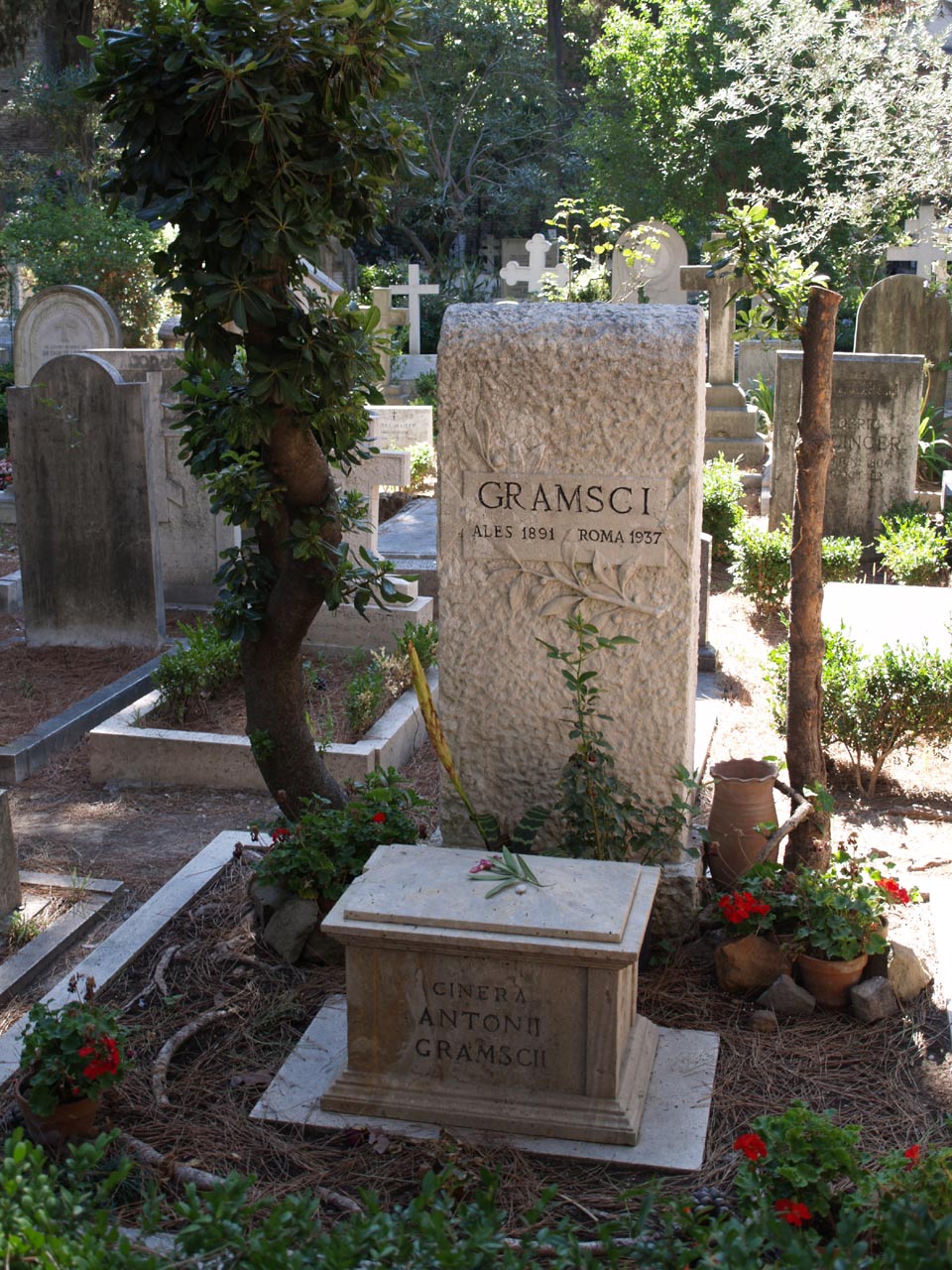
Antonio Gramsci, an Italian Marxist philosopher, politician, and revolutionary, stands as one of the most influential thinkers of the 20th century. His work transcends traditional Marxist thought, introducing nuanced theories of culture, ideology, and power that continue to resonate in contemporary political and cultural analysis. Born on January 22, 1891, in Ales, Sardinia, Gramsci’s early life was marked by poverty and illness, which significantly shaped his worldview. Despite these challenges, he excelled academically, eventually attending the University of Turin, where he was exposed to socialist ideas and became active in political organizing. It was in Turin, a hub of industrial activity, that Gramsci’s intellectual and political trajectory began to coalesce, informed by his observations of class struggle and the dynamics of industrial capitalism.

Gramsci’s contribution to Marxist theory is most prominently encapsulated in his concept of cultural hegemony. Unlike classical Marxism, which emphasized the economic base’s determination of the ideological superstructure, Gramsci proposed a more reciprocal and dynamic relationship between these spheres. He argued that ruling classes maintain dominance not merely through coercive means but also by securing consent from subordinate classes. This consent is achieved through the dissemination of ideologies that naturalize and legitimize the existing social order. For Gramsci, culture and ideology were not mere reflections of economic realities but active arenas of struggle where competing social forces vied for dominance. This insight expanded the scope of Marxist analysis, emphasizing the importance of intellectual and cultural work in revolutionary praxis.

Gramsci’s theory of hegemony also introduced the distinction between civil society and political society. Political society, comprising institutions like the state, law enforcement, and the military, represents the realm of coercive power. In contrast, civil society includes cultural, educational, and religious institutions that shape public consciousness and generate consent. For Gramsci, a revolutionary movement must not only confront the state but also transform civil society, challenging the dominant cultural and ideological frameworks that underpin the status quo. This dual approach necessitates the creation of what Gramsci termed a “counter-hegemony,” an alternative set of ideas and cultural practices that can inspire and mobilize the working class toward revolutionary change.

Gramsci’s emphasis on the role of intellectuals in this process marked another significant departure from traditional Marxism. He challenged the notion of intellectuals as a distinct class, instead categorizing them based on their function within society. Traditional intellectuals, such as clergy and academics, often serve to perpetuate the dominant ideology. In contrast, organic intellectuals emerge from within the working class and articulate its interests and aspirations. These organic intellectuals play a crucial role in fostering class consciousness and building counter-hegemonic movements. Gramsci’s nuanced understanding of intellectuals underscores the importance of education, culture, and leadership in achieving social transformation.

The prison years were a pivotal period in Gramsci’s intellectual development. Arrested in 1926 by Mussolini’s fascist regime, Gramsci spent over a decade in prison, where he produced his most significant work, the Prison Notebooks. These writings, smuggled out of prison, reveal a profound engagement with a wide range of topics, including history, philosophy, literature, and linguistics. Gramsci’s reflections on the Italian Risorgimento, for instance, offer a penetrating analysis of the limitations of bourgeois leadership and the failure to forge a robust popular alliance. He critiqued the passive revolution, a process by which social change occurs without significant popular mobilization, resulting in limited and compromised outcomes. This concept has been influential in analyzing historical and contemporary instances of reform and revolution.

Gramsci’s ideas also grapple with the question of historical agency and the conditions for revolutionary change. While he remained committed to Marxism, he rejected deterministic interpretations of historical materialism. For Gramsci, history is not an inevitable march toward socialism but a terrain of struggle shaped by human action and contingency. This perspective aligns with his broader emphasis on culture and ideology, which he viewed as integral to the dynamics of social transformation. Gramsci’s rejection of economic determinism allowed for a more flexible and context-sensitive analysis of power and resistance, making his work particularly relevant in diverse and complex social contexts.

Language and education were central concerns in Gramsci’s thought. He recognized the role of language in shaping consciousness and social relations, arguing that linguistic practices reflect and reinforce power dynamics. His analysis of the Italian language question, for instance, highlighted the cultural and political implications of linguistic standardization. Gramsci also emphasized the transformative potential of education, advocating for a system that fosters critical thinking and empowers individuals to challenge oppressive structures. His ideas on education continue to influence progressive pedagogical approaches, particularly in the tradition of critical pedagogy developed by scholars like Paulo Freire.

The legacy of Gramsci’s thought extends far beyond his immediate historical context. His theories of hegemony, civil society, and intellectuals have profoundly influenced a wide range of disciplines, including sociology, cultural studies, political science, and education. Postcolonial theorists, for instance, have drawn on Gramsci’s insights to analyze the cultural dimensions of imperialism and resistance. His work has also been instrumental in the development of neo-Marxist theories, particularly within the Frankfurt School and the Birmingham School of Cultural Studies. Scholars such as Stuart Hall and Raymond Williams have built on Gramsci’s ideas to explore the interplay between culture, ideology, and power in modern societies.

Critics of Gramsci have raised concerns about the potential for his emphasis on culture and ideology to dilute the materialist foundations of Marxism. Some argue that his focus on consent and civil society risks underestimating the enduring significance of economic exploitation and state coercion in sustaining capitalist dominance. However, defenders of Gramsci counter that his work does not abandon materialism but rather enriches it by incorporating a more comprehensive understanding of the mechanisms of power. Gramsci’s synthesis of materialist and cultural analysis represents a significant advancement in Marxist theory, offering tools to address the complexities of modern capitalism.

Gramsci’s life and work also serve as a powerful testament to the resilience of human spirit and intellect in the face of adversity. Despite the physical and psychological toll of imprisonment, he produced a body of work that continues to inspire and challenge. His commitment to social justice, intellectual rigor, and revolutionary praxis remains a beacon for those seeking to understand and transform the world. Gramsci’s insights into the dynamics of power and resistance offer a framework for analyzing the challenges of the 21st century, from the rise of authoritarianism to the persistence of inequality and environmental crisis.

Antonio Gramsci’s enduring relevance lies in his ability to bridge the gap between theory and practice, providing a nuanced and actionable understanding of social change. His work challenges us to think critically about the forces that shape our world and to imagine alternative possibilities. In an era marked by profound social and political challenges, Gramsci’s vision of counter-hegemony and transformative praxis offers a vital source of inspiration and guidance. His legacy reminds us that the struggle for a just and equitable society is not only a matter of economic redistribution but also a cultural and ideological battle that demands creativity, courage, and solidarity.

The Essence of Christianity

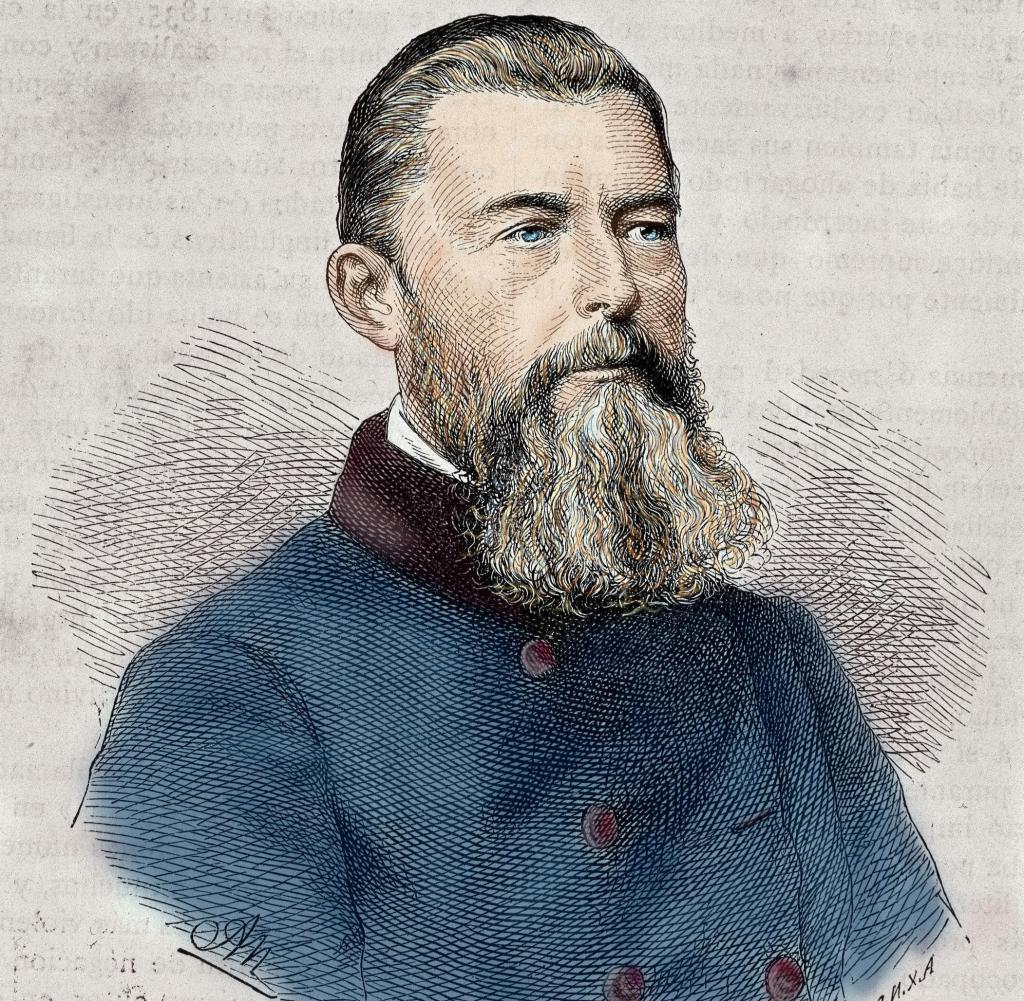
Ludwig Andreas Feuerbach (1804–1872) is a pivotal figure in 19th-century philosophy, whose work bridges the transition from German Idealism to materialist and humanist thought. His critique of religion, encapsulated in his most famous work, The Essence of Christianity (1841), significantly influenced subsequent thinkers, including Karl Marx, Friedrich Engels, and Sigmund Freud. Feuerbach’s philosophy is rooted in a profound critique of metaphysics and theology, reinterpreting them through a lens that places human beings at the center of philosophical inquiry. His ideas remain an essential milestone in the history of philosophy, with relevance to contemporary debates on religion, human nature, and social thought.

Feuerbach was born in Landshut, Bavaria, into an intellectually prominent family. His father, Paul Johann Anselm Ritter von Feuerbach, was a renowned legal scholar, and Ludwig initially followed in his father’s footsteps, studying theology at the University of Heidelberg. However, he soon grew disillusioned with theology’s dogmatic rigidity and shifted his focus to philosophy, moving to Berlin to study under Georg Wilhelm Friedrich Hegel. Hegel’s dialectical method profoundly influenced Feuerbach, but he eventually departed from Hegel’s abstract idealism, which he found overly speculative and disconnected from human experience. Instead, Feuerbach sought to ground philosophy in concrete, empirical reality, focusing on human nature and the material conditions of existence.

Feuerbach’s seminal work, The Essence of Christianity, marks a turning point in the critique of religion. In this book, he posits that theology is, at its core, anthropology. Religion, according to Feuerbach, is a projection of human nature and desires onto an imagined divine being. God, he argues, is nothing more than the idealized abstraction of humanity’s own qualities—power, wisdom, and love.

Feuerbach asserts that religious beliefs originate in human beings’ psychological need to externalize their highest aspirations and values. Humans, confronted with their limitations, create an image of God as a perfect being, embodying attributes they lack. For example, the omniscience and omnipotence ascribed to God reflect humanity’s longing for knowledge and power. By projecting their essence onto God, humans alienate themselves from their own potential. The divine becomes a separate entity that dominates and demands worship, leaving individuals estranged from the very qualities they have attributed to God. Feuerbach’s critique, therefore, is not only philosophical but also emancipatory, urging humanity to reclaim its own power and virtues. His famous assertion, “Man is what he eats,” emphasizes the material and physical grounding of human existence. This aphorism underscores his rejection of metaphysical dualisms and his insistence on the unity of body and mind.

Feuerbach’s philosophy marks a decisive turn toward materialism, a shift that influenced the development of Marxism. While Hegel saw the material world as a manifestation of Spirit (Geist), Feuerbach inverted this relationship, arguing that consciousness arises from material conditions. For Feuerbach, the starting point of philosophy is not abstract ideas but the tangible reality of human beings as embodied, social creatures. His emphasis on the sensory, material basis of human life represents a radical departure from the speculative traditions of German Idealism. Feuerbach’s materialism, however, is not reductive; he does not deny the significance of human consciousness, creativity, and culture. Instead, he seeks to ground these phenomena in the empirical realities of human existence.

Feuerbach’s humanism had a profound impact on Karl Marx and Friedrich Engels, who acknowledged his critique of religion as a necessary step in the development of historical materialism. Marx’s famous assertion that religion is “the opium of the people” owes much to Feuerbach’s analysis of religion as an ideological construct that reflects and perpetuates social alienation. However, Marx and Engels also critiqued Feuerbach for his lack of political engagement and his failure to analyze the social and economic conditions that give rise to alienation. While Feuerbach emphasized the role of human consciousness in creating religious and philosophical systems, Marx insisted that material conditions and class relations are the primary determinants of human thought and behavior.

After The Essence of Christianity, Feuerbach’s philosophical output waned, and he struggled to achieve the same level of influence. His later works, such as Principles of the Philosophy of the Future (1843), reiterated his commitment to a human-centered philosophy but failed to break new ground. Financial difficulties and the political turbulence of mid-19th-century Germany further marginalized him. Despite these challenges, Feuerbach’s legacy endures. His critique of religion laid the groundwork for modern secularism, psychology, and existentialism. Thinkers like Sigmund Freud and Jean-Paul Sartre echoed Feuerbach’s themes of projection and alienation, while his emphasis on human nature influenced the development of humanist ethics.

Feuerbach’s philosophy has been the subject of significant critique. Some have accused him of oversimplifying religion, reducing it to mere anthropological projection while neglecting its complex social and cultural dimensions. His materialism, while innovative, has also been criticized for its lack of a systematic method and for failing to address issues of political and economic power. Moreover, Feuerbach’s reliance on an essentialist notion of human nature has been questioned by contemporary philosophers who argue that human identity is more fluid and socially constructed than he acknowledged. Despite these critiques, Feuerbach’s insights into the human foundations of religious belief remain a cornerstone of modern thought.

In a world increasingly shaped by secularism, Feuerbach’s ideas resonate more than ever. His critique of religion as a form of alienation invites reflection on contemporary issues such as consumerism, nationalism, and the commodification of human relationships. Just as Feuerbach urged humanity to reclaim its essence from the projections of religion, modern society faces the challenge of reclaiming its autonomy from the dehumanizing forces of capitalism and technology. Feuerbach’s humanism also offers a compelling alternative to both nihilism and authoritarianism. By affirming the value and dignity of the human person, Feuerbach provides a foundation for ethical and political thought rooted in empathy, solidarity, and the recognition of shared humanity.

Ludwig Feuerbach was a philosopher ahead of his time, whose radical critique of religion and metaphysics reshaped the intellectual landscape of the 19th century and beyond. By challenging the foundations of theology and idealism, he paved the way for a more human-centered philosophy that continues to influence contemporary thought. While his ideas have been critiqued and refined by later thinkers, Feuerbach’s core insight—that understanding humanity is the key to understanding the world—remains as relevant today as it was in his time. Through his work, Feuerbach reminds us that philosophy is not merely an abstract pursuit but a means of grappling with the profound questions of existence, identity, and the human condition. His legacy endures as a testament to the enduring power of critical thought and the transformative potential of reclaiming our humanity.

Radical Love

To live as if the world were already transformed by a love that transcends reason is to embody a vision of existence where love, in its purest, most unconditional form, is the defining force of life. It means living in alignment with the belief that love is the highest, most transcendent reality—not a mere sentiment or emotional response but a transformative power that reaches beyond the confines of human understanding and reasoning. This form of living invites a radical shift in perspective, where the logic of compassion, empathy, and interconnectedness governs one’s actions rather than self-interest, fear, or the desire for control. It challenges us to embody the reality we wish to see, acting as though the world has already been fully enveloped in the love that transcends reason.

At its core, the idea of a love that transcends reason speaks to a love that cannot be fully understood or grasped by human intellect or logic. This love does not operate within the frameworks of judgment, comparison, or calculation. It is not constrained by conditions or the need for reciprocation. It is a love that flows freely, unbound by human limitations, and transcends every boundary we might try to impose on it—be it cultural, philosophical, or theological. To live as if this love already governs the world is to step into a way of being that reflects this love in the most practical and profound ways.

One of the first things to understand about living as though the world were transformed by love is the paradox at the heart of this notion. On the one hand, love that transcends reason suggests something beyond the ordinary, beyond our human understanding of love, something so vast and cosmic that it cannot be fully contained within the limits of human comprehension. On the other hand, this same love is not distant or abstract—it is immanent, here and now, available in every moment, in every interaction, and in every experience.

Living as though the world is already transformed by this love means recognizing the profound mystery of both transcendence and immanence at play. It means seeing every moment as a possibility for connection with a love that is beyond human logic yet present within human relationships, within nature, and within the depths of our own hearts. In this way, love is both the unseen force shaping everything and the tangible expression of grace that we encounter in everyday life. The love that transcends reason is not an external force acting upon us but something that resides within us, something that we can tap into and channel into the world. This means that we are not passive recipients of this love; we are active participants in its unfolding. Every choice we make, every word we speak, every gesture we offer, is a potential act of love that can ripple out and transform the world around us.

To live in this way also means embracing uncertainty and mystery. The love that transcends reason does not fit neatly into systems of logic or comprehension. It invites us to acknowledge that there are many things in life—both personal and cosmic—that we may never fully understand. This doesn’t mean adopting a stance of nihilism or indifference, but rather, it’s a call to surrender the need for absolute answers and embrace the beauty of the unknown. It’s an invitation to trust in the process of life itself and to hold space for mystery rather than trying to force every question into a logical framework. This kind of living requires that we abandon our need for control and embrace the flow of life as it unfolds. It asks us to sit with the discomfort of not knowing and to find peace in that uncertainty.

In practical terms, this might look like approaching life with a sense of wonder, remaining open to the unexpected, and being comfortable with ambiguity. It means not needing everything to make sense or fit into a rational narrative, but instead allowing the complexities and contradictions of life to unfold in their own time and space. To live as if the world were transformed by a love that transcends reason is to trust in the inherent wisdom of life itself, knowing that while our understanding may be limited, the love that surrounds us is boundless and ever-present. This trust in the mystery of life opens us to experiences that transcend logic and invite us into deeper, more authentic relationships with others and with ourselves.

Compassion is one of the most powerful expressions of a love that transcends reason. In a world that often operates on the logic of retribution and justice, choosing to forgive is an act that defies conventional understanding. Forgiveness is not about denying the wrongs committed or absolving others of responsibility, but about releasing the hold that anger, resentment, and hurt have over us. It is an act of freedom—freeing oneself from the chains of bitterness and allowing love to flow where there once was pain. Living as though the world is already transformed by love means choosing radical forgiveness, both for ourselves and for others. It involves letting go of the need to control outcomes or force resolution and instead, allowing grace to enter into even the most broken and painful parts of life. Grace is unearned favor, an expression of love that cannot be earned or justified by merit. It’s the kind of love that, rather than seeking repayment, offers healing without condition. To live with grace is to acknowledge that we are all flawed, all in need of redemption, and that it is through love that we are healed, not through judgment or condemnation. In choosing grace, we step into the realm of possibility where transformation occurs—not through the mechanisms of law or punishment, but through the liberating force of love.

Radical forgiveness does not deny the complexities of the human experience but embraces them fully. It recognizes the depth of pain that often accompanies the act of forgiveness and the courage it takes to choose love in the face of injustice. But it also acknowledges that the power of forgiveness is far more transformative than the perpetuation of cycles of harm and revenge. To forgive, in this sense, is not to erase the past, but to transform it into something that serves our collective healing, rather than our continued suffering. Living in this way, as if the world were already transformed by love, means embracing forgiveness as an act of liberation—liberating both ourselves and others from the cycles of guilt, shame, and resentment that keep us bound to the past.

To live as though the world is already transformed by a love that transcends reason is not to deny the current state of the world but to actively participate in its transformation. It is to recognize that love is the ultimate force for change in the world—not political ideology, economic power, or technological advancement, but love. Love changes hearts, transforms communities, and heals the deepest wounds. It is the force that has the power to break down walls of division, to heal brokenness, and to create new possibilities where once there seemed to be none. Living in alignment with this truth means being agents of love in every sphere of life—whether in our relationships, our work, our activism, or our inner spiritual practice. It means choosing to prioritize love over fear, collaboration over competition, and understanding over judgment. It is a call to make love the center of all our decisions and actions, knowing that as we live with love, we contribute to the collective transformation of the world.

The transformation of the world through love does not happen overnight, nor does it happen without effort. But it begins in the smallest of moments—in the ways we choose to treat others, in the ways we choose to respond to the challenges and injustices we face, and in the ways we open our hearts to the possibility of healing. The love that transcends reason is not a passive force but an active one. It demands that we show up for the world in all its brokenness and beauty, that we hold space for both the pain and the possibility of redemption. It calls us to live as though the world is already transformed, even as we continue to work toward that transformation.

Living as though the world were already transformed by a love that transcends reason is a radical way of being, one that calls us to embrace the deepest mysteries of existence while acting with profound compassion, forgiveness, and grace. It challenges us to trust in the power of love as the ultimate force of transformation and to embody that love in all that we do. This way of life is not about achieving perfection or solving every problem; rather, it is about living in alignment with the deepest truths of our shared humanity and our connection to a love that surpasses human understanding. In doing so, we participate in the ongoing transformation of the world, one act of love at a time. Each choice, each act of kindness, each gesture of forgiveness is a step toward the world that we know is possible—a world where love, not reason, reigns supreme.

Totality & Infinity


Emmanuel Levinas, a philosopher whose ideas challenge many of the foundational assumptions of Western philosophy, offers a unique vision of ethics that diverges sharply from existentialist and phenomenological traditions. His work, particularly in Totality and Infinity, seeks to redefine the way we understand relationships, knowledge, and responsibility, arguing that the ethical demand to respond to others lies at the heart of human existence. Levinas critiques the Western philosophical tradition’s tendency to prioritize knowledge, categorization, and control—what he calls “totality”—and instead emphasizes “infinity,” a concept that allows for the unknowable, inexhaustible depth of other people. This orientation not only reshapes our understanding of ethics but also challenges traditional views on the nature of God, suggesting a divine dimension within human relationships.

Totality and Infinity: Challenging Western Philosophy

In Totality and Infinity, Levinas critiques the dominant philosophical models that emphasize ontology—the study of being—as the foundation of knowledge. He argues that much of Western philosophy has focused on understanding the world in terms of totality, where the aim is to assimilate all that is other or unknown into a coherent, unified system. This approach, which extends to science, psychology, and many other disciplines, seeks to explain and categorize, thereby making the unknown familiar. While this drive for mastery and knowledge has been incredibly productive in technological and scientific advancements, Levinas contends that it risks stripping away the unique, irreducible aspects of human life. In reducing everything to concepts, categories, or functions, totality overlooks the fundamental individuality and depth of other people.

Levinas’ criticism of totality is particularly directed at the way it treats human beings as objects within a system, as though each person can be fully understood through objective descriptions or functional roles. In this way, totality transforms people into parts of a broader structure, subsuming their unique existence under general categories. This reduction, Levinas argues, is deeply unethical because it ignores the infinite value of each individual, treating them merely as components within a broader project of understanding or control. For Levinas, an ethical philosophy must instead be based on a recognition of the limits of totality, acknowledging that some aspects of human existence are beyond comprehension.

Infinity and the Encounter with the Other

Levinas introduces the concept of infinity to counter this totalizing impulse. While totality seeks to close systems and achieve mastery over everything it encompasses, infinity implies an openness—a recognition of that which is beyond our grasp. In Levinas’ philosophy, infinity is not an abstract metaphysical property; rather, it is embodied in the Other, the person we encounter as an infinitely valuable, irreducible being. In this encounter, the Other cannot be reduced to a mere object within a system; they are someone whose existence challenges us, someone who demands a response that is ethical rather than intellectual or instrumental.

Central to Levinas’ idea of infinity is the “face-to-face” encounter, where we are confronted by the face of the Other. This face is not simply a physical appearance; it is a presence that breaks through any attempt to categorize or control. The face of the Other is vulnerable and exposes us to their humanity in a way that resists any attempt at reduction. In this moment, Levinas argues, we experience an ethical demand, an imperative that compels us to respond to the Other’s needs, to recognize their unique value beyond any utility they may serve for us. This call is asymmetrical: it does not ask for reciprocity but rather places the needs of the Other above our own. Here, Levinas suggests that true ethical responsibility involves a commitment that exceeds self-interest, one that is based on an infinite obligation to respect and care for others.

Science, Totality, and Ethical Limits

Levinas’ critique of totality extends to scientific knowledge, which epitomizes the drive to categorize, explain, and control. Scientific inquiry operates by creating models and systems that explain the natural world in consistent, predictable terms. This approach is valuable in its capacity to harness knowledge for human benefit, but it also embodies the totalizing impulse that Levinas finds ethically concerning. Science, by its very nature, seeks to render the unknown into the known, to break down complex phenomena into measurable, comprehensible elements. When applied to human beings, however, this approach can lead to an objectification of individuals, treating them as parts of a system rather than as unique, irreducible entities.

Levinas does not deny the importance of scientific knowledge, but he warns that it has limitations when applied to the ethical realm. Science operates within the framework of totality, seeking to explain people and things within a unified structure. In doing so, it often misses the infinite aspect of human beings that cannot be captured through objective analysis. For Levinas, ethical life requires us to recognize the limits of this approach, acknowledging that while science may explain many aspects of existence, it cannot encompass the moral and interpersonal dimensions that define our relationships with others. The encounter with the Other, in Levinas’ view, is a moment of ethical significance that transcends the explanatory power of science, reminding us that the essence of human relationships cannot be reduced to systems of knowledge.

The Divine Dimension: Infinity, the Other, and God

Levinas’ ideas about infinity and the Other are closely related to his understanding of God, though he approaches the divine from an ethical rather than theological perspective. Instead of conceiving God as a being within the world or as an object of knowledge, Levinas sees God as a presence that is revealed through ethical relationships. In other words, God is not encountered directly but is instead experienced in the very structure of the ethical demand that arises from the Other.

Levinas suggests that the experience of infinity in the face of the Other carries a divine quality, as it points toward something greater than oneself. When we encounter the Other, we are confronted with an aspect of their being that is unknowable, inexhaustible, and infinitely valuable. This experience of the infinite evokes a sense of transcendence, a moment where we are called out of self-centered existence and into a life of responsibility and humility. For Levinas, this ethical demand is a way of experiencing God—not as an object or entity but as an infinite call that arises from the Other’s presence.

In this way, Levinas transforms the idea of God from a metaphysical question to a lived ethical reality. God is encountered not through direct knowledge or theological reflection but through the ethical obligation to serve and respect others. To respond to the Other, to recognize their infinite worth, is to engage in a kind of worship, an acknowledgment of a divine presence that manifests itself through human relationships. This perspective invites a rethinking of the sacred, where the encounter with God is not found in traditional religious experience but in the ethical commitment to the Other.

Levinas’ Ethical Philosophy

Levinas’ philosophy offers a profound rethinking of ethics, knowledge, and spirituality, one that challenges many of the assumptions of traditional Western thought. In Totality and Infinity, he argues that the drive for totality—the desire to master, categorize, and control—overlooks the fundamental mystery and infinite value of each person. Levinas calls for an ethics grounded not in knowledge or reciprocity but in an infinite responsibility to the Other, a commitment that transcends any attempt to understand or assimilate.

By contrasting totality with infinity, Levinas invites us to see human relationships as sites of transcendence and ethical significance. In the encounter with the Other, we are called to move beyond self-interest and to embrace a life of humility, respect, and care. This ethical demand is, for Levinas, a form of divine encounter, suggesting that God is present in the very act of turning toward others with compassion and responsibility.

Levinas’ philosophy challenges the limits of scientific knowledge, suggesting that while science can explain much of the physical world, it cannot capture the ethical and spiritual dimensions of human life. In his view, the divine is not a being to be comprehended but an ethical force that reveals itself in our relationships with others. Through this lens, Levinas redefines ethics as the highest philosophical inquiry, a call to respond to the infinite value of others in a way that brings us closer to a sense of the divine. In a world dominated by systems of knowledge and power, Levinas’ vision reminds us of the sacred duty to respect, care for, and serve those around us—a duty that transcends understanding and brings us into communion with the infinite.


Emmanuel Levinas was born on January 12, 1906, in Kaunas, Lithuania, to a Jewish family. Raised with a strong grounding in both Jewish and Western European culture, he moved to France in 1923, where he studied philosophy at the University of Strasbourg. Levinas went on to study under prominent phenomenologist Edmund Husserl and later Martin Heidegger in Freiburg, Germany, which deeply influenced his early work.

During World War II, Levinas served as a French soldier but was captured and held in a German prisoner-of-war camp. His family in Lithuania was tragically murdered during the Holocaust. This personal suffering and loss profoundly impacted his philosophical outlook, pushing him to explore ethics as the foundation of philosophy.

After the war, Levinas settled in France, where he became a key figure in French intellectual life, teaching at the University of Poitiers, the University of Paris, and later at the Sorbonne. His major works, Totality and Infinity (1961) and Otherwise than Being (1974), introduced his groundbreaking ethical philosophy, which centered on the ethical responsibility to “the Other.” Levinas’ ideas have since influenced fields from theology and ethics to postcolonial and feminist theory.

Levinas continued to write, lecture, and engage with Jewish thought until his death on December 25, 1995. His work remains foundational in the fields of ethics and Continental philosophy, reshaping discussions on morality, responsibility, and the nature of human relationships.


Further reading: Emmanuel Levinas – Stanford Encyclopedia of Philosophy

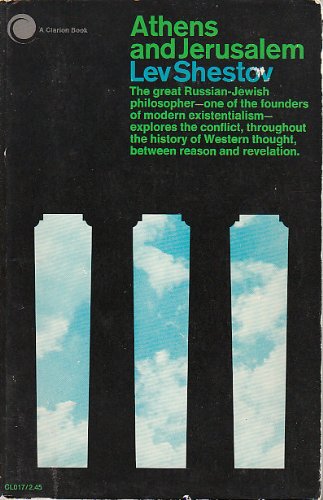
Athens & Jerusalem

FOREWORD

“The greatest good of man is to discourse daily about virtue.”
– PLATO, Apology, 38A.

“Whatsoever is not of faith is sin.”
– ST. PAUL, Romans, 14:23.

A foreword is basically always a post-word. This book, developed and written over a long period of time, is at last finished. The foreword now seeks only to formulate as briefly as possible what has given direction to the author’s thought over the course of several years.

“Athens and Jerusalem,” “religious philosophy” – these expressions are practically identical; they have almost the same meaning. One is as mysterious as the other, and they irritate modern thought to the same degree by the inner contradiction they contain. Would it not be more proper to pose the dilemma as: Athens or Jerusalem, religion or philosophy? Were we to appeal to the judgement of history, the answer would be clear. History would tell us that the greatest representatives of the human spirit have, for almost two thousand years, rejected all the attempts which have been made to oppose Athens to Jerusalem, that they have always passionately maintained the conjunction “and” between Athens and Jerusalem and stubbornly refused “or.” Jerusalem and Athens, religion and rational philosophy, have ever lived peacefully side by side. And this peace was, for men, the guarantee of their dearest longings, whether realised or unrealised.

But can one rely on the judgement of history? Is not history the “wicked judge” of popular Russian legend, to whom the contending parties in pagan countries found themselves obliged to turn? By what does history guide itself in its judgements? The historians would like to believe that they do not judge at all, that they are content simply to relate “what happened,” that they draw from the past and set before us certain “facts” that have been forgotten or lost in the past. It is not the historians who pronounce “judgement”; this rises of itself or is already included in the facts. In this respect the historians do not at all distinguish themselves, and do not wish to be distinguished, from the representatives of the other positive sciences: the fact is, for them, the final and supreme court of judgement; it is impossible to appeal from it to anyone or anything else.

Many philosophers, especially among the moderns, are hypnotised by facts quite as much as are the scientists. To listen to them, one would think that the fact by itself already constitutes truth. But what is a fact? How is a fact to be distinguished from a fiction or a product of the imagination? The philosophers, it is true, admit the possibility of hallucinations, mirages, dreams, etc.; and yet it is rarely recognised that, if we are obliged to disengage the facts from the mass of direct or indirect deliverances of the consciousness, this means that the fact by itself does not constitute the final court of judgement. It means that we place ourselves before every fact with certain ready-made norms, with a certain “theory” that is the precondition of the possibility of seeking and finding truth. What are those norms? What is this theory? Whence do they come to us, and why do we blithely accord them such confidence? Or perhaps other questions should be put: Do we really seek facts? Is it facts that we really need? Are not facts simply a pretext, a screen even, behind which quite other demands of the spirit are concealed?

I have said above that the majority of philosophers bow down before the fact, before “experience.” Certain among the philosophers, however – and not the least of them – have seen clearly that the facts are at best only raw material which by itself furnishes neither knowledge nor truth and which it is necessary to mould and even to transform. Plato distinguished “opinion” (doxa) from “knowledge” (epistêmê). For Aristotle knowledge was knowledge of the universal. Descartes proceeded from veritates aeternae (eternal truths). Spinoza valued only his tertium genus cognitionis (third kind of knowledge). Leibniz distinguished vérités de fait from vérités de raison and was not even afraid to declare openly that the eternal truths had entered into the mind of God without asking His permission. In Kant we read this confession, stated with extraordinary frankness: “Experience, which is content to tell us about what it is that it is but does not tell us that what is is necessarily, does not give us knowledge; not only does it not satisfy but rather it irritates our reason, which avidly aspires to universal and necessary judgements.” It is hard to exaggerate the importance of such a confession, coming especially from the author of The Critique of Pure Reason. Experience and fact irritate us because they do not give us knowledge. It is not knowledge that fact or experience brings us. Knowledge is something quite different from experience or from fact, and only the knowledge which we never succeed in finding either in the facts or in experience is that which reason, “our better part,” seeks with all its powers. There arises here a series of questions, each more troubling than the other. First of all, if it is really so, wherein is the critical philosophy distinguished from the dogmatic? After Kant’s confession, are not Spinoza’s tertium genus cognitionis and Leibniz’s vérités de raison (those truths which entered into the mind of God without His permission) confirmed in their hallowed rights by a centuries-old tradition? Did the critical philosophy overcome that which was the content, the soul even, of the pre-critical philosophy? Did it not assimilate itself to it, having concealed this from us?

I would recall in this connection the very significant conflict, and one which the historians of philosophy for some unknown reason neglect, between Leibniz and the already deceased Descartes. In his letters Descartes several times expresses his conviction that the eternal truths do not exist from all eternity and by their own will, as their eternity would require, but that they were created by God in the same way as He created all that possesses any real or ideal being. “If I affirm,” writes Descartes, “that there cannot be a mountain without a valley, this is not because it is really impossible that it should be otherwise, but simply because God has given me a reason which cannot do other than assume the existence of a valley wherever there is a mountain.” Citing these words of Descartes, Bayle agrees that the thought which they express is remarkable, but that he, Bayle, is incapable of assimilating it; however, he does not give up the hope of someday succeeding in this. Now Leibniz, who was always so calm and balanced and who ordinarily paid such sympathetic attention to the opinions of others, was quite beside himself every time he recalled this judgement of Descartes. Descartes, who permitted himself to defend such absurdities, even though it was only in his private correspondence, aroused his indignation, as did also Bayle whom these absurdities had seduced. Indeed, if Descartes “is right,” if the eternal truths are not autonomous but depend on the will, or, more precisely, the pleasure of the Creator, how would philosophy or what we call philosophy be possible? How would truth in general be possible? When Leibniz set out on the search for truth, he always armed himself with the principle of contradiction and the principle of sufficient reason, just as, in his own words, a captain of a ship arms himself on setting out to sea with a compass and maps. These two principles Leibniz called his invincible soldiers. But if one or the other of these principles is shaken, how is truth to be sought? There is something here about which one feels troubled and even frightened. Aristotle would certainly have declared on the matter of the Cartesian mountain without a valley that such things may be said but cannot be thought. Leibniz could have appealed to Aristotle, but this seemed to him insufficient. He needed proofs but, since after the fall of the principles of contradiction and of sufficient reason the very notion of proof or demonstrability is no longer anything but a mirage or phantom, there remained only one thing for him to do – to be indignant. Indignation, to be sure, is an argumentum ad hominem; it ought then to have no place in philosophy. But when it is a question of supreme goods, man is not too choosy in the matter of proof, provided only that he succeeds somehow or other in protecting himself …

Leibniz’s indignation, however, is not at bottom distinguished from the Kantian formulas – “reason aspires avidly,” “reason is irritated,” etc. Every time reason greatly desires something, is someone bound immediately to furnish whatever it demands? Are we really obliged to flatter all of reason’s desires and forbidden to irritate it? Should not reason, on the contrary, be forced to satisfy us and to avoid in any way arousing our irritation? Kant could not resolve to “criticise” reason in this way and the Kantian critique of reason does not ask such questions, just as the pre-critical philosophy never asked them. Plato and Aristotle, bewitched by Socrates, and, after them, modern philosophy – Descartes, Spinoza, Leibniz, as well as Kant – seek, with all the passion of which men are capable, universal and necessary truths – the only thing, according to them, which is worthy of being called “knowledge.” In short, it would hardly be extravagant to say that the problem of knowledge, or more exactly, knowledge as a problem, not only has never drawn the attention of the most notable representatives of philosophical thought but has repelled them. Everyone has been convinced that man needs knowledge more than anything else in the world, that knowledge is the only source of truth, and especially – I emphasise this particularly and insist upon it – that knowledge furnishes us with universal and necessary truths which embrace all being, truths from which man cannot escape and from which there is consequently no need to escape. Leibniz said that the “eternal truths” are not content to constrain but do something still more important: they “persuade.” And it is not, of course, only Leibniz personally whom they persuade but all men; Leibniz would not have ascribed any value to truths capable of persuading him but incapable of persuading others or even of constraining them.

In this respect there is hardly any difference between Leibniz and Kant. The latter has told us that reason avidly aspires to necessary and universal judgements. It is true that, in the case of Kant, the element of constraint seems to play a decisive and definitive role: even if there should be men whom the truths do not persuade, whom they irritate as experience irritates Kant, this would be no great misfortune; the truths would nevertheless constrain them and thus fully succeed in justifying themselves. And, in the last analysis, does not constraint persuade? In other words, truth is truth so long as it has demonstrative proofs at its disposal. As for indemonstrable truths, no one has any need of them and they appear to be incapable of persuading even a Leibniz.

It is this that determines Kant’s attitude towards metaphysics. It is known that according to Kant, who speaks of this more than once in his Critique of Reason, metaphysics has as its object three problems – God, the immortality of the soul, and freedom. But suddenly it appears that the final result of the Kantian critique is that none of these three metaphysical truths is demonstrable and that there can be no scientific metaphysics. One would have thought that such a discovery would have shaken Kant’s soul to its deepest foundations. But it did nothing of the sort. In his Preface to the Second Edition of The Critique of Pure Reason, Kant declares calmly, almost solemnly: “I had to renounce knowledge (Wissen) in order to make room for faith (Glauben).” So Kant speaks in this same Preface, where we read the following lines: “It will always be a scandal for philosophy and human reason in general that we must accept the existence of things outside ourselves merely on faith and that, if someone should take it into his head to doubt it, we would be incapable of setting before him any sufficient proof.” It is impossible to prove the existence of God, the immortality of the soul, or free will, but there is nothing offensive or disturbing in this either for philosophy or for human reason; all these will get along without proof and will content themselves with faith, with what Kant and everyone call faith. But when it is a question of the existence of objects outside ourselves, then faith does not suffice, then it is absolutely necessary to have proof. And yet, if one admits Kant’s point of departure, the existence of objects outside ourselves is hardly in a more enviable situation, as far as proof is concerned, than God, the immortality of the soul, or free will. At best, the existence of objects outside ourselves can be postulated or be an object of faith. But it is this that Kant cannot endure, just as Leibniz could not endure Descartes’ mountain without a valley. And Kant, not having at his disposal any convincing demonstration, just like Leibniz, did not recoil before the use of an argumentum ad hominem, before indignation: if we do not succeed in knowing that things exist outside ourselves, then philosophy and reason are forever covered with shame; it is a “scandal!…”

Why did Leibniz so passionately defend his eternal truths, and why was be so horrified at the idea of subordinating them to the Creator? Why did Kant take to heart the fate of objects outside ourselves, while the fate of God, of the soul and of freedom left him untouched? Is it not just the opposite which should have happened? The “scandal” of philosophy, one would think, consists in the impossibility of proving the existence of God. One would also think that the dependence of God on the truths would poison man’s mind and fill it with horror. So one would think; but in reality it was the contrary of this that occurred. Reason, which aspires eagerly to necessity and universality, has obtained all that it wished and the greatest representatives of modern philosophy have expelled everything which could irritate reason to the region of the “supra-sensible” from which no echo comes to us and where being is confounded with non-being in a dull and dreary indifference.

Even before The Critique of Pure Reason Kant wrote to Marcus Herz that “in the determination of the origin and validity of our knowledge the deus ex machina is the greatest absurdity that one could choose.” Then, as if he were translating Leibniz’s objections to Descartes, “To say that a supreme being has wisely introduced into us such ideas and principles (i.e., the eternal truths) is completely to destroy all philosophy.” It is on this that all of the critical philosophy, just like the pre-critical philosophy, is built. Reason does not tolerate the idea of what Kant calls a deus ex machina or “a supreme being”; this idea marks the end of all philosophy for reason. Kant could not forgive Leibniz for his modest “pre-established harmony” because it conceals a deus ex machina. For once one accepts the existence of a deus ex machina – this is to say, a God who, even though from afar and only from time to time, intervenes in the affairs of the world – reason would be obliged to renounce forever the idea that what is is necessarily just as it is, or, to use Spinoza’s language, that “things could not have been produced by God in any other way or order than that in which they were produced.”

Kant (in this, also, agreeing with Leibniz) was very unhappy when he was compared with Spinoza. He, like Leibniz, wanted people to consider him (and they did indeed consider him) a Christian philosopher. But for all his piety, he could not accept the idea that God can and must be placed above the truths, that God can be sought and found in our world. Why was this idea unacceptable to him ? And why, when he spoke of the “dogmatic slumber” from which his “critiques” had permitted him to escape, did it not occur to him to ask whether the certitude with which he affirmed the autonomy of the truth, as well as his hatred for “experience,” did not flow from the “dogma” of the sovereignty of reason, a dogma devoid of all foundation and one which is an indication not of slumber but of profound sleep, or even – perhaps – the death of the human spirit? It is a terrible thing to fall into the hands of the living God. But to submit to impersonal Necessity which (no one knows how) has been introduced into being – this is not at all terrible, this calms and even rejoices! But then, why did Kant need to distinguish himself from Leibniz, and why did both Kant and Leibniz need to distinguish themselves from Spinoza? And why, I ask once more, do the historians of philosophy – one might almost say, does the history of philosophy – continue up to our own day to guard so carefully that boundary which Kant drew between himself and his immediate predecessors, between his philosophy, on the one hand, and the medieval and ancient philosophy, on the other hand? His “critiques,” in fact, have not at all shaken the foundations on which the investigative thought of European man has rested. After Kant, as before Kant, the eternal truths continue to shine above our heads like fixed stars; and it is through these that weak mortals, thrown into the infinity of time and space, always orient themselves. Their immutability confers upon them the power of constraint, and also – if Leibniz is to be believed – the power of persuading, of seducing, of attracting us to themselves, no matter what they bring us or what they demand of us, while the truths of experience, whatever they may bring, always irritate us, just as does the “supreme being” (that is to say, deus ex machina) even when he wisely introduces into us eternal truths concerning what exists and what does not exist.

The critical philosophy did not overthrow the fundamental ideas of Spinoza; on the contrary, it accepted and assimilated them. The Ethics and the Tractatus Theologico-Politicus remain alive, though implicitly, in the thought of German idealism quite as much as in the thought of Leibniz: the Necessity which determines the structure and order of being, the ordo et connexio rerum, does not constrain us but persuades us, draws us along, seduces us, rejoices us, and bestows upon us that final contentment and that peace of soul which at all times have been considered in philosophy as the supreme good. “Contentment with one’s self can spring from reason, and that contentment which springs from reason is the highest possible.” Men have imagined, it is true – and certain philosophers have even supported them in this – that man constitutes in nature a kind of state within a state. “After men have persuaded themselves that everything that happens happens for their sakes, they must consider as most important in everything that which is for them most useful, and they must value most that by which they would be best affected.” Consequently, flent, ridunt, contemnunt vel quod plerumque fit, detestantur (they weep, laugh, scorn or – what happens most of the time – curse). It is in this, according to Spinoza, that there lies the fundamental error of man – one could almost say man’s original sin, if Spinoza himself had not so carefully avoided all that could recall the Bible even if only externally.

The first great law of thought which abolishes the biblical interdiction against the fruits of the tree of knowledge is non ridere, non lugere, neque detestari, sed intelligere (not to laugh, not to lament, not to curse, but to understand). Everything is then transformed before our eyes. In contemplating life “under the aspect of eternity or necessity,” we accept whatever we encounter on our road with the same tranquillity and the same feeling of good will. “Even if these things are inconvenient, they are nevertheless necessary and have determinate causes through which we seek to understand their nature, and the mind rejoices just as much over their true contemplation as over the knowledge of those things that are pleasing to the senses.”

In contemplating the necessity of everything that happens in the universe, our mind experiences the highest joy. How does this differ from the statement of Kant, who says that our reason aspires eagerly to universal and necessary judgements? Or from Leibniz’s affirmation that the truths not only constrain but persuade? Or even from the famous Hegelian formula, “All that is real is rational?” And is it not evident that for Leibniz, Kant and Hegel – quite as much as for Spinoza – the pretensions that man makes of occupying a special, privileged place in nature are ungrounded and absolutely unjustified, unless recourse is had to a “supreme being” who does not exist and has never existed? It is only when we forget all “supreme beings” and repress, or rather tear out of our soul, all the ridere, lugere, et detestari, as well as the absurd flere which flows from them and which comes to the ears of no one – it is only when we recognise that our destiny and the very meaning of our existence consist in the pure intelligere, that the true philosophy will be born.

Neither in Leibniz nor in Kant do we find, to be sure, the equivalent of the Tractatus Theologico-Politicus which established what is now called “biblical criticism,” but this does not mean that they had taken any less care than Spinoza to protect themselves from the biblical contamination. If everything that Kant said about Schwärmerei and Aberglauben (fanaticism and superstition) or that Leibniz wrote on the same subject were brought together, one would completely recover the Tractatus Theologico-Politicus. And conversely, all the effort of the Tractatus is bent to ridding our spiritual treasury of the ideas which Scripture had introduced there and which nothing justifies.

The non ridere, non lugere, neque detestari, sed intelligere of Spinoza, who abrogated the ban placed by the Bible on the fruit of the tree of knowledge, constitutes at the same time a reasonable reply to the De profundis ad te, Domine, clamavi (out of the depths I cried unto Thee, O God) of the Psalmist. The Psalmist could cry to God, but the man qui sola ratione ducitur (who is led by reason alone) knows well that it is absolutely useless to cry to God from the depths. If you have fallen into an abyss, try to get out of it as best you can, but forget what the Bible has told us throughout the centuries – that there is somewhere, “in heaven,” a supreme and omnipotent being who is interested in your fate, who can help you, and who is ready to do so. Your fate depends entirely on the conditions in which chance has placed you. It is possible, in some measure, to adapt yourself to these conditions. You may, for example, prolong your earthly existence by working to earn your bread or by taking it away from others. But it is a question only of prolongation, for it is not given anyone to escape death. An ineluctable eternal truth says: “Everything that has a beginning has also an end.” The man of the Bible was unwilling to accept this truth; it did not succeed in “persuading” him. But this shows only that he did not allow himself to be led “by reason alone,” that he was deeply bogged down in Schwärmerei and Aberglauben. The man who has been enlightened – a Spinoza, a Leibniz, a Kant – thinks quite otherwise. The eternal truths do not simply constrain him; they persuade him, they inspire him, they give him wings. Sub specie aeternitatis vel necessitatis – how solemnly these words resound in Spinoza’s mouth! And his amor erga rem aeternam (love for the eternal) – does not one feel ready to sacrifice for this the entire universe, created (if one may believe the doubtful, or rather, quite frankly, false teachings of this same Bible) by God for man? And then there is Spinoza’s “we feel and experience that we are eternal,” and the statement which crowns his Ethics: “Happiness is not the reward of virtue but virtue itself.” Are these words not worth our abandoning all the passing and changing goods which life promises us?

We touch here precisely upon that which deeply distinguishes the biblical philosophy, the biblical thought – or, better, the mode of biblical thought – from the speculative thought that the vast majority of the great philosophers of historic humanity represent and express. The ridere, lugere, and detestari along with the accompanying flere that are rejected by Spinoza, the most audacious and sincere of these philosophers, constitute that dimension of thought which no longer exists, or more accurately, which has been completely atrophied in the man “who is led by reason alone.” One could express this still more strongly: the prerequisite of rational thought consists in our willingness to reject all the possibilities that are bound up with ridere, lugere, et detestari and especially with flere. The biblical words “And God saw that it was very good” seem to us the product of a fantastic imagination, as does the God who reveals Himself to the prophet on Mount Sinai. We, enlightened men, put all our trust in autonomous ethics; its praises are our salvation, its reproofs our eternal damnation. “Beyond” the truths which constrain, “beyond” good and evil, all interests of the mind come, in our opinion, to an end. In the world ruled by “Necessity” the fate of man and the only goal of every reasonable being consist in the performance of duty: autonomous ethics crowns the autonomous laws of being.

The fundamental opposition of biblical philosophy to speculative philosophy shows itself in particularly striking fashion when we set Socrates’ words, “The greatest good of man is to discourse daily about virtue” (or Spinoza’s gaudere vera contemplatione – “to rejoice in true contemplation”) opposite St. Paul’s words, “Whatsoever is not of faith is sin.” The precondition of Socrates’ “greatest good,” or of Spinoza’s “true contemplation,” is the willingness of the man “who knows” to renounce God’s “blessing” by virtue of which the world and everything that is in the world were destined for man’s use. The ancients already had seen the “eternal truth” that man is only one of the links of the chain, without beginning or end, of phenomena; and this eternal truth – constraining, of course, and coming from the outside – in antiquity already had at its disposal the power of constraining the philosophical intelligence and also of seducing it, or, as Leibniz puts it, persuading it. And it is here that there arises the essential philosophical question, which unfortunately did not attract the attention of philosophers – neither of Leibniz nor of all those who, before or after him, considered implicite or explicite that the eternal truths not only constrain but also persuade. It is the question of knowing what is essential in our relationship to the truths: is it the fact that they constrain or the fact that they persuade? To put the matter in another way: if the truth which constrains does not succeed in persuading us, does it thereby lose its status as truth? Is it not enough for the truth to have the power of constraining? As Aristotle says of Parmenides and the other great philosophers of antiquity, they are “constrained by the truth itself.” (hyp’ autês alêtheâs anankazomenoi) It is true that he adds, with a sigh, tên anankên ametapeiston ti einai, “Necessity does not allow itself to be persuaded,” as if he were replying in advance to Leibniz, who said that the truth does more than constrain, that it persuades. But Aristotle ended by repressing his involuntary sigh and began to glorify the constraining truth, as if it were not content to constrain but also persuaded.

In modern philosophy, such expressions as Leibniz’s “persuasion” or Spinoza’s vera contemplatione gaudere constitute, in a way, a substitute for the flere and for the biblical “God blessed,” a substitute smuggled into the domain of objective thought which seemed to have been so carefully and once for all cleansed of all the Schwärmerei and Aberglauben to be found in the neighbourhood of Scripture and its revelations.

But this was not enough for philosophy, or, more precisely, for the philosophers; they wished, and still wish, to think, and they try by all means to suggest to others, to make them think, that their truths possess the gift of persuading all men without exception and not only themselves who have uttered them. Reason recognises as true only these truths. They are the truths that it seeks. It is these alone that it calls “knowledge.” If someone had proposed to Spinoza, Leibniz or Kant that they limit their pretensions, in the sense of recognising that the truths are true only for those whom they persuade and cease to be truths for those whom they do not succeed in persuading, would the truths of Leibniz, Spinoza and Kant have retained their earlier charm in the eyes of these philosophers? Would they have continued to call them truths?

Here is a concrete example (the fundamental opposition between Hellenistic and biblical thought bursts forth fully only in concrete examples): The Psalmist cries to the Lord out of the depths of his human nothingness, and all his thought is oriented – just as the truths that he obtains are determined – not by what is “given,” by what “is,” by what one can “see” be it even by means of the eyes of the mind (oculi mentis), but by something quite different – something to which what is given, what is, remains, despite its self evidence, subordinate. Thus, the immediate deliverances of consciousness do not circumscribe the goal of the Psalmist’s searchings; the facts, the given, experience – these do not constitute for him the final criterion which serves to distinguish truth from falsehood. A fact is for him something which rose one day, which had a beginning, and consequently may, if not must, have an end. We know from history that almost twenty-five hundred years ago Socrates was poisoned in Athens. “The man who is led by reason alone” must bow down before this “fact,” which not only constrains but also persuades him; he will feel calm only when reason will have guaranteed that no force in the world could destroy this fact, i.e., when he will have perceived in it the element of eternity or necessity. It seems to him that by succeeding in transforming even that which happened only once into an eternal truth, he acquires knowledge, the true knowledge which concerns not what begins and ends, what changes and passes, but what is forever immutable. Thus he elevates himself to the understanding of the universe sub specie aeternitatis vel necessitatis. He attains, with a flap of his wings, the regions where truth lives. And what this truth brings with it is then altogether indifferent to him, whether it be the poisoning of the wisest of men or the destruction of a mad dog. The important thing is that he obtain the possibility of contemplating eternal, immutable, unshakable truth. The mind rejoices over the eternity of truth; as for its content, to this it remains quite indifferent. Amor erga rem aeternam fills the human soul with happiness, and the contemplation of the eternity and necessity of everything that happens is the greatest good to which man can aspire.

If someone had taken it into his head to tell Spinoza, Leibniz, or Kant that the truth “Socrates was poisoned” exists only for a definite term and that sooner or later we shall obtain the right to say that no one ever poisoned Socrates, that this truth, like all truths, is in the power of a supreme being who, in answer to our cries, can annul it – Spinoza, Leibniz and Kant would have considered these words a sacrilegious attack on the sacred rights of reason, and they would have been indignant, just as Leibniz was when he recalled Descartes’ mountain without a valley. The fact that on earth righteous men are poisoned like mad dogs does not at all trouble the philosophers, for they believe it in no way threatens philosophy. But to admit that a “supreme being” can rid us of the nightmare of the eternal truth “Socrates was poisoned” – this would appear to them not only absurd but revolting. This would not satisfy or persuade them but, on the contrary, irritate them to the last degree. 0f course, they would have preferred that Socrates had not been poisoned but, since he was poisoned, it is necessary to submit and to be content with thinking up some theodicy; this, even if it does not make us completely forget the horrors which fill human existence, will perhaps succeed in somewhat weakening their impression. To be sure a theodicy – Leibniz’s or anyone else’s – must rely on some eternal truth which, in the final analysis, reduces itself to Spinoza’s sub specie aeternitatis vel necessitatis. It will be said that everything that is created cannot be perfect by reason of the very fact that it was created and that, consequently, the world that was created can only be the “best of all possible worlds”; we must then expect to find in it many bad things, even very bad things.

Why should creation not be perfect? Who suggested this idea to Leibniz, who imposed it on him? To this question we will not find any answer in Leibniz, just as we will not find in any philosopher an answer to the question how a truth of fact is transformed into an eternal truth. In this respect, the enlightened philosophy of modern times is hardly to be distinguished from the philosophy of the “benighted” Middle Ages. The eternal truths constrain and persuade all thinking beings equally. When in the Middle Ages the voice of Peter Damian rang out, proclaiming that God could bring it about that that which had been had not been, it seemed like the voice of one crying in the wilderness. No one, neither of our time nor even of the Middle Ages, dared to admit that the biblical “very good” corresponded to reality, that the world created by God had no defect. Even more: it may be said that medieval philosophy, and even the philosophy of the Church Fathers, was the philosophy of people who, having assimilated Greek culture, thought and wished to think sub specie aeternitatis vel necessitatis. When Spinoza says, in ecstasy, “the love for the eternal and infinite feeds the mind with joy alone, and this itself is free from every sorrow, which is greatly to be wished and striven after with every power,” he is only summing up the teaching of the philosophers of the Middle Ages who had passed through the severe school of the great Greek thinkers. The only difference is that Spinoza, in order to trace the way which would lead him to res aeterna et infinita, believed that it was his duty as a thinker to sharply separate himself from Scripture, while the scholastics made superhuman efforts to save for the Bible the authority which belonged to it as a divinely inspired book.

But the more men occupied themselves with the authority of the Bible, the less they took account of the content of the sacred book; for, indeed, authority demands finally nothing but respect and veneration. Medieval philosophy never stopped repeating that philosophy is only the handmaid of theology and always referred to biblical texts in its reasonings. And yet as competent a historian as Gilson is obliged to recognise that the medieval philosopher, when he read Scripture, could not fail to recall Aristotle’s words about Homer, “The poets lie a great deal.” Gilson also cites the words of Duns Scotus: “I believe, Lord, what your great prophet has said, but if it be possible, make me under-stand it.” So the doctor subtilis, one of the greatest thinkers of the Middle Ages, speaks. When he hears the words, “Rise, take up your bed and go,” he replies, “Give me my crutches that I may have something upon which to lean.” And yet Duns Scotus surely knew the words of the Apostle, “Whatsoever is not of faith is sin,” as well as the biblical account of the fall of the first man, who renounced faith in order to attain knowledge. But, just as later on in the case of Kant, there never occurred to him the thought of seeking in the biblical legend the “critique of reason,” the critique of the knowledge which pure reason brings to man. Is it possible that knowledge leads to the biblical “you shall die” while faith leads to the tree of life? Who will dare admit such a “critique?” The truth that knowledge is above faith, or that faith is only an imperfect kind of knowledge – is not this an “eternal truth,” a truth to which Leibniz’s words, “it not only constrains but also persuades,” could be applied par excellence? This truth had already seduced the first man, and ever since, as Hegel very rightly says, the fruits of the tree of knowledge have become the source of philosophy for all time. The constraining truths of knowledge subdue and persuade men, while the free truth of revelation, which has not and does not seek any “sufficient reason,” irritates men, just as experience irritates them. The faith which, according to Scripture, leads us to salvation and delivers us from sin introduces us, in our view, into the domain of the purely arbitrary, where human thought no longer has any possibility of orienting itself and where it cannot lean upon anything.

And even if the biblical “critique” of reason is right, even if knowledge, by introducing itself into being, leads inevitably to all the horrors of existence and to death – even then, the man who has once tasted the forbidden fruits will never consent to forget them and will not even have the power to do so. Such is the origin of Spinoza’s rule: non ridere, non lugere, neque detestari, sed intelligere. To “understand” we must turn away from all the things to which our joys, our sadnesses, our hopes, our anxieties, and so on are bound. We must renounce the world and that which is in the world. “Constrained by the truth itself,” Spinoza, following the example of antiquity and of the Middle Ages, turns away from the world created by God; everything that exists in the world is reduced for him to “wealth, honours and sensuality.” Everything that exists in the world passes away, is condemned to disappear. Is it worth the trouble to hold on to such a world? Were not the ancient and medieval philosophers, who preferred the ideal world created by human reason to the world created by God and who saw in the former the “greatest good” of man, right? Amor erga rem aeternam is the only thing that can be called “very good,” that is, capable of justifying being in the eyes of man.

There is then, on the one side, Socrates with his “knowledge” who has withdrawn into his ideal world and, on the other side, the biblical legend of the fall of the first man and the Apostle who interprets this legend by declaring that “whatsoever is not of faith is sin.” The task which I have set for myself in this book, Athens and Jerusalem, consists in putting to proof the pretensions to the possession of truth which human reason or speculative philosophy make. Knowledge is not here recognised as the supreme goal of man. Knowledge does not justify being; on the contrary, it is from being that it must obtain its justification. Man wishes to think in the categories in which he lives, and not to live in the categories in which he has become accustomed to think: the tree of knowledge no longer chokes the tree of life.

In the first part, “Parmenides in Chains” (Parmenidês desmôtês), I try to show that, in pursuing knowledge, the great philosophers lost the most precious of the Creator’s gifts – freedom; Parmenides was not a free man but one enchained. The second part, the most difficult, “In the Bull of Phalaris,” reveals the indestructible bond between knowledge, as philosophy understands it, and the horrors of human existence. The immoralist Nietzsche glorifies unpitying cruelty and swears eternal fidelity to fate with all its ineluctabilities; and he rejoices and prides himself on the bargain of his submission to fate, forgetting his “beyond good and evil,” his “will to power,” and all that he had said about the fall of Socrates: the praises and threats of morality have seduced him also. In Kierkegaard mild Christianity loses its mildness and is impregnated with a ferocity which transforms it by ancient destiny – away from the moment where the “fact” has obtained the sovereign right of determining both the will of man and of the Creator. In the third part, “Concupiscentia Invincibilis,” the fruitless efforts of the Middle Ages to reconcile the revealed truth of the Bible with the Hellenistic truth are dealt with. The fourth part, “On the Second Dimension of Thought,” begins by assuming that the truths of reason perhaps constrain us but are far from always persuading us and that, consequently, the ridere, lugere, et detestari and the flere which flows from them not only do not find their solution in the intelligere but, when they attain a certain tension, enter into a struggle against the intelligere – a terrible, desperate struggle – and sometimes overthrow and destroy it. Philosophy is not a curious looking around, not Besinnung, but a great struggle.

A similar purpose underlies all four parts of the book: to throw off the power of the soulless and entirely indifferent truths into which the fruits of the tree of knowledge have been transformed. The “universality and necessity” to which the philosophers have always aspired so eagerly and with which they have always been so delighted awaken in us the greatest suspicion; in them the threatening “you will die” of the biblical critique of reason is transparent. The fear of the fantastic no longer holds us in its power. And the “supreme being,” transformed by speculation into a deus ex machina, no longer signifies for us the end of philosophy but rather that which alone can give meaning and content to human existence and consequently lead to the true philosophy. To speak as did Pascal: the God of Abraham, the God of Isaac, the God of Jacob, and not the God of the philosophers. The God of the philosophers, whether he be a material or ideal principle, carries with him the triumph of constraint, of brutal force. That is why speculation has always so obstinately defended the universality and necessity of its truths. The truth spares no one, no one can escape it; it is this, this alone, that has enticed the philosophers. Leibniz’s “persuasion” was only a hypocritical mask behind which the longed-for “constraint” hid itself. It is said in Scripture, “You shall receive according to your faith.” Would Leibniz or any other philosopher have ever had the audacity to say, “You shall receive according to your truth”? Athens could not bear such a truth. It does not constrain, it does not constrain at all; it will never obtain ethical approval. How could human reason be enticed by it?

But Jerusalem holds only to this truth. The constraining truths, and even the truths which seek the approbation and fear the reprobation of autonomous ethics – those eternal truths which, according to Leibniz, were introduced into the mind of God without asking His permission – not only do not persuade Jerusalem but are, on the contrary, the abomination of desolation. Within the “limits of reason” one can create a science, a sublime ethic, and even a religion; but to find God one must tear oneself away from the seductions of reason with all its physical and moral constraints, and go to another source of truth. In Scripture this source bears the enigmatic name “faith,” which is that dimension of thought where truth abandons itself fearlessly and joyously to the entire disposition of the Creator: “Thy will be done!” The will of Him who, on his side, fearlessly and with sovereign power returns to the believer his lost power: . . . “what things soever ye desire . . . ye shall have them.”

It is here that there begins for fallen man the region, forever condemned by reason, of the miraculous and of the fantastic. And, indeed, are not the prophecy of the 53rd chapter of Isaiah, “the Lord hath laid upon him the iniquity of us all,” and what the New Testament tells of the fulfilment of this prophecy, fantastic? With a sublime daring and unheard power Luther says of this in his Commentary on the Epistle to the Galatians: “All the prophets saw this in the spirit: that Christ would be the greatest robber, thief, defiler of the Temple, murderer, adulterer, etc. – such that no greater will ever be in the world.” The same thought was expressed by Luther in a still plainer, more naked, and truly biblical fashion in another passage of the same commentary: “God sent his only begotten son into the world and laid upon him all the sins of all men, saying: ‘Be thou Peter, that denier; Paul, that persecutor, blasphemer and doer of violence; David, that adulterer; that sinner who ate the apple in paradise; that thief on the cross – in sum, be thou the person who committed the sins of all men.’ ”

Can we “understand,” can we grasp, what the prophets and the apostles announce in Scripture? Will Athens ever consent to allow such “truths” to come into the world? The history of humanity – or, more precisely, all the horrors of the history of humanity – is, by one word of the Almighty, “annulled”; it ceases to exist, and becomes transformed into phantoms or mirages: Peter did not deny; David cut off Goliath’s head but was not an adulterer; the robber did not kill; Adam did not taste the forbidden fruit; Socrates was never poisoned by anyone. The “fact,” the “given”, the “real,” do not dominate us; they do not determine our fate, either in the present, in the future or in the past. What has been becomes what has not been; man returns to the state of innocence and finds that divine freedom, that freedom for good, in contrast with which the freedom that we have to choose between good and evil is extinguished and disappears, or more exactly, in contrast with which our freedom reveals itself to be a pitiful and shameful enslavement. The original sin – that is to say, the knowledge that what is is necessarily – is radically uprooted and torn out of existence. Faith, only the faith that looks to the Creator and that He inspires, radiates from itself the supreme and decisive truths condemning what is and what is not. Reality is transfigured. The heavens glorify the Lord. The prophets and apostles cry in ecstasy, “O death, where is thy sting? Hell, where is thy victory?” And all announce: “Eye hath not seen, non ear heard, neither have entered into the heart of man, the things which God hath prepared for them that love Him.”

The power of the biblical revelation – what there is in it of the incomparably miraculous and, at the same time, of the absurdly paradoxical, or, to put it better, its monstrous absurdity – carries us beyond the limits of all human comprehension and of the possibilities which that comprehension admits. For God, however, the impossible does not exist. God – to speak the language of Kierkegaard, which is that of the Bible – God: this means that there is nothing that is impossible. And despite the Spinozist interdictions, fallen man aspires, in the final analysis, only to the promised “nothing will be impossible for you”; only for this does he implore the Creator. It is here that religious philosophy takes its rise. Religious philosophy is not a search for the eternal structure and order of immutable being; it is not reflection (Besinnung); it is not an understanding of the difference between good and evil, an understanding that falsely promises peace to exhausted humanity. Religious philosophy is a turning away from knowledge and a surmounting by faith, in a boundless tension of all its forces, of the false fear of the unlimited will of the Creator, that fear which the tempter suggested to Adam and which he has transmitted to all of us. To put it another way, religious philosophy is the final, supreme struggle to recover original freedom and the divine “very good” which is hidden in that freedom and which, after the fall, was split into our powerless good and our destructive evil. Reason, I repeat, has ruined faith in our eyes; it has “revealed” in it man’s illegitimate pretension to subordinate the truth to his desires, and it has taken away from us the most precious of heaven’s gifts – the sovereign right to participate in the divine “let there be” – by flattening out our thought and reducing it to the plane of the petrified “it is.”

This is why the “greatest good” of Socrates – engendered by the knowledge that what is is necessarily – no longer tempts or seduces us. It shows itself to be the fruit of the tree of knowledge or, to use the language of Luther, bellua qua non occisa homo non potest vivere (the monster without whose killing man cannot live). The old “ontic” critique of reason is re- established: homo non potest vivere, which is nothing but the “you will die” of the Bible, unmasks the eternal truths that have entered into the consciousness of the Creator, or rather of the creation, without asking leave. Human wisdom is foolishness before God, and the wisest of men, as Kierkegaard and Nietzsche, however unlike each other, both perceived, is the greatest of sinners. Whatsoever is not of faith is sin. As for the philosophy that does not dare to rise above autonomous knowledge and autonomous ethics, the philosophy that bows down will-lessly and helplessly before the material and ideal “data” discovered by reason and that permits them to pillage and plunder the “one thing necessary” – this philosophy does not lead man towards truth but forever turns him away from it.

Lev Shestov
Boulogne s. Seine
April, 1937

The Problem of Being and Existence

“The Problem of Being and Existence” from The Beginning and the End by Nikolai Berdyaev

From ancient times philosophers have sought for the knowledge of being (ousia, essentia). The construction of an ontology has been philosophy’s highest claim. And at the same time the possibility of achieving this has raised doubts among the philosophers. At times it has appeared as though human thought was in this respect pursuing a phantom.

The transition from the many to the One, and from the One to the many was a fundamental theme in Greek philosophy. In a different way the same topic has been fundamental in Indian philosophy also. Indian thought has been disquieted by the question: how does being arise out of non-being? It has to a large extent been focused upon the problem of nothingness, non-being and illusion. It has been occupied with the discovery of the Absolute and deliverance from the relative, which meant salvation. Indian thought has tried to place itself on the other side of being and non-being, and has revealed a dialectic of being and non-being. It is this that has made it important.

The Greeks sought for the primordial. They meditated upon the unchangeable; they were disquieted by the problem of the relation of the unchangeable to the changing; they desired to explain how becoming arises out of being. Philosophy has sought to rise above the deceptive world of the senses and to penetrate behind this world of plurality and change to the One. Doubts were felt even about the reality of movement. If man breaks through to the knowledge of being he will reach the summit of knowledge, and, it was sometimes thought, he will attain salvation through having achieved union with the primary source. Yet at the same time Hegel says that the concept of being is quite futile, while Lotze says that being is indefinable and can only be experienced.

Heidegger, in claiming to construct a new ontology, says that the concept of being is very obscure. Pure being is an abstraction and it is in an abstraction that men seek to lay hold upon primary reality, primary life. Human thought is engaged in the pursuit of its own product. It is in this that the tragedy of philosophical learning lies, the tragedy, that is, of all abstract philosophy. The problem which faces us is this: is not being a product of objectification? Does it not turn the subject matter of philosophical knowledge into objects in which the noumenal world disappears? Is not the concept of being concerned with being qua concept, does being possess existence?

Parmenides is the founder of the ontological tradition in philosophy, a highly significant and important tradition in connection with which the efforts of reason have reached the level of genius. To Parmenides being is one and unchanging. There is no non-being, there is only being. To Plato, who carried on this ontological tradition, true being is the realm of ideas which he sees behind the moving and multiple world of the senses. But at the same time Plato maintains the supremacy of the good and beneficent over being, and from that it is possible to go on to another tradition in philosophy. In Plato the unity of perfection is the highest idea, and the idea of being is being itself. Eckhart held that Esse is Deus. Husserl, after passing through a phase of idealism and asserting the primacy of the mind, came to carry on the tradition of Platonism in the contemplation of ideal being, Wesenheiten.

In the processes of thought the human mind sought to rise above this world of sense which presents itself to us, and in which everything is unstable, above a world which is a world of becoming, rather than of being. But by that very fact the search for being was made to depend upon thinking, and the impress of thought lay upon it. Being became an object of thought and thereby came to denote objectification. What reason finds is its own product. Reality is made to depend upon the fact that it becomes the subject matter of knowledge, in other words an object. But in actual fact the reverse is true, reality is not in front of the knowing subject but ‘behind’ him, in his existentiality.

The erroneous character of the old realism is particularly clear in the case of Thomism, the philosophy of the common or of sound common sense. It regards the products of thinking, the hypostatization of thought, as objective realities. And so St Thomas Aquinas supposes that the intellect, and the intellect alone, comes into touch with being. Being is received from without. This is to make the average normal consciousness, which is also regarded as unchangeable human nature, absolute. That kind of ontology is a clear example of naturalistic metaphysics, and it does not recognize the antinomies to which the reason gives birth. The nature of the intellectual apprehension of being is settled by the fact that being was already beforehand the product of intellectualization. In the Thomist view being comes before thought; but this being was already fabricated by thought. Being is secondary not primary.

In medieval philosophy the question of the relation between essentia and existentia played a great part. Being is essentia. But the question remains: does essentia possess an existentia of its own? In present day philosophy, for example in Heidegger and Jaspers, this question assumes a new form, that of the relation between Sein and Dasein. Aristotle and the scholastics admitted a classification in logic of the same sort as in zoology and in this classification the concept of being took its place as the broadest and highest. Brunschvicg points out with truth that it was Descartes who broke with this naturalism in logic and metaphysics. But ontology has never been able to cut itself off entirely from the naturalistic spirit.

Hegel introduced a new element into the concept of being. He introduced the idea of non-being, nothingness, without which there is no becoming, no emergence of what is new. Being itself is empty and the equivalent of non-being. The initial fact is being-non-being, unity, being and nothingness. Being is nothingness, indeterminate and unqualified being. Dasein in Hegel is the union of being and nothingness, becoming, determinate being. Truth is in the transition from being to nothingness, and from nothingness to being. Hegel wants to put life into numbed and ossified being. He seeks to pass from the concept to concrete being. This is attained by way of recognizing the ontological nature of the concept itself, it is being which is filled with interior life. “Identity”, says Hegel, “is a definition of only simple, immediate, dead being, whereas contradiction is the root of all movement and vitality. It is only in so far as nothingness has within itself its contradiction that it has movement and attains a state of wakefulness and activity.” Dialectic is real life.

But Hegel does not attain to real concreteness. He remains under the sway of object-ness. Vladimir Soloviev, who was much under the influence of Hegel, makes a very valuable and important distinction between being and the existent. Being is the predicate of the existent, which is the subject. We say: “this creature is” and “that sensation is”. A hypostatization of the predicate takes place. Various kinds of being are formed through the abstraction and hypostatization of attributes and qualities. In this way ontologies have been built up which have constituted a doctrine of abstract being, rather than of the concrete existent. But the real subject-matter of philosophy ought to be, not being in general, but that to which and to whom being belongs, that is, the existent, that which exists. A concrete philosophy is an existential philosophy, and that Soloviev did not arrive at, he remained an abstract metaphysician. The doctrine of the all-in-one is ontological monism.

It is not true to say that being is: only the existent is, only that which exists. What being tells of a thing is that something is, it does not speak about what is. The subject of existence confers being. The concept of being is logically and grammatically ambiguous, two meanings are confused in it. Being means that something is, and it also means that which is. This second meaning of “being” ought to have been discarded. Being appears as both a subject and a predicate, in the grammatical sense of those words. In point of fact, being is a predicate only. Being is the common, the universal. But the common has no existence and the universal is only within that which exists, in the subject of existence, not in the object. The world is multiple, everything in it is individual and single. The universally-common is nothing but the attainment of the quality of unity and commonness in this plurality of individualities. There is some degree of truth in what Rickert says, that being is a judgment of value, that the real is the subject-matter of judgment. From this the mistaken conclusion is drawn that truth is obligation, rather than being; the transcendent is only Geltung. Geltung refers to value not to reality.

When the primacy of obligation over being is asserted, this may seem like the Platonic primacy of the good over being. But Soloviev says that that which obliges to be in this world is the eternally existent in another sphere. A fundamental question arises: does meaning, the ideal value, exist and if so in what sense does it exist? Does a subject of meaning, value, and idea exist? My answer to this question is that it does, it exists as spirit. Spirit moreover is not abstract being, it is that which concretely exists. Spirit is a reality of another order than the reality of “objective” nature or the “objectivity” which is born of reason. Ontology should be replaced by pneumatology. Existential philosophy departs from the “ontological” tradition, in which it sees unconscious objectification. When Leibniz sees in the monad a simple substance which enters into a complex organization, his teaching is about the world harmony of monads, and what he is most interested in is the question of simplicity and complexity, he is still in the power of naturalistic metaphysics and an objectified ontology.

It is essential to grasp the inter-relations of such concepts as truth, being, and reality. Of these terms, reality is the least open to doubt and the most independent of schools of philosophical terminology, in the meaning which it has acquired. But originally it was connected with res, a thing, and the impress of an objectified world has been stamped upon it. Truth again is not simply that which exists, it is an attained quality and value, truth is spiritual. That which is, is not to be venerated simply because it is. The error of ontologism leads to an idolatrous attitude towards being. It is Truth that must be venerated, not being. Truth moreover exists concretely not in the world but in Spirit. The miracle of Christianity consists in the fact that in it the incarnation of Truth, of the Logos, of Meaning, appeared, the incarnation of that which is unique, singular and unrepeatable; and that incarnation was not objectification, but an abrupt break with objectification. It must be constantly reiterated that spirit is never an object and that there is no such thing as objective spirit. Being is only one among the offspring of the spirit. But only the trans-subjective is that which exists, the existent. Whereas being is merely a product of hypostatized existence.

Pure ontologism subordinates value to being. To put it in another way, it is compelled to regard being as a unique scale and criterion of value and of truth, of the good and the beautiful. Being, the nature of being, indeed is goodness, truth and beauty. The one and only meaning of goodness, truth and beauty is in this, that they are – being. And the reverse side of the matter is similar, the sole evil, falsehood and ugliness, is non-being, the denial of being. Ontologism has to recognize being as God, to deify being and to define God as being. And this is characteristic of the kataphatic doctrine of God, and distinguishes it in principle from the apophatic which regards God not as being, but as supra-being.

Schelling says that God is not being, but life. “Life” – it is a better word than “being”. But ontological philosophy has a formal likeness to the philosophy of life, to which “life” is the sole standard of truth, goodness and beauty; life at its maximum is to it the supreme value. The highest good, the highest value is defined as the maximum of being or the maximum of life. And there is no disputing the fact that one must be, one must live, before the question of value and good can be raised at all.

Life is more concrete and nearer to us than being. But the inadequacy of the philosophy of life consists in this, that it always has a biological flavor: Nietzsche, Bergson and Klages illustrate the point. Being indeed is abstract and has no interior life. Being can possess the highest qualities, but it may also not possess them, it can be also the very lowest. And therefore being cannot be a standard of quality and value. The situation is always saved when the phrase “real and true” is added. But then “reality and truth” become the highest standard and appraisal. It is the attainment of “real and true” being which is the aim, not the affirmation of being at its maximum. This only underlines the truth that ontologism is a hypostatization of predicates and qualities. Being acquires an axiological sense. Value, goodness, truth and beauty are a vision of quality in existence and rise above being.

But there is something else still more important in characterizing ontologism in philosophy. The recognition of being as the supreme good and value means the primacy of the common over what is individual and this is the philosophy of universals. Being is the world of ideas which crushes the world of the individual, the unique, the unrepeatable. The same thing happens when matter is regarded as the essence of being. Universalist ontologism cannot recognize the supreme value of personality: personality is a means, a tool of the universally common.

In the most living reality essentia is individual in its existentiality, while the universal is a creation of reason (Duns Scotus). The philosophy of ideal values is characterized by the same crushing of personality, nor has it any need to oppose the philosophy of abstract being. Real philosophy is the philosophy of the concrete living entity and entities and it is that which corresponds most closely to Christianity. It is also the philosophy of concrete spirit, for it is in spirit that value and idea are to be found. Meaning also is something which exists and by its existence of communicated to those that exist. Being and becoming must have a living carrier, a subject, a concrete living entity. That which concretely exists is more profound than value and comes before it, and existence goes deeper than being.

Ontologism has been the metaphysics of intellectualism. But the words “ontology” and “ontologism” are used in a broad sense and not rarely are identified with metaphysical realism as a whole. Hartmann says that the irrational in ontology lies deeper than the irrational in mysticism, for it is beyond the bounds not only of what can be known, but also of what can be experienced. But in this way ontological depth is assigned a higher (or deeper) level than the possibility of experience, that is, than existence. This ontological depth is very like the Unknowable of Spencer. In Fichte being exists for the sake of reason and not the other way about. But being is the offspring of reason and reason moreover is a function of primary life or existence. Pascal goes deeper when he says that man is placed between nothingness and infinity. This is the existential position of man, and not an abstraction of thought.

Attempts have been made to stabilize being and strengthen its position between nothingness and infinity, between the lower abyss and the higher, but this has been merely an adjustment of reason and consciousness to the social conditions of existence in the objectified world. But infinity breaks through from below and from above, acts upon man, and overthrows stabilized being and established consciousness. It gives rise to the tragic feeling of life and to the eschatological outlook.

And this accounts for the fact that what I call eschatological metaphysics (which is also an existential metaphysics) is not ontology. It denies the stabilization of being and foresees the end of being, because it regards it as objectification. In this world indeed being is change, not rest. That is what is true in Bergson. I have already said that the problem of the relation between thinking and being has been put in the wrong way. The actual statement of the problem has rested upon failure to understand the fact that knowledge is the kindling of light within being, not taking up a position in front of being as an object.

Apophatic theology is of immense importance for the understanding of the problem of being. It is to be seen in Indian religious philosophy and, in the West, principally in Plotinus, in the Neo-platonists in pseudo-Dionysius the Areopagite, in Eckhart, in Nicholas of Cusa and in German speculative mysticism. Kataphatic theology rationalized the idea of God. It applied to God the rational categories which were worked out in relation to the object world. And so it has been light-heartedly asserted, as a basic truth, that God is being. The kind of thinking which is adapted to the knowledge of being has been applied to him, the sort of thinking which is stamped with the indelible impress of the phenomenal, natural and historical world. This cosmomorphic and sociomorphic knowledge of God has led to the denial of the fundamental religious truth that God is mystery and that mystery lies at the heart of all things.

The teaching of kataphatic theology to the effect that God is being and that he is knowable in concepts is an expression of theological naturalism. God is interpreted as nature and the attributes of nature are transferred to him (almightiness, for example); just as in the same sociomorphic way the properties of power are communicated to him. But God is not nature, and not being, he is Spirit. Spirit is not being, it stands higher than being and is outside objectification. The God of kataphatic theology is a God who reveals himself in objectification. It is a doctrine about what is secondary not about what is primary. The important religious process in the world is one of spiritualizing the human idea of God. The teaching of Eckhart about Gottheit as of greater depth than Gott is profound. Gottheit is mystery and the concept of creator of the world is not applicable to Gottheit. God, as the first thing and the last, is the non-being which is supra-being.

Negative theology recognizes that there is something higher than being. God is not being. He is greater and higher, more mysterious than our rationalized concept of being. Knowledge of being is not the last thing, nor the first. The One in Plotinus is on the other side of being. The depth of the apophatic theology of Plotinus, however, is distorted by monism according to which the separate entity issues from the addition of non-being. This would be true, if by “non-being” we understood freedom as distinct from nature. Eckhart’s teaching is not pantheism, it cannot be turned into the language of rational theology, and those who propose to call it theo-pantheism have a better case. Otto is right when he speaks of the supra-theism not the anti-theism of Sankhara and Eckhart. One must rise higher than being.

The relation which subsists among God, the world and man is not to be thought of in terms of being and necessity. It must be conceived by thought which is integrated in the experience of spirit and freedom. In other words it must be thought of in a sphere which lies beyond all objectification, all object power, authority, cause, necessity and externality, outside all ejection into the external. The sun outside me denotes my fall, it ought to have been within me and to send out its rays from within me.

This is above all of cosmological significance, and it means that man is a microcosm. But in the problem which concerns the relations which subsist between man and God, it certainly should not be taken to mean pantheistic identity. That is always evidence of rationalistic thinking about being in which everything is either relegated to a place outside, or identified with, something. God and man are not external to each other, nor outside one another; neither are they identified, the one nature does not disappear in the other. But it is impossible to work out adequate concepts about this, it can be expressed only in symbols. Symbolic knowledge which throws a bridge across from one world to the other, is apophatic.

Knowledge by concepts which are subject to the restraining laws of logic, is suitable only to being, which is a secondary objectified sphere, and does not meet the needs of the realm of the spirit, which is outside the sphere of being or of supra-being. The concept of being has been a confusion of the phenomenal world with the noumenal, or the secondary with the primary, and of predicate with subject. Indian thought took the right view in asserting that being depends upon act. Fichte also maintains the existence of pure act. Being is postulated as an act of spirit, it is derivative. What is true does not mean what belongs to being, as medieval scholastic philosophy would have it. Existentia is not apprehended by the intellect, whereas essentia is so apprehended, simply because it is a product of the intellect. What is true does not mean what belongs to being, but what belongs to the spirit.

A matter of great importance in the question of the relation between kataphatic and apophatic theology, is the working out of the idea of the Absolute, and this has been in the main the business of philosophy, rather than of religion. The Absolute is the boundary of abstract thought, and what men wish is to impart a positive character to its negative character. The Absolute is that which is separate and self-sufficient, there is in the Absolute no relation to any other. In this sense God is not the Absolute, the Absolute cannot be the Creator, and knows no relation to anything else. The God of the Bible is not the Absolute. It might be put in a paradoxical way by saying that God is the Relative, because God has a relation to his other, that is to say to man and to the world, and he knows the relation of love. The perfection of God is the perfection of his relation; paradoxically speaking, it is the absolute perfection of that relation. Here the state of being absolute is the predicate not the subject. It is doubtful whether the distinction can be allowed which Soloviev draws between the Absolute Existent and the Absolute which is becoming; there is no becoming in the Absolute. The Absolute is the unique, and the thinking mind can assert this of the Gottheit, though it says it very poorly.

A real, not verbal, proof of the being of God is in any case impossible because God is not being, because being is a term which belongs to naturalism, whereas the reality of God is a reality of spirit, of the spiritual sphere which is outside what belongs to being or to supra-being. God cannot in any sense whatever be conceived as an object, not even as the very highest object. God is not to be found in the world of objects. Ontological proof shares in the weakness of all ontologism. The service which Husserl rendered by his fight against all forms of naturalistic metaphysics must be acknowledged. Naturalism understands the fullness of being in terms of the form of a material thing, the naturalization of the mind regards the mind as a part of nature. But existence bears different meaning in different spheres. Husserl draws a distinction between the being of a thing and the being of the mind. In his view the mind is the source of all being, and in this respect he is an idealist. It is the being of consciousness with which he is concerned.

It is rightly pointed out that there is a difference between Husserl and Descartes, in that the latter was not concerned with an investigation into the various meanings of existence. But Husserl is concerned with that, and seeks to pass on from a theory of knowledge to a theory of being. But he preserves the ontologism which comes down from Plato. It is upon being that he keeps his attention fixed. But there is this further to be said, that not only things but even Wesenheiten also exist for the mind only, and that means that they are exposed to the process of objectification. Behind this lies a different sphere, the sphere of the spirit. Spirit is not being, but the existent, that which exists and possesses true existence, and it is not subject to determination by any being at all. Spirit is not a principle, but personality, in other words the highest form of existence.

Those idealists who have taught that God is not being, but existence and value, have simply been teaching, though in a distorted and diminished form, the eschatological doctrine of God. God reveals himself in this world and he is apprehended eschatologically. I stand by a philosophy of spirit, but it differs from the traditional “spiritualist” metaphysics. Spirit is understood not as substance, nor as another nature comparable with material nature. Spirit is freedom, not nature: spirit is act, creative act; nor is it being which is congealed and determined, albeit after a different fashion. To the existential philosophy of spirit the natural material world is a fall, it is the product of objectification, self-alienation within existence. But the form of the human body and the expression of the eyes belong to spiritual personality and are not opposed to spirit.

Dialetheism

Dialetheism, a philosophical stance that challenges the sacrosanct law of non-contradiction, has emerged as a provocative and divisive theory in contemporary logic and metaphysics. This radical doctrine posits the existence of true contradictions, statements or propositions for which both the proposition and its negation hold simultaneously. While this notion defies the foundational principles of classical logic, its proponents argue that dialetheism offers a more comprehensive and nuanced understanding of truth, language, and the nature of reality itself.

The Origins of Dialetheism: Ancient Eastern Antecedents

Though the explicit formulation of dialetheism as a distinct philosophical position is a relatively modern development, its conceptual seeds can be traced back to certain strands of ancient Eastern thought. In particular, the Buddhist philosophical traditions, influenced by the concept of ??nyat? (emptiness or essencelessness), entertained the idea that apparent contradictions or paradoxical statements could be reconciled and transcended through a higher level of understanding.

One of the earliest examples of dialetheic reasoning can be found in the Mūlamadhyamakakārikā, a seminal text of the Madhyamaka school of Mahayana Buddhism, authored by the 2nd-century philosopher Nagarjuna. Nagarjuna employed a style of reasoning known as the “catuṣkoṭi” or “tetralemma,” which involved analyzing a proposition from four perspectives: affirming it, denying it, both affirming and denying it (the seemingly contradictory case), and neither affirming nor denying it. This analytical framework laid the groundwork for exploring the potential meaningfulness of apparent contradictions.

Another precursor to dialetheism in ancient Eastern thought is the Jain theory of anekantavada, or “non-one-sidedness,” developed in the 6th century BCE. This principle asserts that reality is complex and multi-faceted, and that any single viewpoint or statement is inherently limited and potentially contradictory with other perspectives. As such, seemingly contradictory statements could be seen as complementary perspectives on an underlying truth, transcending the limitations of language and conceptual frameworks.

While these Eastern philosophical traditions did not explicitly endorse dialetheism as a formal logical system, their willingness to entertain paradoxical or seemingly contradictory statements as a means of insight or spiritual realization paved the way for the more explicit formulation of dialetheism in modern Western thought.

Dialetheism in the West: A Modern Philosophical Trajectory

The explicit development of dialetheism as a distinct logical and metaphysical position can be traced back to the 20th century, with contributions from various philosophers and logicians. One of the earliest and most influential figures in this regard was the Polish logician Stanisław Jaśkowski, who in the 1940s developed a paraconsistent logic system known as the “discussive” or “discursive” logic. This system aimed to accommodate certain contradictions within a consistent logical framework, challenging the classical principle of explosion (ex contradictione quodlibet), which states that from a contradiction, any proposition can be derived.

However, it was the Australian philosopher Graham Priest who emerged as the most prominent advocate and theorist of dialetheism in the latter half of the 20th century. In his seminal 1979 paper “The Logic of Paradox,” Priest proposed a paraconsistent logic system called “LP” (later developed into the “logic of paradox”), designed to accommodate certain paradoxes and contradictions within a coherent logical framework.

In classical logic, we have a two-valued truth model where a statement is either true or false, and there is no middle ground. However, when we consider dialetheism, we need to modify the inference rules and truth models to accommodate the possibility of true contradictions. In a three-valued logic system, we introduce a third truth value, usually denoted as ‘u’ (unknown or undetermined), alongside true (T) and false (F). The truth tables for logical operations like negation, conjunction, and disjunction are modified to account for this third value. The inference rules in a three-valued logic system are modified to handle the third truth value. For example, the principle of explosion (ex falso quodlibet), which states that any statement follows from a contradiction in classical logic, is no longer valid in a three-valued logic system.

In a four-valued logic system, we introduce a fourth truth value, often denoted as ‘b’ (both true and false), in addition to true (T), false (F), and unknown (u). This fourth value represents the possibility of true contradictions, as allowed by dialetheism. In a four-valued logic system, the inference rules are also modified to handle the additional truth value representing true contradictions. For example, the principle of non-contradiction, which states that a statement and its negation cannot both be true in classical logic, is no longer valid in a four-valued logic system with dialetheism.

Priest’s contributions extended beyond the formal development of paraconsistent logics; he also constructed a comprehensive metaphysical framework for dialetheism, known as “non-classical metaphysics” or “metaphysical dialetheism.” This view holds that reality itself is fundamentally contradictory or “glutty,” containing true contradictions that cannot be eliminated or resolved through traditional logical means.

Dialetheists often cite various paradoxes and conundrums as evidence for the existence of true contradictions, such as the famous Liar Paradox (“This sentence is false”), or the set-theoretical paradoxes encountered in the foundations of mathematics. According to dialetheists, these paradoxes reveal genuine contradictions inherent in language, thought, or the fabric of reality itself, rather than mere linguistic confusions or logical errors.

Philosophical Foundations and Implications

The philosophical foundations of dialetheism rest on several key ideas and arguments that challenge traditional principles of logic and metaphysics. Central to dialetheism is the rejection of the law of non-contradiction. This classical principle states that contradictory statements cannot both be true, formally expressed as ¬(A ? ¬A). Dialetheists argue that there are genuine cases where contradictions of the form (A ? ¬A) can and do occur, and that these contradictions should be accepted as true rather than dismissed or resolved. This bold stance fundamentally challenges the traditional logical framework that has been foundational in Western thought.

Dialetheism is closely tied to the development of paraconsistent logics, which are formal logical systems designed to accommodate contradictory premises without trivializing the entire system. These logics challenge the classical principle of explosion (ex contradictione quodlibet), which states that any conclusion can be derived from a contradiction. In paraconsistent logics, inference rules are modified or restricted to prevent the derivation of arbitrary conclusions from contradictions. For instance, in the classical logic system, from a contradiction (A ? ¬A), any proposition B can be derived: A, ¬A ? B (for any B). However, in a paraconsistent logic like LP (Logic of Paradox), this rule is restricted, preventing the derivation of arbitrary conclusions from contradictions.

Another significant aspect of dialetheism is metaphysical dialetheism, developed by Graham Priest and other proponents. This framework, also known as “non-classical metaphysics,” posits that reality itself is fundamentally contradictory or “glutty,” containing true contradictions that cannot be eliminated or resolved. Formally, this can be expressed as: ?x(Px ? ¬Px), where P represents a property or predicate, and the statement asserts that there exists an entity x that both possesses and does not possess the property P. This perspective challenges the very nature of how we perceive and understand reality, suggesting that contradictions are an inherent part of the fabric of existence.

Dialetheists often point to cases of vagueness and indeterminacy, such as the Sorites paradox (involving the gradual transition from a heap to a non-heap), as examples where contradictory statements may be true. In the “penumbra” region of vagueness, some dialetheists argue that statements like “This is a heap” and “This is not a heap” could both be true for certain borderline cases. This approach highlights the limitations of classical logic in dealing with real-world phenomena that are not easily categorized.

Dialetheism presents a critique of classical logic, challenging the foundations of classical logic, particularly the principle of bivalence (every statement is either true or false) and the law of excluded middle (a statement is either true or its negation is true). Dialetheists argue that these principles are too restrictive and fail to capture the complexity and paradoxical nature of reality. By rejecting these principles, dialetheism opens up new avenues for understanding and interpreting logical and metaphysical issues.

If accepted, dialetheism would represent a seismic shift in the foundations of logic, metaphysics, and rational thought, forcing a re-evaluation of many long-held assumptions and principles. It has significant implications for our understanding of truth, meaning, and the nature of reality itself, challenging us to rethink the very basis of how we conceptualize and engage with the world.

Applications of Dialetheism

Despite its controversial and radical nature, dialetheism and the related development of paraconsistent logics have found various applications and implications across different fields. In the philosophy of logic, dialetheism has led to the creation of paraconsistent logics, which are formal logical systems designed to accommodate contradictory premises without trivializing the entire system. These logics challenge the classical principle of explosion and have practical applications in computer science, artificial intelligence, and the study of vagueness and semantic paradoxes. By providing a framework that can handle inconsistencies, paraconsistent logics enhance our ability to model and reason about complex, real-world scenarios.

In metaphysics and ontology, metaphysical dialetheism, as advocated by Graham Priest, suggests that reality itself may be fundamentally contradictory or “glutty,” containing true contradictions that cannot be eliminated or resolved. This perspective has profound implications for our understanding of existence, identity, and the limits of rational inquiry into the nature of reality. It challenges the traditional metaphysical views that rely on a consistent and non-contradictory foundation, prompting a re-evaluation of how we perceive and describe the world around us.

Dialetheism also impacts the philosophy of language by offering a new way to handle semantic paradoxes, such as the Liar Paradox, which involve self-reference and apparent contradictions. Dialetheists argue that these paradoxes reveal genuine contradictions in natural language and thought, rather than mere logical puzzles. This perspective suggests that natural language is inherently contradictory in some cases, requiring a more flexible approach to understanding and interpreting meaning.

In the philosophy of mathematics, dialetheism has been applied to certain paradoxes and contradictions in set theory, such as Russell’s Paradox. Some dialetheists contend that these paradoxes reveal genuine contradictions in the foundations of mathematics, rather than mere technical problems that can be resolved within classical set theory. This has significant implications for our understanding of the ontological status of mathematical objects and the limits of formalization. It challenges the traditional view of mathematics as a completely consistent and objective discipline.

The philosophy of religion has also seen applications of dialetheism, as it provides a potential framework for understanding and reconciling certain religious paradoxes or seemingly contradictory doctrines. Examples include the paradoxes of the Trinity in Christian theology or the concept of non-duality in Eastern philosophies. By embracing certain contradictions, dialetheism may offer novel insights into the nature of religious mysteries and ineffable truths, providing a more profound and nuanced understanding of theological concepts.

Dialetheism offers a unique perspective on vagueness and indeterminacy, particularly in cases like the Sorites paradox. By allowing for the truth of contradictory statements in “penumbra” regions of vagueness, dialetheism provides a more nuanced understanding of the nature of vagueness and its implications for language and logic. This approach can help resolve longstanding issues related to borderline cases and indeterminate concepts, offering a more flexible and comprehensive view of linguistic and logical phenomena.

Computational applications of paraconsistent logics developed in the context of dialetheism have found significant use in computer science and artificial intelligence. These applications include knowledge representation, reasoning with inconsistent data, and fault-tolerant computing. By enabling systems to handle and process contradictory information without collapsing into triviality, paraconsistent logics enhance the robustness and reliability of computational systems, particularly in environments where inconsistencies are common. These practical applications demonstrate the real-world utility of dialetheistic principles in advancing technology and improving computational methods.

Applications in Computer Science and Artificial Intelligence

One of the most promising domains for the practical application of dialetheism and paraconsistent logics is in the field of computer science and artificial intelligence. These disciplines often encounter situations where dealing with inconsistent or contradictory information is essential, and paraconsistent frameworks offer valuable tools for managing and reasoning with such inconsistencies.

In knowledge representation and reasoning, many knowledge-based systems, such as expert systems or semantic networks, face inconsistencies due to incomplete or conflicting information from different sources. Paraconsistent logics provide a framework for representing and reasoning with such inconsistent knowledge bases without trivializing the entire system. For example, in a medical expert system, contradictory information from different diagnostic tests or expert opinions can be handled through paraconsistent reasoning, allowing for more robust and nuanced decision-making.

Database management systems often encounter inconsistent or conflicting data due to errors, updates from multiple sources, or violations of integrity constraints. Paraconsistent logics can be applied to query and manage such inconsistent databases, allowing for meaningful information retrieval and reasoning despite the presence of contradictions. This has applications in areas such as data integration, data cleaning, and handling inconsistencies in big data systems. By employing paraconsistent reasoning, databases can provide more reliable and accurate information even when faced with conflicting data entries.

Fault-tolerant computing is another area where paraconsistent logics show potential. In fault-tolerant computing systems, contradictions or errors may arise due to hardware or software failures. By utilizing paraconsistent reasoning, these systems can continue to operate and produce meaningful outputs even in the presence of contradictory or inconsistent information, enhancing their robustness and reliability. This capability is crucial for maintaining system functionality and ensuring consistent performance despite encountering faults.

In belief revision and non-monotonic reasoning, paraconsistent logics are relevant to belief revision systems, where an agent’s beliefs may need to be updated or revised in the face of new, potentially contradictory information. Paraconsistent frameworks can help manage and resolve such belief revisions in a non-trivial manner, enabling more flexible and adaptive reasoning processes in artificial intelligence systems. This adaptability is essential for AI systems that must continually learn and adjust their knowledge bases.

Natural language processing (NLP) often deals with ambiguities, contradictions, and context-dependent meanings inherent in natural languages. Paraconsistent logics have been explored as a means to handle and reason about the inherent inconsistencies and paradoxes present in natural language, potentially improving the robustness and accuracy of language processing systems, such as machine translation, sentiment analysis, and conversational agents. By incorporating paraconsistent reasoning, NLP systems can better handle the complexities and nuances of human language.

In the semantic web and ontology engineering, paraconsistent logics can be used to manage and reason with potentially inconsistent ontologies or knowledge bases, allowing for more robust and fault-tolerant semantic applications. This has implications for areas such as data integration, ontology alignment, and reasoning over linked data. By applying paraconsistent frameworks, these systems can maintain coherence and provide reliable semantic insights even when faced with conflicting data.

Artificial intelligence planning and reasoning systems can also benefit from paraconsistent logics. In AI planning and reasoning, contradictory or inconsistent information may arise due to incomplete knowledge or dynamically changing environments. Paraconsistent logics enable more robust and flexible decision-making processes, particularly in domains such as robotics, autonomous systems, and real-time planning scenarios. By incorporating paraconsistent reasoning, AI systems can better adapt to and manage unexpected changes and conflicting information.

While the practical implementation and integration of paraconsistent logics into real-world systems often involve significant challenges and ongoing research, their potential applications in computer science and artificial intelligence are vast and promising. As these fields increasingly grapple with the complexities of real-world data and environments, paraconsistent reasoning may offer valuable tools for managing and exploiting inconsistencies in a principled and non-trivial manner.

Criticisms and Objections to Dialetheism

Despite its bold and thought-provoking claims, dialetheism has faced significant criticisms and objections from various philosophers and logicians. One of the most fundamental criticisms is its violation of the law of non-contradiction. This venerable principle, a cornerstone of Western logic and metaphysics since Aristotle, asserts that contradictory statements cannot both be true. Critics argue that accepting true contradictions undermines the very foundations of rational thought and leads to an unacceptable trivialism, where any proposition can be derived from a contradiction, thereby nullifying meaningful discourse and logical analysis.

Another major criticism is the unintelligibility of dialetheism. Some critics argue that it is impossible to truly grasp or comprehend a genuine contradiction. They contend that apparent contradictions are merely indicative of linguistic confusions, conceptual inadequacies, or logical errors, rather than reflecting any deep truth about reality. This perspective suggests that dialetheism fails to provide a coherent and understandable account of contradictions, undermining its philosophical plausibility.

Skeptical consequences are also a significant concern for critics of dialetheism. They argue that if dialetheism is accepted, it opens the door to a radical form of skepticism, where any belief or proposition can be rendered meaningless or contradictory. This could undermine the very possibility of rational inquiry and knowledge acquisition, leading to a nihilistic view of truth and knowledge that destabilizes the foundations of philosophical and scientific inquiry.

Many critics maintain that the semantic and logical paradoxes cited by dialetheists as evidence for true contradictions are merely artifacts of language or formal systems, and do not necessarily reflect genuine contradictions in reality. These paradoxes, they argue, can be resolved or dissolved through careful analysis or reformulations within classical logic. This perspective sees the paradoxes as linguistic puzzles rather than indications of actual contradictions in the world.

The metaphysical implausibility of dialetheism is another point of contention. Critics argue that the idea of a “contradictory reality” or “glutty” ontology proposed by metaphysical dialetheism is implausible and lacks empirical support. They contend that our experience of the world, while complex and often paradoxical, does not necessitate the existence of literal contradictions. This view challenges the metaphysical foundations of dialetheism, asserting that it is out of step with our empirical understanding of reality.

Unnecessary complexity is another criticism leveled against dialetheism. Some critics argue that it introduces unnecessary complexity and complications into logic and metaphysics. They believe that classical logic and the principle of non-contradiction have served us well in scientific inquiry and rational discourse, and that dialetheism is an ad hoc solution to a set of puzzles that can be resolved within classical frameworks. This perspective favors maintaining the traditional logical structures that have proven effective over time.

Critics propose alternative resolutions to the paradoxes and apparent contradictions cited by dialetheists. These alternatives, such as hierarchical or contextualist approaches, aim to preserve classical logic while offering more nuanced explanations for the puzzling cases. By providing these alternative frameworks, critics seek to address the issues raised by dialetheism without abandoning the foundational principles of classical logic.

While these criticisms are formidable, dialetheists have offered various rebuttals and counter-arguments. They maintain that their position offers a more comprehensive and realistic account of truth, language, and reality by embracing certain contradictions rather than attempting to eliminate or resolve them through traditional logical means. This ongoing debate highlights the deep and complex issues at the heart of philosophical inquiry into logic and truth.

Wider Philosophical Implications of Dialetheism

If dialetheism were to gain widespread acceptance, it would have profound and far-reaching implications for various domains of philosophical inquiry and human understanding. One of the most significant impacts would be on rethinking the foundations of logic. Dialetheism would necessitate a fundamental rethinking of the foundations of logic, challenging long-held principles such as the law of non-contradiction, the principle of bivalence, and the law of excluded middle. This could lead to a paradigm shift in how we conceive of and formalize logical reasoning, with potentially revolutionary consequences for fields that rely heavily on classical logic, such as mathematics, computer science, and formal epistemology. The shift might involve developing new logical systems and frameworks that can accommodate contradictions, thereby transforming our approach to logical analysis and problem-solving.

The metaphysical and ontological implications of dialetheism are also profound. If reality itself is deemed to be fundamentally contradictory or “glutty,” as proposed by metaphysical dialetheism, it would have significant implications for our understanding of the nature of existence, identity, and the ontological status of various entities. This perspective could challenge traditional metaphysical concepts and force a re-evaluation of the limits and scope of rational inquiry into the nature of reality. It might lead to a new ontology that embraces contradictions as an inherent aspect of the fabric of existence, thereby altering our philosophical and scientific perspectives on what constitutes reality.

Dialetheism also forces a re-evaluation of traditional notions of truth and meaning. If contradictions can be true, then the classical principles of bivalence (every statement is either true or false) and the law of excluded middle (a statement is either true or its negation is true) may need to be abandoned or revised. This could lead to the development of alternative semantic theories and conceptions of truth that accommodate dialetheia. Such a shift would impact various fields that depend on clear and consistent definitions of truth, prompting new approaches to understanding and communicating meaning.

The acceptance of dialetheism could pose significant epistemological challenges for the theory of knowledge. If contradictions are deemed to be true, it raises questions about the coherence and consistency of belief systems, the reliability of rational inquiry, and the nature of justification and warrant. Epistemologists may need to develop novel frameworks for knowledge acquisition and belief revision that can accommodate true contradictions. This would involve rethinking the criteria for knowledge and how we assess the validity of beliefs in light of contradictory evidence.

Dialetheism has direct implications for the philosophy of language, particularly in how we understand and handle semantic paradoxes, self-reference, and the relationship between language and reality. It could lead to a re-evaluation of the nature of meaning, reference, and the limits of natural language in capturing the complexities of reality. By accommodating contradictions, philosophers of language might develop new theories that better reflect the intricacies and paradoxes inherent in linguistic and conceptual frameworks.

In the realm of religious and mystical interpretations, dialetheism has been explored as a potential framework for understanding and reconciling certain religious paradoxes or seemingly contradictory doctrines. If embraced by religious thinkers and mystics, dialetheism could offer novel interpretations of religious mysteries, paradoxical teachings, and the ineffable nature of divine truths. This perspective might enrich theological discourse by providing new ways to engage with and interpret complex spiritual concepts.

The acceptance of true contradictions could also have implications for artistic and literary perspectives. It could open up new avenues for exploring paradoxes, ambiguities, and the transcendence of conventional logical constraints. Artists and writers may find dialetheism a fertile ground for exploring the limits of language and representation, and for challenging traditional notions of coherence and meaning. This could lead to innovative forms of expression that embrace and highlight the paradoxical nature of human experience.

Ethical and moral implications are another area where dialetheism could have a significant impact. It might influence how we understand and resolve moral dilemmas or seemingly contradictory ethical principles. Dialetheism could force a re-evaluation of the foundations of moral reasoning and the coherence of ethical frameworks in the face of true contradictions. This could lead to new approaches in ethical theory that acknowledge and address the complexity and often paradoxical nature of moral decisions.

While these wider implications are speculative and subject to ongoing philosophical debate, they highlight the far-reaching and potentially transformative impact that dialetheism could have on various domains of human thought and inquiry. Whether dialetheism ultimately gains widespread acceptance or remains a provocative minority position, it has undoubtedly challenged long-held assumptions and sparked important discussions about the nature of truth, language, and the limits of rational inquiry.

Dialetheism stands as a bold and controversial theory that dares to embrace contradictions as a fundamental aspect of reality. While its proponents argue that it offers a more nuanced and comprehensive understanding of truth, language, and existence, its critics contend that it undermines the foundations of rational thought and leads to unacceptable consequences. Regardless of one’s stance, dialetheism has undoubtedly sparked important debates and ongoing research into the nature of logic, metaphysics, and the boundaries of human understanding. As we continue to grapple with paradoxes, inconsistencies, and the complexities of the world around us, dialetheism remains a provocative and thought-provoking perspective that challenges us to rethink the very foundations of rational inquiry.

Further Reading

Dialetheism (Stanford Encyclopedia of Philosophy)
Paraconsistent Logic (Stanford Encyclopedia of Philosophy)
Logic Search (Stanford Encyclopedia of Philosophy)