The Matrix 20 Years On: How a Sci-fi Film Tackled Big Philosophical Questions

File 20190325 36279 4c3u3u.jpg?ixlib=rb 1.1

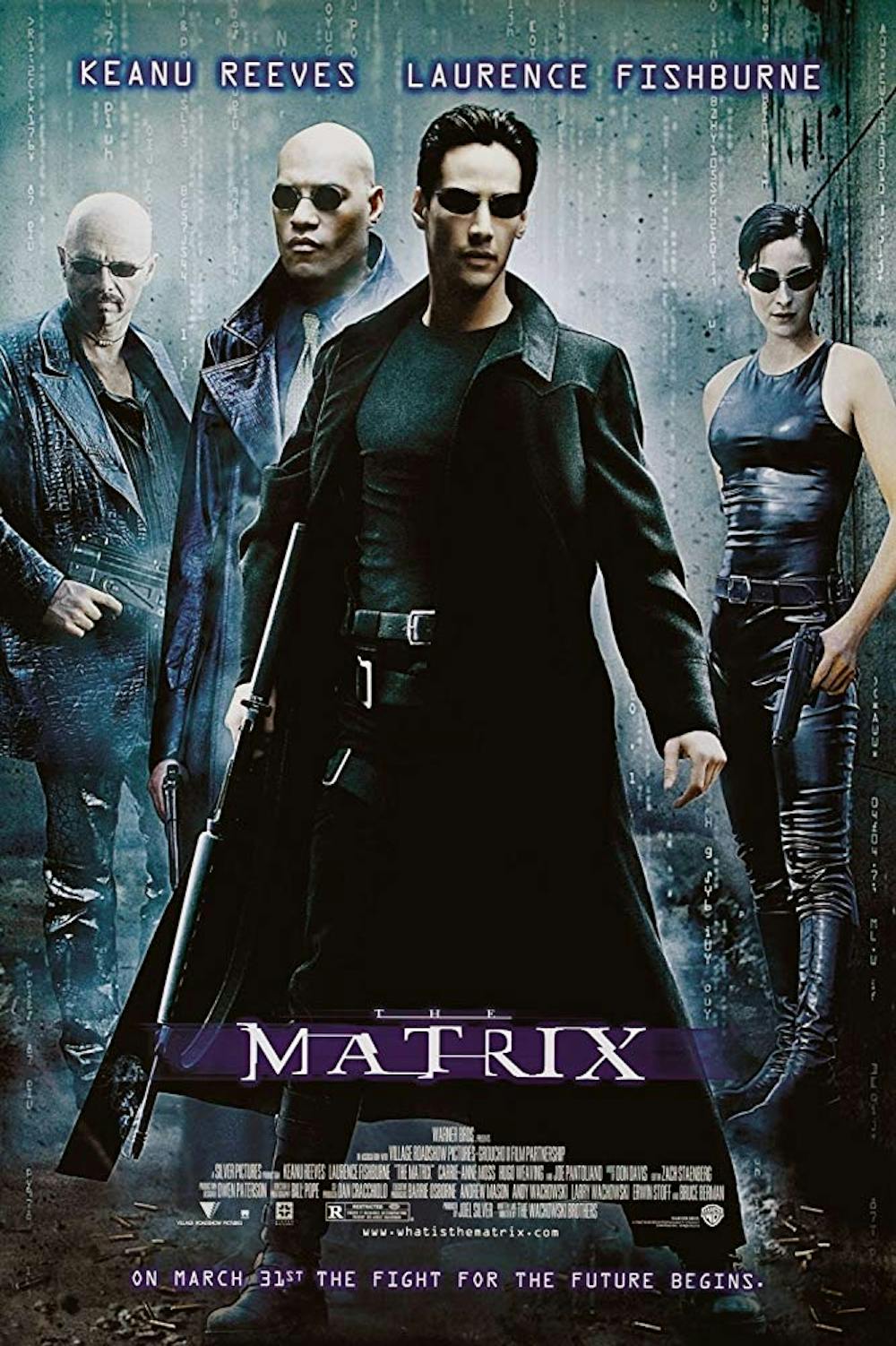
The Matrix was a box office hit, but it also explored some of western philosophy’s most interesting themes.
HD Wallpapers Desktop/Warner Bros

Richard Colledge, Australian Catholic University

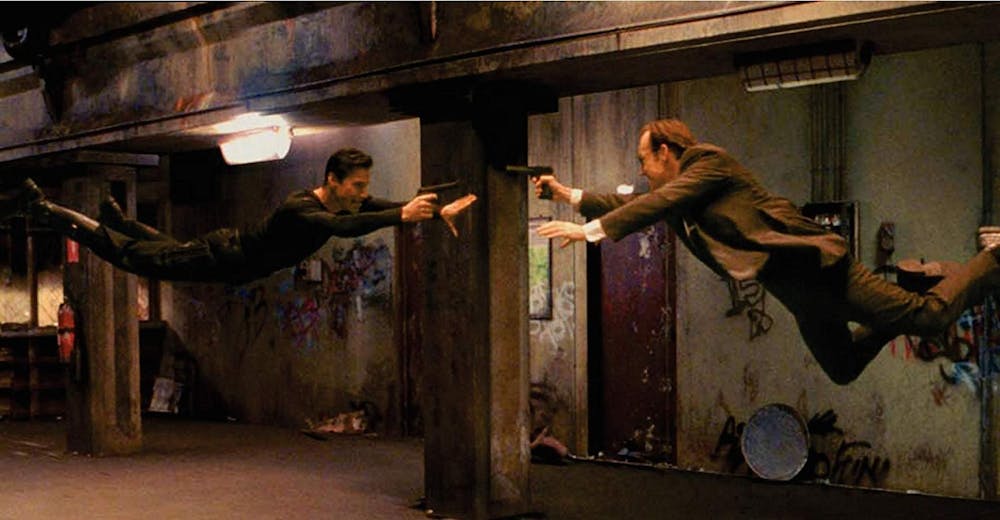
Incredible as it may seem, the end of March marks 20 years since the release of the first film in the Matrix franchise directed by The Wachowski siblings. This “cyberpunk” sci-fi movie was a box office hit with its dystopian futuristic vision, distinctive fashion sense, and slick, innovative action sequences. But it was also a catalyst for popular discussion around some very big philosophical themes.

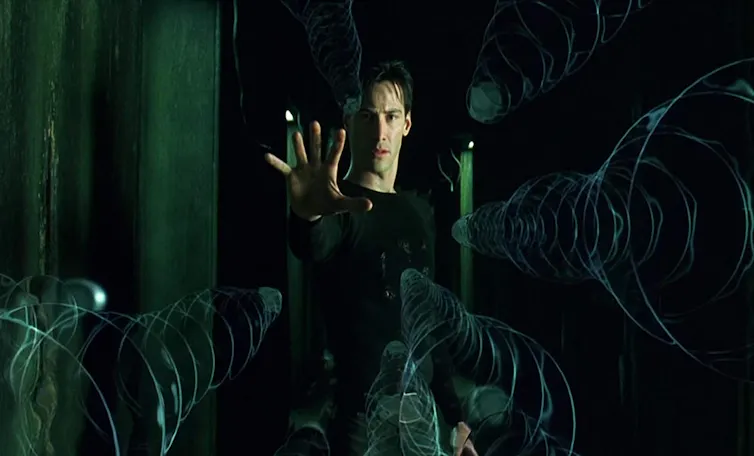
The film centres on a computer hacker, “Neo” (played by Keanu Reeves), who learns that his whole life has been lived within an elaborate, simulated reality. This computer-generated dream world was designed by an artificial intelligence of human creation, which industrially farms human bodies for energy while distracting them via a relatively pleasant parallel reality called the “matrix”.

‘Have you ever had a dream, Neo, that you were so sure was real?’

This scenario recalls one of western philosophy’s most enduring thought experiments. In a famous passage from Plato’s Republic (ca 380 BCE), Plato has us imagine the human condition as being like a group of prisoners who have lived their lives underground and shackled, so that their experience of reality is limited to shadows projected onto their cave wall.


Read more:
The great movie scenes: The Matrix and bullet-time


A freed prisoner, Plato suggests, would be startled to discover the truth about reality, and blinded by the brilliance of the sun. Should he return below, his companions would have no means to understand what he has experienced and surely think him mad. Leaving the captivity of ignorance is difficult.

In The Matrix, Neo is freed by rebel leader Morpheus (ironically, the name of the Greek God of sleep) by being awoken to real life for the first time. But unlike Plato’s prisoner, who discovers the “higher” reality beyond his cave, the world that awaits Neo is both desolate and horrifying.

Our Fallible Senses
The Matrix also trades on more recent philosophical questions famously posed by the 17th century Frenchman René Descartes, concerning our inability to be certain about the evidence of our senses, and our capacity to know anything definite about the world as it really is.

Descartes even noted the difficulty of being certain that human experience is not the result of either a dream or a malevolent systematic deception.

The latter scenario was updated in philosopher Hilary Putnam’s 1981 “brain in a vat” thought experiment, which imagines a scientist electrically manipulating a brain to induce sensations of normal life.


Read more:
How do you know you’re not living in a computer simulation?


So ultimately, then, what is reality? The late 20th century French thinker Jean Baudrillard, whose book appears briefly (with an ironic touch) early in the film, wrote extensively on the ways in which contemporary mass society generates sophisticated imitations of reality that become so realistic they are mistaken for reality itself (like mistaking the map for the landscape, or the portrait for the person).
Of course, there is no need for a matrix-like AI conspiracy to achieve this. We see it now, perhaps even more intensely than 20 years ago, in the dominance of “reality TV” and curated identities of social media.

In some respects, the film appears to be reaching for a view close to that of the 18th century German philosopher, Immanuel Kant, who insisted that our senses do not simply copy the world; rather, reality conforms to the terms of our perception. We only ever experience the world as it is available through the partial spectrum of our senses.

The Ethics of Freedom

Ultimately, the Matrix trilogy proclaims that free individuals can change the future. But how should that freedom be exercised?

This dilemma is unfolded in the first film’s increasingly notorious red/blue pill scene, which raises the ethics of belief. Neo’s choice is to embrace either the “really real” (as exemplified by the red pill he is offered by Morpheus) or to return to his more normal “reality” (via the blue one).

This quandary was captured in a 1974 thought experiment by American philosopher, Robert Nozick. Given an “experience machine” capable of providing whatever experiences we desire, in a way indistinguishable from “real” ones, should we stubbornly prefer the truth of reality? Or can we feel free to reside within comfortable illusion?


Read more:
Why virtual reality cannot match the real thing


In The Matrix we see the rebels resolutely rejecting the comforts of the matrix, preferring grim reality. But we also see the rebel traitor Cypher (Joe Pantoliano) desperately seeking reinsertion into pleasant simulated reality. “Ignorance is bliss,” he affirms.

The film’s chief villain, Agent Smith (Hugo Weaving), darkly notes that unlike other mammals, (western) humanity insatiably consumes natural resources. The matrix, he suggests, is a “cure” for this human “contagion”.

We have heard much about the potential perils of AI, but perhaps there is something in Agent Smith’s accusation. In raising this tension, The Matrix still strikes a nerve – especially after 20 further years of insatiable consumption.The Conversation

Richard Colledge, Senior Lecturer & Head of School of Philosophy, Australian Catholic University

This article is republished from The Conversation under a Creative Commons license. Read the original article.

A Philosophical Approach to Routines can Illuminate Who We Really Are

Elias Anttila | Aeon Ideas

There are hundreds of things we do – repeatedly, routinely – every day. We wake up, check our phones, eat our meals, brush our teeth, do our jobs, satisfy our addictions. In recent years, such habitual actions have become an arena for self-improvement: bookshelves are saturated with bestsellers about ‘life hacks’, ‘life design’ and how to ‘gamify’ our long-term projects, promising everything from enhanced productivity to a healthier diet and huge fortunes. These guides vary in scientific accuracy, but they tend to depict habits as routines that follow a repeated sequence of behaviours, into which we can intervene to set ourselves on a more desirable track.

The problem is that this account has been bleached of much of its historical richness. Today’s self-help books have in fact inherited a highly contingent version of habit – specifically, one that arises in the work of early 20th-century psychologists such as B F Skinner, Clark Hull, John B Watson and Ivan Pavlov. These thinkers are associated with behaviourism, an approach to psychology that prioritises observable, stimulus-response reactions over the role of inner feelings or thoughts. The behaviourists defined habits in a narrow, individualistic sense; they believed that people were conditioned to respond automatically to certain cues, which produced repeated cycles of action and reward.

The behaviourist image of habit has since been updated in light of contemporary neuroscience. For example, the fact that the brain is plastic and changeable allows habits to inscribe themselves in our neural wiring over time by forming privileged connections between brain regions. The influence of behaviourism has enabled researchers to study habits quantitatively and rigorously. But it has also bequeathed a flattened notion of habit that overlooks the concept’s wider philosophical implications.

Philosophers used to look at habits as ways of contemplating who we are, what it means to have faith, and why our daily routines reveal something about the world at large. In his Nicomachean Ethics, Aristotle uses the terms hexis and ethos – both translated today as ‘habit’ – to study stable qualities in people and things, especially regarding their morals and intellect. Hexis denotes the lasting characteristics of a person or thing, like the smoothness of a table or the kindness of a friend, which can guide our actions and emotions. A hexis is a characteristic, capacity or disposition that one ‘owns’; its etymology is the Greek word ekhein, the term for ownership. For Aristotle, a person’s character is ultimately a sum of their hexeis (plural).

An ethos, on the other hand, is what allows one to develop hexeis. It is both a way of life and the basic calibre of one’s personality. Ethos is what gives rise to the essential principles that help to guide moral and intellectual development. Honing hexeis out of an ethos thus takes both time and practice. This version of habit fits with the tenor of ancient Greek philosophy, which often emphasised the cultivation of virtue as a path to the ethical life.

Millennia later, in medieval Christian Europe, Aristotle’s hexis was Latinised into habitus. The translation tracks a shift away from the virtue ethics of the Ancients towards Christian morality, by which habit acquired distinctly divine connotations. In the middle ages, Christian ethics moved away from the idea of merely shaping one’s moral dispositions, and proceeded instead from the belief that ethical character was handed down by God. In this way, the desired habitus should become entwined with the exercise of Christian virtue.

The great theologian Thomas Aquinas saw habit as a vital component of spiritual life. According to his Summa Theologica (1265-1274), habitus involved a rational choice, and led the true believer to a sense of faithful freedom. By contrast, Aquinas used consuetudo to refer to the habits we acquire that inhibit this freedom: the irreligious, quotidian routines that do not actively engage with faith. Consuetudo signifies mere association and regularity, whereas habitus conveys sincere thoughtfulness and consciousness of God. Consuetudo is also where we derive the terms ‘custom’ and ‘costume’ – a lineage which suggests that the medievals considered habit to extend beyond single individuals.

For the Enlightenment philosopher David Hume, these ancient and medieval interpretations of habit were far too limiting. Hume conceived of habit via what it empowers and enables us to do as human beings. He came to the conclusion that habit is the ‘cement of the universe’, which all ‘operations of the mind … depend on’. For instance, we might throw a ball in the air and watch it rise and descend to Earth. By habit, we come to associate these actions and perceptions – the movement of our limb, the trajectory of the ball – in a way that eventually lets us grasp the relationship between cause and effect. Causality, for Hume, is little more than habitual association. Likewise language, music, relationships – any skills we use to transform experiences into something that’s useful are built from habits, he believed. Habits are thus crucial instruments that enable us to navigate the world and to understand the principles by which it operates. For Hume, habit is nothing less than the ‘great guide of human life’.

It’s clear that we ought to see habits as more than mere routines, tendencies and ticks. They encompass our identities and ethics; they teach us how to practise our faiths; if Hume is to believed, they do no less than bind the world together. Seeing habits in this new-yet-old way requires a certain conceptual and historical about-face, but this U-turn offers much more than shallow self-help. It should show us that the things we do every day aren’t just routines to be hacked, but windows through which we might glimpse who we truly are.Aeon counter – do not remove

Elias Anttila

This article was originally published at Aeon and has been republished under Creative Commons. Read the original article here.

Ibn Tufayl and the Story of the Feral Child of Philosophy

scholar-in-garden

Album folio fragment with scholar in a garden. Attributed to Muhammad Ali 1610-15. Courtesy Museum of Fine Arts, Boston

Marwa Elshakry & Murad Idris | Aeon Ideas

Ibn Tufayl, a 12th-century Andalusian, fashioned the feral child in philosophy. His story Hayy ibn Yaqzan is the tale of a child raised by a doe on an unnamed Indian Ocean island. Hayy ibn Yaqzan (literally ‘Living Son of Awakeness’) reaches a state of perfect, ecstatic understanding of the world. A meditation on the possibilities (and pitfalls) of the quest for the good life, Hayy offers not one, but two ‘utopias’: a eutopia (εὖ ‘good’, τόπος ‘place’) of the mind in perfect isolation, and an ethical community under the rule of law. Each has a version of human happiness. Ibn Tufayl pits them against each other, but each unfolds ‘no where’ (οὐ ‘not’, τόπος ‘place’) in the world.

Ibn Tufayl begins with a vision of humanity isolated from society and politics. (Modern European political theorists who employed this literary device called it ‘the state of nature’.) He introduces Hayy by speculating about his origin. Whether Hayy was placed in a basket by his mother to sail through the waters of life (like Moses) or born by spontaneous generation on the island is irrelevant, Ibn Tufayl says. His divine station remains the same, as does much of his life, spent in the company only of animals. Later philosophers held that society elevates humanity from its natural animal state to an advanced, civilised one. Ibn Tufayl took a different view. He maintained that humans can be perfected only outside society, through a progress of the soul, not the species.

In contrast to Thomas Hobbes’s view that ‘man is a wolf to man’, Hayy’s island has no wolves. It proves easy enough for him to fend off other creatures by waving sticks at them or donning terrifying costumes of hides and feathers. For Hobbes, the fear of violent death is the origin of the social contract and the apologia for the state; but Hayy’s first encounter with fear of death is when his doe-mother dies. Desperate to revive her, Hayy dissects her heart only to find one of its chambers is empty. The coroner-turned-theologian concludes that what he loved in his mother no longer resides in her body. Death therefore was the first lesson of metaphysics, not politics.

Hayy then observes the island’s plants and animals. He meditates upon the idea of an elemental, ‘vital spirit’ upon discovering fire. Pondering the plurality of matter leads him to conclude that it must originate from a singular, non-corporeal source or First Cause. He notes the perfect motion of the celestial spheres and begins a series of ascetic exercises (such as spinning until dizzy) to emulate this hidden, universal order. By the age of 50, he retreats from the physical world, meditating in his cave until, finally, he attains a state of ecstatic illumination. Reason, for Ibn Tufayl, is thus no absolute guide to Truth.

The difference between Hayy’s ecstatic journeys of the mind and later rationalist political thought is the role of reason. Yet many later modern European commentaries or translations of Hayy confuse this by framing the allegory in terms of reason. In 1671, Edward Pococke entitled his Latin translation The Self-Taught Philosopher: In Which It Is Demonstrated How Human Reason Can Ascend from Contemplation of the Inferior to Knowledge of the Superior. In 1708, Simon Ockley’s English translation was The Improvement of Human Reason, and it too emphasised reason’s capacity to attain ‘knowledge of God’. For Ibn Tufayl, however, true knowledge of God and the world – as a eutopia for the ‘mind’ (or soul) – could come only through perfect contemplative intuition, not absolute rational thought.

This is Ibn Tufayl’s first utopia: an uninhabited island where a feral philosopher retreats to a cave to reach ecstasy through contemplation and withdrawal from the world. Friedrich Nietzsche’s Zarathustra would be impressed: ‘Flee, my friend, into your solitude!’

The rest of the allegory introduces the problem of communal life and a second utopia. After Hayy achieves his perfect condition, an ascetic is shipwrecked on his island. Hayy is surprised to discover another being who so resembles him. Curiosity leads him to befriend the wanderer, Absal. Absal teaches Hayy language, and describes the mores of his own island’s law-abiding people. The two men determine that the islanders’ religion is a lesser version of the Truth that Hayy discovered, shrouded in symbols and parables. Hayy is driven by compassion to teach them the Truth. They travel to Absal’s home.

The encounter is disastrous. Absal’s islanders feel compelled by their ethical principles of hospitality towards foreigners, friendship with Absal, and association with all people to welcome Hayy. But soon Hayy’s constant attempts to preach irritate them. Hayy realises that they are incapable of understanding. They are driven by satisfactions of the body, not the mind. There can be no perfect society because not everyone can achieve a state of perfection in their soul. Illumination is possible only for the select, in accordance with a sacred order, or a hieros archein. (This hierarchy of being and knowing is a fundamental message of neo-Platonism.) Hayy concludes that persuading people away from their ‘natural’ stations would only corrupt them further. The laws that the ‘masses’ venerate, be they revealed or reasoned, he decides, are their only chance to achieve a good life.

The islanders’ ideals – lawfulness, hospitality, friendship, association – might seem reasonable, but these too exist ‘no where’ in the world. Hence their dilemma: either they adhere to these and endure Hayy’s criticisms, or violate them by shunning him. This is a radical critique of the law and its ethical principles: they are normatively necessary for social life yet inherently contradictory and impossible. It’s a sly reproach of political life, one whose bite endures. Like the islanders, we follow principles that can undermine themselves. To be hospitable, we must be open to the stranger who violates hospitality. To be democratic, we must include those who are antidemocratic. To be worldly, our encounters with other people must be opportunities to learn from them, not just about them.

In the end, Hayy returns to his island with Absal, where they enjoy a life of ecstatic contemplation unto death. They abandon the search for a perfect society of laws. Their eutopia is the quest of the mind left unto itself, beyond the imperfections of language, law and ethics – perhaps beyond even life itself.

The islanders offer a less obvious lesson: our ideals and principles undermine themselves, but this is itself necessary for political life. For an island of pure ethics and law is an impossible utopia. Perhaps, like Ibn Tufayl, all we can say on the search for happiness is (quoting Al-Ghazali):

It was – what it was is harder to say.
Think the best, but don’t make me describe it away.

After all, we don’t know what happened to Hayy and Absal after their deaths – or to the islanders after they left.Aeon counter – do not remove

Marwa Elshakry & Murad Idris

This article was originally published at Aeon and has been republished under Creative Commons. Read the original article here.

Climate Strikes: Researcher explains how Young People can Keep up the Momentum

Harriet Thew, University of Leeds

As part of one of the largest environmental protests ever seen, over a million young people went on strike on Friday March 15 2019, calling for more ambitious action on climate change. Inspired by Greta Thunberg, a Swedish school girl who protested outside the Swedish parliament every Friday throughout 2018, young people in over 100 countries left their classrooms and took to the streets.

The previous #YouthStrike4Climate on February 15 2019 mobilised over 10,000 young people in over 40 locations in the UK alone. Their marches, chants and signs captured attention and prompted debates regarding the motivations and methods of young strikers. Many were criticised by those in the government and the media for simply wanting an opportunity to miss school.

My PhD research explores youth participation in climate change governance, focusing on the UN climate negotiations. Between 2015 and 2018 I closely studied the Youth Climate Coalition (UKYCC) – a UK based, voluntary, youth-led group of 18 to 29 year olds – which attends the international negotiations and coordinates local and national climate change campaigns.

Members of the UK Youth Climate Coalition protest in London.
Harriet Thew, Author provided

My research shows that young people are mobilised by concern for people and wildlife, fears for the future and anger that climate action is neither sufficiently rapid nor ambitious. Young people need to feel as though they are “doing something” about climate change while politicians dither and scientists release increasingly alarming projections of future climate conditions.

The strikes have helped young activists find like-minded peers and new opportunities to engage. They articulate a collective youth voice, wielding the moral power of young people – a group which society agrees it is supposed to protect. All the same, there are threats to sustaining the movement’s momentum which need to be recognised now.

Challenge misplaced paternalism

The paternalism that gives youth a moral platform is a double-edged sword. Patronising responses from adults in positions of authority, from head teachers to the prime minister, dismiss their scientifically informed concerns and attack the messenger, rather than dealing with the message itself.

You’re too young to understand the complexity of this.

You’ll grow out of these beliefs.

You just want to skip school.

Stay in school and wait your turn to make a difference.

Striking may hurt your future job prospects.

The list goes on …

This frightens some children and young people into silence, but doesn’t address the factors which mobilised them in the first place. These threats are also largely unfounded.


Read more:
Climate change: a climate scientist answers questions from teenagers


To any young person reading this, I want to reassure you, as a university educator, that critical thinking, proactivity and an interest in current affairs are qualities that universities encourage. Over 200 academics signed this open letter – myself included – showing our support for the school strikes.

Don’t ‘grow up’

Growing up is inevitable, but it can cause problems for youth movements. As young people gain experience of climate action and expand their professional networks, they “grow out of” being able to represent youth, often getting jobs to advocate for other groups or causes. While this can be positive for individuals, institutional memory is lost when experienced advocates move on to do other things. This puts youth at a disadvantage in relation to other groups who are better resourced and don’t have a “time limit” in how long they can represent their cause.

Well-established youth organisations, such as Guides and Scouts, whom I have worked with in the past, can use their large networks and professional experience to sustain youth advocacy on climate change, though they lack the resources to do so alone. It would also help for other campaigners to show solidarity with the young strikers, and to recognise youth as an important group in climate change debates. This will give people more opportunity to keep supporting the youth climate movement as they get older.

Grow the climate justice movement

Researching the same group of young people for three years, I have identified a shift in their attitudes over time. As young participants become more involved in the movement, they encounter different types of injustices voiced by other groups. They hear activists sharing stories of the devastating climate impacts already experienced by communities, in places where sea level rise is inundating homes and droughts are killing livestock and causing starvation.

The climate justice movement emphasises how climate change exacerbates racial and economic inequality but frequently overlooks the ways these inequalities intersect with age-based disadvantages. Forgetting that frontline communities contain young people, youth movements in developed countries like the UK begin to question the validity of their intergenerational injustice claims.

Indigenous people often inhabit the frontline of impacts from pollution and climate change.
Rainforest Action Network/Flickr, CC BY-NC

Many feel ashamed for having claimed vulnerability, given their relatively privileged position. Over time, they lose faith in their right to be heard. It would strengthen the entire climate movement if other climate justice campaigners more vocally acknowledged young people as a vulnerable group and shared their platform so that these important voices could better amplify one another.

With my own platform, I would like to say this to the thousands who went on strike. You matter. You have a right to be heard and you shouldn’t be embarrassed to speak out. Have confidence in your message, engage with others but stay true to your principles. Stick together and remember that even when you leave school and enter work – you’re never too old to be a youth advocate.

Click here to subscribe to our climate action newsletter. Climate change is inevitable. Our response to it isn’t.The Conversation

Harriet Thew, PhD Researcher in Climate Change Governance, University of Leeds

This article is republished from The Conversation under a Creative Commons license. Read the original article.

Descartes was Wrong: ‘A Person is a Person through Other Persons’

young-moe

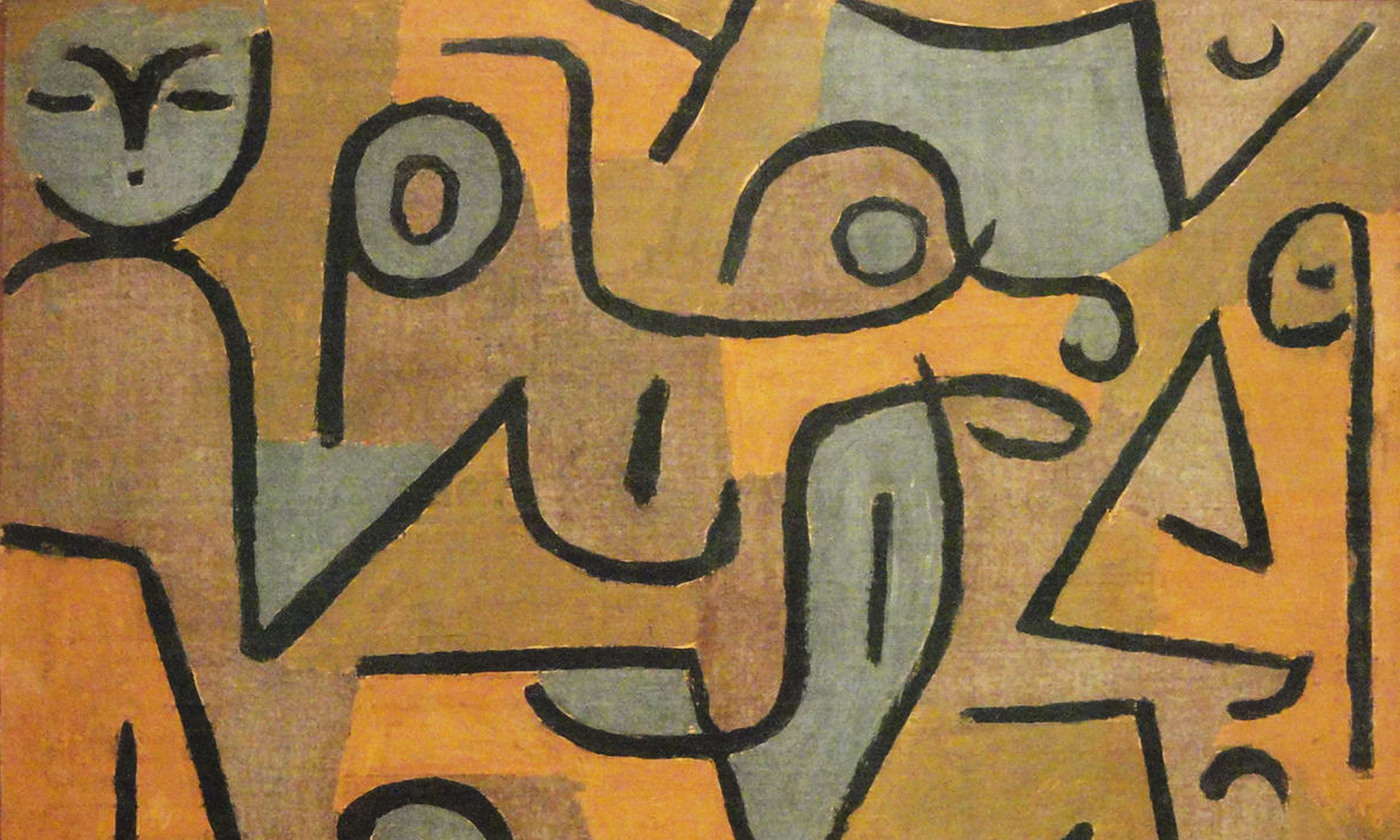
Detail from Young Moe (1938) by Paul Klee. Courtesy Phillips collection/Wikipedia

Abeba Birhane | Aeon Ideas

According to Ubuntu philosophy, which has its origins in ancient Africa, a newborn baby is not a person. People are born without ‘ena’, or selfhood, and instead must acquire it through interactions and experiences over time. So the ‘self’/‘other’ distinction that’s axiomatic in Western philosophy is much blurrier in Ubuntu thought. As the Kenyan-born philosopher John Mbiti put it in African Religions and Philosophy (1975): ‘I am because we are, and since we are, therefore I am.’

We know from everyday experience that a person is partly forged in the crucible of community. Relationships inform self-understanding. Who I am depends on many ‘others’: my family, my friends, my culture, my work colleagues. The self I take grocery shopping, say, differs in her actions and behaviours from the self that talks to my PhD supervisor. Even my most private and personal reflections are entangled with the perspectives and voices of different people, be it those who agree with me, those who criticise, or those who praise me.

Yet the notion of a fluctuating and ambiguous self can be disconcerting. We can chalk up this discomfort, in large part, to René Descartes. The 17th-century French philosopher believed that a human being was essentially self-contained and self-sufficient; an inherently rational, mind-bound subject, who ought to encounter the world outside her head with skepticism. While Descartes didn’t single-handedly create the modern mind, he went a long way towards defining its contours.

Descartes had set himself a very particular puzzle to solve. He wanted to find a stable point of view from which to look on the world without relying on God-decreed wisdoms; a place from which he could discern the permanent structures beneath the changeable phenomena of nature. But Descartes believed that there was a trade-off between certainty and a kind of social, worldly richness. The only thing you can be certain of is your own cogito – the fact that you are thinking. Other people and other things are inherently fickle and erratic. So they must have nothing to do with the basic constitution of the knowing self, which is a necessarily detached, coherent and contemplative whole.

Few respected philosophers and psychologists would identify as strict Cartesian dualists, in the sense of believing that mind and matter are completely separate. But the Cartesian cogito is still everywhere you look. The experimental design of memory testing, for example, tends to proceed from the assumption that it’s possible to draw a sharp distinction between the self and the world. If memory simply lives inside the skull, then it’s perfectly acceptable to remove a person from her everyday environment and relationships, and to test her recall using flashcards or screens in the artificial confines of a lab. A person is considered a standalone entity, irrespective of her surroundings, inscribed in the brain as a series of cognitive processes. Memory must be simply something you have, not something you do within a certain context.

Social psychology purports to examine the relationship between cognition and society. But even then, the investigation often presumes that a collective of Cartesian subjects are the real focus of the enquiry, not selves that co-evolve with others over time. In the 1960s, the American psychologists John Darley and Bibb Latané became interested in the murder of Kitty Genovese, a young white woman who had been stabbed and assaulted on her way home one night in New York. Multiple people had witnessed the crime but none stepped in to prevent it. Darley and Latané designed a series of experiments in which they simulated a crisis, such as an epileptic fit, or smoke billowing in from the next room, to observe what people did. They were the first to identify the so-called ‘bystander effect’, in which people seem to respond more slowly to someone in distress if others are around.

Darley and Latané suggested that this might come from a ‘diffusion of responsibility’, in which the obligation to react is diluted across a bigger group of people. But as the American psychologist Frances Cherry argued in The Stubborn Particulars of Social Psychology: Essays on the Research Process (1995), this numerical approach wipes away vital contextual information that might help to understand people’s real motives. Genovese’s murder had to be seen against a backdrop in which violence against women was not taken seriously, Cherry said, and in which people were reluctant to step into what might have been a domestic dispute. Moreover, the murder of a poor black woman would have attracted far less subsequent media interest. But Darley and Latané’s focus make structural factors much harder to see.

Is there a way of reconciling these two accounts of the self – the relational, world-embracing version, and the autonomous, inward one? The 20th-century Russian philosopher Mikhail Bakhtin believed that the answer lay in dialogue. We need others in order to evaluate our own existence and construct a coherent self-image. Think of that luminous moment when a poet captures something you’d felt but had never articulated; or when you’d struggled to summarise your thoughts, but they crystallised in conversation with a friend. Bakhtin believed that it was only through an encounter with another person that you could come to appreciate your own unique perspective and see yourself as a whole entity. By ‘looking through the screen of the other’s soul,’ he wrote, ‘I vivify my exterior.’ Selfhood and knowledge are evolving and dynamic; the self is never finished – it is an open book.

So reality is not simply out there, waiting to be uncovered. ‘Truth is not born nor is it to be found inside the head of an individual person, it is born between people collectively searching for truth, in the process of their dialogic interaction,’ Bakhtin wrote in Problems of Dostoevsky’s Poetics (1929). Nothing simply is itself, outside the matrix of relationships in which it appears. Instead, being is an act or event that must happen in the space between the self and the world.

Accepting that others are vital to our self-perception is a corrective to the limitations of the Cartesian view. Consider two different models of child psychology. Jean Piaget’s theory of cognitive development conceives of individual growth in a Cartesian fashion, as the reorganisation of mental processes. The developing child is depicted as a lone learner – an inventive scientist, struggling independently to make sense of the world. By contrast, ‘dialogical’ theories, brought to life in experiments such as Lisa Freund’s ‘doll house study’ from 1990, emphasise interactions between the child and the adult who can provide ‘scaffolding’ for how she understands the world.

A grimmer example might be solitary confinement in prisons. The punishment was originally designed to encourage introspection: to turn the prisoner’s thoughts inward, to prompt her to reflect on her crimes, and to eventually help her return to society as a morally cleansed citizen. A perfect policy for the reform of Cartesian individuals. But, in fact, studies of such prisoners suggest that their sense of self dissolves if they are punished this way for long enough. Prisoners tend to suffer profound physical and psychological difficulties, such as confusion, anxiety, insomnia, feelings of inadequacy, and a distorted sense of time. Deprived of contact and interaction – the external perspective needed to consummate and sustain a coherent self-image – a person risks disappearing into non-existence.

The emerging fields of embodied and enactive cognition have started to take dialogic models of the self more seriously. But for the most part, scientific psychology is only too willing to adopt individualistic Cartesian assumptions that cut away the webbing that ties the self to others. There is a Zulu phrase, ‘Umuntu ngumuntu ngabantu’, which means ‘A person is a person through other persons.’ This is a richer and better account, I think, than ‘I think, therefore I am.’Aeon counter – do not remove

Abeba Birhane

This article was originally published at Aeon and has been republished under Creative Commons. Read the original article here.

Do you have a Self-Actualised Personality? Maslow Revisited

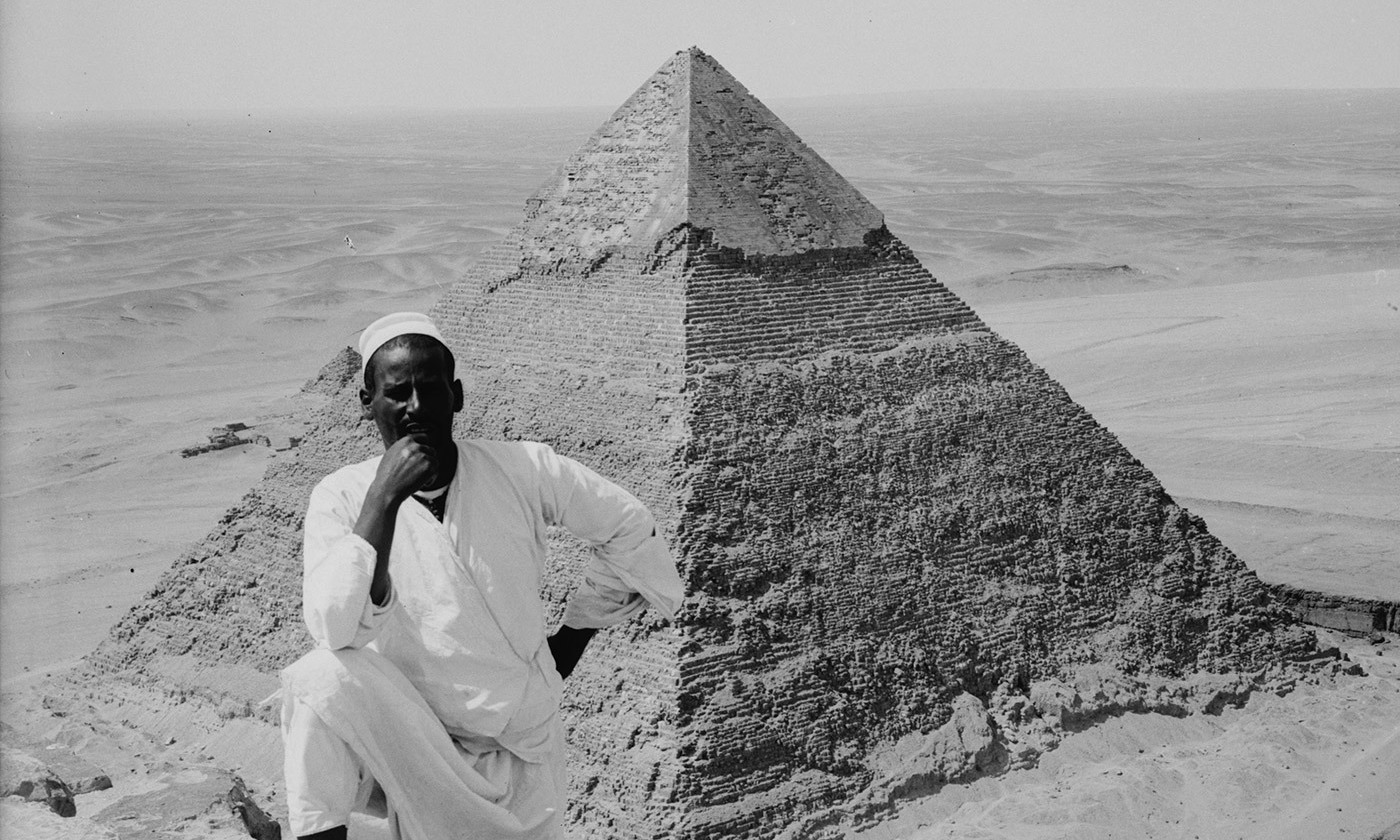
pyramids

View of the second Pyramid from the top of the Great Pyramid. Photo courtesy of the Library of Congress

Christian Jarrett | Aeon Ideas

Abraham Maslow was the 20th-century American psychologist best-known for explaining motivation through his hierarchy of needs, which he represented in a pyramid. At the base, our physiological needs include food, water, warmth and rest. Moving up the ladder, Maslow mentions safety, love, and self-esteem and accomplishment. But after all those have been satisfied, the motivating factor at the top of the pyramid involves striving to achieve our full potential and satisfy creative goals. As one of the founders of humanistic psychology, Maslow proposed that the path to self-transcendence and, ultimately, greater compassion for all of humanity requires the ‘self-actualisation’ at the top of his pyramid – fulfilling your true potential, and becoming your authentic self.

Now Scott Barry Kaufman, a psychologist at Barnard College, Columbia University, believes it is time to revive the concept, and link it with contemporary psychological theory. ‘We live in times of increasing divides, selfish concerns, and individualistic pursuits of power,’ Kaufman wrote recently in a blog in Scientific American introducing his new research. He hopes that rediscovering the principles of self-actualisation might be just the tonic that the modern world is crying out for. To this end, he’s used modern statistical methods to create a test of self-actualisation or, more specifically, of the 10 characteristics exhibited by self-actualised people, and it was recently published in the Journal of Humanistic Psychology.

Kaufman first surveyed online participants using 17 characteristics Maslow believed were shared by self-actualised people. Kaufman found that seven of these were redundant or irrelevant and did not correlate with others, leaving 10 key characteristics of self-actualisation.

Next, he reworded some of Maslow’s original language and labelling to compile a modern 30-item questionnaire featuring three items tapping each of these 10 remaining characteristics: continued freshness of appreciation; acceptance; authenticity; equanimity; purpose; efficient perception of reality; humanitarianism; peak experiences; good moral intuition; and creative spirit (see the full questionnaire below, and take the test on Kaufman’s website).

So what did Kaufman report? In a survey of more than 500 people on Amazon’s Mechanical Turk website, Kaufman found that scores on each of these 10 characteristics tended to correlate, but also that they each made a unique contribution to a unifying factor of self-actualisation – suggesting that this is a valid concept comprised of 10 subtraits.

Participants’ total scores on the test also correlated with their scores on the main five personality traits (that is, with higher extraversion, agreeableness, emotional stability, openness and conscientiousness) and with the metatrait of ‘stability’, indicative of an ability to avoid impulses in the pursuit of one’s goals. That the new test corresponded in this way with established personality measures provides further evidence of its validity.

Next, Kaufman turned to modern theories of wellbeing, such as self-determination theory, to see if people’s scores on his self-actualisation scale correlated with these contemporary measures. Sure enough, he found that people with more characteristics of self-actualisation also tended to score higher on curiosity, life-satisfaction, self-acceptance, personal growth and autonomy, among other factors – just as Maslow would have predicted.

‘Taken together, this total pattern of data supports Maslow’s contention that self-actualised individuals are more motivated by growth and exploration than by fulfilling deficiencies in basic needs,’ Kaufman writes. He adds that the new empirical support for Maslow’s ideas is ‘quite remarkable’ given that Maslow put them together with ‘a paucity of actual evidence’.

A criticism often levelled at Maslow’s notion of self-actualisation is that its pursuit encourages an egocentric focus on one’s own goals and needs. However, Maslow always contended that it is only through becoming our true, authentic selves that we can transcend the self and look outward with compassion to the rest of humanity. Kaufman explored this too, and found that higher scorers on his self-actualisation scale tended also to score higher on feelings of oneness with the world, but not on decreased self-salience, a sense of independence and bias toward information relevant to oneself. (These are the two main factors in a modern measure of self-transcendence developed by the psychologist David Yaden at the University of Pennsylvania.)

Kaufman said that this last finding supports ‘Maslow’s contention that self-actualising individuals are able to paradoxically merge with a common humanity while at the same time able to maintain a strong identity and sense of self’.

Where the new data contradicts Maslow is on the demographic factors that correlate with characteristics of self-actualisation – he thought that self-actualisation was rare and almost impossible for young people. Kaufman, by contrast, found scores on his new scale to be normally distributed through his sample (that is, spread evenly like height or weight) and unrelated to factors such as age, gender and educational attainment (although, in personal correspondence, Kaufman informs me that newer data – more than 3,000 people have since taken the new test – is showing a small, but statistically significant association between older age and having more characteristics of self-actualisation).

In conclusion, Kaufman writes that: ‘[H]opefully the current study … brings Maslow’s motivational framework and the central personality characteristics described by the founding humanistic psychologists, into the 21st century.’

The new test is sure to reinvigorate Maslow’s ideas, but if this is to help heal our divided world, then the characteristics required for self-actualisation, rather than being a permanent feature of our personalities, must be something we can develop deliberately. I put this point to Kaufman and he is optimistic. ‘I think there is significant room to develop these characteristics [by changing your habits],’ he told me. ‘A good way to start with that,’ he added, ‘is by first identifying where you stand on those characteristics and assessing your weakest links. Capitalise on your highest characteristics but also don’t forget to intentionally be mindful about what might be blocking your self-actualisation … Identify your patterns and make a concerted effort to change. I do think it’s possible with conscientiousness and willpower.’

Christian Jarrett

This article was originally published at Aeon and has been republished under Creative Commons. Read the original article here.

The Concept of Probability is not as Simple as You Think

probability

Phil Long/Flickr

Nevin Climenhaga | Aeon Ideas

The gambler, the quantum physicist and the juror all reason about probabilities: the probability of winning, of a radioactive atom decaying, of a defendant’s guilt. But despite their ubiquity, experts dispute just what probabilities are. This leads to disagreements on how to reason about, and with, probabilities – disagreements that our cognitive biases can exacerbate, such as our tendency to ignore evidence that runs counter to a hypothesis we favour. Clarifying the nature of probability, then, can help to improve our reasoning.

Three popular theories analyse probabilities as either frequencies, propensities or degrees of belief. Suppose I tell you that a coin has a 50 per cent probability of landing heads up. These theories, respectively, say that this is:

  • The frequency with which that coin lands heads;
  • The propensity, or tendency, that the coin’s physical characteristics give it to land heads;
  • How confident I am that it lands heads.

But each of these interpretations faces problems. Consider the following case:

Adam flips a fair coin that self-destructs after being tossed four times. Adam’s friends Beth, Charles and Dave are present, but blindfolded. After the fourth flip, Beth says: ‘The probability that the coin landed heads the first time is 50 per cent.’

Adam then tells his friends that the coin landed heads three times out of four. Charles says: ‘The probability that the coin landed heads the first time is 75 per cent.’

Dave, despite having the same information as Charles, says: ‘I disagree. The probability that the coin landed heads the first time is 60 per cent.’

The frequency interpretation struggles with Beth’s assertion. The frequency with which the coin lands heads is three out of four, and it can never be tossed again. Still, it seems that Beth was right: the probability that the coin landed heads the first time is 50 per cent.

Meanwhile, the propensity interpretation falters on Charles’s assertion. Since the coin is fair, it had an equal propensity to land heads or tails. Yet Charles also seems right to say that the probability that the coin landed heads the first time is 75 per cent.

The confidence interpretation makes sense of the first two assertions, holding that they express Beth and Charles’s confidence that the coin landed heads. But consider Dave’s assertion. When Dave says that the probability that the coin landed heads is 60 per cent, he says something false. But if Dave really is 60 per cent confident that the coin landed heads, then on the confidence interpretation, he has said something true – he has truly reported how certain he is.

Some philosophers think that such cases support a pluralistic approach in which there are multiple kinds of probabilities. My own view is that we should adopt a fourth interpretation – a degree-of-support interpretation.

Here, probabilities are understood as relations of evidential support between propositions. ‘The probability of X given Y’ is the degree to which Y supports the truth of X. When we speak of ‘the probability of X’ on its own, this is shorthand for the probability of X conditional on any background information we have. When Beth says that there is a 50 per cent probability that the coin landed heads, she means that this is the probability that it lands heads conditional on the information that it was tossed and some information about its construction (for example, it being symmetrical).

Relative to different information, however, the proposition that the coin landed heads has a different probability. When Charles says that there is a 75 per cent probability that the coin landed heads, he means this is the probability that it landed heads relative to the information that three of four tosses landed heads. Meanwhile, Dave says there is a 60 per cent probability that the coin landed heads, relative to this same information – but since this information in fact supports heads more strongly than 60 per cent, what Dave says is false.

The degree-of-support interpretation incorporates what’s right about each of our first three approaches while correcting their problems. It captures the connection between probabilities and degrees of confidence. It does this not by identifying them – instead, it takes degrees of belief to be rationally constrained by degrees of support. The reason I should be 50 per cent confident that a coin lands heads, if all I know about it is that it is symmetrical, is because this is the degree to which my evidence supports this hypothesis.

Similarly, the degree-of-support interpretation allows the information that the coin landed heads with a 75 per cent frequency to make it 75 per cent probable that it landed heads on any particular toss. It captures the connection between frequencies and probabilities but, unlike the frequency interpretation, it denies that frequencies and probabilities are the same thing. Instead, probabilities sometimes relate claims about frequencies to claims about specific individuals.

Finally, the degree-of-support interpretation analyses the propensity of the coin to land heads as a relation between, on the one hand, propositions about the construction of the coin and, on the other, the proposition that it lands heads. That is, it concerns the degree to which the coin’s construction predicts the coin’s behaviour. More generally, propensities link claims about causes and claims about effects – eg, a description of an atom’s intrinsic characteristics and the hypothesis that it decays.

Because they turn probabilities into different kinds of entities, our four theories offer divergent advice on how to figure out the values of probabilities. The first three interpretations (frequency, propensity and confidence) try to make probabilities things we can observe – through counting, experimentation or introspection. By contrast, degrees of support seem to be what philosophers call ‘abstract entities’ – neither in the world nor in our minds. While we know that a coin is symmetrical by observation, we know that the proposition ‘this coin is symmetrical’ supports the propositions ‘this coin lands heads’ and ‘this coin lands tails’ to equal degrees in the same way we know that ‘this coin lands heads’ entails ‘this coin lands heads or tails’: by thinking.

But a skeptic might point out that coin tosses are easy. Suppose we’re on a jury. How are we supposed to figure out the probability that the defendant committed the murder, so as to see whether there can be reasonable doubt about his guilt?

Answer: think more. First, ask: what is our evidence? What we want to figure out is how strongly this evidence supports the hypothesis that the defendant is guilty. Perhaps our salient evidence is that the defendant’s fingerprints are on the gun used to kill the victim.

Then, ask: can we use the mathematical rules of probability to break down the probability of our hypothesis in light of the evidence into more tractable probabilities? Here we are concerned with the probability of a cause (the defendant committing the murder) given an effect (his fingerprints being on the murder weapon). Bayes’s theorem lets us calculate this as a function of three further probabilities: the prior probability of the cause, the probability of the effect given this cause, and the probability of the effect without this cause.

Since this is all relative to any background information we have, the first probability (of the cause) is informed by what we know about the defendant’s motives, means and opportunity. We can get a handle on the third probability (of the effect without the cause) by breaking down the possibility that the defendant is innocent into other possible causes of the victim’s death, and asking how probable each is, and how probable they make it that the defendant’s fingerprints would be on the gun. We will eventually reach probabilities that we cannot break down any further. At this point, we might search for general principles to guide our assignments of probabilities, or we might rely on intuitive judgments, as we do in the coin cases.

When we are reasoning about criminals rather than coins, this process is unlikely to lead to convergence on precise probabilities. But there’s no alternative. We can’t resolve disagreements about how much the information we possess supports a hypothesis just by gathering more information. Instead, we can make progress only by way of philosophical reflection on the space of possibilities, the information we have, and how strongly it supports some possibilities over others.Aeon counter – do not remove

Nevin Climenhaga

This article was originally published at Aeon and has been republished under Creative Commons. Read the original article here.

Why the Demoniac Stayed in his Comfortable Corner of Hell

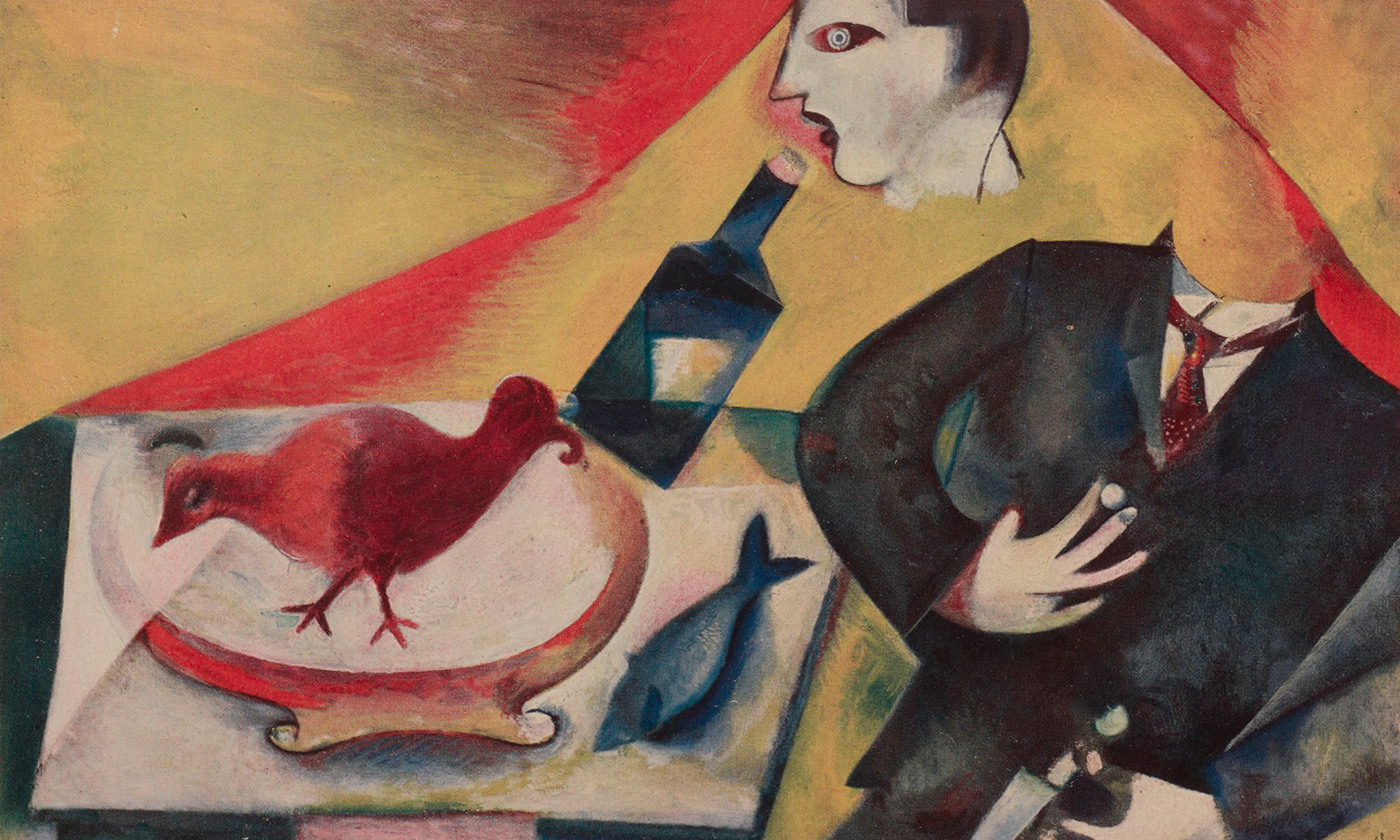
the-drunkard

Detail from The Drunkard (1912) by Marc Chagall. Courtesy Wikipedia

John Kaag | Aeon Ideas

I am not what one might call a religious man. I went to church, and then to confirmation class, under duress. My mother, whom I secretly regarded as more powerful than God, insisted that I go. So I went. Her insistence, however, had the unintended consequence of introducing me to a pastor whom I came to despise. So I eventually quit.

There were many problems with this pastor but the one that bothered me the most was his refusal to explain a story from the New Testament that I found especially hard to believe: the story of the demoniac.

This story from Mark 5:1-20 relates how Jesus and the disciples go to the town of Gerasenes and there encounter a man who is possessed by evil spirits. This demoniac – a self-imposed outcast from society – lived at the outskirts of town and ‘night and day among the tombs and in the hills he would cry out and cut himself with stones’. The grossest part of the story, however, isn’t the self-mutilation. It’s the demoniac’s insane refusal to accept help. When Jesus approached him, the demoniac threw himself to the ground and wailed: ‘What do you want with me? … In God’s name, don’t torture me!’ When you’re possessed by evil spirits, the worst thing in the world is to be healed. In short, the demoniac tells Jesus to bugger off, to leave him and his sharp little stones in his comfortable corner of hell.

When I first read about the demoniac, I was admittedly scared, but I eventually convinced myself that the parable was a manipulative attempt to persuade unbelievers such as me to find religion. And I wasn’t buying it. But when I entered university, went into philosophy, and began to cultivate an agnosticism that one might call atheism, I discovered that many a philosopher had been drawn to this scary story. So I took a second look.

The Danish philosopher Søren Kierkegaard, who spent years analysing the psychological and ethical dimensions of the demoniac, tells us that being demonic is more common than we might like to admit. He points out that when Jesus heals the possessed man, the spirits are exorcised en masse, flying out together as ‘the Legion’ – a vast army of evil forces. There are more than enough little demons to go around, and this explains why they come to roust in some rather mundane places. In Kierkegaard’s words: ‘One may hear the drunkard say: “Let me be the filth that I am.”’ Or, leave me alone with my bottle and let me ruin my life, thank you very much. I heard this first from my father, and then from an increasing number of close friends, and most recently from a voice that occasionally keeps me up at night when everyone else is asleep.

Those who are the most pointedly afflicted are often precisely those who are least able to recognise their affliction, or to save themselves. And those with the resources to rescue themselves are usually already saved. As Kierkegaard suggests, the virtue of sobriety makes perfect sense to one who is already sober. Eating well is second nature to the one who is already healthy; saving money is a no-brainer for one who one is already rich; truth-telling is the good habit of one who is already honest. But for those in the grips of crisis or sin, getting out usually doesn’t make much sense.

Sharp stones can take a variety of forms.

In The Concept of Anxiety (1844), Kierkegaard tells us that the ‘essential nature of [the demoniac] is anxiety about the good’. I’ve been ‘anxious’ about many things – about exams, about spiders, about going to sleep – but Kierkegaard explains that the feeling I have about these nasty things isn’t anxiety at all. It’s fear. Anxiety, on the other hand, has no particular object. It is the sense of uneasiness that one has at the edge of a cliff, or climbing a ladder, or thinking about the prospects of a completely open future – it isn’t fear per se, but the feeling that we get when faced with possibility. It’s the unsettling feeling of freedom. Yes, freedom, that most precious of modern watchwords, is deeply unsettling.

What does this have to do with our demoniac? Everything. Kierkegaard explains that the demoniac reflects ‘an unfreedom that wants to close itself off’; when confronted with the possibility of being healed, he wants nothing to do with it. The free life that Jesus offers is, for the demoniac, pure torture. I’ve often thought that this is the fate of the characters in Jean-Paul Sartre’s play No Exit (1944): they are always free to leave, but leaving seems beyond impossible.

Yet Jesus manages to save the demoniac. And I wanted my pastor to tell me how. At the time, I chalked up most of the miracles from the Bible as exaggeration, or interpretation, or poetic licence. But the healing of the demoniac – unlike the bread and fish and resurrection – seemed really quite fantastic. So how did Jesus do it? I didn’t get a particularly good answer from my pastor, so I left the Church. And never came back.

Today, I still want to know.

I’m not here to explain the salvation of the demoniac. I’m here only to observe, as carefully as I can, that this demonic situation is a problem. Indeed, I suspect it is the problem for many, many readers. The demoniac reflects what theologians call the ‘religious paradox’, namely that it is impossible for fallen human beings – such craven creatures – to bootstrap themselves to heaven. Any redemptive resources at our disposal are probably exactly as botched as we are.

There are many ways to distract ourselves from this paradox – and we are very good at manufacturing them: movies and alcohol and Facebook and all the fixations and obsessions of modern life. But at the end of the day, these are pitifully little comfort.

So this year, as New Year’s Day recedes from memory and the winter darkness remains, I am making a resolution: I will try not to take all the usual escapes. Instead, I will try to simply sit with the plight of the demoniac, to ‘stew in it’ as my mother used to say, for a minute or two more. In his essay ‘Self-will’ (1919), the German author Hermann Hesse put it thus: ‘If you and you … are in pain, if you are sick in body or soul, if you are afraid and have a foreboding of danger – why not, if only to amuse yourselves … try to put the question in another way? Why not ask whether the source of your pain might not be you yourselves?’ I will not reach for my familiar demonic stones, blood-spattered yet comforting. I will ask why I need them in the first place. When I do this, and attempt to come to terms with the demoniac’s underlying suffering, I might notice that it is not unique to me.

When I do, when I let go of the things that I think are going to ease my suffering, I might have the chance to notice that I am not alone in my anxiety. And maybe this is recompense enough. Maybe this is freedom and the best that I can hope for.Aeon counter – do not remove

John Kaag

This article was originally published at Aeon and has been republished under Creative Commons. Read the original article here.

Skateboarding Defies the Neoliberal Logic of the City by making it a Playground for All


Iain Borden, UCL

Skateboarding today is a global phenomenon, with around 50m riders and thousands of skate parks worldwide – it will even feature as a sport in the 2020 Olympic Games. From the full on testosterone of Thrasher skateboard magazine to the fashionable styling of Vogue, the skater girls and boys of Kabul to the Native American reservations of South Dakota, the skate parks of Brazil to the streets of Shenzhen, skateboarding is no longer just for punkish, subcultural rebels – it’s everywhere, for everyone.

Along the way, skateboarders have achieved great things in art, film, photography and DIY skate park construction, and have engaged with important matters of gender, community and professionalism, plus commerce, heritage and social enterprise.

This may come as something of a surprise to those who are mainly familiar with the stereotype of skateboarders as white teenage boys. In fact, a skater today might well be Asian and hipster cool, black and entrepreneurial, female and physically challenged, older and gay – or any other variation imaginable.

Alongside gritty urban streets, new skate terrains have emerged, from DIY constructions, flow bowls and street plazas to longboard parks, multistory wonderlands and hybrid public spaces. Skateboarding’s influence even extends to preservation, heritage, planning and urban politics.

Entering a skate shop, you are as likely to see branded shoes and t-shirts as actual skateboards. Inevitably, big companies are also involved, including the likes of Adidas, Levi’s, New Balance, Nike and Vans.

Many university academics are even now researching skateboarding, from the perspectives of sociology, gender, sexuality, sports professionalism, graphic design, architecture, politics and urbanism. Personally, I’ve been actively researching skateboarding since 1988, culminating in my new book Skateboarding and the City: a Complete History, as well as being an active skateboarder since 1977.

Play over Productivity

Most profound of all is skateboarding’s contribution to city streets and public spaces, for it remains, at heart, an urban activity. While cities are made up of housing, offices, banks, transport, universities and so forth, skateboarding makes use of these buildings without engaging with their productive activities. Freed from the strictures of regimented skate parks and the demands of organised sport, street skateboarders implicitly deny that cities should always be productive or useful.

The kind of skateboarding that rides up the walls of banks, slides down handrails and grinds across plaza ledges, disrupts the economic and functional logic of cities. Instead, skateboarding correlates with Pat Kane’s contention that our dominant work ethic should be accompanied by an equivalent “play ethic”, where play is not just personally pleasurable but also collaborative, creative and politicised.

Here, skateboarding suggests that our lives and cities should be full of mobility, pleasure and joy – and not just of sedentary labour and earnest endeavour. The result is, or should be, a city not of passive shopping malls but of vibrant bodily life.

This, perhaps, is the most overtly political space created by skateboarders: a pleasure ground carved out of the city, as a continuous reaffirmation of one of the central slogans of the 1968 strikes and student protests in Paris: that “sous les pavés, la plage” (beneath the pavement, lies the beach).

Overcoming Obstacles

Today, skateboarding in public spaces is legislated against everywhere from Brisbane and Manchester to Quebec and the Bronx. This accords with a common social fear of teenagers in general, with skaters as young adults being regularly viewed as potential muggers, robbers or worse. As US president George H.W. Bush once said of skateboarders: “Just thank God they don’t have guns” (quoted in Thrasher, March 1992, p.74).

Physical barriers are also put in place to discourage skateboarding. As the homeless are routinely excluded by “defensive architecture” such as odd-shaped benches, spikes on window ledges and sprinklers above doorways, so skaters encounter rough textured surfaces, “skatestopper” blocks, chains and scatterings of gravel, deliberately intended to ruin their run.

Yet skateboarding can be an ideal training ground for entrepreneurs and other model citizens. Skateboarders are constantly learning and inventing new tricks, which demands innovation, risk taking and an ability to learn through failure. Their typical distrust of organisations, teams and routines means they are independent minded, with a sense of personal responsibility.

Skateboarding has provided an experimental space for the likes of video artist Shaun Gladwell, film maker Spike Jonze and photographer Fred Mortagne to hone their creativity (you can find more examples here).

It can also promote community values: the Pushing Boarders events (London 2018 and Malmö 2019) are exploring diversity among skateboarders. As African American skater Karl Watson put it: “The skateboarding community embraces all ways of life, whether you are black or white, old or young – it embraces all people.”


Read more:
How skateboarding flipped its white male image and welcomed the whole world


More positive attitudes towards skateboarding are beginning to emerge, as people become aware of its economic and cultural benefits, and mindful of the need to encourage healthy physical activity among city dwellers of all ages. In cities such as Malmö, London, Brisbane, Rapids City, Coventry and Hull, public recognition for skateboarders has undoubtedly increased in the form of support for skate parks, skateable public spaces, skate-focused schools and city policy.

It seems as though skateboarding is finally being seen in its true light: critical, rebellious, non-conformist – and a dynamic presence in cities around the world.The Conversation

Iain Borden, Professor of Architecture and Urban Culture, UCL

This article is republished from The Conversation under a Creative Commons license. Read the original article.