Enlightenment Failure

Modernity, with its Enlightenment roots and subsequent philosophical developments, brought forth a radical rethinking of metaphysics and ethics. The optimism of reason and progress eventually gave way to an awareness of fragmentation—a disintegration of unified, tradition-based systems of thought. Philosophers such as Alasdair MacIntyre famously critiqued modern ethics for its disconnection from ancient and medieval traditions, and similar critiques can be found in the work of those who examine modern metaphysics. This essay explores how a group of thinkers—Étienne Gilson, David Oderberg, John Milbank, Edward Feser, William Desmond, and Gabriel Marcel—challenge modern philosophical approaches and propose a return to a more integrated, tradition-based understanding of reality and moral life.

Étienne Gilson, a prominent historian of philosophy and a staunch advocate of Thomistic thought, was among the first to articulate a powerful critique of modern metaphysics. He argued that modern philosophy, especially after the Cartesian turn, abandoned the central question of esse—the act of being itself. According to Gilson, Descartes’ emphasis on subjective doubt and the certainty of the cogito led to a fragmentation where metaphysics became an abstract, conceptual exercise detached from the concrete realities of existence. Gilson believed that by neglecting the rich tradition of medieval metaphysics, which saw being as an active, dynamic process imbued with purpose, modern thought had lost its capacity to engage with the true nature of reality. His work calls for a return to a realist framework, one that sees being as participatory and intimately connected to the divine order—a perspective that echoes the later critiques of modern ethics, which lament the loss of a unified moral vision.

In contemporary philosophy, David Oderberg stands out for his vigorous defense of Aristotelian-Thomistic essentialism. Oderberg criticizes modern metaphysical approaches that reject the notion of intrinsic essences and natural kinds, arguing that this rejection has led to a fragmented understanding of identity and purpose. For him, modern metaphysics has become overly reliant on modal logic and abstract reasoning that fails to capture the real, concrete nature of beings. Oderberg contends that the disintegration of metaphysical foundations parallels the breakdown of ethical systems criticized by MacIntyre—both resulting from a neglect of the traditions that once provided coherence and meaning. His call for a return to hylomorphism, the Aristotelian idea that every substance is a composite of matter and form, represents an attempt to restore a more robust framework that acknowledges the inherent order of the natural world.

John Milbank, a leading figure in the Radical Orthodoxy movement, offers a critique of modern metaphysics that is deeply rooted in theological concerns. Milbank argues that the Enlightenment’s secularization of philosophy has led to a dualistic split between the secular and the sacred, thereby impoverishing both metaphysics and ethics. By discarding the theological dimensions that once unified human understanding, modern thought has become a system of isolated and often contradictory ideas. Milbank’s critique extends to modern ethics as well, emphasizing that the loss of a shared, transcendent order has left ethical theories adrift, without the grounding of divine or natural law. His work advocates for a reintegration of theology with philosophy, suggesting that only by reclaiming a pre-modern, unified approach can we hope to overcome the fragmentation that characterizes both modern metaphysics and ethics.

Edward Feser, another prominent contemporary Thomist, directly confronts the legacy of modern metaphysics with a robust defense of scholastic realism. Feser argues that the modern break with Aristotelian thought—initiated by Descartes and furthered by empiricists like Hume and Kant—has led to a metaphysical void where abstract nominalism replaces the richness of realist ontology. In his view, modern metaphysics is marred by its inability to account for essential aspects of being, such as purpose, causality, and the nature of substance. Feser’s critique mirrors that of MacIntyre in ethics: just as modern moral theories have become unmoored from a coherent tradition, so too has modern metaphysics drifted away from the grounding insights of medieval philosophy. His work calls for a return to a framework that recognizes the intrinsic order and teleology of the natural world—a perspective that reaffirms the value of classical metaphysical categories and aligns with a broader, integrated view of human flourishing.

William Desmond contributes to this tradition of critique by focusing on the overly systematic and reductive tendencies of modern metaphysics. Desmond argues that in its quest for rational certainty, modern philosophy has imposed rigid conceptual systems on the world, thereby stripping away the rich, participatory quality of being. He criticizes post-Kantian metaphysics for reducing reality to mere conceptual schemes, neglecting the profound mystery and relational character of existence. For Desmond, the modern approach fails to capture the dynamic interplay between the self and the world—a loss that has profound implications for ethics as well. Without a sense of the mystery and wonder that underlies being, ethical life too becomes a matter of abstract calculation rather than an engaged participation in the fullness of existence. His work, therefore, echoes the calls of other tradition-based thinkers for a return to a metaphysics that is both deeply personal and fundamentally grounded in the concrete reality of life.

Gabriel Marcel occupies a unique position among these critics, bridging existentialism and traditional metaphysics. Unlike the more systematic approaches of Gilson, Oderberg, or Feser, Marcel’s thought is rooted in the lived experience of being. He critiques modern metaphysics for its impersonal and reductionist tendencies, arguing instead for a metaphysics that recognizes the profound mystery inherent in existence. Marcel distinguishes between “problems” and “mysteries.” Modern thought, he contends, treats existence as a series of problems to be solved through rational analysis. In contrast, Marcel insists that true engagement with being requires an acknowledgment of mystery—an openness to the transcendent and the relational aspects of life. His emphasis on participation and communion with being is a direct response to the alienation brought on by Cartesian subjectivity and Kantian formalism. Furthermore, Marcel’s ideas resonate with those of the Thomistic tradition. Like Aquinas, Marcel sees being as inherently relational, where meaning is not something constructed by isolated minds but is discovered in the interconnected web of human experience. This perspective challenges the modern dichotomy between the individual and the world, advocating instead for a vision of existence that is rich in depth, interconnectedness, and transcendence.

The critiques of modern metaphysics and ethics articulated by Gilson, Oderberg, Milbank, Feser, Desmond, and Marcel share a common theme: the modern departure from a tradition-based understanding of reality has led to fragmentation, abstraction, and a loss of meaning. Whether addressing the breakdown of moral systems or the disintegration of metaphysical foundations, these thinkers argue that the modern project has neglected the essential qualities of being—its mystery, relationality, and teleology. Gabriel Marcel’s thought, in particular, serves as a bridge between the existential and the traditional, offering a vision of metaphysics that is not only intellectually rigorous but also deeply connected to the lived experience of hope and communion. Together, these critiques invite a reexamination of modern philosophy, urging us to rediscover the rich, integrated traditions that once provided a coherent account of both the world and our place within it.

In essence, the call is for a philosophical renewal—a return to a perspective where ethics and metaphysics are interwoven with the fabric of human life, each informing and sustaining the other in the quest for truth, meaning, and flourishing.

Radical Love

To live as if the world were already transformed by a love that transcends reason is to embody a vision of existence where love, in its purest, most unconditional form, is the defining force of life. It means living in alignment with the belief that love is the highest, most transcendent reality—not a mere sentiment or emotional response but a transformative power that reaches beyond the confines of human understanding and reasoning. This form of living invites a radical shift in perspective, where the logic of compassion, empathy, and interconnectedness governs one’s actions rather than self-interest, fear, or the desire for control. It challenges us to embody the reality we wish to see, acting as though the world has already been fully enveloped in the love that transcends reason.

At its core, the idea of a love that transcends reason speaks to a love that cannot be fully understood or grasped by human intellect or logic. This love does not operate within the frameworks of judgment, comparison, or calculation. It is not constrained by conditions or the need for reciprocation. It is a love that flows freely, unbound by human limitations, and transcends every boundary we might try to impose on it—be it cultural, philosophical, or theological. To live as if this love already governs the world is to step into a way of being that reflects this love in the most practical and profound ways.

One of the first things to understand about living as though the world were transformed by love is the paradox at the heart of this notion. On the one hand, love that transcends reason suggests something beyond the ordinary, beyond our human understanding of love, something so vast and cosmic that it cannot be fully contained within the limits of human comprehension. On the other hand, this same love is not distant or abstract—it is immanent, here and now, available in every moment, in every interaction, and in every experience.

Living as though the world is already transformed by this love means recognizing the profound mystery of both transcendence and immanence at play. It means seeing every moment as a possibility for connection with a love that is beyond human logic yet present within human relationships, within nature, and within the depths of our own hearts. In this way, love is both the unseen force shaping everything and the tangible expression of grace that we encounter in everyday life. The love that transcends reason is not an external force acting upon us but something that resides within us, something that we can tap into and channel into the world. This means that we are not passive recipients of this love; we are active participants in its unfolding. Every choice we make, every word we speak, every gesture we offer, is a potential act of love that can ripple out and transform the world around us.

To live in this way also means embracing uncertainty and mystery. The love that transcends reason does not fit neatly into systems of logic or comprehension. It invites us to acknowledge that there are many things in life—both personal and cosmic—that we may never fully understand. This doesn’t mean adopting a stance of nihilism or indifference, but rather, it’s a call to surrender the need for absolute answers and embrace the beauty of the unknown. It’s an invitation to trust in the process of life itself and to hold space for mystery rather than trying to force every question into a logical framework. This kind of living requires that we abandon our need for control and embrace the flow of life as it unfolds. It asks us to sit with the discomfort of not knowing and to find peace in that uncertainty.

In practical terms, this might look like approaching life with a sense of wonder, remaining open to the unexpected, and being comfortable with ambiguity. It means not needing everything to make sense or fit into a rational narrative, but instead allowing the complexities and contradictions of life to unfold in their own time and space. To live as if the world were transformed by a love that transcends reason is to trust in the inherent wisdom of life itself, knowing that while our understanding may be limited, the love that surrounds us is boundless and ever-present. This trust in the mystery of life opens us to experiences that transcend logic and invite us into deeper, more authentic relationships with others and with ourselves.

Compassion is one of the most powerful expressions of a love that transcends reason. In a world that often operates on the logic of retribution and justice, choosing to forgive is an act that defies conventional understanding. Forgiveness is not about denying the wrongs committed or absolving others of responsibility, but about releasing the hold that anger, resentment, and hurt have over us. It is an act of freedom—freeing oneself from the chains of bitterness and allowing love to flow where there once was pain. Living as though the world is already transformed by love means choosing radical forgiveness, both for ourselves and for others. It involves letting go of the need to control outcomes or force resolution and instead, allowing grace to enter into even the most broken and painful parts of life. Grace is unearned favor, an expression of love that cannot be earned or justified by merit. It’s the kind of love that, rather than seeking repayment, offers healing without condition. To live with grace is to acknowledge that we are all flawed, all in need of redemption, and that it is through love that we are healed, not through judgment or condemnation. In choosing grace, we step into the realm of possibility where transformation occurs—not through the mechanisms of law or punishment, but through the liberating force of love.

Radical forgiveness does not deny the complexities of the human experience but embraces them fully. It recognizes the depth of pain that often accompanies the act of forgiveness and the courage it takes to choose love in the face of injustice. But it also acknowledges that the power of forgiveness is far more transformative than the perpetuation of cycles of harm and revenge. To forgive, in this sense, is not to erase the past, but to transform it into something that serves our collective healing, rather than our continued suffering. Living in this way, as if the world were already transformed by love, means embracing forgiveness as an act of liberation—liberating both ourselves and others from the cycles of guilt, shame, and resentment that keep us bound to the past.

To live as though the world is already transformed by a love that transcends reason is not to deny the current state of the world but to actively participate in its transformation. It is to recognize that love is the ultimate force for change in the world—not political ideology, economic power, or technological advancement, but love. Love changes hearts, transforms communities, and heals the deepest wounds. It is the force that has the power to break down walls of division, to heal brokenness, and to create new possibilities where once there seemed to be none. Living in alignment with this truth means being agents of love in every sphere of life—whether in our relationships, our work, our activism, or our inner spiritual practice. It means choosing to prioritize love over fear, collaboration over competition, and understanding over judgment. It is a call to make love the center of all our decisions and actions, knowing that as we live with love, we contribute to the collective transformation of the world.

The transformation of the world through love does not happen overnight, nor does it happen without effort. But it begins in the smallest of moments—in the ways we choose to treat others, in the ways we choose to respond to the challenges and injustices we face, and in the ways we open our hearts to the possibility of healing. The love that transcends reason is not a passive force but an active one. It demands that we show up for the world in all its brokenness and beauty, that we hold space for both the pain and the possibility of redemption. It calls us to live as though the world is already transformed, even as we continue to work toward that transformation.

Living as though the world were already transformed by a love that transcends reason is a radical way of being, one that calls us to embrace the deepest mysteries of existence while acting with profound compassion, forgiveness, and grace. It challenges us to trust in the power of love as the ultimate force of transformation and to embody that love in all that we do. This way of life is not about achieving perfection or solving every problem; rather, it is about living in alignment with the deepest truths of our shared humanity and our connection to a love that surpasses human understanding. In doing so, we participate in the ongoing transformation of the world, one act of love at a time. Each choice, each act of kindness, each gesture of forgiveness is a step toward the world that we know is possible—a world where love, not reason, reigns supreme.

Index Librorum Prohibitorum

Remembrance plaque on the Marktplatz in Neustadt an der Weinstrasse, reading: Where they have burned books, they will end in burning human beings. (Heinrich Heine, 1820) In memory of the book burning by the National Socialists on May 14, 1933

Remembrance plaque on the Marktplatz in Neustadt an der Weinstrasse, reading: Where they have burned books, they will end in burning human beings. (Heinrich Heine, 1820) In memory of the book burning by the National Socialists on May 14, 1933


The Index Librorum Prohibitorum (“List of Prohibited Books”) was a list of publications deemed heretical or contrary to morality by the Sacred Congregation of the Index (a former Dicastery of the Roman Curia); Catholics were forbidden to read them.

There were attempts to ban heretical books before the sixteenth century, notably in the ninth-century Decretum Glasianum; the Index of Prohibited Books of 1560 banned thousands of book titles and blacklisted publications, including the works of Europe’s intellectual elites. The 20th and final edition of the Index appeared in 1948; the Index was formally abolished on 14 June 1966 by Pope Paul VI.

The Index condemned religious and secular texts alike, grading works by the degree to which they were seen to be repugnant to the church. The aim of the list was to protect church members from reading theologically, culturally, or politically disruptive books. Such books included works by astronomers, such as Johannes Kepler’s Epitome astronomiae Copernicanae (published in three volumes from 1618 to 1621), which was on the Index from 1621 to 1835; works by philosophers, such as Immanuel Kant’s Critique of Pure Reason (1781); and editions and translations of the Bible that had not been approved. Editions of the Index also contained the rules of the Church relating to the reading, selling, and preemptive censorship of books.

The canon law of the Latin Church still recommends that works should be submitted to the judgment of the local ordinary if they concern sacred scripture, theology, canon law, or church history, religion or morals. The local ordinary consults someone whom he considers competent to give a judgment and, if that person gives the nihil obstat (“nothing forbids”), the local ordinary grants the imprimatur (“let it be printed”). Members of religious institutes require the imprimi potest (“it can be printed”) of their major superior to publish books on matters of religion or morals.

Some of the scientific theories contained in works in early editions of the Index have long been taught at Catholic universities. For example, the general prohibition of books advocating heliocentrism was removed from the Index in 1758, but two Franciscan mathematicians had published an edition of Isaac Newton’s Principia Mathematica (1687) in 1742, with commentaries and a preface stating that the work assumed heliocentrism and could not be explained without it. A work of the Italian Catholic priest and philosopher Antonio Rosmini-Serbati was on the Index, but he was beatified in 2007. Some have argued that the developments since the abolition of the Index signify “the loss of relevance of the Index in the 21st century.”

J. Martínez de Bujanda’s Index Librorum Prohibitorum, 1600–1966 lists the authors and writings in the successive editions of the Index, while Miguel Carvalho Abrantes’s Why Did The Inquisition Ban Certain Books?: A Case Study from Portugal tries to understand why certain books were forbidden based on a Portuguese edition of the Index Librorum Prohibitorum from 1581.

Emperor Constantine and the Council of Nicaea. The burning of Arian books. (Illustration from a compendium of canon law, ca. 825, MS. in the Capitular Library, Vercelli)

Emperor Constantine and the Council of Nicaea. The burning of Arian books. (Illustration from a compendium of canon law, ca. 825, MS. in the Capitular Library, Vercelli)

European Restrictions on the Right to Print

The historical context in which the Index appeared involved the early restrictions on printing in Europe. The refinement of moveable type and the printing press by Johannes Gutenberg circa 1440 changed the nature of book publishing, and the mechanism by which information could be disseminated to the public. Books, once rare and kept carefully in a small number of libraries, could be mass-produced and widely disseminated.

In the 16th century, both the churches and governments in most European countries attempted to regulate and control printing because it allowed for rapid and widespread circulation of ideas and information. The Protestant Reformation generated large quantities of polemical new writing by and within both the Catholic and Protestant camps, and religious subject-matter was typically the area most subject to control. While governments and church encouraged printing in many ways, which allowed the dissemination of Bibles and government information, works of dissent and criticism could also circulate rapidly. As a consequence, governments established controls over printers across Europe, requiring them to have official licenses to trade and produce books.

The early versions of the Index began to appear from 1529 to 1571. In the same time frame, in 1557 the English Crown aimed to stem the flow of dissent by chartering the Stationers’ Company. The right to print was restricted to the two universities (Oxford and Cambridge) and to the 21 existing printers in the city of London, which had between them 53 printing presses.

The French crown also tightly controlled printing, and the printer and writer Etienne Dolet was burned at the stake for atheism in 1546. The 1551 Edict of Châteaubriant comprehensively summarized censorship positions to date, and included provisions for unpacking and inspecting all books brought into France. The 1557 Edict of Compiègne applied the death penalty to heretics and resulted in the burning of a noblewoman at the stake. Printers were viewed as radical and rebellious, with 800 authors, printers and book dealers being incarcerated in the Bastille. At times, the prohibitions of church and state followed each other, e.g. René Descartes was placed on the Index in the 1660s and the French government prohibited the teaching of Cartesianism in schools in the 1670s.

The Copyright Act 1710 in Britain, and later copyright laws in France, eased this situation. Historian Eckhard Höffner claims that copyright laws and their restrictions acted as a barrier to progress in those countries for over a century, since British publishers could print valuable knowledge in limited quantities for the sake of profit. The German economy prospered in the same time frame since there were no restrictions.

Early Indices (1529–1571)

The first list of the kind was not published in Rome, but in Catholic Netherlands (1529); Venice (1543) and Paris (1551) under the terms of the Edict of Châteaubriant followed this example. By mid-century, in the tense atmosphere of wars of religion in Germany and France, both Protestant and Catholic authorities reasoned that only control of the press, including a catalog of prohibited works, coordinated by ecclesiastic and governmental authorities, could prevent the spread of heresy.

Paul F. Grendler (1975) discusses the religious and political climate in Venice from 1540 to 1605. There were many attempts to censor the Venetian press, which at that time was one of the largest concentrations of printers. Both church and government held to a belief in censorship, but the publishers continually pushed back on the efforts to ban books and shut down printing. More than once the index of banned books in Venice was suppressed or suspended because various people took a stand against it.

The first Roman Index was printed in 1557 under the direction of Pope Paul IV (1555–1559), but then withdrawn for unclear reasons. In 1559, a new index was finally published, banning the entire works of some 550 authors in addition to the individual proscribed titles: “The Pauline Index felt that the religious convictions of an author contaminated all his writing.” The work of the censors was considered too severe and met with much opposition even in Catholic intellectual circles; after the Council of Trent had authorized a revised list prepared under Pope Pius IV, the so-called Tridentine Index was promulgated in 1564; it remained the basis of all later lists until Pope Leo XIII, in 1897, published his Index Leonianus.

The blacklisting of some Protestant scholars even when writing on subjects a modern reader would consider outside the realm of dogma meant that, unless they obtained a dispensation, obedient Catholic thinkers were denied access to works including: botanist Conrad Gesner’s Historiae animalium; the botanical works of Otto Brunfels; those of the medical scholar Janus Cornarius; to Christoph Hegendorff or Johann Oldendorp on the theory of law; Protestant geographers and cosmographers like Jacob Ziegler or Sebastian Münster; as well as anything by Protestant theologians like Martin Luther, John Calvin or Philipp Melanchthon. Among the inclusions was the Libri Carolini, a theological work from the 9th-century court of Charlemagne, which was published in 1549 by Bishop Jean du Tillet and which had already been on two other lists of prohibited books before being inserted into the Tridentine Index.
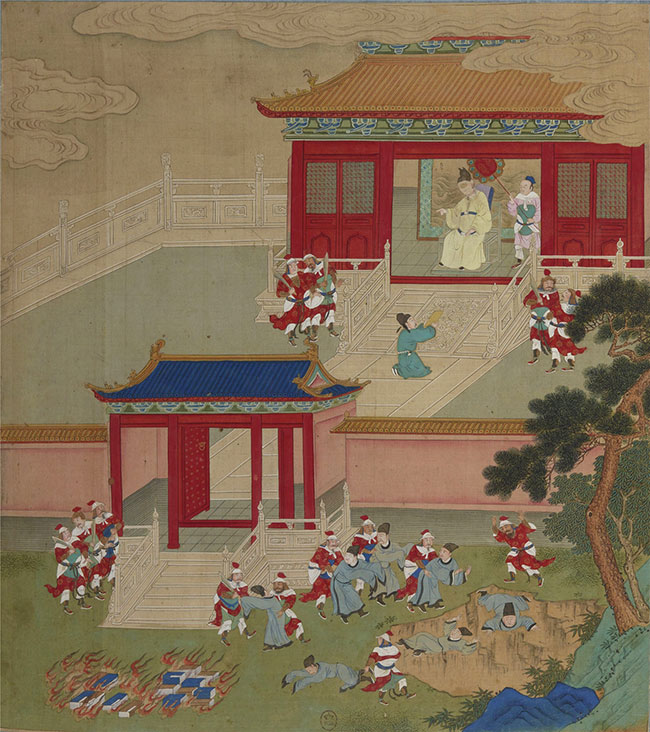
Killing the Scholars and Burning the Books, anonymous 18th century Chinese painted album leaf; Bibliothèque nationale de France, Paris

Killing the Scholars and Burning the Books, anonymous 18th century Chinese painted album leaf; Bibliothèque nationale de France, Paris

Sacred Congregation of the Index (1571–1917)

In 1571, a special congregation was created, the Sacred Congregation of the Index, which had the specific task to investigate those writings that were denounced in Rome as being not exempt of errors, to update the list of Pope Pius IV regularly and also to make lists of required corrections in case a writing was not to be condemned absolutely but only in need of correction; it was then listed with a mitigating clause (e.g., donec corrigatur (forbidden until corrected) or donec expurgetur (forbidden until purged)).

Several times a year, the congregation held meetings. During the meetings, they reviewed various works and documented those discussions. In between the meetings was when the works to be discussed were thoroughly examined, and each work was scrutinized by two people. At the meetings, they collectively decided whether or not the works should be included in the Index. Ultimately, the pope was the one who had to approve of works being added or removed from the Index. It was the documentation from the meetings of the congregation that aided the pope in making his decision.

This sometimes resulted in very long lists of corrections, published in the Index Expurgatorius, which was cited by Thomas James in 1627 as “an invaluable reference work to be used by the curators of the Bodleian Library when listing those works particularly worthy of collecting”. Prohibitions made by other congregations (mostly the Holy Office) were simply passed on to the Congregation of the Index, where the final decrees were drafted and made public, after approval of the Pope (who always had the possibility to condemn an author personally—there are only a few examples of such condemnation, including those of Lamennais and Hermes).

An update to the Index was made by Pope Leo XIII, in the 1897 apostolic constitution Officiorum ac Munerum, known as the “Index Leonianus”. Subsequent editions of the Index were more sophisticated; they graded authors according to their supposed degree of toxicity, and they marked specific passages for expurgation rather than condemning entire books.

The Sacred Congregation of the Inquisition of the Roman Catholic Church later became the Holy Office, and since 1965 has been called the Congregation for the Doctrine of the Faith. The Congregation of the Index was merged with the Holy Office in 1917, by the Motu Proprio “Alloquentes Proxime” of Pope Benedict XV; the rules on the reading of books were again re-elaborated in the new Codex Iuris Canonici. From 1917 onward, the Holy Office (again) took care of the Index.

Holy Office (1917–1966)

While individual books continued to be forbidden, the last edition of the Index to be published appeared in 1948. This 20th edition contained 4,000 titles censored for various reasons: heresy, moral deficiency, sexual explicitness, and so on. That some atheists, such as Schopenhauer and Nietzsche, were not included was due to the general (Tridentine) rule that heretical works (i.e., works that contradict Catholic dogma) are ipso facto forbidden. Some important works are absent simply because nobody bothered to denounce them. Many actions of the congregations were of a definite political content. Among the significant listed works of the period was the Nazi philosopher Alfred Rosenberg’s Myth of the Twentieth Century for scorning and rejecting “all dogmas of the Catholic Church, indeed the very fundamentals of the Christian religion”.

Abolition (1966)

On 7 December 1965, Pope Paul VI issued the Motu Proprio Integrae servandae that reorganized the Holy Office as the Sacred Congregation for the Doctrine of the Faith. The Index was not listed as being a part of the newly constituted congregation’s competence, leading to questioning whether it still was. This question was put to Cardinal Alfredo Ottaviani, pro-prefect of the congregation, who responded in the negative. The Cardinal also indicated in his response that there was going to be a change in the Index soon.

A June 1966 Congregation for the Doctrine of the Faith notification announced that, while the Index maintained its moral force, in that it taught Christians to beware, as required by the natural law itself, of those writings that could endanger faith and morality, it no longer had the force of ecclesiastical positive law with the associated penalties.

Pedro Berruguete: Saint Dominic and the Albigensians

Pedro Berruguete: Saint Dominic and the Albigensians. A dispute between Saint Dominic and the Cathars in which the books of both were thrown on a fire and St. Dominic’s books were miraculously preserved from the flames.

Censorship and Enforcement

The Index was not simply a reactive work. Roman Catholic authors had the opportunity to defend their writings and could prepare a new edition with necessary corrections or deletions, either to avoid or to limit a ban. Pre-publication censorship was encouraged.

The Index was enforceable within the Papal States, but elsewhere only if adopted by the civil powers, as happened in several Italian states. Other areas adopted their own lists of forbidden books. In the Holy Roman Empire book censorship, which preceded publication of the Index, came under control of the Jesuits at the end of the 16th century, but had little effect, since the German princes within the empire set up their own systems. In France it was French officials who decided what books were banned and the Church’s Index was not recognized. Spain had its own Index Librorum Prohibitorum et Expurgatorum, which corresponded largely to the Church’s, but also included a list of books that were allowed once the forbidden part (sometimes a single sentence) was removed or “expurgated”.

Continued Moral Obligation

On 14 June 1966, the Congregation for the Doctrine of the Faith responded to inquiries it had received regarding the continued moral obligation concerning books that had been listed in the Index. The response spoke of the books as examples of books dangerous to faith and morals, all of which, not just those once included in the Index, should be avoided regardless of the absence of any written law against them. The Index, it said, retains its moral force “inasmuch as” (quatenus) it teaches the conscience of Christians to beware, as required by the natural law itself, of writings that can endanger faith and morals, but it (the Index of Forbidden Books) no longer has the force of ecclesiastical law with the associated censures.

The congregation thus placed on the conscience of the individual Christian the responsibility to avoid all writings dangerous to faith and morals, while at the same time abolishing the previously existing ecclesiastical law and the relative censures, without thereby declaring that the books that had once been listed in the various editions of the Index of Prohibited Books had become free of error and danger.

In a letter of 31 January 1985 to Cardinal Giuseppe Siri, regarding the book The Poem of the Man-God, Cardinal Joseph Ratzinger (then Prefect of the Congregation, who later became Pope Benedict XVI), referred to the 1966 notification of the Congregation as follows: “After the dissolution of the Index, when some people thought the printing and distribution of the work was permitted, people were reminded again in L’Osservatore Romano (15 June 1966) that, as was published in the Acta Apostolicae Sedis (1966), the Index retains its moral force despite its dissolution. A decision against distributing and recommending a work, which has not been condemned lightly, may be reversed, but only after profound changes that neutralize the harm which such a publication could bring forth among the ordinary faithful.”

Changing Judgments

The content of the Index Librorum Prohibitorum saw deletions as well as additions over the centuries. Writings by Antonio Rosmini-Serbati were placed on the Index in 1849 but were removed by 1855, and Pope John Paul II mentioned Rosmini’s work as a significant example of “a process of philosophical enquiry which was enriched by engaging the data of faith”. The 1758 edition of the Index removed the general prohibition of works advocating heliocentrism as a fact rather than a hypothesis.

Listed Works and Authors

Noteworthy figures on the Index include Simone de Beauvoir, Nicolas Malebranche, Jean-Paul Sartre, Michel de Montaigne, Voltaire, Denis Diderot, Victor Hugo, Jean-Jacques Rousseau, André Gide, Nikos Kazantzakis, Emanuel Swedenborg, Baruch Spinoza, Desiderius Erasmus, Immanuel Kant, David Hume, René Descartes, Francis Bacon, Thomas Browne, John Milton, John Locke, Nicolaus Copernicus, Galileo Galilei, Blaise Pascal, and Hugo Grotius. The first woman to be placed on the list was Magdalena Haymairus in 1569, who was listed for her children’s book Die sontegliche Episteln über das gantze Jar in gesangsweis gestellt (Sunday Epistles on the whole Year, put into hymns). Other women include Anne Askew, Olympia Fulvia Morata, Ursula of Munsterberg (1491–1534), Veronica Franco, and Paola Antonia Negri (1508–1555). Contrary to a popular misconception, Charles Darwin’s works were never included.

In many cases, an author’s opera omnia (complete works) were forbidden. However, the Index stated that the prohibition of someone’s opera omnia did not preclude works that were not concerned with religion and were not forbidden by the general rules of the Index. This explanation was omitted in the 1929 edition, which was officially interpreted in 1940 as meaning that opera omnia covered all the author’s works without exception.

Cardinal Ottaviani stated in April 1966 that there was too much contemporary literature, and the Sacred Congregation for the Doctrine of the Faith could not keep up with it.

A member of the SA throws confiscated books into the bonfire during the public burning of "un-German" books on the Opernplatz in Berlin. In 1933, Nazis burned works of Jewish authors, and other works considered "un-German", at the library of the Institut für Sexualwissenschaft in Berlin.

A member of the SA throws confiscated books into the bonfire during the public burning of “un-German” books on the Opernplatz in Berlin. In 1933, Nazis burned works of Jewish authors, and other works considered “un-German”, at the library of the Institut für Sexualwissenschaft in Berlin.

Wikipedia – Index Librorum Prohibitorum

List of Book-Burning Incidents

Book Burning

Internet Archive: Digital Library

Open Library

Project Gutenberg

Lex Luthor: Man of Steel

© DC Comics | Cover Art: Lee Bermejo | Writer: Brian Azzarello

Lex Luthor: Man of Steel (later collected as simply Luthor) is a five-issue monthly American comic book limited series written by Brian Azzarello and illustrated by Lee Bermejo, which features Superman’s nemesis Lex Luthor as the protagonist.

The story explores Luthor’s motivations behind being a constant foe to the Man of Steel inside a city that has largely embraced him. Luthor views Superman as a demigod who looks down on humanity and believes that in order to “save” the human race from extraterrestrial threats, Superman must be stopped.

At the onset of the series, the story seems to be narrated from Luthor’s point of view, one depicting himself as someone much different than the ruthless, corrupt killer that readers are accustomed to. He displays a charitable nature by giving a loyal employee an invitation to the grand opening of Luthor’s own “Science Spire”, a new Metropolis attraction under construction. By contrast, many of the “heroes” Luthor encounters during his story (Superman, Batman) are depicted as duplicitous and unworthy of trust. Luthor watches footage of Superman engaging criminals with heat vision and wonders to himself why the public invests so much trust in an alien simply because he looks human. Meanwhile, in Chechnya, Mr. Elias Orr, one of Lex’s operatives, leads a group of mercenaries in a raid to free a Russian scientist named Sasha who is to assist Lex Luthor in a new project.

While holding a meeting, it is brought to Luthor’s attention that the union workers building the Science Spire want a higher wage. Luthor tosses his business plan and decides to build and unveil the attraction as a non-profit project, which undercuts the union’s demands. Upon leaving the boardroom full of stunned executives, Luthor arrives at his lab where he observes Hope, a woman floating inside a gigantic vat apparently asleep. Luthor ask Sasha if he can speak with Hope and Sasha opens the communication relay systems barrier which causes Hope’s eyes to open. Luthor then engages in a conversation with Hope to see how in turn she responds in kind. Hope asks some questions about how Luthor thinks and feels about her. Luthor tells Hope how important she is to him and that how he promised that Sasha would make her better. After this conversation has taken place Sasha informs Luthor that although it is good that Hope responds with questions, what is truly missing are synapses and what is inside. Luthor wishes for a past for Hope but that there is nothing for her outside her development chamber and that what he wants requires more. Luthor then tells Sasha he will get it for him. Sometime later, Orr beats and threatens the union leader into complying with his demands while Lex flies to Gotham City to try to arrange a deal with Bruce Wayne (Batman). Luthor lets Bruce know that he heard of the breakthrough made at Thomas Labs, one of Bruce’s research facilities at Wayne Enterprises, on the Alzheimer’s front and that he thinks that it could be beneficial on another. Lex also tells Bruce of the potential threat that Superman poses due to his vast array of powers and overall strength. As a gift, Lex presents Bruce with kryptonite and asks him to consider how the public only has Superman’s word that he will not turn on them.

That night, Batman is looking at the kryptonite when Superman arrives in Gotham and uses his breath to blow the kryptonite from Batman’s hand before confronting Batman in a brief but intense fight. Superman eventually bests Batman. Superman goes to finish the confrontation with a knockout punch to Batman’s face before stopping, x-ray visioning Batman’s utility belt, picking out Batman’s own lead-lined piece of Kryptonite and crushing in his fist. Later that evening Bruce calls Lex and tells him he will give the research to Luthor.

At the opening for the Science Spire, Lex announces the arrival of a new superhero by introducing Hope to the public, the result of the Sasha’s work and Wayne’s medicinal breakthroughs. Hope displays abilities of super-strength and flight, essentially replacing Superman and becoming a corporate-sponsored hero who soon takes on duties normally reserved for Superman. One month later and Hope has gained a loyal following. At Lexcorp, Lex tells Hope how proud he is of her and that she is more than that he had ever dreamed she would be, much to the chagrin of his secretary Mona.

The next day at Lexcorp, Hope’s Q-rating has gone up through the roof. Luthor watches Hope on TV as she is being given an interview. She tells the reporter named Reggie that her favorite place to eat is at an eatery called The Pineapple King as her father took her there once when she was five and she was hooked for life. It is now realized that Luthor has used Bruce’s research on his Alzheimer’s aiding technology so as to give Hope these fake memories as her past like Sasha asked for earlier. Reggie then makes a joke about hoping that she will not be taking the Justice League there when they come recruiting her or there will be lines wrapped right down around the block. Hope informs Reggie that she has no intention of joining The Justice League as she is a born-and-raised Metropolitan girl. She states that there are many heroes in the country and that they are all blessed to have Justice League as those heroes, but her heart belongs to the city of Metropolis as it is her home and it is their home.

Orr approaches Winslow Schott (Toyman) with an offer on behalf of Lex. Hope and Lex are in bed together when a news bulletin breaks that Schott is wanted for a bombing at the Metropolis Daycare Center (in which over seventy adults and children, including, coincidentally, Sasha and his family are killed). Orr realizes that he has been double-crossed when Schott mentions a different kind of explosive being delivered to him from someone other than Orr’s men. Lex urges Hope to bring the criminal to justice.

Inside his warehouse, Toyman is confronted by Superman, who is immediately met by Toyman’s soldiers as Hope grabs Schott and soars into the sky with him. From a separate location, Lex activates a control and causes her to drop Toyman, a development that pleases many of those watching on television. At the last moment, Superman flies up and catches Toyman.

Hope wonders why she involuntarily let Toyman go just as Superman confronts her for attempted murder. Hope attacks Superman and flies away towards the Science Spire. During a battle with Superman, Hope is blasted by his eye lasers, revealing to both of them that Hope is actually an android. Lex then remotely detonates Hope, causing the Science Spire to explode. This destroys all evidence that she was an android and makes it appear as though Superman killed her.

Superman flies to Lex’s office, where he is waiting with his back turned. Lex says that not one person in Metropolis wanted to see Schott live after the destruction he caused and that, even with his many visions, Superman can’t see Luthor’s soul. Lex is infuriated by Superman’s silent judgment and demands he say something. Superman simply says, “You’re wrong…I can see your soul”. Taken aback, Lex pounds the window in defiance then tries to regain composure, saying that, if Superman could, he would see a man who sacrificed everything, including hope, for “A world without a Superman” and that if just one person out there saw Superman saving a condemned man and “realizes what you are” then his actions were worthwhile. Luthor turns away from the window, asking him to “Please, just fly away”. Superman complies, soaring off with a sad expression, leaving Lex with the thought “I am a man. I hope”.


DC Comics Page

Art by: Lee Bermejo | Jason Martin | Karl Story | Mick Gray

Colorist: Lee Bermejo

Written by: Brian Azzarello

The Jefferson Bible: The Life and Morals of Jesus of Nazareth

In a letter to his daughter, written in 1803, Thomas Jefferson said: “A promise made to a friend some years ago, but executed only lately, has placed my religious creed on paper. I have thought it just that my family, by possessing this, should be enabled to estimate the libels published against me on this, as on every other possible subject.” The “religious creed” to which he referred was a comparison of the doctrines of Jesus with those of others, prepared in fulfillment of a promise made to Dr. Benjamin Rush. This paper, with the letter to Dr. Rush which accompanied it, is a fit introduction to the “Jefferson Bible.”

Washington, April 21, 1803:

Dear Sir: In some of the delightful conversations with you, in the evenings of 1798-99, and which served as an anodyne to the afflictions of the crisis through which our country was then laboring, the Christian religion was sometimes our topic; and I then promised you that one day or other, I would give you my views of it. They are the result of a life of inquiry and reflection, and very different from that Anti-Christian system imputed to me by those who know nothing of my opinions. To the corruptions of Christianity I am indeed opposed; but not to the genuine precepts of Jesus himself. I am a Christian in the only sense in which he wished any one to be; sincerely attached to his doctrines, in preference to all others; ascribing to himself every human excellence, and believing he never claimed any other.

At the short intervals since these conversations, when I could justifiably abstract my mind from public affairs, this subject has been under my contemplation; but the more I considered it, the more it expanded beyond the measure of either my time or information. In the moment of my late departure from Monticello, I received from Dr. Priestly his little treatise of “Socrates and Jesus Compared.” This being a section of the general view I had taken of the field, it became a subject of reflection while on the road, and unoccupied otherwise. The result was to arrange in my mind a syllabus, or outline, of such an estimate of the comparative merits of Christianity, as I wished to see executed by some one of more leisure and information for the task than myself. This I now send you, as the only discharge of my promise I can probably ever execute. And in confiding it to you, I know it will not be exposed to the malignant perversions of those who make every word from me a text for new misrepresentations and calumnies.

I am moreover averse to the communication of my religious tenets to the public; because it would countenance the presumption of those who have endeavored to draw them before that tribunal, and to seduce public opinion to erect itself into that inquisition over the rights of conscience which the laws have so justly proscribed. It behooves every man who values liberty of conscience for himself to resist invasions of it in the case of others, or their case may, by change of circumstances, become his own. It behooves him, too, in his own case, to give no example of concession, betraying the right of independent opinion by answering questions of faith, which the laws have left between God and himself.

Accept my affectionate salutations.

Syllabus of an Estimate of the Doctrines of Jesus, Compared with Those of Others

In a comparative view of the ethics of the enlightened nations of antiquity, of the Jews, and of Jesus, no notice should be taken of the corruptions of reason among the ancients, to wit, the idolatry and superstition of the vulgar, nor of the corruptions of Christianity by the learned among its professors. Let a just view be taken of the moral principles inculcated by the most esteemed of the sects of ancient philosophy, or of their individuals; particularly Pythagoras, Socrates, Epicurus, Cicero, Epictetus, Seneca, Antoninus.

I. PHILOSOPHERS

  1. Their precepts related chiefly to ourselves, and the government of those passions which, unrestrained, would disturb our tranquility of mind. In this branch of philosophy they were really great.
  2. In developing our duties to others, they were short and defective. They embraced indeed the circles of kindred and friends, and inculcated patriotism, or the love of country in the aggregate, as a primary obligation: towards our neighbors and countrymen they taught justice, but scarcely viewed them as within the circle of benevolence. Still less have they inculcated peace, charity, and love to our fellow-men, or embraced with benevolence the whole family of mankind.

II. JEWS

  1. Their system was Deism, that is, the belief in one only God; but their ideas of him and of his attributes were degrading and injurious.
  2. Their ethics were not only imperfect, but often irreconcilable with the sound dictates of reason and morality, as they respect intercourse with those around us; and repulsive and anti-social as respecting other nations. They needed reformation, therefore, in an eminent degree.

III. JESUS

In this state of things among the Jews, Jesus appeared. His parentage was obscure; his condition poor; his education null; his natural endowments great; his life correct and innocent. He was meek, benevolent, patient, firm, disinterested, and of the sublimest eloquence. The disadvantages under which his doctrines appear are remarkable.

  1. Like Socrates and Epictetus, he wrote nothing himself.
  2. But he had not, like them, a Xenophon or an Arrian to write for him. I name not Plato, who only used the name of Socrates to cover the whimsies of his own brain. On the contrary, all the learned of his country, entrenched in its power and riches, were opposed to him, lest his labors should undermine their advantages; and the committing to writing of his life and doctrines fell on unlettered and ignorant men; who wrote, too, from memory, and not till long after the transactions had passed.
  3. According to the ordinary fate of those who attempt to enlighten and reform mankind, he fell an early victim to the jealousy and combination of the altar and the throne, at about 33 years of age, his reason having not yet attained the maximum of its energy, nor the course of his preaching, which was but of three years at most, presented occasions for developing a complete system of morals.
  4. Hence the doctrines which he really delivered were defective, as a whole, and fragments only of what he did deliver have come to us mutilated, misstated, and often unintelligible.
  5. They have been still more disfigured by the corruptions of schismatizing followers, who have found an interest in sophisticating and perverting the simple doctrines he taught, by engrafting on them the mysticisms of a Grecian Sophist (Plato), frittering them into subtilties and obscuring them with jargon, until they have caused good men to reject the whole in disgust, and to view Jesus himself as an impostor.

Notwithstanding these disadvantages, a system of morals is presented to us which, if filled up in the true style and spirit of the rich fragments he left us, would be the most perfect and sublime that has ever been taught by man. The question of his being a member of the Godhead, or in direct communication with it, claimed for him by some of his followers, and denied by others, is foreign to the present view, which is merely an estimate of the intrinsic merits of his doctrines.

  1. He corrected the Deism of the Jews, confirming them in their belief of one only god, and giving them juster notions of his attributes and government.
  2. His moral doctrines, relating to kindred and friends, were more pure and perfect than those of the most correct of the philosophers, and greatly more so than those of the Jews; and they went far beyond both in inculcating universal philanthropy, not only to kindred and friends, to neighbors and countrymen, but to all mankind, gathering all into one family, under the bonds of love, charity, peace, common wants and common aids. A development of this head will evince the peculiar superiority of the system of Jesus over all others.
  3. The precepts of philosophy and of the Hebrew code laid hold of action only. He pushed his scrutinies into the heart of man; erected his tribunal in the region of his thought, and purified the waters at the fountain head.
  4. He taught emphatically the doctrine of a future state, which was either doubted or disbelieved by the Jews; and wielded it with efficacy as an important incentive, supplementary to the other motives to moral conduct.

I, too, have made a wee-little book from the same materials (The Gospels) which I call the Philosophy of Jesus. It is a paradigma of his doctrines, made by cutting the texts out of the book and arranging them on the pages of a blank book, in a certain order of time or subject. A more beautiful or precious morsel of ethics I have never seen. It is a document in proof that I am a real Christian, that is to say, a disciple of the doctrines of Jesus, very different from the Platonists, who call me infidel and themselves Christians and preachers of the Gospel, while they draw all their characteristic dogmas from what its author never said nor saw. They have compounded from the heathen mysteries a system beyond the comprehension of man, of which the great reformer of the vicious ethics and deism of the Jews, were he to return on earth, would not recognize one feature.

– Jefferson to Mr. Charles Thompson


“Say nothing of my religion. It is known to my God and myself alone. Its evidence before the world is to be sought in my life; if that has been honest and dutiful to society, the religion which has regulated it cannot be a bad one.”

– Thomas Jefferson

Full Text of the Jefferson Bible (PDF)

Would you rather have a fish or know how to fish?

fishing-lure

Public domain

Jonny Robinson | Aeon Ideas

Imagine the following. You are living a life with enough money and health and time so as to allow an hour or two of careless relaxation, sitting on the sofa at the end of the day in front of a large television, half-heartedly watching a documentary about solar energy with a glass of wine and scrolling through your phone. You happen to hear a fact about climate change, something to do with recent emission figures. Now, on that same night, a friend who is struggling to meet her financial commitments has just arrived at her second job and misses out on the documentary (and the relaxation). Later in the week, when the two of you meet for a drink and your friend is ignorant of recent emission figures, what kind of intellectual or moral superiority is really justified on your part?

This example is designed to show that knowledge of the truth might very well have nothing to do with our own efforts or character. Many are born into severe poverty with a slim chance at a good education, and others grow up in religious or social communities that prohibit certain lines of enquiry. Others still face restrictions because of language, transport, money, sickness, technology, bad luck and so on. The truth, for various reasons, is much harder to access at these times. At the opposite end of the scale, some are effectively handed the truth about some matter as if it were a mint on their pillow, pleasantly materialising and not a big deal. Pride in this mere knowledge of the truth ignores the way in which some people come to possess it without any care or effort, and the way that others strive relentlessly against the odds for it and still miss out. The phrase ‘We know the truth [and, perhaps, you don’t]’, weaponised and presented without any qualifying modesty, fails to recognise the extraordinary privileges so often involved in that very acquisition, drawing an exclusionary line that overlooks almost everything else of significance.

A good attitude towards knowledge shines through various character traits that put us in a healthy relationship with it. Philosophers call these traits epistemic virtues. Instead of praising those people who happen to possess some piece of knowledge, we ought to praise those who have the right attitude towards it, since only this benchmark also includes those who strive for the truth and miss out on it for reasons not entirely under their control. Consider traits such as intellectual humility (a willingness to be wrong), intellectual courage (to pursue truths that make us uncomfortable), open-mindedness (to contemplate all sides of the argument, limiting preconceptions), and curiosity (to be continually seeking). You can see that the person ready to correct herself, courageous in her pursuit of the truth, open-minded in her deliberation, and driven by a deep curiosity has a better relationship to truth even where she occasionally fails to obtain it than does the indifferent person who is occasionally handed the truth on a silver platter.

In a sense, it’s difficult to answer to the disjunction ‘Is it better to know, or to seek to know?’ because there is not quite enough information in it. In respect to knowing (the first half of the disjunction), we also want to hear how that knowledge came about. That is, was the knowledge acquired despite the disinterest and laziness of the possessor, or was it acquired through diligent seeking? If the latter, then it is better to know since the second half of the disjunction is also accommodated in the first: the possession of knowledge and the attitude of seeking it. We can build on the idea with another example.

Would you rather have a fish or know how to fish? Again, we need some more information. If having the fish is the result of knowing how to fish, then once more the two halves of the disjunction are not necessarily mutually exclusive, and this combination is the ideal. But, if the having is the result of waiting around for someone to give you a fish, it would be better to know how to do it yourself. For where the waiting agent hopes for luck or charity, the agent who knows how to fish can return to the river each morning and each evening, throwing her line into the water over and over until she is satisfied with the catch.

And so it is with knowledge. Yes, it’s better to know, but only where this implies an accompanying attitude. If, instead, the possession of knowledge relies primarily upon the sporadic pillars of luck or privilege (as it so often does), one’s position is uncertain and in danger of an unfounded pride (not to mention pride’s own concomitant complications). Split into two discrete categories, then, we should prefer seeking to knowing. As with the agent who knows how to fish, the one who seeks knowledge can go out into the world, sometimes failing and sometimes succeeding, but in any case able to continue until she is satisfied with her catch, a knowledge attained. And then, the next day, she might return to the river and do it all again.

A person will eventually come up against the world, logically, morally, socially, even physically. Some collisions will be barely noticeable, others will be catastrophic. The consistent posture of seeking the truth gives us the best shot at seeing clearly, and that is what we should praise and value.Aeon counter – do not remove


Jonny Robinson is a tutor and casual lecturer in the department of philosophy at Macquarie University. He lives in Sydney.

This article was originally published at Aeon and has been republished under Creative Commons. View the original article here.

How Mengzi came up with something better than the Golden Rule

family-training

Family Training, unknown artist, Ming (1368-1644) or Qing (1644-1911) dynasty. Courtesy the Met Museum, New York

Eric Schwitzgebel | Aeon Ideas

There’s something I don’t like about the ‘Golden Rule’, the admonition to do unto others as you would have others do unto you. Consider this passage from the ancient Chinese philosopher Mengzi (Mencius):

That which people are capable of without learning is their genuine capability. That which they know without pondering is their genuine knowledge. Among babes in arms there are none that do not know to love their parents. When they grow older, there are none that do not know to revere their elder brothers. Treating one’s parents as parents is benevolence. Revering one’s elders is righteousness. There is nothing else to do but extend these to the world.

One thing I like about the passage is that it assumes love and reverence for one’s family as a given, rather than as a special achievement. It portrays moral development simply as a matter of extending that natural love and reverence more widely.

In another passage, Mengzi notes the kindness that the vicious tyrant King Xuan exhibits in saving a frightened ox from slaughter, and he urges the king to extend similar kindness to the people of his kingdom. Such extension, Mengzi says, is a matter of ‘weighing’ things correctly – a matter of treating similar things similarly, and not overvaluing what merely happens to be nearby. If you have pity for an innocent ox being led to slaughter, you ought to have similar pity for the innocent people dying in your streets and on your battlefields, despite their invisibility beyond your beautiful palace walls.

Mengzian extension starts from the assumption that you are already concerned about nearby others, and takes the challenge to be extending that concern beyond a narrow circle. The Golden Rule works differently – and so too the common advice to imagine yourself in someone else’s shoes. In contrast with Mengzian extension, Golden Rule/others’ shoes advice assumes self-interest as the starting point, and implicitly treats overcoming egoistic selfishness as the main cognitive and moral challenge.

Maybe we can model Golden Rule/others’ shoes thinking like this:

  1. If I were in the situation of person x, I would want to be treated according to principle p.
  2. Golden Rule: do unto others as you would have others do unto you.
  3. Thus, I will treat person x according to principle p.

And maybe we can model Mengzian extension like this:

  1. I care about person y and want to treat that person according to principle p.
  2. Person x, though perhaps more distant, is relevantly similar.
  3. Thus, I will treat person x according to principle p.

There will be other more careful and detailed formulations, but this sketch captures the central difference between these two approaches to moral cognition. Mengzian extension models general moral concern on the natural concern we already have for people close to us, while the Golden Rule models general moral concern on concern for oneself.

I like Mengzian extension better for three reasons. First, Mengzian extension is more psychologically plausible as a model of moral development. People do, naturally, have concern and compassion for others around them. Explicit exhortations aren’t needed to produce this natural concern and compassion, and these natural reactions are likely to be the main seed from which mature moral cognition grows. Our moral reactions to vivid, nearby cases become the bases for more general principles and policies. If you need to reason or analogise your way into concern even for close family members, you’re already in deep moral trouble.

Second, Mengzian extension is less ambitious – in a good way. The Golden Rule imagines a leap from self-interest to generalised good treatment of others. This might be excellent and helpful advice, perhaps especially for people who are already concerned about others and thinking about how to implement that concern. But Mengzian extension has the advantage of starting the cognitive project much nearer the target, requiring less of a leap. Self-to-other is a huge moral and ontological divide. Family-to-neighbour, neighbour-to-fellow citizen – that’s much less of a divide.

Third, you can turn Mengzian extension back on yourself, if you are one of those people who has trouble standing up for your own interests – if you’re the type of person who is excessively hard on yourself or who tends to defer a bit too much to others. You would want to stand up for your loved ones and help them flourish. Apply Mengzian extension, and offer the same kindness to yourself. If you’d want your father to be able to take a vacation, realise that you probably deserve a vacation too. If you wouldn’t want your sister to be insulted by her spouse in public, realise that you too shouldn’t have to suffer that indignity.

Although Mengzi and the 18th-century French philosopher Jean-Jacques Rousseau both endorse mottoes standardly translated as ‘human nature is good’ and have views that are similar in important ways, this is one difference between them. In both Emile (1762) and Discourse on Inequality (1755), Rousseau emphasises self-concern as the root of moral development, making pity and compassion for others secondary and derivative. He endorses the foundational importance of the Golden Rule, concluding that ‘love of men derived from love of self is the principle of human justice’.

This difference between Mengzi and Rousseau is not a general difference between East and West. Confucius, for example, endorses something like the Golden Rule in the Analects: ‘Do not impose on others what you yourself do not desire.’ Mozi and Xunzi, also writing in China in the period, imagine people acting mostly or entirely selfishly until society artificially imposes its regulations, and so they see the enforcement of rules rather than Mengzian extension as the foundation of moral development. Moral extension is thus specifically Mengzian rather than generally Chinese.

Care about me not because you can imagine what you would selfishly want if you were me. Care about me because you see how I am not really so different from others you already love.


This is an edited extract from ‘A Theory of Jerks and Other Philosophical Misadventures’ © 2019 by Eric Schwitzgebel, published by MIT Press.Aeon counter – do not remove

Eric Schwitzgebel is professor of philosophy at the University of California, Riverside. He blogs at The Splintered Mind and is the author of Perplexities of Consciousness (2011) and A Theory of Jerks and Other Philosophical Misadventures (2019).

This article was originally published at Aeon and has been republished under Creative Commons. Read the original article here.

The Meaning to Life? A Darwinian Existentialist has his Answers

human-lifespan

Michael Ruse | Aeon Ideas

I was raised as a Quaker, but around the age of 20 my faith faded. It would be easiest to say that this was because I took up philosophy – my lifelong occupation as a teacher and scholar. This is not true. More accurately, I joke that having had one headmaster in this life, I’ll be damned if I want another in the next. I was convinced back then that, by the age of 70, I would be getting back onside with the Powers That Be. But faith did not then return and, as I approach 80, is nowhere on the horizon. I feel more at peace with myself than ever before. It’s not that I don’t care about the meaning or purpose of life – I am a philosopher! Nor does my sense of peace mean that I am complacent or that I have delusions about my achievements and successes. Rather, I feel that deep contentment that religious people tell us is the gift or reward for proper living.

I come to my present state for two separate reasons. As a student of Charles Darwin, I am totally convinced – God or no God – that we are (as the 19th-century biologist Thomas Henry Huxley used to say) modified monkeys rather than modified mud. Culture is hugely important, but to ignore our biology is just wrong. Second, I am drawn, philosophically, to existentialism. A century after Darwin, Jean-Paul Sartre said that we are condemned to freedom, and I think he is right. Even if God does exist, He or She is irrelevant. The choices are ours.

Sartre denied such a thing as human nature. From this quintessential Frenchman, I take that with a pinch of salt: we are free, within the context of our Darwinian-created human nature. What am I talking about? A lot of philosophers today are uncomfortable even raising the idea of ‘human nature’. They feel that, too quickly, it is used against minorities – gay people, the disabled, and others – to suggest that they are not really human. This is a challenge not a refutation. If a definition of human nature cannot take account of the fact that up to 10 per cent of us have same-sex orientation, then the problem is not with human nature but with the definition.

What, then, is human nature? In the middle of the 20th century, it was popular to suggest that we are killer apes: we can and do make weapons, and we use them. But modern primatologists have little time for this. Their findings suggest that most apes would far rather fornicate than fight. In making war we are really not doing what comes naturally. I don’t deny that humans are violent, however our essence goes the other way. It is one of sociability. We are not that fast, we are not that strong, we are hopeless in bad weather; but we succeed because we work together. Indeed, our lack of natural weapons points that way. We cannot get all we want through violence. We must cooperate.

Darwinians did not discover this fact about our nature. Listen to the metaphysical poet John Donne in 1624:

No man is an island,
Entire of itself,
Every man is a piece of the continent,
A part of the main.
If a clod be washed away by the sea,
Europe is the less.
As well as if a promontory were.
As well as if a manor of thy friend’s
Or of thine own were:
Any man’s death diminishes me,
Because I am involved in mankind,
And therefore never send to know for whom the bell tolls;
It tolls for thee.

Darwinian evolutionary theory shows how this all came about, historically, through the forces of nature. It suggests that there is no eternal future or, if there is, it is not relevant for the here and now. Rather, we must live life to the full, within the context of – liberated by – our Darwinian-created human nature. I see three basic ways in which this occurs.

First, family. Humans are not like male orangutans whose home life is made up mainly of one-night stands. A male turns up, does his business, and then, sexually sated, vanishes. The impregnated female births and raises the children by herself. This is possible simply because she can. If she couldn’t then, biologically it would be in the interests of the males to lend a hand. Male birds help at the nest because, exposed as they are up trees, the chicks need to grow as quickly as possible. Humans face different challenges, but with the same end. We have big brains that need time to develop. Our young cannot fend for themselves within weeks or days. Therefore humans need lots of parental care, and our biology fits us for home life, as it were: spouses, offspring, parents, and more. Men don’t push the pram just by chance. Nor boast to their co-workers about their kid getting into Harvard.

Second, society. Co-workers, shop attendants, teachers, doctors, hotel clerks – the list is endless. Our evolutionary strength is that we work together, helping and expecting help. I am a teacher, not just of my children, but of yours (and others) too. You are a doctor: you give medical care not just to your children, but to mine (and others) too. In this way, we all benefit. As Adam Smith pointed out in 1776, none of this happens by chance or because nature has suddenly become soft: ‘It is not from the benevolence of the butcher, the brewer, or the baker that we expect our dinner, but from their regard to their own self-interest.’ Smith invoked the ‘invisible hand’. The Darwinian puts it down to evolution through natural selection.

Though life can be a drag sometimes, biology ensures that we generally get on with the job, and do it as part of our fulfilled lives. John Stuart Mill had it exactly right in 1863: ‘When people who are fairly fortunate in their material circumstances don’t find sufficient enjoyment to make life valuable to them, this is usually because they care for nobody but themselves.’

Third, culture. Works of art and entertainment, TV, movies, plays, novels, paintings and sport. Note how social it all is. Romeo and Juliet, about two kids in ill-fated love. The Sopranos, about a mob family. A Roy Lichtenstein faux-comic painting; a girl on the phone: ‘Oh, Jeff… I love you, too… but…’ England beating Australia at cricket. There are evolutionists who doubt that culture is so tightly bound to biology, and who are inclined to see it as a side-product of evolution, what Stephen Jay Gould in 1982 called an ‘exaptation’. This is surely true in part. But probably only in part. Darwin thought that culture might have something to do with sexual selection: protohumans using songs and melodies, say, to attract mates. Sherlock Holmes agreed; in A Study in Scarlet (1887), he tells Watson that musical ability predates speech, according to Darwin: ‘Perhaps that is why we are so subtly influenced by it. There are vague memories in our souls of those misty centuries when the world was in its childhood.’

Draw it together. I have had a full family life, a loving spouse and children. I even liked teenagers. I have been a college professor for 55 years. I have not always done the job as well as I could, but I am not lying when I say that Monday morning is my favourite time of the week. I’m not much of a creative artist, and I’m hopeless at sports. But I have done my scholarship and shared with others. Why else am I writing this? And I have enjoyed the work of fellow humans. A great performance of Mozart’s opera The Marriage of Figaro is heaven. I speak literally.

This is my meaning to life. When I meet my nonexistent God, I shall say to Him: ‘God, you gave me talents and it’s been a hell of a lot of fun using them. Thank you.’ I need no more. As George Meredith wrote in his poem ‘In the Woods’ (1870):

The lover of life knows his labour divine,
And therein is at peace.


A Meaning to Life (2019) by Michael Ruse is published via Princeton University Press.Aeon counter – do not remove

Michael Ruse is the Lucyle T Werkmeister Professor of Philosophy and director of the history and philosophy of science at Florida State University. He has written or edited more than 50 books, including most recently On Purpose (2017), Darwinism as Religion (2016), The Problem of War (2018) and A Meaning to Life (2019).

This article was originally published at Aeon and has been republished under Creative Commons. Read the original article here.

To Avoid Moral Failure, Don’t See People as Sherlock Does

sherlock-holmes

Suspicious minds; William Gillette as Sherlock Holmes (right) and Bruce McRae as Dr John Watson in the play Sherlock Holmes (c1900). Courtesy Wikimedia

Rima Basu | Aeon Ideas

If we’re the kind of people who care both about not being racist, and also about basing our beliefs on the evidence that we have, then the world presents us with a challenge. The world is pretty racist. It shouldn’t be surprising then that sometimes it seems as if the evidence is stacked in favour of some racist belief. For example, it’s racist to assume that someone’s a staff member on the basis of his skin colour. But what if it’s the case that, because of historical patterns of discrimination, the members of staff with whom you interact are predominantly of one race? When the late John Hope Franklin, professor of history at Duke University in North Carolina, hosted a dinner party at his private club in Washington, DC in 1995, he was mistaken as a member of staff. Did the woman who did so do something wrong? Yes. It was indeed racist of her, even though Franklin was, since 1962, that club’s first black member.

To begin with, we don’t relate to people in the same way that we relate to objects. Human beings are different in an important way. In the world, there are things – tables, chairs, desks and other objects that aren’t furniture – and we try our best to understand how this world works. We ask why plants grow when watered, why dogs give birth to dogs and never to cats, and so on. But when it comes to people, ‘we have a different way of going on, though it is hard to capture just what that is’, as Rae Langton, now professor of philosophy at the University of Cambridge, put it so nicely in 1991.

Once you accept this general intuition, you might begin to wonder how can we capture that different way in which we ought to relate to others. To do this, first we must recognise that, as Langton goes on to write, ‘we don’t simply observe people as we might observe planets, we don’t simply treat them as things to be sought out when they can be of use to us, and avoid when they are a nuisance. We are, as [the British philosopher P F] Strawson says, involved.’

This way of being involved has been played out in many different ways, but here’s the basic thought: being involved is thinking that others’ attitudes and intentions towards us are important in a special way, and that our treatment of others should reflect that importance. We are, each of us, in virtue of being social beings, vulnerable. We depend upon others for our self-esteem and self-respect.

For example, we each think of ourselves as having a variety of more or less stable characteristics, from marginal ones such as being born on a Friday to central ones such as being a philosopher or a spouse. The more central self-descriptions are important to our sense of self-worth, to our self-understanding, and they constitute our sense of identity. When these central self-descriptions are ignored by others in favour of expectations on the basis of our race, gender or sexual orientation, we’re wronged. Perhaps our self-worth shouldn’t be based on something so fragile, but not only are we all-too-human, these self-descriptions also allow us to understand who we are and where we stand in the world.

This thought is echoed in the American sociologist and civil rights activist W E B DuBois’s concept of double consciousness. In The Souls of Black Folk (1903), DuBois notes a common feeling: ‘this sense of always looking at one’s self through the eyes of others, of measuring one’s soul by the tape of a world that looks on in amused contempt and pity’.

When you believe that John Hope Franklin must be a staff member rather than a club member, you’ve made predictions of him and observed him in the same way that one might observe the planets. Our private thoughts can wrong other people. When someone forms beliefs about you in this predictive way, they fail to see you, they fail to interact with you as a person. This is not only upsetting. It is a moral failing.

The English philosopher W K Clifford argued in 1877 that we were morally criticisable if our beliefs weren’t formed in the right way. He warned that we have a duty to humanity to never believe on the basis of insufficient evidence because to do so would be to put society at risk. As we look at the world around us and the epistemic crisis in which we find ourselves, we see what happens when Clifford’s imperative is ignored. And if we combine Clifford’s warning with DuBois’s and Langton’s observations, it becomes clear that, for our belief-forming practices, the stakes aren’t just high because we depend on one another for knowledge – the stakes are also high because we depend on one another for respect and dignity.

Consider how upset Arthur Conan Doyle’s characters get with Sherlock Holmes for the beliefs this fictional detective forms about them. Without fail, the people whom Holmes encounters find the way he forms beliefs about others to be insulting. Sometimes it’s because it is a negative belief. Often, however, the belief is mundane: eg, what they ate on the train or which shoe they put on first in the morning. There’s something improper about the way that Holmes relates to other human beings. Holmes’s failure to relate is not just a matter of his actions or his words (though sometimes it is also that), but what really rubs us up the wrong way is that Holmes observes us all as objects to be studied, predicted and managed. He doesn’t relate to us as human beings.

Maybe in an ideal world, what goes on inside our heads wouldn’t matter. But just as the personal is the political, our private thoughts aren’t really only our own. If a man believes of every woman he meets: ‘She’s someone I can sleep with,’ it’s no excuse that he never acts on the belief or reveals the belief to others. He has objectified her and failed to relate to her as a human being, and he has done so in a world in which women are routinely objectified and made to feel less-than.

This kind of indifference to the effect one has on others is morally criticisable. It has always struck me as odd that everyone grants that our actions and words are apt for moral critique, but once we enter the realm of thought we’re off the hook. Our beliefs about others matter. We care what others think of us.

When we mistake a person of colour for a staff member, that challenges this person’s central self-descriptions, the descriptions from which he draws his sense of self-worth. This is not to say that there is anything wrong with being a staff member, but if your reason for thinking that someone is staff is tied not only to something he has no control over (his skin colour) but also to a history of oppression (being denied access to more prestigious forms of employment), then that should give you pause.

The facts might not be racist, but the facts that we often rely on can be the result of racism, including racist institutions and policies. So when forming beliefs using evidence that is a result of racist history, we are accountable for failing to show more care and for believing so easily that someone is a staff member. Precisely what is owed can vary along a number of dimensions, but nonetheless we can recognise that some extra care with our beliefs is owed along these lines. We owe each other not only better actions and better words, but also better thoughts.Aeon counter – do not remove


Rima Basu is an assistant professor of philosophy at Claremont McKenna College in California. Her work has been published in Philosophical Studies, among others.

This article was originally published at Aeon and has been republished under Creative Commons. Read the original article here.

How do we Pry Apart the True and Compelling from the False and Toxic?

cpu-stack

Stack of CPU’s. Shawn Stutzman, Pexels

David V Johnson | Aeon Ideas

When false and malicious speech roils the body politic, when racism and violence surge, the right and role of freedom of speech in society comes into crisis. People rightly begin to wonder what are the limits, what should be the rules. It is a complicated issue, and resolving it requires care about the exact problems targeted and solutions proposed. Otherwise the risk to free speech is real.

Propaganda from Russian-funded troll farms (boosted by Facebook data breaches) might have contributed to the United Kingdom’s vote to exit the European Union and aided the United States’ election of Donald Trump as president. Conspiracy theories spread by alternative news outlets or over social media sometimes lead to outbreaks of violence. Politicians exploit the mainstream news media’s commitment to balance, to covering newsworthy public statements and their need for viewers or readers by making baseless, sensational claims.

In On Liberty (1859), John Stuart Mill offers the most compelling defence of freedom of speech, conscience and autonomy ever written. Mill argues that the only reason to restrict speech is to prevent harm to others, such as with hate speech and incitement to violence. Otherwise, all speech must be protected. Even if we know a view is false, Mill says, it is wrong to suppress it. We avoid prejudice and dogmatism, and achieve understanding, through freely discussing and defending what we believe against contrary claims.

Today, a growing number of people see these views as naive. Mill’s arguments are better suited to those who still believe in the open marketplace of ideas, where free and rational debate is the best way to settle all disputes about truth and falsity. Who could possibly believe we live in such a world anymore? Instead, what we have is a Wild West of partisanship and manipulation, where social media gurus exploit research in behavioural psychology to compel users to affirm and echo absurd claims. We have a world where people live in cognitive bubbles of the like-minded and share one another’s biases and prejudices. According to this savvy view, our brave new world is too prone to propaganda and conspiracy-mongering to rely on Mill’s optimism about free speech. To do so is to risk abetting the rise of fascist and absolutist tendencies.

In his book How Fascism Works (2018), the American philosopher Jason Stanley cites the Russian television network RT, which presents all sorts of misleading and slanted views. If Mill is right, claims Stanley, then RT and such propaganda outfits ‘should be the paradigm of knowledge production’ because they force us to scrutinise their claims. But this is a reductio ad absurdum of Mill’s argument. Similarly, Alexis Papazoglou in The New Republic questions whether Nick Clegg, the former British deputy prime minister turned Facebook’s new vice president of global affairs and communication, will be led astray by his appreciation of Mill’s On Liberty. ‘Mill seemed to believe that an open, free debate meant the truth would usually prevail, whereas under censorship, truth could end up being accidentally suppressed, along with falsehood,’ writes Papazoglou. ‘It’s a view that seems a bit archaic in the age of an online marketplace of memes and clickbait, where false stories tend to spread faster and wider than their true counterpoints.’

When important and false beliefs and theories gain traction in public conversation, Mill’s protection of speech can be frustrating. But there is nothing new about ‘fake news’, whether in Mill’s age of sensationalist newspapers or in our age of digital media. Nonetheless to seek a solution in restricting speech is foolish and counterproductive – it lends credibility to the illiberal forces you, paradoxically, seek to silence. It also betrays an elitism about engaging with those of different opinions and a cynicism about affording your fellow citizens the freedom to muddle through the morass on their own. If we want to live in a liberal democratic society, rational engagement is the only solution on offer. Rather than restricting speech, we should look to supplement Mill’s view with effective tools for dealing with bad actors and with beliefs that, although false, seem compelling to some.

Fake news and propaganda are certainly problems, as they were in Mill’s day, but the problems they raise are more serious than the falsity of their claims. After all, they are not unique in saying false things, as the latest newspaper corrections will tell you. More importantly, they involve bad actors: people and organisations who intentionally pass off false views as the truth, and hide their nature and motives. (Think Russian troll farms.) Anyone who knows that they are dealing with bad actors – people trying to mislead – ignores them, and justifiably so. It’s not worth your time to consider the claim of someone you know is trying to deceive you.

There is nothing in Mill that demands that we engage any and all false views. After all, there are too many out there and so people have to be selective. Transparency is key, helping people know with whom, or what, they are dealing. Transparency helps filter out noise and fosters accountability, so that bad actors – those who hide their identity for the purpose of misleading others – are eliminated.

Mill’s critics fail to see the truth that is mixed in with the false views that they wish to restrict, and that makes those views compelling. RT, for instance, has covered many issues, such as the US financial crisis, economic inequality and imperialism more accurately than mainstream news channels. RT also includes informed sources who are ignored by other outlets. The channel might be biased toward demeaning the US and fomenting division, but it often pursues this agenda by speaking truths that are not covered in mainstream US media. Informed news-watchers know to view RT and all news sources with skepticism, and there is no reason not to extend the same respect to the entire viewing public, unless you presume you are a better judge of what to believe than your fellow citizens.

Mill rightly thought that the typical case wasn’t one of views that are false, but views that have a mixture of true and false. It would be far more effective to try to engage with the truth in views we despise than to try to ban them for their alleged falsity. The Canadian psychologist and YouTube sensation Jordan Peterson, for example, says things that are false, misogynistic and illiberal, but one possible reason for his following is that he recognises and speaks to a deficit of meaning and values in many young men’s lives. Here, the right approach is to pry apart the true and compelling from the false and toxic, through reasoned consideration. This way, following Mill’s path, presents a better chance of winning over those who are lost to views we despise. It also helps us improve our own understanding, as Mill wisely suggests.Aeon counter – do not remove

David V Johnson

This article was originally published at Aeon and has been republished under Creative Commons. Read the original article here.