Primary Sources & Encyclopedias

Research

Project Gutenberg

“Project Gutenberg offers over 54,000 free eBooks: Choose among free epub books, free kindle books, download them or read them online. You will find the world’s great literature here, especially older works for which copyright has expired. We digitized and diligently proofread them with the help of thousands of volunteers.”

Early Modern Texts

“On this site you will find versions of some classics of early modern philosophy, and a few from the 19th century, prepared with a view to making them easier to read while leaving intact the main arguments, doctrines, and lines of thought.”

PhilPapers

“PhilPapers is a comprehensive index and bibliography of philosophy maintained by the community of philosophers. We monitor all sources of research content in philosophy, including journals, books, open access archives, and personal pages maintained by academics. We also host the largest open access archive in philosophy. Our index currently contains 2,288,432 entries categorized in 5,268 categories. PhilPapers has over 190,000 registered users.”

Scribd

“In addition to making the best membership book service around, we’ve also built the world’s most popular open platform for publishing and sharing documents of all kinds. To date, people all over the world have shared more than 60 million documents via Scribd, from landmark court filings to business presentations to academic papers from scholars around the world.”

Stanford Encyclopedia of Philosophy

“The Stanford Encyclopedia of Philosophy organizes scholars from around the world in philosophy and related disciplines to create and maintain an up-to-date reference work.”

Internet Encyclopedia of Philosophy

“The Internet Encyclopedia of Philosophy (IEP) (ISSN 2161-0002) was founded in 1995 to provide open access to detailed, scholarly information on key topics and philosophers in all areas of philosophy. The Encyclopedia receives no funding, and operates through the volunteer work of the editors, authors, volunteers, and technical advisers.”

Sacred Texts

“This site is a freely available archive of electronic texts about religion, mythology, legends and folklore, and occult and esoteric topics. Texts are presented in English translation and, where possible, in the original language.”

Planet Publish

“Planet Publish caters to anyone and everyone with an interest in eBooks – the books themselves have been taken from our very own Planet PDF website which caters for professional Web or print publishers seeking appropriate tools, to rank beginners wondering exactly what “PDF” stands for.”

The Internet Archive

“Internet Archive is a non-profit library of millions of free books, movies, software, music, websites, and more.”

JSTOR

“JSTOR provides access to more than 10 million academic journal articles, books, and primary sources in 75 disciplines.”

Marxists Internet Archive

“The Marxists Internet Archive is an all-volunteer, non-profit public library, started more than 20 years ago in 1990. In 2006, MIA averaged 1.1 million visitors per month, downloading 15.5 million files per month.”

Christian Classics Ethereal Library

“The mission of the Christian Classics Ethereal Library (CCEL) is to build up the church by making classic Christian literature widely available and promoting its use for edification and study by interested Christians, seekers and scholars. The CCEL accomplishes this by selecting, collecting, distributing, and promoting valuable literature through the World Wide Web and other media.”

Philosophy Index

“Philosophy Index is a site devoted to the study of philosophy and the philosophers who conduct it. The site contains a number of philosophy texts, brief biographies and introductions to philosophers and explanations on a number of topics.”


Internet History Sourcebooks

“The books that tend to have been put online here, or those that have been linked, tend to be those entire books that are often assigned to students in college classes to be read along with the more usual excerpted texts.”

The Internet Classics Archive

“Select from a list of 441 works of classical literature by 59 different authors, including user-driven commentary and “reader’s choice” Web sites. Mainly Greco-Roman works (some Chinese and Persian), all in English translation.”

The Catholic Encyclopedia

“The Catholic Encyclopedia, as its name implies, proposes to give its readers full and authoritative information on the entire cycle of Catholic interests, action and doctrine. What the Church teaches and has taught; what she has done and is still doing for the highest welfare of mankind; her methods, past and present; her struggles, her triumphs, and the achievements of her members, not only for her own immediate benefit, but for the broadening and deepening of all true science, literature and art— all come within the scope of the Catholic Encyclopedia.”

WikiBooks

“Wikibooks is a collection of open-content textbooks. Wikibooks is for textbooks, annotated texts, instructional guides, and manuals. These materials can be used in a traditional classroom, an accredited or respected institution, a home-school environment, as part of a Wikiversity course, or for self-learning.”

Wikipedia Portal

“A portal for Wikipedia’s philosophy resources, 16,050 articles in English.”

Religion Online

“Religion Online is designed to assist teachers, scholars and general “seekers” who are interested in exploring religious issues. The aim is to develop an extensive library of resources, representing many different points of view, but all written from the perspective of sound scholarship. While the initial orientation has been to seek material written primarily from a Christian perspective, the ultimate aim is to broaden the scope to include material on all the world’s major religions.”

United States of America: Important Documents

“A list of 100 milestone documents, compiled by the National Archives and Records Administration, and drawn primarily from its nationwide holdings. The documents chronicle United States history from 1776 to 1965.”

Liberty Library of Constitutional Classics

“A list of the classic books and other works on constitutional government. It is an attempt to make available on one site everything one would need to decide any constitutional issue.”

Updated 07/25/2017

Perennial Mysticism

This is the Tao of the Buddha, available to all who desire freedom from suffering, identical to the Way of Epictetus:

To practice silent meditation in an effort not to attain Enlightenment or gain any metaphysical knowledge, but to strip away all desire, which is the cause of all suffering, and to encounter the original state of nonthinking.

Amidst all of the teachings of the world, this Dharma is to be practiced, and nothing is to be believed. Such also is the Way of Christ, where the Way is to be practiced, for the practice of the Way is indeed Faith and Faith the practice of the Way, and nothing is to be believed.

Quiet your thoughts and behold your Original Face before you were born.

Before Enlightenment: chop wood, carry water. After Enlightenment: chop wood, carry water.

To those who do not desire freedom from suffering, do what thou wilt shall be the whole of the Law.

Past Tense

A compendium of quotes from various authors with some of my own ideas interspersed throughout.


Life can only be understood backward; but it must be lived forward.

Life is no argument. Suppose a man wanted to impart the following conviction: truth is inwardness, objectively there is no truth, but appropriation is the truth. Suppose him to be very eager and enthusiastic to have this said, since if people could only hear it they would be saved; suppose he said it on every occasion and succeeded in moving the hard-boiled as well as those who perspire easily: what then? No doubt there would be some workers standing idle in the marketplace and simply on hearing this summons would go forth to work in the vineyard – proclaiming this doctrine for all. And then? He would then have contradicted himself still further, just as he had from the beginning; for the eagerness and enthusiasm to have it said and get it heard was already a misunderstanding. What of course was most important was that he should be understood, and the inwardness of the understanding would consist exactly in each individual coming to understand it by himself.

My life as a young man can be described in a single phrase: it was a period absolutely without hope. My life at the time lay entirely in the grips of nihility and despair. My decision, then, to study philosophy was in fact – melodramatic as it might sound – a matter of life and death. In the little history of my soul, this decision meant a kind of conversion. That a materialistic philosophy cannot answer the problems of the soul is clear to me from my own experience. For me there is no way to doubt that the questions of the soul are the fundamental ones for man.

With mind distracted, never thinking, “Death is coming,” to slave away on the pointless business of mundane life, and then to come out empty – it is a tragic error. This is what is sad when one contemplates human life, that so many live out their lives in quiet lostness. They live, as it were, away from themselves and vanish like shadows. Their immortal souls are blown away, and they are not disquieted by the question of its immortality, because they are already disintegrated before they die. The tragedy of life is not death but what we let die inside of us while we live.

Knowledge of the truth I may perhaps have attained to; happiness certainly not. What shall I do? Accomplish something in the world, men tell me. Shall I then publish my grief to the world, contribute one more proof for the wretchedness and misery of existence, perhaps discover a new flaw in human life, hitherto unnoticed? I might then reap the rare reward of becoming famous, like the man who discovered the spots on Jupiter. I prefer, however, to keep silent. Sometimes I feel it’s my mission to bring faith to the faithless and doubt to the faithful.

. . . . .

Under peaceful conditions a warlike man sets upon himself. The specifically Christian concept of sin, along with associated feelings of guilt, finds as its source a falling short of the Platonic Ideal, thus introducing an infinitely indebted bad conscience. Such a description as this of the religious psychology may approximate the truth, but as it has been said – we are condemned to be free. The religious is ineffable. It is that of which language can only communicate indirectly, metaphorically, or not at all. It is not truth, nor creed, nor belief. It is that which exists outside of any abstract thought. Consider the childlike faith and imagination. It is that which disappears the very moment speculation appears. The religious is an understanding that finds outward expression in works of love. Who would give a law unto lovers? Love is unto itself a higher law. It is in this sense that disinterested science and reason cannot possibly begin to approach or understand the religious, much less exist in it via understanding. For psychology, the religious remains a mere intellectual interest in understanding the religious, which is precisely a prevention from attaining the religious. For objectivity, the religious is precisely the paradoxical; for reason, it is the absurd – the intuitive and instinctual. To be religious is to be infinitely interested in existing – to the point where the dualistic designation of subject and object disintegrates in ecstasy.

Being an individual man is a thing that has been abolished, and every speculative philosopher confuses himself with humanity at large. Once you label me, you negate me. In so-called Christian speculative thought, what other presupposition can there be at all than that Christianity is the very opposite of speculative thought, that it is the miraculous, the absurd, the mystical, with the only requirement that the individual is to exist in it. If there is speculative thinking within this presupposition, then the speculative thought will instead have as its task a concentration on the impossibility of speculatively understanding Christianity. People have wanted to perform the astonishing trick of saying: “Christianity is an objective doctrine.” This is what has abolished Christianity.

At the bottom of Christianity there are several subtleties that belong to the Orient. In the first place, it knows that it is of very little consequence whether a thing be true or not, so long as it is believed to be true. Truth and faith: here we have two wholly distinct worlds of ideas, almost two diametrically opposite worlds – the road to the one and the road to the other lie miles apart. To understand that fact thoroughly – this is almost enough, in the Orient, to make one a sage. The Brahmins knew it, Plato knew it, every student of the esoteric knows it. The cause of the origin of a thing and the purpose of its eventual utility lie worlds apart. It is in this sense that the teaching found in mythology is not to be found in any merely literal interpretation.

However far man may extend himself with his knowledge, however objective he may appear to himself, ultimately he reaps nothing but his own biography. Remember, if you gaze long enough into an abyss, then the abyss will gaze back into you. Gradually it has become clear to me what every great philosophy so far has been: namely, the personal confession of its author and a kind of involuntary and unconscious memoir; also that the moral (or immoral) intentions in every philosophy constituted the real germ of life from which the whole plant had grown. Indeed, if one would explain how the abstrusest metaphysical claims of a philosopher really came about, it is always well (and wise) to ask first: at what morality does all this (does he) aim? Accordingly, I do not believe that a “drive to knowledge” is the father of philosophy; but rather that another drive has, here as elsewhere, employed understanding (and misunderstanding) as a mere instrument.

What is the value of truth? Consult the unlearned. If the problem is to calculate where there is more truth, whether on the side of the person who only objectively seeks the truth and the approximation of the truth, or on the side of the person who is infinitely concerned that he in truth relates himself to the world with the infinite passion of inwardness – then there can be no doubt about the answer for anyone who is not totally botched by scholarship and science. Faith consists in the presuppositions on which a man lives his life. In this sense, it is necessarily of a moral nature, which leaves any metaphysical claims in the background.

A scientific interpretation of the world might be one of the most stupid of all possible interpretations of the world, meaning that it would be one of the poorest in meaning. Assuming that one estimated the value of a piece of music according to how much of it can be counted, calculated, and expressed in formulas: how absurd would such a “scientific” estimation of music be. Nothing of what is “music” would be left in it.

No real blood flows in the vein of the knowing subject constructed by Locke, Hume, and Kant, but rather the diluted extract of reason as a mere activity of thought. In this sense we can begin to understand that any analysis of the universe is no replacement for phenomenological experience. Awareness in the present moment, qualia experience, is all we ever really know. Science is also a form of poetry, but in our age this is a much more obscure idea. It is in this sense that the juxtaposition of science proper and authentic religion has produced a widely misunderstood false dichotomy.

Being human may be likened to the act of watching a movie. Knowing fully well that the movie which captivates us consists of many individually meaningless scenes that are arranged in such an order as to produce the illusion of a continuum; knowing fully well that the characters portrayed are not real, but mere actors; we tend to mentally make connections and fill gaps to create order, consistency, and meaning. Likewise, we willingly submit to deluding ourselves into believing that the characters are real people, forgetting all about any notion of actors. So it is that there are two truths involved in the act of watching a movie. Likewise, there are two truths involved in the act of being human.

In our conventional wisdom we all recognize that today is Saturday, January 19, 2013. My intention is not to dispute this notion or to discredit history or our conventions of time or place. What I mean to do is simply elicit not “what” is left when all such conventions are removed from thought, but rather “how” we relate to what is left. This seems to me the ground of the most basic form of bad faith and cognitive dissonance in the human mind. It is in this sense that the bodhisattva understands both his illusion and his freedom.

Nihilism is the greatest danger facing our age, yet it does not realize that nihilism itself is essentially a reactionary speculation and therefore intimately related to the religious. Verily, both disappointment and freedom are observed in the child that loses faith in – Santa.

. . . . .

Even as the will of man has been and continues to be the domination of nature, it is never too late for a return to nature. Wed to bad conscience the unnatural inclinations.

You shall no longer take things at second or third hand, nor look through the eyes of the dead, nor feed on the specters in books. You shall not look through my eyes either, nor take things from me. You shall listen to all sides and filter them from your self.

Pay no attention to the faults of others, things done or left undone by others. Consider only what by yourself is done or left undone. Learn to accept yourself exactly as you are, for therein lies perfection.

Rather than truth, than money, than fame, than power, than possessions, than happiness, than life everlasting – give me authenticity.

Lost out of context, ye had not yet sought yourselves: then did ye find me. Now do I bid you lose me and find yourselves; and only when ye have all denied me, will I return unto you.

Life is a mystery to be lived, not a problem to be solved. We should consider every day lost on which we have not danced at least once. And we should call every truth false which was not accompanied by at least one laugh.

* * * * *

Living in the land of the free and the home of the brave, I feel bound in chains and witness no audacity. People demand freedom of speech as a compensation for the freedom of thought which they seldom use.

Government, as a noun, is a convenient political fiction. Public image is always necessarily an illusion. Pay no attention to the men behind the curtain. These men only hold as much power as you allow them to hold.

Do not let your own fire go out, spark by irreplaceable spark in the hopeless swamps of the not-quite, the not-yet, and the not-at-all. Do not let the hero in your soul perish in lonely frustration for the life you deserved and have never been able to reach. The world you desire can be won. It exists, it is real, it is possible, it’s yours. The question isn’t who is going to let me; it’s who is going to stop me.

Finding the center of strength within ourselves is in the long run the best contribution we can make to our fellow men. One person with indigenous inner strength exercises a great calming effect on panic among people around him. This is what our society needs – not new ideas and inventions; important as these are, and not geniuses and supermen, but persons who can “be”, that is, persons who have a center of strength within themselves.

Political realism is a theory of political philosophy that attempts to explain, model, and prescribe political relations. It takes as its assumption that power is (or ought to be) the primary end of political action, whether in the domestic or international arena. In the domestic arena, the theory asserts that politicians do, or should, strive to maximize their power, whilst on the international stage, nation states are seen as the primary agents that maximize, or ought to maximize, their power. The theory is therefore to be examined as either a prescription of what ought to be the case, that is, nations and politicians ought to pursue power or their own interests, or as a description of the ruling state of affairs – that nations and politicians only pursue (and perhaps only can pursue) power or self-interest. Realpolitik refers to politics or diplomacy based primarily on power and on practical and material factors and considerations, rather than ideological notions or moralistic or ethical premises.

Independence is for the very few; it is a privilege of the strong. And whoever attempts it even with the best right but without inner constraint proves that he is probably not only strong, but also daring to the point of recklessness. He enters into a labyrinth, he multiplies a thousandfold the dangers which life brings with it in any case, not the least of which is that no one can see how and where he loses his way, becomes lonely, and is torn piecemeal by some minotaur of conscience. Supposing one like that comes to grief, this happens so far from the comprehension of men that they neither feel it nor sympathize. And he cannot go back any longer. Nor can he go back to the pity of men.

What happened to the authentic individual? What happened to the free spirit? Precisely how autonomous are we? We have locked ourselves up in cages of fear and, behold, do we now complain that we lack freedom? Our integrity sells for so little, but it is all we really have. It is our very last inch, but within that inch, we are free. I often feel like I’m living a lie. Most people just accept mediocrity and live as though they will never die. Your principles are not my principles. You aren’t worthy of my principles. And don’t you allow me to be worthy of yours. Life is too sacred to allow ourselves to be defined by, or slaves to, any system or ideology. I swear by my life and my love of it that I will never live for the sake of another man, nor ask another man to live for mine.

Reject the insidious pressures in society that would blunt your critical faculties to all that is happening around you, that would caution silence in the face of injustice lest you jeopardize your chances of promotion and self-advancement. This is how it starts and before you know where you are, you’re a fully paid-up member of the rat-pack. The price is too high. It entails the loss of your dignity and human spirit. Or as Christ put it, “What doth it profit a man if he gain the whole world and suffer the loss of his soul?” Beware the merchant and his limitless tools of persuasion, for there is nothing too sacred for his sacrifice. Be the change that you wish to see in the world. The price good men pay for indifference to public affairs is to be ruled by evil men.

. . . . .

Somewhere there are still peoples and herds, but not with us, my brethren: here there are states.

A state? What is that? Well! open now your ears unto me, for now will I say unto you my word concerning the death of peoples.

A state, is called the coldest of all cold monsters. Coldly lieth it also; and this lie creepeth from its mouth: “I, the state, am the people.”

But the state lieth in all languages of good and evil; and whatever it saith it lieth; and whatever it hath it hath stolen.

The state, I call it, where all are poison-drinkers, the good and the bad: the state, where all lose themselves, the good and the bad: the state, where the slow suicide of all – is called “life.”

Many too many are born: for the superfluous ones was the state devised!

. . . . .

Justice is the advantage of the stronger. The world is will to power. Money is power incarnate. And the love of money is the root of all wealth. Natural selection is indifferent until manipulated. Fnord. Nothing is true, everything is permitted. War is father of all, king of all. Some it makes gods, some it makes men, some it makes slaves, some free. What can be smashed must be smashed; whatever will stand the blow is sound, what flies into smithereens is rubbish; at any rate, hit out right and left, no harm will or can come of it.

Do I contradict myself? Very well, then, I contradict myself. I am large, I contain multitudes. With one’s principles one wants to bully one’s habits, or justify, honor, scold, or conceal them: two men with the same principles probably aim with them at something basically different. Jesus said to his Jews: “The law was for servants – love God as I love him, as his son! What are morals to us sons of God!”

Abundance of knowledge does not teach men to be wise. Only authenticity nourishes creativity. Whoever is a teacher through and through takes all things seriously only in relation to his students – even himself.

. . . . .

Therefore do I tear at your web, that your rage may lure you out of your den of lies, and that your revenge may leap forth from behind your word “justice.”

Because, for man to be redeemed from revenge – that is for me the bridge to the highest hope, and a rainbow after long storms.

Otherwise, however, would the tarantulas have it. “Let it be very justice for the world to become full of the storms of our vengeance” – thus do they talk to one another.

“Vengeance will we use, and insult, against all who are not like us” – thus do the tarantula-hearts pledge themselves.

“And ‘Will to Equality’ – that itself shall henceforth be the name of virtue; and against all that hath power will we raise an outcry!”

Ye preachers of equality, the tyrant-frenzy of impotence crieth thus in you for “equality”: your most secret tyrant-longings disguise themselves thus in virtue-words!

But thus do I counsel you, my friends: distrust all in whom the impulse to punish is powerful!

Distrust all those who talk much of their justice! Verily, in their souls not only honey is lacking.

And when they call themselves “the good and just,” forget not, that for them to be Pharisees, nothing is lacking but – power!

With these preachers of equality will I not be mixed up and confounded. For thus speaketh justice unto me: “Men are not equal.”

Good and evil, and rich and poor, and high and low, and all names of values: weapons shall they be!

. . . . .

Some writers have so confounded society with government, as to leave little or no distinction between them; whereas they are not only different, but have different origins. Society is produced by our wants, and government by wickedness; the former promotes our happiness positively by uniting our affections, the latter negatively by restraining our vices. The one encourages intercourse, the other creates distinctions. The first is a patron, the last a punisher. Society in every state is a blessing, but government even in its best state is but a necessary evil; in its worst state an intolerable one.

Out beyond ideas of wrongdoing and rightdoing, there is a field. I’ll meet you there. When the soul lies down in that grass, the world is too full to talk about. Ideas, language, even the phrase “each other” doesn’t make any sense.

Open Letter to Kansas School Board

fsmdrawing

I am writing you with much concern after having read of your hearing to decide whether the alternative theory of Intelligent Design should be taught along with the theory of Evolution. I think we can all agree that it is important for students to hear multiple viewpoints so they can choose for themselves the theory that makes the most sense to them. I am concerned, however, that students will only hear one theory of Intelligent Design.

Let us remember that there are multiple theories of Intelligent Design. I and many others around the world are of the strong belief that the universe was created by a Flying Spaghetti Monster. It was He who created all that we see and all that we feel. We feel strongly that the overwhelming scientific evidence pointing towards evolutionary processes is nothing but a coincidence, put in place by Him.

It is for this reason that I’m writing you today, to formally request that this alternative theory be taught in your schools, along with the other two theories. In fact, I will go so far as to say, if you do not agree to do this, we will be forced to proceed with legal action. I’m sure you see where we are coming from. If the Intelligent Design theory is not based on faith, but instead another scientific theory, as is claimed, then you must also allow our theory to be taught, as it is also based on science, not on faith.

Some find that hard to believe, so it may be helpful to tell you a little more about our beliefs. We have evidence that a Flying Spaghetti Monster created the universe. None of us, of course, were around to see it, but we have written accounts of it. We have several lengthy volumes explaining all details of His power. Also, you may be surprised to hear that there are over 10 million of us, and growing. We tend to be very secretive, as many people claim our beliefs are not substantiated by observable evidence.

What these people don’t understand is that He built the world to make us think the earth is older than it really is. For example, a scientist may perform a carbon-dating process on an artifact. He finds that approximately 75% of the Carbon-14 has decayed by electron emission to Nitrogen-14, and infers that this artifact is approximately 10,000 years old, as the half-life of Carbon-14 appears to be 5,730 years. But what our scientist does not realize is that every time he makes a measurement, the Flying Spaghetti Monster is there changing the results with His Noodly Appendage. We have numerous texts that describe in detail how this can be possible and the reasons why He does this. He is of course invisible and can pass through normal matter with ease.

I’m sure you now realize how important it is that your students are taught this alternate theory. It is absolutely imperative that they realize that observable evidence is at the discretion of a Flying Spaghetti Monster. Furthermore, it is disrespectful to teach our beliefs without wearing His chosen outfit, which of course is full pirate regalia. I cannot stress the importance of this enough, and unfortunately cannot describe in detail why this must be done as I fear this letter is already becoming too long. The concise explanation is that He becomes angry if we don’t.

You may be interested to know that global warming, earthquakes, hurricanes, and other natural disasters are a direct effect of the shrinking numbers of Pirates since the 1800s. For your interest, I have included a graph of the approximate number of pirates versus the average global temperature over the last 200 years. As you can see, there is a statistically significant inverse relationship between pirates and global temperature.

In conclusion, thank you for taking the time to hear our views and beliefs. I hope I was able to convey the importance of teaching this theory to your students. We will of course be able to train the teachers in this alternate theory. I am eagerly awaiting your response, and hope dearly that no legal action will need to be taken. I think we can all look forward to the time when these three theories are given equal time in our science classrooms across the country, and eventually the world; One third time for Intelligent Design, one third time for Flying Spaghetti Monsterism (Pastafarianism), and one third time for logical conjecture based on overwhelming observable evidence.

Sincerely Yours,

Bobby Henderson, concerned citizen.

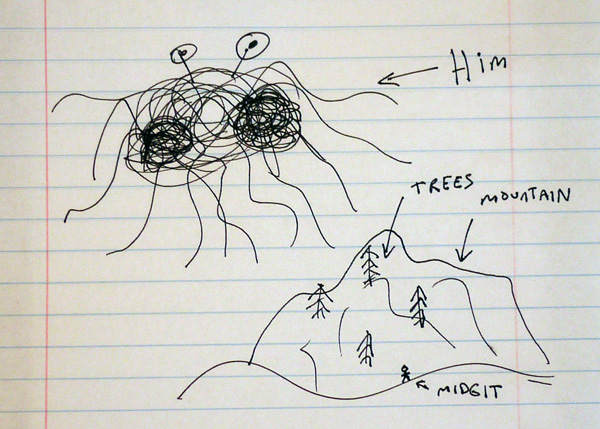
P.S. I have included an artistic drawing of Him creating a mountain, trees, and a midget. Remember, we are all His creatures.

On the Preachers of Death

There are preachers of death; and the earth is full of those to whom one must preach renunciation of life. The earth is full of the superfluous; life is spoiled by the all-too-many. May they be lured from this life with the “eternal life”! Yellow the preachers of death wear, or black. But I want to show them to you in still other colors.

There are the terrible ones who carry around within themselves the beast of prey and have no choice but lust or self-laceration. And even their lust is still self-laceration. They have not even become human beings yet, these terrible ones: let them preach renunciation of life and pass away themselves!

There are those with consumption of the soul: hardly are they born when they begin to die and to long for doctrines of weariness and renunciation. They would like to be dead, and we should welcome their wish. Let us beware of waking the dead and disturbing these living coffins!

They encounter a sick man or an old man or a corpse, and immediately they say, “Life is refuted.” But only they themselves are refuted, and their eyes, which see only this one face of existence. Shrouded in thick melancholy and eager for the little accidents that bring death, thus they wait with clenched teeth. Or they reach for sweets while mocking their own childishness; they clutch the straw of their life and mock that they still clutch a straw. Their wisdom says, “A fool who stays alive – but such fools are we. And this is surely the most foolish thing about life.”

“Life is only suffering,” others say, and do not lie: see to it, then, that you cease! See to it, then, that the life which is only suffering ceases!

And let this be the doctrine of your virtue: “Thou shalt kill thyself! Thou shalt steal away!”

“Lust is sin,” says one group that preaches death; “let us step aside and beget no children.”

“Giving birth is troublesome,” says another group; “why go on giving birth? One bears only unfortunates!”

And they too are preachers of death.

“Pity is needed,” says the third group. “Take from me what I have! Take from me what I am! Life will bind me that much less!”

If they were full of pity through and through, they would make life insufferable for their neighbors. To be evil, that would be their real goodness. But they want to get out of life: what do they care that with their chains and presents they bind others still more tightly?

And, you, too, for whome life is furious work and unrest – are you not very weary of life? Are you not very ripe for the preaching of death? All of you to whome furious work is dear, and whatever is fast, new, and strange – you find it hard to bear yourselves; your industry is escape and the will to forget yourselves. If you believed more in life you would fling yourselves less to the moment. But you do not have contents enough in yourselves for waiting – and not even for idleness.

Everywhere the voice of those who preach death is heard; and the earth is full of those to whom one must preach death. Or “eternal life” – that is the same to me, if only they pass away quickly.

Thus spoke Zarathustra.

– Friedrich Nietzsche

Nothing from Nothing Ever Yet was Born

cathedral

When we hear the old bells ringing out on a Sunday morning, we ask ourselves: can it be possible? This is for a Jew, crucified two thousand years ago, who said he was the son of God. The proof for such a claim is wanting.

Within our times the Christian religion is surely an antiquity jutting out from a far-distant olden time; and the fact that people believe such a claim (while they are otherwise so strict in testing assertions) is perhaps the oldest part of this heritage. A god who conceives children with a mortal woman; a wise man who calls upon us to work no more, to judge no more, but to heed the signs of the imminent apocalypse; a justice that accepts the innocent man as a proxy sacrifice; someone who has his disciples drink his blood; prayers for miraculous interventions; sins against a god, atoned for by a god; fear of the afterlife, to which death is the gate; the figure of the cross as a symbol, in a time that no longer knows the purpose and shame of the cross—how horridly all this wafts over us, as from the grave of the ancient past! Are we to believe that such things are still believed?

–I cannot, at this place, avoid a sigh. There are days when I am visited by a feeling blacker than the blackest melancholy–contempt of man. Let me leave no doubt as to what I despise, whom I despise: it is the man of today, the man with whom I am unhappily contemporaneous. The man of today–I am suffocated by his foul breath! . . . Toward the past, like all who understand, I am full of tolerance, which is to say, generous self-control: with gloomy caution I pass through whole millenniums of this mad house of a world, call it “Christianity,” “Christian faith” or the “Christian church,” as you will–I take care not to hold mankind responsible for its lunacies. But my feeling changes and breaks out irresistibly the moment I enter modern times,our times. Our age knows better. . . What was formerly merely sickly now becomes indecent–it is indecent to be a Christian today. And here my disgust begins.–I look about me: not a word survives of what was once called “truth”; we can no longer bear to hear a priest pronounce the word. Even a man who makes the most modest pretensions to integrity must know that a theologian, a priest, a pope of today not only errs when he speaks, but actually lies–and that he no longer escapes blame for his lie through “innocence” or “ignorance.” The priest knows, as every one knows, that there is no longer any “God,” or any “sinner,” or any “Saviour”–that “free will” and the “moral order of the world” are lies–: serious reflection, the profound self-conquest of the spirit, allow no man to pretend that he does not know it. . . All the ideas of the church are now recognized for what they are–as the worst counterfeits in existence, invented to debase nature and all natural values; the priest himself is seen as he actually is–as the most dangerous form of parasite, as the venomous spider of creation. . – – We know, our conscience now knows–just what the real value of all those sinister inventions of priest and church has been and what ends they have served, with their debasement of humanity to a state of self-pollution, the very sight of which excites loathing,–the concepts “the other world,” “the last judgment,” “the immortality of the soul,” the “soul” itself: they are all merely so many in instruments of torture, systems of cruelty, whereby the priest becomes master and remains master. . . Every one knows this, but nevertheless things remain as before. What has become of the last trace of decent feeling, of self-respect, when our statesmen, otherwise an unconventional class of men and thoroughly anti-Christian in their acts, now call themselves Christians and go to the communion table? . . . A prince at the head of his armies, magnificent as the expression of the egoism and arrogance of his people–and yet acknowledging, without any shame, that he is a Christian! . . . Whom, then, does Christianity deny? what does it call “the world”? To be a soldier, to be a judge, to be a patriot; to defend one’s self; to be careful of one’s honour; to desire one’s own advantage; to be proud . . . every act of everyday, every instinct, every valuation that shows itself in a deed, is now anti-Christian: what a monster of falsehood the modern man must be to call himself nevertheless, and without shame, a Christian!–

Jesus said to his Jews: `The law was made for servants ? love God as I love him, as his son! What have we sons of God to do with morality!’

– Friedrich Nietzsche

Note #24719462

“They are all children of God, loved and created by the same heart of God… Where is my faith? Even deep down… there is nothing but emptiness and darkness… If there be God — please forgive me… Such deep longing for God… Repulsed, empty, no faith, no love, no zeal… What do I labor for? If there be no God, there can be no soul. If there be no soul then, Jesus, You also are not true… Jesus has a very special love for you. As for me, the silence and the emptiness is so great that I look and do not see, listen and do not hear.”

– Mother Teresa

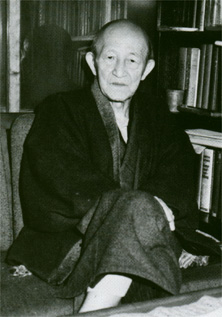
Nishitani

Nishitani

“My life as a young man can be described in a single phrase: it was a period absolutely without hope… My life at the time lay entirely in the grips of nihility and despair… My decision, then, to study philosophy was in fact – melodramatic as it might sound – a matter of life and death… In the little history of my soul, this decision meant a kind of conversion.”

– Keiji Nishitani, “Religion and Nothingness”

Nishitani’s Buddhist Response to Nihilism

“Man is spirit. But what is spirit? Spirit is the self. But what is the self? The self is a relation which relates itself to its own self, or it is that in the relation [which accounts for it] that the relation relates itself to its own self; the self is not the relation but [consists in the fact] that the relation relates itself to its own self.”

– Kierkegaard

Nietzsche & Buddhism

In India our religions will never take root. The ancient wisdom of the human race will not be displaced by what happened in Galilee. On the contrary, Indian philosophy streams back to Europe, and will produce a fundamental change in our knowledge and thought.

– Schopenhauer


It was precisely here that I saw the great danger to mankind, its sublimest enticement and seduction—but to what? to nothingness?—it was precisely here that I saw the beginning of the end, the dead stop, a retrospective weariness, the will turning against life, the tender and sorrowful signs of the ultimate illness: I understood the ever spreading morality of pity that had seized even on philosophers and made them ill, as the most sinister symptom of a European culture that had itself become sinister, perhaps as its by-pass to a new Buddhism? to a Buddhism for Europeans? to—nihilism?

The desire for a unio mystica with God is the desire of the Buddhist for nothingness, Nirvana—and no more!

– Friedrich Nietzsche

Nietzsche on Buddhism in The Antichrist

In my condemnation of Christianity I surely hope I do no injustice to a related religion with an even larger number of believers: I allude to Buddhism. Both are to be reckoned among the nihilistic religions–they are both decadence religions–but they are separated from each other in a very remarkable way. For the fact that he is able to compare them at all the critic of Christianity is indebted to the scholars of India.–Buddhism is a hundred times as realistic as Christianity–it is part of its living heritage that it is able to face problems objectively and coolly; it is the product of long centuries of philosophical speculation. The concept, “god,” was already disposed of before it appeared. Buddhism is the only genuinely positive religion to be encountered in history, and this applies even to its epistemology (which is a strict phenomenalism) –It does not speak of a “struggle with sin,” but, yielding to reality, of the “struggle with suffering.” Sharply differentiating itself from Christianity, it puts the self-deception that lies in moral concepts behind it; it is, in my phrase, beyond good and evil.–The two physiological facts upon which it grounds itself and upon which it bestows its chief attention are: first, an excessive sensitiveness to sensation, which manifests itself as a refined susceptibility to pain, and secondly, an extraordinary spirituality, a too protracted concern with concepts and logical procedures, under the influence of which the instinct of personality has yielded to a notion of the “impersonal.” (–Both of these states will be familiar to a few of my readers, the objectivists, by experience, as they are to me). These physiological states produced a depression, and Buddha tried to combat it by hygienic measures. Against it he prescribed a life in the open, a life of travel; moderation in eating and a careful selection of foods; caution in the use of intoxicants; the same caution in arousing any of the passions that foster a bilious habit and heat the blood; finally, no worry,either on one’s own account or on account of others. He encourages ideas that make for either quiet contentment or good cheer–he finds means to combat ideas of other sorts. He understands good, the state of goodness, as something which promotes health. Prayer is not included, and neither is asceticism. There is no categorical imperative nor any disciplines, even within the walls of a monastery (–it is always possible to leave–). These things would have been simply means of increasing the excessive sensitiveness above mentioned. For the same reason he does not advocate any conflict with unbelievers; his teaching is antagonistic to nothing so much as to revenge, aversion, ressentiment (–“enmity never brings an end to enmity”: the moving refrain of all Buddhism. . .) And in all this he was right, for it is precisely these passions which, in view of his main regiminal purpose, are unhealthful. The mental fatigue that he observes, already plainly displayed in too much “objectivity” (that is, in the individual’s loss of interest in himself, in loss of balance and of “egoism”), he combats by strong efforts to lead even the spiritual interests back to the ego. In Buddha’s teaching egoism is a duty. The “one thing needful,” the question “how can you be delivered from suffering,” regulates and determines the whole spiritual diet. (–Perhaps one will here recall that Athenian who also declared war upon pure “scientificality,” to wit, Socrates, who also elevated egoism to the estate of a morality).

The things necessary to Buddhism are a very mild climate, customs of great gentleness and liberality, and no militarism; moreover, it must get its start among the higher and better educated classes. Cheerfulness, quiet and the absence of desire are the chief desiderata, and they are attained. Buddhism is not a religion in which perfection is merely an object of aspiration: perfection is actually normal.–Under Christianity the instincts of the subjugated and the oppressed come to the fore: it is only those who are at the bottom who seek their salvation in it. Here the prevailing pastime, the favourite remedy for boredom is the discussion of sin, self-criticism, the inquisition of conscience; here the emotion produced by power (called “God”) is pumped up (by prayer); here the highest good is regarded as unattainable, as a gift, as “grace.” Here, too, open dealing is lacking; concealment and the darkened room are Christian. Here body is despised and hygiene is denounced as sensual; the church even ranges itself against cleanliness (–the first Christian order after the banishment of the Moors closed the public baths, of which there were 270 in Cordova alone). Christian, too; is a certain cruelty toward one’s self and toward others; hatred of unbelievers; the will to persecute. Sombre and disquieting ideas are in the foreground; the most esteemed states of mind, bearing the most respectable names are epileptoid; the diet is so regulated as to engender morbid symptoms and over-stimulate the nerves. Christian, again, is all deadly enmity to the rulers of the earth, to the “aristocratic”–along with a sort of secret rivalry with them (–one resigns one’s “body” to them–one wants only one’s “soul” . . . ).  And Christian is all hatred of the intellect, of pride, of courage of freedom, of intellectual libertinage; Christian is all hatred of the senses, of joy in the senses, of joy in general . . .

Buddhism is a religion for peoples in a further  state of development, for races that have become kind, gentle and over-spiritualized (–Europe is not yet ripe for it–): it is a summons  ‘that takes them back to peace and cheerfulness, to a careful rationing of  the spirit, to a certain hardening of the body. Christianity aims at  mastering beasts of prey; its modus operandi is to make them ill–to make feeble is the Christian recipe for taming, for  “civilizing.” Buddhism is a religion for the closing, over-wearied stages of civilization. Christianity appears before civilization has so much as  begun–under certain circumstances it lays the very foundations thereof.

Buddhism, I repeat, is a hundred times more austere, more honest, more objective. It no longer has to justify its pains, its susceptibility  to suffering, by interpreting these things in terms of sin–it simply says,  as it simply thinks, “I suffer.” To the barbarian, however, suffering in itself is scarcely understandable: what he needs, first of all, is an explanation as to why he suffers. (His mere instinct prompts him to deny his suffering altogether, or to endure it in silence.) Here the word  “devil” was a blessing: man had to have an omnipotent and terrible enemy–there was no need to be ashamed of suffering at the hands of such an enemy.

–At the bottom of Christianity there are several subtleties that belong to the Orient. In the first place, it knows that it is of very little consequence whether a thing be true or not, so long as it is believed to be true. Truth and faith: here we have two wholly distinct worlds of ideas, almost two diametrically opposite worlds–the road to the one and the road to the other lie miles apart. To understand that fact thoroughly–this is almost enough, in the Orient, to make one a sage. The Brahmins knew it, Plato knew it, every student of the esoteric knows it. When, for example, a man gets any pleasure out of the notion that he has been saved from sin, it is not necessary for him to be actually sinful, but merely to feel sinful. But when faith is  thus exalted above everything else, it necessarily follows that reason,  knowledge and patient inquiry have to be discredited: the road to the truth  becomes a forbidden road.–Hope, in its stronger forms, is a great deal more  powerful stimulans to life than any sort of realized joy can ever be.  Man must be sustained in suffering by a hope so high that no conflict with actuality can dash it–so high, indeed, that no fulfillment can satisfy it: a hope reaching out beyond this world. (Precisely because of this  power that hope has of making the suffering hold out, the Greeks regarded it  as the evil of evils, as the most malign of evils; it remained behind  at the source of all evil.)3–In order that love may be possible, God must become a  person; in order that the lower instincts may take a hand in the matter God must be young. To satisfy the ardor of the woman a beautiful saint must appear on the scene, and to satisfy that of the men there must be a virgin.  These things are necessary if Christianity is to assume lordship over a soil on which some aphrodisiacal or Adonis cult has already established a notion as to what a cult ought to be. To insist upon chastity greatly strengthens the vehemence and subjectivity of the religious instinct– it makes the cult warmer, more enthusiastic, more soulful.–Love is the state in which man sees things most decidedly as they are not. The force of illusion reaches its highest here, and so does the capacity for sweetening,  for transfiguring. When a man is in love he endures more than at any other time; he submits to anything. The problem was to devise a religion  which would allow one to love: by this means the worst that life has to  offer is overcome–it is scarcely even noticed.–So much for the three  Christian virtues: faith, hope and charity: I call them the three Christian ingenuities.–Buddhism is in too late a stage of development, too  full of positivism, to be shrewd in any such way.–

One now begins to see just what it was that came to an end with the death on the cross: a new and thoroughly original effort to found a Buddhistic peace movement, and so establish happiness on earth–real, not merely promised. For this remains–as I have  already pointed out–the essential difference between the two religions of decadence: Buddhism promises nothing, but actually fulfills;  Christianity promises everything, but fulfills nothing.–

When the centre of gravity of life is placed, not in life itself,  but in “the beyond”–in nothingness–then one has taken away its centre of gravity altogether. The vast lie of personal immortality destroys all reason, all natural instinct–henceforth, everything in the instincts that is beneficial, that fosters life and that safeguards the future is a cause of suspicion. So to live that life no longer has any meaning: this is now the “meaning” of life.

. . .

If there is no other world and there is no fruit and ripening of actions well done or ill done, then here and now in this life I shall be free from hostility, affliction, and anxiety, and I shall live happily.

– Buddha

Further Reading

The Antichrist by Friedrich Nietzsche

God Is Dead: What Next?

Nietzsche and Buddhism

The Buddha and Nietzsche (YouTube)

Nietzsche and Early Buddhism Book Review

Nietzsche’s Anti-Christ: Jesus and Buddhism

Meta-Physical Non-Sense

Arguments for and against the Existence of God

The polytheistic conceptions of God were criticized and derided by the monotheistic religions. Since the Enlightenment, monotheistic concepts have also come under criticism from atheism and pantheism.

Definition of God

For our use here, we mean by the term “God” that entity written about in the holy books of monotheistic religions, which generally includes the properties of omniscience, omnipresence, omnipotence, and omnislash.

Arguments for the Existence of God

Philosophers have tried to provide rational proofs of God’s existence that go beyond dogmatic assertion or appeal to ancient scripture. The major proofs, with their corresponding objections, are as follows:

  1. Ontological Argument:

It is possible to imagine a perfect being. Such a being could not be perfect unless its essence included existence. Therefore a perfect being must exist. That perfect being is God.

Objection: You cannot define or imagine a thing into existence. Existence is not a predicate.

  1. Cosmological Argument:

Everything must have a cause. It is impossible to continue backwards to infinity with causes, therefore there must have been a first cause which was not conditioned by any other cause. That cause must be God.

Objections: If you allow one thing to exist without cause, you contradict your own premise. And if you do, there is no reason why the universe should not be the one thing that exists or originates without cause. Also, proof of an “unmoved mover” or a first cause tells us nothing about that cause, be it God or King Kong.

  1. Teleological Argument:

Animals, plants and planets show clear signs of being designed for specific ends, therefore there must have been a designer. Therefore, God exists.

Objection: The principles of self-organization and evolution provide complete explanations for apparent design. Once again, even if this argument is accepted as valid it would tell us nothing about this universal architect, be it God or King Kong.

3a. Modern Design Argument:

The Anthropic Cosmological Principle: The laws of the universe seem to have been framed in such a way that stars and planets will form and life can emerge. Many constants of nature appear to be very finely tuned for this, and the odds against this happening by chance are astronomical. Therefore, God exists.

Objections: The odds against all possible universes are equally astronomical, yet one of them must be the actual universe. Moreover, if there are very many universes, then some of these will contain the possibility of life. Kant argued that any form of the cosmological argument is in fact the ontological argument in disguise. Even if valid, the anthropic cosmological principle guarantees only that stars and planets and life will emerge – not intelligent life. In its weak form, the anthropic cosmological principle merely states that if we are here to observe the universe, it follows that the universe must have properties that permit intelligent life to emerge.

  1. Experiential:

A very large number of people claim to have personal religious experiences of God.

Objections: We cannot assume that everything imagined in mental experiences (which include dreams, hallucinations etc.) actually exists. Such experiences cannot be repeated, tested or publicly verified. Mystical and other personal experiences can be explained by other causes.

  1. Pragmatic:

Human societies require ethics to survive. Ethics are more effectively enforced if people fear God and Hell and hope for Heaven (cf. the origin of ethical systems).

Objections: The usefulness of a belief does not prove its truth. In any case, many societies have thrived without these beliefs, while crime has thrived in theistic societies believing in heaven and hell. Moreover, ethics can be completely seperated from religion (e.g. virtue ethics).

General objection against all the rational proofs for God:

Each of the above arguments is independent of the others and cannot logically be used to reinforce the others.

The cosmological argument – even if it were valid – would prove only a first cause. It would tell us nothing about the nature of that cause, nor whether the cause was mental or physical. It would not prove that the first cause was the personal, judging, forgiving God of Judaism, Christianity, or Islam. It would not prove the existence of a designer or of a perfect being. Equally, the design argument would prove only a designer, the ontological argument would prove only the existence of a perfect being, and so on. None of these arguments individually can prove that the cause, designer or perfect being were one and the same – they could be three different beings.

Arguments against the existence of God

The major philosophical criticisms of God as viewed by Judaism, Christianity and Islam are as follows:

1. Evil:
Because evil exists, God cannot be all-powerful. all-knowing and loving and good at the same time.
2. Pain:
Because God allows pain, disease and natural disasters to exist, he cannot be all-powerful and also loving and good in the human sense of these words.
3. Injustice:
Destinies are not allocated on the basis of merit or equality. They are allocated either arbitrarily, or on the principle of “to him who has, shall be given, and from him who has not shall be taken even that which he has.” It follows that God cannot be all-powerful and all-knowing and also just in the human sense of the word.
4. Multiplicity:
Since the Gods of various religions differ widely in their characteristics, only one of these religions, or none, can be right about God.
5. Simplicity:
Since God is invisible, and the universe is no different than if he did not exist, it is simpler to assume he does not exist (see Occam’s Razor).None of these criticisms apply to the God of pantheism, which is identical with the universe and nature.

Source: Principia Cybernetica Web


“When one man investigates objectively the problem of immortality, and another embraces an uncertainty with the passion of the infinite: where is there most truth, and who has the greater certainty? The one has entered upon a never-ending approximation, for the certainty of immortality lies precisely in the subjectivity of the individual; the other is immortal, and fights for his immortality by struggling with the uncertainty. Let us consider Socrates. Nowadays everyone dabbles in a few proofs; some have several such proofs, others fewer. But Socrates! He puts the question objectively in a problematic manner: if there is an immortality. He must therefore be accounted a doubter in comparison with one of our modern thinkers with the three proofs? By no means. On this “if” he risks his entire life, he has the courage to meet death, and he has with the passion of the infinite so determined the pattern of his life that it must be found acceptable – if there is an immortality. Is any better proof capable of being given for the immortality of the soul? But those who have the three proofs do not at all determine their lives in conformity therewith; if there is an immortality it must feel disgust over their manner of life: can any better refutation be given of the three proofs? The bit of uncertainty that Socrates had, helped him because he himself contributed the passion of the infinite; the three proofs that the others have do not profit them at all, because they are dead to spirit and enthusiasm, and their three proofs, in lieu of proving anything else, prove just this. A young girl may enjoy all the sweetness of love on the basis of what is merely a weak hope that she is beloved, because she rests everything on this weak hope; but many a wedded matron more than once subjected to the strongest expressions of love, has in so far indeed had proofs, but strangely enough has not enjoyed quod erat demonstrandum.”

– Kierkegaard

“If these glad tidings of your Bible were written on your faces, you would not need to insist so obstinately on the authority of that book… As things are, however, all your apologies for Christianity have their roots in your lack of Christianity; with your defence plea you inscribe your own bill of indictment.”

“In former times, one sought to prove that there is no God – today one indicates how the belief that there is a God arose and how this belief acquired its weight and importance: a counter-proof that there is no God thereby becomes superfluous.- When in former times one had refuted the ‘proofs of the existence of God’ put forward, there always remained the doubt whether better proofs might not be adduced than those just refuted: in those days atheists did not know how to make a clean sweep.”

“After Buddha was dead, his shadow was still shown for centuries in a cave – a tremendous, gruesome shadow. God is dead; but given the way of men, there may still be caves for thousands of years in which his shadow will be shown. -And we- we still have to vanquish his shadow, too.”

– Nietzsche

Further Reading

Natural Theology & Classical Apologetics

http://en.wikipedia.org/wiki/Alvin_Plantinga

http://en.wikipedia.org/wiki/Existence_of_God

Christian Apologetics and Research Ministry

Christian Apologetics by Norman Geisler

The God Delusion by Richard Dawkins

And of course: Nietzsche and Kierkegaard