Philosophy Primary Sources II

library

This post will serve as Part II of Philosophy Primary Sources and a supplement to Primary Sources & Encyclopedias (check out the Links section for even more research sources). There are certain books that are essential to an education about the human condition of which I believe should be available for free and with easy access to everybody. This list is more comprehensive and nuanced than the previous list, as it includes books that hold cultural significance in various fields of study. Each book on this list is in PDF format. I have organized them by topic (many topics intersect) and the last name of the author.


Philosophy

The Life of the Mind by Hannah Arendt

The Human Condition by Hannah Arendt

Language, Truth, and Logic by A.J. Ayer

The Problem of Knowledge by A.J. Ayer

Selected Writings of Jean Baudrillard

The Second Sex by Simone de Beauvoir

The Ethics of Ambiguity by Simone de Beauvoir

Matter and Memory by Henri Bergson

An Introduction to Metaphysics by Henri Bergson

I and Thou by Martin Buber

The Myth of Sisyphus and Other Essays by Albert Camus

The Rebel by Albert Camus

Language and Mind by Noam Chomsky

The God Delusion by Richard Dawkins

Nietzsche and Philosophy by Gilles Deleuze

What is Philosophy? by Gilles Deleuze & Félix Guattari

Darwin’s Dangerous Idea by Daniel Dennett

Speech and Phenomena & Other Essays by Jacques Derrida

Dissemination by Jacques Derrida

In Praise of Folly by Desiderius Erasmus

The Vocation of Man by Johann Gottlieb Fichte

The Science of Knowledge by Johann Gottlieb Fichte

The Archaeology of Knowledge & The Discourse on Language by Michel Foucault

Selected Writings of Mahatma Gandhi

Being and Time by Martin Heidegger

The Question Concerning Technology & Other Essays by Martin Heidegger

What is Metaphysics? by Martin Heidegger

God is Not Great by Christopher Hitchens

Logical Investigations by Edmund Husserl

Reason and Existenz by Karl Jaspers

Fear and Trembling by Søren Kierkegaard

The Sickness Unto Death by Søren Kierkegaard

Philosophical Fragments by Søren Kierkegaard

Last Writings: Nothingness and the Religious Worldview by Nishida Kitar?

The Levinas Reader edited by Sáun Hand

The Postmodern Condition by Jean-François Lyotard

Essays of Michel de Montaigne

On the Genealogy of Morals by Friedrich Nietzsche

The Portable Nietzsche edited by Walter Kaufmann

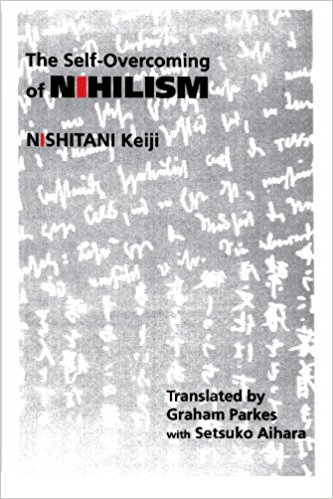
The Self-Overcoming of Nihilism by Keiji Nishitani

Philosophical Explanations by Robert Nozick

Man Has No Nature by José Ortega y Gasset

The Age of Reason by Thomas Paine

Pensées by Blaise Pascal

The Morals of Plutarch

The Virtue of Selfishness by Ayn Rand

Contingency, Irony, and Solidarity by Richard Rorty

Philosophy and the Mirror of Nature by Richard Rorty

The Confessions of Jean-Jacques Rousseau

Free Thought & Official Propaganda by Bertrand Russell

In Praise of Idleness by Bertrand Russell

Mysticism and Logic: And Other Essays by Bertrand Russell

Being and Nothingness by Jean-Paul Sartre

Existentialism is a Humanism by Jean-Paul Sartre

The World as Will and Representation – Vol. 1 by Arthur Schopenhauer

The World as Will and Representation – Vol. 2 by Arthur Schopenhauer

The Basis of Morality by Arthur Schopenhauer

My View of the World (Excerpt) by Erwin Schrödinger

Athens and Jerusalem by Lev Shestov

The Ego and His Own by Max Stirner

The Courage to Be by Paul Tillich

The Eternal Now by Paul Tillich

Weak Thought edited by Gianni Vattimo and Pier Aldo Rovatti

The Wisdom of Insecurity by Alan Watts

Philosophical Investigations by Ludwig Wittgenstein


Science

The Essays of Francis Bacon

The New Organon by Francis Bacon

The Grounds for and Excellence of the Corpuscular or Mechanical Philosophy by Robert Boyle

On the Revolutions of the Heavenly Spheres (Dedication) by Nicolaus Copernicus

On the Origin of Species by Means of Natural Selection by Charles Darwin

The Blind Watchmaker by Richard Dawkins

The Selfish Gene by Richard Dawkins

The Principles of Quantum Mechanics by Paul Dirac

Relativity: The Special and General Theory by Albert Einstein

The Assayer by Galileo Galilei

Dialogues Concerning the Two Chief World Systems by Galileo Galilei

A Brief History of Time by Stephen Hawking

Physics and Philosophy: The Revolution in Modern Science by Werner Heisenberg

The Grand Design by Stephen Hawking & Leonard Mlodinow

Treatise on Light by Christiaan Huygens

The Structure of Scientific Revolutions by Thomas Kuhn

The Copernican Revolution by Thomas Kuhn

The Mathematical Principles of Natural Philosophy by Sir Isaac Newton

Science and Hypothesis by Henri Poincaré

What is Life? by Erwin Schrödinger

Mind and Matter by Erwin Schrödinger

The Physics of the Healing by Ibn Sīnā (Avicenna)


Psychology

Man’s Search for Meaning by Viktor Frankl

The Complete Works of Sigmund Freud

The Principles of Psychology: Volume I by William James

The Principles of Psychology: Volume II by William James

Man and his Symbols by Carl Jung

Memories, Dreams, Reflection by Carl Jung

Écrits by Jacques Lacan

Religions, Values, and Peak Experiences by Abraham Maslow

Cognitive Psychology by Ulric Neisser

Verbal Behavior by B.F. Skinner


Literature

The Tragedies of Aeschylus

The Divine Comedy by Dante Alighieri

Don Quixote by Miguel de Cervantes

The Brothers Karamazov by Fyodor Dostoevsky

Crime and Punishment by Fyodor Dostoevsky

Notes from the Underground by Fyodor Dostoevsky

Euripides: Ion, Hippolytus, Medea, & Alcestis

Faust by Johann Wolfgang von Goethe

The Iliad of Homer

The Odyssey of Homer

Brave New World by Aldous Huxley

The Complete Stories of Franz Kafka

Paradise Lost by John Milton

1984 by George Orwell

Animal Farm by George Orwell

In Search of Lost Time by Marcel Proust

Atlas Shrugged by Ayn Rand

The Fountainhead by Ayn Rand

Letters to a Young Poet by Rainer Maria Rilke

The Notes of Malte Laurids Brigge by Rainer Maria Rilke

The Complete Works of William Shakespeare

The Tragedies of Sophocles

Walden by Henry David Thoreau

War and Peace by Leo Tolstoy

Candide by Voltaire

Player Piano by Kurt Vonnegut

Note: Planet Publish hosts a vast selection of literature in PDF format available for free.


Religious

A Study of Dōgen by Masao Abe

Deliverance from Error by Al-Ghazali

The Incoherence of the Philosophers by Al-Ghazali

The Summa Theologica by Thomas Aquinas

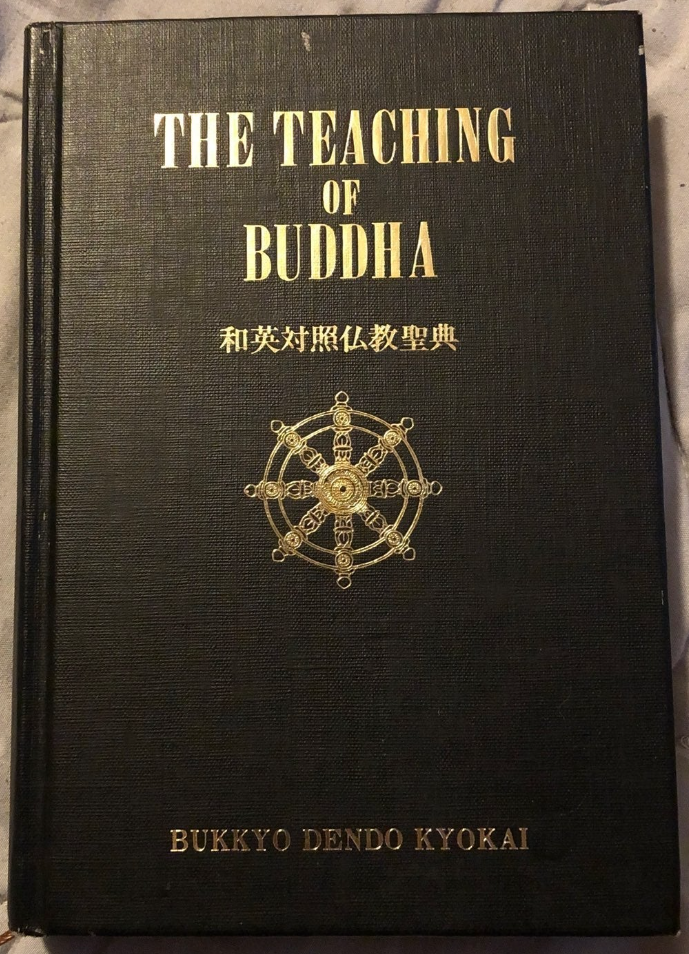
The Teaching of Buddha

Institutes of the Christian Religion by John Calvin

The Analects of Confucius

The Vedas compiled by the Dharmic Scriptures Team

On Divine Names & Mystical Theology by Pseudo-Dionysius the Areopagite

The Shōbōgenzō: Volume I by Eihei Dōgen

The Shōbōgenzō: Volume II by Eihei Dōgen

The Shōbōgenzō: Volume III by Eihei Dōgen

The Shōbōgenzō: Volume IV by Eihei Dōgen

Dōgen’s Extensive Record: A Translation of the Eihei Kōroku

The Tibetan Book of the Dead edited by W. Y. Evans-Wentz

The Essence of Christianity by Ludwig Feuerbach

Christian Apologetics by Norman Geisler

Philosophy of Religion by Norman Geisler

The Principia Discordia by Greg Hill and Kerry Wendell Thornley

The Perennial Philosophy by Aldous Huxley

The Guide for the Perplexed by Moses Maimonides

The Mūlamadhyamakakārikā of Nāgārjuna

On Buddhism by Keiji Nishitani

The Upanishads translated by Swami Paramananda

On the Harmony of Religion and Philosophy by Ibn Rushd (Averroes)

The Incoherence of the Incoherence by Ibn Rushd (Averroes)

Forgotten Truth by Huston Smith

An Introduction to Zen Buddhism by D.T. Suzuki

The Bhagavad Gita translated by Shri Purohit Swami

The New Being by Paul Tillich

The Way of Zen by Alan Watts

Note: Internet Sacred Text Archive hosts an archive of online books about religion, mythology, folklore and the esoteric (including the writings of the early church fathers).


Historical

World History: Patterns of Interaction by Beck, et al.

The Diary of a Young Girl by Anne Frank

The Decline and Fall of the Roman Empire: Volume I by Edward Gibbon

The Decline and Fall of the Roman Empire: Volume II by Edward Gibbon

The Decline and Fall of the Roman Empire: Volume III by Edward Gibbon

The Decline and Fall of the Roman Empire: Volume IV by Edward Gibbon

The Decline and Fall of the Roman Empire: Volume V by Edward Gibbon

The Decline and Fall of the Roman Empire: Volume VI by Edward Gibbon

The Histories of Herodotus

I Have a Dream by Martin Luther King Jr.

The History of Rome by Titus Livius

The History of Western Philosophy by Bertrand Russell

Anti-Semite and Jew: An Exploration of the Etiology of Hate by Jean-Paul Sartre

The Decline of the West by Oswald Spengler

The Annals of Tacitus

The History of the Peloponnesian War by Thucydides

Note: Project Gutenberg and the Internet Archive are excellent sources of historical writings and much more. Ancient Greek and Roman histories can be found at Loebolus.


Important Historical Documents

Magna Carta Libertatum (Great Charter of Liberties)

Universal Declaration of Human Rights

The Code of Hammurabi

Note: OurDocuments.gov hosts a list of 100 milestone documents, compiled by the National Archives and Records Administration, and drawn primarily from its nationwide holdings. The documents chronicle United States history from 1776 to 1965.


Political & Social Theory

On the Reproduction of Capitalism by Louis Althusser

An Introduction to The Principles of Morals and Legislation by Jeremy Bentham

Understanding Power: The Indispensable Chomsky

Anti-Oedipus: Capitalism & Schizophrenia by Gilles Deleuze & Félix Guattari

Discipline and Punish: The Birth of the Prison by Michel Foucault

The History of Sexuality by Michel Foucault

Madness and Civilization by Michel Foucault

The Theory of Communicative Action by Jürgen Habermas

Between Facts and Norms by Jürgen Habermas

Leviathan by Thomas Hobbes

Dialectic of Enlightenment by Max Horkheimer and Theodor Adorno

The General Theory of Employment, Interest, and Money by John Maynard Keynes

Structural Anthropology by Claude Lévi-Strauss

The Savage Mind by Claude Lévi-Strauss

The Prince by Niccolò Machiavelli

Capital: Critique of Political Economy, Volume I by Karl Marx

Capital: Critique of Political Economy, Volume II by Karl Marx

Capital: Critique of Political Economy, Volume III by Karl Marx

Economic and Philosophic Manuscripts of 1844 by Karl Marx

The German Ideology by Karl Marx & Friedrich Engels

Areopagitica by John Milton

The Spirit of Laws by Montesquieu

A Theory of Justice by John Rawls

Émile, or Concerning Education by Jean-Jacques Rousseau

The Origin of Inequality by Jean-Jacques Rousseau

The Social Contract by Jean-Jacques Rousseau

The Wealth of Nations by Adam Smith

Civil Disobedience by Henry David Thoreau

Writings of Leon Trotsky

The Theory of the Leisure Class by Thorstein Veblen

The Protestant Ethic and the Spirit of Capitalism by Max Weber


Check out the Links Section for more sources of primary texts and general research.

The Teaching of Buddha

“Both formerly and now, it is only suffering that I describe, and the cessation of suffering.”

– Siddhārtha Gautama

The Teaching of Buddha is a collection of writings on the essence of Buddhism, selected and edited from the vast Buddhist canon, presented in a concise, easy-to-read, and nonsectarian format. It also includes a brief history of Buddhism, a listing of the source texts, a glossary of Sanskrit terms, and an index.

You can get this book for FREE from Bukkyō Dendō Kyōkai America, the Society for the Promotion of Buddhism. I prefer to read this book as a philosophy of life, a different perspective on things, rather than a religious dogma. There are some great lessons to be found within this book and within yourself while reading it. Siddhārtha Gautama tackles some tough philosophical questions, of which Western philosophers have been dealing with for centuries, from a unique perspective. I would suggest reading On Buddhism by Keiji Nishitani (PDF) as a companion to this book.

Do not believe in anything simply because you have heard it. Do not believe in anything simply because it is spoken and rumored by many. Do not believe in anything simply because it is found written in your religious books. Do not believe in anything merely on the authority of your teachers and elders. Do not believe in traditions because they have been handed down for many generations. But after observation and analysis, when you find that anything agrees with reason and is conducive to the good and benefit of one and all, then accept it and live up to it.

The Teaching of Buddha (PDF)

Schopenhauer

“In India our religions will never take root. The ancient wisdom of the human race will not be displaced by what happened in Galilee. On the contrary, Indian philosophy streams back to Europe, and will produce a fundamental change in our knowledge and thought.”

– Arthur Schopenhauer
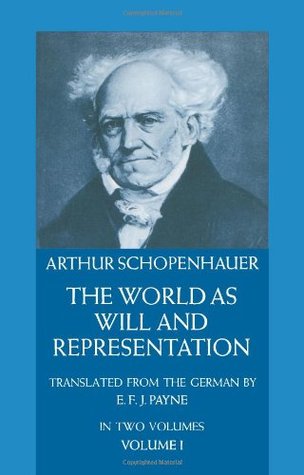
the-world-as-will-and-representation

Full Book (PDF): The World as Will and Representation – Volume I – Volume II

Full Book (PDF): On the Basis of Morality

Schopenhauer’s Thought

A key focus of Schopenhauer was his investigation of individual motivation. Before Schopenhauer, Hegel had popularized the concept of Zeitgeist, the idea that society consisted of a collective consciousness that moved in a distinct direction, dictating the actions of its members. Schopenhauer, a reader of both Kant and Hegel, criticized their logical optimism and the belief that individual morality could be determined by society and reason. Schopenhauer believed that humans were motivated by only their own basic desires, or Wille zum Leben (“Will to Live”), which directed all of mankind.

For Schopenhauer, human desire was futile, illogical, directionless, and, by extension, so was all human action in the world. Einstein paraphrased his views as follows: “Man can indeed do what he wants, but he cannot will what he wants.” In this sense, he adhered to the Fichtean principle of idealism: “The world is for a subject.” This idealism so presented, immediately commits it to an ethical attitude, unlike the purely epistemological concerns of Descartes and Berkeley. To Schopenhauer, the Will is a blind force that controls not only the actions of individual, intelligent agents, but ultimately all observable phenomena—an evil to be terminated via mankind’s duties: asceticism and chastity. He is credited with one of the most famous opening lines of philosophy: “The world is my representation.” Will, for Schopenhauer, is what Kant called the “thing-in-itself”. Friedrich Nietzsche was greatly influenced by this idea of Will, although he eventually rejected it.

For Schopenhauer, human desiring, “willing”, and craving cause suffering or pain. A temporary way to escape this pain is through aesthetic contemplation (a method comparable to Zapffe’s “Sublimation“). Aesthetic contemplation allows one to escape this pain—albeit temporarily—because it stops one perceiving the world as mere presentation. Instead, one no longer perceives the world as an object of perception (therefore as subject to the Principle of Sufficient Grounds; time, space and causality) from which one is separated; rather one becomes one with that perception: “one can thus no longer separate the perceiver from the perception” (The World as Will and Representation, section 34). From this immersion with the world one no longer views oneself as an individual who suffers in the world due to one’s individual will but, rather, becomes a “subject of cognition” to a perception that is “Pure, will-less, timeless” (section 34) where the essence, “ideas”, of the world are shown. Art is the practical consequence of this brief aesthetic contemplation as it attempts to depict one’s immersion with the world, thus tries to depict the essence/pure ideas of the world. Music, for Schopenhauer, was the purest form of art because it was the one that depicted the will itself without it appearing as subject to the Principle of Sufficient Grounds, therefore as an individual object. According to Daniel Albright, “Schopenhauer thought that music was the only art that did not merely copy ideas, but actually embodied the will itself”.

He deemed music a timeless, universal language comprehended everywhere, that can imbue global enthusiasm, if in possession of a significant melody.

Will as Noumenon

Schopenhauer accepted Kant’s double-aspect of the universe—the phenomenal (world of experience) and the noumenal (the true world, independent of experience). Some commentators suggest that Schopenhauer claimed that the noumenon, or thing-in-itself, was the basis for Schopenhauer’s concept of the will. Other commentators suggest that Schopenhauer considered will to be only a subset of the “thing-in-itself” class, namely that which we can most directly experience.

Schopenhauer’s identification of the Kantian noumenon (i.e., the actually existing entity) with what he termed “will” deserves some explanation. The noumenon was what Kant called the Ding an sich (the Thing in Itself), the reality that is the foundation of our sensory and mental representations of an external world. In Kantian terms, those sensory and mental representations are mere phenomena. Schopenhauer departed from Kant in his description of the relationship between the phenomenon and the noumenon. According to Kant, things-in-themselves ground the phenomenal representations in our minds; Schopenhauer, on the other hand, believed that phenomena and noumena are two different sides of the same coin. Noumena do not cause phenomena, but rather phenomena are simply the way by which our minds perceive the noumena, according to the principle of sufficient reason.

Schopenhauer’s second major departure from Kant’s epistemology concerns the body. Kant’s philosophy was formulated as a response to the radical philosophical skepticism of David Hume, who claimed that causality could not be observed empirically. Schopenhauer begins by arguing that Kant’s demarcation between external objects, knowable only as phenomena, and the Thing in Itself of noumenon, contains a significant omission. There is, in fact, one physical object we know more intimately than we know any object of sense perception: our own body.

We know our human bodies have boundaries and occupy space, the same way other objects known only through our named senses do. Though we seldom think of our body as a physical object, we know even before reflection that it shares some of an object’s properties. We understand that a watermelon cannot successfully occupy the same space as an oncoming truck; we know that if we tried to repeat the experiment with our own body, we would obtain similar results—we know this even if we do not understand the physics involved.

We know that our consciousness inhabits a physical body, similar to other physical objects only known as phenomena. Yet our consciousness is not commensurate with our body. Most of us possess the power of voluntary motion. We usually are not aware of the breathing of our lungs or the beating of our heart unless somehow our attention is called to them. Our ability to control either is limited. Our kidneys command our attention on their schedule rather than one we choose. Few of us have any idea what our liver is doing right now, though this organ is as needful as lungs, heart, or kidneys. The conscious mind is the servant, not the master, of these and other organs. These organs have an agenda the conscious mind did not choose, and over which it has limited power.

When Schopenhauer identifies the noumenon with the desires, needs, and impulses in us that we name “will”, what he is saying is that we participate in the reality of an otherwise unachievable world outside the mind through will. We cannot prove that our mental picture of an outside world corresponds with a reality by reasoning; through will, we know—without thinking—that the world can stimulate us. We suffer fear, or desire: these states arise involuntarily; they arise prior to reflection; they arise even when the conscious mind would prefer to hold them at bay. The rational mind is, for Schopenhauer, a leaf borne along in a stream of pre-reflective and largely unconscious emotion. That stream is will, and through will, if not through logic, we can participate in the underlying reality beyond mere phenomena. It is for this reason that Schopenhauer identifies the noumenon with what we call our will.

In his criticism of Kant, Schopenhauer claimed that sensation and understanding are separate and distinct abilities. Yet, for Kant, an object is known through each of them. Kant wrote: “[T]here are two stems of human knowledge … namely, sensibility and understanding, objects being given by the former [sensibility] and thought by the latter [understanding].” Schopenhauer disagreed. He asserted that mere sense impressions, not objects, are given by sensibility. According to Schopenhauer, objects are intuitively perceived by understanding and are discursively thought by reason (Kant had claimed that (1) the understanding thinks objects through concepts and that (2) reason seeks the unconditioned or ultimate answer to “why?”). Schopenhauer said that Kant’s mistake regarding perception resulted in all of the obscurity and difficult confusion that is exhibited in the Transcendental Analytic section of his critique.

Lastly, Schopenhauer departed from Kant in how he interpreted the Platonic ideas. In The World as Will and Representation Schopenhauer explicitly stated:

…Kant used the word [Idea] wrongly as well as illegitimately, although Plato had already taken possession of it, and used it most appropriately.

Instead Schopenhauer relied upon the Neoplatonist interpretation of the biographer Diogenes Laërtius from Lives and Opinions of Eminent Philosophers. In reference to Plato’s Ideas, Schopenhauer quotes Laërtius verbatim in an explanatory footnote.

Diogenes Laërtius (III, 12): Plato teaches that the Ideas exist in nature, so to speak, as patterns or prototypes, and that the remainder of things only resemble them, and exist as their copies.
schopenhauer_statue

Moral Theory

Schopenhauer’s moral theory proposed that only compassion can drive moral acts. According to Schopenhauer, compassion alone is the good of the object of the acts, that is, they cannot be inspired by either the prospect of personal utility or the feeling of duty. Mankind can also be guided by egoism and malice. Egotistic acts are those guided by self-interest, desire for pleasure or happiness. Schopenhauer believed most of our deeds belong to this class. Acts of malice are different from egotistic acts. As in the case of acts of compassion, these do not target personal utility. Their aim is to cause damage to others, independently of personal gains. He believed, like Swami Vivekananda in the unity of all with one-self and also believed that ego is the origin of pain and conflicts, that reduction of ego frames the moral principles.

Even though Schopenhauer ended his treatise on the freedom of human will with the postulate of everyone’s responsibility for their character and, consequently, acts—the responsibility following from one’s being the Will as noumenon (from which also all the characters and creations come)—he considered his views incompatible with theism, on grounds of fatalism and, more generally, responsibility for evil. In Schopenhauer’s philosophy the dogmas of Christianity lose their significance, and the “Last Judgment” is no longer preceded by anything—”The world is itself the Last Judgment on it.” Whereas God, if he existed, would be evil.

He named a force within man that he felt took invariable precedence over reason: the Will to Live or Will to Life (Wille zum Leben), defined as an inherent drive within human beings, and indeed all creatures, to stay alive; a force that inveigles us into reproducing.

Schopenhauer refused to conceive of love as either trifling or accidental, but rather understood it as an immensely powerful force that lay unseen within man’s psyche and dramatically shaped the world:

The ultimate aim of all love affairs … is more important than all other aims in man’s life; and therefore it is quite worthy of the profound seriousness with which everyone pursues it. What is decided by it is nothing less than the composition of the next generation.
young_schopenhauer

Influence of Eastern Thought

Schopenhauer read the Latin translation of the ancient Hindu texts, The Upanishads, which French writer Anquetil du Perron had translated from the Persian translation of Prince Dara Shikoh entitled Sirre-Akbar (“The Great Secret”). He was so impressed by their philosophy that he called them “the production of the highest human wisdom”, and believed they contained superhuman concepts. The Upanishads was a great source of inspiration to Schopenhauer. Writing about them, he said:

It is the most satisfying and elevating reading (with the exception of the original text) which is possible in the world; it has been the solace of my life and will be the solace of my death.

It is well known that the book Oupnekhat (Upanishad) always lay open on his table, and he invariably studied it before sleeping at night. He called the opening up of Sanskrit literature “the greatest gift of our century”, and predicted that the philosophy and knowledge of the Upanishads would become the cherished faith of the West.

Schopenhauer was first introduced to the 1802 Latin Upanishad translation through Friedrich Majer. They met during the winter of 1813–1814 in Weimar at the home of Schopenhauer’s mother according to the biographer Safranski. Majer was a follower of Herder, and an early Indologist. Schopenhauer did not begin a serious study of the Indic texts, however, until the summer of 1814. Sansfranski maintains that between 1815 and 1817, Schopenhauer had another important cross-pollination with Indian thought in Dresden. This was through his neighbor of two years, Karl Christian Friedrich Krause. Krause was then a minor and rather unorthodox philosopher who attempted to mix his own ideas with that of ancient Indian wisdom. Krause had also mastered Sanskrit, unlike Schopenhauer, and the two developed a professional relationship. It was from Krause that Schopenhauer learned meditation and received the closest thing to expert advice concerning Indian thought.

Most noticeable, in the case of Schopenhauer’s work, was the significance of the Chandogya Upanishad, whose Mahavakya, Tat Tvam Asi is mentioned throughout The World as Will and Representation.

Schopenhauer noted a correspondence between his doctrines and the Four Noble Truths of Buddhism. Similarities centered on the principles that life involves suffering, that suffering is caused by desire (taṇhā), and that the extinction of desire leads to liberation. Thus three of the four “truths of the Buddha” correspond to Schopenhauer’s doctrine of the will. In Buddhism, however, while greed and lust are always unskillful, desire is ethically variable – it can be skillful, unskillful, or neutral.

For Schopenhauer, Will had ontological primacy over the intellect; in other words, desire is understood to be prior to thought. Schopenhauer felt this was similar to notions of puruṣārtha or goals of life in Vedānta Hinduism.

In Schopenhauer’s philosophy, denial of the will is attained by either:

  • personal experience of an extremely great suffering that leads to loss of the will to live; or
  • knowledge of the essential nature of life in the world through observation of the suffering of other people.

However, Buddhist nirvāṇa is not equivalent to the condition that Schopenhauer described as denial of the will. Nirvāṇa is not the extinguishing of the person as some Western scholars have thought, but only the “extinguishing” (the literal meaning of nirvana) of the flames of greed, hatred, and delusion that assail a person’s character. Occult historian Joscelyn Godwin (1945– ) stated, “It was Buddhism that inspired the philosophy of Arthur Schopenhauer, and, through him, attracted Richard Wagner. This Orientalism reflected the struggle of the German Romantics, in the words of Leon Poliakov, to “free themselves from Judeo-Christian fetters”. In contradistinction to Godwin’s claim that Buddhism inspired Schopenhauer, the philosopher himself made the following statement in his discussion of religions:

If I wished to take the results of my philosophy as the standard of truth, I should have to concede to Buddhism pre-eminence over the others. In any case, it must be a pleasure to me to see my doctrine in such close agreement with a religion that the majority of men on earth hold as their own, for this numbers far more followers than any other. And this agreement must be yet the more pleasing to me, inasmuch as in my philosophizing I have certainly not been under its influence. For up till 1818, when my work appeared, there was to be found in Europe only a very few accounts of Buddhism.

Buddhist philosopher Nishitani Keiji, however, sought to distance Buddhism from Schopenhauer. While Schopenhauer’s philosophy may sound rather mystical in such a summary, his methodology was resolutely empirical, rather than speculative or transcendental:

Philosophy … is a science, and as such has no articles of faith; accordingly, in it nothing can be assumed as existing except what is either positively given empirically, or demonstrated through indubitable conclusions.

Also note:

This actual world of what is knowable, in which we are and which is in us, remains both the material and the limit of our consideration.

The argument that Buddhism affected Schopenhauer’s philosophy more than any other Dharmic faith loses more credence when viewed in light of the fact that Schopenhauer did not begin a serious study of Buddhism until after the publication of The World as Will and Representation in 1818. Scholars have started to revise earlier views about Schopenhauer’s discovery of Buddhism. Proof of early interest and influence, however, appears in Schopenhauer’s 1815/16 notes (transcribed and translated by Urs App) about Buddhism. They are included in a recent case study that traces Schopenhauer’s interest in Buddhism and documents its influence. Other scholarly work questions how similar Schopenhauer’s philosophy actually is to Buddhism.

Schopenhauer said he was influenced by the Upanishads, Immanuel Kant and Plato. References to Eastern philosophy and religion appear frequently in his writing. As noted above, he appreciated the teachings of the Buddha and even called himself a Buddhist. He said that his philosophy could not have been conceived before these teachings were available.

Concerning the Upanishads and Vedas, he writes in The World as Will and Representation:

If the reader has also received the benefit of the Vedas, the access to which by means of the Upanishads is in my eyes the greatest privilege which this still young century (1818) may claim before all previous centuries, if then the reader, I say, has received his initiation in primeval Indian wisdom, and received it with an open heart, he will be prepared in the very best way for hearing what I have to tell him. It will not sound to him strange, as to many others, much less disagreeable; for I might, if it did not sound conceited, contend that every one of the detached statements which constitute the Upanishads, may be deduced as a necessary result from the fundamental thoughts which I have to enunciate, though those deductions themselves are by no means to be found there.

Among Schopenhauer’s other influences were: Shakespeare, Jean-Jacques Rousseau, John Locke, Thomas Reid, Baruch Spinoza, Matthias Claudius, George Berkeley, David Hume, and René Descartes.
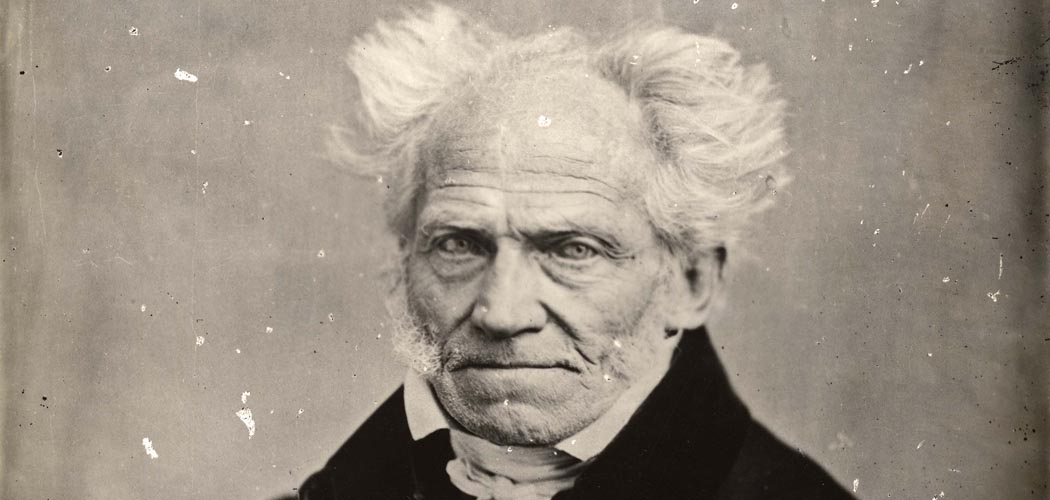
schopenhauer

Schopenhauer’s Influence

Schopenhauer has had a massive influence upon later thinkers, though more so in the arts (especially literature and music) and psychology than in philosophy. His popularity peaked in the early twentieth century, especially during the Modernist era, and waned somewhat thereafter. Nevertheless, a number of recent publications have reinterpreted and modernised the study of Schopenhauer. His theory is also being explored by some modern philosophers as a precursor to evolutionary theory and modern evolutionary psychology.

Russian writer and philosopher Leo Tolstoy was greatly influenced by Schopenhauer. After reading Schopenhauer’s The World as Will and Representation, Tolstoy gradually became converted to the ascetic morality upheld in that work as the proper spiritual path for the upper classes: “Do you know what this summer has meant for me? Constant raptures over Schopenhauer and a whole series of spiritual delights which I’ve never experienced before. … no student has ever studied so much on his course, and learned so much, as I have this summer”

Richard Wagner, writing in his autobiography, remembered his first impression that Schopenhauer left on him (when he read The World as Will and Representation):

Schopenhauer’s book was never completely out of my mind, and by the following summer I had studied it from cover to cover four times. It had a radical influence on my whole life.

Wagner also commented on that “serious mood, which was trying to find ecstatic expression” created by Schopenhauer inspired the conception of Tristan und Isolde.

Friedrich Nietzsche owed the awakening of his philosophical interest to reading The World as Will and Representation and admitted that he was one of the few philosophers that he respected, dedicating to him his essay Schopenhauer als Erzieher one of his Untimely Meditations.

Jorge Luis Borges remarked that the reason he had never attempted to write a systematic account of his world view, despite his penchant for philosophy and metaphysics in particular, was because Schopenhauer had already written it for him.

As a teenager, Ludwig Wittgenstein adopted Schopenhauer’s epistemological idealism. However, after his study of the philosophy of mathematics, he rejected epistemological idealism for Gottlob Frege’s conceptual realism. In later years, Wittgenstein was highly dismissive of Schopenhauer, describing him as an ultimately shallow thinker: “Schopenhauer has quite a crude mind… where real depth starts, his comes to an end.”

The philosopher Gilbert Ryle read Schopenhauer’s works as a student, but later largely forgot them, only to unwittingly recycle ideas from Schopenhauer in his The Concept of Mind (1949).


Further Study

Arthur Schopenhauer (SEP)

Arthur Schopenhauer (IEP)

Schopenhauer’s Works (Project Gutenberg)

Schopenhauer’s Works (Wikisource)

The Absurd

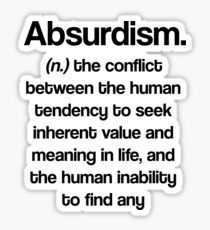
absurdism_definition

The Nature of the Absurd

A nihilist is not one who believes in nothing, but one who does not believe in what exists.

My contention has been that death and the certain prospect of death make an absurdity out of life. But, argues Albert Camus, even if we humans were immortal, this would make life no less absurd. According to Absurdism, humans historically attempt to find meaning in their lives. Traditionally, this search results in one of two conclusions: either that life is meaningless, or life contains within it a purpose set forth by a higher power—a belief in God, or adherence to some religion or other abstract concept.

I don’t know whether this world has a meaning that transcends it. But I know that I cannot know that meaning and that it is impossible for me just now to know it. What can a meaning outside my condition mean to me? I can understand only in human terms. What I touch, what resists me — that I understand. And these two certainties — my appetite for the absolute and for unity and the impossibility of reducing this world to a rational and reasonable principle — I also know that I cannot reconcile them. What other truth can I admit without lying, without bringing in a hope I lack and which means nothing within the limits of my conditions?

In philosophy, “the Absurd” refers to the conflict between the human tendency to seek inherent value and meaning in life and the human inability to find any. In this context, absurd does not mean “logically impossible,” but rather “humanly impossible.” The universe and the human mind do not each separately cause the Absurd, but rather, the Absurd arises by the contradictory nature of the two existing simultaneously.

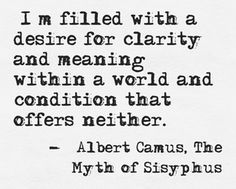
I said that the world is absurd, but I was too hasty. This world in itself is not reasonable, that is all that can be said. But what is absurd is the confrontation of this irrational and the wild longing for clarity whose call echoes in the human heart. The absurd depends as much on man as on the world. For the moment it is all that links them together. It binds them one to the other as only hatred can weld two creatures together. This is all I can discern clearly in this measureless universe where my adventure takes place.

Accordingly, Absurdism is a philosophical school of thought stating that the efforts of humanity to find inherent meaning will ultimately fail (and hence are absurd) because the sheer amount of information, as well as the vast realm of the unknown, make total certainty impossible. As a philosophy, absurdism furthermore explores the fundamental nature of the Absurd and how individuals, once becoming conscious of the Absurd, should respond to it. The absurdist philosopher Albert Camus stated that individuals should embrace the absurd condition of human existence while also defiantly continuing to explore and search for meaning.

In a universe suddenly divested of illusions and lights, man feels an alien, a stranger. His exile is without remedy since he is deprived of the memory of a lost home or the hope of a promised land. This divorce between man and his life, the actor and his setting, is properly the feeling of absurdity.

Absurdism shares some concepts, and a common theoretical template, with existentialism and nihilism. It has its origins in the work of the 19th-century Danish philosopher Søren Kierkegaard, who chose to confront the crisis that humans face with the Absurd by developing his own existentialist philosophy. Absurdism as a belief system was born of the European existentialist movement that ensued, specifically when Camus rejected certain aspects of that philosophical line of thought and published his essay The Myth of Sisyphus. The aftermath of World War II provided the social environment that stimulated absurdist views and allowed for their popular development, especially in the devastated country of France.

At this point of his effort man stands face to face with the irrational. He feels within him his longing for happiness and for reason. The absurd is born of this confrontation between the human need and the unreasonable silence of the world. 

Camus perceives filling the void with some invented belief or meaning as a mere “act of eluding”—that is, avoiding or escaping rather than acknowledging and embracing the Absurd. To Camus, elusion is a fundamental flaw in religion, existentialism, and various other schools of thought. If the individual eludes the Absurd, then he or she can never confront it. Camus also concedes that elusion is the most common response to the absurd.

Even with a spiritual power as the answer to meaning, another question arises: What is the purpose of a belief in God? Kierkegaard believed that there is no human-comprehensible purpose of God, making faith in God absurd itself. Camus, on the other hand, states that to believe in God is to “deny one of the terms of the contradiction” between humanity and the universe (and is therefore not absurd but what he calls “philosophical suicide”). Camus (as well as Kierkegaard), though, suggests that while absurdity does not lead to belief in God, neither does it lead to the denial of God. Camus notes, “I did not say ‘excludes God’, which would still amount to asserting”.

Intelligence, too, tells me in its way that this world is absurd. Its contrary, blind reason, may well claim that all is clear; I was waiting for proof and longing for it to be right. But despite so many pretentious centuries and over the heads of so many eloquent and persuasive men, I know that is false. On this plane, at least, there is no happiness if I cannot know. That universal reason, practical or ethical, that determinism, those categories that explain everything are enough to make a decent man laugh. They have nothing to do with the mind. They negate its profound truth, which is to be enchained. In this unintelligible and limited universe, man’s fate henceforth assumes its meaning. A horde of irrationals has sprung up and surrounds him until his ultimate end. In his recovered and now studied lucidity, the feeling of the absurd becomes clear and definite.

camus_quote

Creation as Rebellion

Nothing can discourage the appetite for divinity in the heart of man.

For Camus, the beauty people encounter in life makes it worth living. People may create meaning in their own lives, which may not be the objective meaning of life (if there is one), but can still provide something to strive for. However, he insisted that one must always maintain an ironic distance between this invented meaning and the knowledge of the absurd, lest the fictitious meaning take the place of the absurd.

In absurdist philosophy, the Absurd arises out of the fundamental disharmony between the individual’s search for meaning and the meaninglessness of the universe. As beings looking for meaning in a meaningless world, humans have three ways of resolving the dilemma. Kierkegaard and Camus describe the solutions in their works, The Sickness Unto Death (1849) and The Myth of Sisyphus (1942), respectively:

  • Suicide (or, “escaping existence”): a solution in which a person ends one’s own life. Both Kierkegaard and Camus dismiss the viability of this option. Camus states that it does not counter the Absurd. Rather, the act of ending one’s existence only becomes more absurd.
  • Religious, spiritual, or abstract belief in a transcendent realm, being, or idea: a solution in which one believes in the existence of a reality that is beyond the Absurd, and, as such, has meaning. Kierkegaard stated that a belief in anything beyond the Absurd requires an irrational but perhaps necessary religious acceptance in such an intangible and empirically unprovable thing (now commonly referred to as a “leap of faith“). However, Camus regarded this solution, and others, as “philosophical suicide”.
  • Acceptance of the Absurd: a solution in which one accepts the Absurd and continues to live in spite of it. Camus endorsed this solution, believing that by accepting the Absurd, one can achieve the greatest extent of their freedom, and that by recognizing no religious or other moral constraints and by revolting against the Absurd while simultaneously accepting it as unstoppable, one could possibly be content from the personal meaning constructed in the process. Kierkegaard, on the other hand, regarded this solution as “demoniac madness”: “He rages most of all at the thought that eternity might get it into its head to take his misery from him!“

There exists an obvious fact that seems utterly moral: namely, that a man is always a prey to his truths. Once he has admitted them, he cannot free himself from them. One has to pay something. A man who has become conscious of the absurd is forever bound to it. A man devoid of hope and conscious of being so has ceased to belong to the future. That is natural. But it is just as natural that he should strive to escape the universe of which he is the creator.

Absurdism originated from (as well as alongside) the 20th-century strains of existentialism and nihilism; it shares some prominent starting points with, though also entails conclusions that are uniquely distinct from, these other schools of thought. All three arose from the human experience of anguish and confusion stemming from the Absurd: the apparent meaninglessness in a world in which humans, nevertheless, are so compelled to find or create meaning. The three schools of thought diverge from there. Existentialists have generally advocated the individual’s construction of his or her own meaning in life as well as the free will of the individual. Nihilists, on the contrary, contend that “it is futile to seek or to affirm meaning where none can be found.” Absurdists, following Camus’s formulation, hesitantly allow the possibility for some meaning or value in life, but are neither as certain as existentialists are about the value of one’s own constructed meaning nor as nihilists are about the total inability to create meaning. Absurdists following Camus also devalue or outright reject free will, encouraging merely that the individual live defiantly and authentically in spite of the psychological tension of the Absurd.

To work and create “for nothing,” to sculpture in clay, to know one’s creation has no future, to see one’s work destroyed in a day while being aware that fundamentally this has no more importance than building for centuries — this is the difficult wisdom that absurd thought sanctions. Performing these two tasks simultaneously, negating on the one hand and magnifying on the other, is the way open to the absurd creator. He must give the void its colors.

Camus himself passionately worked to counter nihilism, as he explained in his essay “The Rebel,” while he also categorically rejected the label of “existentialist” in his essay “Enigma” and in the compilation The Lyrical and Critical Essays of Albert Camus, though he was, and still is, often broadly characterized by others as an existentialist. Both existentialism and absurdism entail consideration of the practical applications of becoming conscious of the truth of existential nihilism: i.e., how a driven seeker of meaning should act when suddenly confronted with the seeming concealment, or downright absence, of meaning in the universe. Camus’s own understanding of the world (e.g., “a benign indifference”, in The Stranger), and every vision he had for its progress, however, sets him apart from the general existentialist trend.

The absurd … is an experience to be lived through, a point of departure, the equivalent, in existence of Descartes’ methodical doubt. Absurdism, like methodical doubt, has wiped the slate clean. It leaves us in a blind alley. But, like methodical doubt, it can, by returning upon itself, open up a new field of investigation, and in the process of reasoning then pursues the same course. I proclaim that I believe in nothing and that everything is absurd, but I cannot doubt the validity of my proclamation and I must at least believe in my protest. The first and only evidence that is supplied me, within the terms of the absurdist experience, is rebellion … Rebellion is born of the spectacle of irrationality, confronted with an unjust and incomprehensible condition.

Though the notion of the ‘absurd’ pervades all Albert Camus’s writing, The Myth of Sisyphus is his chief work on the subject. In it, Camus considers absurdity as a confrontation, an opposition, a conflict or a “divorce” between two ideals. Specifically, he defines the human condition as absurd, as the confrontation between man’s desire for significance, meaning and clarity on the one hand – and the silent, cold universe on the other. He continues that there are specific human experiences evoking notions of absurdity. Such a realization or encounter with the absurd leaves the individual with a choice: suicide, a leap of faith, or recognition. He concludes that recognition is the only defensible option.

Rebellion in itself is not an element of civilization. But it is a preliminary to all civilization. Rebellion alone, in the blind alley in which we live, allows us to hope for the future of which Nietzsche dreamed: “Instead of the judge and the oppressor, the creator.” … Of all the schools of patience and lucidity, creation is the most effective. It is also the staggering evidence of man’s sole dignity: the dogged revolt against his condition, perseverance in an effort considered sterile.

Freedom cannot be achieved beyond what the absurdity of existence permits; however, the closest one can come to being absolutely free is through acceptance of the Absurd. Camus introduced the idea of “acceptance without resignation” as a way of dealing with the recognition of absurdity, asking whether or not man can “live without appeal”, while defining a “conscious revolt” against the avoidance of absurdity of the world. In a world devoid of higher meaning or judicial afterlife, the human nature becomes as close to absolutely free as is humanly possible.

I am not a philosopher, because I don’t believe in reason enough to believe in a system. What interests me is knowing how we must behave, and more precisely, how to behave when one does not believe in God or reason.

The rejection of hope, in absurdism, denotes the refusal to believe in anything more than what this absurd life provides. Hope, Camus emphasizes, however, has nothing to do with despair (meaning that the two terms are not opposites). One can still live fully while rejecting hope, and, in fact, can only do so without hope. Hope is perceived by the absurdist as another fraudulent method of evading the Absurd, and by not having hope, one is motivated to live every fleeting moment to the fullest. In the words of Nikos Kazantzakis’ epitaph: “I hope for nothing. I fear nothing. I am free.”

should_i_kill_myself

Suicide

There is but one truly serious philosophical problem and that is suicide. Judging whether life is or is not worth living amounts to answering the fundamental question of philosophy. All the rest – whether or not the world has three dimensions, whether the mind has nine or twelve categories – comes afterwards. These are games; one must first answer.

For Camus, suicide is a “confession” that life is not worth living; it is a choice that implicitly declares that life is “too much.” Suicide offers the most basic “way out” of absurdity: the immediate termination of the self and its place in the universe.

The final conclusion of absurdist reasoning is, in fact, the repudiation of suicide and the acceptance of the desperate encounter between human inquiry and the silence of the universe. Suicide would mean the end of this encounter, and absurdist reasoning considers that it could not consent to this without negating its own premises. According to absurdist reasoning, such a solution would be the equivalent of flight or deliverance. But it is obvious that absurdism hereby admits that human life is the only necessary good since it is precisely life that makes this encounter possible and since, without life, the absurdist wager would have no basis. To say that life is absurd, the conscience must be alive.

The absurd encounter can also arouse a “leap of faith,” a term derived from one of Kierkegaard’s early pseudonyms, Johannes de Silentio (although the term was not used by Kierkegaard himself), where one believes that there is more than the rational life (aesthetic or ethical). To take a “leap of faith,” one must act with the “virtue of the absurd” (as Johannes de Silentio put it), where a suspension of the ethical may need to exist. This faith has no expectations, but is a flexible power initiated by a recognition of the absurd. (Although at some point, one recognizes or encounters the existence of the Absurd and, in response, actively ignores it.) However, Camus states that because the leap of faith escapes rationality and defers to abstraction over personal experience, the leap of faith is not absurd. Camus considers the leap of faith as “philosophical suicide,” rejecting both this and physical suicide.

You have already grasped that Sisyphus is the absurd hero. He is, as much through his passions as through his torture. His scorn of the gods, his hatred of death, and his passion for life won him that unspeakable penalty in which the whole being is exerted toward accomplishing nothing. This is the price that must be paid for the passions of this earth. Nothing is told us about Sisyphus in the underworld. Myths are made for the imagination to breathe life into them.

Lastly, a person can choose to embrace their own absurd condition. According to Camus, one’s freedom – and the opportunity to give life meaning – lies in the recognition of absurdity. If the absurd experience is truly the realization that the universe is fundamentally devoid of absolutes, then we as individuals are truly free. “To live without appeal,” as he puts it, is a philosophical move to define absolutes and universals subjectively, rather than objectively. The freedom of humans is thus established in a human’s natural ability and opportunity to create their own meaning and purpose; to decide (or think) for him- or herself. The individual becomes the most precious unit of existence, representing a set of unique ideals that can be characterized as an entire universe in its own right. In acknowledging the absurdity of seeking any inherent meaning, but continuing this search regardless, one can be happy, gradually developing meaning from the search alone.

To shed light upon the step taken by the mind when, starting from a philosophy of the world’s lack of meaning, it ends up by finding a meaning and depth in it.

Camus states in The Myth of Sisyphus: “Thus I draw from the absurd three consequences, which are my revolt, my freedom, and my passion. By the mere activity of consciousness I transform into a rule of life what was an invitation to death, and I refuse suicide.” “Revolt” here refers to the refusal of suicide and search for meaning despite the revelation of the Absurd; “Freedom” refers to the lack of imprisonment by religious devotion or others’ moral codes; “Passion” refers to the most wholehearted experiencing of life, since hope has been rejected, and so he concludes that every moment must be lived fully.

Every ideology is contrary to human psychology.

The absurdist is not guided by morality, but rather, by their own integrity. The absurdist is, in fact, amoral (though not necessarily immoral). The Absurdist’s view of morality implies an unwavering sense of definite right and wrong at all times, while integrity implies honesty with one’s self and consistency in the motivations of one’s actions and decisions.

The preceding merely defines a way of thinking. But the point is to live.

In the midst of winter, I found there was, within me, an invincible summer. And that makes me happy. For it says that no matter how hard the world pushes against me, within me, there’s something stronger – something better, pushing right back.

– (All quotes in this article are from Albert Camus)

camus2

See Also

Absurdism (Wikipedia)

Albert Camus (SEP)

Absurdism (Wikiquote)

A Reconstructed Conversation with Camus (Nautilus)

Albert Camus (Wikiquote)

The Self-Overcoming of Nihilism

the self-overcoming of nihilism

Full Book (PDF): The Self-Overcoming of Nihilism by Nishitani Keiji

As a past reader of Nishitani in both the original Japanese and English translation, I find this manuscript to be the most accessible and clearly written of any book-length work I have read by him. It shows Nishitani as a vital and vigorous thinker, and serves as an introduction to his widely acclaimed Religion and Nothingness.

The summaries of the relation to nihilism of Hegel, Schopenhauer, Kierkegaard, Feuerbach, and Stirner, a nearly forgotten figure in intellectual history, are all perspicacious. Even the chapters on Nietzsche, about whom volumes are written these days, provide new insights. The brief section on the problem of nihilism for Japan is unprecedented in the English literature, and the sketches on karma and historicity whet the appetite for the more extensive and difficult expositions in Religion and Nothingness.

It will be mandatory reading for an understanding of both Nishitani’s thought and the problem of nihilism. Scholars and other persons interested in nihilism, in Nietzsche, and/or in contemporary Buddhist or Japanese philosophy, will greatly profit from a study of this book.

– John C. Maraldo, Department of Philosophy, University of North Florida

This is a fine translation of an important work in the corpus of Nishitani’s early writings. The translation is timely both because of the Western interest in Nishitani as a preeminent contemporary Japanese philosopher and because of the continuing Western perplexity about the problems Nishitani addresses. Nishitani is one of the world’s greatest living philosophers and even in this early work of his that brilliance shines through.

– Thomas P. Kasulis, Department of Philosophy, Northland College

Nishitani Keiji was for many years Professor of Religious Philosophy at Kyoto University and the leading thinker of the “Kyoto School” of philosophy. He died in 1990. Graham Parkes is Professor of Philosophy at the University of Hawaii, the editor of Heidegger and Asian Thought and Nietzsche and Asian Thought, and the author of Composing the Soul: Reaches of Nietzsche’s Psychology. Setsuko Aihara has taught Japanese at the University of Hawaii and Harvard University, and is the author of Strategies for Reading Japanese: A Rational Approach to the Japanese Sentence.

Contents

Chapter One – Nihilism as Existence

1. Two Problems

2. Nihilism and the Philosophy of History

3. European Nihilism

Chapter Two – From Realism to Nihilism: Hegel, Schopenhauer, Kierkegaard, Feuerbach

1. Hegel’s Absolute Idealism and Radical Realism

2. Schopenhauer—Will as Real—The Nullity of Existence

3. Kierkegaard—Becoming and Existence

4. Feuerbach—Critique of Religion, Philosophy, and Ethics

Chapter Three – Friedrich Nietzsche: The First Consummate Nihilist

1. The Significance of Nihilism in Nietzsche

2. Radical Nihilism

3. Nietzsche’s Interpretation of Christianity

4. The Concept of “Sincerity”—”Will to Illusion”

Chapter Four – Nietzsche’s Affirmative Nihilism: Amor Fati and Eternal Recurrence

1. Value-Interpretation and Perspectivism

2. The Problem of Amor Fati

3. Love of Fate as “Innermost Nature”—Suffering—Soul

4. The Idea of Eternal Recurrence: The “Moment” and Eternity

5. Eternal Recurrence and Overcoming the Spirit of Gravity

6. Love of Fate and Eternal Recurrence

7. The Self-Overcoming of Nihilism

Chapter Five – Nihilism and Existence in Nietzsche

1. “God is Dead”

2. Critique of Religion

3. The Stages of Nihilism

4. Nihilism as Existence

5. The First Stage of Existence

6. The Second Stage of Existence

7. Nihilism as Scientific Conscience

8. Science and History as Existence

9. “Living Dangerously” and “Experimentation”

10. The Third Stage—Existence as Body

11. The Dialectical Development of Nihilism

Chapter Six – Nihilism as Egoism: Max Stirner

1. Stirner’s Context

2. The Meaning of Egoism

3. Realist, Idealist, Egoist—”Creative Nothing”

4. From Paganism to Christianity

5. From Christianity to Liberalism

6. From Liberalism to Egoism

7. Ownness and Property—All and Nothing

8. The State and the Individual

Chapter Seven – Nihilism in Russia

1. Russian Nihilism

2. Bazarov’s Nihilism—”Fathers and Sons”

3. Nihilism as Contemplation—”Notes from Underground”

Chapter Eight – Nihilism as Philosophy: Martin Heidegger

1. Existentialism as a Discipline

2. The “Ontological Difference”

3. Transcendence and Being-in-the-World

4. Being-toward-Death and Anxiety

5. Finitude—Metaphysics—Existence—Freedom

Chapter Nine – The Meaning of Nihilism for Japan

1. The Crisis in Europe and Nihilism

2. The Crisis Compounded

3. The Significance of European Nihilism for Us

4. Buddhism and Nihilism

Appendix – The Problem of Atheism

1. Marxist Humanism

2. Sartrean Existentialism

3. Atheism in the World of Today

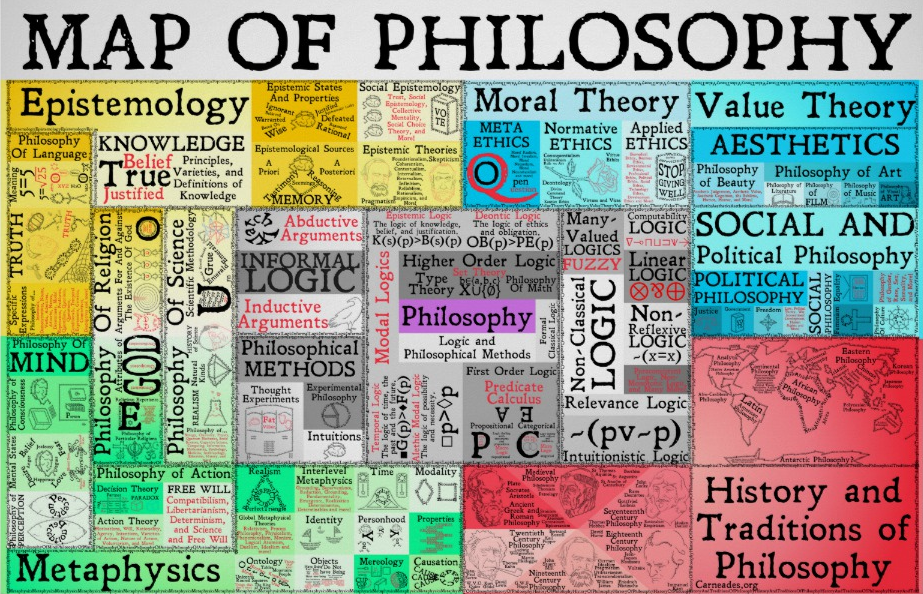
The Map of Philosophy

This video is such an excellent and comprehensive introduction to the various areas of philosophical interest. The narrator explains the intricate relations that each area has with the others. Also included in each section of the video are links to more videos about each specific subject. Carneades.org really did a great job creating this. They are also selling a full-sized poster of the Map of Philosophy on Zazzle.

Description from YouTube: A comprehensive map of all of the disciplines, areas and subdivisions of philosophy. Including logic, History of philosophy, philosophical traditions, value theory, epistemology, metaphysics, philosophy of religion, philosophy of science, philosophy of mind, philosophy of language, philosophy of action, ethics, aesthetics, social philosophy, political philosophy, philosophical methods and more! This video breaks down and offers a brief explanation of each area of study, and should serve as a good introduction for beginners, a solid refresher for journeymen and a cool illustration for experts. Enjoy!

map-of-philosophy

Carneades.org also maintains a website with videos and more. The website has an interesting stated goal:

“Carneades.org was created with the simple purpose of searching for knowledge.  The hope is to provide a place for anyone to submit beliefs and arguments for consideration and then subject those beliefs to rigorous criticism with the intent of finding those arguments which can withstand a skeptical eye.  Renowned and amateur arguments alike will be put to the test with the hope that some may pass.  Carneades.org does not assent to or endorse any beliefs, but rather cultivates a disposition to seek wisdom through rigorous argument.  In true skeptical fashion, suspension of judgement is encouraged whenever certain knowledge is unattainable.  An attempt will be made to find ways to doubt and challenge any and all arguments, beliefs, positions, or conclusions.”

You can find them on twitter at @CarneadesCyrene.

Related

A Taxonomic Map of Philosophy

Emil Cioran

Image result for emil cioran

On the heights of despair, the passion for the absurd is the only thing that can still throw a demonic light on chaos. When all the current reasons—moral, aesthetic, religious, social, and so on—no longer guide one’s life, how can one sustain life without succumbing to nothingness?

Over this past Easter weekend, a good friend of mine happened to mention an obscure philosopher that he had recently stumbled upon. After a bit of research, I’ve found this philosopher to be a man after my own heart. This philosopher’s name is Emil Cioran and he had some interesting things to say about existence. I’m not sure why, but I tend to find philosophical pessimism inspiring. Perhaps it’s because it makes me feel some sort of camaraderie, that perhaps I am not alone in the world. He can also be quite funny.

Out of the shadow of the abstract man, who thinks for the pleasure of thinking, emerges the organic man, who thinks because of a vital imbalance, and who is beyond science and art.

According to Wikipedia, Emil (1911 – 1995) was a Romanian philosopher and essayist, who published works in both Romanian and French. Cioran was born in Resinár (Rășinari), Szeben County, which was part of Austria-Hungary at the time. His work has been noted for its pervasive philosophical pessimism, and frequently engaged with issues of suffering, decay, and nihilism. Among his best known works are On the Heights of Despair (1934) and The Trouble with Being Born (1973). Cioran’s first French book, A Short History of Decay, was awarded the prestigious Rivarol Prize in 1950. The Latin Quarter of Paris was his permanent residence and he lived much of his life in isolation with his partner Simone Boué.

There are questions which, once approached, either isolate you or kill you outright.

Professing a lack of interest in conventional philosophy in his early youth, Cioran dismissed abstract speculation in favor of personal reflection and passionate lyricism. “I’ve invented nothing; I’ve simply been the secretary of my sensations”, he later said.

By all evidence we are in the world to do nothing.

Pessimism characterizes all of his works, which many critics trace back to events of his childhood (in 1935 his mother is reputed to have told him that if she had known he was going to be so unhappy she would have aborted him). However, Cioran’s pessimism (in fact, his skepticism, even nihilism) remains both inexhaustible and, in its own particular manner, joyful; it is not the sort of pessimism which can be traced back to simple origins, single origins themselves being questionable. When Cioran’s mother spoke to him of abortion, he confessed that it did not disturb him, but made an extraordinary impression which led to an insight about the nature of existence. “I’m simply an accident. Why take it all so seriously?” is what he later said in reference to the incident.

As far as I am concerned, I resign from humanity. I no longer want to be, nor can still be, a man. What should I do? Work for a social and political system, make a girl miserable? Hunt for weaknesses in philosophical systems, fight for moral and aesthetic ideals? It’s all too little. I renounce my humanity even though I may find myself alone. But am I not already alone in this world from which I no longer expect anything?

His works often depict an atmosphere of torment, a state that Cioran himself experienced, and came to be dominated by lyricism and, often, the expression of intense and even violent feeling. The books he wrote in Romanian especially display this latter characteristic. Preoccupied with the problems of death and suffering, he was attracted to the idea of suicide, believing it to be an idea that could help one go on living, an idea which he fully explored in On the Heights of Despair. He revisits suicide in depth in The New Gods, which contains a section of aphorisms devoted to the subject. The theme of human alienation, the most prominent existentialist theme, presented by Jean-Paul Sartre and Albert Camus, is thus formulated, in 1932, by young Cioran: “Is it possible that existence is our exile and nothingness our home?” in On the Heights of Despair.

Religion comforts us for the defeat of our will to power. It adds new worlds to ours, and thus brings us hope of new conquests and new victories. We are converted to religion out of fear of suffocating within the narrow confines of this world.

Cioran’s works encompass many other themes as well: original sin, the tragic sense of history, the end of civilization, the refusal of consolation through faith, the obsession with the absolute, life as an expression of man’s metaphysical exile, etc. He was a thinker passionate about history; widely reading the writers that were associated with the period of “decadent“. One of these writers was Oswald Spengler who influenced Cioran’s political philosophy in that he offered Gnostic reflections on the destiny of man and civilization. According to Cioran, as long as man has kept in touch with his origins and hasn’t cut himself off from himself, he has resisted decadence. Today, he is on his way to his own destruction through self-objectification, impeccable production and reproduction, excess of self-analysis and transparency, and artificial triumph.

The only minds which seduce us are the minds which have destroyed themselves trying to give their life a meaning.

Regarding God, Cioran has noted that “without Bach, God would be a complete second rate figure” and that “Bach’s music is the only argument proving the creation of the Universe cannot be regarded as a complete failure”. In an interview he stated that Bach had been a “kind of religion” for him. He mentioned that Bach and Dostoyevsky were the two great obsessions of his life, but that while his passion for Dostoyevsky ended up diminishing somewhat, his obsession with Bach “remained intact”.

We are fulfilled only when we aspire to nothing, when we are impregnated by that nothing to the point of intoxication.

William H. Gass called Cioran’s work “a philosophical romance on the modern themes of alienation, absurdity, boredom, futility, decay, the tyranny of history, the vulgarities of change, awareness as agony, reason as disease”.

I like thought which preserves a whiff of flesh and blood, and I prefer a thousand times an idea rising from sexual tension or nervous depression to empty abstraction.

Cioran became most famous while writing not in Romanian but French, a language with which he had struggled since his youth. During Cioran’s lifetime, Saint-John Perse called him “the greatest French writer to honor our language since the death of Paul Valéry.” Cioran’s tone and usage in his adopted language were seldom as harsh as in Romanian (though his use of Romanian is said to be more original).

The terrifying experience and obsession of death, when preserved in consciousness, becomes ruinous. If you talk about death, you save part of yourself. But at the same time, something of your real self dies, because objectified meanings lose the actuality they have in consciousness.

A concise list of quotes and aphorisms from Cioran can be found on the Wikiquote page dedicated to him and his works.

The only interesting philosophers are the ones who have stopped thinking and have begun to search for happiness.

When you know that every problem is only a false problem, you are dangerously close to salvation.

Silence

There is a saying here: Mountains and rivers can be moved, but man’s nature cannot be moved… We find our original nature in Japan. Perhaps it’s what’s meant by finding God.

– Father Ferreira

Related image

I recently watched the new Martin Scorsese film, Silence. It is based upon the 1966 novel of the same name by Shūsaku Endō. Silence holds a special significance for me since I have studied, and at times embraced, both Christianity and Buddhism. The film explores the lived experiences of faith and religion through the historical context of 17th century Jesuit priests on a mission to Catholicize Japan.

Father in Heaven, praised be Thy name. I’m just a foreigner who brought disaster. That’s what they think of me now.

– Father Rodrigues

While on foreign soil the Jesuit priests encounter a culture that they cannot understand, yet presume to. In much the same way, the Japanese struggle to understand Christianity and Western values. The priests, along with secret Japanese Christians, attempt to remain hidden as an inquisition sweeps the land purging itself of Catholicism. Worldviews and values clash as the priests are inevitably found, captured and forced to recant their beliefs.

Inquisitor: The doctrine you bring with you may be true in Spain and Portugal, but we have studied it carefully, thought about it over much time, and find it is of no use and of no value in Japan. We have concluded that it is a danger.

Father Rodrigues: But we believe we have brought you the truth. And the truth is universal. It’s common to all countries at all times. That’s why we call it the truth. If a doctrine weren’t as true here in Japan as it is in Portugal then we couldn’t call it the truth.

Inquisitor: I see you do not work with your hands, Father, but everyone knows a tree which flourishes in one kind of earth may decay and die in another. It is the same with the tree of Christianity. The leaves decay here. The buds die.

As nihilism encroaches upon the West and the death of God is both celebrated and denied, Silence offers a unique and insightful perspective on religion and the faithful. Myriad thoughts came to mind while I was watching the film. I was frequently reminded of Kierkegaard, Nietzsche, Nishitani, Jesus and Buddha. Sometimes I even veered in the direction of considering the missionaries as part of a national psychological operation geared toward global domination via the poison of ideology. In the end, though, I am reminded only of my own suffering at the hands of Christianity and the false hope it once offered.

I feel so tempted. I feel so tempted to despair. I’m afraid. The weight of your silence is terrible. I pray, but I’m lost. Or am I just praying to nothing? Nothing. Because you are not there?

– Father Rodrigues

Philosophy Primary Sources

sky-bookshelf

Full books in PDF format. These are the books that are generally considered standard reading for anybody interested in philosophy. You can find even more primary sources in Philosophy Primary Sources II, and head to the Links section for even more research sources!

Fragments By Anaxagoras of Clazomenae

Summa Contra Gentiles By Aquinas

De Anima (On the Soul) By Aristotle

Categories By Aristotle

On Dreams By Aristotle

Nicomachean Ethics By Aristotle

On Interpretation By Aristotle

Metaphysics By Aristotle

Physics By Aristotle

Poetics By Aristotle

Politics By Aristotle

Posterior Analytics By Aristotle

Prior Analytics By Aristotle

Rhetoric By Aristotle

City of God By Augustine

Confessions By Augustine

The Meditations By Marcus Aurelius Antoninus

Three Dialogues Between Hylas and Philonous By Berkeley

A Treatise Concerning the Principles of Human Knowledge By Berkeley

The Consolation of Philosophy By Boethius

The Dhammapada By Buddha

The Vagrakkhedikâ Or Diamond-Cutter By Buddha

Discourse on the Method of Rightly Conducting the Reason and Seeking for Truth in the Sciences By Descartes

Meditations on First Philosophy By Descartes

Democracy and Education By Dewey

Discourses By Epictetus

The Enchiridion, or Manual By Epictetus

Letter to Menoeceus By Epicurus

Principal Doctrines By Epicurus

The Philosophy Of History (Introduction) By G. W. F. Hegel

Philosophy Of Mind: Part Three of the Encyclopaedia of the Philosophical Sciences By G.W.F. Hegel

Fragments By Heraclitus

Dialogues Concerning Natural Religion By Hume

An Enquiry Concerning Human Understanding By Hume

Does Consciousness Exist? By James

What Pragmatism Means By James

The Varieties of Religious Experience By James

The Will to Believe By James

The Critique of Pure Reason By Kant

Fundamental Principles of the Metaphysics of Morals By Kant

The Critique of Judgement By Kant

Introduction to the Metaphysics of Morals By Kant

Prolegomena to any Future Metaphysics By Kant

Critique of Practical Reason By Kant

Tao Te Ching By Lao-Tzu

Monadology By Leibniz

An Essay Concerning Human Understanding By Locke

The Second Treatise of Government By Locke

Communist Manifesto By Marx

On Liberty By Mill

Utilitarianism By Mill

On Subjection of Women By Mill

Thus Spake Zarathustra By Nietzsche

Fragments and Commentary By Parmenides

The Fixation of Belief By Peirce

How to Make Our Ideas Clear By Peirce

Apology By Plato

Charmides By Plato

Cratylus By Plato

Crito By Plato

Euthydemus By Plato

Euthyphro By Plato

Gorgias By Plato

Ion By Plato

Laches By Plato

Laws By Plato

Meno By Plato

Parmenides By Plato

Phaedo By Plato

Phaedrus By Plato

Philebus By Plato

Protagoras By Plato

The Republic By Plato

Sophist By Plato

Statesman By Plato

Symposium By Plato

Theaetetus By Plato

Timaeus By Plato

Enneads By Plotinus

Fragments and Commentary By Pythagoras

On Denoting By Russell

The Problems of Philosophy By Russell

Ethics By Spinoza

On the Improvement of Understanding By Spinoza

Fragments and Commentary of Thales

A Vindication of the Rights of Women By Wollstonecraft


Check out Philosophy Primary Sources II and the Links section for even more research sources!

Plutonomy and the Precariat

Day_12_Occupy_Wall_Street_September_28_2011_Shankbone_33

05/08/2012 08:44 am 08:44:21 | Updated Jul 08, 2012

Noam Chomsky

Institute Professor emeritus, MIT Department of Linguistics and Philosophy; Author, ‘Who Rules the World?’

On the History of the U.S. Economy in Decline

Cross-posted with TomDispatch.com

The Occupy movement has been an extremely exciting development. Unprecedented, in fact. There’s never been anything like it that I can think of.  If the bonds and associations it has established can be sustained through a long, dark period ahead — because victory won’t come quickly — it could prove a significant moment in American history.

The fact that the Occupy movement is unprecedented is quite appropriate. After all, it’s an unprecedented era and has been so since the 1970s, which marked a major turning point in American history. For centuries, since the country began, it had been a developing society, and not always in very pretty ways. That’s another story, but the general progress was toward wealth, industrialization, development, and hope. There was a pretty constant expectation that it was going to go on like this. That was true even in very dark times.

I’m just old enough to remember the Great Depression. After the first few years, by the mid-1930s — although the situation was objectively much harsher than it is today — nevertheless, the spirit was quite different. There was a sense that “we’re gonna get out of it,” even among unemployed people, including a lot of my relatives, a sense that “it will get better.”

There was militant labor union organizing going on, especially from the CIO (Congress of Industrial Organizations). It was getting to the point of sit-down strikes, which are frightening to the business world — you could see it in the business press at the time — because a sit-down strike is just a step before taking over the factory and running it yourself. The idea of worker takeovers is something which is, incidentally, very much on the agenda today, and we should keep it in mind. Also New Deal legislation was beginning to come in as a result of popular pressure. Despite the hard times, there was a sense that, somehow, “we’re gonna get out of it.”

It’s quite different now. For many people in the United States, there’s a pervasive sense of hopelessness, sometimes despair. I think it’s quite new in American history. And it has an objective basis.

On the Working Class

In the 1930s, unemployed working people could anticipate that their jobs would come back. If you’re a worker in manufacturing today — the current level of unemployment there is approximately like the Depression — and current tendencies persist, those jobs aren’t going to come back.

The change took place in the 1970s. There are a lot of reasons for it. One of the underlying factors, discussed mainly by economic historian Robert Brenner, was the falling rate of profit in manufacturing. There were other factors. It led to major changes in the economy — a reversal of several hundred years of progress towards industrialization and development that turned into a process of de-industrialization and de-development. Of course, manufacturing production continued overseas very profitably, but it’s no good for the work force.

Along with that came a significant shift of the economy from productive enterprise — producing things people need or could use — to financial manipulation. The financialization of the economy really took off at that time.

On Banks

Before the 1970s, banks were banks. They did what banks were supposed to do in a state capitalist economy: they took unused funds from your bank account, for example, and transferred them to some potentially useful purpose like helping a family buy a home or send a kid to college. That changed dramatically in the 1970s. Until then, there had been no financial crises since the Great Depression. The 1950s and 1960s had been a period of enormous growth, the highest in American history, maybe in economic history.

And it was egalitarian.  The lowest quintile did about as well as the highest quintile. Lots of people moved into reasonable lifestyles — what’s called the “middle class” here, the “working class” in other countries — but it was real.  And the 1960s accelerated it. The activism of those years, after a pretty dismal decade, really civilized the country in lots of ways that are permanent.

When the 1970s came along, there were sudden and sharp changes: de-industrialization, the off-shoring of production, and the shift to financial institutions, which grew enormously. I should say that, in the 1950s and 1960s, there was also the development of what several decades later became the high-tech economy: computers, the Internet, the IT Revolution developed substantially in the state sector.

The developments that took place during the 1970s set off a vicious cycle. It led to the concentration of wealth increasingly in the hands of the financial sector. This doesn’t benefit the economy — it probably harms it and society — but it did lead to a tremendous concentration of wealth.

On Politics and Money

Concentration of wealth yields concentration of political power. And concentration of political power gives rise to legislation that increases and accelerates the cycle. The legislation, essentially bipartisan, drives new fiscal policies and tax changes, as well as the rules of corporate governance and deregulation. Alongside this began a sharp rise in the costs of elections, which drove the political parties even deeper into the pockets of the corporate sector.

The parties dissolved in many ways. It used to be that if a person in Congress hoped for a position such as a committee chair, he or she got it mainly through seniority and service. Within a couple of years, they started having to put money into the party coffers in order to get ahead, a topic studied mainly by Tom Ferguson. That just drove the whole system even deeper into the pockets of the corporate sector (increasingly the financial sector).

This cycle resulted in a tremendous concentration of wealth, mainly in the top tenth of one percent of the population. Meanwhile, it opened a period of stagnation or even decline for the majority of the population. People got by, but by artificial means such as longer working hours, high rates of borrowing and debt, and reliance on asset inflation like the recent housing bubble. Pretty soon those working hours were much higher in the United States than in other industrial countries like Japan and various places in Europe. So there was a period of stagnation and decline for the majority alongside a period of sharp concentration of wealth. The political system began to dissolve.

There has always been a gap between public policy and public will, but it just grew astronomically. You can see it right now, in fact.  Take a look at the big topic in Washington that everyone concentrates on: the deficit. For the public, correctly, the deficit is not regarded as much of an issue. And it isn’t really much of an issue. The issue is joblessness. There’s a deficit commission but no joblessness commission. As far as the deficit is concerned, the public has opinions. Take a look at the polls. The public overwhelmingly supports higher taxes on the wealthy, which have declined sharply in this period of stagnation and decline, and the preservation of limited social benefits.

The outcome of the deficit commission is probably going to be the opposite. The Occupy movements could provide a mass base for trying to avert what amounts to a dagger pointed at the heart of the country.

Plutonomy and the Precariat

For the general population, the 99% in the imagery of the Occupy movement, it’s been pretty harsh — and it could get worse. This could be a period of irreversible decline. For the 1% and even less — the .1% — it’s just fine. They are richer than ever, more powerful than ever, controlling the political system, disregarding the public. And if it can continue, as far as they’re concerned, sure, why not?

Take, for example, Citigroup. For decades, Citigroup has been one of the most corrupt of the major investment banking corporations, repeatedly bailed out by the taxpayer, starting in the early Reagan years and now once again. I won’t run through the corruption, but it’s pretty astonishing.

In 2005, Citigroup came out with a brochure for investors called “Plutonomy: Buying Luxury, Explaining Global Imbalances.” It urged investors to put money into a “plutonomy index.” The brochure says, “The World is dividing into two blocs — the Plutonomy and the rest.”

Plutonomy refers to the rich, those who buy luxury goods and so on, and that’s where the action is. They claimed that their plutonomy index was way outperforming the stock market. As for the rest, we set them adrift. We don’t really care about them. We don’t really need them. They have to be around to provide a powerful state, which will protect us and bail us out when we get into trouble, but other than that they essentially have no function. These days they’re sometimes called the “precariat” — people who live a precarious existence at the periphery of society. Only it’s not the periphery anymore. It’s becoming a very substantial part of society in the United States and indeed elsewhere. And this is considered a good thing.

So, for example, Fed Chairman Alan Greenspan, at the time when he was still “Saint Alan” — hailed by the economics profession as one of the greatest economists of all time (this was before the crash for which he was substantially responsible) — was testifying to Congress in the Clinton years, and he explained the wonders of the great economy that he was supervising. He said a lot of its success was based substantially on what he called “growing worker insecurity.” If working people are insecure, if they’re part of the precariat, living precarious existences, they’re not going to make demands, they’re not going to try to get better wages, they won’t get improved benefits. We can kick ’em out, if we don’t need ’em. And that’s what’s called a “healthy” economy, technically speaking. And he was highly praised for this, greatly admired.

So the world is now indeed splitting into a plutonomy and a precariat — in the imagery of the Occupy movement, the 1% and the 99%. Not literal numbers, but the right picture. Now, the plutonomy is where the action is and it could continue like this.

If it does, the historic reversal that began in the 1970s could become irreversible. That’s where we’re heading. And the Occupy movement is the first real, major, popular reaction that could avert this. But it’s going to be necessary to face the fact that it’s a long, hard struggle. You don’t win victories tomorrow. You have to form the structures that will be sustained, that will go on through hard times and can win major victories. And there are a lot of things that can be done.

Toward Worker Takeover

I mentioned before that, in the 1930s, one of the most effective actions was the sit-down strike. And the reason is simple: that’s just a step before the takeover of an industry.

Through the 1970s, as the decline was setting in, there were some important events that took place.  In 1977, U.S. Steel decided to close one of its major facilities in Youngstown, Ohio. Instead of just walking away, the workforce and the community decided to get together and buy it from the company, hand it over to the work force, and turn it into a worker-run, worker-managed facility. They didn’t win. But with enough popular support, they could have won.  It’s a topic that Gar Alperovitz and Staughton Lynd, the lawyer for the workers and community, have discussed in detail.

It was a partial victory because, even though they lost, it set off other efforts. And now, throughout Ohio, and in other places, there’s a scattering of hundreds, maybe thousands, of sometimes not-so-small worker/community-owned industries that could become worker-managed. And that’s the basis for a real revolution. That’s how it takes place.

In one of the suburbs of Boston, about a year ago, something similar happened. A multinational decided to close down a profitable, functioning facility carrying out some high-tech manufacturing. Evidently, it just wasn’t profitable enough for them. The workforce and the union offered to buy it, take it over, and run it themselves. The multinational decided to close it down instead, probably for reasons of class-consciousness. I don’t think they want things like this to happen. If there had been enough popular support, if there had been something like the Occupy movement that could have gotten involved, they might have succeeded.

And there are other things going on like that. In fact, some of them are major. Not long ago, President Barack Obama took over the auto industry, which was basically owned by the public. And there were a number of things that could have been done. One was what was done: reconstitute it so that it could be handed back to the ownership, or very similar ownership, and continue on its traditional path.

The other possibility was to hand it over to the workforce — which owned it anyway — turn it into a worker-owned, worker-managed major industrial system that’s a big part of the economy, and have it produce things that people need. And there’s a lot that we need.

We all know or should know that the United States is extremely backward globally in high-speed transportation, and it’s very serious. It not only affects people’s lives, but the economy.  In that regard, here’s a personal story. I happened to be giving talks in France a couple of months ago and had to take a train from Avignon in southern France to Charles De Gaulle Airport in Paris, the same distance as from Washington, DC, to Boston. It took two hours.  I don’t know if you’ve ever taken the train from Washington to Boston, but it’s operating at about the same speed it was 60 years ago when my wife and I first took it. It’s a scandal.

It could be done here as it’s been done in Europe. They had the capacity to do it, the skilled work force. It would have taken a little popular support, but it could have made a major change in the economy.

Just to make it more surreal, while this option was being avoided, the Obama administration was sending its transportation secretary to Spain to get contracts for developing high-speed rail for the United States, which could have been done right in the rust belt, which is being closed down. There are no economic reasons why this can’t happen. These are class reasons, and reflect the lack of popular political mobilization. Things like this continue.

Climate Change and Nuclear Weapons

I’ve kept to domestic issues, but there are two dangerous developments in the international arena, which are a kind of shadow that hangs over everything we’ve discussed. There are, for the first time in human history, real threats to the decent survival of the species.

One has been hanging around since 1945. It’s kind of a miracle that we’ve escaped it. That’s the threat of nuclear war and nuclear weapons. Though it isn’t being much discussed, that threat is, in fact, being escalated by the policies of this administration and its allies. And something has to be done about that or we’re in real trouble.

The other, of course, is environmental catastrophe. Practically every country in the world is taking at least halting steps towards trying to do something about it. The United States is also taking steps, mainly to accelerate the threat.  It is the only major country that is not only not doing something constructive to protect the environment, it’s not even climbing on the train. In some ways, it’s pulling it backwards.

And this is connected to a huge propaganda system, proudly and openly declared by the business world, to try to convince people that climate change is just a liberal hoax. “Why pay attention to these scientists?”

We’re really regressing back to the dark ages. It’s not a joke.  And if that’s happening in the most powerful, richest country in history, then this catastrophe isn’t going to be averted — and in a generation or two, everything else we’re talking about won’t matter. Something has to be done about it very soon in a dedicated, sustained way.

It’s not going to be easy to proceed. There are going to be barriers, difficulties, hardships, failures.  It’s inevitable. But unless the spirit of the last year, here and elsewhere in the country and around the globe, continues to grow and becomes a major force in the social and political world, the chances for a decent future are not very high.

Noam Chomsky is Institute Professor Emeritus in the MIT Department of Linguistics and Philosophy.  A TomDispatch regular, he is the author of numerous best-selling political works, most recently, Hopes and Prospects, Making the Future, and Occupy, published by Zuccotti Park Press, from which this speech, given last October, is excerpted and adapted. His web site is www.chomsky.info.

Follow TomDispatch on Twitter @TomDispatch and join us on Facebook.

To stay on top of important articles like these, sign up to receive the latest updates from TomDispatch.com here.

Source: Huffington Post

See Also

Occupy (Occupied Media Pamphlet Series) by Noam Chomsky

Occupy (book) on Wikipedia

“Precariat” (Wikipedia)