Constitutional Idolatry?

Political Fundamentalism is the continuation of the Inquisition, adapting to a changing world in an attempt to prevent the world itself from adapting to changing circumstances and insights, creating an obstruction to the continuation of the growth and application of the Scientific Revolution and the Enlightenment.

– Steve Harvey

political idol


Thomas Jefferson to James Madison

6 Sept. 1789Papers 15:392–97

I sit down to write to you without knowing by what occasion I shall send my letter. I do it because a subject comes into my head which I would wish to develope a little more than is practicable in the hurry of the moment of making up general dispatches.

The question Whether one generation of men has a right to bind another, seems never to have been started either on this or our side of the water. Yet it is a question of such consequences as not only to merit decision, but place also, among the fundamental principles of every government. The course of reflection in which we are immersed here on the elementary principles of society has presented this question to my mind; and that no such obligation can be so transmitted I think very capable of proof.–I set out on this ground, which I suppose to be self evident, “that the earth belongs in usufruct to the living”: that the dead have neither powers nor rights over it. The portion occupied by an individual ceases to be his when himself ceases to be, and reverts to the society. If the society has formed no rules for the appropriation of it’s lands in severality, it will be taken by the first occupants. These will generally be the wife and children of the decedent. If they have formed rules of appropriation, those rules may give it to the wife and children, or to some one of them, or to the legatee of the deceased. So they may give it to his creditor. But the child, the legatee, or creditor takes it, not by any natural right, but by a law of the society of which they are members, and to which they are subject. Then no man can, by natural right, oblige the lands he occupied, or the persons who succeed him in that occupation, to the paiment of debts contracted by him. For if he could, he might, during his own life, eat up the usufruct of the lands for several generations to come, and then the lands would belong to the dead, and not to the living, which would be the reverse of our principle.

What is true of every member of the society individually, is true of them all collectively, since the rights of the whole can be no more than the sum of the rights of the individuals.–To keep our ideas clear when applying them to a multitude, let us suppose a whole generation of men to be born on the same day, to attain mature age on the same day, and to die on the same day, leaving a succeeding generation in the moment of attaining their mature age all together. Let the ripe age be supposed of 21. years, and their period of life 34. years more, that being the average term given by the bills of mortality to persons who have already attained 21. years of age. Each successive generation would, in this way, come on, and go off the stage at a fixed moment, as individuals do now. Then I say the earth belongs to each of these generations, during it’s course, fully, and in their own right. The 2d. generation receives it clear of the debts and incumberances of the 1st. the 3d of the 2d. and so on. For if the 1st. could charge it with a debt, then the earth would belong to the dead and not the living generation. Then no generation can contract debts greater than may be paid during the course of it’s own existence. At 21. years of age they may bind themselves and their lands for 34. years to come: at 22. for 33: at 23. for 32. and at 54. for one year only; because these are the terms of life which remain to them at those respective epochs.–But a material difference must be noted between the succession of an individual, and that of a whole generation. Individuals are parts only of a society, subject to the laws of the whole. These laws may appropriate the portion of land occupied by a decedent to his creditor rather than to any other, or to his child on condition he satisfies the creditor. But when a whole generation, that is, the whole society dies, as in the case we have supposed, and another generation or society succeeds, this forms a whole, and there is no superior who can give their territory to a third society, who may have lent money to their predecessors beyond their faculties of paying.

What is true of a generation all arriving to self-government on the same day, and dying all on the same day, is true of those in a constant course of decay and renewal, with this only difference. A generation coming in and going out entire, as in the first case, would have a right in the 1st. year of their self-dominion to contract a debt for 33. years, in the 10th. for 24. in the 20th. for 14. in the 30th. for 4. whereas generations, changing daily by daily deaths and births, have one constant term, beginning at the date of their contract, and ending when a majority of those of full age at that date shall be dead. The length of that term may be estimated from the tables of mortality, corrected by the circumstances of climate, occupation &c. peculiar to the country of the contractors. Take, for instance, the table of M. de Buffon wherein he states 23,994 deaths, and the ages at which they happened. Suppose a society in which 23,994 persons are born every year, and live to the ages stated in this table. The conditions of that society will be as follows. 1st. It will consist constantly of 617,703. persons of all ages. 21y. Of those living at any one instant of time, one half will be dead in 24. years 8. months. 3dly. 1[8],675 will arrive every year at the age of 21. years complete. 41y. It will constantly have 348,417 persons of all ages above 21. years. 5ly. And the half of those of 21. years and upwards living at any one instant of time will be dead in 18. years 8. months, or say 19. years as the nearest integral number. Then 19. years is the term beyond which neither the representatives of a nation, nor even the whole nation itself assembled, can validly extend a debt.

To render this conclusion palpable by example, suppose that Louis XIV. and XV. had contracted debts in the name of the French nation to the amount of 10,000 milliards of livres, and that the whole had been contracted in Genoa. The interest of this sum would be 500. milliards, which is said to be the whole rent roll or nett proceeds of the territory of France. Must the present generation of men have retired from the territory in which nature produced them, and ceded it to the Genoese creditors? No. They have the same rights over the soil on which they were produced, as the preceding generations had. They derive these rights not from their predecessors, but from nature. They then and their soil are by nature clear of the debts of their predecessors.

Again suppose Louis XV. and his cotemporary generation had said to the money-lenders of Genoa, give us money that we may eat, drink, and be merry in our day; and on condition you will demand no interest till the end of 19. years you shall then for ever after receive an annual interest of 125/8 per cent. The money is lent on these conditions, is divided among the living, eaten, drank, and squandered. Would the present generation be obliged to apply the produce of the earth and of their labour to replace their dissipations? Not at all.

I suppose that the recieved opinion, that the public debts of one generation devolve on the next, has been suggested by our seeing habitually in private life that he who succeeds to lands is required to pay the debts of his ancestor or testator: without considering that this requisition is municipal only, not moral; flowing from the will of the society, which has found it convenient to appropriate lands, become vacant by the death of their occupant, on the condition of a paiment of his debts: but that between society and society, or generation and generation, there is no municipal obligation, no umpire but the law of nature. We seem not to have percieved that, by the law of nature, one generation is to another as one independant nation to another.

The interest of the national debt of France being in fact but a two thousandth part of it’s rent roll, the paiment of it is practicable enough: and so becomes a question merely of honor, or of expediency. But with respect to future debts, would it not be wise and just for that nation to declare, in the constitution they are forming, that neither the legislature, nor the nation itself, can validly contract more debt than they may pay within their own age, or within the term of 19. years? And that all future contracts will be deemed void as to what shall remain unpaid at the end of 19. years from their date? This would put the lenders, and the borrowers also, on their guard. By reducing too the faculty of borrowing within it’s natural limits, it would bridle the spirit of war, to which too free a course has been procured by the inattention of money-lenders to this law of nature, that succeeding generations are not responsible for the preceding.

On similar ground it may be proved that no society can make a perpetual constitution, or even a perpetual law. The earth belongs always to the living generation. They may manage it then, and what proceeds from it, as they please, during their usufruct. They are masters too of their own persons, and consequently may govern them as they please. But persons and property make the sum of the objects of government. The constitution and the laws of their predecessors extinguished then in their natural course with those who gave them being. This could preserve that being till it ceased to be itself, and no longer. Every constitution then, and every law, naturally expires at the end of 19 years. If it be enforced longer, it is an act of force, and not of right.–It may be said that the succeeding generation exercising in fact the power of repeal, this leaves them as free as if the constitution or law has been expressly limited to 19 years only. In the first place, this objection admits the right, in proposing an equivalent. But the power of repeal is not an equivalent. It might be indeed if every form of government were so perfectly contrived that the will of the majority could always be obtained fairly and without impediment. But this is true of no form. The people cannot assemble themselves. Their representation is unequal and vicious. Various checks are opposed to every legislative proposition. Factions get possession of the public councils. Bribery corrupts them. Personal interests lead them astray from the general interests of their constituents: and other impediments arise so as to prove to every practical man that a law of limited duration is much more manageable than one which needs a repeal.

This principle that the earth belongs to the living, and not to the dead, is of very extensive application and consequences, in every country, and most especially in France. It enters into the resolution of the questions Whether the nation may change the descent of lands holden in tail? Whether they may change the appropriation of lands given antiently to the church, to hospitals, colleges, orders of chivalry, and otherwise in perpetuity? Whether they may abolish the charges and privileges attached on lands, including the whole catalogue ecclesiastical and feudal? It goes to hereditary offices, authorities and jurisdictions; to hereditary orders, distinctions and appellations; to perpetual monopolies in commerce, the arts and sciences; with a long train of et ceteras: and it renders the question of reimbursement a question of generosity and not of right. In all these cases, the legislature of the day could authorize such appropriations and establishments for their own time, but no longer; and the present holders, even where they, or their ancestors, have purchased, are in the case of bonâ fide purchasers of what the seller had no right to convey.

Turn this subject in your mind, my dear Sir, and particularly as to the power of contracting debts; and develope it with that perspicuity and cogent logic so peculiarly yours. Your station in the councils of our country gives you an opportunity of producing it to public consideration, of forcing it into discussion. At first blush it may be rallied, as a theoretical speculation: but examination will prove it to be solid and salutary. It would furnish matter for a fine preamble to our first law for appropriating the public revenue; and it will exclude at the threshold of our new government the contagious and ruinous errors of this quarter of the globe, which have armed despots with means, not sanctioned by nature, for binding in chains their fellow men. We have already given in example one effectual check to the Dog of war by transferring the power of letting him loose from the Executive to the Legislative body, from those who are to spend to those who are to pay. I should be pleased to see this second obstacle held out by us also in the first instance. No nation can make a declaration against the validity of long-contracted debts so disinterestedly as we, since we do not owe a shilling which may not be paid with ease, principal and interest, within the time of our own lives.–Establish the principle also in the new law to be passed for protecting copyrights and new inventions, by securing the exclusive right for 19. instead of 14. years. Besides familiarising us to this term, it will be an instance the more of our taking reason for our guide, instead of English precedent, the habit of which fetters us with all the political heresies of a nation equally remarkeable for it’s early excitement from some errors, and long slumbering under others.

. . . . .

Federalist No. 49

Method of Guarding Against the Encroachments of Any One Department of Government by Appealing to the People Through a Convention
From the New York Packet.
Tuesday, February 5, 1788.

Author: Alexander Hamilton or James Madison

To the People of the State of New York:

THE author of the “Notes on the State of Virginia,” quoted in the last paper, has subjoined to that valuable work the draught of a constitution, which had been prepared in order to be laid before a convention, expected to be called in 1783, by the legislature, for the establishment of a constitution for that commonwealth. The plan, like every thing from the same pen, marks a turn of thinking, original, comprehensive, and accurate; and is the more worthy of attention as it equally displays a fervent attachment to republican government and an enlightened view of the dangerous propensities against which it ought to be guarded.

One of the precautions which he proposes, and on which he appears ultimately to rely as a palladium to the weaker departments of power against the invasions of the stronger, is perhaps altogether his own, and as it immediately relates to the subject of our present inquiry, ought not to be overlooked. His proposition is, “that whenever any two of the three branches of government shall concur in opinion, each by the voices of two thirds of their whole number, that a convention is necessary for altering the constitution, or CORRECTING BREACHES OF IT, a convention shall be called for the purpose. “As the people are the only legitimate fountain of power, and it is from them that the constitutional charter, under which the several branches of government hold their power, is derived, it seems strictly consonant to the republican theory, to recur to the same original authority, not only whenever it may be necessary to enlarge, diminish, or new-model the powers of the government, but also whenever any one of the departments may commit encroachments on the chartered authorities of the others. The several departments being perfectly co-ordinate by the terms of their common commission, none of them, it is evident, can pretend to an exclusive or superior right of settling the boundaries between their respective powers; and how are the encroachments of the stronger to be prevented, or the wrongs of the weaker to be redressed, without an appeal to the people themselves, who, as the grantors of the commissions, can alone declare its true meaning, and enforce its observance? There is certainly great force in this reasoning, and it must be allowed to prove that a constitutional road to the decision of the people ought to be marked out and kept open, for certain great and extraordinary occasions. But there appear to be insuperable objections against the proposed recurrence to the people, as a provision in all cases for keeping the several departments of power within their constitutional limits. In the first place, the provision does not reach the case of a combination of two of the departments against the third. If the legislative authority, which possesses so many means of operating on the motives of the other departments, should be able to gain to its interest either of the others, or even one third of its members, the remaining department could derive no advantage from its remedial provision. I do not dwell, however, on this objection, because it may be thought to be rather against the modification of the principle, than against the principle itself. In the next place, it may be considered as an objection inherent in the principle, that as every appeal to the people would carry an implication of some defect in the government, frequent appeals would, in a great measure, deprive the government of that veneration which time bestows on every thing, and without which perhaps the wisest and freest governments would not possess the requisite stability. If it be true that all governments rest on opinion, it is no less true that the strength of opinion in each individual, and its practical influence on his conduct, depend much on the number which he supposes to have entertained the same opinion. The reason of man, like man himself, is timid and cautious when left alone, and acquires firmness and confidence in proportion to the number with which it is associated. When the examples which fortify opinion are ANCIENT as well as NUMEROUS, they are known to have a double effect. In a nation of philosophers, this consideration ought to be disregarded. A reverence for the laws would be sufficiently inculcated by the voice of an enlightened reason. But a nation of philosophers is as little to be expected as the philosophical race of kings wished for by Plato. And in every other nation, the most rational government will not find it a superfluous advantage to have the prejudices of the community on its side. The danger of disturbing the public tranquillity by interesting too strongly the public passions, is a still more serious objection against a frequent reference of constitutional questions to the decision of the whole society. Notwithstanding the success which has attended the revisions of our established forms of government, and which does so much honor to the virtue and intelligence of the people of America, it must be confessed that the experiments are of too ticklish a nature to be unnecessarily multiplied. We are to recollect that all the existing constitutions were formed in the midst of a danger which repressed the passions most unfriendly to order and concord; of an enthusiastic confidence of the people in their patriotic leaders, which stifled the ordinary diversity of opinions on great national questions; of a universal ardor for new and opposite forms, produced by a universal resentment and indignation against the ancient government; and whilst no spirit of party connected with the changes to be made, or the abuses to be reformed, could mingle its leaven in the operation. The future situations in which we must expect to be usually placed, do not present any equivalent security against the danger which is apprehended. But the greatest objection of all is, that the decisions which would probably result from such appeals would not answer the purpose of maintaining the constitutional equilibrium of the government. We have seen that the tendency of republican governments is to an aggrandizement of the legislative at the expense of the other departments. The appeals to the people, therefore, would usually be made by the executive and judiciary departments. But whether made by one side or the other, would each side enjoy equal advantages on the trial? Let us view their different situations. The members of the executive and judiciary departments are few in number, and can be personally known to a small part only of the people. The latter, by the mode of their appointment, as well as by the nature and permanency of it, are too far removed from the people to share much in their prepossessions. The former are generally the objects of jealousy, and their administration is always liable to be discolored and rendered unpopular. The members of the legislative department, on the other hand, are numberous. They are distributed and dwell among the people at large. Their connections of blood, of friendship, and of acquaintance embrace a great proportion of the most influential part of the society. The nature of their public trust implies a personal influence among the people, and that they are more immediately the confidential guardians of the rights and liberties of the people. With these advantages, it can hardly be supposed that the adverse party would have an equal chance for a favorable issue. But the legislative party would not only be able to plead their cause most successfully with the people. They would probably be constituted themselves the judges.

The same influence which had gained them an election into the legislature, would gain them a seat in the convention. If this should not be the case with all, it would probably be the case with many, and pretty certainly with those leading characters, on whom every thing depends in such bodies. The convention, in short, would be composed chiefly of men who had been, who actually were, or who expected to be, members of the department whose conduct was arraigned. They would consequently be parties to the very question to be decided by them. It might, however, sometimes happen, that appeals would be made under circumstances less adverse to the executive and judiciary departments. The usurpations of the legislature might be so flagrant and so sudden, as to admit of no specious coloring. A strong party among themselves might take side with the other branches. The executive power might be in the hands of a peculiar favorite of the people. In such a posture of things, the public decision might be less swayed by prepossessions in favor of the legislative party. But still it could never be expected to turn on the true merits of the question. It would inevitably be connected with the spirit of pre-existing parties, or of parties springing out of the question itself. It would be connected with persons of distinguished character and extensive influence in the community. It would be pronounced by the very men who had been agents in, or opponents of, the measures to which the decision would relate. The PASSIONS, therefore, not the REASON, of the public would sit in judgment. But it is the reason, alone, of the public, that ought to control and regulate the government. The passions ought to be controlled and regulated by the government.

We found in the last paper, that mere declarations in the written constitution are not sufficient to restrain the several departments within their legal rights. It appears in this, that occasional appeals to the people would be neither a proper nor an effectual provision for that purpose. How far the provisions of a different nature contained in the plan above quoted might be adequate, I do not examine. Some of them are unquestionably founded on sound political principles, and all of them are framed with singular ingenuity and precision.

PUBLIUS.

. . . . .

A subject comes into my head as well. Should we idolize the founding fathers? Would they recognize this country after so much has evolved? Should we rewrite the foundational documents of our nation based on this evolution? Have the basic principles of nature changed since the 18th century? Do we need a new John Locke and Adam Smith? I dare not take these questions or their answers lightly. I shrink from the daunting task.

There is nothing which I dread so much as a division of the republic into two great parties, each arranged under its leader, and concerting measures in opposition to each other. This, in my humble apprehension, is to be dreaded as the greatest political evil under our Constitution.

– John Adams

See Also

Preliminary Warnings on ‘Constitutional’ Idolatry

Idolatry in Constitutional Interpretation

Our Constitution is Outdated and Broken

Requiem for the American Dream

Available Now on Netflix

Requiem for the American Dream is the definitive discourse with Noam Chomsky, widely regarded as the most important intellectual alive, on the defining characteristic of our time – the deliberate concentration of wealth and power in the hands of a select few. Through interviews filmed over four years, Chomsky unpacks the principles that have brought us to the crossroads of historically unprecedented inequality – tracing a half century of policies designed to favor the most wealthy at the expense of the majority – while also looking back on his own life of activism and political participation. Profoundly personal and thought provoking, Chomsky provides penetrating insight into what may well be the lasting legacy of our time – the death of the middle class, and swan song of functioning democracy. A potent reminder that power ultimately rests in the hands of the governed, Requiem is required viewing for all who maintain hope in a shared stake in the future.

Noam Chomsky is an American linguist, philosopher, cognitive scientist, historian, logician, social critic, and political activist. Sometimes described as “the father of modern linguistics”, Chomsky is also a major figure in analytic philosophy, and one of the founders of the field of cognitive science. He has spent more than half a century at the Massachusetts Institute of Technology (MIT), where he is Institute Professor Emeritus, and is the author of over 100 books on topics such as linguistics, war, politics, and mass media. Ideologically, he aligns with anarcho-syndicalism and libertarian socialism.

http://requiemfortheamericandream.com/

https://chomsky.info/

On Mythology

All the gods, all the heavens, all the hells, are within you.

– Joseph Campbell

Myths are stories that are based on tradition. Some may have factual origins, while others are completely fictional. But myths are more than mere stories and they serve a more profound purpose in ancient and modern cultures. Myths are sacred tales that explain the world and man’s experience.

– PBS

Monomyth

Campbell’s concept of monomyth (one myth) refers to the theory that sees all mythic narratives as variations of a single great story. The theory is based on the observation that a common pattern exists beneath the narrative elements of most great myths, regardless of their origin or time of creation. Campbell often referred to the ideas of Adolf Bastian and his distinction between what he called “folk” and “elementary” ideas, the latter referring to the prime matter of monomyth while the former to the multitude of local forms the myth takes in order to remain an up-to-date carrier of sacred meanings. The central pattern most studied by Campbell is often referred to as the hero’s journey and was first described in The Hero with a Thousand Faces (1949). An enthusiast of novelist James Joyce, Campbell borrowed the term “monomyth” from Joyce’s Finnegans Wake. Campbell also made heavy use of Carl Jung‘s theories on the structure of the human psyche, and he often used terms such as “anima/animus” and “ego consciousness“.

As a strong believer in the psychic unity of mankind and its poetic expression through mythology, Campbell made use of the concept to express the idea that the whole of the human race can be seen as engaged in the effort of making the world “transparent to transcendence” by showing that underneath the world of phenomena lies an eternal source which is constantly pouring its energies into this world of time, suffering, and ultimately death. To achieve this task one needs to speak about things that existed before and beyond words, a seemingly impossible task, the solution to which lies in the metaphors found in myths. These metaphors are statements that point beyond themselves into the transcendent. The Hero’s Journey was the story of the man or woman who, through great suffering, reached an experience of the eternal source and returned with gifts powerful enough to set their society free.

As this story spread through space and evolved through time, it was broken down into various local forms (masks), depending on the social structures and environmental pressures that existed for the culture that interpreted it. The basic structure, however, has remained relatively unchanged and can be classified using the various stages of a hero’s adventure through the story, stages such as the Call to Adventure, Receiving Supernatural Aid, Meeting with the Goddess/Atonement with the Father and Return. These stages, as well as the symbols one encounters throughout the story, provide the necessary metaphors to express the spiritual truths the story is trying to convey. Metaphor for Campbell, in contrast with comparisons which make use of the word like, pretend to a literal interpretation of what they are referring to, as in the sentence “Jesus is the Son of God” rather than “the relationship of man to God is like that of a son to a father”. For example, according to Campbell, the Genesis myth from the Bible ought not be taken as a literal description of historical events happening in our current understanding of time and space, but as a metaphor for the rise of man’s cognitive consciousness as it evolved from a prior animal state. In the 2000 documentary Joseph Campbell: A Hero’s Journey, he explains God in terms of a metaphor:

God is a metaphor for a mystery that absolutely transcends all human categories of thought, even the categories of being and non-being. Those are categories of thought. I mean it’s as simple as that. So it depends on how much you want to think about it. Whether it’s doing you any good. Whether it is putting you in touch with the mystery that’s the ground of your own being. If it isn’t, well, it’s a lie. So half the people in the world are religious people who think that their metaphors are facts. Those are what we call theists. The other half are people who know that the metaphors are not facts. And so, they’re lies. Those are the atheists.

Some scholars have disagreed with the concept of the “monomyth” because of its oversimplification of different cultures. According to Robert Ellwood, “A tendency to think in generic terms of people, races… is undoubtedly the profoundest flaw in mythological thinking.”

Functions of Myth

Campbell often described mythology as having a fourfold function within human society. These appear at the end of his work The Masks of God: Creative Mythology, as well as various lectures.

The Metaphysical Function
Awakening a sense of awe before the mystery of being
According to Campbell, the absolute mystery of life, what he called transcendent reality, cannot be captured directly in words or images. Symbols and mythic metaphors on the other hand point outside themselves and into that reality. They are what Campbell called “being statements” and their enactment through ritual can give to the participant a sense of that ultimate mystery as an experience. “Mythological symbols touch and exhilarate centers of life beyond the reach of reason and coercion…. The first function of mythology is to reconcile waking consciousness to the mysterium tremendum et fascinans of this universe as it is.”
The Cosmological Function
Explaining the shape of the universe
For pre-modern societies, myth also functioned as a proto-science, offering explanations for the physical phenomena that surrounded and affected their lives, such as the change of seasons and the life cycles of animals and plants.
The Sociological Function
Validate and support the existing social order
Ancient societies had to conform to an existing social order if they were to survive at all. This is because they evolved under “pressure” from necessities much more intense than the ones encountered in our modern world. Mythology confirmed that order and enforced it by reflecting it into the stories themselves, often describing how the order arrived from divine intervention. Campbell often referred to these “conformity” myths as the “Right Hand Path” to reflect the brain’s left hemisphere’s abilities for logic, order and linearity. Together with these myths however, he observed the existence of the “Left Hand Path”, mythic patterns like the “Hero’s Journey” which are revolutionary in character in that they demand from the individual a surpassing of social norms and sometimes even of morality.
The Pedagogical Function
Guide the individual through the stages of life
As a person goes through life, many psychological challenges will be encountered. Myth may serve as a guide for successful passage through the stages of one’s life.

Evolution of Myth

Campbell’s view of mythology was by no means static and his books describe in detail how mythologies evolved through time, reflecting the realities in which each society had to adjust. Various stages of cultural development have different yet identifiable mythological systems. In brief these are:

The Way of the Animal Powers
Hunting and gathering societies
At this stage of evolution religion was animistic, as all of nature was seen as being infused with a spirit or divine presence. At center stage was the main hunting animal of that culture, whether the buffalo for Native Americans or the eland for South African tribes, and a large part of religion focused on dealing with the psychological tension that came from the reality of the necessity to kill versus the divinity of the animal. This was done by presenting the animals as springing from an eternal archetypal source and coming to this world as willing victims, with the understanding that their lives would be returned to the soil or to the Mother through a ritual of restoration. The act of slaughter then becomes a ritual where both parties, animal and mankind, are equal participants. In Mythos and The Power of Myth, Campbell recounts the story he calls “The Buffalo’s Wife” as told by the Blackfoot tribe of North America. The story tells of a time when the buffalo stopped coming to the hunting plains, leaving the tribe to starve. The chief’s daughter promises to marry the buffalo chief in return for their reappearance, but is eventually spared and taught the buffalo dance by the animals themselves, through which the spirits of their dead will return to their eternal life source. Indeed, Campbell taught that throughout history mankind has held a belief that all life comes from and returns to another dimension which transcends temporality, but which can be reached through ritual.
The Way of the Seeded Earth
Early agrarian societies
Beginning in the fertile grasslands of Europe in the Bronze Age and moving to the Levant and the Fertile Crescent of Mesopotamia, the practice of agriculture spread along with a new way of understanding mankind’s relationship to the world. At this time the earth was seen as the Mother, and the myths focused around Her life-giving powers. The plant and cultivation cycle was mirrored in religious rituals which often included human sacrifice, symbolic or literal. The main figures of this system were a female Great Goddess, Mother Earth, and her ever-dying and ever-resurrected son/consort, a male God. At this time the focus was to participate in the repetitive rhythm the world moved in expressed as the four seasons, the birth and death of crops and the phases of the moon. At the center of this motion was the Mother Goddess from whom all life springs and to whom all life returns. This often gave Her a dual aspect as both mother and destroyer.
The Way of the Celestial Lights
The first high civilizations
As the first agricultural societies evolved into the high civilizations of Mesopotamia and Babylonia, the observation of the stars inspired them with the idea that life on earth must also follow a similar mathematically predetermined pattern in which individual beings are but mere participants in an eternal cosmic play. The king was symbolized by the Sun with the golden crown as its main metaphor, while his court were the orbiting planets. The Mother Goddess remained, but her powers were now fixed within the rigid framework of a clockwork universe.

However, two barbarian incursions changed that. As the Indo-European (Aryan) people descended from the north and the Semites swept up from the Arabian desert, they carried with them a male dominated mythology with a warrior god whose symbol was the thunder. As they conquered, mainly due to the superior technology of iron smithing, their mythology blended with and subjugated the previous system of the Earth Goddess. Many mythologies of the ancient world, such as those of Greece, India, and Persia, are a result of that fusion with gods retaining some of their original traits and character but now belonging to a single system. Figures such as Zeus and Indra are thunder gods who now interact with Demeter and Dionysus, whose ritual sacrifice and rebirth, bearing testament to his pre-Indo-European roots, were still enacted in classical Greece. But for the most part, the focus heavily shifted toward the masculine, with Zeus ascending the throne of the gods and Dionysus demoted to a mere demi-god.

This demotion was very profound in the case of the Biblical imagery where the female elements were marginalized to an extreme. Campbell believed that Eve and the snake that tempted her were once fertility gods worshiped in their own rights with the tree of knowledge being the Tree of Life. He also found significance in the biblical story of Cain and Abel, with Cain being a farmer whose agrarian offering is not accepted by God, while herder Abel’s animal sacrifice is. In the lecture series of Mythos, Campbell speaks of the Mysteries of Eleusis in Ancient Greece, where Demeter’s journey in the underworld was enacted for young men and women of the time. There he observed that wheat was presented as the ultimate mystery with wine being a symbol of Dionysus, much like in the Christian mysteries where bread and wine are considered to incarnate the body and blood of Jesus. Both religions carry the same “seeded earth” cosmology in different forms while retaining an image of the ever-dying, ever-resurrected God.

The Way of Man
Medieval mythology, romantic love, and the birth of the modern spirit
Campbell recognized that the poetic form of courtly love, carried through medieval Europe by the traveling troubadours, contained a complete mythology in its own right. In The Power of Myth as well as the “Occidental Mythology” volume of The Masks of God, Campbell describes the emergence of a new kind of erotic experience as a “person to person” affair, in contrast with the purely physical definition given to Eros in the ancient world and the communal agape found in the Christian religion. An archetypal story of this kind is the legend of Tristan and Isolde which, apart from its mystical function, shows the transition from an arranged-marriage society as practiced in the Middle Ages and sanctified by the church, into the form of marriage by “falling in love” with another person that we recognize today. So what essentially started from a mythological theme has since become a social reality, mainly due to a change in perception brought about by a new mythology—and represents a central foundational manifestation of Campbell’s overriding interpretive message, “Follow your bliss.”

Campbell believed that in the modern world the function served by formal, traditional mythological systems has been taken on by individual creators such as artists and philosophers. In the works of some of his favorites, such as Thomas Mann, Pablo Picasso and James Joyce, he saw mythological themes that could serve the same life-giving purpose that mythology had once played. Accordingly, Campbell believed the religions of the world to be the various culturally influenced “masks” of the same fundamental, transcendent truths. All religions can bring one to an elevated awareness above and beyond a dualistic conception of reality, or idea of “pairs of opposites” such as being and non-being, or right and wrong. Indeed, he quotes from the Rigveda in the preface to The Hero with a Thousand Faces: “Truth is one, the sages speak of it by many names.”

Source: https://en.wikipedia.org/wiki/Joseph_Campbell

There is Nothing New Under the Sun

king-solomon

All is Vanity

The words of the Teacher, the son of David, king in Jerusalem. Vanity of vanities, says the Teacher, vanity of vanities! All is vanity. What do people gain from all the toil at which they toil under the sun? A generation goes, and a generation comes, but the earth remains for ever. The sun rises and the sun goes down, and hurries to the place where it rises. The wind blows to the south, and goes round to the north; round and round goes the wind, and on its circuits the wind returns. All streams run to the sea, but the sea is not full; to the place where the streams flow, there they continue to flow. All things are wearisome; more than one can express; the eye is not satisfied with seeing, or the ear filled with hearing. What has been is what will be, and what has been done is what will be done; there is nothing new under the sun. Is there a thing of which it is said, ‘See, this is new’? It has already been, in the ages before us. The people of long ago are not remembered, nor will there be any remembrance of people yet to come by those who come after them.

I, the Teacher, when king over Israel in Jerusalem, applied my mind to seek and to search out by wisdom all that is done under heaven; it is an unhappy business that God has given to human beings to be busy with. I saw all the deeds that are done under the sun; and see, all is vanity and a chasing after wind. What is crooked cannot be made straight, and what is lacking cannot be counted.

I said to myself, ‘I have acquired great wisdom, surpassing all who were over Jerusalem before me; and my mind has had great experience of wisdom and knowledge.’ And I applied my mind to know wisdom and to know madness and folly. I perceived that this also is but a chasing after wind. For in much wisdom is much vexation, and those who increase knowledge increase sorrow.

I said to myself, ‘Come now, I will make a test of pleasure; enjoy yourself.’ But again, this also was vanity. I said of laughter, ‘It is mad’, and of pleasure, ‘What use is it?’ I searched with my mind how to cheer my body with wine—my mind still guiding me with wisdom—and how to lay hold on folly, until I might see what was good for mortals to do under heaven during the few days of their life. I made great works; I built houses and planted vineyards for myself; I made myself gardens and parks, and planted in them all kinds of fruit trees. I made myself pools from which to water the forest of growing trees. I bought male and female slaves, and had slaves who were born in my house; I also had great possessions of herds and flocks, more than any who had been before me in Jerusalem. I also gathered for myself silver and gold and the treasure of kings and of the provinces; I got singers, both men and women, and delights of the flesh, and many concubines.

So I became great and surpassed all who were before me in Jerusalem; also my wisdom remained with me. Whatever my eyes desired I did not keep from them; I kept my heart from no pleasure, for my heart found pleasure in all my toil, and this was my reward for all my toil. Then I considered all that my hands had done and the toil I had spent in doing it, and again, all was vanity and a chasing after wind, and there was nothing to be gained under the sun.

So I turned to consider wisdom and madness and folly; for what can the one do who comes after the king? Only what has already been done. Then I saw that wisdom excels folly as light excels darkness. The wise have eyes in their head, but fools walk in darkness.

Yet I perceived that the same fate befalls all of them. Then I said to myself, ‘What happens to the fool will happen to me also; why then have I been so very wise?’ And I said to myself that this also is vanity. For there is no enduring remembrance of the wise or of fools, seeing that in the days to come all will have been long forgotten. How can the wise die just like fools? So I hated life, because what is done under the sun was grievous to me; for all is vanity and a chasing after wind.

I hated all my toil in which I had toiled under the sun, seeing that I must leave it to those who come after me —and who knows whether they will be wise or foolish? Yet they will be master of all for which I toiled and used my wisdom under the sun. This also is vanity. So I turned and gave my heart up to despair concerning all the toil of my labours under the sun, because sometimes one who has toiled with wisdom and knowledge and skill must leave all to be enjoyed by another who did not toil for it. This also is vanity and a great evil. What do mortals get from all the toil and strain with which they toil under the sun? For all their days are full of pain, and their work is a vexation; even at night their minds do not rest. This also is vanity.

There is nothing better for mortals than to eat and drink, and find enjoyment in their toil. This also, I saw, is from the hand of God; for apart from him who can eat or who can have enjoyment? For to the one who pleases him God gives wisdom and knowledge and joy; but to the sinner he gives the work of gathering and heaping, only to give to one who pleases God. This also is vanity and a chasing after wind.

– Ecclesiastes 1-2 (King Solomon)

The Kyoto School’s Takeover of Hegel

Japanese Journal of Religious Studies 38/1 (2011)

Reviews, pp. 223-226

kyoto hegel

Peter Suares, The Kyoto School’s Takeover of Hegel: Nishida,

Nishitani, and Tanabe Remake the Philosophy of Spirit

Lanham, MD: Lexington Books, 2010. 238 pp. Cloth, $65.00.

ISBN 0-7391-4688-2/978-0-7391-4688-0.


Suares’s first book-length publication on philosophy fills a conspicuous lacuna of

scholarship on the complex relationship between Hegel and the philosophers of the

Kyoto School. The uptake of Hegel’s thought in Japan has been addressed by scholars

in articles, book chapters, or in passing within the context of other subjects;

but given the pervasive influence of Hegelian philosophy on Nishida and Tanabe in

particular, Suares’s in-depth treatment of the Kyoto School’s “takeover” of Hegel is a

needed addition to the existing comparative studies on this topic.


Suares makes a compelling and well-documented argument demonstrating that

Nishida, Nishitani, and Tanabe all rely heavily on Hegel’s ideas and methodology in

fashioning their own positions, despite their harsh criticisms of certain views they

attribute to him. Suares does a convincing job of showing that though the Kyoto

scholars unanimously reject what they take to be the central tenets of Hegel’s philosophy,

namely his “dogmatic Christian theism, the promotion of being to the central

category of reality, and rigid rationalism,” these “ostensibly Hegelian features

are in fact nowhere to be found in his philosophy”(190). Not only do the Kyoto

scholars misinterpret Hegel in their critiques of him, Suares argues, they actually

incorporate Hegel’s thought in significant ways such that their own philosophies

must be considered Hegelian in many respects. This idea itself is not new, however,

and Suares acknowledges that others have made similar observations. The contribution

made by this book is its thorough demonstration of this fact, with trenchant

reasoning and clear explanations of the many confounding formulations employed

by these thinkers.


The book consists of a short introduction and five chapters. Besides a brief chapter

on “The Danish Parallel” which addresses Kierkegaard’s critique of Hegel and his

stance on faith in relation to reason, the author primarily examines and critiques the

thought of Nishida, Nishitani, and Tanabe. While dimensions of Hegel’s philosophy

are discussed at length throughout the volume, the book focuses on the work of

the Kyoto School philosophers and the presence of Hegel’s ideas therein. This being

the case, the reading of Hegel adopted by Suares is not worked out in conversation

with current developments in Hegel scholarship. This may be a disappointment to

those who come to the subject well versed in those debates since the reader must

simply accept the author’s interpretation of Hegel in order to follow him through

his comparative enterprise. This disappointment is far outweighed, however, by

the original insights offered. Suares’s analysis of the uptake of Hegel in Japan illuminates

issues germane to Hegel studies and the history of philosophy broadly. In

fact, this volume’s account of how the Kyoto scholars “remake” Hegel’s philosophy

of spirit addresses important issues in Hegel scholarship that have not been probed

this deeply until now. For example, the in-depth analysis of Hegelian contradiction

given within this context provides a lucid explanation of perhaps the most notorious

dimensions of his philosophy—the inner workings of his dialectical method.

With the Kyoto scholars as Hegel’s conversation partners, the nature of dialectic

and the movement of spirit in self-consciousness becomes clearer than it could have

been had it been treated exclusively within the European and American context.


The first chapter, which comprises roughly half of the book, is devoted to

Nishida and surveys the development of his thought throughout his life. The chapter

is divided into two main sections. The first describes the “anatomy of subjectivity”

and the “world within,” situating Nishida’s conception of self-consciousness

within the context of Western philosophy. Here Nishida’s notion of pure experience

and his logic of place are examined alongside Hegel’s developmental model of

selfconsciousness, in addition to the models put forth by other notable figures such as

Kant, Fichte, Schelling, Hölderlin, and Josiah Royce. The second section confronts

“the objective dimension” which delves into the finer workings of “the dialectical

formula” operative in both Hegel and Nishida and addresses Nishida’s attempts at

sociopolitical thought in relation to history. Nishida’s notion of jikaku ??,

or selfawareness, establishes the continuity of the chapter in that it encompasses both the

subjective and objective components of reality in one two-fold activity. The most

notable strength of this discussion lies in its analysis and explication of the form of

Nishida’s logic in relation to Hegel’s. The analysis Suares gives is highly technical,

providing an account of paradox, contradiction, and negation in the work of both

authors. Suares tackles their perplexing dialectical maneuvers with uncommon

precision and clarity, relating them at times to their possible counterparts within

certain Buddhist strands such as Mādhyamika and Pure Land.


In addition to the analysis of the logical forms employed by Hegel and Nishida,

one of the most provocative elements of Suares’s discussion—and one which warrants

further debate—is his investigation into the limits of rationality for these

thinkers, a theme that continues throughout the remaining chapters of the book.

Despite the close analysis of the logical structures shaping the thought of each, the

question remains as to whether a fully rational account of reality and experience is

possible. Suares writes of Nishida, “The reconciliation of the rationality of everyday

life with the transrational level of consciousness at the base of reality is the central

problem with which he will struggle until the end of his career” (12). This struggle

is evident in Nishida’s simultaneous commitment to rational, philosophical discourse

and his use of utterly paradoxical language to formulate his position. This

tension points to a deeper issue not specifically taken up in the book, which is the

possibility that contradiction and paradox are themselves forms of rationality, both

operating within and pointing beyond the laws that define them. For both Nishida

and Hegel, self-consciousness and the reality it grounds exist through dialectical

conflict. For Hegel, as Suares points out, “Contradiction is the motor of life” (57).

And for Nishida, remaining true to the convolutions of the self in its ordinary and

ultimate character requires articulations that conjoin antithetical terms. Nishida’s

notions of the eternal now (eien no ima, 永遠の今), the continuity of discontinuity

(hirenzoku no renzoku, 非連続の連続), and the self-identity of absolute contradictories

(zettai mujunteki jikodōitsu, 絶対矛盾的自己同一) are examples. Prompted by

the author’s comparison of the ways these thinkers conceive of contradiction, the

reader is led to question the nature of logic itself and to confront how dialectical

reason challenges common notions of rationality.


The limits of reason discussed within the context of Nishida’s philosophy are

taken up in different ways, both directly and indirectly, in the following chapters

on Nishitani, Tanabe, and Kierkegaard. In the chapter on Nishitani, his “postulate

of emptiness as enhancement of being” as a means to counter the problem of nihilism

is examined through his accounts of “original nature” and emptiness as “double

exposure.” Nishitani’s notion of double exposure in particular proves to be a useful

tool for explaining how seemingly incompatible views can be held at the same time.

This also provides a useful point of comparison with Hegel’s logic, elucidating similar

conundrums therein, shedding light on the issues related to rationality just noted.


Suares’s general approach in each chapter is to lay out his chosen thinkers’ critiques

of Hegel and proceed to show whether or not they successfully avoid the

pitfalls into which they perceive Hegel to have fallen. In each case he concludes that

they are either unsuccessful in clearing themselves of the same charges that they

level against him, or that their criticisms reject claims that Hegel cannot be proven

to have actually made. In Tanabe’s case, these failures are particularly pointed,

Suares argues, since his adoption of numerous Hegelian features in his own work

clashes harshly with his stringent critique of those same features in Hegel’s philosophy.

In addition, Tanabe rejects certain ideas that he incorrectly attributes to Hegel.

For Tanabe, Hegel is both a well of inspiration and a foil he continually pits himself

against, and, as Suares aptly shows, that ambivalence has problematic consequences

that come to bear in the anti-philosophical position Tanabe eventually adopts.


Overall, Suares’s study is well-documented with an extensive bibliography

divided into sections according to subjects for convenient reference. Textual references

to Hegel and the Kyoto scholars make use of both translations and the sources

in their original languages, providing guidance for readers at various levels of expertise.

There is one reference, however, that must be flagged. On page 69, Suares cites

a passage from David Dilworth’s translation of Nishida’s final essay, “The Logic of

Nothingness [Place] and the Religious Worldview,” in which the philosopher says of

his logic that it “is illustrated by Nāgārjuna’s logic of the eightfold negation” and “is

decidedly not a dialectic of substance in the Hegelian sense.” Michiko Yusa (1988),

in her review of this translation, makes the important observation that in the original

text Nishida makes no direct mention of either Nāgārjuna or Hegel here, and

charges Dilworth with having been excessively interpretive at this point in his translation.

This pivotal passage bears upon a number of themes dealt with in Suares’s

book, so readers should consult the original text, mindful of its disputed translation.


The book’s thesis, succinctly put forth in the conclusion, emphasizes the closeness

of the principal views held by Hegel and the philosophers of the Kyoto School.

Suares, in fact, finds no significant difference between the notion of absolute spirit

delineated by Hegel and the Japanese philosophers’ notion of absolute nothingness.

Though he voices good reasons to support this view, not enough analysis of

Hegel’s notion of spirit is given to prove this particular point. But whether or not

this point is proved, the final assessment of the relationship between Hegel and the

Kyoto scholars given in the conclusion presents a new reading of Hegel informed

by the ways his thought has been adapted by Nishida, Nishitani, and Tanabe. The

convergence of their various dialectics opens new ways of understanding Hegel, in

addition to bringing together and clarifying the ideas that have shaped philosophical

thought in Japan. In this respect The Kyoto School’s Takeover of Hegel is a model

work of comparative scholarship and makes a highly valuable contribution to the

field. All in all, this work boldly charts exciting frontiers in world philosophy, demonstrating

the potential fruit that may come from thorough and intelligent crosscultural

comparative studies.


References

Yusa, Michiko

1988 Review of “Last writings: The logic of nothingness and the religious worldview.”

Journal of the American Academy of Religion 56: 802–804.


Lucy Schultz

University of Oregon


Source: Nanzan Institute for Religion and Culture

Self-Transcendence

world-religions

Buddhism begins with a man. In his later years, when India was afire with his message and kings themselves were bowing before him, people came to him even as they were to come to Jesus asking what he was. How many people have provoked this question – not “Who are you?” with respect to name, origin, or ancestry, but “What are you? What order of being do you belong to? What species do you represent?” Not Caesar, certainly. Not Napoleon, or even Socrates. Only two: Jesus and Buddha. When the people carried their puzzlement to the Buddha himself, the answer he gave provided an identity for his entire message.

“Are you a god?” they asked. “No.” “An angel?” “No.” “A saint?” “No.” “Then what are you?”

Buddha answered, “I am awake.”

His answer became his title, for this is what Buddha means. The Sanskrit root budh denotes both to wake up and to know. Buddha, then, means the “Enlightened One,” or the “Awakened One.” While the rest of the world was wrapped in the womb of sleep, dreaming a dream known as the waking state of human life, one of their number roused himself. Buddhism begins with a man who shook off the daze, the doze, the dream-like vagaries of ordinary awareness. It begins with a man who woke up…

To appreciate the force of [the Parable of the Ferryboat] we must remember the role the ferry played in traditional Asian life. In lands laced by rivers and canals, almost every considerable journey required a ferry. This routine fact underlies and inspires every school of Buddhism, as the use of the word yana by all of them attests. Buddhism is a voyage across life’s river, a transport from the common-sense shore of ignorance, grasping, and death, to the further bank of wisdom and enlightenment. Compared with this settled fact, the differences within Buddhism are no more than variations in the kind of vehicle one boards, or the stage one has reached on the journey.

What are these stages?

While we are on the first bank it is in effect the world for us. Its earth underfoot is solid and reassuring. The rewards and disappointments of its social life are vivid and compelling. The opposite shore is barely visible and has no impact on our dealings.

If, however, something prompts us to see what the other side is like, we may decide to attempt a crossing. If we are of independent bent, we may decide to make it on our own. In this case we are Theravadins; we follow the Buddha’s design for a sturdy craft, but we build ours ourself. Most of us, however, have neither the time nor the talent for such a project of such proportions. We are Mahayanists and move down the bank to where a ready-made ferryboat is expected. As the group of explorers clamber aboard at the landing there is an air of excitement. Attention is focused on the distant bank, still indistinct, but the voyagers are still very much like citizens of this side of the river.

The ferry pushes off and moves across the water. The bank we are leaving behind is losing its substance. The shops and streets and ant-like figures are blending together and releasing their hold on us. Meanwhile, the shore toward which we are headed is not in focus either; it seems almost as far away as it ever was. There is an interval in the crossing when the only tangible realities are the water, with its treacherous currents, and the boat, which is stoutly but precariously contending with them. This is the moment for Buddhism’s Three Vows: I take refuge in the Buddha, the fact that there was an explorer who made this trip and proved to us that is can succeed. I take refuge in the dharma, the vehicle of transport, this boat to which we have committed our lives in the conviction that it is seaworthy. I take refuge in the sangha, the order, the crew that is navigating this ship, in whom we have confidence. The shoreline of the world has been left behind. Until we set foot on the further bank, these are the only things in which we can trust.

The further shore draws near, becomes real. The craft jolts onto the sand and we step onto solid ground. The land, which had been misty and unsubstantial as a dream, is now fact. And the shore that we left behind, which was so palpable and real, is now only a slender horizontal line, a visual patch, a memory without substance.

Impatient to explore our new surroundings, we nevertheless remember our gratitude for the splendid ship and crew who have brought us safely to what promises to be a rewarding land. It will not be gratitude, however, to insist on packing the boat with us as we plunge into the woods. “Would he be a clever man,” the Buddha asked, “if out of gratitude for the raft that has carried him across the stream to safety he, having reached the other shore, should cling to it, take it on his back, and walk about with the weight of it? Would not the clever man be the one who left the raft, no longer of use to him, to the current of the stream and walked ahead without turning back to look at it? Is it not simply a tool to be cast away and forsaken once it has served the purpose for which it was made? In the same way the vehicle of the doctrine is to be cast away and forsaken once the other shore of Enlightenment has been attained.”

Here we come to the Prajnaparamita or Perfection of Wisdom sutras, which are widely considered to be the culminating texts of Buddhism. The Five Precepts and the Eightfold Path; the technical terminology of dukkha, karma, nirvana, and their like; the committed order and the person of the Buddha himself – all these are vitally important to the individual in the act of making the crossing. They lose their relevance for those who have arrived. Indeed, to the traveler who has not only reached the promised shore but who keeps moving into its interior, there comes a time when not only the raft but the river itself drops from view. When such a one turns around to look for the land that has been left behind, what appears? What of that land can appear to one who has crossed a horizon beyond which the river dividing this shore from that shore has vanished? One looks, and there is no other shore. There is no separating river: There is no raft, no ferryman. These things are not a part of the new world.

Before the river was crossed the two shores, human and divine, had to appear distinct from each other, different as life and death, as day and night. But once the crossing has been made, no dichotomy remains. The realm of the gods is not a distinct place. It is where the traveler stands; and if that stance happens to be in this world, the world itself is transmuted. It is in this sense that we are to read the avowals in The Perfection of Wisdom that “this our worldly life is an activity of Nirvana itself; not the slightest distinction exists between them.” Introspection having led to a condition described positively as nirvana and negatively as Emptiness because it transcends all forms, the “stream-winner” now finds in the world itself this same Emptiness that he discovered within. “Form is emptiness, emptiness is form. Emptiness is not different from form, form is not different from emptiness.” The noisy disjunction between acceptance and rejection having been stilled, every moment is affirmed for what it actually is. It is Indra’s cosmic net, laced with jewels at every juncture. Each jewel reflects the others, together with all the reflections in the others. In such a vision the categories of good and evil disappear. “That which is sin is also Wisdom” we read; and once again, “the realm of Becoming is Nirvana.”

This earth on which we stand

is the promised Lotus Land,

And this very body

is the body of the Buddha.

This new-found shore throws light on the bodhisattva‘s vow not to enter nirvana “until the grass itself be enlightened.” As grass keeps coming, does this mean that the bodhisattva will never be enlightened? Not exactly. It means, rather, that he (or she) has risen to the point where the distinction between time and eternity has lost its force. That distinction, drawn by the rational mind, is dissolved in the lightning-and-thunder insight that annihilates opposites. Time and eternity are now two aspects of the same experiential whole, two sides of the same coin. “The jewel of eternity is in the lotus of birth and death.”

From the standpoint of normal, worldly consciousness there must always remain an inconsistency between this climactic insight and worldly prudence. This, though, should not surprise us, for it would be flatly contradictory if the world looked exactly the same to those who have crossed the river of ignorance. Only they can dissolve the world’s distinctions – or, perhaps we should say, take them in their stride, for the distinctions persist, but now without difference. Where to eagle vision the river can still be seen, it is seen as connecting the two banks rather than dividing them.

– Huston Smith, The World’s Religions: Our Great Wisdom Traditions

* * * * *
buddha

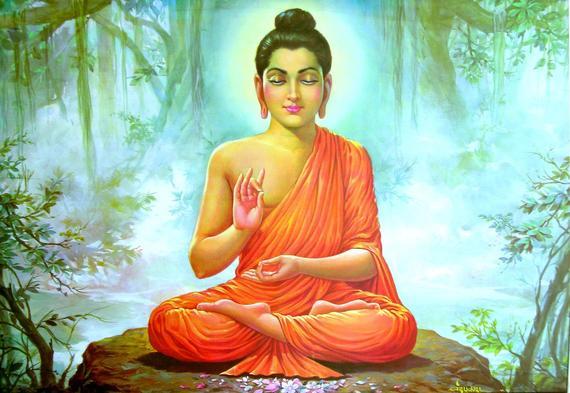
For ten years, in the different Pavilions of Spring, Autumn and the Rainy Season, the Prince was immersed in rounds of music, dancing and pleasure, but always his thoughts returned to the problem of suffering of human life.

“The luxuries of the palace, this healthy body, this rejoicing youth! What do they mean to me?” he thought. “Some day we may be sick, we shall become aged; from death there is no escape. Pride of youth, pride of health, pride of existence – all thoughtful people should cast them aside.”

“If he looks in the right way he recognizes the true nature of sickness, old age and death, and he searches for meaning in that which transcends all human sufferings. In my life of pleasures I seem to be looking in the wrong way.”

Thus the spiritual struggle went on in the mind of the Prince until his only child, Rahula, was born when he was 29. This seemed to bring things to a climax, for he then decided to leave the palace and look for the solution of his spiritual unrest in the homeless life of a mendicant. He left the castle one night with only his charioteer, Chandaka, and his favorite horse, the snow-white Kanthaka.

His anguish did not end and many devils tempted him saying: “You would do better to return to the castle for the whole world would soon be yours.” But he told the devil that he did not want the whole world. So he shaved his head and turned his steps toward the south, carrying a begging bowl in his hand.

The Prince first visited the hermit Bhagava and watched the ascetic practices. He then went to Arada Kalama and Udraka Ramaputra to learn their methods of attaining Enlightenment through meditation; but after practicing them for a time he became convinced that they would not lead him to Enlightenment. Finally, he went to the land of Magadha and practiced asceticism in the forest of Uruvilva on the banks of the Nairanjana River, which flows by the Gaya Village.

The methods of his practice where unbelievably rigorous. He spurred himself on with the though that “no ascetic in the past, none in the present, and none in the future, ever has practiced or ever will practice more earnestly than I do.”

Still the Prince could not realize his goal. After six years in the forest, he gave up the practice of asceticism. He went bathing in the river and accepted a bowl of milk from the hand of Sujata, a maiden who lived in the neighboring village. The five companions who had been living with the Prince during the six years of his ascetic practice were shocked that he should receive milk from the hand of a maiden; they thought him degraded and left him.

Thus the Prince was left alone. He was still weak, but at the risk of losing his life he attempted yet another period of meditation, saying to himself, “Blood may become exhausted, flesh may decay, bones may fall apart, but I will never leave this place until I find the way to Enlightenment.”

It was an intense and incomparable struggle for him. He was desperate and filled with confusing thoughts, dark shadows overhung his spirit, and he was beleaguered by all the lures of the devils. Carefully and patiently he examined them one by one and rejected them all. It was a hard struggle indeed, making his blood run thin, his flesh fall away, and his bones crack.

But when the morning star appeared in the eastern sky, the struggle was over and the Prince’s mind was as clear and bright as the breaking day. He had, at last, found the path to Enlightenment. It was December eighth, when the Prince became a Buddha at thirty-five years of age.

From this time on the Prince was known by different names: some spoke of him as Buddha, the Perfectly Enlightened One, Tathagata; some spoke of him as Shakyamuni, the Sage of the Shakya clan; others called him the World-Honored One.

He went first to Mrigadava in Varanasi where the five mendicants who had lived with him during the six years of his ascetic life were staying. At first they shunned him, but after they had talked with him, they believed in him and became his first followers. He then went to the Rajagriha Castle and won over King Bimbisara who had always been his friend. From there he went about the country living on alms and teaching men to accept his way of life.

Men responded to him as the thirsty seek water and the hungry food. Two great disciples, Shariputra and Maudgalyayana, and their two thousand followers, came to him.

At first the Buddha’s father, King Shuddhodana, still inwardly suffering because of his son’s decision to leave the palace, remained aloof, but then became his faithful disciple. Mahaprajapati, the Buddha’s foster mother, and Princess Yashodhara, his wife, and all the members of the Shakya clan began to follow him. Multitudes of others also became his devoted and faithful followers.

For forty-five years the Buddha went about the country preaching and persuading men to follow his way of life. But when he was eighty, at Vaisali and on his way from Rajagriha to Shrvasti, he became ill and predicted that after three months he would enter Nirvana. Still he journeyed on until he reached Pava where he fell seriously ill from some food offered by Chundra, a blacksmith. Eventually, in spite of great pain and weakness, he reached the forest that bordered Kusinagara.

Lying between two large sala trees, he continued teaching his disciples until his last moment. Thus, he entered into perfect tranquility after he had completed his work as the world’s greatest teacher.

. . .

Beneath the sala trees at Kusinagara, in his last words to his disciples, the Buddha said: Make of yourself a light. Rely upon yourself: do not depend upon anyone else. Make my teachings your light. Rely upon them: do not depend upon any other teaching.

Consider your body: Think of its impurity. Knowing that both its pain and its delight are alike causes of suffering, how can you indulge in its desires? Consider your ‘self’; think of its transiency; how can you fall into delusion about it and cherish pride and selfishness, knowing that they must all end in inevitable suffering? Consider all substances; can you find among them any enduring ‘self’? Are they not all aggregates that sooner or later will break apart and be scattered? Do not be confused by the universality of suffering, but follow my teaching, even after my death, and you will be rid of pain. Do this and you will indeed be my disciples.

My disciples, the teachings that I have given you are never to be forgotten or abandoned. They are always to be treasured, they are to be thought about, they are to be practiced. If you follow these teachings you will always be happy.
The point of the teachings is to control your own mind. Keep your mind from greed, and you will keep your behavior right, your mind pure and your words faithful. By always thinking about the transience of your life, you will be able to resist green and anger, and will be able to avoid all evils.

If you find your mind tempted and so entangled in greed, you must suppress and control the temptation; be the master of your own mind.

A man’s mind may make him a Buddha, or it may make him a beast. Misled by error, one becomes a demon; enlightened, one becomes a Buddha. Therefore, control your mind and do not let it deviate from the right path.

You should respect each other, follow my teachings, and refrain from disputes; you should not, like water and oil, repel each other, but should, like milk and water, mingle together.

Study together, learn together, practice my teachings together. Do not waste your mind and time in idleness and quarreling. Enjoy the blossoms of Enlightenment in their season and harvest the fruit of the right path.

The teachings which I have given you, I gained by following the path myself… If you neglect them, it means that you have never really met me. It means that you are far from me, even if you are actually with me; but if you accept and practise my teachings, then you are very near to me, even though you are far away.

My disciples, my end is approaching, our parting is near, but do not lament. Life is ever changing; none can escape the dissolution of the body. This I am now to show by my own death, my body falling apart like a dilapidated cart.

Do not vainly lament, but realize that nothing is permanent and learn from it the emptiness of human life. Do not cherish the unworthy desire that the changeable might become unchanging.

The demon of worldly desires is always seeking chances to deceive the mind. If a viper lives in your room and you wish to have a peaceful sleep, you must first chase it out.

You must break the bonds of worldly passions and drive them away as you would a viper. You must positively protect your own mind.

My disciples, my last moment has come, but do not forget that death is only the end of the physical body. The body was born from parents and was nourished by food; just as inevitable are sickness and death.

But the true Buddha is not a human body: — it is Enlightenment. A human body must die, but the Wisdom of Enlightenment will exist forever in the truth of the Dharma, and in the practice of the Dharma. He who sees merely my body does not truly see me. Only he who accepts my teaching truly sees me.

After my death, the Dharma shall be your teacher. Follow the Dharma and you will be true to me.

During the last forty-five years of my life, I have withheld nothing from my teachings. There is no secret teaching, no hidden meaning; everything has been taught openly and clearly.

My dear disciples, this is the end. In a moment, I shall be passing into Nirvana. This is my instruction.

. . .

If one carefully considers all the facts, one must be convinced that at the basis of all suffering lies the principle of craving desire. If avarice can be removed, human suffering will come to an end.

From ignorance and greed there spring impure desires for things that are, in fact, unobtainable, but for which men restlessly and blindly search.

Because of ignorance and greed, people imagine discriminations where, in reality, there are no discriminations. Inherently, there is no discrimination of right and wrong in human behavior; but people, because of ignorance, imagine such distinctions and judge them as right or wrong.

In reality, therefore, it is their own mind that causes the delusions of grief, lamentation, pain and agony.

The whole world of delusion is nothing but a shadow caused by the mind. And yet, it is also from this same mind that the world of Enlightenment appears.

If everything in the last resort is in the hands of an unknowable God, or of blind chance, what hope has humanity except in submission? It is no wonder that people holding these conceptions lose hope and neglect efforts to act wisely and to avoid evil.

There are four truths in this world: first, all living beings rise from ignorance; second, all objects of desire are impermanent, uncertain and suffering; third, all existing things are also impermanent, uncertain and suffering; fourth, there is nothing that can be called an “ego,” and there is no such thing as “mind” in all the world.

Both delusion and Enlightenment originate within the mind, and every existence or phenomenon arises from the functions of the mind, just as different things appear from the sleeve of a magician.

An unenlightened life rises from a mind that is bewildered by its own world or delusion. If we learn that there is no world of delusion outside the mind, the bewildered mind becomes clear; and because we cease to create impure surroundings, we attain Enlightenment.

Since everything in this world is brought about by causes and conditions, there can be no fundamental distinctions among things. The apparent distinctions exist because of people’s absurd and discriminating thoughts.

In the sky there is no distinction of east and west; people create the distinctions out of their own minds and then believe them to be true.

Mathematical numbers from one to infinity are each complete numbers, and each in itself carries no distinction of quantity; but people make the discrimination for their own convenience, so as to be able to indicate varying amounts.

They make arbitrary distinctions between existence and non-existence, good and bad, right and wrong.

The world, indeed, is like a dream and the treasures of the world are an alluring mirage.

The categories of everlasting life and death, and existence and non-existence, do not apply to the essential nature of things, but only to their appearances as they are observed by defiled human eyes.

Yet it can not be said that, apart from this world of change and appearance, there is another world of permanence and truth. It is a mistake to regard this world as either a temporal or as a real one.

To those who choose the path that leads to Enlightenment, there are two extremes that should be carefully avoided. First, there is the extreme of indulgence in the desires of the body. Second, there is the opposite extreme of ascetic discipline, torturing one’s body and mind unreasonably.

If in his search for Enlightenment he does not become contemptuous of delusion, nor fear it, such a person is following the Middle Way.

Enlightenment exists solely because of delusion and ignorance; if they disappear, so will Enlightenment. As long as people desire Enlightenment and grasp at it, it means that delusion is still with them; therefore, those who are following the way to Enlightenment must not grasp at it, and if they reach Enlightenment they must not linger in it.

When people attain Enlightenment in this sense, it means that everything is Enlightenment itself as it is; therefore, people should follow the path to Enlightenment until in their thoughts, worldly passions and Enlightenment become identical as they are.

This concept of universal oneness – that things in their essential nature have no distinguishing marks – is called “??nyat?.” ??nyat? means non-substantiality, the un-born, having no self-nature, no duality. It is because things in themselves have no form or characteristics that we can speak of them as neither being born nor being destroyed.

Nothing ever exists entirely alone; everything is in relation to everything else. People make distinctions between good and evil, but good and evil do not exist separately. Those who are following the path to Enlightenment recognize no such duality, and it leads them to neither praise the good and condemn the evil, nor despise the good and condone the evil.

Therefore, all the words that express relations of duality – such as existence and non-existence, worldly-passions and true-knowledge, purity and impurity, good and evil – none of these terms of contrast in one’s thinking are expressed or recognized in their true nature. When people keep free from such terms and from the emotions engendered by them, they realize ??nyat?’s universal truth.

Buddha teaches the Middle Way transcending these prejudiced concepts, where duality merges into oneness.

. . .

In the search for truth there are certain questions that are unimportant. Of what material is the universe constructed? Is the universe eternal? Are there limits or not to the universe? In what way is this human society put together? What is the ideal form of organization for human society? If a man were to postpone his search and practicing for Enlightenment until such questions were solved, he would die before he found the path.

The question of whether the universe has limits or is eternal can wait until some way is found to extinguish the fires of birth, old age, sickness and death; in the presence of misery, sorrow, suffering and agony, one should first search for a way to solve these problems and devote oneself to the practice of that way.

The Buddha’s teaching contains what is important to know and not what is unimportant. Those who seek the true path to Enlightenment must not expect any offer of respect, honor or devotion. And further, they must not aim with a slight effort, at a trifling advance in calmness or knowledge or insight.

[Upon suffering an injustice a woman shouted,] “Righteousness must have disappeared from the world… Now, we must have a funeral of this ‘righteousness’.” Like a mad woman she went to the cemetery to hold a funeral service.

Righteousness is never lost forever unless one casts it away oneself. Righteousness occasionally may seem to disappear, but, in fact, it never disappears. When it seems to be disappearing, it is because one is losing the righteousness of one’s own mind.

The world has no substance of its own. It is simply a vast concordance of causes and conditions that have had their origin, solely and exclusively, in the activities of the mind that has been stimulated by ignorance, false imagination, desires and infatuation. It is not something external about which the mind has false conceptions; it has no substance whatever. It has come into appearance by the processes of the mind itself, manifesting its own delusions. It is founded and built up out of the desires of the mind, out of its sufferings and struggles incidental to the pain caused by its own greed, anger and foolishness. Men who seek the way to Enlightenment should be ready to fight such a mind to attain their goal.

Those who really seek the path to Enlightenment dictate terms to their mind. Then they proceed with strong determination. Even though they are abused by some and scorned by others, they go forward undisturbed.

Sadaprarudita… [being an earnest seeker of the true path] sometimes… slept where night found him in a lonely field or in the wild mountains. At last Sadaprarudita reached the presence of the teacher himself and then he had a new difficulty. He had no paper on which to take notes and no brush or ink to write with. Then he pricked his wrist with a dagger and took notes in his own blood. In this way he secured the precious Truth.

[My disciples] must not argue with worldly people. The practice of Concentration helps one to control a wandering and futile mind. Offering and keeping Precepts make the foundation necessary to build a great castle on. Endurance and Endeavor are the walls of the castle that protect it against enemies from outside. Concentration and Wisdom are the personal armour that protects one against the assaults of life and death.

An evil mind is as hard to remove as letters carved in stone, and a right mind is as easy to lose as words written in water. Indeed, it is the most difficult thing in life to train oneself for Enlightenment.

If a man possesses a repentant spirit his sins will disappear, but if he has an unrepentant spirit his sins will continue and condemn him forever.

It is only the one who hears the true teaching rightly and realizes its meaning and relation to oneself who can receive and profit by it. If a man merely hears the true teaching but does not acquire it, he will fail in his search for Enlightenment.

Pain is only a reaction of the mind.

Faith is the fire that consumes all the impurities of worldly desires, it removes the burden, and it is the guide that leads one’s way.

Indeed, there is nothing more dreadful than doubt. It is, indeed, hard to be born in this world. It is hard to hear the Dharma; it is harder to awaken faith.

Do not dwell in the past, do not dream of the future, concentrate the mind on the present moment.

If a man lives a pure life nothing can destroy him; if he has conquered greed nothing can limit his freedom.

One should forget oneself for the sake of one’s family; one should forget one’s family for the sake of one’s village; one should forget one’s village for the sake of the nation; and one should forget everything for the sake of Enlightenment.

A man who wishes to become my disciple must be willing to give up all direct relations with his family, the social life of the world and all dependence upon wealth.

The fact is there is only one world, not two worlds, one meaningless and the other full of meaning, or one good and the other bad. People only think there are two worlds, due to their discriminating faculty.

The life of a homeless brother is not an easy one; he ought not to undertake it if he can not keep his mind free from greed and anger or if he can not control his mind or his five senses.

. . .

There are two kinds of worldly passions that defile and cover the purity of Buddha-nature. The first is the passion for analysis and discussion by which people become confused in judgement. The second is the passion for emotional experience by which people’s values become confused.

Both delusions of reasoning and delusions of practice can be thought of as a classification of all human defilements, but really there are two original worldly predicaments in their bases. The first is ignorance, and the second is desire.

The delusions of reasoning are based upon ignorance, and the delusions of practice are based upon desire, so that the two sets are really one set after all, and together they are the source of all unhappiness.

If people are ignorant they cannot reason correctly and safely. As they yield to a desire for existence, graspings, clingings and attachments to everything inevitably follow. It is this constant hunger for every pleasant thing seen and heard that leads people into the delusions of habit. Some people even yield to the desire for the death of the body.

From these primary sources all greed, anger, foolishness, misunderstanding, resentment, jealousy, flattery, deceit, pride, contempt, inebriety, selfishness, have their generations and appearances.

Hatred never ceases by hatred, but by love alone is healed. This is an ancient and eternal law.

Greed rises from wrong ideas of satisfaction; anger rises from wrong ideas concerning the state of one’s affairs and surroundings; foolishness rises from the inability to judge what correct conduct is.

Human desires are endless. It is like the thirst of a man who drinks salt water: he gets no satisfaction and his thirst is only increased.

So it is with a man who seeks to gratify his desires; he only gains increased dissatisfaction and his woes are multiplied.

The gratification of desires never satisfies; it always leaves behind unrest and irritation that can never be allayed, and then, if the gratification of his desires is thwarted, it will often drive him “insane.”

Although the nature of Buddhahood is possessed by all people, it is buried so deeply in the defilements of worldly passion that it long remains unknown. That is why suffering is so universal and why there is this endless recurrence of miserable lives.

There are three other kinds of people. The first are those who are proud, act rashly and are never satisfied; their natures are easy to understand. Then there are those who are courteous and always act after consideration; their natures are hard to understand. Then there are those who have overcome desire completely; it is impossible to understand their natures.

It would be impossible for a son to repay his parents for their gracious kindness, even if he could carry his father on his right shoulder and his mother on his left for one hundred long years.

And even if he could bathe the bodies of his parents in sweet-smelling ointments for a hundred years, serve as an ideal son, gain a throne for them, and give them all the luxuries of the world, still he would not be able to repay them sufficiently for the great indebtedness of gratitude he owes to them.

But if he leads his parents to Buddha and explains the Buddha’s teachings to them, and persuades them to give up a wrong course and follow a right one, leading them to give up all greed and enjoy the practice of offering, then he will be more than repaying them.

A fool who thinks that he is a fool is for that very reason a wise man. The fool who thinks that he is wise is called a fool indeed.

Though he should conquer a thousand men in the battlefield a thousand times, yet he, indeed, who would conquer himself is the noblest victor.

In the spirit of these vows [the bodhisattva seeks to] cast away all worldly attachments and realize the impermanence of this world. And they devote their merits to the emancipation of all sentient life; they integrate their own lives with the lives of all others, sharing their illusions and sufferings but, at the same time, realizing their freedom from the bonds and attachments of this worldly life.

They know the hindrances and difficulties of worldly living but they know, also, the boundless potentialities of Buddha’s compassion. They are free to go or come, they are free to advance or to stop as they wish, but they choose to remain with those upon whom Buddha has compassion.

– The Teaching of Buddha

* * * * *
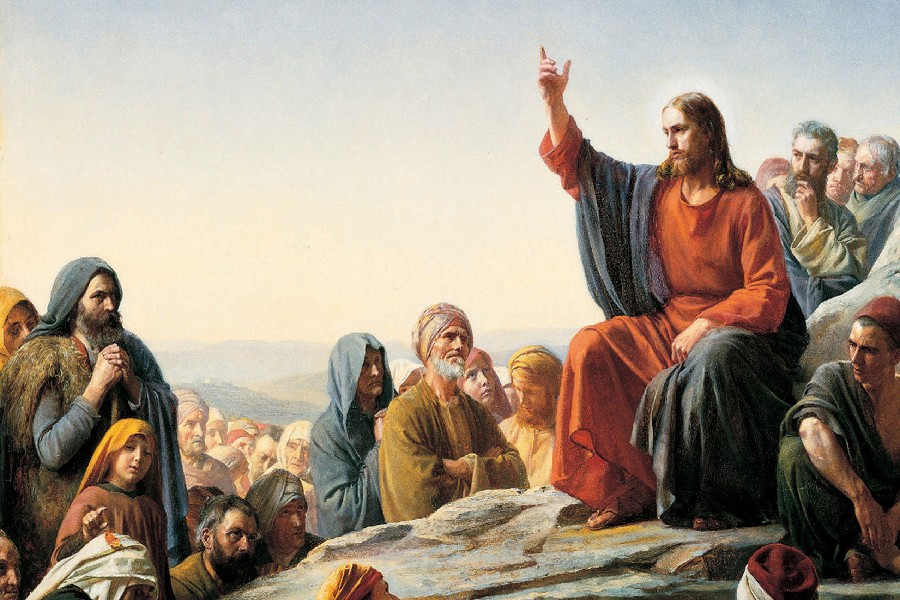
jesus

Assuredly, I say to you, unless you are changed and become as little children, you will by no means enter the kingdom of heaven.

The kingdom of God does not come with observation; nor will they say, ‘See here!’ or ‘See there!’ For indeed, the kingdom of God is within you.

Blessed are the poor in spirit,
For theirs is the kingdom of heaven.
Blessed are those who mourn,
For they shall be comforted.
Blessed are the meek,
For they shall inherit the earth.
Blessed are those who hunger and thirst for righteousness,
For they shall be filled.
Blessed are the merciful,
For they shall obtain mercy.
Blessed are the pure in heart,
For they shall see God.
Blessed are the peacemakers,
For they shall be called sons of God.
Blessed are those who are persecuted for righteousness’ sake,
For theirs is the kingdom of heaven.

Blessed are you when they revile and persecute you, and say all kinds of evil against you falsely for my sake. Rejoice and be exceedingly glad, for great is your reward in heaven, for so they persecuted the prophets who were before you.

You are the salt of the earth; but if the salt loses its flavor, how shall it be seasoned? It is then good for nothing but to be thrown out and trampled underfoot by men.

You are the light of the world. A city that is set on a hill cannot be hidden. Nor do they light a lamp and put it under a basket, but on a lampstand, and it gives light to all who are in the house. Let your light so shine before men, that they may see your good works and glorify your Father in heaven.

Do not think that I came to destroy the Law or the Prophets. I did not come to destroy but to fulfill. For assuredly, I say to you, till heaven and earth pass away, one jot or one tittle will by no means pass from the law till all is fulfilled. Whoever therefore breaks one of the least of these commandments, and teaches men so, shall be called least in the kingdom of heaven; but whoever does and teaches them, he shall be called great in the kingdom of heaven. For I say to you, that unless your righteousness exceeds the righteousness of the scribes and Pharisees, you will by no means enter the kingdom of heaven.

You have heard that it was said to those of old, ‘You shall not murder, and whoever murders will be in danger of the judgment.’ But I say to you that whoever is angry with his brother without a cause shall be in danger of the judgment. And whoever says to his brother, ‘Raca [worthless]!’ shall be in danger of the council. But whoever says, ‘You fool!’ shall be in danger of hell fire. Therefore if you bring your gift to the altar, and there remember that your brother has something against you, leave your gift there before the altar, and go your way. First be reconciled to your brother, and then come and offer your gift. Agree with your adversary quickly, while you are on the way with him, lest your adversary deliver you to the judge, the judge hand you over to the officer, and you be thrown into prison. Assuredly, I say to you, you will by no means get out of there till you have paid the last penny.

You have heard that it was said to those of old, ‘You shall not commit adultery.’ But I say to you that whoever looks at a woman to lust for her has already committed adultery with her in his heart. If your right eye causes you to sin, pluck it out and cast it from you; for it is more profitable for you that one of your members perish, than for your whole body to be cast into hell. And if your right hand causes you to sin, cut it off and cast it from you; for it is more profitable for you that one of your members perish, than for your whole body to be cast into hell.

Again you have heard that it was said to those of old, ‘You shall not swear falsely, but shall perform your oaths to the Lord.’ But I say to you, do not swear at all: neither by heaven, for it is God’s throne; nor by the earth, for it is His footstool; nor by Jerusalem, for it is the city of the great king. Nor shall you swear by your head, because you cannot make one hair white or black. But let your ‘Yes’ be ‘Yes,’ and your ‘No,’ ‘No.’ For whatever is more than these is from the evil one.

You have heard that it was said, ‘An eye for an eye and a tooth for a tooth.’ But I tell you not to resist an evil person. But whoever slaps you on your right cheek, turn the other to him also. If anyone wants to sue you and take away your tunic, let him have your cloak also. And whoever compels you to go one mile, go with him two. Give to him who asks you, and from him who wants to borrow from you do not turn away.

You have heard that it was said, ‘You shall love your neighbor and hate your enemy.’ But I say to you, love your enemies, bless those who curse you, do good to those who hate you, and pray for those who spitefully use you and persecute you, that you may be sons of your Father in heaven; for He makes His sun rise on the evil and on the good, and sends rain on the just and on the unjust. For if you love those who love you, what reward have you? Do not even the tax collectors do the same? And if you greet your brethren only, what do you do more than others? Do not even the tax collectors do so? Therefore you shall be perfect, just as your Father in heaven is perfect.

Take heed that you do not do your charitable deeds before men, to be seen by them. Otherwise you have no reward from your Father in heaven. Therefore, when you do a charitable deed, do not sound a trumpet before you as the hypocrites do in the synagogues and in the streets, that they may have glory from men. Assuredly, I say to you, they have their reward. But when you do a charitable deed, do not let your left hand know what your right hand is doing, that your charitable deed may be in secret; and your Father who sees in secret will Himself reward you openly.

And when you pray, you shall not be like the hypocrites. For they love to pray standing in the synagogues and on the corners of the streets, that they may be seen by men. Assuredly, I say to you, they have their reward. But you, when you pray, go into your room, and when you have shut your door, pray to your Father who is in the secret place; and your Father who sees in secret will reward you openly. And when you pray, do not use vain repetitions as the heathen do. For they think that they will be heard for their many words.

Therefore I say to you, do not worry about your life, what you will eat or what you will drink; nor about your body, what you will put on. Is not life more than food and the body more than clothing? Look at the birds of the air, for they neither sow nor reap nor gather into barns; yet your heavenly Father feeds them. Are you not of more value than they? Which of you by worrying can add one cubit to his stature?

So why do you worry about clothing? Consider the lilies of the field, how they grow: they neither toil nor spin; and yet I say to you that even Solomon in all his glory was not arrayed like one of these. Now if God so clothes the grass of the field, which today is, and tomorrow is thrown into the oven, will He not much more clothe you, O you of little faith?

Therefore do not worry, saying, ‘What shall we eat?’ or ‘What shall we drink?’ or ‘What shall we wear?’ For after all these things the Gentiles seek. For your heavenly Father knows that you need all these things. But seek first the kingdom of God and His righteousness, and all these things shall be added to you. Therefore do not worry about tomorrow, for tomorrow will worry about its own things. Sufficient for the day is its own trouble.

Do not lay up for yourselves treasures on earth, where moth and rust destroy and where thieves break in and steal; but lay up for yourselves treasures in heaven, where neither moth nor rust destroys and where thieves do not break in and steal. For where your treasure is, there your heart will be also.

No one can serve two masters; for either he will hate the one and love the other, or else he will be loyal to the one and despise the other. You cannot serve God and mammon [material wealth]. It is easier for a camel to go through the eye of a needle than for a rich man to enter the kingdom of God.

If you want to be perfect, go, sell what you have and give to the poor, and you will have treasure in heaven; and come, follow me.

For whoever desires to save his life will lose it, but whoever loses his life for my sake and the gospel’s will save it. For what will it profit a man if he gains the whole world, and loses his own soul? Or what will a man give in exchange for his soul?
For if you forgive men their trespasses, your heavenly Father will also forgive you. But if you do not forgive men their trespasses, neither will your Father forgive your trespasses.

Judge not, that you be not judged. For with what judgment you judge, you will be judged; and with the measure you use, it will be measured back to you. And why do you look at the speck in your brother’s eye, but do not consider the plank in your own eye? Or how can you say to your brother, ‘Let me remove the speck from your eye’; and look, a plank is in your own eye? Hypocrite! First remove the plank from your own eye, and then you will see clearly to remove the speck from your brother’s eye.

Ask, and it will be given to you; seek, and you will find; knock, and it will be opened to you. For everyone who asks receives, and he who seeks finds, and to him who knocks it will be opened. Or what man is there among you who, if his son asks for bread, will give him a stone? Or if he asks for a fish, will he give him a serpent? If you then, being evil, know how to give good gifts to your children, how much more will your Father who is in heaven give good things to those who ask Him! Therefore, whatever you want men to do to you, do also to them, for this is the Law and the Prophets.

A new commandment I give to you, that you love one another; as I have loved you, that you also love one another. By this all will know that you are my disciples, if you have love for one another.

Enter by the narrow gate; for wide is the gate and broad is the way that leads to destruction, and there are many who go in by it. Because narrow is the gate and difficult is the way which leads to life, and there are few who find it.

Beware of false prophets, who come to you in sheep’s clothing, but inwardly they are ravenous wolves. You will know them by their fruits. Do men gather grapes from thornbushes or figs from thistles? Even so, every good tree bears good fruit, but a bad tree bears bad fruit. A good tree cannot bear bad fruit, nor can a bad tree bear good fruit. Every tree that does not bear good fruit is cut down and thrown into the fire. Therefore by their fruits you will know them.

Not everyone who says to me, ‘Lord, Lord,’ shall enter the kingdom of heaven, but he who does the will of my Father in heaven. Many will say to me in that day, ‘Lord, Lord, have we not prophesied in your name, cast out demons in your name, and done many wonders in your name?’ And then I will declare to them, ‘I never knew you; depart from me, you who practice lawlessness!’

Therefore whoever hears these sayings of mine, and does them, I will liken him to a wise man who built his house on the rock: and the rain descended, the floods came, and the winds blew and beat on that house; and it did not fall, for it was founded on the rock.

But everyone who hears these sayings of mine, and does not do them, will be like a foolish man who built his house on the sand: and the rain descended, the floods came, and the winds blew and beat on that house; and it fell. And great was its fall.

Again, the kingdom of heaven is like treasure hidden in a field, which a man found and hid; and for joy over it he goes and sells all that he has and buys that field.

Again, the kingdom of heaven is like a merchant seeking beautiful pearls, who, when he had found one pearl of great price, went and sold all that he had and bought it.

Do you not know that you are the temple of God and that the Spirit of God dwells in you? If anyone defiles the temple of God, God will destroy him. For the temple of God is holy, which temple you are.

If you abide in my word, you are truly my disciples, and you will know the truth, and the truth will set you free.

It is written, ‘Man shall not live by bread alone, but by every word that proceeds from the mouth of God.’

And so it was, when Jesus had ended these sayings, that the people were astonished at his teaching, for he taught them as one having authority, and not as the scribes.

And the disciples came and said to him, “Why do you speak to them in parables?”

He answered and said to them, “Because it has been given to you to know the mysteries of the kingdom of heaven, but to them it has not been given. For whoever has, to him more will be given, and he will have abundance; but whoever does not have, even what he has will be taken away from him. Therefore I speak to them in parables, because seeing they do not see, and hearing they do not hear, nor do they understand.

Now it came to pass, when Jesus had finished these parables, that he departed from there. When he had come to his own country, he taught them in their synagogue, so that they were astonished and said, “Where did this man get this wisdom and these mighty works? Is this not the carpenter’s son? Is not his mother called Mary? And his brothers James, Joses, Simon, and Judas? And his sisters, are they not all with us? Where then did this man get all these things?” So they were offended at him.

But Jesus said to them, “A prophet is not without honor except in his own country and in his own house.” Now he did not do many mighty works there because of their unbelief.

Behold, I send you out as sheep in the midst of wolves. Therefore be wise as serpents and harmless as doves. But beware of men, for they will deliver you up to councils and scourge you in their synagogues. You will be brought before governors and kings for my sake. And you will be hated by all for my name’s sake. But he who endures to the end will be saved. When they persecute you in this city, flee to another.

For even the son of man did not come to be served, but to serve, and to give his life as a ransom for many.

Do not think that I came to bring peace on earth. I did not come to bring peace but a sword. For I have come to ‘set a man against his father, a daughter against her mother, and a daughter-in-law against her mother-in-law’; and ‘a man’s enemies will be those of his own household.’ He who loves father or mother more than me is not worthy of me. And he who loves son or daughter more than me is not worthy of me. And he who does not take his cross and follow after me is not worthy of me. He who finds his life will lose it, and he who loses his life for my sake will find it.

Therefore do not fear them. For there is nothing covered that will not be revealed, and hidden that will not be known. And do not fear those who kill the body but cannot kill the soul. But rather fear Him who is able to destroy both soul and body in hell. Blessed are those who are persecuted for righteousness’ sake, for theirs is the kingdom of heaven.

All authority has been given to me in heaven and on earth. Go therefore and make disciples of all the nations, baptizing them in the name of the Father and of the son and of the holy spirit, teaching them to observe all things that I have commanded you; and lo, I am with you always, even to the end of the age.

. . .

When I was a child, I spoke as a child, I understood as a child, I thought as a child; but when I became a man, I put away childish things. For now we see in a mirror, dimly, but then face to face. Now I know in part, but then I shall know just as I also am known.

Let no one deceive himself. If anyone among you seems to be wise in this age, let him become a fool that he may become wise. For the wisdom of this world is foolishness with God. Beware lest anyone cheat you through philosophy and empty deceit, according to the tradition of men, according to the basic principles of the world, and not according to Christ.

But someone will say, “How are the dead raised up? And with what body do they come?” Foolish one, what you sow is not made alive unless it dies. All flesh is not the same flesh, but there is one kind of flesh of men, another flesh of animals, another of fish, and another of birds. There are also celestial bodies and terrestrial bodies; but the glory of the celestial is one, and the glory of the terrestrial is another. There is one glory of the sun, another glory of the moon, and another glory of the stars; for one star differs from another star in glory.

So also is the resurrection of the dead. The body is sown in corruption, it is raised in incorruption. It is sown in dishonor, it is raised in glory. It is sown in weakness, it is raised in power. It is sown a natural body, it is raised a spiritual body. There is a natural body, and there is a spiritual body. And so it is written, “The first man Adam became a living being.” The last Adam became a life-giving spirit. However, the spiritual is not first, but the natural, and afterward the spiritual. The first man was of the earth, made of dust; the second man is the Lord from heaven. As was the man of dust, so also are those who are made of dust; and as is the heavenly man, so also are those who are heavenly. And as we have borne the image of the man of dust, we shall also bear the image of the heavenly man.

Now this I say, brethren, that flesh and blood cannot inherit the kingdom of God; nor does corruption inherit incorruption. Behold, I tell you a mystery: We shall not all sleep, but we shall all be changed— in a moment, in the twinkling of an eye, at the last trumpet. For the trumpet will sound, and the dead will be raised incorruptible, and we shall be changed. For this corruptible must put on incorruption, and this mortal must put on immortality. So when this corruptible has put on incorruption, and this mortal has put on immortality, then shall be brought to pass the saying that is written: “Death is swallowed up in victory.”

O Death, where is your sting?
O Hades, where is your victory?

The sting of death is sin, and the strength of sin is the law. But thanks be to God, who gives us the victory through our Lord Jesus Christ.

For since by man came death, by man also came the resurrection of the dead. For as in Adam all die, even so in Christ all shall be made alive. I die daily. If, in the manner of men, I have fought with beasts at Ephesus, what advantage is it to me? If the dead do not rise, “Let us eat and drink, for tomorrow we die!”

Now faith is the substance of things hoped for, the evidence of things not seen. Assuredly, I say to you, if you have faith and do not doubt, you will not only do what was done to the fig tree, but also if you say to this mountain, ‘Be removed and be cast into the sea,’ it will be done.

Though I speak with the tongues of men and of angels, but have not love, I have become sounding brass or a clanging cymbal. And though I have the gift of prophecy, and understand all mysteries and all knowledge, and though I have all faith, so that I could remove mountains, but have not love, I am nothing. And though I bestow all my goods to feed the poor, and though I give my body to be burned, but have not love, it profits me nothing.

Love suffers long and is kind; love does not envy; love does not parade itself, is not puffed up; does not behave rudely, does not seek its own, is not provoked, thinks no evil; does not rejoice in iniquity, but rejoices in the truth; bears all things, believes all things, hopes all things, endures all things.

Love never fails. But whether there are prophecies, they will fail; whether there are tongues, they will cease; whether there is knowledge, it will vanish away. For we know in part and we prophesy in part. But when that which is perfect has come, then that which is in part will be done away.

And now abide faith, hope, love, these three; but the greatest of these is love.

– The Teaching of Jesus

Consider also the Gospel of Thomas and other apocryphal writings.

* * * * *

“Understand the nature and purpose of teaching by way of myth and parable and allegory. Blessed are those with ears to hear and eyes to see beyond the literal word to the metaphorical and spiritual and moral meaning. Do not listen as the fool listens, for he hears only the literal word and it profits him not. It would be better for him to hear only the noise of words than to understand only the literal word and not the true teaching.“

– The Teaching of Joshua Synon

Secessio Plebis

Secessio plebis (withdrawal of the commoners, or Secession of the Plebs) was an informal exercise of power by Rome’s plebeian citizens, similar to a general strike taken to the extreme. During a secessio plebis, the plebs would simply abandon the city en masse and leave the patrician order to themselves. Therefore a secessio meant that all shops and workshops would shut down and commercial transactions would largely cease. This was an effective strategy in the Conflict of the Orders due to strength in numbers; plebeian citizens made up the vast majority of Rome’s populace and produced most of its food and resources, while a patrician citizen was a member of the minority upper class, the equivalent of the landed gentry of later times. Authors report different numbers for how many secessions there were. Cary & Scullard (p. 66) state there were five between 494 BC and 287 BC.

Contents

  • 1 Secessions in Roman history
    • 1 494 BC
    • 2 449 BC
    • 3 445 BC
    • 4 342 BC
    • 5 287 BC
  • 2 References
  • 3 Bibliography

Secessions in Roman history

494 BC

In 494 BC, in response to the harsh rule of Appius Claudius Sabinus Inregillensis, the plebeians seceded and fled to Mons Sacer (the Sacred Mountain) and threatened to found a new town. (The mountain was not the Aventine Hill where they gathered in 449 BC [see below], thus giving its name to the Aventine Secession in the 20th century AD). In response, the patricians freed some of the plebs from their debts and conceded some of their power by creating the office of the Tribune of the Plebs. This tribune was the first government position held by the plebs. The powers of the tribunes changed over time. At their zenith, the plebeian tribunes exercised the power of veto (Latin: “I forbid”), by which they could forbid or invalidate any decision or action of a magistrate, including a consul or praetor, or indeed of the whole Senate, that he deemed harmful to the plebs. The nadir of the tribunician power in the republican period may have occurred with the constitutional legislation of the dictator Sulla.

This settlement led to the foundation of the Temple of Concord.

449 BC

In 449 BC, the plebs seceded again to force the patricians to adopt the Twelve Tables. Unlike the earlier secret laws which only the priests had access to, these new laws amounted to a written and published legal code. And unlike the earlier non-published laws, the Twelve Tables presented a basic set of laws and rights to the Roman public, as opposed hidden and secret laws which gave no specific rights to the ordinary plebeian Roman. The patricians vehemently opposed it but were nevertheless forced to found a commission headed by adecemvir who in turn announced the Twelve Tables in the Roman Forum. With the announcement of the new laws, the plebs were to a degree freed from injustice and subjectivity during trials. However, they were still obliged to pay slavery debt.

445 BC

The third secession is alluded to by Florus (Lex Canuleia).

342 BC

This fourth secession is noted by Livy. The Oxford Classical Dictionary calls this an “obscure military revolt”.

287 BC

In 287 BC, the plebs seceded a final time to the Janiculum to force the patricians to adopt the Lex Hortensia, which gave plebiscites the force of law.

Bibliography

  • ‘The Growth of Plebeian Privilege in Rome’, The English Historical Review II (April 1886)
  • Forsythe, G., A Critical History of Early Rome”, Berkeley, 2005

Reminds me of the secession of the creative minds of the world in Ayn Rand’s Atlas Shrugged.

Revolution on the Horizon?

Whenever any Form of Government becomes destructive of these ends, it is the Right of the People to alter or to abolish it, and to institute new Government, laying its foundation on such principles and organizing its powers in such form, as to them shall seem most likely to effect their Safety and Happiness. Prudence, indeed, will dictate that Governments long established should not be changed for light and transient causes; and accordingly all experience hath shewn that mankind are more disposed to suffer, while evils are sufferable than to right themselves by abolishing the forms to which they are accustomed. But when a long train of abuses and usurpations, pursuing invariably the same Object evinces a design to reduce them under absolute Despotism, it is their right, it is their duty, to throw off such Government, and to provide new Guards for their future security.

Last night I watched this movie entitled In Time starring Justin Timberlake and Amanda Seyfried; directed and written by one Andrew Niccol.

In a future where people stop aging at 25, but are engineered to live only one more year, having the means to buy your way out of the situation is a shot at immortal youth. Here, Will Salas finds himself accused of murder and on the run with a hostage – a connection that becomes an important part of the way against the system.

Time, digitally engraved on their forearm, is literally money in their world. And money is power incarnate just like in real life. There are few with over 100 years, and many with mere days. The wealthiest are millionaires. Most die around the age of 26 in the ghetto. I immediately drew the political connection to real life as it was quite obvious, much like the message about middle eastern oil in Syriana.

So I googled it. And guess what I came up with. The Occupy Wall Street Movement as Marxism mostly, with this movie as their rallying cry. “We are the 99%.” I’ve heard it takes an income of 600k per year to be placed in the top 1% of the wealthiest folks in our nation. Of course 1% is around 300,000 people and there’s a few billionaires and a bunch of millionaires in there.

The OWS protests are against social and economic inequality, greed, corruption and the undue influence of corporations on government – particularly from the financial services sector.

Does not capitalism in its essence guarantee inequality? You reap what you sow. All men are not created equal in any case. Some are born into wealthy families. Others are born in the slums of Midgar. One is born with a natural talent in one area while another is born with a natural talent in another area. Some are born deformed or with complete lack of talent. All else aside, nobody is equal and the 1% are the only people who seem to realize this. It’s all about family and money. Verily, there exist gods among men who are indeed above the common laws of man.

As John Locke, a highly influential philosopher in terms of the U.S. Constitution, writes, the rulers of individual nations are in a state of nature with respect to eachother, while all of their governed subjects are equal yet burdened by a social contract which alienates at least some of their natural rights – rights which the rulers may enjoy.

Are we just now realizing how similar to an oligarchy the U.S. has turned out to become since its days of bondage to Britain? Doubtful. I’m sure there has always been a sharp distinction between rich and poor in every society (Plato wrote about it 2,400 years ago).

Is the OWS movement ideologically similar to Marxism? The media certainly seems to be portraying them in such a manner. I don’t think the fact of financial inequality should be the main focus of OWS though. If anything, it should be the vast influence that the (wealthy) private sector has on political matters.

In light of globalization and wars in the name of democracy, national security and freedom, which is indeed an impious lie, is a revolution on the horizon? Doubtful. People are either too afraid or too lazy or too contentedly ignorant.

I, for one, can assure you that if I were part of the 1%, I would never allow it. As I am not, I can either choose to settle with what I have and what is possible for a commoner to obtain or I can fight. But then again, there are countries much worse off than the U.S. Yet the U.S. is where I was born and live and where my conscience leads me is yet to be determined.

What would you do if you made 600k+ per year?

When governments fear the people, there is liberty. When the people fear the government, there is tyranny. The strongest reason for the people to retain the right to keep and bear arms is, as a last resort, to protect themselves against tyranny in government.