This limitation leads me to myself, where I can no longer withdraw behind an objective point of view that I am merely representing, where neither I myself nor the existence of others can any longer become an object for me. – Karl Jaspers
Selected passages from The Myth of Sisyphus by Albert Camus
Preface
For me “The Myth of Sisyphus” marks the beginning of an idea which I was to pursue in The Rebel. It attempts to resolve the problem of suicide, as The Rebel attempts to resolve that of murder, in both cases without the aid of eternal values which, temporarily perhaps, are absent or distorted in contemporary Europe. The fundamental subject of “The Myth of Sisyphus” is this: it is legitimate and necessary to wonder whether life has a meaning; therefore it is legitimate to meet the problem of suicide face to face. The answer, underlying and appearing through the paradoxes which cover it, is this: even if one does not believe in God, suicide is not legitimate. Written fifteen years ago, in 1940, amid the French and European disaster, this book declares that even within the limits of nihilism it is possible to find the means to proceed beyond nihilism. In all the books I have written since, I have attempted to pursue this direction. Although “The Myth of Sisyphus” poses mortal problems, it sums itself up for me as a lucid invitation to live and to create, in the very midst of the desert.
The pages that follow deal with an absurd sensitivity that can be found widespread in the age. But it is useful to note that the absurd, hitherto taken as a conclusion, is considered in this essay as a starting-point. In this sense it may be said that there is something provisional in my commentary: one cannot prejudge the position it entails. There will be found here merely the description, in the pure state, of an intellectual malady.
Absurdity and Suicide
There is but one truly serious philosophical problem, and that is suicide. Judging whether life is or is not worth living amounts to answering the fundamental question of philosophy. All the rest – whether or not the world has three dimensions, whether the mind has nine or twelve categories – comes afterward. These are games; one must first answer. If I ask myself how to judge that this question is more urgent than that, I reply that one judges by the actions it entails. I have never seen anyone die for the ontological argument. On the other hand, I see many people die because they judge that life is not worth living.
Suicide has never been dealt with except as a social phenomenon. On the contrary, we are concerned here, at the outset, with the relationship between individual thought and suicide. In a sense, and as in melodrama, killing yourself amounts to confessing. It is confessing that life is too much for you or that you do not understand it. Let’s not go too far in such analogies, however, but rather return to everyday words. It is merely confessing that that “is not worth the trouble.” Living, naturally, is never easy. You continue making the gestures commanded by existence for many reasons, the first of which is habit. Dying voluntarily implies that you have recognized, even instinctively, the ridiculous character of that habit, the absence of any profound reason for living, the insane character of that daily agitation, and the uselessness of suffering.
What, then, is that incalculable feeling that deprives the mind of the sleep necessary to life? A world that can be explained even with bad reasons is a familiar world. But, on the other hand, in a universe suddenly divested of illusions and lights, man feels an alien, a stranger. His exile is without remedy since he is deprived of the memory of a lost home or the hope of a promised land. This divorce between man and his life, the actor and his setting, is properly the feeling of absurdity. All healthy men having thought of their own suicide, it can be seen, without further explanation, that there is a direct connection between this feeling and the longing for death.
The subject of this essay is precisely this relationship between the absurd and suicide, the exact degree to which suicide is a solution to the absurd. Does its absurdity require one to escape it through hope or suicide – this is what must be clarified, hunted down, and elucidated while brushing aside all the rest. Does the Absurd dictate death? It is always easy to be logical. It is almost impossible to be logical to the bitter end. Men who die by their own hand consequently follow to its conclusion their emotional inclination. Reflection on suicide gives me an opportunity to raise the only problem to interest me: is there a logic to the point of death?
Absurd Walls
It is essential to consider as a constant point of reference in this essay the regular hiatus between what we fancy we know and what we really know, practical assent and simulated ignorance which allows us to live with ideas which, if we truly put them to the test, ought to upset our whole life. If the only significant history of human thought were to be written, it would have to be the history of its successive regrets and its impotences.
Of whom and of what indeed can I say: “I know that!” This heart within me I can feel, and I judge that it exists. This world I can touch, and I likewise judge that it exists. There ends all my knowledge, and the rest is construction. For if I try to seize this self of which I feel sure, if I try to define and to summarize it, it is nothing but water slipping through my fingers. I can sketch one by one all the aspects it is able to assume, all those likewise that have been attributed to it, this upbringing, this origin, this ardor or these silences, this nobility or this vileness. But aspects cannot be added up. This very heart which is mine will forever remain indefinable to me. Between the certainty I have of my existence and the content I try to give to that assurance, the gap will never be filled. Forever I shall be a stranger to myself. In psychology as in logic, there are truths but no truth. Socrates’ “Know thyself” has as much value as the “Be virtuous” of our confessionals. They reveal a nostalgia at the same time as an ignorance. They are sterile exercises on great subjects. They are legitimate only precisely so far as they are approximate.
And here are trees and I know their gnarled surface, water and I feel its taste. These scents of grass and stars at night, certain evenings when the heart relaxes – how shall I negate this world whose power and strength I feel? Yet all the knowledge on earth will give me nothing to assure me that this world is mine. You describe it to me and you teach me to classify it. You enumerate its laws and in my thirst for knowledge I admit that they are true. You take apart its mechanism and my hope increases. At the final stage you teach me that this wondrous and multicolored universe can be reduced to the atom and that the atom itself can be reduced to the electron. All this is good and I wait for you to continue. But you tell me of an invisible planetary system in which electrons gravitate around a nucleus. You explain this world to me with an image. I realize then that you have been reduced to poetry: I shall never know. Have I the time to become indignant? You have already changed theories. So that science that was to teach me everything ends up in a hypothesis, that lucidity founders in metaphor, that uncertainty is resolved in a work of art. What need had I of so many efforts? The soft lines of these hills and the hand of evening on this troubled heart teach me much more. I have returned to my beginning. I realize that if through science I can seize phenomena and enumerate them, I cannot, for all that, apprehend the world. Were I to trace its entire relief with my finger, I should not know any more. And you give me the choice between a description that is sure but that teaches me nothing and hypotheses that claim to teach me but that are not sure. A stranger to myself and to the world, armed solely with a thought that negates itself as soon as it asserts, what is this condition in which I can have peace only by refusing to know and to live, in which the appetite for conquest bumps into walls that defy its assaults? To will is to stir up paradoxes. Everything is ordered in such a way as to bring into being that poisoned peace produced by thoughtlessness, lack of heart, or fatal renunciations.
Hence the intelligence, too, tells me in its way that this world is absurd. Its contrary, blind reason, may well claim that all is clear; I was waiting for proof and longing for it to be right. But despite so many pretentious centuries and over the heads of so many eloquent and persuasive men, I know that is false. On this plane, at least, there is no happiness if I cannot know. That universal reason, practical or ethical, that determinism, those categories that explain everything are enough to make a decent man laugh. They have nothing to do with the mind. They negate its profound truth, which is to be enchained. In this unintelligible and limited universe, man’s fate henceforth assumes its meaning. A horde of irrationals has sprung up and surrounds him until his ultimate end. In his recovered and now studied lucidity, the feeling of the absurd becomes clear and definite. I said that the world is absurd, but I was too hasty. This world in itself is not reasonable, that is all that can be said. But what is absurd is the confrontation of this irrational and the wild longing for clarity whose call echoes in the human heart. The absurd depends as much on man as on the world. For the moment it is all that links them together. It binds them one to the other as only hatred can weld two creatures together. This is all I can discern clearly in this measureless universe where my adventure takes place. Let us pause here. If I hold to be true that absurdity that determines my relationship with life, if I become thoroughly imbued with that sentiment that seizes me in face of the world’s scenes, with that lucidity imposed on me by the pursuit of a science, I must sacrifice everything to these certainties and I must see them squarely to be able to maintain them. Above all, I must adapt my behavior to them and pursue them in all their consequences. I am speaking here of decency. But I want to know beforehand if thought can live in those deserts.
I already know that thought has at least entered those deserts. There it found its bread. There it realized that it had previously been feeding on phantoms. It justified some of the most urgent themes of human reflection. From the moment absurdity is recognized, it becomes a passion, the most harrowing of all. But whether or not one can live with one’s passions, whether or not one can accept their law, which is to burn the heart they simultaneously exalt – that is the whole question.
Never perhaps at any time has the attack on reason been more violent than in ours. Since Zarathustra’s great outburst: “By chance it is the oldest nobility in the world. I conferred it upon all things when I proclaimed that above them no eternal will was exercised,” since Kierkegaard’s fatal illness, “that malady that leads to death with nothing else following it,” the significant and tormenting themes of absurd thought have followed one another. Or at least, and this proviso is of capital importance, the themes of irrational and religious thought. From Jaspers to Heidegger, from Kierkegaard to Chestov, from the phenomenologists to Scheler, on the logical plane and on the moral plane, a whole family of minds related by their nostalgia but opposed by their methods or their aims, have persisted in blocking the royal road of reason and in recovering the direct paths of truth. Here I assume these thoughts to be known and lived. Whatever may be or have been their ambitions, all started out from that indescribable universe where contradiction, antinomy, anguish, or impotence reigns.
Heidegger considers the human condition coldly and announces that existence is humiliated. The only reality is “anxiety” in the whole chain of beings. To the man lost in the world and its diversions this anxiety is a brief, fleeting fear. But if that fear becomes conscious of itself, it becomes anguish, the perpetual climate of the lucid man “in whom existence is concentrated.” This professor of philosophy writes without trembling and in the most abstract language in the world that “the finite and limited character of human existence is more primordial than man himself.” His interest in Kant extends only to recognizing the restricted character of his “pure Reason.” This is to conclude at the end of his analyses that “the world can no longer offer anything to the man filled with anguish.”
Jaspers despairs of any ontology because he claims that we have lost “naïveté.” He knows that we can achieve nothing that will transcend the fatal game of appearances. He knows that the end of the mind is failure. He tarries over the spiritual adventures revealed by history and pitilessly discloses the flaw in each system, the illusion that saved everything, the preaching that hid nothing. In this ravaged world in which the impossibility of knowledge is established, in which everlasting nothingness seems the only reality and irremediable despair seems the only attitude, he tries to recover the Ariadne’s thread that leads to divine secrets.
Chestov, for his part, throughout a wonderfully monotonous work, constantly straining toward the same truths, tirelessly demonstrates that the tightest system, the most universal rationalism always stumbles eventually on the irrational of human thought. None of the ironic facts or ridiculous contradictions that depreciate the reason escapes him. One thing only interests him, and that is the exception, whether in the domain of the heart or of the mind. Through the Dostoevskian experiences of the condemned man, the exacerbated adventures of the Nietzschean mind, Hamlet’s imprecations, or the bitter aristocracy of an Ibsen, he tracks down, illuminates, and magnifies the human revolt against the irremediable. He refuses the reason its reasons and begins to advance with some decision only in the middle of that colorless desert where all certainties have become stones.
Of all perhaps the most engaging, Kierkegaard, for a part of his existence at least, does more than discover the absurd, he lives it. The man who writes: “The surest of stubborn silences is not to hold one’s tongue but to talk” makes sure in the beginning that no truth is absolute or can render satisfactory an existence that is impossible in itself. Don Juan of the understanding, he multiplies pseudonyms and contradictions, writes his Discourses of Edification at the same time as that manual of cynical spiritualism, The Diary of the Seducer. He refuses consolations, ethics, reliable principles. As for that thorn he feels in his heart, he is careful not to quiet its pain. On the contrary, he awakens it and, in the desperate joy of a man crucified and happy to be so, he builds up piece by piece – lucidity, refusal, make-believe – a category of the man possessed. That face both tender and sneering, those pirouettes followed by a cry from the heart are the absurd spirit itself grappling with a reality beyond its comprehension. And the spiritual adventure that leads Kierkegaard to his beloved scandals begins likewise in the chaos of an experience divested of its setting and relegated to its original incoherence.
On quite a different plane, that of method, Husserl and the phenomenologists, by their very extravagances, reinstate the world in its diversity and deny the transcendent power of the reason. The spiritual universe becomes incalculably enriched through them. The rose petal, the milestone, or the human hand are as important as love, desire, or the laws of gravity. Thinking ceases to be unifying or making a semblance familiar in the guise of a major principle. Thinking is learning all over again to see, to be attentive, to focus consciousness; it is turning every idea and every image, in the manner of Proust, into a privileged moment. What justifies thought is its extreme consciousness. Though more positive than Kierkegaard’s or Chestov’s, Husserl’s manner of proceeding, in the beginning, nevertheless negates the classic method of the reason, disappoints hope, opens to intuition and to the heart a whole proliferation of phenomena, the wealth of which has about it something inhuman. These paths lead to all sciences or to none. This amounts to saying that in this case the means are more important than the end. All that is involved is “an attitude for understanding” and not a consolation. Let me repeat: in the beginning, at very least.
How can one fail to feel the basic relationship of these minds! How can one fail to see that they take their stand around a privileged and bitter moment in which hope has no further place? I want everything to be explained to me or nothing. And the reason is impotent when it hears this cry from the heart. The mind aroused by this insistence seeks and finds nothing but contradictions and nonsense. What I fail to understand is nonsense. The world is peopled with such irrationals. The world itself, whose single meaning I do not understand, is but a vast irrational. If one could only say just once: “This is clear,” all would be saved. But these men vie with one another in proclaiming that nothing is clear, all is chaos, that all man has is his lucidity and his definite knowledge of the walls surrounding him.
Philosophical Suicide
There exists an obvious fact that seems utterly moral: namely, that a man is always a prey to his truths. Once he has admitted them, he cannot free himself from them. One has to pay something. A man who has become conscious of the absurd is forever bound to it. A man devoid of hope and conscious of being so has ceased to belong to the future. That is natural. But it is just as natural that he should strive to escape the universe of which he is the creator. All the foregoing has significance only on account of this paradox. Certain men, starting from a critique of rationalism, have admitted the absurd climate. Nothing is more instructive in this regard than to scrutinize the way in which they have elaborated their consequences.
Now, to limit myself to existential philosophies, I see that all of them without exception suggest escape. Through an odd reasoning, starting out from the absurd over the ruins of reason, in a closed universe limited to the human, they deify what crushes them and find reason to hope in what impoverishes them. That forced hope is religious in all of them.
Jaspers is left powerless to realize the transcendent, incapable of plumbing the depth of experience, and conscious of that universe upset by failure. Will he advance or at least draw the conclusions from that failure? He contributes nothing new. He has found nothing in experience but the confession of his own impotence and no occasion to infer any satisfactory principle. Yet without justification, as he says to himself, he suddenly asserts all at once the transcendent, the essence of experience, and the superhuman significance of life when he writes: “Does not the failure reveal, beyond any possible explanation and interpretation, not the absence but the existence of transcendence?” That existence which, suddenly and through a blind act of human confidence, explains everything, he defines as “the unthinkable unity of the general and the particular.” Thus the absurd becomes god (in the broadest meaning of this word) and that inability to understand becomes to existence that illuminates everything. Nothing logically prepares this reasoning. I can call it a leap.
Mystical thought has familiarized us with such devices. They are just as legitimate as any attitude of mind. But for the moment I am acting as if I took a certain problem seriously. Without judging beforehand the general value of this attitude or its educative power, I mean simply to consider whether it answers the conditions I set myself, whether it is worthy of the conflict that concerns me. Thus I return to Chestov. A commentator relates a remark of his that deserves interest: “The only true solution,” he said, “is precisely where human judgment sees no solution. Otherwise, what need would we have of God? We turn toward God only to obtain the impossible. As for the possible, men suffice.” If there is a Chestovian philosophy, I can say that it is altogether summed up in this way. For when, at the conclusion of his passionate analyses, Chestov discovers the fundamental absurdity of all existence, he does not say: “This is the absurd,” but rather: “This is God: we must rely on him even if he does not correspond to any of our rational categories.”
Now, if it is admitted that the absurd is the contrary of hope, it is seen that existential thought for Chestov presupposes the absurd but proves it only to dispel it. Such subtlety of thought is a conjuror’s emotional trick. If there is an absurd, it is in man’s universe. The moment the notion transforms itself into eternity’s springboard, it ceases to be linked to human lucidity. The absurd is no longer that evidence that man ascertains without consenting to it. The struggle is eluded. Man integrates the absurd and in that communion causes to disappear its essential character, which is opposition, laceration, and divorce. This leap is an escape. The intoxication of the irrational and the vocation of rapture turn a lucid mind away from the absurd. To Chestov reason is useless but there is something beyond reason. To an absurd mind reason is useless and there is nothing beyond reason.
Kierkegaard likewise takes the leap. His childhood having been so frightened by Christianity, he ultimately returns to its harshest aspect. For him, too, antinomy and paradox become criteria of the religious. Thus, the very thing that led to despair of the meaning and depth of this life now gives it its truth and its clarity. Christianity is the scandal, and what Kierkegaard calls for quite plainly is the third sacrifice required by Ignatius Loyola, the one in which God most rejoices: “The sacrifice of the intellect.” This effect of the “leap” is odd, but must not surprise us any longer. He makes of the absurd the criterion of the other world, whereas it is simply a residue of the experience of this world. “In his failure,” says Kierkegaard, “the believer finds his triumph.” If he substitutes for his cry of revolt a frantic adherence, at once he is led to blind himself to the absurd which hitherto enlightened him and to deify the only certainty he henceforth possesses, the irrational.
Kierkegaard wants to be cured. To be cured is his frenzied wish, and it runs throughout his whole journal. The entire effort of his intelligence is to escape the antinomy of the human condition. Thus it is that, through a strained subterfuge, he gives the irrational the appearance and God the attributes of the absurd: unjust, incoherent, and incomprehensible. Reconciliation through scandal is still reconciliation. It allows one perhaps, as can be seen, to derive hope of its contrary, which is death. I want to know whether I can live with what I know and with that alone. I am told again that here the intelligence must sacrifice its pride and the reason bow down. But if I recognize the limits of the reason, I do not therefore negate it, recognizing its relative powers. I merely want to remain in this middle path where the intelligence can remain clear. If that is its pride, I see no sufficient reason for giving it up. Nothing more profound, for example, than Kierkegaard’s view according to which despair is not a fact but a state: the very state of sin. For sin is what alienates from God. The absurd, which is the metaphysical state of the conscious man, does not lead to God. Perhaps this notion will become clearer if I risk this shocking statement: the absurd is sin without God.
It is a matter of living in that state of the absurd. I know on what it is founded, this mind and this world straining against each other without being able to embrace each other. I ask for the rule of life of that state, and what I am offered neglects its basis, negates one of the terms of the painful opposition, demands of me a resignation. I ask what is involved in the condition I recognize as mine; I know it implies obscurity and ignorance; and I am assured that this ignorance explains everything and that this darkness is my light. But there is no reply here to my intent, and this stirring lyricism cannot hide the paradox from me. One must therefore turn away. Kierkegaard may shout in warning: “If man had no eternal consciousness, if, at the bottom of everything, there were merely a wild, seething force producing everything, both large and trifling, in the storm of dark passions, if the bottomless void that nothing can fill underlay all things, what would life be but despair?” This cry is not likely to stop the absurd man. Seeking what is true is not seeking what is desirable. If in order to elude the anxious question: “What would life be?” one must, like the donkey, feed on the roses of illusion, then the absurd mind, rather than resigning itself to falsehood, prefers to adopt fearlessly Kierkegaard’s reply: “despair.” Everything considered, a determined soul will always manage.
I am taking the liberty at this point of calling the existential attitude philosophical suicide. But this does not imply a judgment. It is a convenient way of indicating the movement by which a thought negates itself and tends to transcend itself in its very negation. For the existentials negation is their God. To be precise, that god is maintained only through the negation of human reason. But, like suicides, gods change with men. There are many ways of leaping, the essential being to leap. Those redeeming negations, those ultimate contradictions which negate the obstacle that has not yet been leaped over, may spring just as well (this is the paradox at which this reasoning aims) from a certain religious inspiration as from the rational order. They always lay claim to the eternal, and it is solely in this that they take the leap.
It is futile to be amazed by the apparent paradox that leads thought to its own negation by the opposite paths of humiliated reason and triumphal reason. From the abstract god of Husserl to the dazzling god of Kierkegaard the distance is not so great. Reason and the irrational lead to the same preaching. In truth the way matters but little; the will to arrive suffices. The abstract philosopher and the religious philosopher start out from the same disorder and support each other in the same anxiety. But the essential is to explain. Nostalgia is stronger here than knowledge. It is significant that the thought of the epoch is at once one of the most deeply imbued with a philosophy of the non-significance of the world and one of the most divided in its conclusions. It is constantly oscillating between extreme rationalization of reality which tends to break up that thought into standard reasons and its extreme irrationalization which tends to deify it. But this divorce is only apparent. It is a matter of reconciliation, and, in both cases, the leap suffices.
Just as reason was able to soothe the melancholy of Plotinus, it provides modern anguish the means of calming itself in the familiar setting of the eternal. The absurd mind has less luck. For it the world is neither so rational nor so irrational. It is unreasonable and only that. With Husserl the reason eventually has no limits at all. The absurd, on the contrary, establishes its limits since it is powerless to calm its anguish. Kierkegaard independently asserts that a single limit is enough to negate that anguish. But the absurd does not go so far. For it that limit is directed solely at the reason’s ambitions. The theme of the irrational, as it is conceived by the existentials, is reason becoming confused and escaping by negating itself. The absurd is lucid reason noting its limits.
Absurd Freedom
I don’t know whether this world has a meaning that transcends it. But I know that I do not know that meaning and that it is impossible for me just now to know it. What can a meaning outside my condition mean to me? I can understand only in human terms. What I touch, what resists me—that is what I understand. And these two certainties—my appetite for the absolute and for unity and the impossibility of reducing this world to a rational and reasonable principle—I also know that I cannot reconcile them. What other truth can I admit without lying, without bringing in a hope I lack and which means nothing within the limits of my condition?
If I were a tree among trees, a cat among animals, this life would have a meaning, or rather this problem would not arise, for I should belong to this world. I should be this world to which I am now opposed by my whole consciousness and my whole insistence upon familiarity. This ridiculous reason is what sets me in opposition to all creation. I cannot cross it out with a stroke of the pen. What I believe to be true I must therefore preserve. What seems to me so obvious, even against me, I must support. And what constitutes the basis of that conflict, of that break between the world and my mind, but the awareness of it? If therefore I want to preserve it, I can through a constant awareness, ever revived, ever alert. This is what, for the moment, I must remember. At this moment the absurd, so obvious and yet so hard to win, returns to a man’s life and finds its home there. At this moment, too, the mind can leave the arid, dried-up path of lucid effort. That path now emerges in daily life. It encounters the world of the anonymous impersonal pronoun “one,” but henceforth man enters in with his revolt and his lucidity. He has forgotten how to hope. This hell of the present is his Kingdom at last. All problems recover their sharp edge. Abstract evidence retreats before the poetry of forms and colors. Spiritual conflicts become embodied and return to the abject and magnificent shelter of man’s heart. None of them is settled. But all are transfigured. Is one going to die, escape by the leap, rebuild a mansion of ideas and forms to one’s own scale? Is one, on the contrary, going to take up the heart-rending and marvelous wager of the absurd? Let’s make a final effort in this regard and draw all our conclusions. The body, affection, creation, action, human nobility will then resume their places in this mad world. At last man will again find there the wine of the absurd and the bread of indifference on which he feeds his greatness.
At a certain point on his path the absurd man is tempted. History is not lacking in either religions or prophets, even without gods. He is asked to leap. All he can reply is that he doesn’t fully understand, that it is not obvious. Indeed, he does not want to do anything but what he fully understands. He is assured that this is the sin of pride, but he does not understand the notion of sin; that perhaps hell is in store, but he has not enough imagination to visualize that strange future; that he is losing immortal life, but that seems to him an idle consideration. An attempt is made to get him to admit his guilt. He feels innocent. To tell the truth, that is all he feels—his irreparable innocence. This is what allows him everything. Hence, what he demands of himself is to live solely with what he knows, to accommodate himself to what is, and to bring in nothing that is not certain. He is told that nothing is. But this at least is a certainty. And it is with this that he is concerned: he wants to find out if it is possible to live without appeal.
To abolish conscious revolt is to elude the problem. The theme of permanent revolution is thus carried into individual experience. Living is keeping the absurd alive. Keeping it alive is, above all, contemplating it. Unlike Eurydice, the absurd dies only when we turn away from it. One of the only coherent philosophical positions is thus revolt. It is a constant confrontation between man and his own obscurity. It is an insistence upon an impossible transparency. It challenges the world anew every second. Just as danger provided man the unique opportunity of seizing awareness, so metaphysical revolt extends awareness to the whole of experience. It is that constant presence of man in his own eyes. It is not aspiration, for it is devoid of hope. That revolt is the certainty of a crushing fate, without the resignation that ought to accompany it.
This is where it is seen to what a degree absurd experience is remote from suicide. It may be thought that suicide follows revolt—but wrongly. For it does not represent the logical outcome of revolt. It is just the contrary by the consent it presupposes. Suicide, like the leap, is acceptance at its extreme. Everything is over and man returns to his essential history. His future, his unique and dreadful future—he sees and rushes toward it. In its way, suicide settles the absurd. It engulfs the absurd in the same death. But I know that in order to keep alive, the absurd cannot be settled. It escapes suicide to the extent that it is simultaneously awareness and rejection of death.
That revolt gives life its value. Spread out over the whole length of a life, it restores its majesty to that life. To a man devoid of blinders, there is no finer sight than that of the intelligence at grips with a reality that transcends it. The sight of human pride is unequaled. No disparagement is of any use. That discipline that the mind imposes on itself, that will conjured up out of nothing, that face-to-face struggle have something exceptional about them. To impoverish that reality whose inhumanity constitutes man’s majesty is tantamount to impoverishing him himself. I understand then why the doctrines that explain everything to me also debilitate me at the same time. They relieve me of the weight of my own life, and yet I must carry it alone. At this juncture, I cannot conceive that a skeptical metaphysics can be joined to an ethics of renunciation.
Consciousness and revolt, these rejections are the contrary of renunciation. Everything that is indomitable and passionate in a human heart quickens them, on the contrary, with its own life. It is essential to die unreconciled and not of one’s own free will. Suicide is a repudiation. The absurd man can only drain everything to the bitter end, and deplete himself. The absurd is his extreme tension, which he maintains constantly by solitary effort, for he knows that in that consciousness and in that day-to-day revolt he gives proof of his only truth, which is defiance.
There is no future. Henceforth this is the reason for my inner freedom. I shall use two comparisons here. Mystics, to begin with, find freedom in giving themselves. By losing themselves in their god, by accepting his rules, they become secretly free. In spontaneously accepted slavery they recover a deeper independence. But what does that freedom mean? It may be said, above all, that they feel free with regard to themselves, and not so much free as liberated. Likewise, completely turned toward death (taken here as the most obvious absurdity), the absurd man feels released from everything outside that passionate attention crystallizing in him. He enjoys a freedom with regard to common rules. It can be seen at this point that the initial themes of existential philosophy keep their entire value.
It is clear that death and the absurd are here the principles of the only reasonable freedom: that which a human heart can experience and live. The absurd man thus catches sight of a burning and frigid, transparent and limited universe in which nothing is possible but everything is given, and beyond which all is collapse and nothingness. He can then decide to accept such a universe and draw from it his strength, his refusal to hope, and the unyielding evidence of a life without consolation.
But what does life mean in such a universe? Nothing else for the moment but indifference to the future and a desire to use up everything that is given. Belief in the meaning of life always implies a scale of values, a choice, our preferences. Belief in the absurd, according to our definitions, teaches the contrary.
Knowing whether or not one can live without appeal is all that interests me. I do not want to get out of my depth. This aspect of life being given me, can I adapt myself to it? By the mere activity of consciousness I transform into a rule of life what was an invitation to death—and I refuse suicide. I know, to be sure, the dull resonance that vibrates throughout these days. Yet I have but a word to say: that it is necessary. When Nietzsche writes: “It clearly seems that the chief thing in heaven and on earth is to obey at length and in a single direction: in the long run there results something for which it is worth the trouble of living on this earth as, for example, virtue, art, music, the dance, reason, the mind—something that transfigures, something delicate, mad, or divine,” he elucidates the rule of a really distinguished code of ethics. But he also points the way of the absurd man. Obeying the flame is both the easiest and the hardest thing to do. However, it is good for man to judge himself occasionally. He is alone in being able to do so.
“Prayer,” says Alain, “is when night descends over thought.” “But the mind must meet the night,” reply the mystics and the existentials. Yes, indeed, but not that night that is born under closed eyelids and through the mere will of man—dark, impenetrable night that the mind calls up in order to plunge into it. If it must encounter a night, let it be rather that of despair, which remains lucid—polar night, vigil of the mind, whence will arise perhaps that white and virginal brightness which outlines every object in the light of the intelligence. At that degree, equivalence encounters passionate understanding. Then it is no longer even a question of judging the existential leap. It resumes its place amid
the age-old fresco of human attitudes. For the spectator, if he is conscious, that leap is still absurd. In so far as it thinks it solves the paradox, it reinstates it intact. On this score, it is stirring. On this score, everything resumes its place and the absurd world is reborn in all its splendor and diversity.
But it is bad to stop, hard to be satisfied with a single way of seeing, to go without contradiction, perhaps the most subtle of all spiritual forces. The preceding merely defines a way of thinking. But the point is to live.
(Oriental thought teaches that one can indulge in the same effort of logic by choosing against the world. That is just as legitimate and gives this essay its perspectives and its limits.)
The Absurd Man
The lover, the actor, or the adventurer plays the absurd. But equally well, if he wishes, the chaste man, the civil servant, or the president of the Republic. It is enough to know and to mask nothing. In Italian museums are sometimes found little painted screens that the priest used to hold in front of the face of condemned men to hide the scaffold from them. The leap in all its forms, rushing into the divine or the eternal, surrendering to the illusions of the everyday or of the idea—all these screens hide the absurd. But there are civil servants without screens, and they are the ones of whom I mean to speak. I have chosen the most extreme ones. At this level the absurd gives them a royal power. It is true that those princes are without a kingdom. But they have this advantage over others: they know that all royalties are illusory. They know that is their whole nobility, and it is useless to speak in relation to them of hidden misfortune or the ashes of disillusion. Being deprived of hope is not despairing. The flames of earth are surely worth celestial perfumes. Neither I nor anyone can judge them here. They are not striving to be better; they are attempting to be consistent. If the term “wise man” can be applied to the man who lives on what he has without speculating on what he has not, then they are wise men.
In any case, it was essential to restore to the absurd reasoning more cordial examples. The imagination can add many others, inseparable from time and exile, who likewise know how to live in harmony with a universe without future and without weakness. This absurd, godless world is, then, peopled with men who think clearly and have ceased to hope. And I have not yet spoken of the most absurd character, who is the creator.
Absurd Creation
All those lives maintained in the rarefied air of the absurd could not persevere without some profound and constant thought to infuse its strength into them. Right here, it can be only a strange feeling of fidelity. Conscious men have been seen to fulfill their task amid the most stupid of wars without considering themselves in contradiction. This is because it was essential to elude nothing. There is thus a metaphysical honor in enduring the world’s absurdity. Conquest or play-acting, multiple loves, absurd revolt are tributes that man pays to his dignity in a campaign in which he is defeated in advance.
It is merely a matter of being faithful to the rule of the battle. That thought may suffice to sustain a mind; it has supported and still supports whole civilizations. War cannot be negated. One must live it or die of it. So it is with the absurd: it is a question of breathing with it, of recognizing its lessons and recovering their flesh. In this regard the absurd joy par excellence is creation. “Art and nothing but art,” said Nietzsche; “we have art in order not to die of the truth.”
Kirilov
All of Dostoevsky’s heroes question themselves as to the meaning of life. In this they are modern: they do not fear ridicule. What distinguishes modern sensibility from classical sensibility is that the latter thrives on moral problems and the former on metaphysical problems. In Dostoevsky’s novels the question is propounded with such intensity that it can only invite extreme solutions. Existence is illusory or it is eternal. If Dostoevsky were satisfied with this inquiry, he would be a philosopher. But he illustrates the consequences that such intellectual pastimes may have in a man’s life, and in this regard he is an artist. Among those consequences, his attention is arrested particularly by the last one, which he himself calls logical suicide in his Diary of a Writer. In the installments for December 1876, indeed, he imagines the reasoning of “logical suicide.” Convinced that human existence is an utter absurdity for anyone without faith in immortality, the desperate man comes to the following conclusions:
“Since in reply to my questions about happiness, I am told, through the intermediary of my consciousness, that I cannot be happy except in harmony with the great all, which I cannot conceive and shall never be in a position to conceive, it is evident …”
“Since, finally, in this connection, I assume both the role of the plaintiff and that of the defendant, of the accused and of the judge, and since I consider this comedy perpetrated by nature altogether stupid, and since I even deem it humiliating for me to deign to play
it …”
“In my indisputable capacity of plaintiff and defendant, of judge and accused, I condemn that nature which, with such impudent nerve, brought me into being in order to suffer—I condemn it to be annihilated with me.”
There remains a little humor in that position. This suicide kills himself because, on the metaphysical plane, he is vexed. In a certain sense he is taking his revenge. This is his way of proving that he “will not be had.” It is known, however, that the same theme is embodied, but with the most wonderful generality, in Kirilov of The Possessed, likewise an advocate of logical suicide. Kirilov the engineer declares somewhere that he wants to take his own life because it “is his idea.” Obviously the word must be taken in its proper sense. It is for an idea, a thought, that he is getting ready for death. This is the superior suicide. Progressively, in a series of scenes in which Kirilov’s mask is gradually illuminated, the fatal thought driving him is revealed to us. The engineer, in fact, goes back to the arguments of the Diary. He feels that God is necessary and that he must exist. But he knows that he does not and cannot exist. “Why do you not realize,” he exclaims, “that this is sufficient reason for killing oneself?” That attitude involves likewise for him some of the absurd consequences. Through indifference he accepts letting his suicide be used to the advantage of a cause he despises. “I decided last night that I didn’t care.” And finally he prepares his deed with a mixed feeling of revolt and freedom. “I shall kill myself in order to assert my insubordination, my new and dreadful liberty.” It is no longer a question of revenge, but of revolt. Kirilov is consequently an absurd character—yet with this essential reservation: he kills himself. But he himself explains this contradiction, and in such a way that at the same time he reveals the absurd secret in all its purity. In truth, he adds to his fatal logic an extraordinary ambition which gives the character its full perspective: he wants to kill himself to become god.
The reasoning is classic in its clarity. If God does not exist, Kirilov is god. If God does not exist, Kirilov must kill himself. Kirilov must therefore kill himself to become god. That logic is absurd, but it is what is needed. The interesting thing, however, is to give a meaning to that divinity brought to earth. That amounts to clarifying the premise: “If God does not exist, I am god,” which still remains rather obscure. It is important to note at the outset that the man who flaunts that mad claim is indeed of this world. He performs his gymnastics every morning to preserve his health. He is stirred by the joy of Chatov recovering his wife. On a sheet of paper to be found after his death he wants to draw a face sticking out his tongue at “them.” He is childish and irascible, passionate, methodical, and sensitive. Of the superman he has nothing but the logic and the obsession, whereas of man he has the whole catalogue. Yet it is he who speaks calmly of his divinity. He is not mad, or else Dostoevsky is. Consequently it is not a megalomaniac’s illusion that excites him. And taking the words in their specific sense would, in this instance, be ridiculous.
Kirilov himself helps us to understand. In reply to a question from Stavrogin, he makes clear that he is not talking of a god-man. It might be thought that this springs from concern to distinguish himself from Christ. But in reality it is a matter of annexing Christ. Kirilov in fact fancies for a moment that Jesus at his death did not find himself in Paradise. He found out then that his torture had been useless. “The laws of nature,” says the engineer, “made Christ live in the midst of falsehood and die for a falsehood.” Solely in this sense Jesus indeed personifies the whole human drama. He is the complete man, being the one who realized the most absurd condition. He is not the God-man but the man-god. And, like him, each of us can be crucified and victimized—and is to a certain degree.
The divinity in question is therefore altogether terrestrial. “For three years,” says Kirilov, “I sought the attribute of my divinity and I have found it. The attribute of my divinity is independence.” Now can be seen the meaning of Kirilov’s premise: “If God does not exist, I am god.” To become god is merely to be free on this earth, not to serve an immortal being. Above all, of course, it is drawing all the inferences from that painful independence. If God exists, all depends on him and we can do nothing against his will. If he does not exist, everything depends on us. For Kirilov, as for Nietzsche, to kill God is to become god oneself; it is to realize on this earth the eternal life of which the Gospel speaks.
But if this metaphysical crime is enough for man’s fulfillment, why add suicide? Why kill oneself and leave this world after having won freedom? That is contradictory. Kirilov is well aware of this, for he adds: “If you feel that, you are a tsar and, far from killing yourself, you will live covered with glory.” But men in general do not know it. They do not feel “that.” As in the time of Prometheus, they entertain blind hopes. They need to be shown the way and cannot do without preaching. Consequently, Kirilov must kill himself out of love for humanity. He must show his brothers a royal and difficult path on which he will be the first. It is a pedagogical suicide. Kirilov sacrifices himself, then. But if he is crucified, he will not be victimized. He remains the man-god, convinced of a death without future, imbued with evangelical melancholy. “I,” he says, “am unhappy because I am obliged to assert my freedom.”
But once he is dead and men are at last enlightened, this earth will be peopled with tsars and lighted up with human glory. Kirilov’s pistol shot will be the signal for the last revolution. Thus, it is not despair that urges him to death, but love of his neighbor for his own sake. Before terminating in blood an indescribable spiritual adventure, Kirilov makes a remark as old as human suffering: “All is well.”
This theme of suicide in Dostoevsky, then, is indeed an absurd theme. Let us merely note before going on that Kirilov reappears in other characters who themselves set in motion additional absurd themes. Stavrogin and Ivan Karamazov try out the absurd truths in
practical life. They are the ones liberated by Kirilov’s death. They try their skill at being tsars. Stavrogin leads an “ironic” life, and it is well known in what regard. He arouses hatred around him. And yet the key to the character is found in his farewell letter: “I have not been able to detest anything.” He is a tsar in indifference. Ivan is likewise by refusing to surrender the royal powers of the mind. To those who, like his brother, prove by their lives that it is essential to humiliate oneself in order to believe, he might reply that the condition is shameful. His key word is: “Everything is permitted,” with the appropriate shade of melancholy. Of course, like Nietzsche, the most famous of God’s assassins, he ends in madness. But this is a risk worth running, and, faced with such tragic ends, the essential impulse of the absurd mind is to ask: “What does that prove?”
Thus the novels, like the Diary, propound the absurd question. They establish logic unto death, exaltation, “dreadful” freedom, the glory of the tsars become human. All is well, everything is permitted, and nothing is hateful—these are absurd judgments. But what an amazing creation in which those creatures of fire and ice seem so familiar to us. The passionate world of indifference that rumbles in their hearts does not seem at all monstrous to us. We recognize in it our everyday anxieties. And probably no one so much as Dostoevsky has managed to give the absurd world such familiar and tormenting charms.
Yet what is his conclusion? Two quotations will show the complete metaphysical reversal that leads the writer to other revelations. The argument of the one who commits logical suicide having provoked protests from the critics, Dostoevsky in the following installments of the Diary amplifies his position and concludes thus: “If faith in immortality is so necessary to the human being (that without it he comes to the point of killing himself), it must therefore be the normal state of humanity. Since this is the case, the immortality of the human soul exists without any doubt.” Then again in the last pages of his last novel, at the conclusion of that gigantic combat with God, some children ask Aliocha: “Karamazov, is it true what religion says, that we shall rise from the dead, that we shall see one another again?” And Aliocha answers: “Certainly, we shall see one another again, we shall joyfully tell one another everything that has happened.’’
Thus Kirilov, Stavrogin, and Ivan are defeated. The Brothers Karamazov replies to The Possessed. And it is indeed a conclusion. Aliocha’s case is not ambiguous, as is that of Prince Muichkin. Ill, the latter lives in a perpetual present, tinged with smiles and indifference, and that blissful state might be the eternal life of which the Prince speaks. On the contrary, Aliocha clearly says: “We shall meet again.” There is no longer any question of suicide and of madness. What is the use, for anyone who is sure of immortality and of its joys? Man exchanges his divinity for happiness. “We shall joyfully tell one another everything that has happened.” Thus again Kirilov’s pistol rang out somewhere in Russia, but the world continued to cherish its blind hopes. Men did not understand “that.”
Consequently, it is not an absurd novelist addressing us, but an existential novelist. Here, too, the leap is touching and gives its nobility to the art that inspires it. It is a stirring acquiescence, riddled with doubts, uncertain and ardent. Speaking of The Brothers Karamazov, Dostoevsky wrote: “The chief question that will be pursued throughout this book is the very one from which I have suffered consciously or unconsciously all life long: the existence of God.” It is hard to believe that a novel sufficed to transform into joyful certainty the suffering of a lifetime. One commentator correctly pointed out that Dostoevsky is on Ivan’s side and that the affirmative chapters took three months of effort whereas what he called “the blasphemies” were written in three weeks in a state of excitement. There is not one of his characters who does not have that thorn in the flesh, who does not aggravate it or seek a remedy for it in sensation or immortality. In any case, let us remain with this doubt. Here is a work which, in a chiaroscuro more gripping than the light of day, permits us to seize man’s struggle against his hopes. Having reached the end, the creator makes his choice against his characters. That contradiction thus allows us to make a distinction. It is not an absurd work that is involved here, but a work that propounds the absurd problem.
Dostoevsky’s reply is humiliation, “shame” according to Stavrogin. An absurd work, on the contrary, does not provide a reply; that is the whole difference. Let us note this carefully in conclusion: what contradicts the absurd in that work is not its Christian character, but rather its announcing a future life. It is possible to be Christian and absurd. There are examples of Christians who do not believe in a future life. In regard to the work of art, it should therefore be possible to define one of the directions of the absurd analysis that could have been anticipated in the preceding pages. It leads to propounding “the absurdity of the Gospel.” It throws light upon this idea, fertile in repercussions, that convictions do not prevent incredulity. On the contrary, it is easy to see that the author of The Possessed, familiar with these paths, in conclusion took a quite different way. The surprising reply of the creator to his characters, of Dostoevsky to Kirilov, can indeed be summed up thus: existence is illusory and it is eternal.
Ephemeral Creation
At this point I perceive, therefore, that hope cannot be eluded forever and that it can beset even those who wanted to be free of it. This is the interest I find in the works discussed up to this point. I could, at least in the realm of creation, list some truly absurd works. But everything must have a beginning. The object of this quest is a certain fidelity. The Church has been so harsh with heretics only because she deemed that there is no worse enemy than a child who has gone astray. But the record of Gnostic effronteries and the persistence of Manichean currents have contributed more to the construction of orthodox dogma than all the prayers. With due allowance, the same is true of the absurd. One recognizes one’s course by discovering the paths that stray from it. At the very conclusion of the absurd reasoning, in one of the attitudes dictated by its logic, it is not a matter of indifference to find hope coming back in under one of its most touching guises. That shows the difficulty of the absurd ascesis. Above all, it shows the necessity of unfailing alertness and thus confirms the general plan of this essay.
But if it is still too early to list absurd works, at least a conclusion can be reached as to the creative attitude, one of those which can complete absurd existence. Art can never be so well served as by a negative thought. Its dark and humiliated proceedings are as necessary to the understanding of a great work as black is to white. To work and create “for nothing,” to sculpture in clay, to know that one’s creation has no future, to see one’s work destroyed in a day while being aware that fundamentally this has no more importance than building for centuries—this is the difficult wisdom that absurd thought sanctions. Performing these two tasks simultaneously, negating on the one hand and magnifying on the other, is the way open to the absurd creator. He must give the void its colors.
This leads to a special conception of the work of art. Too often the work of a creator is looked upon as a series of isolated testimonies. Thus, artist and man of letters are confused. A profound thought is in a constant state of becoming; it adopts the experience of a life and assumes its shape, likewise, a man’s sole creation is strengthened in its successive and multiple aspects: his works. One after another, they complement one another, correct or overtake one another, contradict one another too. If something brings creation to an end, it is not the victorious and illusory cry of the blinded artist: “I have said everything,” but the death of the creator which closes his experience and the book of his genius.
That effort, that superhuman consciousness are not necessarily apparent to the reader. There is no mystery in human creation. Will performs this miracle. But at least there is no true creation without a secret. To be sure, a succession of works can be but a series of approximations of the same thought. But it is possible to conceive of another type of creator proceeding by juxtaposition. Their works may seem to be devoid of interrelations. To a certain degree, they are contradictory.
But viewed all together, they resume their natural grouping. From death, for instance, they derive their definitive significance. They receive their most obvious light from the very life of their author. At the moment of death, the succession of his works is but a collection of failures. But if those failures all have the same resonance, the creator has managed to repeat the image of his own condition, to make the air echo with the sterile secret he possesses.
The effort to dominate is considerable here. But human intelligence is up to much more. It will merely indicate clearly the voluntary aspect of creation. Elsewhere I have brought out the fact that human will had no other purpose than to maintain awareness. But that could not do without discipline. Of all the schools of patience and lucidity, creation is the most effective. It is also the staggering evidence of man’s sole dignity: the dogged revolt against his condition, perseverance in an effort considered sterile. It calls for a daily effort, self-mastery, a precise estimate of the limits of truth, measure, and strength. It constitutes an ascesis. All that “for nothing,” in order to repeat and mark time. But perhaps the great work of art has less importance in itself than in the ordeal it demands of a man and the opportunity it provides him of overcoming his phantoms and approaching a little closer to his naked reality.
Let there be no mistake in aesthetics. It is not patient inquiry, the unceasing, sterile illustration of a thesis that I am calling for here. Quite the contrary, if I have made myself clearly understood. The thesis-novel, the work that proves, the most hateful of all, is the one that most often is inspired by a smug thought. You demonstrate the truth you feel sure of possessing. But those are ideas one launches, and ideas are the contrary of thought. Those creators are philosophers, ashamed of themselves. Those I am speaking of or whom I imagine are, on the contrary, lucid thinkers. At a certain point where thought turns back on itself, they raise up the images of their works like the obvious symbols of a limited, mortal, and rebellious thought.
They perhaps prove something. But those proofs are ones that the novelists provide for themselves rather than for the world in general. The essential is that the novelists should triumph in the concrete and that this constitute their nobility. This wholly carnal triumph has been prepared for them by a thought in which abstract powers have been humiliated. When they are completely so, at the same time the flesh makes the creation shine forth in all its absurd luster. After all, ironic philosophies produce passionate works.
Any thought that abandons unity glorifies diversity. And diversity is the home of art. The only thought to liberate the mind is that which leaves it alone, certain of its limits and of its impending end. No doctrine tempts it. It awaits the ripening of the work and of life. Detached from it, the work will once more give a barely muffled voice to a soul Forever freed from hope. Or it will give voice to nothing if the creator, tired of his activity, intends to turn away. That is equivalent.
Thus, I ask of absurd creation what I required from thought—revolt, freedom, and diversity. Later on it will manifest its utter futility. In that daily effort in which intelligence and passion mingle and delight each other, the absurd man discovers a discipline that will make up the greatest of his strengths. The required diligence, the doggedness and lucidity thus resemble the conqueror’s attitude. To create is likewise to give a shape to one’s fate. For all these characters, their work defines them at least as much as it is defined by them. The actor taught us this: there is no frontier between being and appearing.
Let me repeat. None of all this has any real meaning. On the way to that liberty, there is still a progress to be made. The final effort for these related minds, creator or conqueror, is to manage to free themselves also from their undertakings: succeed in granting that the very work, whether it be conquest, love, or creation, may well not be; consummate thus the utter futility of any individual life. Indeed, that gives them more freedom in the realization of that work, just as becoming aware of the absurdity of life authorized them to plunge into it with every excess.
All that remains is a fate whose outcome alone is fatal. Outside of that single fatality of death, everything, joy or happiness, is liberty. A world remains of which man is the sole master. What bound him was the illusion of another world. The outcome of his thought, ceasing to be renunciatory, flowers in images. It frolics—in myths, to be sure, but myths with no other depth than that of human suffering and, like it, inexhaustible. Not the divine fable that amuses and blinds, but the terrestrial face, gesture, and drama in which are summed up a difficult wisdom and an ephemeral passion.
The Myth of Sisyphus
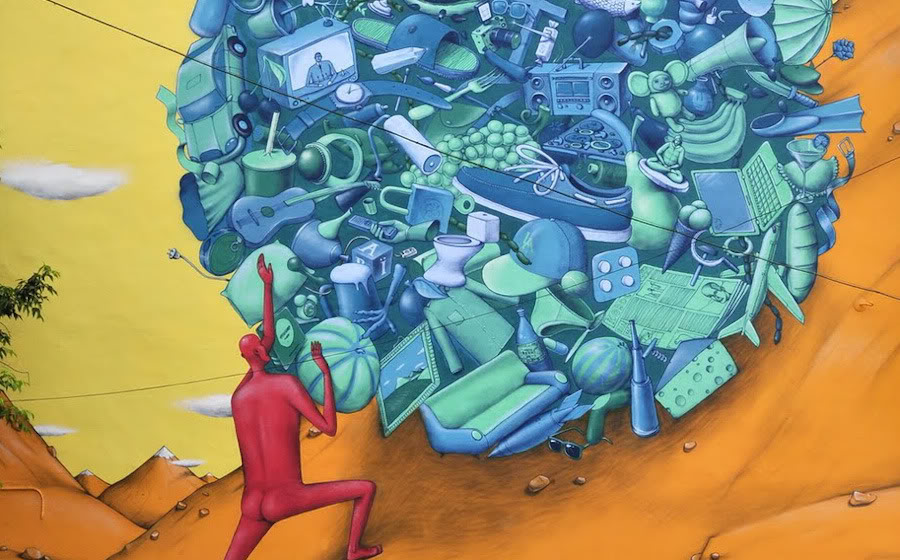
The gods had condemned Sisyphus to ceaselessly rolling a rock to the top of a mountain, whence the stone would fall back of its own weight. They had thought with some reason that there is no more dreadful punishment than futile and hopeless labor. If one believes Homer, Sisyphus was the wisest and most prudent of mortals. According to another tradition, however, he was disposed to practice the profession of highwayman. I see no contradiction in this. Opinions differ as to the reasons why he became the futile laborer of the underworld. To begin with, he is accused of a certain levity in regard to the gods. He stole their secrets. Aegina, the daughter of Aesopus, was carried off by Jupiter. The father was shocked by that disappearance and complained to Sisyphus. He, who knew of the abduction, offered to tell about it on condition that Aesopus would give water to the citadel of Corinth. To the celestial thunderbolts he preferred the benediction of water. He was punished for this in the underworld. Homer tells us also that Sisyphus had put Death in chains. Pluto could not endure the sight of his deserted, silent empire. He dispatched the god of war, who liberated Death from the hands of her conqueror.
It is said also that Sisyphus, being near to death, rashly wanted to test his wife’s love. He ordered her to cast his unburied body into the middle of the public square. Sisyphus woke up in the underworld. And there, annoyed by an obedience so contrary to human love, he obtained from Pluto permission to return to earth in order to chastise his wife. But when he had seen again the face of this world, enjoyed water and sun, warm stones and the sea, he no longer wanted to go back to the infernal darkness. Recalls, signs of anger, warnings were of no avail. Many years more he lived facing the curve of the gulf, the sparkling sea, and the smiles of earth. A decree of the gods was necessary. Mercury came and seized the impudent man by the collar and, snatching him from his joys, led him forcibly back to the underworld, where his rock was ready for him.
You have already grasped that Sisyphus is the absurd hero. He is, as much through his passions as through his torture. His scorn of the gods, his hatred of death, and his passion for life won him that unspeakable penalty in which the whole being is exerted toward accomplishing nothing. This is the price that must be paid for the passions of this earth. Nothing is told us about Sisyphus in the underworld. Myths are made for the imagination to breathe life into them. As for this myth, one sees merely the whole effort of a body straining to raise the huge stone, to roll it and push it up a slope a hundred times over; one sees the face screwed up, the cheek tight against the stone, the shoulder bracing the clay-covered mass, the foot wedging it, the fresh start with arms outstretched, the wholly human security of two earth-clotted hands. At the very end of his long effort measured by skyless space and time without depth, the purpose is achieved. Then Sisyphus watches the stone rush down in a few moments toward that lower world whence he will have to push it up again toward the summit. He goes back down to the plain.
It is during that return, that pause, that Sisyphus interests me. A face that toils so close to stones is already stone itself! I see that man going back down with a heavy yet measured step toward the torment of which he will never know the end. That hour like a breathing-space which returns as surely as his suffering, that is the hour of consciousness. At each of those moments when he leaves the heights and gradually sinks toward the lairs of the gods, he is superior to his fate. He is stronger than his rock.
If this myth is tragic, that is because its hero is conscious. Where would his torture be, indeed, if at every step the hope of succeeding upheld him? The workman of today works every day in his life at the same tasks, and this fate is no less absurd. But it is tragic only at the rare moments when it becomes conscious. Sisyphus, proletarian of the gods, powerless and rebellious, knows the whole extent of his wretched condition: it is what he thinks of during his descent. The lucidity that was to constitute his torture at the same time crowns his victory. There is no fate that cannot be surmounted by scorn.
If the descent is thus sometimes performed in sorrow, it can also take place in joy. This word is not too much. Again I fancy Sisyphus returning toward his rock, and the sorrow was in the beginning. When the images of earth cling too tightly to memory, when the call of happiness becomes too insistent, it happens that melancholy rises in man’s heart: this is the rock’s victory, this is the rock itself. The boundless grief is too heavy to bear. These are our nights of Gethsemane. But crushing truths perish from being acknowledged. Thus, Oedipus at the outset obeys fate without knowing it. But from the moment he knows, his tragedy begins. Yet at the same moment, blind and desperate, he realizes that the only bond linking him to the world is the cool hand of a girl. Then a tremendous remark rings out: “Despite so many ordeals, my advanced age and the nobility of my soul make me conclude that all is well.” Sophocles’ Oedipus, like Dostoevsky’s Kirilov, thus gives the recipe for the absurd victory. Ancient wisdom confirms modern heroism.
One does not discover the absurd without being tempted to write a manual of happiness. “What! by such narrow ways—?” There is but one world, however. Happiness and the absurd are two sons of the same earth. They are inseparable. It would be a mistake to say that happiness necessarily springs from the absurd discovery. It happens as well that the feeling of the absurd springs from happiness. “I conclude that all is well,” says Oedipus, and that remark is sacred. It echoes in the wild and limited universe of man. It teaches that all is not, has not been, exhausted. It drives out of this world a god who had come into it with dissatisfaction and a preference for futile sufferings. It makes of fate a human matter, which must be settled among men.
All Sisyphus’ silent joy is contained therein. His fate belongs to him. His rock is his thing. Likewise, the absurd man, when he contemplates his torment, silences all the idols. In the universe suddenly restored to its silence, the myriad wondering little voices of the earth rise up. Unconscious, secret calls, invitations from all the faces, they are the necessary reverse and price of victory. There is no sun without shadow, and it is essential to know the night. The absurd man says yes and his effort will henceforth be unceasing. If there is a personal fate, there is no higher destiny, or at least there is but one which he concludes is inevitable and despicable. For the rest, he knows himself to be the master of his days. At that subtle moment when man glances backward over his life, Sisyphus returning toward his rock, in that slight pivoting he contemplates that series of unrelated actions which becomes his fate, created by him, combined under his memory’s eye and soon sealed by his death. Thus, convinced of the wholly human origin of all that is human, a blind man eager to see who knows that the night has no end, he is still on the go. The rock is still rolling.
I leave Sisyphus at the foot of the mountain! One always finds one’s burden again. But Sisyphus teaches the higher fidelity that negates the gods and raises rocks. He too concludes that all is well. This universe henceforth without a master seems to him neither sterile nor futile. Each atom of that stone, each mineral flake of that night-filled mountain, in itself forms a world. The struggle itself toward the heights is enough to fill a man’s heart. One must imagine Sisyphus happy.