The Problem of Atheism

Human Values and Science, Art and Mathematics

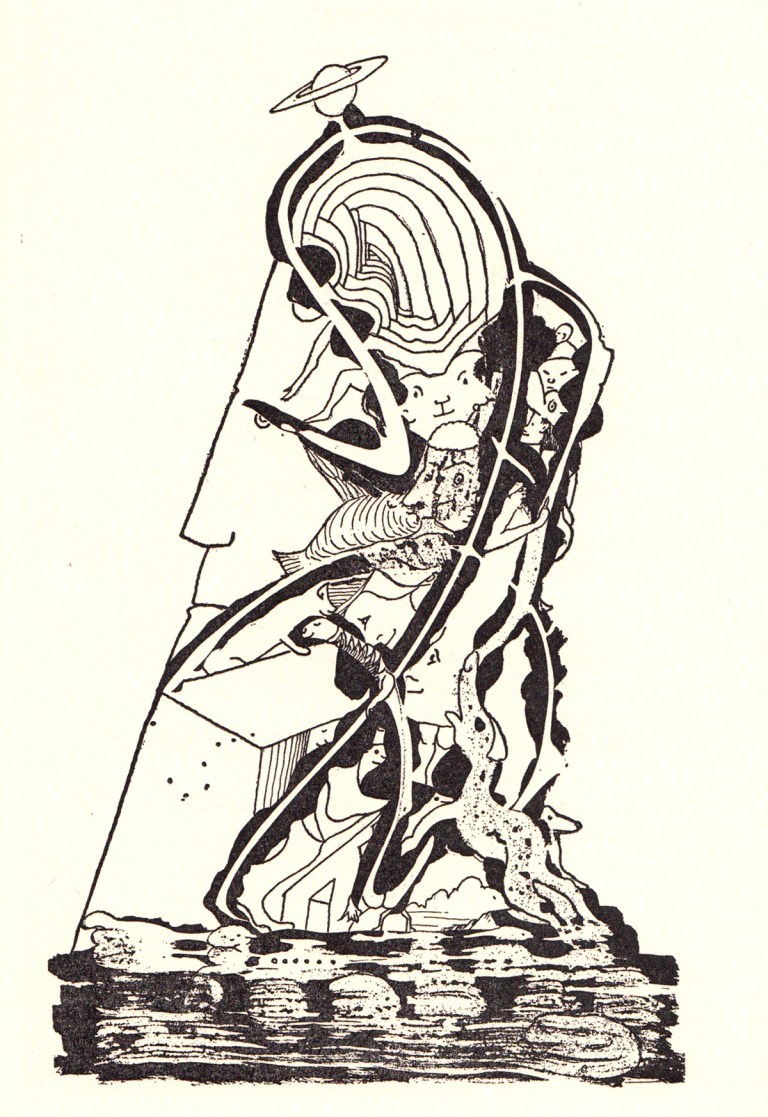
Illustration by artist Hugh Lieber from Human Values and Science, Art and Mathematics by mathematician Lillian Lieber


Excerpts from Keiji Nishitani (1900-1990), The Self-Overcoming of Nihilism (Appendix)

Marxist Humanism

As is commonly known, Marxism looks on religion as a way for those unable to come to terms with the frustrations of life to find satisfaction at the ideal level by imagining a world beyond. In so doing, the argument goes, they nullify the self and transpose the essence of their humanity into the image of “God” in the other world. In this act of religious “self-alienation” both nature and humanity become nonessential, void, and without substance. Atheism consists in the negation of this nonessentiality. By denying God it affirms the essence of the human. This emancipation of the human in turn is of a single root with human freedom.

This variety of atheism is connected with Marx’s characterization of the essence of the human individual as worker: humanity is achieved by remaking the world through work. The process of self-creation by which one gradually makes oneself human through work is what constitutes history. Seen from such a perspective, atheism is unavoidable. For since the source of religious self-alienation lies in economic self-alienation (the condition of being deprived of one’s humanity economically), once the latter is overcome, the former will fall away as a matter of course. According to Marx, then, atheism is a humanism wrought through the negation of religion.

Now insofar as Marx’s atheistic humanism is a humanism that has become self-conscious dialectically – its affirmation rests on the negation of religion – it clearly strikes at the very heart of religion. In it we find a clear and pointed expression of the general indifference, if not outright antagonism, to religion in the modern mind. From its very beginning, modern humanism has combined the two facets of maintaining ties to religion and gradually breaking away from it. In a sense, the history of modern philosophy can be read as a struggle among approaches to humanism based on one or the other of these aspects. At present the debate over humanism – what it is that constitutes the essence of the human – has become completely polarized. The responses provided by the various religious traditions show no signs of being able to allay the situation. Questions such as freedom, history, and labor, in the sense in which Marx discusses them in relation to the essence of humanity, paint a picture of the modern individual that had until recently escaped the notice of religion. To come to grips with such questions, religion will have to open up a new horizon.

Even if we grant that Marx’s thought touches the problem of religion at some depth, it is hard to sustain the claim that he understood its true foundations correctly. Matters like the meaning of life and death, or the impermanence of all things, simply cannot be reduced without remainder to a matter of economic self-alienation. These are questions of much broader and deeper reach, indeed questions essential for human being.

The problem expressed in the term “all is suffering” is a good example. It is clearly much more than a matter of the socio-historical suffering of human individuals; it belongs essentially to the way of being of all things in the world. The problem of human suffering is a problem of the suffering of the human being as “being-in-the-world,” too profound a matter to be alleviated merely by removing socio-historical suffering. It has to do with a basic mode of human being that also serves as the foundation for the pleasure, or the freedom from suffering and pleasure, that we oppose to suffering.

Or again, we might say that the issue of “the non-self nature of all dharmas” refers to “the nonessentiality of nature and humanity,” but this does not mean that we can reduce the claim to a self-alienating gesture of projecting the essence of our humanity on to “God.” It refers to the essential way that all things in the world are: depending on each other and existing only in interdependency. It is meant to point to the essential “non-essentiality” of all beings, and hence to a domain that no society can alter, however far it may progress. It is, in short, the very domain of religion that remains untouched by Marx’s critique. Marx argues emphatically that through work human beings conquer nature, change the world, and give the self its human face. But deep in the recesses behind the world of work lies a world whose depth and vastness are beyond our ken, a world in which everything arises only by depending on everything else, in which no single thing exists through the power of a “self” (or what is called “self-power”). This is the world of human beings who exist as “being-in-the-world.”

As for religion itself, whose maxim all along has been “all is suffering,” the idea that this has to do with “historical” suffering has not often come to the fore. (In this regard, Christianity represents an exception.) The idea of “karma” is supposed to relate concretely to the historicity of human existence, but even this viewpoint has not been forthcoming. The human activities of producing and using various things through “self-power,” of changing nature and society and creating a “human” self – in short, the emancipation of the human and the freedom of the human individual – would seem to be the most concrete “karma” of humanity and therefore profoundly connected with modern atheism. But none of these ideas has been forthcoming from the traditional religions. Even though for Christianity the fact that we must labor by the sweat of our brows is related to original sin, the germ of this idea has not, to my knowledge, been developed anywhere in modern theology.


Sartrean Existentialism

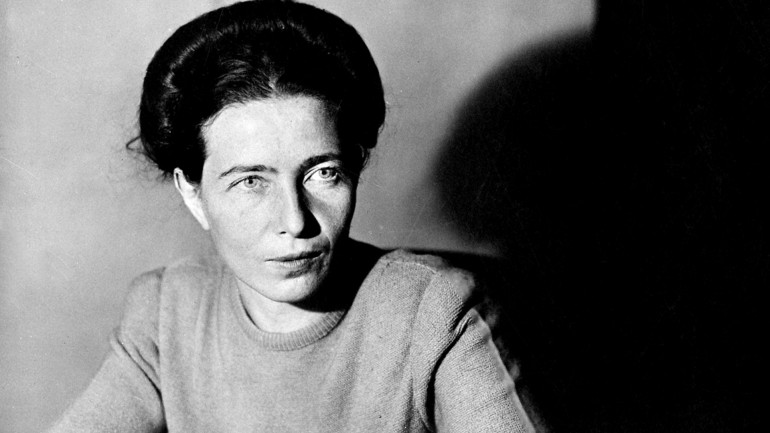
Modern atheism also appears in the form of existentialism. The same sharp and total opposition that separates existentialism and Marxism in general applies also to their respective forms of atheism. Unlike Marxism, which understands the human being as an essentially social being, existentialism thinks of the human being essentially as an individual; that is, it defines the human as a way of being in which each individual relates to itself. Marx’s critique of religion begins from the self-alienation of human beings in religion, redefines it as an economic self-alienation, and then deals with religion in terms of its social functions. In contrast, the existentialist Sartre, for example, understands the relationship between God and humanity as a problem of each individual’s relating to the essence of “self”-being itself. In other words, he begins from something like an ontological self-alienation implied in seeing human beings as creatures of God. For all the differences between the standpoints, they share the basic tenet that it is only by denying God that we can regain our own humanity. As is the case with Marx’s socialist individual, for Sartre’s existentialist individual humanism is viable only as an atheism – which is the force of Sartre’s referring to existentialism as a humanism.

According to Sartre, if God existed and had indeed created us, there would be basically no human freedom. If human existence derived from God and the essence of human existence consisted in this derivation, the individual’s every action and situation would be determined by this essential fact. In traditional terms, “essential being” precedes “actual being” and continually determines it. This means that the whole of actual human being is essentially contained within the “Providence” of God and is necessarily predetermined by God’s will. Such predestination amounts to a radical negation of human freedom. If we grant the existence of God we must admit God’s creation; and if we grant God’s creation, we must also allow for God’s predestination – in other words, we are forced to deny that there is any such thing as human freedom. If human freedom is to be affirmed, the existence of God must be denied.

Human “existence” (a temporal and “phenomenal” way of being) does not have behind it any essential being (a supratemporal and “noumenal” way of being) that would constitute its ground. There is nothing at all at the ground of existence. And it is from this ground of “nothing” where there is simply nothing at all that existence must continually determine itself. We must create ourselves anew ever and again out of nothing. Only in this way can one secure the being of a self – and exist. To be a human being is to humanize the self constantly, to create, indeed to have no choice other than to create, a “human being.” This self-being as continued self-creation out of nothing is what Sartre calls freedom. Insofar as one actually creates the self as human, actual existence precedes essence in the human being. In essence, the human individual is existence itself. This way of being human is “Existence,” and Existence can stand only on an atheism.

Of late we are beginning to see a turn in the standpoint of Heidegger, in that he no longer refers to his thought as an “existentialism.” Still, it seems important to point out what his thinking up until now has shared in common with the existentialism of Sartre. That human beings continually create themselves out of nothing is meant to supplant the Christian notion of God’s creatio ex nihilo. To this extent it is not the standpoint of “self-power” in the ordinary sense. Self-creation out of nothing is not brought about simply by the inner power of a being called human and hence is not a power contained within the framework of human being. This “being” is continually stepping beyond the framework of “being.” Nothingness means transcendence, but since this transcendence does not mean that there is some transcendent “other” apart from self-being, it implies a standpoint of “self-power,” not of “other-power.” In contrast to Christianity, it is a view in which nothingness becomes the ground of the subject and thereby becomes subjective nothing – a self-power based on nothing. Here the consciousness of freedom in the modern mind finds a powerful expression and amounts to what is, at least in the West, an entirely new standpoint. It seems doubtful that this standpoint can be confronted from within the traditional horizons that have defined Christianity so far. It is quite different with Buddhism.

From the perspective of Buddhism, Sartre’s notion of Existence, according to which one must create oneself continually in order to maintain oneself within nothing, remains a standpoint of attachment to the self – indeed, the most profound form of this attachment – and as such is caught in the self-contradiction this implies. It is not simply a question here of a standpoint of ordinary self-love in which the self is willfully attached to itself. It is rather a question of the self being compelled to be attached to itself willfully. To step out of the framework of being and into nothing is only to enter into a new framework of being once again. This self-contradiction constitutes a way of being in which the self is its own “prison,” which amounts to a form of karma. Self-creation, or freedom, may be self-aware, but only because, as Sartre himself says, we are “condemned to be free.” Such a freedom is not true freedom. Again, it may represent an exhaustive account of what we normally take freedom to be, but this only means that our usual idea of freedom is basically a kind of karma. Karma manifests itself in the way modern men and women ground themselves on an absolute affirmation of their freedom. As Sartre himself says, his standpoint of Existence is a radical carrying out of the cogito, ergo sum of Descartes, for the Cartesian ego shows us what the modern mode of being is.

That Sartre’s “Existence” retains a sense of attachment to the self implies, if we can get behind the idea, that the “nothingness” of which he speaks remains a nothingness to which the self is attached. It was remarked earlier that in existentialism nothingness became subjective nothingness, which means that, as in the case of Greek philosophy or Christianity, it is still bound to the human individual. Again looked at from behind, we find that human subjectivity is bound up inextricably with nothingness and that at the ground of human existence there is nothing, albeit a nothing of which there is still consciousness at the ground of the self. No matter how “pre-reflective” this consciousness is, it is not the point at which the being of the self is transformed existentially into absolute nothingness. Sartre’s nothingness is unable to make the being of the self (Existence) sufficiently “ek-static,” and to this extent it differs radically from Buddhist “emptiness.” The standpoint of emptiness appears when Sartrean Existence is overturned one more time. The question is whether Buddhism, in its traditional form, is equal to the confrontation with existentialism.

Sartre thinks that to be a human being is to “human-ize” the self continually and to create the self as human out of nothing. Pushing this idea to the extreme, and speaking from the standpoint of emptiness in Buddhism, it is a matter of continually assuming human form from a point where this form has been left behind and absolutely negated. It is, as it were, a matter of continued creative “accommodation,” a never-ending “return” to being a new “human.” Taken in the context of Buddhist thought as a whole, there is some question as to whether this idea of “accommodation” really carries such an actual and existential sense. Does it really, as Sartre’s idea of continual humanization does, have to do with our actual being at each moment?

When Sartre speaks of ceaseless self-creation out of nothing, he refers to an Existence that is temporal through and through. It does not admit of any separate realm of being, such as a supratemporal (or “eternal”) essence, but is simply based on “nothing.” But for Sartre Existence is self-created within a socio-historical situation, which demonstrates his profound appreciation of the social and historical dimensions of the human way of being. In the case of the standpoint of Buddhist emptiness, in which human being is understood as arising out of emptiness and existing in emptiness, we need to ask how far the actual Existence of the human being at each moment is included. How much of the Existence within the actual socio-historical situation, and completely temporalized in this actuality, is comprehended? To the extent that the comprehension is inadequate, the standpoint of Buddhism has become detached from our actuality, and that means that we have failed to take the standpoint of emptiness seriously enough and to make it existential. In this case, talk of “accommodation” is merely a kind of mythologizing.


Atheism in the World of Today

A crisis is taking place in the contemporary world in a variety of forms, cutting across the realms of culture, ethics, politics, and so forth. At the ground of these problems is that fact that the essence of being human has turned into a question mark for humanity itself. This means that a crisis has also struck in the field of religion, and that this crisis is the root of the problems that have arisen in other areas. We see evidence of this state of affairs in the fact that the most recent trends of thought in contemporary philosophy which are having a great influence – directly and indirectly – on culture, ethics, politics, and so on, are all based on a standpoint of atheism. This applies not only to Marxism and existentialism, especially as represented by Sartre, but also to logical positivism and numerous other currents of thought.

Involved in the problem of the essence of human being are the questions, “What is a human being?” and “By what values should one live?” These are questions that need to be thought through in terms of the totality of beings, the “myriad things” of which human beings are only one part. It is a question, too, of the place of human beings in the order of the totality of beings, and of how to accommodate to this position (that is, how to be truly human). For the order of being implies a ranking of values.

For example, even if “man” is said to be the lord of creation, this places him in a certain “locus” within the totality of things, and therefore refers to how one ought to live as a human being. In the Western tradition the locus of human being has been defined in relation to God. While we are said to have been created from nothing, our soul contains the imago dei. This divine image was shattered through original sin, to be restored only through the atonement of God’s Son, Jesus, and our faith in him as the Christ. Here the locus of human beings in the order of being and ranking of value takes a different form from the straightforward characterization of man as lord of creation, a form consisting of a complex interplay of negation and affirmation. This locus of human being is well expressed in Augustine’s saying: “Oh God, you have created us for you, and our hearts are restless until they rest in you.” Needless to say, the basic dynamism behind the forming of this locus came from Greek philosophy and Christianity.

Modern atheism, Marxism, and existentialism share in common the attempt to repudiate this traditional location of the human in order to restore human nature and freedom. The seriousness of this new humanism is that such a restoration is possible only through a denial of God. At the same time, the new humanism harbors a schism in its ranks between the standpoints of Marxism and existentialism. The axis of the existentialist standpoint is a subjectivity in which the self becomes truly itself, while Marxism, for all its talk of human beings as subjects of praxis, does not go beyond a view of the human being as an objective factor in the objective world of nature or society. Each of them comprehends human being from a locus different from the other.

In the Western tradition the objective world and subjective being – the natural and social orders on the one hand, the “soul” with its innate orientation to God on the other – were united within a single system. The two main currents in modern atheism correspond respectively to these two coordinates, the soul and the world, but there is little hope of their uniting given the current confrontation. There is no way for modern men and women simply to return to the old locus, and the new atheism offers only a locus split into two. Confusion reigns in today’s world at the most basic level concerning what human beings are and how they are to live.

Each of these two standpoints seeks to ground itself from start to finish in actual being. This is related to the denial of God, in that full engagement of the self in actual being requires a denial of having already been determined within the world-order established by God, as well as a denial of having been fitted out in advance with an orientation to God in one’s very soul. Both standpoints stress the importance of not becoming detached from the locus in which one “actually” is, of remaining firmly grounded in one’s actual socio-historical situation, or more fundamentally, in actual “time” and “space.” But do these standpoints really engage actual being to the full?

Earlier on I suggested that as long as Marxism and existentialism continue to hold to the standpoint of the “human,” they will never be able to give a full account of actual human being. These new forms of humanism try to restore human beings to actual being by eliminating from the world and the soul the element of divine “predetermination.” The result is that they leave a gaping void at the foundations, as is evidenced by the lack of a locus from which to address the problem of life and death. Since the human mode of being consists in life and death, we must pass beyond the human standpoint to face the problem of life and death squarely. But to overcome the human standpoint does not necessarily mean that one merely returns to the “predetermination” of God, nor that one simply extinguishes freedom or actual being. It is rather a matter of opening up the horizon in which the question can be engaged truly and to its outermost limits.

Earlier I also proposed consideration of the locus of Buddhist “emptiness” in this regard. In the locus of emptiness, beyond the human standpoint, a world of “dependent origination” is opened up in which everything is related to everything else. Seen in this light there is nothing in the world that arises from “self-power” and yet all “self-powered” workings arise from the world. Existence at each instant, Sartre’s self-creation as “human,” the humanization in which the self becomes human – all these can be said to arise ceaselessly as new accommodations from a locus of emptiness that absolutely negates the human standpoint. From the standpoint of emptiness, it is at least possible to see the actuality of human being in its socio-historical situation in such a way that one does not take leave of “actual” time and space. In the words of the Zen master Mus?:

When acting apprehend the place of acting, when sitting apprehend the place of sitting, when lying apprehend the place of lying, when seeing and hearing apprehend the place of seeing and hearing, and when experiencing and knowing apprehend the place of experiencing and knowing.


Further Reading

The Self-Overcoming of Nihilism by Keiji Nishitani (PDF)

On Buddhism by Keiji Nishitani (PDF)

The Kyoto School (SEP)
Philosophers Should be Keener to Talk about the Meaning of Life

gachet-van-gogh

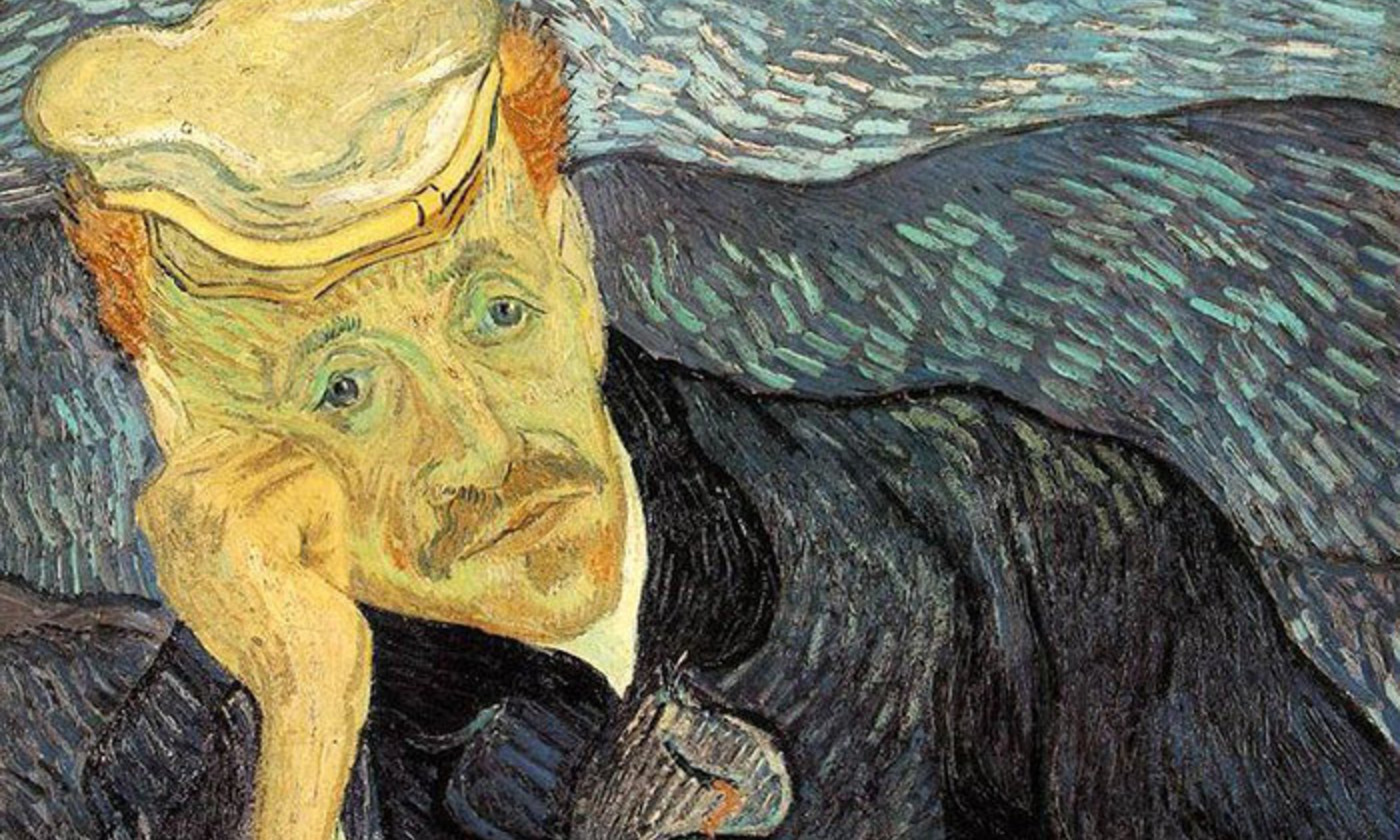
Detail from Portrait of Dr Gachet (1890), by Vincent van Gogh. Private collection. Photo courtesy Wikipedia

Kieran Setiya | Aeon Ideas

Philosophers ponder the meaning of life. At least, that is the stereotype. When I risk admitting to a stranger that I teach philosophy for a living and face the question ‘What is the meaning of life?’, I have a ready response: we figured that out in the 1980s, but we have to keep it secret or we’d be out of a job; I could tell you, but then I’d have to kill you. In fact, professional philosophers rarely ask the question and, when they do, they often dismiss it as nonsense.

The phrase itself is of relatively recent origin. Its first use in English is in Thomas Carlyle’s parodic novel Sartor Resartus (1836), where it appears in the mouth of a comic German philosopher, Diogenes Teufelsdröckh (‘God-born devil-dung’), noted for his treatise on clothes. The question of life’s meaning remains both easy to mock and paradigmatically obscure.

What is the meaning of ‘meaning’ in ‘the meaning of life’? We talk about the meaning of words, or linguistic meaning, the meaning of an utterance or of writing in a book. When we ask if human life has meaning, are we asking whether it has meaning in this semantic sense? Could human history be a sentence in some cosmic language? The answer is that it could, in principle, but that this isn’t what we want when we search for the meaning of life. If we are unwitting ink in some alien script, it would be interesting to know what we spell out, but the answer would not have authority over us, as befits the meaning of life.

‘Meaning’ could mean purpose or function in a larger system. Could human life play that role? Again, it could, but yet again, this seems irrelevant. In Douglas Adams’s Hitchhiker’s books, the Earth is part of a galactic computer, designed (ironically) to reveal the meaning of life. Whatever that meaning might be, our role in the computer program is not it. To discover that we are cogs in some cosmic machine is not to discover the meaning of life. It leaves our existential maladies untouched.

Seeing no other way to interpret the question, many philosophers conclude that the question is confused. If they go on to talk about meaning in life, they have in mind the meaning of individual lives, the question of whether this life or that life is meaningful for the person who is living it. But the meaning of life is not an individual possession. If life has meaning, it has a meaning that applies to us all. Does this idea make sense?

I think it does. We can make progress if we turn from the words that make up the question – ‘meaning’ in particular – to the contexts in which we feel compelled to ask it. We raise the question ‘Does life have meaning?’ in times of anguish, or despair, or emptiness. We ask it when we confront mortality and loss, the pervasiveness of suffering and injustice, the facts of life from which we recoil and which we cannot accept. Life seems profoundly flawed. Is there meaning to it all? Historically, the question of life’s meaning comes into focus through the anxiety of early existentialist philosophers, such as Søren Kierkegaard and Friedrich Nietzsche, who worried that it has none.

On the interpretation that this context suggests, the meaning of life would be a truth about us and about the world that makes sense of the worst. It would be something we could know about life, the Universe and everything, that should reconcile us to mortality and loss, suffering and injustice. Knowledge of this truth would make it irrational not to affirm life as it is, not to accept things as they are. It would show that despair, or angst, is a mistake.

The idea that life has meaning is the idea that there is a truth of this extraordinary kind. Whether or not there is, the suggestion is not nonsense. It is a hope that animates the great religions. Whatever else they do, religions offer metaphysical pictures whose acceptance is meant to bestow salvation, to reconcile us to the seeming faults of life. Or if they do not supply the truth, if they do not claim to convey the meaning of life, they offer the conviction that there is one, however hard to grasp or articulate it might be.

The meaning of life might be theistic, involving God or gods, or it might be non-theistic, as in one form of Buddhism. What distinguishes Buddhist meditation from mindfulness-based stress-reduction is the aim of ending suffering through metaphysical revelation. The emotional solace of Buddhism is meant to derive from insight into how things are – in particular, into the non-existence of the self – an insight that should move anyone. To come to terms with life through meditation for serenity, or through talk therapy, is not to discover the meaning of life, since it is not to discover any such truth.

Albert Einstein wrote that to know an answer to the question ‘What is the meaning of human life?’ means to be religious. But there is in principle room for non-religious accounts of meaning, ones that do not appeal to anything beyond the given world or the world revealed to us by science. Religion has no monopoly on meaning, even if it is hard to see how a non-transcendent truth could meet our definition: to know the meaning of life is to be reconciled to all that is wrong with the world. At the same time, it is hard to prove a negative, to show that nothing short of religion could play this role.

Philosophers are prone to see confusion in the question ‘What is the meaning of life?’ They have replaced it with questions about meaningful lives. But the search for life’s meaning will not go away and it is perfectly intelligible. I cannot tell you the meaning of life or give assurance that it has one. But I can say that it is not a mistake to ask the question. Does life have meaning? The answer is: it might.Aeon counter – do not remove

Kieran Setiya

This article was originally published at Aeon and has been republished under Creative Commons.

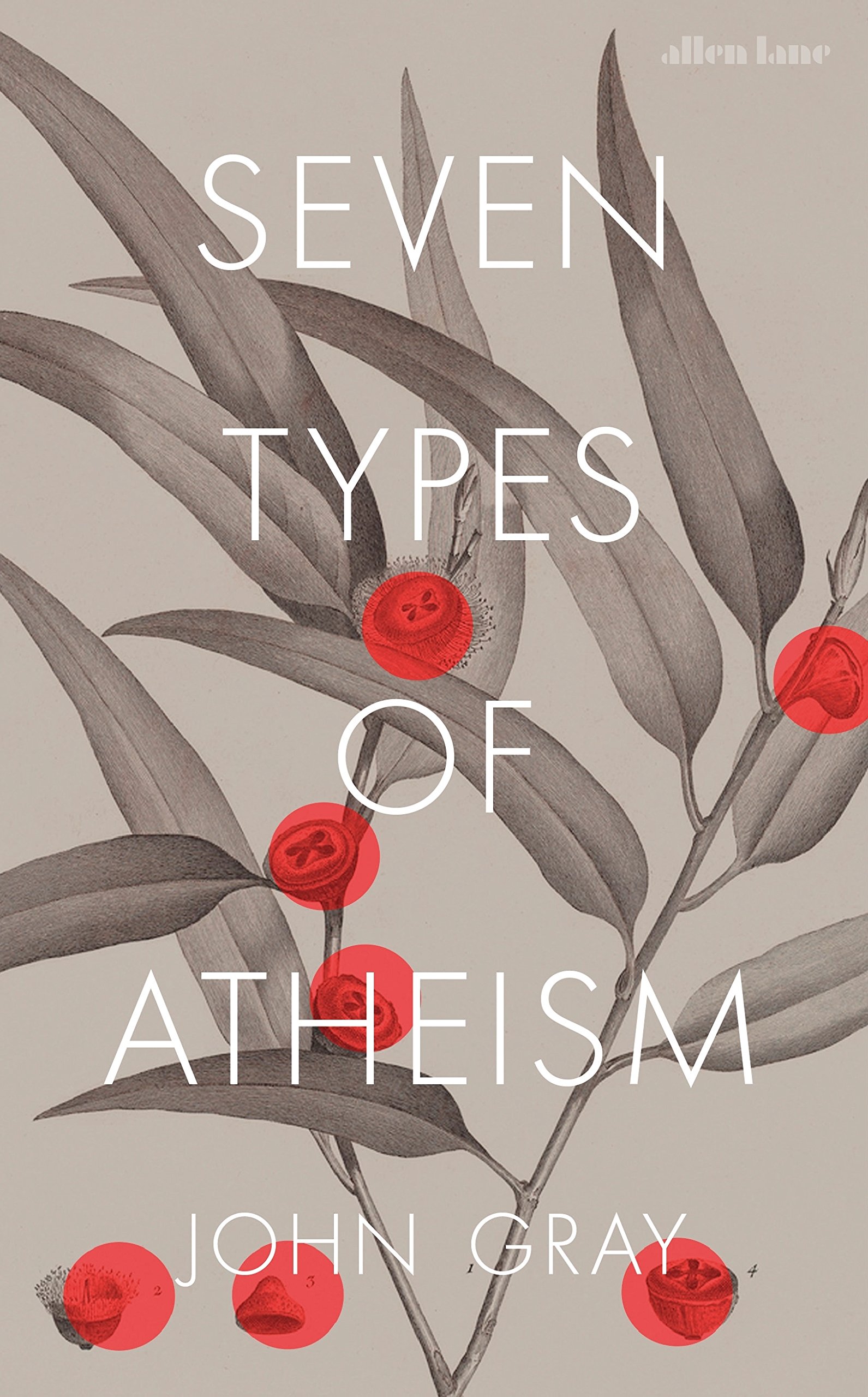
Seven Types of Atheism

But you will have gathered what I am driving at, namely, that it is still a metaphysical faith upon which our faith in science rests—that even we seekers after knowledge today, we godless anti-metaphysicians still take our fire, too, from the flame lit by a faith that is thousands of years old, that Christian faith which was also the faith of Plato, that God is the truth, that truth is divine. —But what if this should become more and more incredible, if nothing should prove to be divine any more unless it were error, blindness, the lie—if God himself should prove to be our most enduring lie?

– Friedrich Nietzsche, The Gay Science (1882)


seven-types-atheism


From the provocative author of Straw Dogs comes an incisive, surprising intervention in the political and scientific debate over religion and atheism. A meditation on the importance of atheism in the modern world – and its inadequacies and contradictions – by one of Britain’s leading philosophers.

When you explore older atheisms, you will find that some of your firmest convictions—secular or religious—are highly questionable. If this prospect disturbs you, what you are looking for may be freedom from thought.

For a generation now, public debate has been corroded by a shrill, narrow derision of religion in the name of an often vaguely understood “science.” John Gray’s stimulating and enjoyable new book, Seven Types of Atheism, describes the complex, dynamic world of older atheisms, a tradition that is, he writes, in many ways intertwined with and as rich as religion itself.

Along a spectrum that ranges from the convictions of “God-haters” like the Marquis de Sade to the mysticism of Arthur Schopenhauer, from Bertrand Russell’s search for truth in mathematics to secular political religions like Jacobinism and Nazism, Gray explores the various ways great minds have attempted to understand the questions of salvation, purpose, progress, and evil. The result is a book that sheds an extraordinary light on what it is to be human.


“In former times, one sought to prove that there is no God—today one indicates how the belief that there is a God arose and how this belief acquired its weight and importance: a counter-proof that there is no God thereby becomes superfluous.—When in former times one had refuted the ‘proofs of the existence of God’ put forward, there always remained the doubt whether better proofs might not be adduced than those just refuted: in those days atheists did not know how to make a clean sweep.”

– Friedrich Nietzsche, Daybreak (1881)


See also: VICE Interviews John Gray about Seven Types of Atheism

The Dynamics of Faith

Faith is the state of being ultimately concerned. The content matters infinitely for the life of the believer, but it does not matter for the formal definition of faith. And this is the first step we have to make in order to understand the dynamics of faith.

– Paul Tillich, Dynamics of Faith (1957)

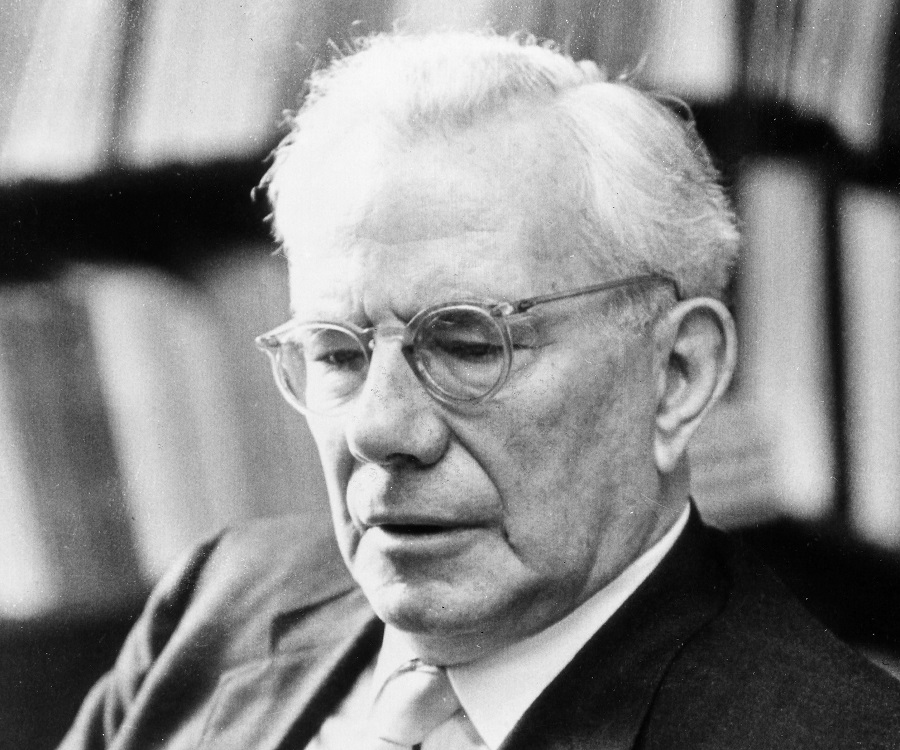
Paul Johannes Tillich (August 20, 1886 – October 22, 1965) was a German-American Christian existentialist philosopher and Lutheran Protestant theologian who is widely regarded as one of the most influential theologians of the twentieth century.

Man, like every living being, is concerned about many things, above all about those which condition his very existence … If [a situation or concern] claims ultimacy it demands the total surrender of him who accepts this claim … it demands that all other concerns … be sacrificed.

Among the general public, he is best known for his works The Courage to Be (1952) and Dynamics of Faith (1957), which introduced issues of theology and modern culture to a general readership. In academic theology, he is best known for his major three-volume work Systematic Theology (1951–63) in which he developed his “method of correlation”, an approach of exploring the symbols of Christian revelation as answers to the problems of human existence raised by contemporary existential philosophical analysis.

Faith as ultimate concern is an act of the total personality. It happens in the center of the personal life and includes all its elements. Faith is the most centered act of the human mind. It is not a movement of a special section or a special function of man’s total being. They all are united in the act of faith. But faith is not the sum total of their impacts. It transcends every special impact as well as the totality of them and it has itself a decisive impact on each of them.

Two of Tillich’s works, The Courage to Be (1952) and Dynamics of Faith (1957), were read widely, including by people who would not normally read religious books. In The Courage to Be, he lists three basic anxieties: anxiety about our biological finitude, i.e. that arising from the knowledge that we will eventually die; anxiety about our moral finitude, linked to guilt; and anxiety about our existential finitude, a sense of aimlessness in life. Tillich related these to three different historical eras: the early centuries of the Christian era; the Reformation; and the 20th century. Tillich’s popular works have influenced psychology as well as theology, having had an influence on Rollo May, whose “The Courage to Create” was inspired by “The Courage to Be”.

[The God of theological theism] deprives me of my subjectivity because he is all-powerful and all-knowing. I revolt and make him into an object, but the revolt fails and becomes desperate. God appears as the invincible tyrant, the being in contrast with whom all other beings are without freedom and subjectivity. He is equated with the recent tyrants who with the help of terror try to transform everything into a mere object, a thing among things, a cog in a machine they control. He becomes the model of everything against which Existentialism revolted. This is the God Nietzsche said had to be killed because nobody can tolerate being made into a mere object of absolute knowledge and absolute control. This is the deepest root of atheism. It is an atheism which is justified as the reaction against theological theism and its disturbing implications.

Today, Tillich’s most observable legacy may well be that of a spiritually-oriented public intellectual and teacher with a broad and continuing range of influence. Tillich‘s chapel sermons (especially at Union) were enthusiastically received (Tillich was known as the only faculty member of his day at Union willing to attend the revivals of Billy Graham) Tillich’s students have commented on Tillich’s approachability as a lecturer and his need for interaction with his audience. When Tillich was University Professor at Harvard, he was chosen as keynote speaker from among an auspicious gathering of many who had appeared on the cover of Time Magazine during its first four decades. Tillich along with his student, psychologist Rollo May, was an early leader at the Esalen Institute. Contemporary New Age catchphrases describing God (spatially) as the “Ground of Being” and (temporally) as the “Eternal Now,” in tandem with the view that God is not an entity among entities but rather is “Being-Itself”—notions which Eckhart Tolle, for example, has invoked repeatedly throughout his career—were paradigmatically renovated by Tillich, although of course these ideas derive from Christian mystical sources as well as from ancient and medieval theologians such as St. Augustine and St. Thomas Aquinas.

The separation of faith and love is always a consequence of a deterioration of religion.

The introductory philosophy course taught by the person Tillich considered to be his best student, John Edwin Smith, “probably turned more undergraduates to the study of philosophy at Yale than all the other philosophy courses put together. His courses in philosophy of religion and American philosophy defined those fields for many years. Perhaps most important of all, he has educated a younger generation in the importance of the public life in philosophy and in how to practice philosophy publicly.” In the 1980s and 1990s the Boston University Institute for Philosophy and Religion, a leading forum dedicated to the revival of the American public tradition of philosophy and religion, flourished under the leadership of Tillich’s student and expositor Leroy S. Rouner.

[Faith] transcends both the drives of the nonrational unconsciousness and the structures of the rational conscious…the ecstatic character of faith does not exclude its rational character although it is not identical with it, and it includes nonrational strivings without being identical with them. ‘Ecstasy’ means ‘standing outside of oneself’ – without ceasing to be oneself – with all the elements which are united in the personal center.

Martin Buber criticized Tillich’s “transtheistic position” as a reduction of God to the impersonal “necessary being” of Thomas Aquinas.

Tillich has been criticized from the Barthian wing of Protestantism for what is alleged to be correlation theory’s tendency to reduce God and his relationship to man to anthropocentric terms. Tillich counters that Barth’s approach to theology denies the “possibility of understanding God’s relation to man in any other way than heteronomously or extrinsically”. Defenders of Tillich claim that critics misunderstand the distinction Tillich makes between God’s essence as the unconditional (“das unbedingte”) “Ground of Being” which is unknowable, and how God reveals himself to mankind in existence. Tillich establishes the distinction in the first chapter of his Systematic Theology Volume One: “But though God in his abysmal nature [footnote: ‘Calvin: in his essence’ ] is in no way dependent on man, God in his self manifestation to man is dependent on the way man receives his manifestation.”

Faith as the state of being ultimately concerned implies love, namely, the desire and urge toward the reunion of the separated.

Some conservative strains of Evangelical Christianity believe Tillich’s thought is too unorthodox to qualify as Christianity at all, but rather as a form of pantheism or atheism. The Evangelical Dictionary of Theology states, “At best Tillich was a pantheist, but his thought borders on atheism.”

In such a state the God of both religious and theological language disappears. But something remains, namely, the seriousness of that doubt in which meaning within meaninglessness is affirmed. The source of this affirmation of meaning within meaninglessness, of certitude within doubt, is not the God of traditional theism but the “God above God,” the power of being, which works through those who have no name for it, not even the name God.


tillich

Marxism and Existentialism

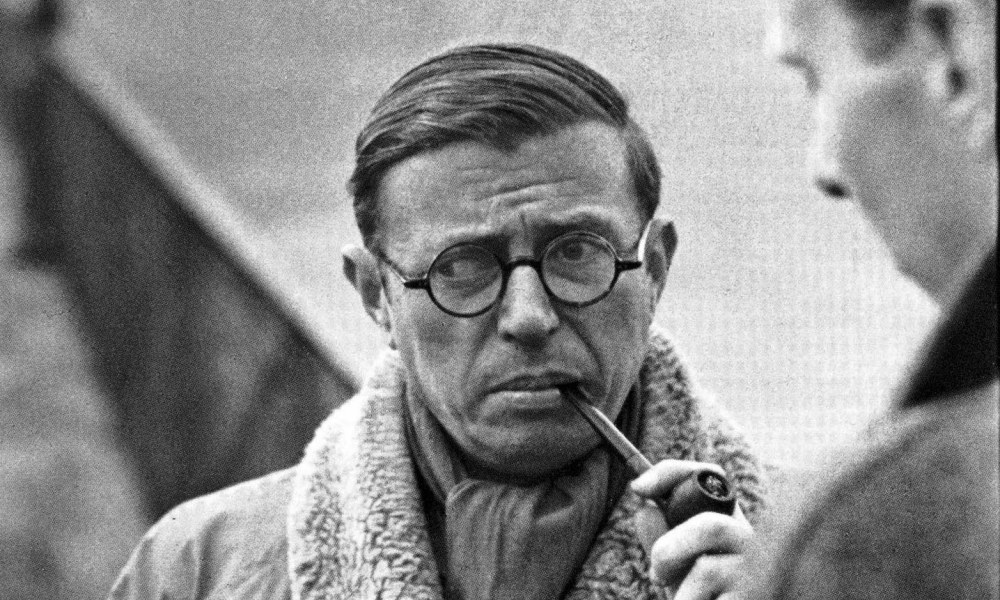
And Since I am to speak of existentialism, let it be understood that I take it to be an “ideology.” It is a parasitical system living on the margin of Knowledge, which at first it opposed but into which today it seeks to be integrated. If we are to understand its present ambitions and its function we must go back to the time of Kierkegaard…

sartre

Compared with Hegel, Kierkegaard scarcely seems to count. He is certainly not a philosopher; moreover, he himself refused this title. In fact he is a Christian who is not willing to let himself be enclosed in the system and who, against Hegel’s “intellectualism,” asserts unrelentingly the irreducibility and the specificity of what is lived. There is no doubt, as Jean Wahl has remarked, that a Hegelian would have assimilated this romantic and obstinate consciousness to the “unhappy consciousness,” a moment which had already been surpassed and known in its essential characteristics. But it is precisely this objective knowledge which Kierkegaard challenges. For him the surpassing of the unhappy consciousness remains purely verbal. The existing man cannot be assimilated by a system of ideas…

We see that Kierkegaard is inseparable from Hegel, and that this vehement negation of every system can arise only within a cultural field entirely dominated by Hegelianism. The Dane feels himself hemmed in by concepts, by History, he fights for his life; it is the reaction of Christian romanticism against the rationalist humanization of faith. It would be too easy to reject this work as simply subjectivism; what we ought rather to point out, in placing it back within the framework of its period, is that Kierkegaard has as much right on his side as Hegel has on his. Hegel is right: unlike the Danish ideologist, who obstinately fixed his stand on poor, frozen paradoxes ultimately referring to an empty subjectivity, the philosopher of Jena aims through his concepts at the veritable concrete; for him, mediation is always presented as an enrichment. Kierkegaard is right: grief, need, passion, the pain of men, are brute realities which can be neither surpassed nor changed by knowledge. To be sure, Kierkegaard’s religious subjectivism can with good reason be taken as the very peak of idealism; but in relation to Hegel, he marks a progress toward realism, since he insists above all on the primacy of the specifically real over thought, that the real cannot be reduced to thought. There are today some psychologists and psychiatrists who consider certain evolutions of our inward life to be the result of a work which it performs upon itself. In this sense Kierkegaardian existence is the work of our inner life – resistances overcome and perpetually reborn, efforts perpetually renewed, despairs surmounted, provisional failures and precarious victories – and this work is directly opposed to intellectual knowing. Kierkegaard was perhaps the first to point out, against Hegel and thanks to him, the incommensurability of the real and knowledge…

Now, in the present phase of our history, productive forces have entered into conflict with relations of production. Creative work is alienated; man does not recognize himself in his own product, and his exhausting labor appears to him as a hostile force. Since alienation comes about as the result of this conflict, it is a historical reality and completely irreducible to an idea. If men are to free themselves from it, and if their work is to become the pure objectification of themselves, it is not enough that “consciousness think itself”; there must be material work and revolutionary praxis. When Marx writes: “Just as we do not judge an individual by his own idea of himself, so we cannot judge a … period of revolutionary upheaval by its own self-consciousness,” he is indicating the priority of action (work and social praxis) over knowledge as well as their heterogeneity. He too asserts that the human fact is irreducible to knowing, that it must be lived and produced; but he is not going to confuse it with the empty subjectivity of a puritanical and mystified petite bourgeoisie. He makes of it the immediate theme of the philosophical totalization, and it is the concrete man whom he puts at the center of his research, that man who is defined simultaneously by his needs, by the material conditions of his existence, and by the nature of his work – that is, by his struggle against things and against men.

Thus Marx, rather than Kierkegaard or Hegel, is right, since he asserts with Kierkegaard the specificity of human existence and, along with Hegel, takes the concrete man in his objective reality. Under these circumstances, it would seem natural if existentialism, this idealist protest against idealism, had lost all usefulness and had not survived the decline of Hegelianism…

Between the two World Wars the appearance of a German existentialism certainly corresponds – at least in the work of Jaspers – to a surreptitious wish to resuscitate the transcendent. Already – as Jean Wahl has pointed out – one could wonder if Kierkegaard did not lure his readers into the depths of subjectivity for the sole purpose of making them discover there the unhappiness of man without God. This trap would be quite in keeping with the “great solitary” who denied communication between human beings and who saw no way to influence his fellow man except by “indirect action.”

Jaspers himself put his cards on the table. He has done nothing except to comment upon his master; his originality consists especially in putting certain themes into relief and in hiding others. The transcendent, for example, appears at first to be absent from his thought, which in fact is haunted by it. We are taught to catch a presentiment of the transcendent in our failures; it is their profound meaning…

Kierkegaard was unwilling to play the role of a concept in the Hegelian system; Jaspers refuses to cooperate as an individual with the history which Marxists are making…

It is one more existentialism which has developed at the margin of Marxism and not against it. It is Marx with whom we claim kinship, and Marx of whom I wish to speak now… It was at about this time [1925] that I read Capital and German Ideology. I found everything perfectly clear, and I really understood absolutely nothing. To understand is to change, to go beyond oneself. This reading did not change me. By contrast, what did begin to change me was the reality of Marxism, the heavy presence on my horizon of the masses of workers, an enormous, somber body which lived Marxism, which practiced it, and which at a distance exercised an irresistible attraction on petit bourgeois intellectuals…

Why then has “existentialism” preserved its autonomy? Why has it not simply dissolved in Marxism?

Lukacs believed that he had answered this question in a small book called Existentialism and Marxism… Lukacs fails absolutely to account for the principal fact: we were convinced at one and the same time that historical materialism furnished the only valid interpretation of history and that existentialism remained the only concrete approach to reality. I do not pretend to deny the contradictions in this attitude. I simply assert that Lukacs does not even suspect it. Many intellectuals, many students, have lived and still live with the tension of this double demand. How does this come about? It is due to a circumstance which Lukacs knew perfectly well but which he could not at that time even mention: Marxism, after drawing us to it as the moon draws the tides, after transforming all our ideas, after liquidating the categories of our bourgeois thought, abruptly left us stranded. It did not satisfy our need to understand. In the particular situation in which we were placed, it no longer had anything new to teach us, because it had come to a stop…

Marxism stopped…

Existentialism has been able to return and to maintain itself because it reaffirmed the reality of men as Kierkegaard asserted his own reality against Hegel. However, the Dane rejected the Hegelian conception of man and of the real. Existentialism and Marxism, on the contrary, aim at the same object…

Far from being exhausted, Marxism is still very young, almost in its infancy; it has scarcely begun to develop. It remains, therefore, the philosophy of our time. We cannot go beyond it because we have not gone beyond the circumstances which engendered it…

Let us go further. We agree with Garaudy when he writes (Humanité, May 17, 1955): “Marxism forms today the system of coordinates which alone permits it to situate and to define a thought in any domain whatsoever – from political economy to physics, from history to ethics.” …

As soon as there will exist for everyone a margin of real freedom beyond the production of life, Marxism will have lived out its span; a philosophy of freedom will take its place. But we have no means, no intellectual instrument, no concrete experience which allows us to conceive of this freedom or of this philosophy…

Why, then, are we not simply Marxists? It is because we take the statements of Engels and Garaudy as guiding principles, as indications of jobs to be done, as problems – not as concrete truths.

– Jean-Paul Sartre (1960)


See Also

Existentialism is Humanism by Jean-Paul Sartre (1946, PDF)

The Self-Overcoming of Nihilism by Keiji Nishitani (1990, PDF)

I Believe Because it is Absurd

the-incredulity-of-saint-thomas

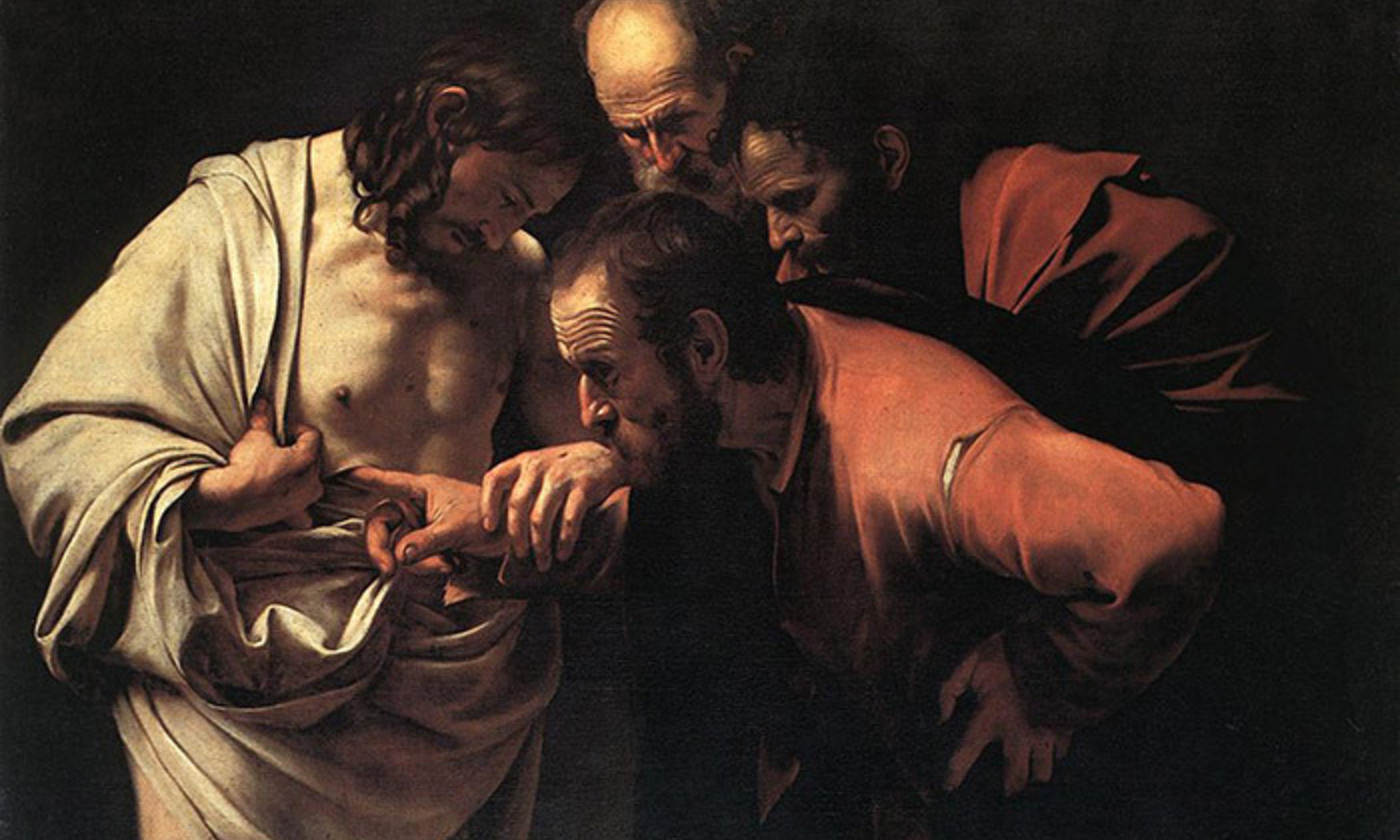
The Incredulity of Saint Thomas (1601-1602), by Caravaggio, Sanssouci Palace, Potsdam, Germany. Courtesy Wikipedia

Peter Harrison | Aeon Ideas


Religious belief is often thought to evince a precarious kind of commitment, in which the degree of conviction is inversely proportional to correspondence with the facts. Exhibit A for this common characterisation of religious belief is the maxim of the third-century Christian writer Tertullian, who is credited with the saying ‘I believe because it is absurd.’ This paradoxical expression makes a routine appearance in philosophical evaluations of the rationality of religious belief, in contemporary polemics addressed to an imagined opposition between science and religion, and in virtually every reputable dictionary of quotations.

Scholars of early Christianity have long known that Tertullian never wrote those words. What he originally said and meant poses intriguing questions, but equally interesting is the story of how the invented expression came to be attributed to him in the first place, what its invention tells us about changing conceptions of ‘faith’, and why, in spite of attempts to correct the record, it stubbornly persists as an irradicable meme about the irrationality of religious commitment.

On the face of it, being committed to something because it is absurd is an unpromising foundation for a belief system. It should not come as a complete surprise, then, that Tertullian did not advocate this principle. He did, however, make this observation, with specific reference to the death and resurrection of Christ: ‘it is entirely credible, because it is unfitting … it is certain, because it is impossible’ (For Latinists out there: prorsus credibile est, quia ineptum est … certum est, quia impossibile). This might seem to be within striking distance of the fideistic phrase commonly attributed to him. Puzzlingly, though, even this original formulation does not fit with Tertullian’s generally positive view of reason and rational justification. Elsewhere, he insists that Christians ‘should believe nothing but that nothing should be rashly believed’. For Tertullian, God is ‘author of Reason’, the natural order of the world is ‘ordained by reason’, and everything is to be ‘understood by reason’.

One likely explanation for this apparent incongruence is that, in his paradoxical juxtaposition of impossibility and certainty, Tertullian is drawing upon a principle set out in Aristotle’s Rhetoric. Addressing himself to the credibility of highly improbable events, Aristotle observes: ‘We may argue that people could not have believed them, if they had not been true or nearly true. And that they are more likely to be true because they are incredible.’ His point seems to be that the apparent incredibility of a reported claim can actually provide a reason for believing it, since a witness seeking to perpetuate a false story would most likely have come up with something that at least seemed plausible. If this connection is on the right track, Tertullian, who almost certainly knew Aristotle’s Rhetoric, is not advocating belief without justification, but suggesting that we sometimes have good reasons to believe the highly improbable.

This leaves us with the question of how Tertullian came to be attributed with authorship of the rather different expression: ‘I believe because it is absurd.’ For this, we need to look to two decisive moments in the early modern period.

In the middle of the 17th century, the physician and polymath Thomas Browne drew attention to Tertullian’s original remarks in his bestselling Religio Medici (1643), or The Religion of a Physician. Crucially, not only did Browne introduce numerous readers to this relatively unnoticed passage in Tertullian, but he lent it an entirely new interpretation, proposing as a general principle that the strength of one’s faith is inversely proportional to the probability of what is believed: ‘Methinks there be not impossibilities enough in Religion for an active faith.’ Before long, numerous sources were quoting Tertullian, albeit disapprovingly, as having said: ‘I believe, because it is impossible’. The philosopher John Locke thus makes reference to this new version of the paradox in his classic An Essay Concerning Human Understanding (1689), summing up the view of most of his contemporaries that this was a ‘very ill Rule for Men to chuse their Opinions, or Religion by’.

A key element of the background to this development was the rise of sectarian disputes in the wake of the Reformation. Protestants chastised Catholics for their overcredulous ‘implicit faith’ – the giving of assent to doctrines promulgated by the Church but without a full comprehension of what was being assented to. A prime case was the doctrine of transubstantiation – a theory, based on Aristotle’s philosophy, of how during the Mass the elements of bread and wine could become the body and blood of Christ. For many Protestants, this was an emblematic instance of believing something that was literally impossible. The maxim ‘I believe because it is impossible’ thus first gained currency because of its deployment in anti-Catholic polemic.

The second phase in the transformation of Tertullian’s original remarks came when the French philosopher Voltaire introduced the ‘absurdity’ condition. In the entry for ‘Faith’ in his Philosophical Dictionary (1764), Voltaire concludes a characteristically entertaining account of the exploits of the notoriously promiscuous Pope Alexander VI by defining faith as ‘believing things because they are impossible’. The first appearance of the phrase ‘I believe because it is absurd’ comes subsequently in one of Voltaire’s 1767 publications, in which Voltaire attributes to the church father Augustine (rather than to Tertullian), the maxim: ‘I believe because it is absurd, I believe because it is impossible.’

Thereafter, ‘I believe because it is absurd’ became the standard form of the credo, and it was increasingly applied indiscriminately to all religious belief. Lending the phrase greater authenticity was its circulation in Latin as credo quia absurdum – a reverse-engineered version of Voltaire’s je le crois parce que cela est absurd. The misattribution of the saying to Augustine serves as a helpful marker of Voltaire’s influence, and for many years Augustine was regarded as the author of the paradox. While attributions to Augustine are rare today, Voltaire’s subtle insinuation of ‘absurdity’ into the new ‘I believe’ version of the paradox has persisted.

Since Voltaire’s time, the maxim ‘I believe because it is absurd’ has continued to serve the purpose intended by its Enlightenment originator – a gesture towards the inherent irrationality of religious belief. Thus in 1928, Sigmund Freud cited the motto as evidence of the infantile nature of religion, which he characterised as always attempting to shield its beliefs from rational scrutiny. The German philosopher Ernst Cassirer similarly maintained that the maxim typified a particular religious psychology that attended both the birth of religion and its regrettable contemporary manifestations: ‘The motto “I believe because it is absurd” exhibits its old force here and everywhere,’ he complained in 1951. Reference works, though generally less partisan, often convey similar sentiments. Typical is the offering in the Oxford Dictionary of Philosophy (1996), where the entry on credo quia absurdum est reads: ‘Also known as Tertullian’s dictum or paradox. Literally (Latin), I believe because it is absurd: that is, the very impossibility of a proposition becomes (mostly in theology) a kind of motivation for belief in it.’

One of the more conspicuous sites for the contemporary deployment of the maxim has been unflattering comparisons of fanciful religious belief with the ‘facts’ of science. In his lecture ‘Science as a Vocation’ (1917), Max Weber invented for himself an even more extreme Latin variant of Tertullian’s saying (Credo non quod, sed quia absurdum est – ‘I believe nothing except that which is absurd’, which Weber attributes to Augustine) in order to illustrate what he thought was an intrinsic tension between science and religion. Contemporary science vs religion warriors such as Richard Dawkins and Jerry Coyne have predictably followed suit, pointing to Tertullian as a personification of the irrationality of religious belief.

Much could be said about the differences and similarities between religious and scientific commitment, but it is worth observing, in brief, that the contemporary sciences afford conspicuous instances of justified belief in both the impossible (quantum mechanics) and the staggeringly improbable (Big Bang cosmology). This brings us back to the original context of Tertullian’s remarks, which were not about belief motivated by the absurdity of its object, but whether is it ever warranted to believe in things we consider to be impossible or extremely improbable. Clearly, that remains a live question.Aeon counter – do not remove

Peter Harrison

This article was originally published at Aeon and has been republished under Creative Commons.


Commentary

This reminds me of Kierkegaard. I wonder why he wasn’t mentioned:

Revelation is marked by mystery, eternal happiness by suffering, the certitude of faith by uncertainty, easiness by difficulty, truth by absurdity; if this is not maintained, then the esthetic and the religious merge in common confusion. … The religious lies in the dialectic of inwardness deepening and therefore, with regard to the conception of God, this means that he himself is moved, is changed. An action in the eternal transforms the individual’s existence.


When the question about truth is asked objectively, truth is reflected upon objectively as an object to which the knower relates himself. What is reflected upon is not the relation but that what he related himself to is the truth, the true. If only that to which he relates himself is the truth, the true, then the subject is in the truth. When the question about truth is asked subjectively, the individual’s relation is reflected upon subjectively. If only the how of this relation is in truth, the individual is in truth, even if he in this way were to relate himself to untruth.


When subjectivity, inwardness, is truth, then truth, objectively defined, is a paradox; and that truth is objectively a paradox shows precisely that subjectivity is truth, since the objectivity does indeed thrust away, and the objectivity’s repulsion, or the expression for the objectivity’s repulsion, is the resilience and dynamometer of inwardness. The paradox is the objective uncertainty that is the expression for the passion of inwardness that is truth. So much for the Socratic. The eternal, essential truth, that is, the truth that is related essentially to the existing person by pertaining essentially to what it means to exist (viewed Socratically, all other knowledge is accidental, its degree and scope indifferent), is a paradox. Nevertheless the eternal, essential truth is itself not at all a paradox, but it is a paradox by being related to an existing person… The Socratic inwardness in existing is an analogue to faith, except that the inwardness of faith, corresponding not to the repulsion exerted by ignorance but to the repulsion exerted by the absurd, is infinitely deeper.

–  Søren Kierkegaard, Concluding Unscientific Postscript to Philosophical Fragments (1846)

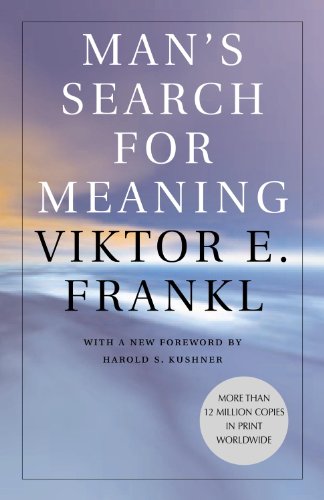
Man’s Search for Meaning


Man’s Search for Meaning is a 1946 book by Viktor Frankl chronicling his experiences as an Auschwitz concentration camp inmate during World War II, and describing his psychotherapeutic method, which involved identifying a purpose in life to feel positively about, and then immersively imagining that outcome. According to Frankl, the way a prisoner imagined the future affected his longevity. The book intends to answer the question “How was everyday life in a concentration camp reflected in the mind of the average prisoner?” Part One constitutes Frankl’s analysis of his experiences in the concentration camps, while Part Two introduces his ideas of meaning and his theory called logotherapy.

According to a survey conducted by the Book-of-the-Month Club and the Library of Congress, Man’s Search for Meaning belongs to a list of “the ten most influential books in the United States.” At the time of the author’s death in 1997, the book had sold over 10 million copies and had been translated into 24 languages.

Frankl identifies three psychological reactions experienced by all inmates to one degree or another: (1) shock during the initial admission phase to the camp, (2) apathy after becoming accustomed to camp existence, in which the inmate values only that which helps himself and his friends survive, and (3) reactions of depersonalization, moral deformity, bitterness, and disillusionment if he survives and is liberated.

Frankl concludes that the meaning of life is found in every moment of living; life never ceases to have meaning, even in suffering and death. In a group therapy session during a mass fast inflicted on the camp’s inmates trying to protect an anonymous fellow inmate from fatal retribution by authorities, Frankl offered the thought that for everyone in a dire condition there is someone looking down, a friend, family member, or even God, who would expect not to be disappointed. Frankl concludes from his experience that a prisoner’s psychological reactions are not solely the result of the conditions of his life, but also from the freedom of choice he always has even in severe suffering. The inner hold a prisoner has on his spiritual self relies on having a hope in the future, and that once a prisoner loses that hope, he is doomed.

An example of Frankl’s idea of finding meaning in the midst of extreme suffering is found in his account of an experience he had while working in the harsh conditions of the Auschwitz concentration camp:

… We stumbled on in the darkness, over big stones and through large puddles, along the one road leading from the camp. The accompanying guards kept shouting at us and driving us with the butts of their rifles. Anyone with very sore feet supported himself on his neighbor’s arm. Hardly a word was spoken; the icy wind did not encourage talk. Hiding his mouth behind his upturned collar, the man marching next to me whispered suddenly: “If our wives could see us now! I do hope they are better off in their camps and don’t know what is happening to us.”

That brought thoughts of my own wife to mind. And as we stumbled on for miles, slipping on icy spots, supporting each other time and again, dragging one another up and onward, nothing was said, but we both knew: each of us was thinking of his wife. Occasionally I looked at the sky, where the stars were fading and the pink light of the morning was beginning to spread behind a dark bank of clouds. But my mind clung to my wife’s image, imagining it with an uncanny acuteness. I heard her answering me, saw her smile, her frank and encouraging look. Real or not, her look was then more luminous than the sun which was beginning to rise.

A thought transfixed me: for the first time in my life I saw the truth as it is set into song by so many poets, proclaimed as the final wisdom by so many thinkers. The truth—that love is the ultimate and the highest goal to which man can aspire. Then I grasped the meaning of the greatest secret that human poetry and human thought and belief have to impart: The salvation of man is through love and in love. I understood how a man who has nothing left in this world still may know bliss, be it only for a brief moment, in the contemplation of his beloved. In a position of utter desolation, when man cannot express himself in positive action, when his only achievement may consist in enduring his sufferings in the right way—an honorable way—in such a position man can, through loving contemplation of the image he carries of his beloved, achieve fulfillment. For the first time in my life I was able to understand the meaning of the words, “The angels are lost in perpetual contemplation of an infinite glory….”

Frankl also concludes that there are only two races of men, decent men and indecent. No society is free of either of them, and thus there were “decent” Nazi guards and “indecent” prisoners, most notably the kapo who would torture and abuse their fellow prisoners for personal gain.

His concluding passage in Part One describes the psychological reaction of the inmates to their liberation, which he separates into three stages. The first is depersonalization—a period of readjustment, in which a prisoner gradually returns to the world. Initially, the liberated prisoners are so numb that they are unable to understand what freedom means, or to emotionally respond to it. Part of them believes that it is an illusion or a dream that will be taken away from them. In their first foray outside their former prison, the prisoners realized that they could not comprehend pleasure. Flowers and the reality of the freedom they had dreamed about for years were all surreal, unable to be grasped in their depersonalization.

The body is the first element to break out of this stage, responding by big appetites of eating and wanting more sleeping. Only after the partial replenishing of the body is the mind finally able to respond, as “feeling suddenly broke through the strange fetters which had restrained it”.

This begins the second stage, in which there is a danger of deformation. As the intense pressure on the mind is released, mental health can be endangered. Frankl uses the analogy of a diver suddenly released from his pressure chamber. He recounts the story of a decent friend who became immediately obsessed with dispensing the same violence in judgment of his abusers that they had inflicted on him.

Upon returning home, the prisoners had to struggle with two fundamental experiences which could also damage their mental health: bitterness and disillusionment. The last stage is bitterness at the lack of responsiveness of the world outside—a “superficiality and lack of feeling… so disgusting that one finally felt like creeping into a hole and neither hearing nor seeing human beings any more”. Worse was disillusionment, which was the discovery that suffering does not end, that the longed-for happiness will not come. This was the experience of those who—like Frankl—returned home to discover that no one awaited them. The hope that had sustained them throughout their time in the concentration camp was now gone. Frankl cites this experience as the most difficult to overcome.

As time passed, however, the prisoner’s experience in a concentration camp finally became nothing but a remembered nightmare. What is more, he comes to believe that he has nothing left to fear any more, “except his God”.


frankl.jpg

Man’s Search for Meaning (PDF)

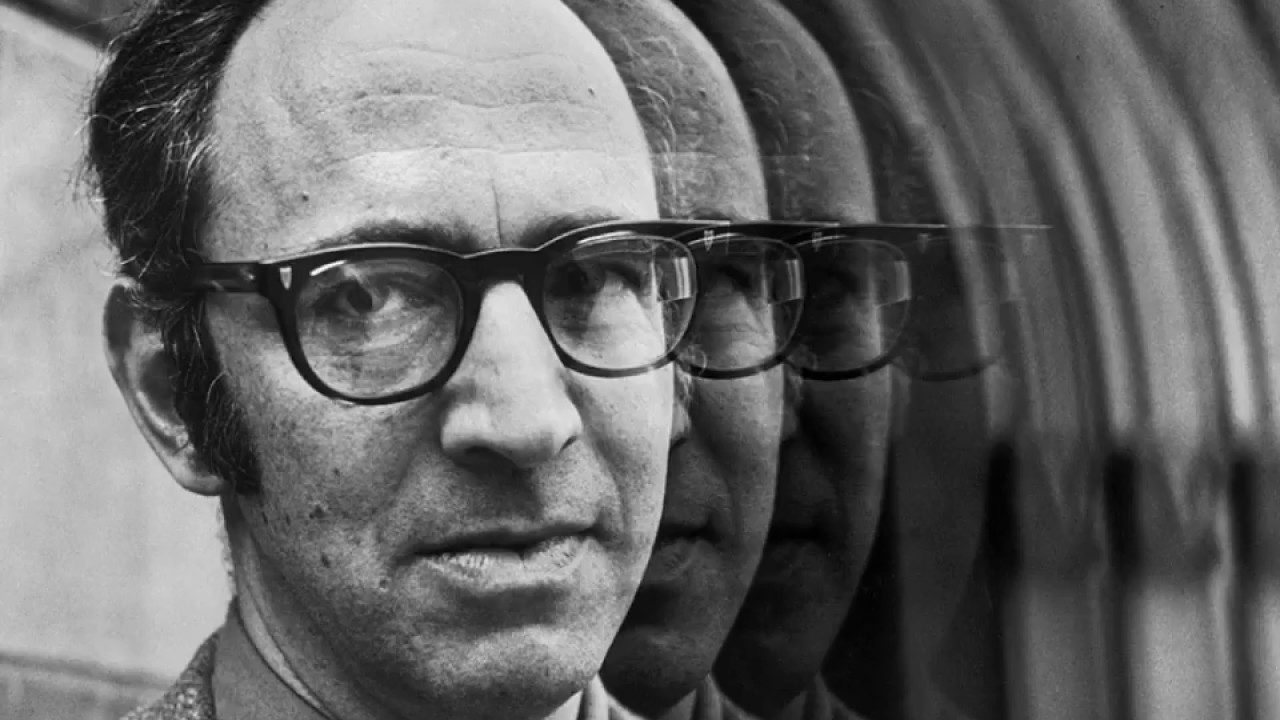
The Structure of Scientific Revolutions

We may, to be more precise, have to relinquish the notion, explicit or implicit, that changes of paradigm carry scientists and those who learn from them closer and closer to the truth.

– Thomas Kuhn

kuhn.jpg

The Structure of Scientific Revolutions (1962) is a book about the history of science by the philosopher Thomas S. Kuhn. Its publication was a landmark event in the history, philosophy, and sociology of scientific knowledge. Kuhn challenged the then prevailing view of progress in “normal science”. Normal scientific progress was viewed as “development-by-accumulation” of accepted facts and theories. Kuhn argued for an episodic model in which periods of such conceptual continuity in normal science were interrupted by periods of revolutionary science. The discovery of “anomalies” during revolutions in science leads to new paradigms. New paradigms then ask new questions of old data, move beyond the mere “puzzle-solving” of the previous paradigm, change the rules of the game and the “map” directing new research.

For example, Kuhn’s analysis of the Copernican Revolution emphasized that, in its beginning, it did not offer more accurate predictions of celestial events, such as planetary positions, than the Ptolemaic system, but instead appealed to some practitioners based on a promise of better, simpler, solutions that might be developed at some point in the future. Kuhn called the core concepts of an ascendant revolution its “paradigms” and thereby launched this word into widespread analogical use in the second half of the 20th century. Kuhn’s insistence that a paradigm shift was a mélange of sociology, enthusiasm and scientific promise, but not a logically determinate procedure, caused an uproar in reaction to his work. Kuhn addressed concerns in the 1969 postscript to the second edition. For some commentators, The Structure of Scientific Revolutions introduced a realistic humanism into the core of science, while for others the nobility of science was tarnished by Kuhn’s introduction of an irrational element into the heart of its greatest achievements.

In a sense that I am unable to explicate further, the proponents of competing paradigms practice their trades in different worlds.

History

The Structure of Scientific Revolutions was first published as a monograph in the International Encyclopedia of Unified Science, then as a book by University of Chicago Press in 1962. In 1969, Kuhn added a postscript to the book in which he replied to critical responses to the first edition. A 50th Anniversary Edition (with an introductory essay by Ian Hacking) was published by the University of Chicago Press in April 2012.

Kuhn dated the genesis of his book to 1947 when he was a graduate student at Harvard University and had been asked to teach a science class for humanities undergraduates with a focus on historical case studies. Kuhn later commented that until then, “I’d never read an old document in science.” Aristotle’s Physics was astonishingly unlike Isaac Newton’s work in its concepts of matter and motion. Kuhn wrote “… as I was reading him, Aristotle appeared not only ignorant of mechanics, but a dreadfully bad physical scientist as well. About motion, in particular, his writings seemed to me full of egregious errors, both of logic and of observation.” This was in an apparent contradiction with the fact that Aristotle was a brilliant mind. While perusing Aristotle’s Physics, Kuhn formed the view that in order to properly appreciate Aristotle’s reasoning, one must be aware of the scientific conventions of the time. Kuhn concluded that Aristotle’s concepts were not “bad Newton,” just different. This insight was the foundation of The Structure of Scientific Revolutions.

Prior to the publication of Kuhn’s book, a number of ideas regarding the process of scientific investigation and discovery had already been proposed. Ludwik Fleck developed the first system of the sociology of scientific knowledge in his book The Genesis and Development of a Scientific Fact (1935). He claimed that the exchange of ideas led to the establishment of a thought collective, which, when developed sufficiently, served to separate the field into esoteric (professional) and exoteric (laymen) circles. Kuhn wrote the foreword to the 1979 edition of Fleck’s book, noting that he read it in 1950 and was reassured that someone “saw in the history of science what I myself was finding there.”

Kuhn was not confident about how his book would be received. Harvard University had denied his tenure, a few years before. However, by the mid-1980s, his book had achieved blockbuster status.

One theory to which Kuhn replies directly is Karl Popper’s “falsificationism,” which stresses falsifiability as the most important criterion for distinguishing between that which is scientific and that which is unscientific. Kuhn also addresses verificationism, a philosophical movement that emerged in the 1920s among logical positivists. The verifiability principle claims that meaningful statements must be supported by empirical evidence or logical requirements.

Scientists work from models acquired through education and through subsequent exposure to the literature often without quite knowing or needing to know what characteristics have given these models the status of community paradigms.

Basic Approach

Kuhn’s approach to the history and philosophy of science focuses on conceptual issues like the practice of normal science, influence of historical events, emergence of scientific discoveries, nature of scientific revolutions and progress through scientific revolutions. What sorts of intellectual options and strategies were available to people during a given period? What types of lexicons and terminology were known and employed during certain epochs? Stressing the importance of not attributing traditional thought to earlier investigators, Kuhn’s book argues that the evolution of scientific theory does not emerge from the straightforward accumulation of facts, but rather from a set of changing intellectual circumstances and possibilities. Such an approach is largely commensurate with the general historical school of non-linear history.

Kuhn did not see scientific theory as proceeding linearly from an objective, unbiased accumulation of all available data, but rather as paradigm-driven. “The operations and measurements that a scientist undertakes in the laboratory are not ‘the given’ of experience but rather ‘the collected with difficulty.’ They are not what the scientist sees—at least not before his research is well advanced and his attention focused. Rather, they are concrete indices to the content of more elementary perceptions, and as such they are selected for the close scrutiny of normal research only because they promise opportunity for the fruitful elaboration of an accepted paradigm. Far more clearly than the immediate experience from which they in part derive, operations and measurements are paradigm-determined. Science does not deal in all possible laboratory manipulations. Instead, it selects those relevant to the juxtaposition of a paradigm with the immediate experience that that paradigm has partially determined. As a result, scientists with different paradigms engage in different concrete laboratory manipulations.”

History, if viewed as a repository for more than anecdote or chronology, could produce a decisive transformation in the image of science by which we are now possessed.

Historical Examples of Chemistry

Kuhn explains his ideas using examples taken from the history of science. For instance, eighteenth century scientists believed that homogenous solutions were chemical compounds. Therefore, a combination of water and alcohol was generally classified as a compound. Nowadays it is considered to be a solution, but there was no reason then to suspect that it was not a compound. Water and alcohol would not separate spontaneously, nor will they separate completely upon distillation (they form an azeotrope). Water and alcohol can be combined in any proportion.

Under this paradigm, scientists believed that chemical reactions (such as the combination of water and alcohol) did not necessarily occur in fixed proportion. This belief was ultimately overturned by Dalton’s atomic theory, which asserted that atoms can only combine in simple, whole-number ratios. Under this new paradigm, any reaction which did not occur in fixed proportion could not be a chemical process. This type world-view transition among the scientific community exemplifies Kuhn’s paradigm shift.

To my complete surprise, that exposure to out-of-date scientific theory and practice radically undermined some of my basic conceptions about the nature of science and the reasons for its special success.

Copernican Revolution

A famous example of a revolution in scientific thought is the Copernican Revolution. In Ptolemy’s school of thought, cycles and epicycles (with some additional concepts) were used for modeling the movements of the planets in a cosmos that had a stationary Earth at its center. As accuracy of celestial observations increased, complexity of the Ptolemaic cyclical and epicyclical mechanisms had to increase to maintain the calculated planetary positions close to the observed positions. Copernicus proposed a cosmology in which the Sun was at the center and the Earth was one of the planets revolving around it. For modeling the planetary motions, Copernicus used the tools he was familiar with, namely the cycles and epicycles of the Ptolemaic toolbox. Yet Copernicus’ model needed more cycles and epicycles than existed in the then-current Ptolemaic model, and due to a lack of accuracy in calculations, his model did not appear to provide more accurate predictions than the Ptolemy model. Copernicus’ contemporaries rejected his cosmology, and Kuhn asserts that they were quite right to do so: Copernicus’ cosmology lacked credibility.

Kuhn illustrates how a paradigm shift later became possible when Galileo Galilei introduced his new ideas concerning motion. Intuitively, when an object is set in motion, it soon comes to a halt. A well-made cart may travel a long distance before it stops, but unless something keeps pushing it, it will eventually stop moving. Aristotle had argued that this was presumably a fundamental property of nature: for the motion of an object to be sustained, it must continue to be pushed. Given the knowledge available at the time, this represented sensible, reasonable thinking.

Galileo put forward a bold alternative conjecture: suppose, he said, that we always observe objects coming to a halt simply because some friction is always occurring. Galileo had no equipment with which to objectively confirm his conjecture, but he suggested that without any friction to slow down an object in motion, its inherent tendency is to maintain its speed without the application of any additional force.

The Ptolemaic approach of using cycles and epicycles was becoming strained: there seemed to be no end to the mushrooming growth in complexity required to account for the observable phenomena. Johannes Kepler was the first person to abandon the tools of the Ptolemaic paradigm. He started to explore the possibility that the planet Mars might have an elliptical orbit rather than a circular one. Clearly, the angular velocity could not be constant, but it proved very difficult to find the formula describing the rate of change of the planet’s angular velocity. After many years of calculations, Kepler arrived at what we now know as the law of equal areas.

Galileo’s conjecture was merely that — a conjecture. So was Kepler’s cosmology. But each conjecture increased the credibility of the other, and together, they changed the prevailing perceptions of the scientific community. Later, Newton showed that Kepler’s three laws could all be derived from a single theory of motion and planetary motion. Newton solidified and unified the paradigm shift that Galileo and Kepler had initiated.

Only when they must choose between competing theories do scientists behave like philosophers.

Coherence

One of the aims of science is to find models that will account for as many observations as possible within a coherent framework. Together, Galileo’s rethinking of the nature of motion and Keplerian cosmology represented a coherent framework that was capable of rivaling the Aristotelian/Ptolemaic framework.

Once a paradigm shift has taken place, the textbooks are rewritten. Often the history of science too is rewritten, being presented as an inevitable process leading up to the current, established framework of thought. There is a prevalent belief that all hitherto-unexplained phenomena will in due course be accounted for in terms of this established framework. Kuhn states that scientists spend most (if not all) of their careers in a process of puzzle-solving. Their puzzle-solving is pursued with great tenacity, because the previous successes of the established paradigm tend to generate great confidence that the approach being taken guarantees that a solution to the puzzle exists, even though it may be very hard to find. Kuhn calls this process normal science.

As a paradigm is stretched to its limits, anomalies — failures of the current paradigm to take into account observed phenomena — accumulate. Their significance is judged by the practitioners of the discipline. Some anomalies may be dismissed as errors in observation, others as merely requiring small adjustments to the current paradigm that will be clarified in due course. Some anomalies resolve themselves spontaneously, having increased the available depth of insight along the way. But no matter how great or numerous the anomalies that persist, Kuhn observes, the practicing scientists will not lose faith in the established paradigm until a credible alternative is available; to lose faith in the solvability of the problems would in effect mean ceasing to be a scientist.

In any community of scientists, Kuhn states, there are some individuals who are bolder than most. These scientists, judging that a crisis exists, embark on what Kuhn calls revolutionary science, exploring alternatives to long-held, obvious-seeming assumptions. Occasionally this generates a rival to the established framework of thought. The new candidate paradigm will appear to be accompanied by numerous anomalies, partly because it is still so new and incomplete. The majority of the scientific community will oppose any conceptual change, and, Kuhn emphasizes, so they should. To fulfill its potential, a scientific community needs to contain both individuals who are bold and individuals who are conservative. There are many examples in the history of science in which confidence in the established frame of thought was eventually vindicated. It is almost impossible to predict whether the anomalies in a candidate for a new paradigm will eventually be resolved. Those scientists who possess an exceptional ability to recognize a theory’s potential will be the first whose preference is likely to shift in favor of the challenging paradigm. There typically follows a period in which there are adherents of both paradigms. In time, if the challenging paradigm is solidified and unified, it will replace the old paradigm, and a paradigm shift will have occurred.

Suddenly the fragments in my head sorted themselves out in a new way, and fell into place together. My jaw dropped, for all at once Aristotle seemed a very good physicist indeed, but of a sort I’d never dreamed possible. Now I could understand why he had said what he’d said, and what his authority had been.

Phases

Kuhn explains the process of scientific change as the result of various phases of paradigm change.

Phase 1 – It exists only once and is the pre-paradigm phase, in which there is no consensus on any particular theory. This phase is characterized by several incompatible and incomplete theories. Consequently, most scientific inquiry takes the form of lengthy books, as there is no common body of facts that may be taken for granted. If the actors in the pre-paradigm community eventually gravitate to one of these conceptual frameworks and ultimately to a widespread consensus on the appropriate choice of methods, terminology and on the kinds of experiment that are likely to contribute to increased insights.

Phase 2 – Normal science begins, in which puzzles are solved within the context of the dominant paradigm. As long as there is consensus within the discipline, normal science continues. Over time, progress in normal science may reveal anomalies, facts that are difficult to explain within the context of the existing paradigm. While usually these anomalies are resolved, in some cases they may accumulate to the point where normal science becomes difficult and where weaknesses in the old paradigm are revealed.

Phase 3 – If the paradigm proves chronically unable to account for anomalies, the community enters a crisis period. Crises are often resolved within the context of normal science. However, after significant efforts of normal science within a paradigm fail, science may enter the next phase.

Phase 4 – Paradigm shift, or scientific revolution, is the phase in which the underlying assumptions of the field are reexamined and a new paradigm is established.

Phase 5- Post-Revolution, the new paradigm’s dominance is established and so scientists return to normal science, solving puzzles within the new paradigm.

A science may go through these cycles repeatedly, though Kuhn notes that it is a good thing for science that such shifts do not occur often or easily.

Philosophers of science have repeatedly demonstrated that more than one theoretical construction can always be placed upon a given collection of data. History of science indicates that, particularly in the early developmental stages of a new paradigm, it is not even very difficult to invent such alternates.

Incommensurability

According to Kuhn, the scientific paradigms preceding and succeeding a paradigm shift are so different that their theories are incommensurable — the new paradigm cannot be proven or disproven by the rules of the old paradigm, and vice versa. (A later interpretation by Kuhn of ‘commensurable’ versus ‘incommensurable’ was as a distinction between languages, namely, that statements in commensurable languages were translatable fully from one to the other, while in incommensurable languages, strict translation is not possible.) The paradigm shift does not merely involve the revision or transformation of an individual theory, it changes the way terminology is defined, how the scientists in that field view their subject, and, perhaps most significantly, what questions are regarded as valid, and what rules are used to determine the truth of a particular theory. The new theories were not, as the scientists had previously thought, just extensions of old theories, but were instead completely new world views. Such incommensurability exists not just before and after a paradigm shift, but in the periods in between conflicting paradigms. It is simply not possible, according to Kuhn, to construct an impartial language that can be used to perform a neutral comparison between conflicting paradigms, because the very terms used are integral to the respective paradigms, and therefore have different connotations in each paradigm. The advocates of mutually exclusive paradigms are in a difficult position: “Though each may hope to convert the other to his way of seeing science and its problems, neither may hope to prove his case. The competition between paradigms is not the sort of battle that can be resolved by proofs.” Scientists subscribing to different paradigms end up talking past one another.

Kuhn states that the probabilistic tools used by verificationists are inherently inadequate for the task of deciding between conflicting theories, since they belong to the very paradigms they seek to compare. Similarly, observations that are intended to falsify a statement will fall under one of the paradigms they are supposed to help compare, and will therefore also be inadequate for the task. According to Kuhn, the concept of falsifiability is unhelpful for understanding why and how science has developed as it has. In the practice of science, scientists will only consider the possibility that a theory has been falsified if an alternative theory is available that they judge credible. If there is not, scientists will continue to adhere to the established conceptual framework. If a paradigm shift has occurred, the textbooks will be rewritten to state that the previous theory has been falsified.

Kuhn further developed his ideas regarding incommensurability in the 1980s and 1990s. In his unpublished manuscript The Plurality of Worlds, Kuhn introduces the theory of kind concepts: sets of interrelated concepts that are characteristic of a time period in a science and differ in structure from the modern analogous kind concepts. These different structures imply different “taxonomies” of things and processes, and this difference in taxonomies constitutes incommensurability. This theory is strongly naturalistic and draws on developmental psychology to “found a quasi-transcendental theory of experience and of reality.”

Scientific revolutions are inaugurated by a growing sense… that an existing paradigm has ceased to function adequately in the exploration of an aspect of nature to which that paradigm itself had previously led the way.

Exemplar

Kuhn introduced the concept of an exemplar in a postscript to the second edition of The Structure of Scientific Revolutions (1970). He noted that he was substituting the term ‘exemplars’ for ‘paradigm’, meaning the problems and solutions that students of a subject learn from the beginning of their education. For example, physicists might have as exemplars the inclined plane, Kepler’s laws of planetary motion, or instruments like the calorimeter.

According to Kuhn, scientific practice alternates between periods of normal science and revolutionary science. During periods of normalcy, scientists tend to subscribe to a large body of interconnecting knowledge, methods, and assumptions which make up the reigning paradigm. Normal science presents a series of problems that are solved as scientists explore their field. The solutions to some of these problems become well known and are the exemplars of the field.

Those who study a scientific discipline are expected to know its exemplars. There is no fixed set of exemplars, but for a physicist today it would probably include the harmonic oscillator from mechanics and the hydrogen atom from quantum mechanics.

By now it may be clear that the position I’m developing is a sort of post-Darwinian Kantianism.

Kuhn on Scientific Progress

The first edition of The Structure of Scientific Revolutions ended with a chapter titled “Progress through Revolutions”, in which Kuhn spelled out his views on the nature of scientific progress. Since he considered problem solving to be a central element of science, Kuhn saw that for a new candidate paradigm to be accepted by a scientific community, “First, the new candidate must seem to resolve some outstanding and generally recognized problem that can be met in no other way. Second, the new paradigm must promise to preserve a relatively large part of the concrete problem solving activity that has accrued to science through its predecessors.

While the new paradigm is rarely as expansive as the old paradigm in its initial stages, it must nevertheless have significant promise for future problem-solving. As a result, though new paradigms seldom or never possess all the capabilities of their predecessors, they usually preserve a great deal of the most concrete parts of past achievement and they always permit additional concrete problem-solutions besides.

In the second edition, Kuhn added a postscript in which he elaborated his ideas on the nature of scientific progress. He described a thought experiment involving an observer who has the opportunity to inspect an assortment of theories, each corresponding to a single stage in a succession of theories. What if the observer is presented with these theories without any explicit indication of their chronological order? Kuhn anticipates that it will be possible to reconstruct their chronology on the basis of the theories’ scope and content, because the more recent a theory is, the better it will be as an instrument for solving the kinds of puzzle that scientists aim to solve. Kuhn remarked: “That is not a relativist’s position, and it displays the sense in which I am a convinced believer in scientific progress.”

The man who is striving to solve a problem defined by existing knowledge and technique is not, however, just looking around. He knows what he wants to achieve, and he designs his instruments and directs his thoughts accordingly. Unanticipated novelty, the new discovery, can emerge only to the extent that his anticipations about nature and his instruments prove wrong… There is no other effective way in which discoveries might be generated.

If these out-of date beliefs are to be called myths, then myths can be produced by the same sorts of methods and held for the same sorts of reasons that now lead to scientific knowledge.


See Also: Science as Mythology

The Second Sex

beauvoir.jpg

The Second Sex is a 1949 book by the French existentialist Simone de Beauvoir, in which the author discusses the treatment of women throughout history. Beauvoir researched and wrote the book in about 14 months when she was 38 years old. She published it in two volumes, Facts and Myths and Lived Experience. One of Beauvoir’s best-known books, The Second Sex is often regarded as a major work of feminist philosophy and the starting point of second-wave feminism.

Beauvoir asks “What is woman?” She argues that man is considered the default, while woman is considered the “Other”: “Thus humanity is male and man defines woman not herself but as relative to him.” Beauvoir describes the relationship of ovum to sperm in various creatures (fish, insects, mammals), leading up to the human being. She describes women’s subordination to the species in terms of reproduction, compares the physiology of men and women, concluding that values cannot be based on physiology and that the facts of biology must be viewed in light of the ontological, economic, social, and physiological context.

Authors whose views Beauvoir rejects include Sigmund Freud and Alfred Adler, and Friedrich Engels. Beauvoir argues that while Engels, in his The Origin of the Family, Private Property and the State (1884), maintained that “the great historical defeat of the female sex” is the result of the invention of bronze and the emergence of private property, his claims are unsupported.

According to Beauvoir, two factors explain the evolution of women’s condition: participation in production and freedom from reproductive slavery. Beauvoir writes that motherhood left woman “riveted to her body” like an animal and made it possible for men to dominate her and Nature. She describes man’s gradual domination of women, starting with the statue of a female Great Goddess found in Susa, and eventually the opinion of ancient Greeks like Pythagoras who wrote, “There is a good principle that created order, light and man and a bad principle that created chaos, darkness and woman.” Men succeed in the world by transcendence, but immanence is the lot of women. Beauvoir writes that men oppress women when they seek to perpetuate the family and keep patrimony intact. She compares women’s situation in ancient Greece with Rome. In Greece, with exceptions like Sparta where there were no restraints on women’s freedom, women were treated almost like slaves. In Rome because men were still the masters, women enjoyed more rights but, still discriminated against on the basis of their gender, had only empty freedom.

Discussing Christianity, Beauvoir argues that, with the exception of the German tradition, it and its clergy have served to subordinate women. She also describes prostitution and the changes in dynamics brought about by courtly love that occurred about the twelfth century. Beauvoir describes from the early fifteenth century “great Italian ladies and courtesans” and singles out the Spaniard Teresa of Ávila as successfully raising “herself as high as a man.” Through the nineteenth century women’s legal status remained unchanged but individuals (like Marguerite de Navarre) excelled by writing and acting. Some men helped women’s status through their works. Beauvoir finds fault with the Napoleonic Code, criticizes Auguste Comte and Honoré de Balzac, and describes Pierre-Joseph Proudhon as an anti-feminist. The Industrial Revolution of the nineteenth century gave women an escape from their homes but they were paid little for their work. Beauvoir traces the growth of trade unions and participation by women. She examines the spread of birth control methods and the history of abortion. Beauvoir relates the history of women’s suffrage, and writes that women like Rosa Luxemburg and Marie Curie “brilliantly demonstrate that it is not women’s inferiority that has determined their historical insignificance: it is their historical insignificance that has doomed them to inferiority”.

Beauvoir provides a presentation about the “everlasting disappointment” of women, for the most part from a male heterosexual’s point of view. She covers female menstruation, virginity, and female sexuality including copulation, marriage, motherhood, and prostitution. To illustrate man’s experience of the “horror of feminine fertility”, Beauvoir quotes the British Medical Journal of 1878 in which a member of the British Medical Association writes, “It is an indisputable fact that meat goes bad when touched by menstruating women.” She quotes poetry by André Breton, Léopold Sédar Senghor, Michel Leiris, Paul Verlaine, Edgar Allan Poe, Paul Valéry, Johann Wolfgang von Goethe, and William Shakespeare along with other novels, philosophers, and films. Beauvoir writes that sexual division is maintained in homosexuality.

Examining the work of Henry de Montherlant, D. H. Lawrence, Paul Claudel, André Breton, and Stendhal, Beauvoir writes that these “examples show that the great collective myths are reflected in each singular writer”. “Feminine devotion is demanded as a duty by Montherlant and Lawrence; less arrogant, Claudel, Breton, and Stendhal admire it as a generous choice….” She finds that woman is “the privileged Other“, that Other is defined in the “way the One chooses to posit himself”, and writes that, “But the only earthly destiny reserved to the woman equal, child-woman, soul sister, woman-sex, and female animal is always man.” Beauvoir writes that, “The absence or insignificance of the female element in a body of work is symptomatic… it loses importance in a period like ours in which each individual’s particular problems are of secondary import.”

Beauvoir writes that “mystery” is prominent among men’s myths about women. She also writes that mystery is not confined by sex to women but instead by situation, and that it pertains to any slave. She thinks it disappeared during the eighteenth century when men however briefly considered women to be peers. She quotes Arthur Rimbaud, who writes that hopefully one day, women can become fully human beings when man gives her her freedom.

Presenting a child’s life beginning with birth, Beauvoir contrasts a girl’s upbringing with a boy’s, who at age 3 or 4 is told he is a “little man”. A girl is taught to be a woman and her “feminine” destiny is imposed on her by society. She has no innate “maternal instinct”. A girl comes to believe in and to worship a male god and to create imaginary adult lovers. The discovery of sex is a “phenomenon as painful as weaning” and she views it with disgust. When she discovers that men, not women, are the masters of the world this “imperiously modifies her consciousness of herself”. Beauvoir describes puberty, the beginning of menstruation, and the way girls imagine sex with a man. She relates several ways that girls in their late teens accept their “femininity”, which may include running away from home, fascination with the disgusting, following nature, or stealing. Beauvoir describes sexual relations with men, maintaining that the repercussions of the first of these experiences informs a woman’s whole life. Beauvoir describes women’s sexual relations with women. She writes that “homosexuality is no more a deliberate perversion than a fatal curse”.

Beauvoir writes that “to ask two spouses bound by practical, social and moral ties to satisfy each other sexually for their whole lives is pure absurdity”. She describes the work of married women, including housecleaning, writing that it is “holding away death but also refusing life”. She thinks, “what makes the lot of the wife-servant ungratifying is the division of labor that dooms her wholly to the general and inessential”. Beauvoir writes that a woman finds her dignity only in accepting her vassalage which is bed “service” and housework “service”. A woman is weaned away from her family and finds only “disappointment” on the day after her wedding. Beauvoir points out various inequalities between a wife and husband and finds they pass the time not in love but in “conjugal love”. She thinks that marriage “almost always destroys woman”. She quotes Sophia Tolstoy who wrote in her diary: “you are stuck there forever and there you must sit”. Beauvoir thinks marriage is a perverted institution oppressing both men and women.

In Beauvoir’s view, abortions performed legally by doctors would have little risk to the mother. She argues that the Catholic Church cannot make the claim that the souls of the unborn would not end up in heaven because of their lack of baptism because that would be contradictory to other Church teachings. She writes that the issue of abortion is not an issue of morality but of “masculine sadism” toward woman. Beauvoir describes pregnancy, which is viewed as both a gift and a curse to woman. In this new creation of a new life the woman loses her self, seeing herself as “no longer anything… [but] a passive instrument”. Beauvoir writes that, “maternal sadomasochism creates guilt feelings for the daughter that will express themselves in sadomasochistic behavior toward her own children, without end”, and makes an appeal for socialist child-rearing practices.

Beauvoir describes a woman’s clothes, her girl friends and her relationships with men. She writes that “marriage, by frustrating women’s erotic satisfaction, denies them the freedom and individuality of their feelings, drives them to adultery”. Beauvoir describes prostitutes and their relationships with pimps and with other women, as well as hetaeras. In contrast to prostitutes, hetaeras can gain recognition as an individual and if successful can aim higher and be publicly distinguished. Beauvoir writes that women’s path to menopause might arouse woman’s homosexual feelings (which Beauvoir thinks are latent in most women). When she agrees to grow old she becomes elderly with half of her adult life left to live. Woman might choose to live through her children (often her son) or her grandchildren but she faces “solitude, regret, and ennui”. To pass her time she might engage in useless “women’s handiwork”, watercolors, music or reading, or she might join charitable organizations. While a few rare women are committed to a cause and have an end in mind, Beauvoir concludes that “the highest form of freedom a woman-parasite can have is stoic defiance or skeptical irony”.

According to Beauvoir, while a woman knows how to be as active, effective and silent as a man, her situation keeps her being useful, preparing food, clothes, and lodging. She worries because she does not do anything, she complains, she cries, and she may threaten suicide. She protests but doesn’t escape her lot. She may achieve happiness in “Harmony” and the “Good” as illustrated by Virginia Woolf and Katherine Mansfield. Beauvoir thinks it is pointless to try to decide whether woman is superior or inferior, and that it is obvious that the man’s situation is “infinitely preferable”. She writes, “for woman there is no other way out than to work for her liberation”.

Beauvoir describes narcissistic women, who might find themselves in a mirror and in the theater, and women in and outside marriage: “The day when it will be possible for the woman to love in her strength and not in her weakness, not to escape from herself but to find herself, not out of resignation but to affirm herself, love will become for her as for man the source of life and not a mortal danger.” Beauvoir discusses the lives of several women, some of whom developed stigmata. Beauvoir writes that these women may develop a relation “with an unreal”— with their double or a god, or they create an “unreal relation with a real being”. She also mentions women with careers who are able to escape sadism and masochism. A few women have successfully reached a state of equality, and Beauvoir, in a footnote, singles out the example of Clara and Robert Schumann. Beauvoir says that the goals of wives can be overwhelming: as a wife tries to be elegant, a good housekeeper and a good mother. Singled out are “actresses, dancers and singers” who may achieve independence. Among writers, Beauvoir chooses only Emily Brontë, Woolf and (“sometimes”) Mary Webb (and she mentions Colette and Mansfield) as among those who have tried to approach nature “in its inhuman freedom”. Beauvoir then says that women don’t “challenge the human condition” and that in comparison to the few “greats”, woman comes out as “mediocre” and will continue at that level for quite some time. A woman could not have been Vincent van Gogh or Franz Kafka. Beauvoir thinks that perhaps, of all women, only Saint Teresa lived her life for herself. She says it is “high time” woman “be left to take her own chances”.

In her conclusion, Beauvoir looks forward to a future when women and men are equals, something the “Soviet revolution promised” but did not ever deliver. She concludes that, “to carry off this supreme victory, men and women must, among other things and beyond their natural differentiations, unequivocally affirm their brotherhood.”


Source: The Second Sex

Primary Source: The Second Sex (PDF)

Postmodernism in Ancient Greece

plato-aristotle

Plato and Aristotle Plato (left) and Aristotle, detail from School of Athens, fresco by Raphael, 1508–11; in the Stanza della Segnatura, the Vatican. Plato pointing to the heavens and the realm of forms, Aristotle to the earth and the realm of things. Album/Oronoz/SuperStock

The 5th-Century Sophists

The Sophists taught men how to speak and what arguments to use in public debate. A Sophistic education was increasingly sought after both by members of the oldest families and by aspiring newcomers without family backing. The changing pattern of Athenian society made merely traditional attitudes in many cases no longer adequate. Criticizing such attitudes and replacing them by rational arguments held special attraction for the young, and it explains the violent distaste which they aroused in traditionalists. Plato thought that much of the Sophistic attack upon traditional values was unfair and unjustified. But even he learned at least one thing from the Sophists—if the older values were to be defended, it must be by reasoned argument, not by appeals to tradition and unreflecting faith.

Seen from this point of view, the Sophistic movement performed a valuable function within Athenian democracy in the 5th century BCE. It offered an education designed to facilitate and promote success in public life. All of the Sophists appear to have provided a training in rhetoric and in the art of speaking, and the Sophistic movement, responsible for large advances in rhetorical theory, contributed greatly to the development of style in oratory. In modern times the view occasionally has been advanced that this was the Sophists’ only concern. But the range of topics dealt with by the major Sophists makes this unlikely, and even if success in this direction was their ultimate aim, the means they used were surely as much indirect as direct, for the pupils were instructed not merely in the art of speaking, but in grammar; in the nature of virtue (aret?) and the bases of morality; in the history of society and the arts; in poetry, music, and mathematics; and also in astronomy and the physical sciences. Naturally the balance and emphasis differed from Sophist to Sophist, and some offered wider curricula than others. But this was an individual matter, and attempts by earlier historians of philosophy to divide the Sophistic movement into periods in which the nature of the instruction was altered are now seen to fail for lack of evidence. The 5th-century Sophists inaugurated a method of higher education that in range and method anticipated the modern humanistic approach inaugurated or revived during the European Renaissance.

Nature of Sophistic Thought

A question still discussed is whether the Sophists in general had any real regard for truth or whether they taught their pupils that truth was unimportant compared with success in argument. Plato’s hostile judgment on both counts is still frequently repeated without question. The Platonic writings make frequent reference to what Plato calls “eristic” (eristikos, “fond of wrangling”) and “antilogic”; the two often have been incorrectly treated as identical. Eristic, for Plato, consists in arguments aimed at victory rather than at truth. Antilogic involves the assignment to any argument of a counterargument that negates it, with the implication that both argument and counterargument are equally true. Antilogic in this sense was especially associated with Protagoras; but Plato, no doubt correctly, attributes its use to other Sophists as well. He regards the use of antilogic as essentially eristic, whether it be used to silence an opponent by making his position seem self-contradictory, or whether it be used mechanically to negate any proposition put forward in debate. He concludes that the widespread use of antilogic is evidence that Sophists had no real regard for the truth, which must itself be free from antilogic.

But Plato himself believed, for much or possibly all of his life, that the phenomenal world was essentially antilogical inasmuch as no statement about it could be made possessing a greater degree of truth than the contradictory of that statement. For example, if a person is tall in relation to one object, he will be short in relation to another object. In so characterizing the phenomenal world, Plato certainly did not wish to be called eristic—he regarded the application of antilogic to the description of the phenomenal world as an essential preliminary to the search for the truth residing in the Platonic forms, which are themselves free from antilogic.

Seen in this perspective, the Sophistic use of antilogic must be judged less harshly. To the extent that it was used irresponsibly to secure success in debate it was eristic, and the temptation so to use it must often have arisen. But where it was invoked in the sincere belief that antilogic elements were indeed involved, or where it was used for analyzing a complex situation in order to reveal its complexity, then antilogic was in no way inconsistent with devotion to truth. This raises the question to what extent the Sophists possessed any general view of the world or gave expression to any genuine philosophical views, whether original or derived. Ancient writers, influenced by Plato and Aristotle, seem to have excluded the Sophists, apart from Protagoras, from their schematized accounts of early Greek thinkers. Modern writers have frequently maintained that, whatever else they were, the Sophists were in no sense philosophers. Even those who acknowledge the philosophical interest of certain particular doctrines attributed to individual Sophists often tend to regard these as exceptions and claim that, inasmuch as the Sophists were not a school but only independent teachers and writers, as a class they were not philosophers. Two questions are involved: whether the Sophists held common intellectual doctrines and whether some or all of these could actually be termed philosophical.

Among moderns, Georg Wilhelm Friedrich Hegel was one of the first to reinsert the Sophists into the history of Greek philosophy. He did so within the framework of his own dialectic, in which every thesis invokes its own opposite, or antithesis; thus, he treated the Sophists as representing the antithesis to the thesis of the group of philosophers known collectively as the pre-Socratics. Pre-Socratics such as Thales, Heracleitus, and Parmenides sought the truth about the external world with a bold enthusiasm that produced a series of explanations, each claiming to be correct. None of these explanations of the physical world paid attention to the observer and each was driven to reject more and more of the phenomenal world itself as unreal. Finally, with the Eleatics, a 5th-century school at Elea in Italy that held that reality is a static one, of which Parmenides and Zeno are representatives, little or nothing of the phenomenal world was left as real. This trend in turn produced a growing distrust of the power of human beings to attain knowledge of the ultimate basis of natural phenomena. Philosophy had reached an impasse, and there was a danger of complete skepticism. Such an extreme position, according to Hegel’s view, provoked the “antithesis” of the Sophistic movement, which rejected the “thesis” of the objectivists and concentrated attention upon humankind rather than upon nature. To Hegel, the Sophists were subjective idealists, holding that reality is only minds and their contents, and so philosophy could move forward by turning its attention to the subjective element in knowing. Reflection upon the contrast between the thought of the Sophists and that of their predecessors produced the “syntheses” of Plato and Aristotle.

Whether any of the Sophists actually were subjective idealists may be doubted. The conclusion depends in part on whether Protagoras held that phenomena had subjective existence only, or whether he thought that all things perceived had objective existence but were perceived differently according to the nature of the percipient and their relation to him—i.e., whether he interpreted phenomena subjectively or relativistically. It is fairly clear, however, that the Sophists did concentrate very largely upon human beings and human society, upon questions of words in their relations to things, upon issues in the theory of knowledge, and upon the importance of the observer and the subjective element in reality and in the correct understanding of reality.

This emphasis helps to explain the philosophical hostility of Plato and Aristotle. Particularly in the eyes of Plato, anyone who looks for the truth in phenomena alone, whether he interprets it subjectively or relativistically, cannot hope to find it there; and his persistence in turning away from the right direction virtually amounts to a rejection of philosophy and of the search for truth. Many a subsequent thinker for whom metaphysics, or the investigation of the deepest nature of reality, was the crowning achievement of philosophy has felt with Plato that the Sophists were so antimetaphysical that they have no claim to rank as philosophers. But since the mid-19th century there has been growing appreciation of a number of problems and doctrines recurring in the discussions of the Sophists in the 5th and 4th centuries BCE. In the 18th and early 19th centuries the Sophists were considered charlatans. Their intellectual honesty was impugned, and their doctrines were blamed for weakening the moral fibre of Greece. The charge was based on two contentions, both correct: first, that many of the Sophists attacked the traditionally accepted moral code; and second, that they explored and even commended alternative approaches to morality that would condone or allow behaviour of a kind inadmissible under the stricter traditional code.

Much less weight is now attached to these charges. First, many of the attacks on the traditional morality were in the name of a new morality that claimed to be of greater validity. Attacks upon particular doctrines often claimed that accepted views should be abandoned as morally defective. Furthermore, even when socially disfavoured action seemed to be commended, this was frequently done to introduce a principle necessary in any satisfactory moral theory. Thus, when Thrasymachus in the first book of Plato’s Republic argues that justice is unwarranted when it merely contributes to another’s good and not to the good of the doer, Plato agrees. Finally, there is no evidence that any of the Sophists were personally immoral or that any of their pupils were induced to immoral actions by Sophistic teaching. The serious discussion of moral problems and the theory of morality tends to improve behaviour, not to corrupt it.

Theoretical Issues

Relativism and skepticism have often been regarded as common features of the Sophistic movement as a whole. But it was early pointed out that only in Protagoras and Gorgias is there any suggestion of a radical skepticism about the possibility of knowledge; and even in their case Sextus Empiricus, in his discussion of skepticism, is probably right when he declares that neither was really a skeptic. Protagoras does seem to have restricted knowledge to sense experience, but he believed emphatically that whatever was perceived by the senses was certainly true. This led him to assert that the tangent does not touch the circle at a point only but along a definite length of the circumference; clearly he was referring to human perception of drawn tangents and circles. Gorgias, who claimed that nothing exists, or if it does exist it cannot be known, or if it exists and is knowable it cannot be communicated to another, has often been accused of denying all reality and all knowledge. Yet he also seems to have appealed in his very discussion of these themes to the certainty of perceived facts about the physical world; e.g., that chariots do not race across the sea. Others dismiss his whole thesis as a satire or joke against philosophers.

Probably neither view is correct. What Gorgias seems to have been attacking was not perceived reality nor one’s power to perceive it but the attempt to assign existence or nonexistence (with the metaphysical implications of such an operation) to what one perceives. There is evidence that other Sophists (e.g., Hippias) were interested in questions of this kind, and it is likely that they were all concerned to some degree with rejecting claims of any nonsensible existence, such as those of the Eleatics. The Sophists, in fact, were attempting to explain the phenomenal world without appealing to any principles outside phenomena. They believed that this could be done by including the observer within the phenomenal world. Their refusal to go beyond phenomena was, for Plato, the great weakness in their thinking.

A second common generalization about the Sophists has been that they represent a revolt against science and the study of the physical world. The evidence is against this, inasmuch as for Hippias, Prodicus, Gorgias, and Protagoras there are records of a definite interest in questions of this kind. The truth is rather that they were in revolt against attempts to explain the physical world by appeals to principles that could not be perceived by the senses; and instead of framing new “objective” explanations, they attempted to explain things, where explanation was required, by introducing the perceiver as one element in the perceptual situation.

One of the most famous doctrines associated with the Sophistic movement was the opposition between nature and custom or convention in morals. It is probable that the antithesis did not originate in Sophistic circles but was rather earlier; but it was clearly very popular and figured largely in Sophistic discussions. The commonest form of the doctrine involved an appeal from conventional laws to supposedly higher laws based on nature. Sometimes these higher laws were invoked to remedy defects in actual laws and to impose more stringent obligations; but usually it was in order to free the individual from restrictions unjustifiably imposed by human laws that the appeal to nature was made. In its extreme form the appeal involved the throwing off of all restraints upon self-interest and the desires of the individual (e.g., the doctrine of Callicles in Plato’s Gorgias that might, if one possesses it, is actually right), and it was this, more than anything else, that gave support to charges against the Sophists of immoral teaching. On other occasions the terms of the antithesis were reversed and human laws were explicitly acclaimed as superior to the laws of nature and as representing progress achieved by human endeavour. In all cases the laws of nature were regarded not as generalized descriptions of what actually happens in the natural world (and so not like the laws of physics to which no exceptions are possible) but rather as norms that people ought to follow but are free to ignore. Thus, the appeal to nature tended to mean an appeal to human nature treated as a source for norms of conduct. (See also natural law.)

To Greeks this appeal was not very novel. It represented a conscious probing and exploration into an area wherein, according to their whole tradition of thought, lay the true source for norms of conduct. If Plato’s Callicles represents a position actually held by a living Sophist when he advocates free rein for the passions, then it was easy for Plato to argue in reply that human nature, if it is to be fulfilled, requires organization and restraint in the license given to the desires of particular aspects of it; otherwise the interests of the whole will be frustrated. Both Plato and Aristotle, in basing so much of their ethics on human nature, are only following up the approach begun by the Sophists.

Humanistic Issues

The Sophists have sometimes been characterized by their attacks on the traditional religious beliefs of the Greeks (see Greek religion). It is true that more than one Sophist seems to have faced prosecution for impiety, as did Socrates also. Protagoras wrote “concerning the gods, I cannot know either that they exist or that they do not exist nor what they are like in form,” and Prodicus offered a sociological account of the development of religion. Critias went further when he supposed that the gods were deliberately invented to inspire fear in the evildoer. It is thus probably correct to say that the tendency of much Sophistic thought was to reject the traditional doctrines about the gods. Indeed, this follows almost inevitably if the supposition is correct that all the Sophists were attempting to explain the phenomenal world from within itself, while excluding all principles or entities not discernible in phenomena. But in their agnostic attitudes toward the Olympian deities, the Sophists were probably at one with most of the pre-Socratic philosophers of the 6th and 5th centuries and also with most thinking people living toward the end of the 5th century. It is thus probably misleading to regard them as revolutionary in their religious beliefs.

The importance the Sophists attached to human beings meant that they were extremely interested in the history and organization of human societies. Here again most is known about Protagoras, and there is a danger of treating his particular doctrines as typical of the Sophistic movement as a whole. In the 5th century, human history was very commonly seen in terms of a decline from an earlier golden age. Another view supposed that there were recurring cycles in human affairs according to which a progression from good to bad would give way to one from bad to good. The typical Sophistic attitude toward society rejected both of these views in favour of one that saw human history in terms of progress from savagery to civilization. In a famous myth, Protagoras explained how humans achieved civilized society first with the aid of arts and crafts and then by gaining a sense of respect and justice in the ordering of their affairs. The general thinking of most of the Sophists seems to have been along similar lines.

One of the most distinctive Sophistic tenets was that virtue can be taught, a position springing naturally from the Sophists’ professional claim to be the teachers of young men. But the word virtue (aret?) implied both success in living and the qualities necessary for achieving such success, and the claim that aret? could be taught by the kind of teaching that the Sophists offered had far-ranging implications. It involved the rejection of the view that aret? came only by birth—for example, by being born a member of a noble family—and it involved also the rejection of the doctrine that aret? was a matter of the chance occurrence of specified qualities in particular individuals. Aret?, in the Sophists’ view, was the result of known and controllable procedures, a contention of profound importance for the organization of society. Moreover, what can be taught has some relation to what can be known and understood. The belief that teaching of a high intellectual calibre could produce success both for the individual and for governments has had a profound influence upon the subsequent history of education. Once again, it is through the acceptance of this doctrine by Plato and Aristotle that the Sophistic position came to be part of subsequent humanist tradition.


Source

Encyclopedia Britannica – Sophist