Primary Sources & Encyclopedias

Research

Project Gutenberg

“Project Gutenberg offers over 54,000 free eBooks: Choose among free epub books, free kindle books, download them or read them online. You will find the world’s great literature here, especially older works for which copyright has expired. We digitized and diligently proofread them with the help of thousands of volunteers.”

Early Modern Texts

“On this site you will find versions of some classics of early modern philosophy, and a few from the 19th century, prepared with a view to making them easier to read while leaving intact the main arguments, doctrines, and lines of thought.”

PhilPapers

“PhilPapers is a comprehensive index and bibliography of philosophy maintained by the community of philosophers. We monitor all sources of research content in philosophy, including journals, books, open access archives, and personal pages maintained by academics. We also host the largest open access archive in philosophy. Our index currently contains 2,288,432 entries categorized in 5,268 categories. PhilPapers has over 190,000 registered users.”

Scribd

“In addition to making the best membership book service around, we’ve also built the world’s most popular open platform for publishing and sharing documents of all kinds. To date, people all over the world have shared more than 60 million documents via Scribd, from landmark court filings to business presentations to academic papers from scholars around the world.”

Stanford Encyclopedia of Philosophy

“The Stanford Encyclopedia of Philosophy organizes scholars from around the world in philosophy and related disciplines to create and maintain an up-to-date reference work.”

Internet Encyclopedia of Philosophy

“The Internet Encyclopedia of Philosophy (IEP) (ISSN 2161-0002) was founded in 1995 to provide open access to detailed, scholarly information on key topics and philosophers in all areas of philosophy. The Encyclopedia receives no funding, and operates through the volunteer work of the editors, authors, volunteers, and technical advisers.”

Sacred Texts

“This site is a freely available archive of electronic texts about religion, mythology, legends and folklore, and occult and esoteric topics. Texts are presented in English translation and, where possible, in the original language.”

Planet Publish

“Planet Publish caters to anyone and everyone with an interest in eBooks – the books themselves have been taken from our very own Planet PDF website which caters for professional Web or print publishers seeking appropriate tools, to rank beginners wondering exactly what “PDF” stands for.”

The Internet Archive

“Internet Archive is a non-profit library of millions of free books, movies, software, music, websites, and more.”

JSTOR

“JSTOR provides access to more than 10 million academic journal articles, books, and primary sources in 75 disciplines.”

Marxists Internet Archive

“The Marxists Internet Archive is an all-volunteer, non-profit public library, started more than 20 years ago in 1990. In 2006, MIA averaged 1.1 million visitors per month, downloading 15.5 million files per month.”

Christian Classics Ethereal Library

“The mission of the Christian Classics Ethereal Library (CCEL) is to build up the church by making classic Christian literature widely available and promoting its use for edification and study by interested Christians, seekers and scholars. The CCEL accomplishes this by selecting, collecting, distributing, and promoting valuable literature through the World Wide Web and other media.”

Philosophy Index

“Philosophy Index is a site devoted to the study of philosophy and the philosophers who conduct it. The site contains a number of philosophy texts, brief biographies and introductions to philosophers and explanations on a number of topics.”


Internet History Sourcebooks

“The books that tend to have been put online here, or those that have been linked, tend to be those entire books that are often assigned to students in college classes to be read along with the more usual excerpted texts.”

The Internet Classics Archive

“Select from a list of 441 works of classical literature by 59 different authors, including user-driven commentary and “reader’s choice” Web sites. Mainly Greco-Roman works (some Chinese and Persian), all in English translation.”

The Catholic Encyclopedia

“The Catholic Encyclopedia, as its name implies, proposes to give its readers full and authoritative information on the entire cycle of Catholic interests, action and doctrine. What the Church teaches and has taught; what she has done and is still doing for the highest welfare of mankind; her methods, past and present; her struggles, her triumphs, and the achievements of her members, not only for her own immediate benefit, but for the broadening and deepening of all true science, literature and art— all come within the scope of the Catholic Encyclopedia.”

WikiBooks

“Wikibooks is a collection of open-content textbooks. Wikibooks is for textbooks, annotated texts, instructional guides, and manuals. These materials can be used in a traditional classroom, an accredited or respected institution, a home-school environment, as part of a Wikiversity course, or for self-learning.”

Wikipedia Portal

“A portal for Wikipedia’s philosophy resources, 16,050 articles in English.”

Religion Online

“Religion Online is designed to assist teachers, scholars and general “seekers” who are interested in exploring religious issues. The aim is to develop an extensive library of resources, representing many different points of view, but all written from the perspective of sound scholarship. While the initial orientation has been to seek material written primarily from a Christian perspective, the ultimate aim is to broaden the scope to include material on all the world’s major religions.”

United States of America: Important Documents

“A list of 100 milestone documents, compiled by the National Archives and Records Administration, and drawn primarily from its nationwide holdings. The documents chronicle United States history from 1776 to 1965.”

Liberty Library of Constitutional Classics

“A list of the classic books and other works on constitutional government. It is an attempt to make available on one site everything one would need to decide any constitutional issue.”

Updated 07/25/2017

Power and Terror

Whether Noam Chomsky, the MIT linguist and political philosopher, is the most important intellectual alive, as the New York Times once famously called him, is open for debate. But without a doubt, Chomsky, now 73, is one of the most straight-talking and committed dissidents of our time. A steadfast critic of United States foreign policy for decades, in the aftermath of the terrorist attacks of September 11th, his profile took a quantum leap as he provided much-needed analysis and historical perspective to concerned citizens throughout the world. In the months that followed, he gave dozens of talks on four continents, conducted scores of interviews, and wrote a book 9-11 that was published in 22 countries and became a surprise bestseller in many of them, including Japan. Chomsky’s voice may be unpopular, but his incisive arguments, based on decades of research and analysis, are heard and considered in this chronicle comprised of interview footage, and various talks he’s given. Chomsky places the terrorist attacks in the context of American foreign intervention throughout the postwar decades–in Vietnam, Central America, the Middle East, and elsewhere. Beginning with the fundamental principle that the exercise of violence against civilian populations is terror, regardless of whether the perpetrator is a well-organized band of Muslim extremists, or the most powerful state in the world. Chomsky, in stark and uncompromising terms, challenges the United States to apply to its own actions the moral standards it demands of others.

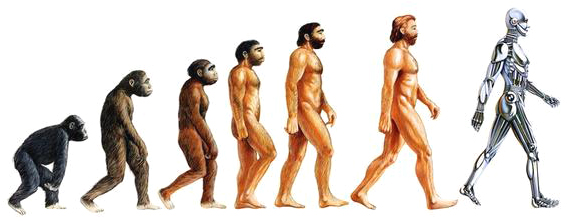
Posthumanism

Posthuman

In critical theory, the posthuman is a speculative being that represents or seeks to enact a re-writing of what is generally conceived of as human. It is the object of posthumanist criticism, which critically questions Renaissance humanism, a branch of humanist philosophy which claims that human nature is a universal state from which the human being emerges; human nature is autonomous, rational, capable of free will, and unified in itself as the apex of existence. Thus, the posthuman recognizes imperfectability and disunity within him or herself, instead understanding the world through context and heterogeneous perspectives while maintaining intellectual rigour and a dedication to objective observations of the world. Key to this posthuman practice is the ability to fluidly change perspectives and manifest oneself through different identities. The posthuman, for critical theorists of the subject, has an emergent ontology rather than a stable one; in other words, the posthuman is not a singular, defined individual, but rather one who can “become” or embody different identities and understand the world from multiple, heterogeneous perspectives.

The posthuman, and posthumanism with it, are philosophical positions that overlap and are constantly engaged with much of postmodern philosophy, process philosophy, emerging technologies, and evolutionary biology, so the field is constantly changing. The critical notion of the posthuman is isolated from these fields as the embodiment of critical engagement itself; that is to say that the posthuman is not necessarily human in the first place, but is rather an embodied medium through which critical consciousness is manifested.

Steve Nichols published the Post-Human Manifesto in 1988, and holds a contrarian view that human beings are already post-human compared to previous generations.

Critical discourses surrounding posthumanism are not homogeneous, but in fact present a series of often contradictory ideas, and the term itself is contested, with one of the foremost authors associated with posthumanism, Manuel de Landa, decrying the term as “very silly.” Covering the ideas of, for example, Pepperell’s The Posthuman Condition, and Hayles’s How We Became Posthuman under a single term is distinctly problematic due to these contradictions.

The posthuman is roughly synonymous with the “cyborg” of A Cyborg Manifesto by Donna Haraway. Haraway’s conception of the cyborg is an ironic take on traditional conceptions of the cyborg that inverts the traditional trope of the cyborg whose presence questions the salient line between humans and robots. Haraway’s cyborg is in many ways the “beta” version of the posthuman, as her cyborg theory prompted the issue to be taken up in critical theory.

Following Haraway, Hayles, whose work grounds much of the critical posthuman discourse, asserts that liberal humanism – which separates the mind from the body and thus portrays the body as a “shell” or vehicle for the mind – becomes increasingly complicated in the late 20th and 21st centuries because information technology put the human body in question. Hayles maintains that we must be conscious of information technological advancements while understanding information as “disembodied,” that is, something which cannot fundamentally replace the human body but can only be incorporated into it and human life practices.

The posthuman is a being that relies on context rather than relativity, on situated objectivity rather than universal objectivity, and on the creation of meaning through ‘play’ betweenconstructions of informational pattern and reductions to the randomness of on-off switches, which are the foundation of digital binary systems.

Transhumanism

Definition

According to transhumanist thinkers, a posthuman is a hypothetical future being “whose basic capacities so radically exceed those of present humans as to be no longer unambiguously human by our current standards.”

The difference between the posthuman and other hypothetical sophisticated non-humans is that a posthuman was once a human, either in its lifetime or in the lifetimes of some or all of its direct ancestors. Therefore, a prerequisite for becoming a posthuman is having been a transhuman, the point at which the human being begins surpassing his or her own limitations but is still recognizable as a human person or similar. In this sense, the transition between human and posthuman may be viewed as a continuum rather than an all-or-nothing event.

Methods

Posthumans could be a symbiosis of human and artificial intelligence, or uploaded consciousnesses, or the result of making many smaller but cumulatively profound technological augmentations to a biological human, i.e. a cyborg. Some examples of the latter are redesigning the human organism using advanced nanotechnology or radical enhancement using some combination of technologies such as genetic engineering, psychopharmacology, life extension therapies, neural interfaces, advanced information management tools, memory enhancing drugs, wearable or implanted computers, and cognitive techniques.

Posthuman future

As used in this article, “posthuman” does not necessarily refer to a conjectured future where humans are extinct or otherwise absent from the Earth. As with other species who speciate from one another, both humans and posthumans could continue to exist. However, the apocalyptic scenario appears to be a viewpoint shared among a minority of transhumanists such as Marvin Minsky and Hans Moravec, who could be considered misanthropes, at least in regards to humanity in its current state. Alternatively, others such as Kevin Warwick argue for the likelihood that both humans and posthumans will continue to exist but the latter will predominate in society over the former because of their abilities.

Many science fiction authors, such as Greg Egan, Bruce Sterling, Greg Bear, Charles Stross, Neal Asher, Ken MacLeod and authors of the Orion’s Arm Universe, have written works set in posthuman futures.

Posthuman god

A variation on the posthuman theme is the notion of a “posthuman god”; the idea that posthumans, being no longer confined to the parameters of human nature, might grow physically and mentally so powerful as to appear possibly god-like by human standards. This notion should not be interpreted as being related to the idea portrayed in some science fiction that a sufficiently advanced species may “ascend” to a higher plane of existence—rather, it merely means that some posthuman beings may become so exceedingly intelligent and technologically sophisticated that their behaviour would not possibly be comprehensible to modern humans, purely by reason of their limited intelligence and imagination. The difference here is that the latter stays within the bounds of the laws of the material universe, while the former exceeds them by going beyond it.

Source: https://en.wikipedia.org/wiki/Posthuman

Philosophy of Gaming

Jonathan Blow (born 1971) is an American independent video game developer. He is best known for his game Braid, which won the “Game Design” award at the Independent Games Festival in 2006. He is currently developing The Witness, to be released in 2012.

For many years Blow wrote the Inner Product column for Game Developer Magazine. He is the primary host of the Experimental Gameplay Workshop each March at the Game Developers Conference, which has become a premier showcase for new ideas in video games. In addition, Blow is a regular participant in the Indie Game Jam.

In a speech at the Free Play conference in Australia in September 2007, Blow suggested games were approaching the level of societal influence of other forms of art, such as films and novels. One example that Blow cites is World of Warcraft, which he labels “unethical”, stating that such games exploit players by using a simple reward-for-suffering scheme to keep them in front of their computer. In his view, developers need to think about what reinforcement the games are providing players when they reward them for performing certain actions. He emphasized the need for developers to design inspiring new games using “innovative, ethical and personal art.”

In an interview with Jeff Glor CBS This Morning, Blow noted that games could have a “much bigger role” in culture in the future, but current game development does not address this potential, instead aiming for low-risk, high-profit titles.

For more:

Ethical Dilemmas

The Most Dangerous Gamer

Philosophy as Autobiography

However far man may extend himself with his knowledge, however objective he may appear to himself ultimately he reaps nothing but his own biography.

Gradually it has become clear to me what every great philosophy so far has been: namely, the personal confession of its author and a kind of involuntary and unconscious memoir; also that the moral (or immoral) intentions in every philosophy constituted the real germ of life from which the whole plant had grown.

Indeed, if one would explain how the abstrusest metaphysical claims of a philosopher really came about, it is always well (and wise) to ask first: at what morality does all this (does he) aim? Accordingly, I do not believe that a “drive to knowledge” is the father of philosophy; but rather that another drive has, here as elsewhere, employed understanding (and misunderstanding) as a mere instrument…

In the philosopher there is nothing whatsoever that is impersonal….

“My judgment is my judgment”: no one else is easily entitled to it –that is what such a philosopher of the future may perhaps say of himself.

Even apart from the value of such claims as “there is a categorical imperative in us,” one can still always ask: what does such a claim tell us about the man who makes it?

– Nietzsche

————–

Every model we make tells us how our mind works as much as it tells about the universe. These are just human symbolic games. The universe itself is bigger than any of our models.

According to Zen Buddhism, and most forms of Buddhism, and quantum mechanics, any description of the universe which leaves you out is inaccurate, because any description of the universe is a description of the instrument that you use to take your reading of the universe — if the only instrument you use is your own nervous system, you gotta include your own nervous system in your description of the universe.

So, ergo, any model we make does not describe the universe, it describes what our brains are capable of seeing at this time.

– Robert Anton Wilson

Perennial Mysticism

This is the Tao of the Buddha, available to all who desire freedom from suffering, identical to the Way of Epictetus:

To practice silent meditation in an effort not to attain Enlightenment or gain any metaphysical knowledge, but to strip away all desire, which is the cause of all suffering, and to encounter the original state of nonthinking.

Amidst all of the teachings of the world, this Dharma is to be practiced, and nothing is to be believed. Such also is the Way of Christ, where the Way is to be practiced, for the practice of the Way is indeed Faith and Faith the practice of the Way, and nothing is to be believed.

Quiet your thoughts and behold your Original Face before you were born.

Before Enlightenment: chop wood, carry water. After Enlightenment: chop wood, carry water.

To those who do not desire freedom from suffering, do what thou wilt shall be the whole of the Law.

Past Tense

A compendium of quotes from various authors with some of my own ideas interspersed throughout.


Life can only be understood backward; but it must be lived forward.

Life is no argument. Suppose a man wanted to impart the following conviction: truth is inwardness, objectively there is no truth, but appropriation is the truth. Suppose him to be very eager and enthusiastic to have this said, since if people could only hear it they would be saved; suppose he said it on every occasion and succeeded in moving the hard-boiled as well as those who perspire easily: what then? No doubt there would be some workers standing idle in the marketplace and simply on hearing this summons would go forth to work in the vineyard – proclaiming this doctrine for all. And then? He would then have contradicted himself still further, just as he had from the beginning; for the eagerness and enthusiasm to have it said and get it heard was already a misunderstanding. What of course was most important was that he should be understood, and the inwardness of the understanding would consist exactly in each individual coming to understand it by himself.

My life as a young man can be described in a single phrase: it was a period absolutely without hope. My life at the time lay entirely in the grips of nihility and despair. My decision, then, to study philosophy was in fact – melodramatic as it might sound – a matter of life and death. In the little history of my soul, this decision meant a kind of conversion. That a materialistic philosophy cannot answer the problems of the soul is clear to me from my own experience. For me there is no way to doubt that the questions of the soul are the fundamental ones for man.

With mind distracted, never thinking, “Death is coming,” to slave away on the pointless business of mundane life, and then to come out empty – it is a tragic error. This is what is sad when one contemplates human life, that so many live out their lives in quiet lostness. They live, as it were, away from themselves and vanish like shadows. Their immortal souls are blown away, and they are not disquieted by the question of its immortality, because they are already disintegrated before they die. The tragedy of life is not death but what we let die inside of us while we live.

Knowledge of the truth I may perhaps have attained to; happiness certainly not. What shall I do? Accomplish something in the world, men tell me. Shall I then publish my grief to the world, contribute one more proof for the wretchedness and misery of existence, perhaps discover a new flaw in human life, hitherto unnoticed? I might then reap the rare reward of becoming famous, like the man who discovered the spots on Jupiter. I prefer, however, to keep silent. Sometimes I feel it’s my mission to bring faith to the faithless and doubt to the faithful.

. . . . .

Under peaceful conditions a warlike man sets upon himself. The specifically Christian concept of sin, along with associated feelings of guilt, finds as its source a falling short of the Platonic Ideal, thus introducing an infinitely indebted bad conscience. Such a description as this of the religious psychology may approximate the truth, but as it has been said – we are condemned to be free. The religious is ineffable. It is that of which language can only communicate indirectly, metaphorically, or not at all. It is not truth, nor creed, nor belief. It is that which exists outside of any abstract thought. Consider the childlike faith and imagination. It is that which disappears the very moment speculation appears. The religious is an understanding that finds outward expression in works of love. Who would give a law unto lovers? Love is unto itself a higher law. It is in this sense that disinterested science and reason cannot possibly begin to approach or understand the religious, much less exist in it via understanding. For psychology, the religious remains a mere intellectual interest in understanding the religious, which is precisely a prevention from attaining the religious. For objectivity, the religious is precisely the paradoxical; for reason, it is the absurd – the intuitive and instinctual. To be religious is to be infinitely interested in existing – to the point where the dualistic designation of subject and object disintegrates in ecstasy.

Being an individual man is a thing that has been abolished, and every speculative philosopher confuses himself with humanity at large. Once you label me, you negate me. In so-called Christian speculative thought, what other presupposition can there be at all than that Christianity is the very opposite of speculative thought, that it is the miraculous, the absurd, the mystical, with the only requirement that the individual is to exist in it. If there is speculative thinking within this presupposition, then the speculative thought will instead have as its task a concentration on the impossibility of speculatively understanding Christianity. People have wanted to perform the astonishing trick of saying: “Christianity is an objective doctrine.” This is what has abolished Christianity.

At the bottom of Christianity there are several subtleties that belong to the Orient. In the first place, it knows that it is of very little consequence whether a thing be true or not, so long as it is believed to be true. Truth and faith: here we have two wholly distinct worlds of ideas, almost two diametrically opposite worlds – the road to the one and the road to the other lie miles apart. To understand that fact thoroughly – this is almost enough, in the Orient, to make one a sage. The Brahmins knew it, Plato knew it, every student of the esoteric knows it. The cause of the origin of a thing and the purpose of its eventual utility lie worlds apart. It is in this sense that the teaching found in mythology is not to be found in any merely literal interpretation.

However far man may extend himself with his knowledge, however objective he may appear to himself, ultimately he reaps nothing but his own biography. Remember, if you gaze long enough into an abyss, then the abyss will gaze back into you. Gradually it has become clear to me what every great philosophy so far has been: namely, the personal confession of its author and a kind of involuntary and unconscious memoir; also that the moral (or immoral) intentions in every philosophy constituted the real germ of life from which the whole plant had grown. Indeed, if one would explain how the abstrusest metaphysical claims of a philosopher really came about, it is always well (and wise) to ask first: at what morality does all this (does he) aim? Accordingly, I do not believe that a “drive to knowledge” is the father of philosophy; but rather that another drive has, here as elsewhere, employed understanding (and misunderstanding) as a mere instrument.

What is the value of truth? Consult the unlearned. If the problem is to calculate where there is more truth, whether on the side of the person who only objectively seeks the truth and the approximation of the truth, or on the side of the person who is infinitely concerned that he in truth relates himself to the world with the infinite passion of inwardness – then there can be no doubt about the answer for anyone who is not totally botched by scholarship and science. Faith consists in the presuppositions on which a man lives his life. In this sense, it is necessarily of a moral nature, which leaves any metaphysical claims in the background.

A scientific interpretation of the world might be one of the most stupid of all possible interpretations of the world, meaning that it would be one of the poorest in meaning. Assuming that one estimated the value of a piece of music according to how much of it can be counted, calculated, and expressed in formulas: how absurd would such a “scientific” estimation of music be. Nothing of what is “music” would be left in it.

No real blood flows in the vein of the knowing subject constructed by Locke, Hume, and Kant, but rather the diluted extract of reason as a mere activity of thought. In this sense we can begin to understand that any analysis of the universe is no replacement for phenomenological experience. Awareness in the present moment, qualia experience, is all we ever really know. Science is also a form of poetry, but in our age this is a much more obscure idea. It is in this sense that the juxtaposition of science proper and authentic religion has produced a widely misunderstood false dichotomy.

Being human may be likened to the act of watching a movie. Knowing fully well that the movie which captivates us consists of many individually meaningless scenes that are arranged in such an order as to produce the illusion of a continuum; knowing fully well that the characters portrayed are not real, but mere actors; we tend to mentally make connections and fill gaps to create order, consistency, and meaning. Likewise, we willingly submit to deluding ourselves into believing that the characters are real people, forgetting all about any notion of actors. So it is that there are two truths involved in the act of watching a movie. Likewise, there are two truths involved in the act of being human.

In our conventional wisdom we all recognize that today is Saturday, January 19, 2013. My intention is not to dispute this notion or to discredit history or our conventions of time or place. What I mean to do is simply elicit not “what” is left when all such conventions are removed from thought, but rather “how” we relate to what is left. This seems to me the ground of the most basic form of bad faith and cognitive dissonance in the human mind. It is in this sense that the bodhisattva understands both his illusion and his freedom.

Nihilism is the greatest danger facing our age, yet it does not realize that nihilism itself is essentially a reactionary speculation and therefore intimately related to the religious. Verily, both disappointment and freedom are observed in the child that loses faith in – Santa.

. . . . .

Even as the will of man has been and continues to be the domination of nature, it is never too late for a return to nature. Wed to bad conscience the unnatural inclinations.

You shall no longer take things at second or third hand, nor look through the eyes of the dead, nor feed on the specters in books. You shall not look through my eyes either, nor take things from me. You shall listen to all sides and filter them from your self.

Pay no attention to the faults of others, things done or left undone by others. Consider only what by yourself is done or left undone. Learn to accept yourself exactly as you are, for therein lies perfection.

Rather than truth, than money, than fame, than power, than possessions, than happiness, than life everlasting – give me authenticity.

Lost out of context, ye had not yet sought yourselves: then did ye find me. Now do I bid you lose me and find yourselves; and only when ye have all denied me, will I return unto you.

Life is a mystery to be lived, not a problem to be solved. We should consider every day lost on which we have not danced at least once. And we should call every truth false which was not accompanied by at least one laugh.

* * * * *

Living in the land of the free and the home of the brave, I feel bound in chains and witness no audacity. People demand freedom of speech as a compensation for the freedom of thought which they seldom use.

Government, as a noun, is a convenient political fiction. Public image is always necessarily an illusion. Pay no attention to the men behind the curtain. These men only hold as much power as you allow them to hold.

Do not let your own fire go out, spark by irreplaceable spark in the hopeless swamps of the not-quite, the not-yet, and the not-at-all. Do not let the hero in your soul perish in lonely frustration for the life you deserved and have never been able to reach. The world you desire can be won. It exists, it is real, it is possible, it’s yours. The question isn’t who is going to let me; it’s who is going to stop me.

Finding the center of strength within ourselves is in the long run the best contribution we can make to our fellow men. One person with indigenous inner strength exercises a great calming effect on panic among people around him. This is what our society needs – not new ideas and inventions; important as these are, and not geniuses and supermen, but persons who can “be”, that is, persons who have a center of strength within themselves.

Political realism is a theory of political philosophy that attempts to explain, model, and prescribe political relations. It takes as its assumption that power is (or ought to be) the primary end of political action, whether in the domestic or international arena. In the domestic arena, the theory asserts that politicians do, or should, strive to maximize their power, whilst on the international stage, nation states are seen as the primary agents that maximize, or ought to maximize, their power. The theory is therefore to be examined as either a prescription of what ought to be the case, that is, nations and politicians ought to pursue power or their own interests, or as a description of the ruling state of affairs – that nations and politicians only pursue (and perhaps only can pursue) power or self-interest. Realpolitik refers to politics or diplomacy based primarily on power and on practical and material factors and considerations, rather than ideological notions or moralistic or ethical premises.

Independence is for the very few; it is a privilege of the strong. And whoever attempts it even with the best right but without inner constraint proves that he is probably not only strong, but also daring to the point of recklessness. He enters into a labyrinth, he multiplies a thousandfold the dangers which life brings with it in any case, not the least of which is that no one can see how and where he loses his way, becomes lonely, and is torn piecemeal by some minotaur of conscience. Supposing one like that comes to grief, this happens so far from the comprehension of men that they neither feel it nor sympathize. And he cannot go back any longer. Nor can he go back to the pity of men.

What happened to the authentic individual? What happened to the free spirit? Precisely how autonomous are we? We have locked ourselves up in cages of fear and, behold, do we now complain that we lack freedom? Our integrity sells for so little, but it is all we really have. It is our very last inch, but within that inch, we are free. I often feel like I’m living a lie. Most people just accept mediocrity and live as though they will never die. Your principles are not my principles. You aren’t worthy of my principles. And don’t you allow me to be worthy of yours. Life is too sacred to allow ourselves to be defined by, or slaves to, any system or ideology. I swear by my life and my love of it that I will never live for the sake of another man, nor ask another man to live for mine.

Reject the insidious pressures in society that would blunt your critical faculties to all that is happening around you, that would caution silence in the face of injustice lest you jeopardize your chances of promotion and self-advancement. This is how it starts and before you know where you are, you’re a fully paid-up member of the rat-pack. The price is too high. It entails the loss of your dignity and human spirit. Or as Christ put it, “What doth it profit a man if he gain the whole world and suffer the loss of his soul?” Beware the merchant and his limitless tools of persuasion, for there is nothing too sacred for his sacrifice. Be the change that you wish to see in the world. The price good men pay for indifference to public affairs is to be ruled by evil men.

. . . . .

Somewhere there are still peoples and herds, but not with us, my brethren: here there are states.

A state? What is that? Well! open now your ears unto me, for now will I say unto you my word concerning the death of peoples.

A state, is called the coldest of all cold monsters. Coldly lieth it also; and this lie creepeth from its mouth: “I, the state, am the people.”

But the state lieth in all languages of good and evil; and whatever it saith it lieth; and whatever it hath it hath stolen.

The state, I call it, where all are poison-drinkers, the good and the bad: the state, where all lose themselves, the good and the bad: the state, where the slow suicide of all – is called “life.”

Many too many are born: for the superfluous ones was the state devised!

. . . . .

Justice is the advantage of the stronger. The world is will to power. Money is power incarnate. And the love of money is the root of all wealth. Natural selection is indifferent until manipulated. Fnord. Nothing is true, everything is permitted. War is father of all, king of all. Some it makes gods, some it makes men, some it makes slaves, some free. What can be smashed must be smashed; whatever will stand the blow is sound, what flies into smithereens is rubbish; at any rate, hit out right and left, no harm will or can come of it.

Do I contradict myself? Very well, then, I contradict myself. I am large, I contain multitudes. With one’s principles one wants to bully one’s habits, or justify, honor, scold, or conceal them: two men with the same principles probably aim with them at something basically different. Jesus said to his Jews: “The law was for servants – love God as I love him, as his son! What are morals to us sons of God!”

Abundance of knowledge does not teach men to be wise. Only authenticity nourishes creativity. Whoever is a teacher through and through takes all things seriously only in relation to his students – even himself.

. . . . .

Therefore do I tear at your web, that your rage may lure you out of your den of lies, and that your revenge may leap forth from behind your word “justice.”

Because, for man to be redeemed from revenge – that is for me the bridge to the highest hope, and a rainbow after long storms.

Otherwise, however, would the tarantulas have it. “Let it be very justice for the world to become full of the storms of our vengeance” – thus do they talk to one another.

“Vengeance will we use, and insult, against all who are not like us” – thus do the tarantula-hearts pledge themselves.

“And ‘Will to Equality’ – that itself shall henceforth be the name of virtue; and against all that hath power will we raise an outcry!”

Ye preachers of equality, the tyrant-frenzy of impotence crieth thus in you for “equality”: your most secret tyrant-longings disguise themselves thus in virtue-words!

But thus do I counsel you, my friends: distrust all in whom the impulse to punish is powerful!

Distrust all those who talk much of their justice! Verily, in their souls not only honey is lacking.

And when they call themselves “the good and just,” forget not, that for them to be Pharisees, nothing is lacking but – power!

With these preachers of equality will I not be mixed up and confounded. For thus speaketh justice unto me: “Men are not equal.”

Good and evil, and rich and poor, and high and low, and all names of values: weapons shall they be!

. . . . .

Some writers have so confounded society with government, as to leave little or no distinction between them; whereas they are not only different, but have different origins. Society is produced by our wants, and government by wickedness; the former promotes our happiness positively by uniting our affections, the latter negatively by restraining our vices. The one encourages intercourse, the other creates distinctions. The first is a patron, the last a punisher. Society in every state is a blessing, but government even in its best state is but a necessary evil; in its worst state an intolerable one.

Out beyond ideas of wrongdoing and rightdoing, there is a field. I’ll meet you there. When the soul lies down in that grass, the world is too full to talk about. Ideas, language, even the phrase “each other” doesn’t make any sense.

Open Letter to Kansas School Board

fsmdrawing

I am writing you with much concern after having read of your hearing to decide whether the alternative theory of Intelligent Design should be taught along with the theory of Evolution. I think we can all agree that it is important for students to hear multiple viewpoints so they can choose for themselves the theory that makes the most sense to them. I am concerned, however, that students will only hear one theory of Intelligent Design.

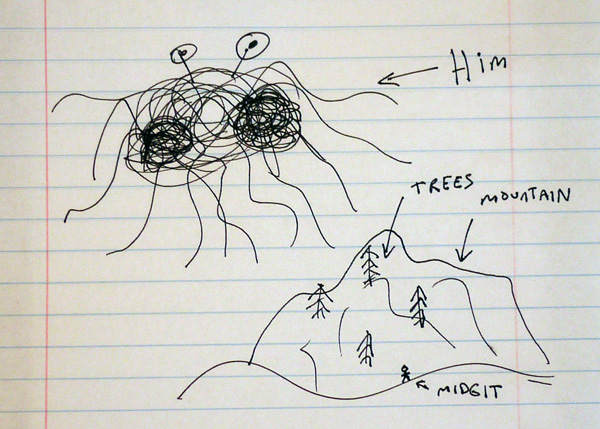
Let us remember that there are multiple theories of Intelligent Design. I and many others around the world are of the strong belief that the universe was created by a Flying Spaghetti Monster. It was He who created all that we see and all that we feel. We feel strongly that the overwhelming scientific evidence pointing towards evolutionary processes is nothing but a coincidence, put in place by Him.

It is for this reason that I’m writing you today, to formally request that this alternative theory be taught in your schools, along with the other two theories. In fact, I will go so far as to say, if you do not agree to do this, we will be forced to proceed with legal action. I’m sure you see where we are coming from. If the Intelligent Design theory is not based on faith, but instead another scientific theory, as is claimed, then you must also allow our theory to be taught, as it is also based on science, not on faith.

Some find that hard to believe, so it may be helpful to tell you a little more about our beliefs. We have evidence that a Flying Spaghetti Monster created the universe. None of us, of course, were around to see it, but we have written accounts of it. We have several lengthy volumes explaining all details of His power. Also, you may be surprised to hear that there are over 10 million of us, and growing. We tend to be very secretive, as many people claim our beliefs are not substantiated by observable evidence.

What these people don’t understand is that He built the world to make us think the earth is older than it really is. For example, a scientist may perform a carbon-dating process on an artifact. He finds that approximately 75% of the Carbon-14 has decayed by electron emission to Nitrogen-14, and infers that this artifact is approximately 10,000 years old, as the half-life of Carbon-14 appears to be 5,730 years. But what our scientist does not realize is that every time he makes a measurement, the Flying Spaghetti Monster is there changing the results with His Noodly Appendage. We have numerous texts that describe in detail how this can be possible and the reasons why He does this. He is of course invisible and can pass through normal matter with ease.

I’m sure you now realize how important it is that your students are taught this alternate theory. It is absolutely imperative that they realize that observable evidence is at the discretion of a Flying Spaghetti Monster. Furthermore, it is disrespectful to teach our beliefs without wearing His chosen outfit, which of course is full pirate regalia. I cannot stress the importance of this enough, and unfortunately cannot describe in detail why this must be done as I fear this letter is already becoming too long. The concise explanation is that He becomes angry if we don’t.

You may be interested to know that global warming, earthquakes, hurricanes, and other natural disasters are a direct effect of the shrinking numbers of Pirates since the 1800s. For your interest, I have included a graph of the approximate number of pirates versus the average global temperature over the last 200 years. As you can see, there is a statistically significant inverse relationship between pirates and global temperature.

In conclusion, thank you for taking the time to hear our views and beliefs. I hope I was able to convey the importance of teaching this theory to your students. We will of course be able to train the teachers in this alternate theory. I am eagerly awaiting your response, and hope dearly that no legal action will need to be taken. I think we can all look forward to the time when these three theories are given equal time in our science classrooms across the country, and eventually the world; One third time for Intelligent Design, one third time for Flying Spaghetti Monsterism (Pastafarianism), and one third time for logical conjecture based on overwhelming observable evidence.

Sincerely Yours,

Bobby Henderson, concerned citizen.

P.S. I have included an artistic drawing of Him creating a mountain, trees, and a midget. Remember, we are all His creatures.

OOOH! What Now Nietzsche!?

In its answers to the question concerning beings as such, metaphysics operates with a prior conception of Being. It speaks of Being necessarily and hence continually. But metaphysics does not induce Being itself to speak, for metaphysics does not recall Being in its truth, nor does it recall truth as unconcealedness, nor does it recall the nature of unconcealedness. To metaphysics the nature of truth always appears only in the derivative form of the truth of knowledge and the truth of propositions which formulate our knowledge. Unconcealedness, however, might be prior to all truth in the sense of veritas. Alitheia might be the word that offers a hitherto unnoticed hint concerning the nature of esse which has not yet been recalled.

If this should be so, then the representational thinking of metaphysics could certainly never reach this nature of truth, however zealously it might devote itself to historical studies of pre-Socratic philosophy; for what is at stake here is not some renaissance of pre-Socratic thinking: any such attempt would be vain and absurd. What is wanted is rather some regard for the arrival of the hitherto unexpressed nature of unconcealedness, for it is in this form that Being has announced itself. Meanwhile the truth of Being has remained concealed from metaphysics during its long history from Anaximander to Nietzsche.

Why does metaphysics not recall it? Is the failure to recall it merely a function of some kinds of metaphysical thinking? Or is it an essential feature of the fate of metaphysics that its own ground eludes it because in the rise of unconcealedness its very core, namely concealedness, stays away in favor of the unconcealed which appears in the form of beings?

– Martin Heidegger

My question to you, late Heidegger: What compels you to write about the nature of Being up to Nietzsche and YOU in metaphysics?

As a philosopher apparently I converse with the dead. They’re my friends, but they’re all idiots. At least Nietzsche’s Being is interesting though, Heidegger.

On Truth & Lies in a Non-Moral Sense

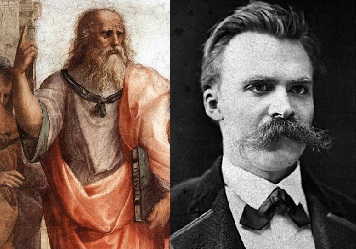
nietzsche-vs-plato

By Friedrich Nietzsche

In some remote corner of the universe, poured out and glittering in innumerable solar systems, there once was a star on which clever animals invented knowledge. That was the highest and most mendacious minute of “world history”—yet only a minute. After nature had drawn a few breaths the star grew cold, and the clever animals had to die.

One might invent such a fable and still not have illustrated sufficiently how wretched, how shadowy and flighty, how aimless and arbitrary, the human intellect appears in nature. There have been eternities when it did not exist; and when it is done for again, nothing will have happened. For this intellect has no further mission that would lead beyond human life. It is human, rather, and only its owner and producer gives it such importance, as if the world pivoted around it. But if we could communicate with the mosquito, then we would learn that he floats through the air with the same self-importance, feeling within itself the flying center of the world. There is nothing in nature so despicable or insignificant that it cannot immediately be blown up like a bag by a slight breath of this power of knowledge; and just as every porter wants an admirer, the proudest human being, the philosopher, thinks that he sees on the eyes of the universe telescopically focused from all sides on his actions and thoughts.

It is strange that this should be the effect of the intellect, for after all it was given only as an aid to the most unfortunate, most delicate, most evanescent beings in order to hold them for a minute in existence, from which otherwise, without this gift, they would have every reason to flee as quickly as Lessing’s son. [In a famous letter to Johann Joachim Eschenburg (December 31, 1778), Lessing relates the death of his infant son, who “understood the world so well that he left it at the first opportunity.”] That haughtiness which goes with knowledge and feeling, which shrouds the eyes and senses of man in a blinding fog, therefore deceives him about the value of existence by carrying in itself the most flattering evaluation of knowledge itself. Its most universal effect is deception; but even its most particular effects have something of the same character.

The intellect, as a means for the preservation of the individual, unfolds its chief powers in simulation; for this is the means by which the weaker, less robust individuals preserve themselves, since they are denied the chance of waging the struggle for existence with horns or the fangs of beasts of prey. In man this art of simulation reaches its peak: here deception, flattering, lying and cheating, talking behind the back, posing, living in borrowed splendor, being masked, the disguise of convention, acting a role before others and before oneself—in short, the constant fluttering around the single flame of vanity is so much the rule and the law that almost nothing is more incomprehensible than how an honest and pure urge for truth could make its appearance among men. They are deeply immersed in illusions and dream images; their eye glides only over the surface of things and sees “forms”; their feeling nowhere lead into truth, but contents itself with the reception of stimuli, playing, as it were, a game of blindman’s buff on the backs of things. Moreover, man permits himself to be lied to at night, his life long, when he dreams, and his moral sense never even tries to prevent this—although men have been said to have overcome snoring by sheer will power.

What, indeed, does man know of himself! Can he even once perceive himself completely, laid out as if in an illuminated glass case? Does not nature keep much the most from him, even about his body, to spellbind and confine him in a proud, deceptive consciousness, far from the coils of the intestines, the quick current of the blood stream, and the involved tremors of the fibers? She threw away the key; and woe to the calamitous curiosity which might peer just once through a crack in the chamber of consciousness and look down, and sense that man rests upon the merciless, the greedy, the insatiable, the murderous, in the indifference of his ignorance—hanging in dreams, as it were, upon the back of a tiger. In view of this, whence in all the world comes the urge for truth?

Insofar as the individual wants to preserve himself against other individuals, in a natural state of affairs he employs the intellect mostly for simulation alone. But because man, out of need and boredom, wants to exist socially, herd-fashion, he requires a peace pact and he endeavors to banish at least the very crudest bellum omni contra omnes [war of all against all] from his world. This peace pact brings with it something that looks like the first step toward the attainment of this enigmatic urge for truth. For now that is fixed which henceforth shall be “truth”; that is, a regularly valid and obligatory designation of things is invented, and this linguistic legislation also furnishes the first laws of truth: for it is here that the contrast between truth and lie first originates. The liar uses the valid designations, the words, to make the unreal appear as real; he says, for example, “I am rich,” when the word “poor” would be the correct designation of his situation. He abuses the fixed conventions by arbitrary changes or even by reversals of the names. When he does this in a self-serving way damaging to others, then society will no longer trust him but exclude him. Thereby men do not flee from being deceived as much as from being damaged by deception: what they hate at this stage is basically not the deception but the bad, hostile consequences of certain kinds of deceptions. In a similarly limited way man wants the truth: he desires the agreeable life-preserving consequences of truth, but he is indifferent to pure knowledge, which has no consequences; he is even hostile to possibly damaging and destructive truths. And, moreover, what about these conventions of language? Are they really the products of knowledge, of the sense of truth? Do the designations and the things coincide? Is language the adequate expression of all realities?

Only through forgetfulness can man ever achieve the illusion of possessing a “truth” in the sense just designated. If he does not wish to be satisfied with truth in the form of a tautology—that is, with empty shells—then he will forever buy illusions for truths. What is a word? The image of a nerve stimulus in sounds. But to infer from the nerve stimulus, a cause outside us, that is already the result of a false and unjustified application of the principle of reason. If truth alone had been the deciding factor in the genesis of language, and if the standpoint of certainty had been decisive for designations, then how could we still dare to say “the stone is hard,” as if “hard” were something otherwise familiar to us, and not merely a totally subjective stimulation! We separate things according to gender, designating the tree as masculine and the plant as feminine. What arbitrary assignments! How far this oversteps the canons of certainty! We speak of a “snake”: this designation touches only upon its ability to twist itself and could therefore also fit a worm. What arbitrary differentiations! What one-sided preferences, first for this, then for that property of a thing! The different languages, set side by side, show that what matters with words is never the truth, never an adequate expression; else there would not be so many languages. The “thing in itself” (for that is what pure truth, without consequences, would be) is quite incomprehensible to the creators of language and not at all worth aiming for. One designates only the relations of things to man, and to express them one calls on the boldest metaphors. A nerve stimulus, first transposed into an image—first metaphor. The image, in turn, imitated by a sound—second metaphor. And each time there is a complete overleaping of one sphere, right into the middle of an entirely new and different one. One can imagine a man who is totally deaf and has never had a sensation of sound and music. Perhaps such a person will gaze with astonishment at Chladni’s sound figures; perhaps he will discover their causes in the vibrations of the string and will now swear that he must know what men mean by “sound.” It is this way with all of us concerning language; we believe that we know something about the things themselves when we speak of trees, colors, snow, and flowers; and yet we possess nothing but metaphors for things—metaphors which correspond in no way to the original entities. In the same way that the sound appears as a sand figure, so the mysterious X of the thing in itself first appears as a nerve stimulus, then as an image, and finally as a sound. Thus the genesis of language does not proceed logically in any case, and all the material within and with which the man of truth, the scientist, and the philosopher later work and build, if not derived from never-never land, is a least not derived from the essence of things.

Let us still give special consideration to the formation of concepts. Every word immediately becomes a concept, inasmuch as it is not intended to serve as a reminder of the unique and wholly individualized original experience to which it owes its birth, but must at the same time fit innumerable, more or less similar cases—which means, strictly speaking, never equal—in other words, a lot of unequal cases. Every concept originates through our equating what is unequal. No leaf ever wholly equals another, and the concept “leaf” is formed through an arbitrary abstraction from these individual differences, through forgetting the distinctions; and now it gives rise to the idea that in nature there might be something besides the leaves which would be “leaf”—some kind of original form after which all leaves have been woven, marked, copied, colored, curled, and painted, but by unskilled hands, so that no copy turned out to be a correct, reliable, and faithful image of the original form. We call a person “honest.” Why did he act so honestly today? we ask. Our answer usually sounds like this: because of his honesty. Honesty! That is to say again: the leaf is the cause of the leaves. After all, we know nothing of an essence-like quality named “honesty”; we know only numerous individualized, and thus unequal actions, which we equate by omitting the unequal and by then calling them honest actions. In the end, we distill from them a qualitas occulta [hidden quality] with the name of “honesty.” We obtain the concept, as we do the form, by overlooking what is individual and actual; whereas nature is acquainted with no forms and no concepts, and likewise with no species, but only with an X which remains inaccessible and undefinable for us. For even our contrast between individual and species is something anthropomorphic and does not originate in the essence of things; although we should not presume to claim that this contrast does not correspond o the essence of things: that would of course be a dogmatic assertion and, as such, would be just as indemonstrable as its opposite.

What, then, is truth? A mobile army of metaphors, metonyms, and anthropomorphisms—in short, a sum of human relations which have been enhanced, transposed, and embellished poetically and rhetorically, and which after long use seem firm, canonical, and obligatory to a people: truths are illusions about which one has forgotten that this is what they are; metaphors which are worn out and without sensuous power; coins which have lost their pictures and now matter only as metal, no longer as coins.

We still do not know where the urge for truth comes from; for as yet we have heard only of the obligation imposed by society that it should exist: to be truthful means using the customary metaphors—in moral terms: the obligation to lie according to a fixed convention, to lie herd-like in a style obligatory for all. Now man of course forgets that this is the way things stand for him. Thus he lies in the manner indicated, unconsciously and in accordance with habits which are centuries’ old; and precisely by means of this unconsciousness and forgetfulness he arrives at his sense of truth. From the sense that one is obliged to designate one thing as red, another as cold, and a third as mute, there arises a moral impulse in regard to truth. The venerability, reliability, and utility of truth is something which a person demonstrates for himself from the contrast with the liar, whom no one trusts and everyone excludes. As a rational being, he now places his behavior under the control of abstractions. He will no longer tolerate being carried away by sudden impressions, by intuitions. First he universalizes all these impressions into less colorful, cooler concepts, so that he can entrust the guidance of his life and conduct to them. Everything which distinguishes man from the animals depends upon this ability to volatilize perceptual metaphors in a schema, and thus to dissolve an image into a concept. For something is possible in the realm of these schemata which could never be achieved with the vivid first impressions: the construction of a pyramidal order according to castes and degrees, the creation of a new world of laws, privileges, subordinations, and clearly marked boundaries—a new world, one which now confronts that other vivid world of first impressions as more solid, more universal, better known, and more human than the immediately perceived world, and thus as the regulative and imperative world. Whereas each perceptual metaphor is individual and without equals and is therefore able to elude all classification, the great edifice of concepts displays the rigid regularity of a Roman columbarium and exhales in logic that strength and coolness which is characteristic of mathematics. Anyone who has felt this cool breath [of logic] will hardly believe that even the concept—which is as bony, foursquare, and transposable as a die—is nevertheless merely the residue of a metaphor, and that the illusion which is involved in the artistic transference of a nerve stimulus into images is, if not the mother, then the grandmother of every single concept. But in this conceptual crap game “truth” means using every die in the designated manner, counting its spots accurately, fashioning the right categories, and never violating the order of caste and class rank. Just as the Romans and Etruscans cut up the heavens with rigid mathematical lines and confined a god within each of the spaces thereby delimited, as within a templum, so every people has a similarly mathematically divided conceptual heaven above themselves and henceforth thinks that truth demands that each conceptual god be sought only within his own sphere. Here one may certainly admire man as a mighty genius of construction, who succeeds in piling an infinitely complicated dome of concepts upon an unstable foundation, and, as it were, on running water. Of course, in order to be supported by such a foundation, his construction must be like one constructed of spiders’ webs: delicate enough to be carried along by the waves, strong enough not to be blown apart by every wind. As a genius of construction man raises himself far above the bee in the following way: whereas the bee builds with wax that he gathers from nature, man builds with the far more delicate conceptual material which he first has to manufacture from himself. In this he is greatly to be admired, but not on account of his drive for truth or for pure knowledge of things. When someone hides something behind a bush and looks for it again in the same place and finds it there as well, there is not much to praise in such seeking and finding. Yet this is how matters stand regarding seeking and finding “truth” within the realm of reason. If I make up the definition of a mammal, and then, after inspecting a camel, declare “look, a mammal” I have indeed brought a truth to light in this way, but it is a truth of limited value. That is to say, it is a thoroughly anthropomorphic truth which contains not a single point which would be “true in itself” or really and universally valid apart from man. At bottom, what the investigator of such truths is seeking is only the metamorphosis of the world into man. He strives to understand the world as something analogous to man, and at best he achieves by his struggles the feeling of assimilation. Similar to the way in which astrologers considered the stars to be in man ‘s service and connected with his happiness and sorrow, such an investigator considers the entire universe in connection with man: the entire universe as the infinitely fractured echo of one original sound-man; the entire universe as the infinitely multiplied copy of one original picture-man. His method is to treat man as the measure of all things, but in doing so he again proceeds from the error of believing that he has these things [which he intends to measure] immediately before him as mere objects. He forgets that the original perceptual metaphors are metaphors and takes them to be the things themselves.

Only by forgetting this primitive world of metaphor can one live with any repose, security, and consistency: only by means of the petrification and coagulation of a mass of images which originally streamed from the primal faculty of human imagination like a fiery liquid, only in the invincible faith that this sun, this window, this table is a truth in itself, in short, only by forgetting that he himself is an artistically creating subject, does man live with any repose, security, and consistency. If but for an instant he could escape from the prison walls of this faith, his “self consciousness” would be immediately destroyed. It is even a difficult thing for him to admit to himself that the insect or the bird perceives an entirely different world from the one that man does, and that the question of which of these perceptions of the world is the more correct one is quite meaningless, for this would have to have been decided previously in accordance with the criterion of the correct perception, which means, in accordance with a criterion which is not available. But in any case it seems to me that the correct perception—which would mean the adequate expression of an object in the subject—is a contradictory impossibility. For between two absolutely different spheres, as between subject and object, there is no causality, no correctness, and no expression; there is, at most, an aesthetic relation: I mean, a suggestive transference, a stammering translation into a completely foreign tongue—for which I there is required, in any case, a freely inventive intermediate sphere and mediating force. “Appearance” is a word that contains many temptations, which is why I avoid it as much as possible. For it is not true that the essence of things “appears” in the empirical world. A painter without hands who wished to express in song the picture before his mind would, by means of this substitution of spheres, still reveal more about the essence of things than does the empirical world. Even the relationship of a nerve stimulus to the generated image is not a necessary one. But when the same image has been generated millions of times and has been handed down for many generations and finally appears on the same occasion every time for all mankind, then it acquires at last the same meaning for men it would have if it were the sole necessary image and if the relationship of the original nerve stimulus to the generated image were a strictly causal one. In the same manner, an eternally repeated dream would certainly be felt and judged to be reality. But the hardening and congealing of a metaphor guarantees absolutely nothing concerning its necessity and exclusive justification.

Every person who is familiar with such considerations has no doubt felt a deep mistrust of all idealism of this sort: just as often as he has quite early convinced himself of the eternal consistency, omnipresence, and fallibility of the laws of nature. He has concluded that so far as we can penetrate here—from the telescopic heights to the microscopic depths—everything is secure, complete, infinite, regular, and without any gaps. Science will be able to dig successfully in this shaft forever, and the things that are discovered will harmonize with and not contradict each other. How little does this resemble a product of the imagination, for if it were such, there should be some place where the illusion and reality can be divined. Against this, the following must be said: if each us had a different kind of sense perception—if we could only perceive things now as a bird, now as a worm, now as a plant, or if one of us saw a stimulus as red, another as blue, while a third even heard the same stimulus as a sound—then no one would speak of such a regularity of nature, rather, nature would be grasped only as a creation which is subjective in the highest degree. After all, what is a law of nature as such for us? We are not acquainted with it in itself, but only with its effects, which means in its relation to other laws of nature—which, in turn, are known to us only as sums of relations. Therefore all these relations always refer again to others and are thoroughly incomprehensible to us in their essence. All that we actually know about these laws of nature is what we ourselves bring to them—time and space, and therefore relationships of succession and number. But everything marvelous about the laws of nature, everything that quite astonishes us therein and seems to demand explanation, everything that might lead us to distrust idealism: all this is completely and solely contained within the mathematical strictness and inviolability of our representations of time and space. But we produce these representations in and from ourselves with the same necessity with which the spider spins. If we are forced to comprehend all things only under these forms, then it ceases to be amazing that in all things we actually comprehend nothing but these forms. For they must all bear within themselves the laws of number, and it is precisely number which is most astonishing in things. All that conformity to law, which impresses us so much in the movement of the stars and in chemical processes, coincides at bottom with those properties which we bring to things. Thus it is we who impress ourselves in this way. In conjunction with this, it of course follows that the artistic process of metaphor formation with which every sensation begins in us already presupposes these forms and thus occurs within them. The only way in which the possibility of subsequently constructing a new conceptual edifice from metaphors themselves can be explained is by the firm persistence of these original forms That is to say, this conceptual edifice is an imitation of temporal, spatial, and numerical relationships in the domain of metaphor.

We have seen how it is originally language which works on the construction of concepts, a labor taken over in later ages by science. Just as the bee simultaneously constructs cells and fills them with honey, so science works unceasingly on this great columbarium of concepts, the graveyard of perceptions. It is always building new, higher stories and shoring up, cleaning, and renovating the old cells; above all, it takes pains to fill up this monstrously towering framework and to arrange therein the entire empirical world, which is to say, the anthropomorphic world. Whereas the man of action binds his life to reason and its concepts so that he will not be swept away and lost, the scientific investigator builds his hut right next to the tower of science so that he will be able to work on it and to find shelter for himself beneath those bulwarks which presently exist. And he requires shelter, for there are frightful powers which continuously break in upon him, powers which oppose scientific truth with completely different kinds of “truths” which bear on their shields the most varied sorts of emblems.

The drive toward the formation of metaphors is the fundamental human drive, which one cannot for a single instant dispense with in thought, for one would thereby dispense with man himself. This drive is not truly vanquished and scarcely subdued by the fact that a regular and rigid new world is constructed as its prison from its own ephemeral products, the concepts. It seeks a new realm and another channel for its activity, and it finds this in myth and in art generally. This drive continually confuses the conceptual categories and cells by bringing forward new transferences, metaphors, and metonymies. It continually manifests an ardent desire to refashion the world which presents itself to waking man, so that it will be as colorful, irregular, lacking in results and coherence, charming, and eternally new as the world of dreams. Indeed, it is only by means of the rigid and regular web of concepts that the waking man clearly sees that he is awake; and it is precisely because of this that he sometimes thinks that he must be dreaming when this web of concepts is torn by art. Pascal is right in maintaining that if the same dream came to us every night we would be just as occupied with it as we are with the things that we see every day. “If a workman were sure to dream for twelve straight hours every night that he was king,” said Pascal, “I believe that he would be just as happy as a king who dreamt for twelve hours every night that he was a workman.” In fact, because of the way that myth takes it for granted that miracles are always happening, the waking life of a mythically inspired people—the ancient Greeks, for instance—more closely resembles a dream than it does the waking world of a scientifically disenchanted thinker. When every tree can suddenly speak as a nymph, when a god in the shape of a bull can drag away maidens, when even the goddess Athena herself is suddenly seen in the company of Peisastratus driving through the market place of Athens with a beautiful team of horses—and this is what the honest Athenian believed—then, as in a dream, anything is possible at each moment, and all of nature swarms around man as if it were nothing but a masquerade of the gods, who were merely amusing themselves by deceiving men in all these shapes.

But man has an invincible inclination to allow himself to be deceived and is, as it were, enchanted with happiness when the rhapsodist tells him epic fables as if they were true, or when the actor in the theater acts more royally than any real king. So long as it is able to deceive without injuring, that master of deception, the intellect, is free; it is released from its former slavery and celebrates its Saturnalia. It is never more luxuriant, richer, prouder, more clever and more daring. With creative pleasure it throws metaphors into confusion and displaces the boundary stones of abstractions, so that, for example, it designates the stream as “the moving path which carries man where he would otherwise walk.” The intellect has now thrown the token of bondage from itself. At other times it endeavors, with gloomy officiousness, to show the way and to demonstrate the tools to a poor individual who covets existence; it is like a servant who goes in search of booty and prey for his master. But now it has become the master and it dares to wipe from its face the expression of indigence. In comparison with its previous conduct, everything that it now does bears the mark of dissimulation, just as that previous conduct did of distortion. The free intellect copies human life, but it considers this life to be something good and seems to be quite satisfied with it. That immense framework and planking of concepts to which the needy man clings his whole life long in order to preserve himself is nothing but a scaffolding and toy for the most audacious feats of the liberated intellect. And when it smashes this framework to pieces, throws it into confusion, and puts it back together in an ironic fashion, pairing the most alien things and separating the closest, it is demonstrating that it has no need of these makeshifts of indigence and that it will now be guided by intuitions rather than by concepts. There is no regular path which leads from these intuitions into the land of ghostly schemata, the land of abstractions. There exists no word for these intuitions; when man sees them he grows dumb, or else he speaks only in forbidden metaphors and in unheard-of combinations of concepts. He does this so that by shattering and mocking the old conceptual barriers he may at least correspond creatively to the impression of the powerful present intuition.

There are ages in which the rational man and the intuitive man stand side by side, the one in fear of intuition, the other with scorn for abstraction. The latter is just as irrational as the former is inartistic. They both desire to rule over life: the former, by knowing how to meet his principle needs by means of foresight, prudence, and regularity; the latter, by disregarding these needs and, as an “overjoyed hero,” counting as real only that life which has been disguised as illusion and beauty. Whenever, as was perhaps the case in ancient Greece, the intuitive man handles his weapons more authoritatively and victoriously than his opponent, then, under favorable circumstances, a culture can take shape and art’s mastery over life can be established. All the manifestations of such a life will be accompanied by this dissimulation, this disavowal of indigence, this glitter of metaphorical intuitions, and, in general, this immediacy of deception: neither the house, nor the gait, nor the clothes, nor the clay jugs give evidence of having been invented because of a pressing need. It seems as if they were all intended to express an exalted happiness, an Olympian cloudlessness, and, as it were, a playing with seriousness. The man who is guided by concepts and abstractions only succeeds by such means in warding off misfortune, without ever gaining any happiness for himself from these abstractions. And while he aims for the greatest possible freedom from pain, the intuitive man, standing in the midst of a culture, already reaps from his intuition a harvest of continually inflowing illumination, cheer, and redemption—in addition to obtaining a defense against misfortune. To be sure, he suffers more intensely, when he suffers; he even suffers more frequently, since he does not understand how to learn from experience and keeps falling over and over again into the same ditch. He is then just as irrational in sorrow as he is in happiness: he cries aloud and will not be consoled. How differently the stoical man who learns from experience and governs himself by concepts is affected by the same misfortunes! This man, who at other times seeks nothing but sincerity, truth, freedom from deception, and protection against ensnaring surprise attacks, now executes a masterpiece of deception: he executes his masterpiece of deception in misfortune, as the other type of man executes his in times of happiness. He wears no quivering and changeable human face, but, as it were, a mask with dignified, symmetrical features. He does not cry; he does not even alter his voice. When a real storm cloud thunders above him, he wraps himself in his cloak, and with slow steps he walks from beneath it.

Further Reading

A Contemporary Nietzsche Reader

A Simple Rhetorical Analysis: “On Truth and Lies…”