Slaying the Snark: What Nonsense Verse tells us about Reality

hunting-snark

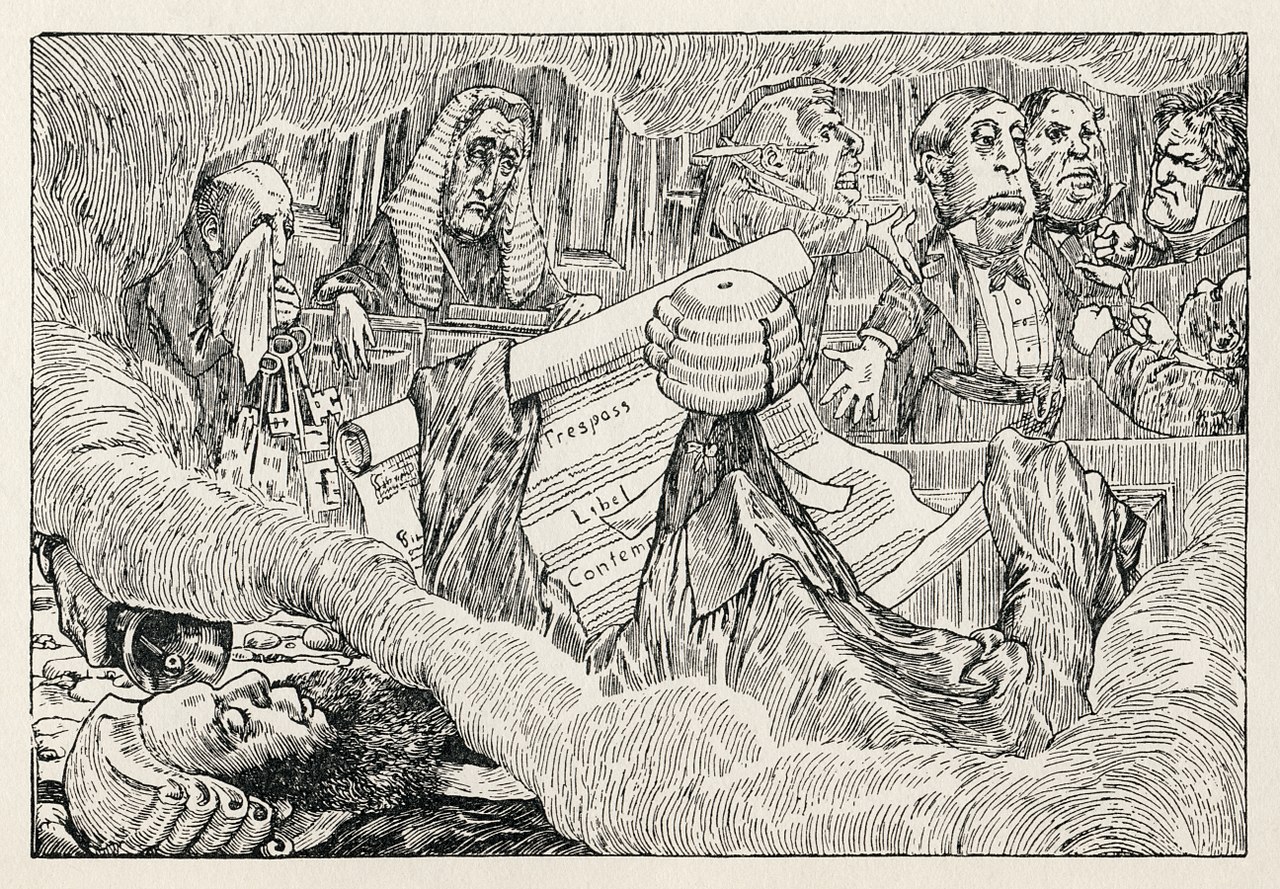
Eighth of Henry Holiday’s original illustrations to “The Hunting of the Snark” by Lewis Carroll, Wikipedia

Nina Lyon | Aeon Ideas

The English writer Lewis Carroll’s nonsense poem The Hunting of the Snark (1876) is an exceptionally difficult read. In it, a crew of improbable characters boards a ship to hunt a Snark, which might sound like a plot were it not for the fact that nobody knows what a Snark actually is. It doesn’t help that any attempt to describe a Snark turns into a pile-up of increasingly incoherent attributes: it is said to taste ‘meagre and hollow, but crisp: / Like a coat that is rather too tight in the waist’.

The only significant piece of information we have about the Snark’s identity is that it might be a Boojum. Unfortunately nobody knows what that is either, apart from the fact that anyone who encounters a Boojum will ‘softly and suddenly vanish away’ into nothingness.

Nothingness also characterises the crew’s map: a ‘perfect and absolute blank!’

‘What’s the good of Mercator’s North Poles and Equators,
Tropics, Zones and Meridian Lines?’
So the Bellman would cry: and the crew would reply,
‘They are merely conventional signs!’

Nonsense such as this might get tiresome to read, but it can make for a useful thought-experiment – particularly about language. In the Snark, as in the Alice books of 1865 and 1871, the commonsense assumptions that usually govern language and meaning are turned upside down. It makes us wonder what all of those assumptions are up to, and how they work. How do we know that this sentence is trying to say something serious, or that where we are now is not a dream?

Language can’t always convey meaning alone – it might need sense, which is the governing context that framed it. We talk about ‘common sense’, or whether something ‘makes sense’, or dismiss things as ‘nonsense’, but we rarely think about what sense itself is, until it goes missing. The German logician Gottlob Frege in 1892 used sense to describe a proposition’s meaning, as something distinct from what it denoted. Sense therefore appears to be a mental entity, resistant to fixed definition.

Shortly after Carroll’s death in 1898, a seismic turn took place in both logic and metaphysics. Building on Frege, logical positivists such as Bertrand Russell sought to deploy logic and mathematics in order to establish unconditional truths. A logical truth was, like mathematics, true whether or not people changed their minds about it. Realism, the belief in a mind-independent reality, began to assert itself afresh after a long spell in the philosophical wilderness.

Sense and nonsense would therefore become landmines in a battle over logic’s ability to untether truth from thought. If an issue over meaning seeks recourse in sense, it seeks recourse in thought too. Carroll anticipated where logic was headed, and the strangest of his creations was more than a game, an experiment conceived, as the English author G K Chesterton once wrote of his work, ‘in order to study that darkest problem of metaphysics’.

In 1901, the pragmatist philosopher and provocateur F C S Schiller created a parody Christmas edition of the philosophical journal Mind called Mind!. The frontispiece was a ‘Portrait of Its Immanence the Absolute’, which, Schiller noted, was ‘very like the Bellman’s map in the Hunting of the Snark’: completely blank.

The Absolute – or the Infinite or Ultimate Reality, among other grand aliases – was the sum of all experience and being, and inconceivable to the human mind. It was monistic, consuming all into the One. If it sounded like something you’d struggle to get your head around, that was pretty much the point. The Absolute was an emblem of metaphysical idealism, the doctrine that truth could exist only within the domain of thought. Idealism had dominated the academy for the entirety of Carroll’s career, and it was beginning to come under attack. The realist mission, headed by Russell, was to clean up philosophy’s act with the sound application of mathematics and objective facts, and it felt like a breath of fresh air.

Schiller delighted in trolling absolute idealists in general and the English idealist philosopher F H Bradley in particular. In Mind!, Schiller claimed that the Snark was a satire on the Absolute, whose notorious ineffability drove its seekers to derangement. But this was disingenuous. Bradley’s major work, Appearance and Reality (1893), mirrors the point, insofar that there is one, of the Snark. When you home in on a thing and try to pin it down by describing its attributes, and then try to pin down what those are too – Bradley uses the example of a lump of sugar – it all begins to crumble, and must be something other instead. What appeared to be there was only ever an idea. Carroll was, contrariwise, in line with idealist thinking.

A passionate logician, Carroll had been working on a three-part book on symbolic logic that remained unfinished at his death. Two logical paradoxes that he posed in Mind and shared privately with friends and colleagues, such as Bradley, hint at a troublemaking sentiment regarding where logic might be headed. ‘A Logical Paradox’ (1894) resulted in two contradictory statements being simultaneously true; ‘What the Tortoise Said to Achilles’ (1895) set up a predicament in which each proposition requires an additional supporting proposition, creating an infinite regress.

A few years after Carroll’s death, Russell began to flex logic as a tool for denoting the world and testing the validity of propositions about it. Carroll’s paradoxes were problematic and demanded a solution. Russell’s response to ‘A Logical Paradox’ was to legislate nonsense away into a ‘null-class’ – a set of nonexistent propositions that, because it had no real members, didn’t exist either.

Russell’s solution to ‘What the Tortoise Said to Achilles’, tucked away in a footnote to the Principles of Mathematics (1903), entailed a recourse to sense in order to determine whether or not a proposition should be asserted in the first place, teetering into the mind-dependent realm of idealism. Mentally determining meaning is a bit like mentally determining reality, and it wasn’t a neat win for logic’s role as objective sword of truth.

In the Snark, the principles of narrative self-immolate, so that the story, rather than describing things and events in the world, undoes them into something other. It ends like this:

In the midst of the word he was trying to say,
In the midst of his laughter and glee,
He had softly and suddenly vanished away –
For the Snark was a Boojum, you see.

Strip the plot down to those eight final words, and it is all there. The thing sought turned out, upon examination, to be something else entirely. Beyond the flimsy veil of appearance, formed from words and riddled with holes, lies an inexpressible reality.

By the late-20th century, when Russell had won the battle of ideas and commonsense realism prevailed, critics such as Martin Gardner, author of The Annotated Hunting of the Snark (2006), were rattled by Carroll’s antirealism. If the reality we perceive is all there is, and it falls apart, we are left with nothing.

Carroll’s attacks on realism might look nihilistic or radical to a postwar mind steeped in atheist scientism, but they were neither. Carroll was a man of his time, taking a philosophically conservative party line on absolute idealism and its theistic implications. But he was also prophetic, seeing conflict at the limits of language, logic and reality, and laying a series of conceptual traps that continue to provoke it.

The Snark is one such trap. Carroll rejected his illustrator Henry Holiday’s image of the Boojum on the basis that it needed to remain unimaginable, for, after all, how can you illustrate the incomprehensible nature of ultimate reality? It is a task as doomed as saying the unsayable – which, paradoxically, was a task Carroll himself couldn’t quite resist.Aeon counter – do not remove

Nina Lyon

This article was originally published at Aeon and has been republished under Creative Commons.
Modern Technology is akin to the Metaphysics of Vedanta

whitehead-vedanta.jpg

Akhandadhi Das | Aeon Ideas

You might think that digital technologies, often considered a product of ‘the West’, would hasten the divergence of Eastern and Western philosophies. But within the study of Vedanta, an ancient Indian school of thought, I see the opposite effect at work. Thanks to our growing familiarity with computing, virtual reality (VR) and artificial intelligence (AI), ‘modern’ societies are now better placed than ever to grasp the insights of this tradition.

Vedanta summarises the metaphysics of the Upanishads, a clutch of Sanskrit religious texts, likely written between 800 and 500 BCE. They form the basis for the many philosophical, spiritual and mystical traditions of the Indian sub-continent. The Upanishads were also a source of inspiration for some modern scientists, including Albert Einstein, Erwin Schrödinger and Werner Heisenberg, as they struggled to comprehend quantum physics of the 20th century.

The Vedantic quest for understanding begins from what it considers the logical starting point: our own consciousness. How can we trust conclusions about what we observe and analyse unless we understand what is doing the observation and analysis? The progress of AI, neural nets and deep learning have inclined some modern observers to claim that the human mind is merely an intricate organic processing machine – and consciousness, if it exists at all, might simply be a property that emerges from information complexity. However, this view fails to explain intractable issues such as the subjective self and our experience of qualia, those aspects of mental content such as ‘redness’ or ‘sweetness’ that we experience during conscious awareness. Figuring out how matter can produce phenomenal consciousness remains the so-called ‘hard problem’.

Vedanta offers a model to integrate subjective consciousness and the information-processing systems of our body and brains. Its theory separates the brain and the senses from the mind. But it also distinguishes the mind from the function of consciousness, which it defines as the ability to experience mental output. We’re familiar with this notion from our digital devices. A camera, microphone or other sensors linked to a computer gather information about the world, and convert the various forms of physical energy – light waves, air pressure-waves and so forth – into digital data, just as our bodily senses do. The central processing unit processes this data and produces relevant outputs. The same is true of our brain. In both contexts, there seems to be little scope for subjective experience to play a role within these mechanisms.

While computers can handle all sorts of processing without our help, we furnish them with a screen as an interface between the machine and ourselves. Similarly, Vedanta postulates that the conscious entity – something it terms the atma – is the observer of the output of the mind. The atma possesses, and is said to be composed of, the fundamental property of consciousness. The concept is explored in many of the meditative practices of Eastern traditions.

You might think of the atma like this. Imagine you’re watching a film in the cinema. It’s a thriller, and you’re anxious about the lead character, trapped in a room. Suddenly, the door in the movie crashes open and there stands… You jump, as if startled. But what is the real threat to you, other than maybe spilling your popcorn? By suspending an awareness of your body in the cinema, and identifying with the character on the screen, we are allowing our emotional state to be manipulated. Vedanta suggests that the atma, the conscious self, identifies with the physical world in a similar fashion.

This idea can also be explored in the all-consuming realm of VR. On entering a game, we might be asked to choose our character or avatar – originally a Sanskrit word, aptly enough, meaning ‘one who descends from a higher dimension’. In older texts, the term often refers to divine incarnations. However, the etymology suits the gamer, as he or she chooses to descend from ‘normal’ reality and enter the VR world. Having specified our avatar’s gender, bodily features, attributes and skills, next we learn how to control its limbs and tools. Soon, our awareness diverts from our physical self to the VR capabilities of the avatar.

In Vedanta psychology, this is akin to the atma adopting the psychological persona-self it calls the ahankara, or the ‘pseudo-ego’. Instead of a detached conscious observer, we choose to define ourselves in terms of our social connections and the physical characteristics of the body. Thus, I come to believe in myself with reference to my gender, race, size, age and so forth, along with the roles and responsibilities of family, work and community. Conditioned by such identification, I indulge in the relevant emotions – some happy, some challenging or distressing – produced by the circumstances I witness myself undergoing.

Within a VR game, our avatar represents a pale imitation of our actual self and its entanglements. In our interactions with the avatar-selves of others, we might reveal little about our true personality or feelings, and know correspondingly little about others’. Indeed, encounters among avatars – particularly when competitive or combative – are often vitriolic, seemingly unrestrained by concern for the feelings of the people behind the avatars. Connections made through online gaming aren’t a substitute for other relationships. Rather, as researchers at Johns Hopkins University have noted, gamers with strong real-world social lives are less likely to fall prey to gaming addiction and depression.

These observations mirror the Vedantic claim that our ability to form meaningful relationships is diminished by absorption in the ahankara, the pseudo-ego. The more I regard myself as a physical entity requiring various forms of sensual gratification, the more likely I am to objectify those who can satisfy my desires, and to forge relationships based on mutual selfishness. But Vedanta suggests that love should emanate from the deepest part of the self, not its assumed persona. Love, it claims, is soul-to-soul experience. Interactions with others on the basis of the ahankara offer only a parody of affection.

As the atma, we remain the same subjective self throughout the whole of our life. Our body, mentality and personality change dramatically – but throughout it all, we know ourselves to be the constant observer. However, seeing everything shift and give way around us, we suspect that we’re also subject to change, ageing and heading for annihilation. Yoga, as systematised by Patanjali – an author or authors, like ‘Homer’, who lived in the 2nd century BCE – is intended to be a practical method for freeing the atma from relentless mental tribulation, and to be properly situated in the reality of pure consciousness.

In VR, we’re often called upon to do battle with evil forces, confronting jeopardy and virtual mortality along the way. Despite our efforts, the inevitable almost always happens: our avatar is killed. Game over. Gamers, especially pathological gamers, are known to become deeply attached to their avatars, and can suffer distress when their avatars are harmed. Fortunately, we’re usually offered another chance: Do you want to play again? Sure enough, we do. Perhaps we create a new avatar, someone more adept, based on the lessons learned last time around. This mirrors the Vedantic concept of reincarnation, specifically in its form of metempsychosis: the transmigration of the conscious self into a new physical vehicle.

Some commentators interpret Vedanta as suggesting that there is no real world, and that all that exists is conscious awareness. However, a broader take on Vedantic texts is more akin to VR. The VR world is wholly data, but it becomes ‘real’ when that information manifests itself to our senses as imagery and sounds on the screen or through a headset. Similarly, for Vedanta, it is the external world’s transitory manifestation as observable objects that makes it less ‘real’ than the perpetual, unchanging nature of the consciousness that observes it.

To the sages of old, immersing ourselves in the ephemeral world means allowing the atma to succumb to an illusion: the illusion that our consciousness is somehow part of an external scene, and must suffer or enjoy along with it. It’s amusing to think what Patanjali and the Vedantic fathers would make of VR: an illusion within an illusion, perhaps, but one that might help us to grasp the potency of their message.Aeon counter – do not remove

Akhandadhi Das

This article was originally published at Aeon and has been republished under Creative Commons.


Why Amartya Sen Remains the Century’s Great Critic of Capitalism

amartya-sen

Nobel laureate Amartya Kumar Sen in 2000, Wikipedia


Tim Rogan | Aeon Ideas

Critiques of capitalism come in two varieties. First, there is the moral or spiritual critique. This critique rejects Homo economicus as the organising heuristic of human affairs. Human beings, it says, need more than material things to prosper. Calculating power is only a small part of what makes us who we are. Moral and spiritual relationships are first-order concerns. Material fixes such as a universal basic income will make no difference to societies in which the basic relationships are felt to be unjust.

Then there is the material critique of capitalism. The economists who lead discussions of inequality now are its leading exponents. Homo economicus is the right starting point for social thought. We are poor calculators and single-minded, failing to see our advantage in the rational distribution of prosperity across societies. Hence inequality, the wages of ungoverned growth. But we are calculators all the same, and what we need above all is material plenty, thus the focus on the redress of material inequality. From good material outcomes, the rest follows.

The first kind of argument for capitalism’s reform seems recessive now. The material critique predominates. Ideas emerge in numbers and figures. Talk of non-material values in political economy is muted. The Christians and Marxists who once made the moral critique of capitalism their own are marginal. Utilitarianism grows ubiquitous and compulsory.

But then there is Amartya Sen.

Every major work on material inequality in the 21st century owes a debt to Sen. But his own writings treat material inequality as though the moral frameworks and social relationships that mediate economic exchanges matter. Famine is the nadir of material deprivation. But it seldom occurs – Sen argues – for lack of food. To understand why a people goes hungry, look not for catastrophic crop failure; look rather for malfunctions of the moral economy that moderates competing demands upon a scarce commodity. Material inequality of the most egregious kind is the problem here. But piecemeal modifications to the machinery of production and distribution will not solve it. The relationships between different members of the economy must be put right. Only then will there be enough to go around.

In Sen’s work, the two critiques of capitalism cooperate. We move from moral concerns to material outcomes and back again with no sense of a threshold separating the two. Sen disentangles moral and material issues without favouring one or the other, keeping both in focus. The separation between the two critiques of capitalism is real, but transcending the divide is possible, and not only at some esoteric remove. Sen’s is a singular mind, but his work has a widespread following, not least in provinces of modern life where the predominance of utilitarian thinking is most pronounced. In economics curricula and in the schools of public policy, in internationalist secretariats and in humanitarian NGOs, there too Sen has created a niche for thinking that crosses boundaries otherwise rigidly observed.

This was no feat of lonely genius or freakish charisma. It was an effort of ordinary human innovation, putting old ideas together in new combinations to tackle emerging problems. Formal training in economics, mathematics and moral philosophy supplied the tools Sen has used to construct his critical system. But the influence of Rabindranath Tagore sensitised Sen to the subtle interrelation between our moral lives and our material needs. And a profound historical sensibility has enabled him to see the sharp separation of the two domains as transient.

Tagore’s school at Santiniketan in West Bengal was Sen’s birthplace. Tagore’s pedagogy emphasised articulate relations between a person’s material and spiritual existences. Both were essential – biological necessity, self-creating freedom – but modern societies tended to confuse the proper relation between them. In Santiniketan, pupils played at unstructured exploration of the natural world between brief forays into the arts, learning to understand their sensory and spiritual selves as at once distinct and unified.

Sen left Santiniketan in the late 1940s as a young adult to study economics in Calcutta and Cambridge. The major contemporary controversy in economics was the theory of welfare, and debate was affected by Cold War contention between market- and state-based models of economic order. Sen’s sympathies were social democratic but anti-authoritarian. Welfare economists of the 1930s and 1940s sought to split the difference, insisting that states could legitimate programmes of redistribution by appeal to rigid utilitarian principles: a pound in a poor man’s pocket adds more to overall utility than the same pound in the rich man’s pile. Here was the material critique of capitalism in its infancy, and here is Sen’s response: maximising utility is not everyone’s abiding concern – saying so and then making policy accordingly is a form of tyranny – and in any case using government to move money around in pursuit of some notional optimum is a flawed means to that end.

Economic rationality harbours a hidden politics whose implementation damaged the moral economies that groups of people built up to govern their own lives, frustrating the achievement of its stated aims. In commercial societies, individuals pursue economic ends within agreed social and moral frameworks. The social and moral frameworks are neither superfluous nor inhibiting. They are the coefficients of durable growth.

Moral economies are not neutral, given, unvarying or universal. They are contested and evolving. Each person is more than a cold calculator of rational utility. Societies aren’t just engines of prosperity. The challenge is to make non-economic norms affecting market conduct legible, to bring the moral economies amid which market economies and administrative states function into focus. Thinking that bifurcates moral on the one hand and material on the other is inhibiting. But such thinking is not natural and inevitable, it is mutable and contingent – learned and apt to be unlearned.

Sen was not alone in seeing this. The American economist Kenneth Arrow was his most important interlocutor, connecting Sen in turn with the tradition of moral critique associated with R H Tawney and Karl Polanyi. Each was determined to re-integrate economics into frameworks of moral relationship and social choice. But Sen saw more clearly than any of them how this could be achieved. He realised that at earlier moments in modern political economy this separation of our moral lives from our material concerns had been inconceivable. Utilitarianism had blown in like a weather front around 1800, trailing extremes of moral fervour and calculating zeal in its wake. Sen sensed this climate of opinion changing, and set about cultivating ameliorative ideas and approaches eradicated by its onset once again.

There have been two critiques of capitalism, but there should be only one. Amartya Sen is the new century’s first great critic of capitalism because he has made that clear.Aeon counter – do not remove

Tim Rogan

This article was originally published at Aeon and has been republished under Creative Commons.
How Al-Farabi drew on Plato to argue for censorship in Islam

Israel-2013(2)-Jerusalem-Temple_Mount-Dome_of_the_Rock_(SE_exposure)

Andrew Shiva / Wikipedia

Rashmee Roshan Lall | Aeon Ideas

You might not be familiar with the name Al-Farabi, a 10th-century thinker from Baghdad, but you know his work, or at least its results. Al-Farabi was, by all accounts, a man of steadfast Sufi persuasion and unvaryingly simple tastes. As a labourer in a Damascus vineyard before settling in Baghdad, he favoured a frugal diet of lambs’ hearts and water mixed with sweet basil juice. But in his political philosophy, Al-Farabi drew on a rich variety of Hellenic ideas, notably from Plato and Aristotle, adapting and extending them in order to respond to the flux of his times.

The situation in the mighty Abbasid empire in which Al-Farabi lived demanded a delicate balancing of conservatism with radical adaptation. Against the backdrop of growing dysfunction as the empire became a shrunken version of itself, Al-Farabi formulated a political philosophy conducive to civic virtue, justice, human happiness and social order.

But his real legacy might be the philosophical rationale that Al-Farabi provided for controlling creative expression in the Muslim world. In so doing, he completed the aniconism (or antirepresentational) project begun in the late seventh century by a caliph of the Umayyads, the first Muslim dynasty. Caliph Abd al-Malik did it with nonfigurative images on coins and calligraphic inscriptions on the Dome of the Rock in Jerusalem, the first monument of the new Muslim faith. This heralded Islamic art’s break from the Greco-Roman representative tradition. A few centuries later, Al-Farabi took the notion of creative control to new heights by arguing for restrictions on representation through the word. He did it using solidly Platonic concepts, and can justifiably be said to have helped concretise the way Islam understands and responds to creative expression.

Word portrayals of Islam and its prophet can be deemed sacrilegious just as much as representational art. The consequences of Al-Farabi’s rationalisation of representational taboos are apparent in our times. In 1989, Iran’s Ayatollah Khomeini issued a fatwa sentencing Salman Rushdie to death for writing The Satanic Verses (1988). The book outraged Muslims for its fictionalised account of Prophet Muhammad’s life. In 2001, the Taliban blew up the sixth-century Bamiyan Buddhas in Afghanistan. In 2005, controversy erupted over the publication by the Danish newspaper Jyllands-Posten of cartoons depicting the Prophet. The cartoons continued to ignite fury in some way or other for at least a decade. There were protests across the Middle East, attacks on Western embassies after several European papers reprinted the cartoons, and in 2008 Osama bin Laden issued an incendiary warning to Europe of ‘grave punishment’ for its ‘new Crusade’ against Islam. In 2015, the offices of Charlie Hebdo, a satirical magazine in Paris that habitually offended Muslim sensibilities, was attacked by armed gunmen, killing 12. The magazine had featured Michel Houellebecq’s novel Submission (2015), a futuristic vision of France under Islamic rule.

In a sense, the destruction of the Bamiyan Buddhas was no different from the Rushdie fatwa, which was like the Danish cartoons fallout and the violence wreaked on Charlie Hebdo’s editorial staff. All are linked by the desire to control representation, be it through imagery or the word.

Control of the word was something that Al-Farabi appeared to judge necessary if Islam’s biggest project – the multiethnic commonwealth that was the Abbasid empire – was to be preserved. Figural representation was pretty much settled as an issue for Muslims when Al-Farabi would have been pondering some of his key theories. Within 30 years of the Prophet’s death in 632, art and creative expression took two parallel paths depending on the context for which it was intended. There was art for the secular space, such as the palaces and bathhouses of the Umayyads (661-750). And there was the art considered appropriate for religious spaces – mosques and shrines such as the Dome of the Rock (completed in 691). Caliph Abd al-Malik had already engaged in what has been called a ‘polemic of images’ on coinage with his Byzantine counterpart, Emperor Justinian II. Ultimately, Abd al-Malik issued coins inscribed with the phrases ‘ruler of the orthodox’ and ‘representative [caliph] of Allah’ rather than his portrait. And the Dome of the Rock had script rather than representations of living creatures as a decoration. The lack of image had become an image. In fact, the word was now the image. That is why calligraphy became the greatest of Muslim art forms. The importance of the written word – its absorption and its meaning – was also exemplified by the Abbasids’ investment in the Greek-to-Arabic translation movement from the eighth to the 10th centuries.

Consequently, in Al-Farabi’s time, what was most important for Muslims was to control representation through the word. Christian iconophiles made their case for devotional images with the argument that words have the same representative power as paintings. Words are like icons, declared the iconophile Christian priest Theodore Abu Qurrah, who lived in dar-al Islam and wrote in Arabic in the ninth century. And images, he said, are the writing of the illiterate.

Al-Farabi was concerned about the power – for good or ill – of writings at a time when the Abbasid empire was in decline. He held creative individuals responsible for what they produced. Abbasid caliphs increasingly faced a crisis of authority, both moral and political. This led Al-Farabi – one of the Arab world’s most original thinkers – to extrapolate from topical temporal matters the key issues confronting Islam and its expanding and diverse dominions.

Al-Farabi fashioned a political philosophy that naturalised Plato’s imaginary ideal state for the world to which he belonged. He tackled the obvious issue of leadership, reminding Muslim readers of the need for a philosopher-king, a ‘virtuous ruler’ to preside over a ‘virtuous city’, which would be run on the principles of ‘virtuous religion’.

Like Plato, Al-Farabi suggested creative expression should support the ideal ruler, thus shoring up the virtuous city and the status quo. Just as Plato in the Republic demanded that poets in the ideal state tell stories of unvarying good, especially about the gods, Al-Farabi’s treatises mention ‘praiseworthy’ poems, melodies and songs for the virtuous city. Al-Farabi commended as ‘most venerable’ for the virtuous city the sorts of writing ‘used in the service of the supreme ruler and the virtuous king.’

It is this idea of writers following the approved narrative that most clearly joins Al-Farabi’s political philosophy to that of the man he called Plato the ‘Divine’. When Al-Farabi seized on Plato’s argument for ‘a censorship of the writers’ as a social good for Muslim society, he was making a case for managing the narrative by controlling the word. It would be important to the next phase of Islamic image-building.

Some of Al-Farabi’s ideas might have influenced other prominent Muslim thinkers, including the Persian polymath Ibn Sina, or Avicenna, (c980-1037) and the Persian theologian Al-Ghazali (c1058-1111). Certainly, his rationalisation for controlling creative writing enabled a further move to deny legitimacy to new interpretation.Aeon counter – do not remove

Rashmee Roshan Lall

This article was originally published at Aeon and has been republished under Creative Commons.

Possibility and Necessity: An Introduction to Modality

We frequently say things like, ‘This seems possible,’ ‘That can’t be done,’ ‘This must happen,’ ‘She might be able to . . ,’ ‘This is necessary for . .’ and so on.[1]

Claims like these are modal claims. They involve the modal concepts of actuality, possibility, and necessity. Modality concerns the mode or way in which a claim is true or false, and how something exists or does not exist.

This essay explains basic modal concepts, illustrates some different kinds of possibility and necessity, and briefly explains how we try to identify whether a modal claim is true or false…

Read the rest at 1000-Word Philosophy: An Introduction Anthology.

How Camus and Sartre Split Up Over the Question of How to be Free

camus

Albert Camus by Cecil Beaton for Vogue in 1946. Photo by Getty

Sam Dresser | Aeon Ideas

They were an odd pair. Albert Camus was French Algerian, a pied-noir born into poverty who effortlessly charmed with his Bogart-esque features. Jean-Paul Sartre, from the upper reaches of French society, was never mistaken for a handsome man. They met in Paris during the Occupation and grew closer after the Second World War. In those days, when the lights of the city were slowly turning back on, Camus was Sartre’s closest friend. ‘How we loved you then,’ Sartre later wrote.

They were gleaming icons of the era. Newspapers reported on their daily movements: Sartre holed up at Les Deux Magots, Camus the peripatetic of Paris. As the city began to rebuild, Sartre and Camus gave voice to the mood of the day. Europe had been immolated, but the ashes left by war created the space to imagine a new world. Readers looked to Sartre and Camus to articulate what that new world might look like. ‘We were,’ remembered the fellow philosopher Simone de Beauvoir, ‘to provide the postwar era with its ideology.’

It came in the form of existentialism. Sartre, Camus and their intellectual companions rejected religion, staged new and unnerving plays, challenged readers to live authentically, and wrote about the absurdity of the world – a world without purpose and without value. ‘[There are] only stones, flesh, stars, and those truths the hand can touch,’ Camus wrote. We must choose to live in this world and to project our own meaning and value onto it in order to make sense of it. This means that people are free and burdened by it, since with freedom there is a terrible, even debilitating, responsibility to live and act authentically.

If the idea of freedom bound Camus and Sartre philosophically, then the fight for justice united them politically. They were committed to confronting and curing injustice, and, in their eyes, no group of people was more unjustly treated than the workers, the proletariat. Camus and Sartre thought of them as shackled to their labour and shorn of their humanity. In order to free them, new political systems must be constructed.

In October 1951, Camus published The Rebel. In it, he gave voice to a roughly drawn ‘philosophy of revolt’. This wasn’t a philosophical system per se, but an amalgamation of philosophical and political ideas: every human is free, but freedom itself is relative; one must embrace limits, moderation, ‘calculated risk’; absolutes are anti-human. Most of all, Camus condemned revolutionary violence. Violence might be used in extreme circumstances (he supported the French war effort, after all) but the use of revolutionary violence to nudge history in the direction you desire is utopian, absolutist, and a betrayal of yourself.

‘Absolute freedom is the right of the strongest to dominate,’ Camus wrote, while ‘absolute justice is achieved by the suppression of all contradiction: therefore it destroys freedom.’ The conflict between justice and freedom required constant re-balancing, political moderation, an acceptance and celebration of that which limits the most: our humanity. ‘To live and let live,’ he said, ‘in order to create what we are.’

Sartre read The Rebel with disgust. As far as he was concerned, it was possible to achieve perfect justice and freedom – that described the achievement of communism. Under capitalism, and in poverty, workers could not be free. Their options were unpalatable and inhumane: to work a pitiless and alienating job, or to die. But by removing the oppressors and broadly returning autonomy to the workers, communism allows each individual to live without material want, and therefore to choose how best they can realise themselves. This makes them free, and through this unbending equality, it is also just.

The problem is that, for Sartre and many others on the Left, communism required revolutionary violence to achieve because the existing order must be smashed. Not all leftists, of course, endorsed such violence. This division between hardline and moderate leftists – broadly, between communists and socialists – was nothing new. The 1930s and early ’40s, however, had seen the Left temporarily united against fascism. With the destruction of fascism, the rupture between hardline leftists willing to condone violence and moderates who condemned it returned. This split was made all the more dramatic by the practical disappearance of the Right and the ascendancy of the Soviet Union – which empowered hardliners throughout Europe, but raised disquieting questions for communists as the horrors of gulags, terror and show trials came to light. The question for every leftist of the postwar era was simple: which side are you on?

With the publication of The Rebel, Camus declared for a peaceful socialism that would not resort to revolutionary violence. He was appalled by the stories emerging from the USSR: it was not a country of hand-in-hand communists, living freely, but a country with no freedom at all. Sartre, meanwhile, would fight for communism, and he was prepared to endorse violence to do so.

The split between the two friends was a media sensation. Les Temps Modernes – the journal edited by Sartre, which published a critical review of The Rebel – sold out three times over. Le Monde and L’Observateur both breathlessly covered the falling out. It’s hard to imagine an intellectual feud capturing that degree of public attention today, but, in this disagreement, many readers saw the political crises of the times reflected back at them. It was a way of seeing politics played out in the world of ideas, and a measure of the worth of ideas. If you are thoroughly committed to an idea, are you compelled to kill for it? What price for justice? What price for freedom?

Sartre’s position was shot through with contradiction, with which he struggled for the remainder of his life. Sartre, the existentialist, who said that humans are condemned to be free, was also Sartre, the Marxist, who thought that history does not allow much space for true freedom in the existential sense. Though he never actually joined the French Communist Party, he would continue to defend communism throughout Europe until 1956, when the Soviet tanks in Budapest convinced him, finally, that the USSR did not hold the way forward. (Indeed, he was dismayed by the Soviets in Hungary because they were acting like Americans, he said.) Sartre would remain a powerful voice on the Left throughout his life, and chose the French president Charles de Gaulle as his favourite whipping boy. (After one particularly vicious attack, de Gaulle was asked to arrest Sartre. ‘One does not imprison Voltaire,’ he responded.) Sartre remained unpredictable, however, and was engaged in a long, bizarre dalliance with hardline Maoism when he died in 1980. Though Sartre moved away from the USSR, he never completely abandoned the idea that revolutionary violence might be warranted.

Philosophy Feud: Sartre vs Camus from Aeon Video on Vimeo

The violence of communism sent Camus on a different trajectory. ‘Finally,’ he wrote in The Rebel, ‘I choose freedom. For even if justice is not realised, freedom maintains the power of protest against injustice and keeps communication open.’ From the other side of the Cold War, it is hard not to sympathise with Camus, and to wonder at the fervour with which Sartre remained a loyal communist. Camus’s embrace of sober political reality, of moral humility, of limits and fallible humanity, remains a message well-heeded today. Even the most venerable and worthy ideas need to be balanced against one another. Absolutism, and the impossible idealism it inspires, is a dangerous path forward – and the reason Europe lay in ashes, as Camus and Sartre struggled to envision a fairer and freer world.Aeon counter – do not remove

Sam Dresser

This article was originally published at Aeon and has been republished under Creative Commons.

Being ‘interesting’ is Not an Objective Feature of the World

carina-nebula

Colour-composite image of the Carina Nebula. Courtesy ESO

Lorraine L Besser | Aeon Ideas

Most of us know and value pleasant experiences. We savour the taste of a freshly picked strawberry. We laugh more than an event warrants, just because laughing feels good. We might argue about the degree to which such pleasant experiences are valuable, and the extent to which they ought to shape our lives, but we can’t deny their value.

So pleasant experiences are necessarily valuable, but are there also valuable experiences that are not necessarily pleasant? It seems there are. Often, we have experiences that captivate us, that we cherish even though they are not entirely pleasant. We read a novel that leads us to feel both horror and awe. We binge-watch a TV show that explores the shocking course of moral corruption of someone who could be your neighbour, friend, even your spouse. The experience is both painful and horrifying, but we can’t turn it off.

These experiences seem intuitively valuable in the same way that pleasant experiences are intuitively valuable. But they are not valuable because they are pleasant – rather, they are valuable by virtue of being interesting.

What does it mean for an experience to be interesting? First, to say that something is interesting is to describe what the experience feels like to the person undergoing it. This is the phenomenological quality of the experience. When we study the phenomenology of something, we examine what it feels like, from the inside, to experience that thing. For instance, most of us would describe eating our favourite foods as a pleasurable experience: the food itself isn’t pleasurable, but the experience of eating it is. Similarly, when we talk about something being beautiful or awe-inspiring, we aren’t describing the thing itself, but rather our experience of it. We see the sunset and feel moved by it; the beauty is something we experience. Likewise the awe it inspires is a feature of our experiential reaction to it. The interesting is just like this. It is a feature of our experiential reaction, of our engagement.

We don’t always use the word ‘interesting’ in this way. In ordinary language, we often describe the objects of experience as interesting. We talk about interesting books, interesting people, and so on. When we say that a book is interesting, we more likely mean that the experience of reading the book is interesting. It just doesn’t make sense to describe a book to be objectively interesting, independently of people experiencing it as interesting. How could a book be interesting without being read? And if a book is objectively interesting, shouldn’t we all find it interesting? We don’t all find the same things to be interesting. It is a common experience for something to be interesting to one person, yet not another. So while we might describe objects as interesting, we should recognise that this is a loose, and shorthand, way to describe what’s really interesting – our experience of them.

Another way in which we use the word ‘interesting’ is in the context of describing what a person is interested in: John is interested in Second World War novels, for example. This usage also differs from what I’m describing as the ‘interesting’. It describes a particular fit between one’s interests and the objects of one’s experiences. But notice that fitting with your interests, and being interested in something, is actually a different experience to finding something interesting. We’ve all been interested in things that turn out to be boring, and we’ve all found experiences interesting when we had no prior interest in them. The interesting is thus not an objective feature of an object, nor an experience that necessarily aligns or follows from your interests. It is rather a feature of our experiences.

To say that something is interesting is also to describe a particular kind of synthesis that arises within the experience. Whenever we engage in an activity, we bring to that experience some combination of expectations, likes/desires, beliefs, curiosity, and so forth. This package contributes to the activity delivering a particular subjective experience. There is a synthesis, specific to the individual’s engagement, that determines what her experience feels like – its phenomenological quality. It is within this synthesis that a person finds an experience interesting, or not. There is no one synthesis that makes an experience interesting. Sometimes, a clash of expectations and reality makes something interesting, sometimes someone’s curiosity allows one to notice features that make an activity interesting, and so on. Because the interesting lies within a synthesis between the individual and an activity, one individual can find something interesting (say, reading philosophy) that another person doesn’t.

The synthesis is complex, unique to the subject and the experience – and, in the end, unspecifiable. This is why we tend to overlook the interesting as a valuable feature of our experiences. Pleasure, by contrast, is a fairly uniform feature of experience. We know exactly what others are talking about when they talk about pleasurable experiences, and can relate to that experience in a personal way – even if it is something that we have not experienced as pleasurable. Our reactions to the experiences that others find interesting are often different. John finds reading Second World War novels to be an ongoing source of interest, yet Julia can’t imagine a more boring way of spending her time, and can’t understand how anyone would find them interesting. In such scenarios, we are more likely to discredit the value of John’s experience than to try to understand and appreciate it. Because the interesting is by nature a more complicated, harder-to-reach, harder-to-describe feature than others, we rarely stop to think about just what the interesting is.

While wrapping our head around the interesting might be challenging, it is important to acknowledge the value intrinsic to interesting experiences. Recognising it as valuable validates those who choose to pursue the interesting, and also opens up a new dimension of value that can enrich our lives. Most of us know there is more to life than pleasure, yet it is all too easy to choose our experiences for the sake of pleasure. For many of us, though, interesting experiences are more rewarding than pleasurable experiences, insofar as their intrinsic value is a product of multifaceted aspects of our engagement. Interesting experiences spark the mind in a way that stimulates and lingers. They can also be easy to come by – sometimes just a sense of curiosity is needed to make an activity interesting. Look around, feel the pull, and cherish the interesting.Aeon counter – do not remove

Lorraine L Besser

This article was originally published at Aeon and has been republished under Creative Commons.

Why it’s only Science that can Answer all the Big Questions

amplituhedron

An amplituhedron is a geometric structure introduced in 2013 by Nima Arkani-Hamed and Jaroslav Trnka. It enables simplified calculation of particle interactions in some quantum field theories. – Wikipedia

Peter Atkins | Aeon Ideas

Science has proved itself to be a reliable way to approach all kinds of questions about the physical world. As a scientist, I am led to wonder whether its ability to provide understanding is unlimited. Can it in fact answer all the great questions, the ‘big questions of being’, that occur to us?

To begin with, what are these big questions? In my view, they fall into two classes.

One class consists of invented questions that are often based on unwarranted extrapolations of human experience. They typically include questions of purpose and worries about the annihilation of the self, such as Why are we here? and What are the attributes of the soul? They are not real questions, because they are not based on evidence. Thus, as there is no evidence for the Universe having a purpose, there is no point in trying to establish its purpose or to explore the consequences of that purported purpose. As there is no evidence for the existence of a soul (except in a metaphorical sense), there is no point in spending time wondering what the properties of that soul might be should the concept ever be substantiated. Most questions of this class are a waste of time; and because they are not open to rational discourse, at worst they are resolved only by resort to the sword, the bomb or the flame.

The second class of big questions concerns features of the Universe for which there is evidence other than wish-fulfilling speculation and the stimulation provided by the study of sacred texts. They include investigations into the origin of the Universe, and specifically how it is that there is something rather than nothing, the details of the structure of the Universe (particularly the relative strengths of the fundamental forces and the existence of the fundamental particles), and the nature of consciousness. These are all real big questions and, in my view, are open to scientific elucidation.

The first class of questions, the inventions, commonly but not invariably begin with Why. The second class properly begin with How but, to avoid a lot of clumsy language, are often packaged as Why questions for convenience of discourse. Thus, Why is there something rather than nothing? (which is coloured by hints of purpose) is actually a disguised form of How is it that something emerged from nothing? Such Why questions can always be deconstructed into concatenations of How questions, and are in principle worthy of consideration with an expectation of being answered.

I accept that some will criticise me along the lines that I am using a circular argument: that the real big questions are the ones that can be answered scientifically, and therefore only science can in principle elucidate such questions, leaving aside the invented questions as intellectual weeds. That might be so. Publicly accessible evidence, after all, is surely an excellent sieve for distinguishing the two classes of question, and the foundation of science is evidence.

Science is like Michelangelo. The young Michelangelo demonstrated his skill as a sculptor by carving the ravishing Pietà in the Vatican; the mature Michelangelo, having acquired and demonstrated his skill, broke free of the conventions and created his extraordinary later quasi-abstractions. Science has trod a similar path. Through its four centuries of serious endeavour, from Galileo onwards, when evidence was mingled with mathematics, and the extraordinary reticulation of concepts and achievements emerged, science has acquired maturity, and from the elucidation of simple observations it is now capable of dealing with the complex. Indeed, the emergence of computation as a component of the unfolding implications of theories and the detection of patterns in massive data sets has extended the reach of the rational and greatly enriches the scientific method by augmenting the analytic.

The triple-pronged armoury of science – the observational, the analytic and the computational – is now ready to attack the real big questions. They are, in chronological order: How did the Universe begin? How did matter in the Universe become alive? and How did living matter become self-conscious? When inspected and picked apart, these questions include many others, such as – in the first question – the existence of the fundamental forces and particles and, by extension, the long-term future of the Universe. It includes the not-so-little problem of the union of gravitation and quantum mechanics.

The second question includes not only the transition from inorganic to organic but details of the evolution of species and the ramifications of molecular biology. The third includes not merely our ability to cogitate and create but also the nature of aesthetic and moral judgment. I see no reason why the scientific method cannot be used to answer, or at least illuminate, Socrates’ question ‘How should we live?’ by appealing to those currently semi-sciences (the social sciences) including anthropology, ethology, psychology and economics. The cyclic raises its head here too, for it is conceivable that the limitations of consciousness preclude full comprehension of the deep structure of the fabric of reality, so perhaps in the third, arising as it does from the first, the first finds itself bounded. We are already seeing a hint of that with quantum mechanics, which is so far removed from common experience (I could add, as it maps on to our brains) that no one currently really understands it (but that has not inhibited our ability to deploy it).

The lubricant of the scientific method is optimism, optimism that given patience and effort, often collaborative effort, comprehension will come. It has in the past, and there is no reason to suppose that such optimism is misplaced now. Of course, foothills have given way to mountains, and rapid progress cannot be expected in the final push. Maybe effort will take us, at least temporarily, down blind alleys (string theory perhaps) but then the blindness of that alley might suddenly be opened and there is a surge of achievement. Perhaps whole revised paradigms of thought, such as those a century or so ago when relativity and quantum mechanics emerged, will take comprehension in currently unimaginable directions. Maybe we shall find that the cosmos is just mathematics rendered substantial. Maybe our comprehension of consciousness will have to be left to the artificial device that we thought was merely a machine for simulating it. Maybe, indeed, circularity again, only the artificial consciousness we shall have built will have the capacity to understand the emergence of something from nothing.

I consider that there is nothing that the scientific method cannot elucidate. Indeed, we should delight in the journey of the collective human mind in the enterprise we call science.Aeon counter – do not remove

Peter Atkins

This article was originally published at Aeon and has been republished under Creative Commons.

Why Atheists are Not as Rational as Some Like to Think

File 20180924 85755 lffuqk.jpg?ixlib=rb 1.1

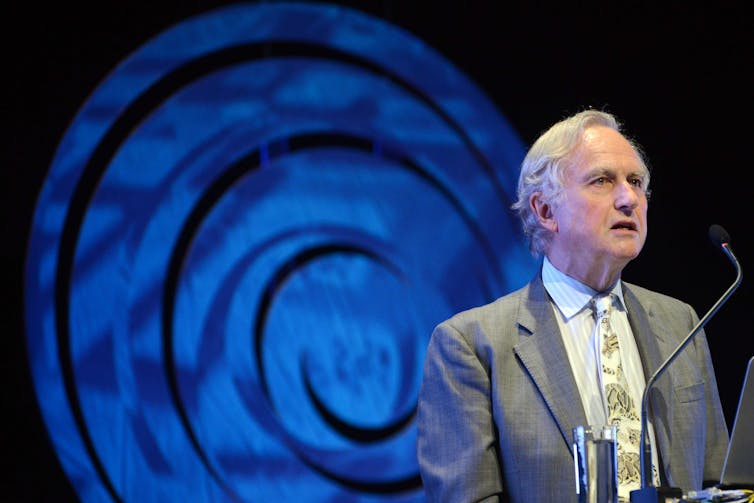
Richard Dawkins, author, evolutionary biologist and emeritus fellow of New College, University of Oxford, is one of the world’s most prominent atheists.
Fronteiras do Pensamento/Wikipedia, CC BY-SA

By Lois Lee, University of Kent

Many atheists think that their atheism is the product of rational thinking. They use arguments such as “I don’t believe in God, I believe in science” to explain that evidence and logic, rather than supernatural belief and dogma, underpin their thinking. But just because you believe in evidence-based, scientific research – which is subject to strict checks and procedures – doesn’t mean that your mind works in the same way.

When you ask atheists about why they became atheists (as I do for a living), they often point to eureka moments when they came to realise that religion simply doesn’t make sense.

Oddly perhaps, many religious people actually take a similar view of atheism. This comes out when theologians and other theists speculate that it must be rather sad to be an atheist, lacking (as they think atheists do) so much of the philosophical, ethical, mythical and aesthetic fulfilments that religious people have access to – stuck in a cold world of rationality only.

The Science of Atheism

The problem that any rational thinker needs to tackle, though, is that the science increasingly shows that atheists are no more rational than theists. Indeed, atheists are just as susceptible as the next person to “group-think” and other non-rational forms of cognition. For example, religious and nonreligious people alike can end up following charismatic individuals without questioning them. And our minds often prefer righteousness over truth, as the social psychologist Jonathan Haidt has explored.

Even atheist beliefs themselves have much less to do with rational inquiry than atheists often think. We now know, for example, that nonreligious children of religious parents cast off their beliefs for reasons that have little to do with intellectual reasoning. The latest cognitive research shows that the decisive factor is learning from what parents do rather than from what they say. So if a parent says that they’re Christian, but they’ve fallen out of the habit of doing the things they say should matter – such as praying or going to church – their kids simply don’t buy the idea that religion makes sense.

This is perfectly rational in a sense, but children aren’t processing this on a cognitive level. Throughout our evolutionary history, humans have often lacked the time to scrutinise and weigh up the evidence – needing to make quick assessments. That means that children to some extent just absorb the crucial information, which in this case is that religious belief doesn’t appear to matter in the way that parents are saying it does.

Children’s choices often aren’t based on rational thinking.
Anna Nahabed/Shutterstock

Even older children and adolescents who actually ponder the topic of religion may not be approaching it as independently as they think. Emerging research is demonstrating that atheist parents (and others) pass on their beliefs to their children in a similar way to religious parents – through sharing their culture as much as their arguments.

Some parents take the view that their children should choose their beliefs for themselves, but what they then do is pass on certain ways of thinking about religion, like the idea that religion is a matter of choice rather than divine truth. It’s not surprising that almost all of these children – 95% – end up “choosing” to be atheist.

Science versus Beliefs

But are atheists more likely to embrace science than religious people? Many belief systems can be more or less closely integrated with scientific knowledge. Some belief systems are openly critical of science, and think it has far too much sway over our lives, while other belief systems are hugely concerned to learn about and respond to scientific knowledge.

But this difference doesn’t neatly map onto whether you are religious or not. Some Protestant traditions, for example, see rationality or scientific thinking as central to their religious lives. Meanwhile, a new generation of postmodern atheists highlight the limits of human knowledge, and see scientific knowledge as hugely limited, problematic even, especially when it comes to existential and ethical questions. These atheists might, for example, follow thinkers like Charles Baudelaire in the view that true knowledge is only found in artistic expression.

Science can give us existential fulfilment, too.
Vladimir Pustovit/Flicr, CC BY-SA

And while many atheists do like to think of themselves as pro science, science and technology itself can sometimes be the basis of religious thinking or beliefs, or something very much like it. For example, the rise of the transhumanist movement, which centres on the belief that humans can and should transcend their current natural state and limitations through the use of technology, is an example of how technological innovation is driving the emergence of new movements that have much in common with religiosity.

Even for those atheists sceptical of transhumanism, the role of science isn’t only about rationality – it can provide the philosophical, ethical, mythical and aesthetic fulfilments that religious beliefs do for others. The science of the biological world, for example, is much more than a topic of intellectual curiosity – for some atheists, it provides meaning and comfort in much the same way that belief in God can for theists. Psychologists show that belief in science increases in the face of stress and existential anxiety, just as religious beliefs intensify for theists in these situations.

Clearly, the idea that being atheist is down to rationality alone is starting to look distinctly irrational. But the good news for all concerned is that rationality is overrated. Human ingenuity rests on a lot more than rational thinking. As Haidt says of “the righteous mind”, we are actually “designed to ‘do’ morality” – even if we’re not doing it in the rational way we think we are. The ability to make quick decisions, follow our passions and act on intuition are also important human qualities and crucial for our success.

It is helpful that we have invented something that, unlike our minds, is rational and evidence-based: science. When we need proper evidence, science can very often provide it – as long as the topic is testable. Importantly, the scientific evidence does not tend to support the view that atheism is about rational thought and theism is about existential fulfilments. The truth is that humans are not like science – none of us get by without irrational action, nor without sources of existential meaning and comfort. Fortunately, though, nobody has to.The Conversation

Lois Lee, Research Fellow, Department of Religious Studies, University of Kent

This article is republished from The Conversation under a Creative Commons license. Read the original article.

Religion is About Emotion Regulation, and It’s Very Good at It

westernwall

Stephen T Asma | Aeon Ideas

Religion does not help us to explain nature. It did what it could in pre-scientific times, but that job was properly unseated by science. Most religious laypeople and even clergy agree: Pope John Paul II declared in 1996 that evolution is a fact and Catholics should get over it. No doubt some extreme anti-scientific thinking lives on in such places as Ken Ham’s Creation Museum in Kentucky, but it has become a fringe position. Most mainstream religious people accept a version of Galileo’s division of labour: ‘The intention of the Holy Ghost is to teach us how one goes to heaven, not how heaven goes.’

Maybe, then, the heart of religion is not its ability to explain nature, but its moral power? Sigmund Freud, who referred to himself as a ‘godless Jew’, saw religion as delusional, but helpfully so. He argued that we humans are naturally awful creatures – aggressive, narcissistic wolves. Left to our own devices, we would rape, pillage and burn our way through life. Thankfully, we have the civilising influence of religion to steer us toward charity, compassion and cooperation by a system of carrots and sticks, otherwise known as heaven and hell.

The French sociologist Émile Durkheim, on the other hand, argued in The Elementary Forms of the Religious Life (1912) that the heart of religion was not its belief system or even its moral code, but its ability to generate collective effervescence: intense, shared experiences that unify individuals into cooperative social groups. Religion, Durkheim argued, is a kind of social glue, a view confirmed by recent interdisciplinary research.

While Freud and Durkheim were right about the important functions of religion, its true value lies in its therapeutic power, particularly its power to manage our emotions. How we feel is as important to our survival as how we think. Our species comes equipped with adaptive emotions, such as fear, rage, lust and so on: religion was (and is) the cultural system that dials these feelings and behaviours up or down. We see this clearly if we look at mainstream religion, rather than the deleterious forms of extremism. Mainstream religion reduces anxiety, stress and depression. It provides existential meaning and hope. It focuses aggression and fear against enemies. It domesticates lust, and it strengthens filial connections. Through story, it trains feelings of empathy and compassion for others. And it provides consolation for suffering.

Emotional therapy is the animating heart of religion. Social bonding happens not only when we agree to worship the same totems, but when we feel affection for each other. An affective community of mutual care emerges when groups share rituals, liturgy, song, dance, eating, grieving, comforting, tales of saints and heroes, hardships such as fasting and sacrifice. Theological beliefs are bloodless abstractions by comparison.

Emotional management is important because life is hard. The Buddha said: ‘All life is suffering’ and most of us past a certain age can only agree. Religion evolved to handle what I call the ‘vulnerability problem’. When we’re sick, we go to the doctor, not the priest. But when our child dies, or we lose our home in a fire, or we’re diagnosed with Stage-4 cancer, then religion is helpful because it provides some relief and some strength. It also gives us something to do, when there’s nothing we can do.

Consider how religion helps people after a death. Social mammals who have suffered separation distress are restored to health by touch, collective meals and grooming. Human grieving customs involve these same soothing prosocial mechanisms. We comfort-touch and embrace a person who has lost a loved one. Our bodies give ancient comfort directly to the grieving body. We provide the bereaved with food and drink, and we break bread with them (think of the Jewish tradition of shiva, or the visitation tradition of wakes in many cultures). We share stories about the loved one, and help the bereaved reframe their pain in larger optimistic narratives. Even music, in the form of consoling melodies and collective singing, helps to express shared sorrow and also transforms it from an unbearable and lonely experience to a bearable communal one. Social involvement from the community after a death can act as an antidepressant, boosting adaptive emotional changes in the bereaved.

Religion also helps to manage sorrow with something I’ll call ‘existential shaping’ or more precisely ‘existential debt’. It is common for Westerners to think of themselves as individuals first and as members of a community second, but our ideology of the lone protagonist fulfilling an individual destiny is more fiction than fact. Losing someone reminds us of our dependence on others and our deep vulnerability, and at such moments religion turns us toward the web of relations rather than away from it. Long after your parents have died, for example, religion helps you memorialise them and acknowledge your existential debt to them. Formalising the memory of the dead person, through funerary rites, or tomb-sweeping (Qingming) festivals in Asia, or the Day of the Dead in Mexico, or annual honorary masses in Catholicism, is important because it keeps reminding us, even through the sorrow, of the meaningful influence of these deceased loved ones. This is not a self-deception about the unreality of death, but an artful way of learning to live with it. The grief becomes transformed in the sincere acknowledgment of the value of the loved one, and religious rituals help people to set aside time and mental space for that acknowledgment.

An emotion such as grief has many ingredients. The physiological arousal of grief is accompanied by cognitive evaluations: ‘I will never see my friend again’; ‘I could have done something to prevent this’; ‘She was the love of my life’; and so on. Religions try to give the bereaved an alternative appraisal that reframes their tragedy as something more than just misery. Emotional appraisals are proactive, according to the psychologists Phoebe Ellsworth at the University of Michigan and Klaus Scherer at the University of Geneva, going beyond the immediate disaster to envision the possible solutions or responses. This is called ‘secondary appraisal’. After the primary appraisal (‘This is very sad’), the secondary appraisal assesses our ability to deal with the situation: ‘This is too much for me’ – or, positively: ‘I will survive this.’ Part of our ability to cope with suffering is our sense of power or agency: more power generally means better coping ability. If I acknowledge my own limitations when faced with unavoidable loss, but I feel that a powerful ally, God, is part of my agency or power, then I can be more resilient.

Because religious actions are often accompanied by magical thinking or supernatural beliefs, Christopher Hitchens argued in God Is not Great (2007) that religion is ‘false consolation’. Many critics of religion echo his condemnation. But there is no such thing as false consolation. Hitchens and fellow critics are making a category mistake, like saying: ‘The colour green is sleepy.’ Consolation or comfort is a feeling, and it can be weak or strong, but it can’t be false or true. You can be false in your judgment of why you’re feeling better, but feeling better is neither true nor false. True and false applies only if we’re evaluating whether our propositions correspond with reality. And no doubt many factual claims of religion are false in that way – the world was not created in six days.

Religion is real consolation in the same way that music is real consolation. No one thinks that the pleasure of Mozart’s opera The Magic Flute is ‘false pleasure’ because singing flutes don’t really exist. It doesn’t need to correspond to reality. It’s true that some religious devotees, unlike music devotees, pin their consolation to additional metaphysical claims, but why should we trust them to know how religion works? Such believers do not recognise that their unthinking religious rituals and social activities are the true sources of their therapeutic healing. Meanwhile, Hitchens and other critics confuse the factual disappointments of religion with the value of religion generally, and thereby miss the heart of it.

‘Why We Need Religion: An Agnostic Celebration of Spiritual Emotions’ by Stephen Asma © 2018 is published by Oxford University Press.Aeon counter – do not remove

Stephen T Asma

This article was originally published at Aeon and has been republished under Creative Commons.