Philosophy Primary Sources

sky-bookshelf

Full books in PDF format. These are the books that are generally considered standard reading for anybody interested in philosophy. You can find even more primary sources in Philosophy Primary Sources II, and head to the Links section for even more research sources!

Fragments By Anaxagoras of Clazomenae

Summa Contra Gentiles By Aquinas

De Anima (On the Soul) By Aristotle

Categories By Aristotle

On Dreams By Aristotle

Nicomachean Ethics By Aristotle

On Interpretation By Aristotle

Metaphysics By Aristotle

Physics By Aristotle

Poetics By Aristotle

Politics By Aristotle

Posterior Analytics By Aristotle

Prior Analytics By Aristotle

Rhetoric By Aristotle

City of God By Augustine

Confessions By Augustine

The Meditations By Marcus Aurelius Antoninus

Three Dialogues Between Hylas and Philonous By Berkeley

A Treatise Concerning the Principles of Human Knowledge By Berkeley

The Consolation of Philosophy By Boethius

The Dhammapada By Buddha

The Vagrakkhedikâ Or Diamond-Cutter By Buddha

Discourse on the Method of Rightly Conducting the Reason and Seeking for Truth in the Sciences By Descartes

Meditations on First Philosophy By Descartes

Democracy and Education By Dewey

Discourses By Epictetus

The Enchiridion, or Manual By Epictetus

Letter to Menoeceus By Epicurus

Principal Doctrines By Epicurus

The Philosophy Of History (Introduction) By G. W. F. Hegel

Philosophy Of Mind: Part Three of the Encyclopaedia of the Philosophical Sciences By G.W.F. Hegel

Fragments By Heraclitus

Dialogues Concerning Natural Religion By Hume

An Enquiry Concerning Human Understanding By Hume

Does Consciousness Exist? By James

What Pragmatism Means By James

The Varieties of Religious Experience By James

The Will to Believe By James

The Critique of Pure Reason By Kant

Fundamental Principles of the Metaphysics of Morals By Kant

The Critique of Judgement By Kant

Introduction to the Metaphysics of Morals By Kant

Prolegomena to any Future Metaphysics By Kant

Critique of Practical Reason By Kant

Tao Te Ching By Lao-Tzu

Monadology By Leibniz

An Essay Concerning Human Understanding By Locke

The Second Treatise of Government By Locke

Communist Manifesto By Marx

On Liberty By Mill

Utilitarianism By Mill

On Subjection of Women By Mill

Thus Spake Zarathustra By Nietzsche

Fragments and Commentary By Parmenides

The Fixation of Belief By Peirce

How to Make Our Ideas Clear By Peirce

Apology By Plato

Charmides By Plato

Cratylus By Plato

Crito By Plato

Euthydemus By Plato

Euthyphro By Plato

Gorgias By Plato

Ion By Plato

Laches By Plato

Laws By Plato

Meno By Plato

Parmenides By Plato

Phaedo By Plato

Phaedrus By Plato

Philebus By Plato

Protagoras By Plato

The Republic By Plato

Sophist By Plato

Statesman By Plato

Symposium By Plato

Theaetetus By Plato

Timaeus By Plato

Enneads By Plotinus

Fragments and Commentary By Pythagoras

On Denoting By Russell

The Problems of Philosophy By Russell

Ethics By Spinoza

On the Improvement of Understanding By Spinoza

Fragments and Commentary of Thales

A Vindication of the Rights of Women By Wollstonecraft


Check out Philosophy Primary Sources II and the Links section for even more research sources!

Economics is for Everyone!

Published on Jul 14, 2016

‘Economics is for everyone’, argues legendary economist Ha-Joon Chang in our latest mind-blowing RSA Animate. This is the video economists don’t want you to see! Chang explains why every single person can and SHOULD get their head around basic economics. He pulls back the curtain on the often mystifying language of derivatives and quantitative easing, and explains how easily economic myths and assumptions become gospel. Arm yourself with some facts, and get involved in discussions about the fundamentals that underpin our day-to-day lives.

Check out our new Citizen’s Economic Council (http://bit.ly/29GuCBI) for more on what the RSA is doing to make economics accessible to all.

Subscribe to our channel for more amazing animations!

Speaker: Ha-Joon Chang
Animator: Cognitive Media
Producer: Abi Stephenson

Follow the RSA Events on Twitter: https://twitter.com/RSAEvents
Like the RSA on Facebook: https://www.facebook.com/rsaeventsoff…
Listen to RSA podcasts: https://soundcloud.com/the_rsa
See RSA Events behind the scenes: https://instagram.com/rsa_events/

Plutonomy and the Precariat

Day_12_Occupy_Wall_Street_September_28_2011_Shankbone_33

05/08/2012 08:44 am 08:44:21 | Updated Jul 08, 2012

Noam Chomsky

Institute Professor emeritus, MIT Department of Linguistics and Philosophy; Author, ‘Who Rules the World?’

On the History of the U.S. Economy in Decline

Cross-posted with TomDispatch.com

The Occupy movement has been an extremely exciting development. Unprecedented, in fact. There’s never been anything like it that I can think of.  If the bonds and associations it has established can be sustained through a long, dark period ahead — because victory won’t come quickly — it could prove a significant moment in American history.

The fact that the Occupy movement is unprecedented is quite appropriate. After all, it’s an unprecedented era and has been so since the 1970s, which marked a major turning point in American history. For centuries, since the country began, it had been a developing society, and not always in very pretty ways. That’s another story, but the general progress was toward wealth, industrialization, development, and hope. There was a pretty constant expectation that it was going to go on like this. That was true even in very dark times.

I’m just old enough to remember the Great Depression. After the first few years, by the mid-1930s — although the situation was objectively much harsher than it is today — nevertheless, the spirit was quite different. There was a sense that “we’re gonna get out of it,” even among unemployed people, including a lot of my relatives, a sense that “it will get better.”

There was militant labor union organizing going on, especially from the CIO (Congress of Industrial Organizations). It was getting to the point of sit-down strikes, which are frightening to the business world — you could see it in the business press at the time — because a sit-down strike is just a step before taking over the factory and running it yourself. The idea of worker takeovers is something which is, incidentally, very much on the agenda today, and we should keep it in mind. Also New Deal legislation was beginning to come in as a result of popular pressure. Despite the hard times, there was a sense that, somehow, “we’re gonna get out of it.”

It’s quite different now. For many people in the United States, there’s a pervasive sense of hopelessness, sometimes despair. I think it’s quite new in American history. And it has an objective basis.

On the Working Class

In the 1930s, unemployed working people could anticipate that their jobs would come back. If you’re a worker in manufacturing today — the current level of unemployment there is approximately like the Depression — and current tendencies persist, those jobs aren’t going to come back.

The change took place in the 1970s. There are a lot of reasons for it. One of the underlying factors, discussed mainly by economic historian Robert Brenner, was the falling rate of profit in manufacturing. There were other factors. It led to major changes in the economy — a reversal of several hundred years of progress towards industrialization and development that turned into a process of de-industrialization and de-development. Of course, manufacturing production continued overseas very profitably, but it’s no good for the work force.

Along with that came a significant shift of the economy from productive enterprise — producing things people need or could use — to financial manipulation. The financialization of the economy really took off at that time.

On Banks

Before the 1970s, banks were banks. They did what banks were supposed to do in a state capitalist economy: they took unused funds from your bank account, for example, and transferred them to some potentially useful purpose like helping a family buy a home or send a kid to college. That changed dramatically in the 1970s. Until then, there had been no financial crises since the Great Depression. The 1950s and 1960s had been a period of enormous growth, the highest in American history, maybe in economic history.

And it was egalitarian.  The lowest quintile did about as well as the highest quintile. Lots of people moved into reasonable lifestyles — what’s called the “middle class” here, the “working class” in other countries — but it was real.  And the 1960s accelerated it. The activism of those years, after a pretty dismal decade, really civilized the country in lots of ways that are permanent.

When the 1970s came along, there were sudden and sharp changes: de-industrialization, the off-shoring of production, and the shift to financial institutions, which grew enormously. I should say that, in the 1950s and 1960s, there was also the development of what several decades later became the high-tech economy: computers, the Internet, the IT Revolution developed substantially in the state sector.

The developments that took place during the 1970s set off a vicious cycle. It led to the concentration of wealth increasingly in the hands of the financial sector. This doesn’t benefit the economy — it probably harms it and society — but it did lead to a tremendous concentration of wealth.

On Politics and Money

Concentration of wealth yields concentration of political power. And concentration of political power gives rise to legislation that increases and accelerates the cycle. The legislation, essentially bipartisan, drives new fiscal policies and tax changes, as well as the rules of corporate governance and deregulation. Alongside this began a sharp rise in the costs of elections, which drove the political parties even deeper into the pockets of the corporate sector.

The parties dissolved in many ways. It used to be that if a person in Congress hoped for a position such as a committee chair, he or she got it mainly through seniority and service. Within a couple of years, they started having to put money into the party coffers in order to get ahead, a topic studied mainly by Tom Ferguson. That just drove the whole system even deeper into the pockets of the corporate sector (increasingly the financial sector).

This cycle resulted in a tremendous concentration of wealth, mainly in the top tenth of one percent of the population. Meanwhile, it opened a period of stagnation or even decline for the majority of the population. People got by, but by artificial means such as longer working hours, high rates of borrowing and debt, and reliance on asset inflation like the recent housing bubble. Pretty soon those working hours were much higher in the United States than in other industrial countries like Japan and various places in Europe. So there was a period of stagnation and decline for the majority alongside a period of sharp concentration of wealth. The political system began to dissolve.

There has always been a gap between public policy and public will, but it just grew astronomically. You can see it right now, in fact.  Take a look at the big topic in Washington that everyone concentrates on: the deficit. For the public, correctly, the deficit is not regarded as much of an issue. And it isn’t really much of an issue. The issue is joblessness. There’s a deficit commission but no joblessness commission. As far as the deficit is concerned, the public has opinions. Take a look at the polls. The public overwhelmingly supports higher taxes on the wealthy, which have declined sharply in this period of stagnation and decline, and the preservation of limited social benefits.

The outcome of the deficit commission is probably going to be the opposite. The Occupy movements could provide a mass base for trying to avert what amounts to a dagger pointed at the heart of the country.

Plutonomy and the Precariat

For the general population, the 99% in the imagery of the Occupy movement, it’s been pretty harsh — and it could get worse. This could be a period of irreversible decline. For the 1% and even less — the .1% — it’s just fine. They are richer than ever, more powerful than ever, controlling the political system, disregarding the public. And if it can continue, as far as they’re concerned, sure, why not?

Take, for example, Citigroup. For decades, Citigroup has been one of the most corrupt of the major investment banking corporations, repeatedly bailed out by the taxpayer, starting in the early Reagan years and now once again. I won’t run through the corruption, but it’s pretty astonishing.

In 2005, Citigroup came out with a brochure for investors called “Plutonomy: Buying Luxury, Explaining Global Imbalances.” It urged investors to put money into a “plutonomy index.” The brochure says, “The World is dividing into two blocs — the Plutonomy and the rest.”

Plutonomy refers to the rich, those who buy luxury goods and so on, and that’s where the action is. They claimed that their plutonomy index was way outperforming the stock market. As for the rest, we set them adrift. We don’t really care about them. We don’t really need them. They have to be around to provide a powerful state, which will protect us and bail us out when we get into trouble, but other than that they essentially have no function. These days they’re sometimes called the “precariat” — people who live a precarious existence at the periphery of society. Only it’s not the periphery anymore. It’s becoming a very substantial part of society in the United States and indeed elsewhere. And this is considered a good thing.

So, for example, Fed Chairman Alan Greenspan, at the time when he was still “Saint Alan” — hailed by the economics profession as one of the greatest economists of all time (this was before the crash for which he was substantially responsible) — was testifying to Congress in the Clinton years, and he explained the wonders of the great economy that he was supervising. He said a lot of its success was based substantially on what he called “growing worker insecurity.” If working people are insecure, if they’re part of the precariat, living precarious existences, they’re not going to make demands, they’re not going to try to get better wages, they won’t get improved benefits. We can kick ’em out, if we don’t need ’em. And that’s what’s called a “healthy” economy, technically speaking. And he was highly praised for this, greatly admired.

So the world is now indeed splitting into a plutonomy and a precariat — in the imagery of the Occupy movement, the 1% and the 99%. Not literal numbers, but the right picture. Now, the plutonomy is where the action is and it could continue like this.

If it does, the historic reversal that began in the 1970s could become irreversible. That’s where we’re heading. And the Occupy movement is the first real, major, popular reaction that could avert this. But it’s going to be necessary to face the fact that it’s a long, hard struggle. You don’t win victories tomorrow. You have to form the structures that will be sustained, that will go on through hard times and can win major victories. And there are a lot of things that can be done.

Toward Worker Takeover

I mentioned before that, in the 1930s, one of the most effective actions was the sit-down strike. And the reason is simple: that’s just a step before the takeover of an industry.

Through the 1970s, as the decline was setting in, there were some important events that took place.  In 1977, U.S. Steel decided to close one of its major facilities in Youngstown, Ohio. Instead of just walking away, the workforce and the community decided to get together and buy it from the company, hand it over to the work force, and turn it into a worker-run, worker-managed facility. They didn’t win. But with enough popular support, they could have won.  It’s a topic that Gar Alperovitz and Staughton Lynd, the lawyer for the workers and community, have discussed in detail.

It was a partial victory because, even though they lost, it set off other efforts. And now, throughout Ohio, and in other places, there’s a scattering of hundreds, maybe thousands, of sometimes not-so-small worker/community-owned industries that could become worker-managed. And that’s the basis for a real revolution. That’s how it takes place.

In one of the suburbs of Boston, about a year ago, something similar happened. A multinational decided to close down a profitable, functioning facility carrying out some high-tech manufacturing. Evidently, it just wasn’t profitable enough for them. The workforce and the union offered to buy it, take it over, and run it themselves. The multinational decided to close it down instead, probably for reasons of class-consciousness. I don’t think they want things like this to happen. If there had been enough popular support, if there had been something like the Occupy movement that could have gotten involved, they might have succeeded.

And there are other things going on like that. In fact, some of them are major. Not long ago, President Barack Obama took over the auto industry, which was basically owned by the public. And there were a number of things that could have been done. One was what was done: reconstitute it so that it could be handed back to the ownership, or very similar ownership, and continue on its traditional path.

The other possibility was to hand it over to the workforce — which owned it anyway — turn it into a worker-owned, worker-managed major industrial system that’s a big part of the economy, and have it produce things that people need. And there’s a lot that we need.

We all know or should know that the United States is extremely backward globally in high-speed transportation, and it’s very serious. It not only affects people’s lives, but the economy.  In that regard, here’s a personal story. I happened to be giving talks in France a couple of months ago and had to take a train from Avignon in southern France to Charles De Gaulle Airport in Paris, the same distance as from Washington, DC, to Boston. It took two hours.  I don’t know if you’ve ever taken the train from Washington to Boston, but it’s operating at about the same speed it was 60 years ago when my wife and I first took it. It’s a scandal.

It could be done here as it’s been done in Europe. They had the capacity to do it, the skilled work force. It would have taken a little popular support, but it could have made a major change in the economy.

Just to make it more surreal, while this option was being avoided, the Obama administration was sending its transportation secretary to Spain to get contracts for developing high-speed rail for the United States, which could have been done right in the rust belt, which is being closed down. There are no economic reasons why this can’t happen. These are class reasons, and reflect the lack of popular political mobilization. Things like this continue.

Climate Change and Nuclear Weapons

I’ve kept to domestic issues, but there are two dangerous developments in the international arena, which are a kind of shadow that hangs over everything we’ve discussed. There are, for the first time in human history, real threats to the decent survival of the species.

One has been hanging around since 1945. It’s kind of a miracle that we’ve escaped it. That’s the threat of nuclear war and nuclear weapons. Though it isn’t being much discussed, that threat is, in fact, being escalated by the policies of this administration and its allies. And something has to be done about that or we’re in real trouble.

The other, of course, is environmental catastrophe. Practically every country in the world is taking at least halting steps towards trying to do something about it. The United States is also taking steps, mainly to accelerate the threat.  It is the only major country that is not only not doing something constructive to protect the environment, it’s not even climbing on the train. In some ways, it’s pulling it backwards.

And this is connected to a huge propaganda system, proudly and openly declared by the business world, to try to convince people that climate change is just a liberal hoax. “Why pay attention to these scientists?”

We’re really regressing back to the dark ages. It’s not a joke.  And if that’s happening in the most powerful, richest country in history, then this catastrophe isn’t going to be averted — and in a generation or two, everything else we’re talking about won’t matter. Something has to be done about it very soon in a dedicated, sustained way.

It’s not going to be easy to proceed. There are going to be barriers, difficulties, hardships, failures.  It’s inevitable. But unless the spirit of the last year, here and elsewhere in the country and around the globe, continues to grow and becomes a major force in the social and political world, the chances for a decent future are not very high.

Noam Chomsky is Institute Professor Emeritus in the MIT Department of Linguistics and Philosophy.  A TomDispatch regular, he is the author of numerous best-selling political works, most recently, Hopes and Prospects, Making the Future, and Occupy, published by Zuccotti Park Press, from which this speech, given last October, is excerpted and adapted. His web site is www.chomsky.info.

Follow TomDispatch on Twitter @TomDispatch and join us on Facebook.

To stay on top of important articles like these, sign up to receive the latest updates from TomDispatch.com here.

Source: Huffington Post

See Also

Occupy (Occupied Media Pamphlet Series) by Noam Chomsky

Occupy (book) on Wikipedia

“Precariat” (Wikipedia)

Critical Voter

critical voter

Critical Voter: Using the Next Election to Make Yourself (and Your Kids) Smarter

Get it for free on July 12 and July 19!

Why waste the next election feeling suckered, ignored or manipulated when you can follow the simple lessons in this book to become a member of the most fearsome of all demographics: the free and truly independent critical thinker.

Critical Voter, the new book by writer and educational researcher Jonathan Haber, provides easy-to-follow explanations, illustrated with examples from presidential campaign politics, to show you how to:

* Decode arguments to understand what people (including presidential candidates) are really trying to convince you to believe
* Understand when persuasive language is being used to push you one way or another, as well as how to master the persuaders’ techniques to get people to do what you want
* Identify and overcome biases (especially the ones that are holding you back)
* See past what the media is telling you
* Make the Internet your servant for discovering the truth

From Cicero to Mr. Spock, from Aristotle’s logic to the latest work of cognitive science, Critical Voter applies 2500 years of practical advice to today’s news headlines to help you learn to think clearly, communicate convincingly, and live a more successful and happier life.

About the Author

Jonathan Haber is an educational researcher, writer and recovering entrepreneur working in the field of technology-enabled learning and teacher education. His Degree of Freedom One Year BA project, which involved trying to learn the equivalent of a BA in just twelve months using only Massive Open Online Courses (MOOCs) and other forms of free learning, has been featured in The New York Times, The Boston Globe, The Chronicle of Higher Education, The Wall Street Journal and other major media sources. His writing on education-related topics has also appeared in Slate, EdSurge and other publications.

http://criticalvoter.com/

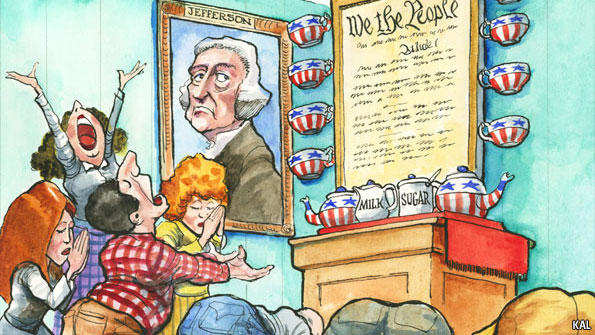
Constitutional Idolatry?

Political Fundamentalism is the continuation of the Inquisition, adapting to a changing world in an attempt to prevent the world itself from adapting to changing circumstances and insights, creating an obstruction to the continuation of the growth and application of the Scientific Revolution and the Enlightenment.

– Steve Harvey
political idol


Thomas Jefferson to James Madison

6 Sept. 1789Papers 15:392–97

I sit down to write to you without knowing by what occasion I shall send my letter. I do it because a subject comes into my head which I would wish to develope a little more than is practicable in the hurry of the moment of making up general dispatches.

The question Whether one generation of men has a right to bind another, seems never to have been started either on this or our side of the water. Yet it is a question of such consequences as not only to merit decision, but place also, among the fundamental principles of every government. The course of reflection in which we are immersed here on the elementary principles of society has presented this question to my mind; and that no such obligation can be so transmitted I think very capable of proof.–I set out on this ground, which I suppose to be self evident, “that the earth belongs in usufruct to the living”: that the dead have neither powers nor rights over it. The portion occupied by an individual ceases to be his when himself ceases to be, and reverts to the society. If the society has formed no rules for the appropriation of it’s lands in severality, it will be taken by the first occupants. These will generally be the wife and children of the decedent. If they have formed rules of appropriation, those rules may give it to the wife and children, or to some one of them, or to the legatee of the deceased. So they may give it to his creditor. But the child, the legatee, or creditor takes it, not by any natural right, but by a law of the society of which they are members, and to which they are subject. Then no man can, by natural right, oblige the lands he occupied, or the persons who succeed him in that occupation, to the paiment of debts contracted by him. For if he could, he might, during his own life, eat up the usufruct of the lands for several generations to come, and then the lands would belong to the dead, and not to the living, which would be the reverse of our principle.

What is true of every member of the society individually, is true of them all collectively, since the rights of the whole can be no more than the sum of the rights of the individuals.–To keep our ideas clear when applying them to a multitude, let us suppose a whole generation of men to be born on the same day, to attain mature age on the same day, and to die on the same day, leaving a succeeding generation in the moment of attaining their mature age all together. Let the ripe age be supposed of 21. years, and their period of life 34. years more, that being the average term given by the bills of mortality to persons who have already attained 21. years of age. Each successive generation would, in this way, come on, and go off the stage at a fixed moment, as individuals do now. Then I say the earth belongs to each of these generations, during it’s course, fully, and in their own right. The 2d. generation receives it clear of the debts and incumberances of the 1st. the 3d of the 2d. and so on. For if the 1st. could charge it with a debt, then the earth would belong to the dead and not the living generation. Then no generation can contract debts greater than may be paid during the course of it’s own existence. At 21. years of age they may bind themselves and their lands for 34. years to come: at 22. for 33: at 23. for 32. and at 54. for one year only; because these are the terms of life which remain to them at those respective epochs.–But a material difference must be noted between the succession of an individual, and that of a whole generation. Individuals are parts only of a society, subject to the laws of the whole. These laws may appropriate the portion of land occupied by a decedent to his creditor rather than to any other, or to his child on condition he satisfies the creditor. But when a whole generation, that is, the whole society dies, as in the case we have supposed, and another generation or society succeeds, this forms a whole, and there is no superior who can give their territory to a third society, who may have lent money to their predecessors beyond their faculties of paying.

What is true of a generation all arriving to self-government on the same day, and dying all on the same day, is true of those in a constant course of decay and renewal, with this only difference. A generation coming in and going out entire, as in the first case, would have a right in the 1st. year of their self-dominion to contract a debt for 33. years, in the 10th. for 24. in the 20th. for 14. in the 30th. for 4. whereas generations, changing daily by daily deaths and births, have one constant term, beginning at the date of their contract, and ending when a majority of those of full age at that date shall be dead. The length of that term may be estimated from the tables of mortality, corrected by the circumstances of climate, occupation &c. peculiar to the country of the contractors. Take, for instance, the table of M. de Buffon wherein he states 23,994 deaths, and the ages at which they happened. Suppose a society in which 23,994 persons are born every year, and live to the ages stated in this table. The conditions of that society will be as follows. 1st. It will consist constantly of 617,703. persons of all ages. 21y. Of those living at any one instant of time, one half will be dead in 24. years 8. months. 3dly. 1[8],675 will arrive every year at the age of 21. years complete. 41y. It will constantly have 348,417 persons of all ages above 21. years. 5ly. And the half of those of 21. years and upwards living at any one instant of time will be dead in 18. years 8. months, or say 19. years as the nearest integral number. Then 19. years is the term beyond which neither the representatives of a nation, nor even the whole nation itself assembled, can validly extend a debt.

To render this conclusion palpable by example, suppose that Louis XIV. and XV. had contracted debts in the name of the French nation to the amount of 10,000 milliards of livres, and that the whole had been contracted in Genoa. The interest of this sum would be 500. milliards, which is said to be the whole rent roll or nett proceeds of the territory of France. Must the present generation of men have retired from the territory in which nature produced them, and ceded it to the Genoese creditors? No. They have the same rights over the soil on which they were produced, as the preceding generations had. They derive these rights not from their predecessors, but from nature. They then and their soil are by nature clear of the debts of their predecessors.

Again suppose Louis XV. and his cotemporary generation had said to the money-lenders of Genoa, give us money that we may eat, drink, and be merry in our day; and on condition you will demand no interest till the end of 19. years you shall then for ever after receive an annual interest of 125/8 per cent. The money is lent on these conditions, is divided among the living, eaten, drank, and squandered. Would the present generation be obliged to apply the produce of the earth and of their labour to replace their dissipations? Not at all.

I suppose that the recieved opinion, that the public debts of one generation devolve on the next, has been suggested by our seeing habitually in private life that he who succeeds to lands is required to pay the debts of his ancestor or testator: without considering that this requisition is municipal only, not moral; flowing from the will of the society, which has found it convenient to appropriate lands, become vacant by the death of their occupant, on the condition of a paiment of his debts: but that between society and society, or generation and generation, there is no municipal obligation, no umpire but the law of nature. We seem not to have percieved that, by the law of nature, one generation is to another as one independant nation to another.

The interest of the national debt of France being in fact but a two thousandth part of it’s rent roll, the paiment of it is practicable enough: and so becomes a question merely of honor, or of expediency. But with respect to future debts, would it not be wise and just for that nation to declare, in the constitution they are forming, that neither the legislature, nor the nation itself, can validly contract more debt than they may pay within their own age, or within the term of 19. years? And that all future contracts will be deemed void as to what shall remain unpaid at the end of 19. years from their date? This would put the lenders, and the borrowers also, on their guard. By reducing too the faculty of borrowing within it’s natural limits, it would bridle the spirit of war, to which too free a course has been procured by the inattention of money-lenders to this law of nature, that succeeding generations are not responsible for the preceding.

On similar ground it may be proved that no society can make a perpetual constitution, or even a perpetual law. The earth belongs always to the living generation. They may manage it then, and what proceeds from it, as they please, during their usufruct. They are masters too of their own persons, and consequently may govern them as they please. But persons and property make the sum of the objects of government. The constitution and the laws of their predecessors extinguished then in their natural course with those who gave them being. This could preserve that being till it ceased to be itself, and no longer. Every constitution then, and every law, naturally expires at the end of 19 years. If it be enforced longer, it is an act of force, and not of right.–It may be said that the succeeding generation exercising in fact the power of repeal, this leaves them as free as if the constitution or law has been expressly limited to 19 years only. In the first place, this objection admits the right, in proposing an equivalent. But the power of repeal is not an equivalent. It might be indeed if every form of government were so perfectly contrived that the will of the majority could always be obtained fairly and without impediment. But this is true of no form. The people cannot assemble themselves. Their representation is unequal and vicious. Various checks are opposed to every legislative proposition. Factions get possession of the public councils. Bribery corrupts them. Personal interests lead them astray from the general interests of their constituents: and other impediments arise so as to prove to every practical man that a law of limited duration is much more manageable than one which needs a repeal.

This principle that the earth belongs to the living, and not to the dead, is of very extensive application and consequences, in every country, and most especially in France. It enters into the resolution of the questions Whether the nation may change the descent of lands holden in tail? Whether they may change the appropriation of lands given antiently to the church, to hospitals, colleges, orders of chivalry, and otherwise in perpetuity? Whether they may abolish the charges and privileges attached on lands, including the whole catalogue ecclesiastical and feudal? It goes to hereditary offices, authorities and jurisdictions; to hereditary orders, distinctions and appellations; to perpetual monopolies in commerce, the arts and sciences; with a long train of et ceteras: and it renders the question of reimbursement a question of generosity and not of right. In all these cases, the legislature of the day could authorize such appropriations and establishments for their own time, but no longer; and the present holders, even where they, or their ancestors, have purchased, are in the case of bonâ fide purchasers of what the seller had no right to convey.

Turn this subject in your mind, my dear Sir, and particularly as to the power of contracting debts; and develope it with that perspicuity and cogent logic so peculiarly yours. Your station in the councils of our country gives you an opportunity of producing it to public consideration, of forcing it into discussion. At first blush it may be rallied, as a theoretical speculation: but examination will prove it to be solid and salutary. It would furnish matter for a fine preamble to our first law for appropriating the public revenue; and it will exclude at the threshold of our new government the contagious and ruinous errors of this quarter of the globe, which have armed despots with means, not sanctioned by nature, for binding in chains their fellow men. We have already given in example one effectual check to the Dog of war by transferring the power of letting him loose from the Executive to the Legislative body, from those who are to spend to those who are to pay. I should be pleased to see this second obstacle held out by us also in the first instance. No nation can make a declaration against the validity of long-contracted debts so disinterestedly as we, since we do not owe a shilling which may not be paid with ease, principal and interest, within the time of our own lives.–Establish the principle also in the new law to be passed for protecting copyrights and new inventions, by securing the exclusive right for 19. instead of 14. years. Besides familiarising us to this term, it will be an instance the more of our taking reason for our guide, instead of English precedent, the habit of which fetters us with all the political heresies of a nation equally remarkeable for it’s early excitement from some errors, and long slumbering under others.

. . . . .

Federalist No. 49

Method of Guarding Against the Encroachments of Any One Department of Government by Appealing to the People Through a Convention
From the New York Packet.
Tuesday, February 5, 1788.

Author: Alexander Hamilton or James Madison

To the People of the State of New York:

THE author of the “Notes on the State of Virginia,” quoted in the last paper, has subjoined to that valuable work the draught of a constitution, which had been prepared in order to be laid before a convention, expected to be called in 1783, by the legislature, for the establishment of a constitution for that commonwealth. The plan, like every thing from the same pen, marks a turn of thinking, original, comprehensive, and accurate; and is the more worthy of attention as it equally displays a fervent attachment to republican government and an enlightened view of the dangerous propensities against which it ought to be guarded.

One of the precautions which he proposes, and on which he appears ultimately to rely as a palladium to the weaker departments of power against the invasions of the stronger, is perhaps altogether his own, and as it immediately relates to the subject of our present inquiry, ought not to be overlooked. His proposition is, “that whenever any two of the three branches of government shall concur in opinion, each by the voices of two thirds of their whole number, that a convention is necessary for altering the constitution, or CORRECTING BREACHES OF IT, a convention shall be called for the purpose. “As the people are the only legitimate fountain of power, and it is from them that the constitutional charter, under which the several branches of government hold their power, is derived, it seems strictly consonant to the republican theory, to recur to the same original authority, not only whenever it may be necessary to enlarge, diminish, or new-model the powers of the government, but also whenever any one of the departments may commit encroachments on the chartered authorities of the others. The several departments being perfectly co-ordinate by the terms of their common commission, none of them, it is evident, can pretend to an exclusive or superior right of settling the boundaries between their respective powers; and how are the encroachments of the stronger to be prevented, or the wrongs of the weaker to be redressed, without an appeal to the people themselves, who, as the grantors of the commissions, can alone declare its true meaning, and enforce its observance? There is certainly great force in this reasoning, and it must be allowed to prove that a constitutional road to the decision of the people ought to be marked out and kept open, for certain great and extraordinary occasions. But there appear to be insuperable objections against the proposed recurrence to the people, as a provision in all cases for keeping the several departments of power within their constitutional limits. In the first place, the provision does not reach the case of a combination of two of the departments against the third. If the legislative authority, which possesses so many means of operating on the motives of the other departments, should be able to gain to its interest either of the others, or even one third of its members, the remaining department could derive no advantage from its remedial provision. I do not dwell, however, on this objection, because it may be thought to be rather against the modification of the principle, than against the principle itself. In the next place, it may be considered as an objection inherent in the principle, that as every appeal to the people would carry an implication of some defect in the government, frequent appeals would, in a great measure, deprive the government of that veneration which time bestows on every thing, and without which perhaps the wisest and freest governments would not possess the requisite stability. If it be true that all governments rest on opinion, it is no less true that the strength of opinion in each individual, and its practical influence on his conduct, depend much on the number which he supposes to have entertained the same opinion. The reason of man, like man himself, is timid and cautious when left alone, and acquires firmness and confidence in proportion to the number with which it is associated. When the examples which fortify opinion are ANCIENT as well as NUMEROUS, they are known to have a double effect. In a nation of philosophers, this consideration ought to be disregarded. A reverence for the laws would be sufficiently inculcated by the voice of an enlightened reason. But a nation of philosophers is as little to be expected as the philosophical race of kings wished for by Plato. And in every other nation, the most rational government will not find it a superfluous advantage to have the prejudices of the community on its side. The danger of disturbing the public tranquillity by interesting too strongly the public passions, is a still more serious objection against a frequent reference of constitutional questions to the decision of the whole society. Notwithstanding the success which has attended the revisions of our established forms of government, and which does so much honor to the virtue and intelligence of the people of America, it must be confessed that the experiments are of too ticklish a nature to be unnecessarily multiplied. We are to recollect that all the existing constitutions were formed in the midst of a danger which repressed the passions most unfriendly to order and concord; of an enthusiastic confidence of the people in their patriotic leaders, which stifled the ordinary diversity of opinions on great national questions; of a universal ardor for new and opposite forms, produced by a universal resentment and indignation against the ancient government; and whilst no spirit of party connected with the changes to be made, or the abuses to be reformed, could mingle its leaven in the operation. The future situations in which we must expect to be usually placed, do not present any equivalent security against the danger which is apprehended. But the greatest objection of all is, that the decisions which would probably result from such appeals would not answer the purpose of maintaining the constitutional equilibrium of the government. We have seen that the tendency of republican governments is to an aggrandizement of the legislative at the expense of the other departments. The appeals to the people, therefore, would usually be made by the executive and judiciary departments. But whether made by one side or the other, would each side enjoy equal advantages on the trial? Let us view their different situations. The members of the executive and judiciary departments are few in number, and can be personally known to a small part only of the people. The latter, by the mode of their appointment, as well as by the nature and permanency of it, are too far removed from the people to share much in their prepossessions. The former are generally the objects of jealousy, and their administration is always liable to be discolored and rendered unpopular. The members of the legislative department, on the other hand, are numberous. They are distributed and dwell among the people at large. Their connections of blood, of friendship, and of acquaintance embrace a great proportion of the most influential part of the society. The nature of their public trust implies a personal influence among the people, and that they are more immediately the confidential guardians of the rights and liberties of the people. With these advantages, it can hardly be supposed that the adverse party would have an equal chance for a favorable issue. But the legislative party would not only be able to plead their cause most successfully with the people. They would probably be constituted themselves the judges.

The same influence which had gained them an election into the legislature, would gain them a seat in the convention. If this should not be the case with all, it would probably be the case with many, and pretty certainly with those leading characters, on whom every thing depends in such bodies. The convention, in short, would be composed chiefly of men who had been, who actually were, or who expected to be, members of the department whose conduct was arraigned. They would consequently be parties to the very question to be decided by them. It might, however, sometimes happen, that appeals would be made under circumstances less adverse to the executive and judiciary departments. The usurpations of the legislature might be so flagrant and so sudden, as to admit of no specious coloring. A strong party among themselves might take side with the other branches. The executive power might be in the hands of a peculiar favorite of the people. In such a posture of things, the public decision might be less swayed by prepossessions in favor of the legislative party. But still it could never be expected to turn on the true merits of the question. It would inevitably be connected with the spirit of pre-existing parties, or of parties springing out of the question itself. It would be connected with persons of distinguished character and extensive influence in the community. It would be pronounced by the very men who had been agents in, or opponents of, the measures to which the decision would relate. The PASSIONS, therefore, not the REASON, of the public would sit in judgment. But it is the reason, alone, of the public, that ought to control and regulate the government. The passions ought to be controlled and regulated by the government.

We found in the last paper, that mere declarations in the written constitution are not sufficient to restrain the several departments within their legal rights. It appears in this, that occasional appeals to the people would be neither a proper nor an effectual provision for that purpose. How far the provisions of a different nature contained in the plan above quoted might be adequate, I do not examine. Some of them are unquestionably founded on sound political principles, and all of them are framed with singular ingenuity and precision.

PUBLIUS.

. . . . .

A subject comes into my head as well. Should we idolize the founding fathers? Would they recognize this country after so much has evolved? Should we rewrite the foundational documents of our nation based on this evolution? Have the basic principles of nature changed since the 18th century? Do we need a new John Locke and Adam Smith? I dare not take these questions or their answers lightly. I shrink from the daunting task.

There is nothing which I dread so much as a division of the republic into two great parties, each arranged under its leader, and concerting measures in opposition to each other. This, in my humble apprehension, is to be dreaded as the greatest political evil under our Constitution.

– John Adams

See Also

Preliminary Warnings on ‘Constitutional’ Idolatry

Idolatry in Constitutional Interpretation

Our Constitution is Outdated and Broken

Requiem for the American Dream

Available Now on Netflix

Requiem for the American Dream is the definitive discourse with Noam Chomsky, widely regarded as the most important intellectual alive, on the defining characteristic of our time – the deliberate concentration of wealth and power in the hands of a select few. Through interviews filmed over four years, Chomsky unpacks the principles that have brought us to the crossroads of historically unprecedented inequality – tracing a half century of policies designed to favor the most wealthy at the expense of the majority – while also looking back on his own life of activism and political participation. Profoundly personal and thought provoking, Chomsky provides penetrating insight into what may well be the lasting legacy of our time – the death of the middle class, and swan song of functioning democracy. A potent reminder that power ultimately rests in the hands of the governed, Requiem is required viewing for all who maintain hope in a shared stake in the future.

Noam Chomsky is an American linguist, philosopher, cognitive scientist, historian, logician, social critic, and political activist. Sometimes described as “the father of modern linguistics”, Chomsky is also a major figure in analytic philosophy, and one of the founders of the field of cognitive science. He has spent more than half a century at the Massachusetts Institute of Technology (MIT), where he is Institute Professor Emeritus, and is the author of over 100 books on topics such as linguistics, war, politics, and mass media. Ideologically, he aligns with anarcho-syndicalism and libertarian socialism.

http://requiemfortheamericandream.com/

https://chomsky.info/

What’s on the Agenda

I remember, in my youth, feeling a certain sense of loss when I realized that the WWF was scripted. In the same way, reality television fans would be bummed to find out that their favorite show is scripted. It’s a feeling akin to what is felt when one learns that the Easter Bunny does not exist, Santa Claus does not exist, and as a result one is doubtful about the existence of God. But this is not about theology or wrestling. This is just a short list of some interesting scripted entertainment.

CNN

The Daily Show

Fox News

Russia Today

Alex Jones

Colbert Nation

NBC

BBC

To Be Governed

To be governed is to be watched, inspected, spied upon, directed, law-driven, numbered, regulated, enrolled, indoctrinated, preached at, controlled, checked, estimated, valued, censured, commanded, by creatures who have neither the right nor the wisdom nor the virtue to do so. To be governed is to be at every operation, at every transaction noted, registered, counted, taxed, stamped, measured, numbered, assessed, licensed, authorized, admonished, prevented, forbidden, reformed, corrected, punished. It is, under pretext of public utility, and in the name of the public interest, to be placed under contribution, drilled, fleeced, exploited, monopolized, extorted from, squeezed, hoaxed, robbed; then, at the slightest resistance, the first word of complaint, to be repressed, fined, vilified, harassed, hunted down, abused, clubbed, disarmed, bound, choked, imprisoned, judged, condemned, shot, deported, sacrificed, sold, betrayed; and to crown all, mocked, ridiculed, derided, outraged, dishonored. That is government; that is its justice; that is its morality.

– Pierre-Joseph Proudhon

The Shocking Truth About the Crackdown on Occupy

Naomi Wolf

Guardian.co.uk, Friday 25 November 2011 12.25 EST

The violent police assaults across the US are no coincidence. Occupy has touched the third rail of our political class’s venality.

US citizens of all political persuasions are still reeling from images of unparallelled police brutality in a coordinated crackdown against peaceful OWS protesters in cities across the nation this past week. An elderly woman was pepper-sprayed in the face; the scene of unresisting, supine students at UC Davis being pepper-sprayed by phalanxes of riot police went viral online; images proliferated of young women – targeted seemingly for their gender – screaming, dragged by the hair by police in riot gear; and the pictures of a young man, stunned and bleeding profusely from the head, emerged in the record of the middle-of-the-night clearing of Zuccotti Park.

But just when Americans thought we had the picture – was this crazy police and mayoral overkill, on a municipal level, in many different cities? – the picture darkened. The National Union of Journalists and the Committee to Protect Journalists issued a Freedom of Information Act request to investigate possible federal involvement with law enforcement practices that appeared to target journalists. The New York Times reported that “New York cops have arrested, punched, whacked, shoved to the ground and tossed a barrier at reporters and photographers” covering protests. Reporters were asked by NYPD to raise their hands to prove they had credentials: when many dutifully did so, they were taken, upon threat of arrest, away from the story they were covering, andpenned far from the site in which the news was unfolding. Other reporters wearing press passes were arrested and roughed up by cops, after being – falsely – informed by police that “It is illegal to take pictures on the sidewalk.”

In New York, a state supreme court justice and a New York City council member were beaten up; in Berkeley, California, one of our greatest national poets, Robert Hass, was beaten with batons. The picture darkened still further when Wonkette and Washingtonsblog.com reportedthat the Mayor of Oakland acknowledged that the Department of Homeland Security had participated in an 18-city mayor conference call advising mayors on “how to suppress” Occupy protests.

To Europeans, the enormity of this breach may not be obvious at first. Our system of government prohibits the creation of a federalised police force, and forbids federal or militarised involvement in municipal peacekeeping.

I noticed that rightwing pundits and politicians on the TV shows on which I was appearing were all on-message against OWS. Journalist Chris Hayes reported on a leaked memo that revealed lobbyists vying for an $850,000 contract to smear Occupy. Message coordination of this kind is impossible without a full-court press at the top. This was clearly not simply a case of a freaked-out mayors’, city-by-city municipal overreaction against mess in the parks and cranky campers. As the puzzle pieces fit together, they began to show coordination against OWS at the highest national levels.

Why this massive mobilisation against these not-yet-fully-articulated, unarmed, inchoate people? After all, protesters against the war in Iraq, Tea Party rallies and others have all proceeded without this coordinated crackdown. Is it really the camping? As I write, two hundred young people, with sleeping bags, suitcases and even folding chairs, are still camping out all night and day outside of NBC on public sidewalks – under the benevolent eye of an NYPD cop – awaiting Saturday Night Live tickets, so surely the camping is not the issue. I was still deeply puzzled as to why OWS, this hapless, hopeful band, would call out a violent federal response.

That is, until I found out what it was that OWS actually wanted.

The mainstream media was declaring continually “OWS has no message”. Frustrated, I simply asked them. I began soliciting online “What is it you want?” answers from Occupy. In the first 15 minutes, I received 100 answers. These were truly eye-opening.

The No 1 agenda item: get the money out of politics. Most often cited was legislation to blunt the effect of the Citizens United ruling, which lets boundless sums enter the campaign process. No 2: reform the banking system to prevent fraud and manipulation, with the most frequent item being to restore the Glass-Steagall Act – the Depression-era law, done away with by President Clinton, that separates investment banks from commercial banks. This law would correct the conditions for the recent crisis, as investment banks could not take risks for profit that create kale derivatives out of thin air, and wipe out the commercial and savings banks.

No 3 was the most clarifying: draft laws against the little-known loophole that currently allows members of Congress to pass legislation affecting Delaware-based corporations in which they themselves are investors.

When I saw this list – and especially the last agenda item – the scales fell from my eyes. Of course, these unarmed people would be having the shit kicked out of them.

For the terrible insight to take away from news that the Department of Homeland Security coordinated a violent crackdown is that the DHS does not freelance. The DHS cannot say, on its own initiative, “we are going after these scruffy hippies”. Rather, DHS is answerable up a chain of command: first, to New York Representative Peter King, head of the House homeland security subcommittee, who naturally is influenced by his fellow congressmen and women’s wishes and interests. And the DHS answers directly, above King, to the president (who was conveniently in Australia at the time).

In other words, for the DHS to be on a call with mayors, the logic of its chain of command and accountability implies that congressional overseers, with the blessing of the White House, told the DHS to authorise mayors to order their police forces – pumped up with millions of dollars of hardware and training from the DHS – to make war on peaceful citizens.

But wait: why on earth would Congress advise violent militarised reactions against its own peaceful constituents? The answer is straightforward: in recent years, members of Congress have started entering the system as members of the middle class (or upper middle class) – but they are leaving DC privy to vast personal wealth, as we see from the “scandal” of presidential contender Newt Gingrich’s having been paid $1.8m for a few hours’ “consulting” to special interests. The inflated fees to lawmakers who turn lobbyists are common knowledge, but the notion that congressmen and women are legislating their own companies’ profitsis less widely known – and if the books were to be opened, they would surely reveal corruption on a Wall Street spectrum. Indeed, we do already know that congresspeople are massively profiting from trading on non-public information they have on companies about which they are legislating – a form of insider trading that sent Martha Stewart to jail.

Since Occupy is heavily surveilled and infiltrated, it is likely that the DHS and police informers are aware, before Occupy itself is, what its emerging agenda is going to look like. If legislating away lobbyists’ privileges to earn boundless fees once they are close to the legislative process, reforming the banks so they can’t suck money out of fake derivatives products, and, most critically, opening the books on a system that allowed members of Congress to profit personally – and immensely – from their own legislation, are two beats away from the grasp of an electorally organised Occupy movement … well, you will call out the troops on stopping that advance.

So, when you connect the dots, properly understood, what happened this week is the first battle in a civil war; a civil war in which, for now, only one side is choosing violence. It is a battle in which members of Congress, with the collusion of the American president, sent violent, organised suppression against the people they are supposed to represent. Occupy has touched the third rail: personal congressional profits streams. Even though they are, as yet, unaware of what the implications of their movement are, those threatened by the stirrings of their dreams of reform are not.

Sadly, Americans this week have come one step closer to being true brothers and sisters of the protesters in Tahrir Square. Like them, our own national leaders, who likely see their own personal wealth under threat from transparency and reform, are now making war upon us.

Do we really want a civil war? Is there another option? Will a call to arms occur as peaceful demonstrations are brought down violently? Stay tuned to planet Earth for updates!