What did Max Weber mean by the ‘Spirit’ of Capitalism?

ludwigshafen

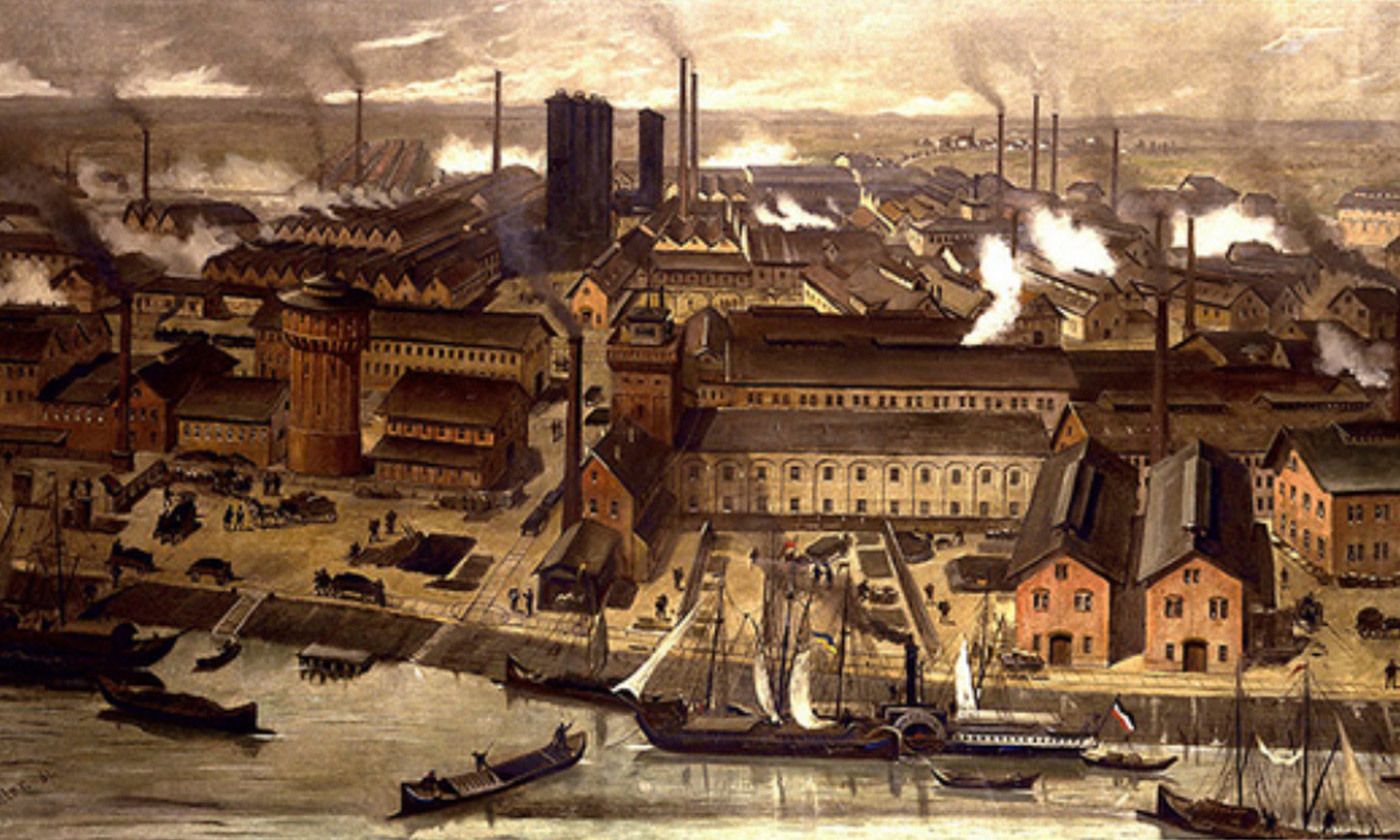
The BASF factory at Ludwigshafen, Germany, pictured on a postcard in 1881. Courtesy Wikipedia

Peter Ghosh | Aeon Ideas

Max Weber’s famous text The Protestant Ethic and the Spirit of Capitalism (1905) is surely one of the most misunderstood of all the canonical works regularly taught, mangled and revered in universities across the globe. This is not to say that teachers and students are stupid, but that this is an exceptionally compact text that ranges across a very broad subject area, written by an out-and-out intellectual at the top of his game. He would have been dumb­founded to find that it was being used as an elementary introduction to sociology for undergraduate students, or even schoolchildren.

We use the word ‘capitalism’ today as if its meaning were self-evident, or else as if it came from Marx, but this casualness must be set aside. ‘Capitalism’ was Weber’s own word and he defined it as he saw fit. Its most general meaning was quite simply modernity itself: capitalism was ‘the most fateful power in our modern life’. More specifically, it controlled and generated ‘modern Kultur’, the code of values by which people lived in the 20th-century West, and now live, we may add, in much of the 21st-century globe. So the ‘spirit’ of capitalism is also an ‘ethic’, though no doubt the title would have sounded a bit flat if it had been called The Protestant Ethic and the Ethic of Capitalism.

This modern ‘ethic’ or code of values was unlike any other that had gone before. Weber supposed that all previous ethics – that is, socially accepted codes of behaviour rather than the more abstract propositions made by theologians and philosophers – were religious. Religions supplied clear messages about how to behave in society in straightforward human terms, messages that were taken to be moral absolutes binding on all people. In the West this meant Christianity, and its most important social and ethical prescription came out of the Bible: ‘Love thy neighbour.’ Weber was not against love, but his idea of love was a private one – a realm of intimacy and sexuality. As a guide to social behaviour in public places ‘love thy neighbour’ was obviously nonsense, and this was a principal reason why the claims of churches to speak to modern society in authentically religious terms were marginal. He would not have been surprised at the long innings enjoyed by the slogan ‘God is love’ in the 20th-century West – its career was already launched in his own day – nor that its social consequences should have been so limited.

The ethic or code that dominated public life in the modern world was very different. Above all it was impersonal rather than personal: by Weber’s day, agreement on what was right and wrong for the individual was breaking down. The truths of religion – the basis of ethics – were now contested, and other time-honoured norms – such as those pertaining to sexuality, marriage and beauty – were also breaking down. (Here is a blast from the past: who today would think to uphold a binding idea of beauty?) Values were increasingly the property of the individual, not society. So instead of humanly warm contact, based on a shared, intuitively obvious understanding of right and wrong, public behaviour was cool, reserved, hard and sober, governed by strict personal self-control. Correct behaviour lay in the observance of correct procedures. Most obviously, it obeyed the letter of the law (for who could say what its spirit was?) and it was rational. It was logical, consistent, and coherent; or else it obeyed unquestioned modern realities such as the power of numbers, market forces and technology.

There was another kind of disintegration besides that of traditional ethics. The proliferation of knowledge and reflection on knowledge had made it impossible for any one person to know and survey it all. In a world which could not be grasped as a whole, and where there were no universally shared values, most people clung to the particular niche to which they were most committed: their job or profession. They treated their work as a post-religious calling, ‘an absolute end in itself’, and if the modern ‘ethic’ or ‘spirit’ had an ultimate found­ation, this was it. One of the most widespread clichés about Weber’s thought is to say that he preached a work ethic. This is a mistake. He personally saw no particular virtue in sweat – he thought his best ideas came to him when relaxing on a sofa with a cigar – and had he known he would be misunder­stood in this way, he would have pointed out that a capacity for hard work was something that did not dist­inguish the modern West from previous soc­ieties and their value systems. However, the idea that people were being ever more defined by the blinkered focus of their employment was one he regarded as profoundly modern and characteristic.

The blinkered pro­fessional ethic was common to entrepreneurs and an increasingly high-wage, skilled labour force, and it was this combination that produced a situation where the ‘highest good’ was the making of money and ever more money, without any limit. This is what is most readily recognisable as the ‘spirit’ of capitalism, but it should be stressed that it was not a simple ethic of greed which, as Weber recognised, was age-old and eternal. In fact there are two sets of ideas here, though they overlap. There is one about potentially universal rational pro­cedures – specialisation, logic, and formally consistent behaviour – and another that is closer to the modern economy, of which the central part is the professional ethic. The modern situation was the product of narrow-minded adhesion to one’s particular function under a set of conditions where the attempt to understand modernity as a whole had been abandoned by most people. As a result they were not in control of their own destiny, but were governed by the set of rational and impersonal pro­cedures which he likened to an iron cage, or ‘steel housing’. Given its rational and impersonal foundations, the housing fell far short of any human ideal of warmth, spontaneity or breadth of outlook; yet rationality, technology and legality also produced material goods for mass consumption in unprecedented amounts. For this reason, though they could always do so if they chose to, people were unlikely to leave the housing ‘until the last hundredweight of fossil fuel is burned up’.

It is an extremely powerful analysis, which tells us a great deal about the 20th-century West and a set of Western ideas and priorities that the rest of the world has been increasingly happy to take up since 1945. It derives its power not simply from what it says, but because Weber sought to place under­standing before judgment, and to see the world as a whole. If we wish to go beyond him, we must do the same.Aeon counter – do not remove

Peter Ghosh

This article was originally published at Aeon and has been republished under Creative Commons.

Is Philosophy Absurd? Only When You’re Doing it Right

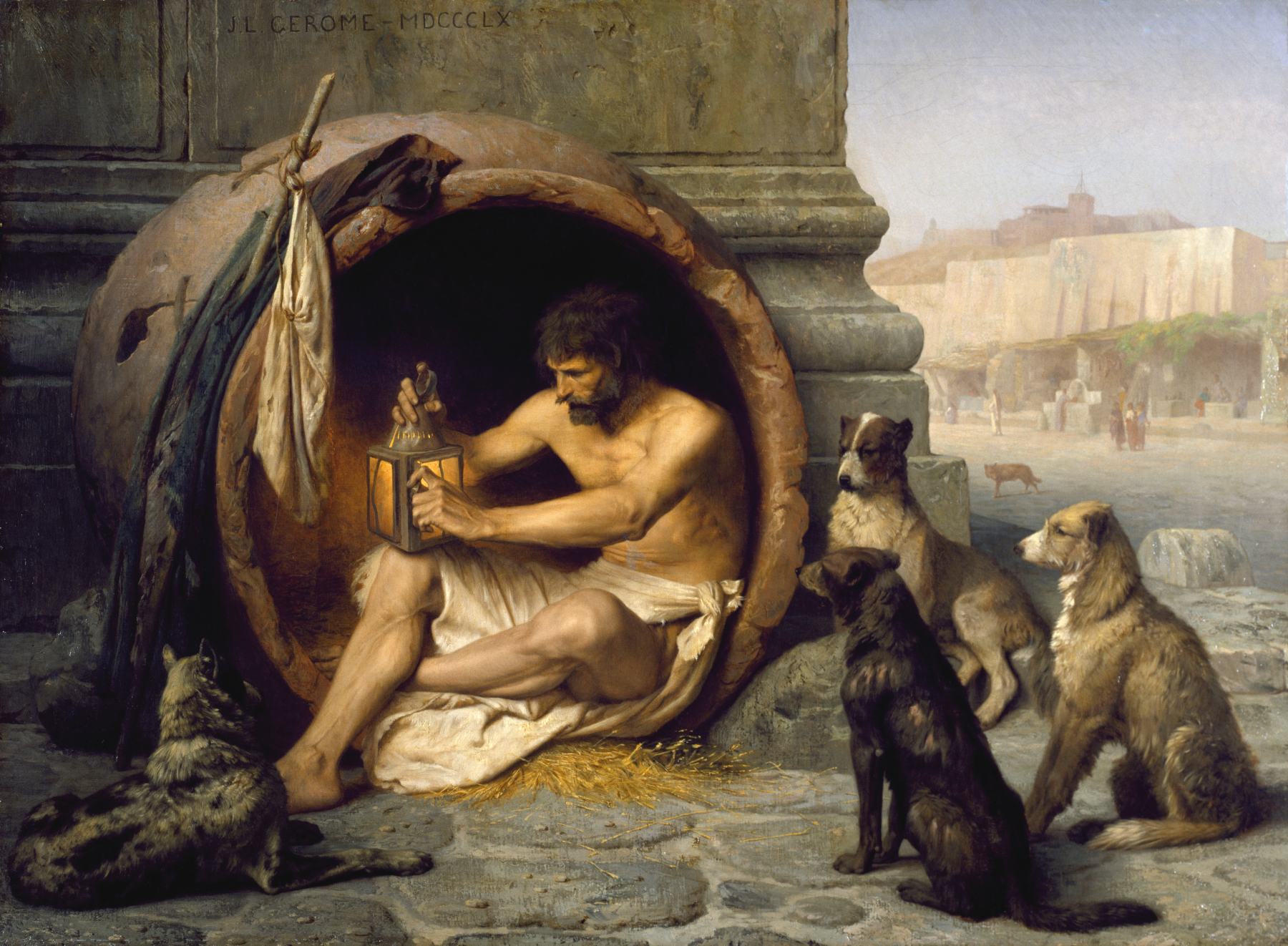
diogenes

Helena de Bres | Aeon Ideas

Last semester, halfway through a meeting of my ‘Meaning of Life’ seminar, I found myself lying on a window seat along the eastern wall of the classroom. I was scheduled for spinal surgery in a few months, and sitting and standing were tough. I needed a break.

‘It was the Romantics,’ I intoned, adjusting the pillow under my head, ‘who first argued that living “authentically” is an end in itself. For some, authenticity overtook morality as the ultimate ideal. As Ralph Waldo Emerson put it [here I began to gesticulate energetically]: The only right is what is after my constitution, the only wrong what is against it!’ I whacked my elbow involuntarily against the wall. ‘Nothing is at last sacred but the integrity of your own mind!’

I glanced up at my students and faltered. It had occurred to me, and perhaps to them, that I was being absurd.

I had this thought, and then, because overthinking is my profession, I analysed it. Why absurd, exactly? On one account, absurdity springs from a noticeable gap between expectation and reality, aim and outcome, or means and end. Sometimes the discrepancy is amusing. Imagine an artist-in-residence’s end-of-year exhibition involving only a tiny makeshift diorama depicting the artist sleeping. Other times, the discrepancy is terrifying, as when a darling of the fossil-fuel industry is appointed to lead the Environmental Protection Agency. In my case, the mismatch was between the command and authority that a professor is expected to display and the fact that I was lying below eye level on a puffy log-shaped pillow.

My horizontal lecture wouldn’t have been quite as absurd, though, if I were, say, an economist or historian. There’s something especially absurd about philosophers, supine or not. The explanation for this might lie in the best-known philosophical account of absurdity, offered by Thomas Nagel in 1971. Nagel argued that when we sense that something – or everything – in life is absurd, we’re experiencing the clash of two perspectives from which to view the world. One is that of the engaged agent, seeing her life from the inside, with her heart vibrating in her chest. The other is that of the detached spectator, watching human activity coolly, as if from the distance of another planet. Nagel notes that it’s our nature to flip between these points of view. One moment we’re fully caught up in our mushroom-cultivation class, our infatuation with our sister’s husband or our intractable power struggle with Terri in accounting. The next moment, our mental tectonics shift and we see ourselves from an emotional remove, like a spirit hovering over its own body. It becomes evident to us that, ‘from the point of view of the Universe’, to use the 19th-century utilitarian Henry Sidgwick’s phrase, none of these things matter.

Our sense of absurdity kicks in when we snap between these two perspectives rapidly, in a kind of duck-rabbit movement of the soul. The sense of absurdity depends on this instability. If we could retain the internal perspective forever, we’d never experience the shock of doubt about whether what we were doing was ultimately worthwhile or made any kind of sense. If, alternatively, we could permanently view all human affairs, our own included, from the perspective of the Universe, we’d never find ourselves eagerly attempting to adhere fungi to a damp log. We’d be full-time ascetics, to whom nothing human mattered at all, people who couldn’t be caught red-handed caring about something small.

Though Nagel says that we all adopt both the internal and external perspectives on our lives, some people clearly identify more with one than the other. And some of these people cluster in professions where one perspective is disproportionately valued. Academic philosophy is one such profession. When people say: ‘Let’s be philosophical about this,’ they mean: ‘Let’s calm down, step back, detach.’ The philosopher, in the public imagination, is set apart from the mundane concerns and fiery attachments that govern the rest of humanity. He or she takes the external perspective on pretty much everything. When Søren Kierkegaard collapsed at a party and people tried to help him up, he allegedly said: ‘Oh, leave it. Let the maid sweep it up in the morning.’

If this image is accurate, and if Nagel’s account is right, philosophers, parked forever in only one of Nagel’s perspectives, will escape the absurdity of the human condition. We philosophers, however, are among the most absurd people I’ve ever met. The reason for this has a whiff of paradox. Abstraction and detachment might be a philosopher’s stock-in-trade, but philosophers are often fiercely attached to those very things: passionate about impassion, abstract in the most concrete of ways. They spend years working obsessively on papers with titles such as ‘Nonreducible Supervenient Causation’ and then have public brawls about them at conferences. This is part of philosophy’s charm for me. There’s something especially absurd, yes, but also endearing, about people who are so serious about their core life endeavour that they regularly forget its ridiculous aspects, even though the endeavour itself is meant to serve as a perpetual reminder.

So I was both abstract and fervent down there on my log pillow. But what does this really have to do with the absurd? Many of us associate the concept not with simple discrepancy, nor with Nagel’s more complex perspectival clash, but with futility. A nice illustration of this is the video of a Japanese game show named ‘Slippery Stairs’ that went viral last year. The show requires its contestants – barefoot, in skin-tight onesies – to scramble to the top of a staircase coated with what looks like tepid ice. The video portrays six people painstakingly, desperately, attempting to do this, and repeatedly sliding dramatically back down the stairs, often taking the other five with them. ‘Life,’ someone wrote in the comments.

What attitude should we take to our situation or ourselves, once we recognise that they’re absurd, in any of these ways? One option is to shake our noble fists at the cosmos, cursing its silent coldness and slippery stairs. This stance appeals to a certain kind of guy in college. But some of us – women, the disabled, ethnic and gender minorities, etc – got the memo pretty early on that we weren’t plausibly the centre of the Universe. So when our adolescent attention was directed to life’s disappointments and farcicality, we were more inclined to shrug and get back to what we were doing than get theatrical about it.

Nagel recommends something like this approach. He writes: ‘If sub specie aeternitatis [viewed in relation to the eternal; in a universal perspective] there is no reason to believe that anything matters, then that doesn’t matter either, and we can approach our absurd lives with irony instead of heroism or despair.’ But irony might be less attractive in 2018 than it was in 1971. There’s something about seeing everything you value under constant attack that increases your sense that some things do matter.

My preferred take is this. The absurdity of our situation is only troubling if it implies that nothing really matters and that all human pursuits are inherently meaningless. But none of the accounts of absurdity canvassed above have that implication. If you love what you’re doing, and if what you love has genuine human-sized value (roughly, the moral philosopher Susan Wolf’s definition of meaningfulness), your life can have depth and purpose even if it involves incongruity and failure, and even if the Universe cares naught for it, or for you. Talking seriously about philosophy with teenagers, while your back collapses, their hearts break, their parents struggle, and the country falls apart – you could call it absurd. But you could also look up from your window seat, catch yourself in the thick of it, and, after a twinge of embarrassment, call it beautiful. Then get back to work.Aeon counter – do not remove

Helena de Bres

This article was originally published at Aeon and has been republished under Creative Commons.

The Problem of Atheism

Human Values and Science, Art and Mathematics

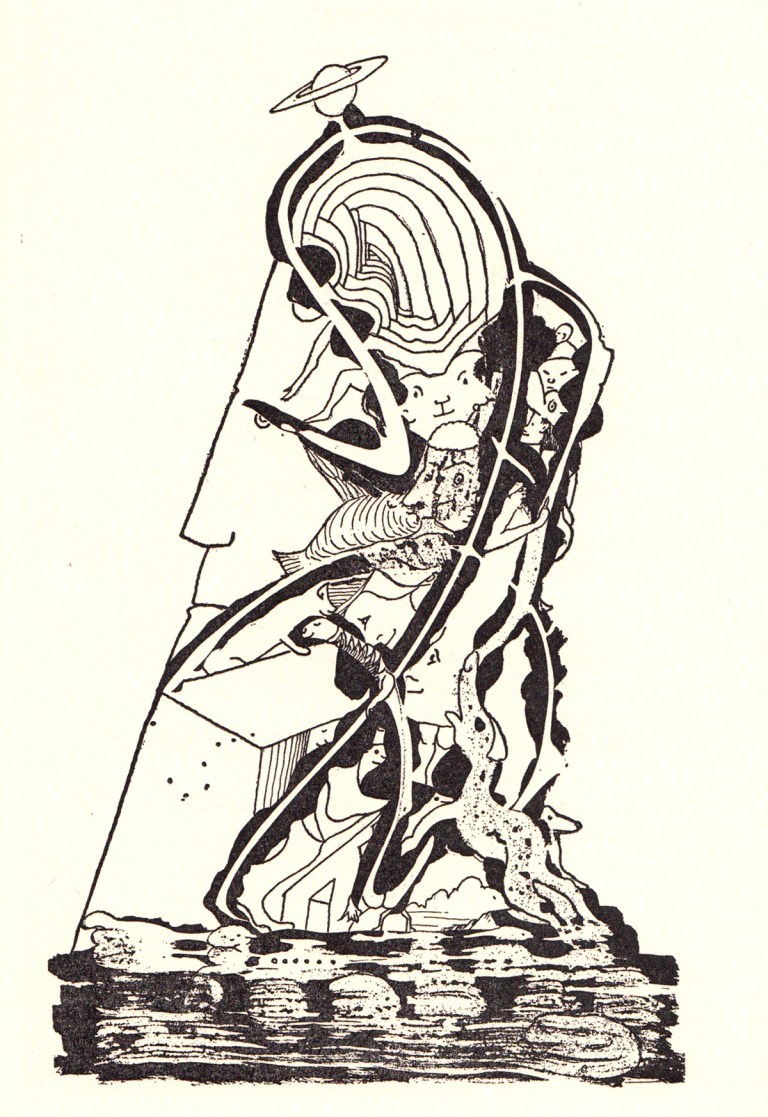
Illustration by artist Hugh Lieber from Human Values and Science, Art and Mathematics by mathematician Lillian Lieber


Excerpts from Keiji Nishitani (1900-1990), The Self-Overcoming of Nihilism (Appendix)

Marxist Humanism

As is commonly known, Marxism looks on religion as a way for those unable to come to terms with the frustrations of life to find satisfaction at the ideal level by imagining a world beyond. In so doing, the argument goes, they nullify the self and transpose the essence of their humanity into the image of “God” in the other world. In this act of religious “self-alienation” both nature and humanity become nonessential, void, and without substance. Atheism consists in the negation of this nonessentiality. By denying God it affirms the essence of the human. This emancipation of the human in turn is of a single root with human freedom.

This variety of atheism is connected with Marx’s characterization of the essence of the human individual as worker: humanity is achieved by remaking the world through work. The process of self-creation by which one gradually makes oneself human through work is what constitutes history. Seen from such a perspective, atheism is unavoidable. For since the source of religious self-alienation lies in economic self-alienation (the condition of being deprived of one’s humanity economically), once the latter is overcome, the former will fall away as a matter of course. According to Marx, then, atheism is a humanism wrought through the negation of religion.

Now insofar as Marx’s atheistic humanism is a humanism that has become self-conscious dialectically – its affirmation rests on the negation of religion – it clearly strikes at the very heart of religion. In it we find a clear and pointed expression of the general indifference, if not outright antagonism, to religion in the modern mind. From its very beginning, modern humanism has combined the two facets of maintaining ties to religion and gradually breaking away from it. In a sense, the history of modern philosophy can be read as a struggle among approaches to humanism based on one or the other of these aspects. At present the debate over humanism – what it is that constitutes the essence of the human – has become completely polarized. The responses provided by the various religious traditions show no signs of being able to allay the situation. Questions such as freedom, history, and labor, in the sense in which Marx discusses them in relation to the essence of humanity, paint a picture of the modern individual that had until recently escaped the notice of religion. To come to grips with such questions, religion will have to open up a new horizon.

Even if we grant that Marx’s thought touches the problem of religion at some depth, it is hard to sustain the claim that he understood its true foundations correctly. Matters like the meaning of life and death, or the impermanence of all things, simply cannot be reduced without remainder to a matter of economic self-alienation. These are questions of much broader and deeper reach, indeed questions essential for human being.

The problem expressed in the term “all is suffering” is a good example. It is clearly much more than a matter of the socio-historical suffering of human individuals; it belongs essentially to the way of being of all things in the world. The problem of human suffering is a problem of the suffering of the human being as “being-in-the-world,” too profound a matter to be alleviated merely by removing socio-historical suffering. It has to do with a basic mode of human being that also serves as the foundation for the pleasure, or the freedom from suffering and pleasure, that we oppose to suffering.

Or again, we might say that the issue of “the non-self nature of all dharmas” refers to “the nonessentiality of nature and humanity,” but this does not mean that we can reduce the claim to a self-alienating gesture of projecting the essence of our humanity on to “God.” It refers to the essential way that all things in the world are: depending on each other and existing only in interdependency. It is meant to point to the essential “non-essentiality” of all beings, and hence to a domain that no society can alter, however far it may progress. It is, in short, the very domain of religion that remains untouched by Marx’s critique. Marx argues emphatically that through work human beings conquer nature, change the world, and give the self its human face. But deep in the recesses behind the world of work lies a world whose depth and vastness are beyond our ken, a world in which everything arises only by depending on everything else, in which no single thing exists through the power of a “self” (or what is called “self-power”). This is the world of human beings who exist as “being-in-the-world.”

As for religion itself, whose maxim all along has been “all is suffering,” the idea that this has to do with “historical” suffering has not often come to the fore. (In this regard, Christianity represents an exception.) The idea of “karma” is supposed to relate concretely to the historicity of human existence, but even this viewpoint has not been forthcoming. The human activities of producing and using various things through “self-power,” of changing nature and society and creating a “human” self – in short, the emancipation of the human and the freedom of the human individual – would seem to be the most concrete “karma” of humanity and therefore profoundly connected with modern atheism. But none of these ideas has been forthcoming from the traditional religions. Even though for Christianity the fact that we must labor by the sweat of our brows is related to original sin, the germ of this idea has not, to my knowledge, been developed anywhere in modern theology.


Sartrean Existentialism

Modern atheism also appears in the form of existentialism. The same sharp and total opposition that separates existentialism and Marxism in general applies also to their respective forms of atheism. Unlike Marxism, which understands the human being as an essentially social being, existentialism thinks of the human being essentially as an individual; that is, it defines the human as a way of being in which each individual relates to itself. Marx’s critique of religion begins from the self-alienation of human beings in religion, redefines it as an economic self-alienation, and then deals with religion in terms of its social functions. In contrast, the existentialist Sartre, for example, understands the relationship between God and humanity as a problem of each individual’s relating to the essence of “self”-being itself. In other words, he begins from something like an ontological self-alienation implied in seeing human beings as creatures of God. For all the differences between the standpoints, they share the basic tenet that it is only by denying God that we can regain our own humanity. As is the case with Marx’s socialist individual, for Sartre’s existentialist individual humanism is viable only as an atheism – which is the force of Sartre’s referring to existentialism as a humanism.

According to Sartre, if God existed and had indeed created us, there would be basically no human freedom. If human existence derived from God and the essence of human existence consisted in this derivation, the individual’s every action and situation would be determined by this essential fact. In traditional terms, “essential being” precedes “actual being” and continually determines it. This means that the whole of actual human being is essentially contained within the “Providence” of God and is necessarily predetermined by God’s will. Such predestination amounts to a radical negation of human freedom. If we grant the existence of God we must admit God’s creation; and if we grant God’s creation, we must also allow for God’s predestination – in other words, we are forced to deny that there is any such thing as human freedom. If human freedom is to be affirmed, the existence of God must be denied.

Human “existence” (a temporal and “phenomenal” way of being) does not have behind it any essential being (a supratemporal and “noumenal” way of being) that would constitute its ground. There is nothing at all at the ground of existence. And it is from this ground of “nothing” where there is simply nothing at all that existence must continually determine itself. We must create ourselves anew ever and again out of nothing. Only in this way can one secure the being of a self – and exist. To be a human being is to humanize the self constantly, to create, indeed to have no choice other than to create, a “human being.” This self-being as continued self-creation out of nothing is what Sartre calls freedom. Insofar as one actually creates the self as human, actual existence precedes essence in the human being. In essence, the human individual is existence itself. This way of being human is “Existence,” and Existence can stand only on an atheism.

Of late we are beginning to see a turn in the standpoint of Heidegger, in that he no longer refers to his thought as an “existentialism.” Still, it seems important to point out what his thinking up until now has shared in common with the existentialism of Sartre. That human beings continually create themselves out of nothing is meant to supplant the Christian notion of God’s creatio ex nihilo. To this extent it is not the standpoint of “self-power” in the ordinary sense. Self-creation out of nothing is not brought about simply by the inner power of a being called human and hence is not a power contained within the framework of human being. This “being” is continually stepping beyond the framework of “being.” Nothingness means transcendence, but since this transcendence does not mean that there is some transcendent “other” apart from self-being, it implies a standpoint of “self-power,” not of “other-power.” In contrast to Christianity, it is a view in which nothingness becomes the ground of the subject and thereby becomes subjective nothing – a self-power based on nothing. Here the consciousness of freedom in the modern mind finds a powerful expression and amounts to what is, at least in the West, an entirely new standpoint. It seems doubtful that this standpoint can be confronted from within the traditional horizons that have defined Christianity so far. It is quite different with Buddhism.

From the perspective of Buddhism, Sartre’s notion of Existence, according to which one must create oneself continually in order to maintain oneself within nothing, remains a standpoint of attachment to the self – indeed, the most profound form of this attachment – and as such is caught in the self-contradiction this implies. It is not simply a question here of a standpoint of ordinary self-love in which the self is willfully attached to itself. It is rather a question of the self being compelled to be attached to itself willfully. To step out of the framework of being and into nothing is only to enter into a new framework of being once again. This self-contradiction constitutes a way of being in which the self is its own “prison,” which amounts to a form of karma. Self-creation, or freedom, may be self-aware, but only because, as Sartre himself says, we are “condemned to be free.” Such a freedom is not true freedom. Again, it may represent an exhaustive account of what we normally take freedom to be, but this only means that our usual idea of freedom is basically a kind of karma. Karma manifests itself in the way modern men and women ground themselves on an absolute affirmation of their freedom. As Sartre himself says, his standpoint of Existence is a radical carrying out of the cogito, ergo sum of Descartes, for the Cartesian ego shows us what the modern mode of being is.

That Sartre’s “Existence” retains a sense of attachment to the self implies, if we can get behind the idea, that the “nothingness” of which he speaks remains a nothingness to which the self is attached. It was remarked earlier that in existentialism nothingness became subjective nothingness, which means that, as in the case of Greek philosophy or Christianity, it is still bound to the human individual. Again looked at from behind, we find that human subjectivity is bound up inextricably with nothingness and that at the ground of human existence there is nothing, albeit a nothing of which there is still consciousness at the ground of the self. No matter how “pre-reflective” this consciousness is, it is not the point at which the being of the self is transformed existentially into absolute nothingness. Sartre’s nothingness is unable to make the being of the self (Existence) sufficiently “ek-static,” and to this extent it differs radically from Buddhist “emptiness.” The standpoint of emptiness appears when Sartrean Existence is overturned one more time. The question is whether Buddhism, in its traditional form, is equal to the confrontation with existentialism.

Sartre thinks that to be a human being is to “human-ize” the self continually and to create the self as human out of nothing. Pushing this idea to the extreme, and speaking from the standpoint of emptiness in Buddhism, it is a matter of continually assuming human form from a point where this form has been left behind and absolutely negated. It is, as it were, a matter of continued creative “accommodation,” a never-ending “return” to being a new “human.” Taken in the context of Buddhist thought as a whole, there is some question as to whether this idea of “accommodation” really carries such an actual and existential sense. Does it really, as Sartre’s idea of continual humanization does, have to do with our actual being at each moment?

When Sartre speaks of ceaseless self-creation out of nothing, he refers to an Existence that is temporal through and through. It does not admit of any separate realm of being, such as a supratemporal (or “eternal”) essence, but is simply based on “nothing.” But for Sartre Existence is self-created within a socio-historical situation, which demonstrates his profound appreciation of the social and historical dimensions of the human way of being. In the case of the standpoint of Buddhist emptiness, in which human being is understood as arising out of emptiness and existing in emptiness, we need to ask how far the actual Existence of the human being at each moment is included. How much of the Existence within the actual socio-historical situation, and completely temporalized in this actuality, is comprehended? To the extent that the comprehension is inadequate, the standpoint of Buddhism has become detached from our actuality, and that means that we have failed to take the standpoint of emptiness seriously enough and to make it existential. In this case, talk of “accommodation” is merely a kind of mythologizing.


Atheism in the World of Today

A crisis is taking place in the contemporary world in a variety of forms, cutting across the realms of culture, ethics, politics, and so forth. At the ground of these problems is that fact that the essence of being human has turned into a question mark for humanity itself. This means that a crisis has also struck in the field of religion, and that this crisis is the root of the problems that have arisen in other areas. We see evidence of this state of affairs in the fact that the most recent trends of thought in contemporary philosophy which are having a great influence – directly and indirectly – on culture, ethics, politics, and so on, are all based on a standpoint of atheism. This applies not only to Marxism and existentialism, especially as represented by Sartre, but also to logical positivism and numerous other currents of thought.

Involved in the problem of the essence of human being are the questions, “What is a human being?” and “By what values should one live?” These are questions that need to be thought through in terms of the totality of beings, the “myriad things” of which human beings are only one part. It is a question, too, of the place of human beings in the order of the totality of beings, and of how to accommodate to this position (that is, how to be truly human). For the order of being implies a ranking of values.

For example, even if “man” is said to be the lord of creation, this places him in a certain “locus” within the totality of things, and therefore refers to how one ought to live as a human being. In the Western tradition the locus of human being has been defined in relation to God. While we are said to have been created from nothing, our soul contains the imago dei. This divine image was shattered through original sin, to be restored only through the atonement of God’s Son, Jesus, and our faith in him as the Christ. Here the locus of human beings in the order of being and ranking of value takes a different form from the straightforward characterization of man as lord of creation, a form consisting of a complex interplay of negation and affirmation. This locus of human being is well expressed in Augustine’s saying: “Oh God, you have created us for you, and our hearts are restless until they rest in you.” Needless to say, the basic dynamism behind the forming of this locus came from Greek philosophy and Christianity.

Modern atheism, Marxism, and existentialism share in common the attempt to repudiate this traditional location of the human in order to restore human nature and freedom. The seriousness of this new humanism is that such a restoration is possible only through a denial of God. At the same time, the new humanism harbors a schism in its ranks between the standpoints of Marxism and existentialism. The axis of the existentialist standpoint is a subjectivity in which the self becomes truly itself, while Marxism, for all its talk of human beings as subjects of praxis, does not go beyond a view of the human being as an objective factor in the objective world of nature or society. Each of them comprehends human being from a locus different from the other.

In the Western tradition the objective world and subjective being – the natural and social orders on the one hand, the “soul” with its innate orientation to God on the other – were united within a single system. The two main currents in modern atheism correspond respectively to these two coordinates, the soul and the world, but there is little hope of their uniting given the current confrontation. There is no way for modern men and women simply to return to the old locus, and the new atheism offers only a locus split into two. Confusion reigns in today’s world at the most basic level concerning what human beings are and how they are to live.

Each of these two standpoints seeks to ground itself from start to finish in actual being. This is related to the denial of God, in that full engagement of the self in actual being requires a denial of having already been determined within the world-order established by God, as well as a denial of having been fitted out in advance with an orientation to God in one’s very soul. Both standpoints stress the importance of not becoming detached from the locus in which one “actually” is, of remaining firmly grounded in one’s actual socio-historical situation, or more fundamentally, in actual “time” and “space.” But do these standpoints really engage actual being to the full?

Earlier on I suggested that as long as Marxism and existentialism continue to hold to the standpoint of the “human,” they will never be able to give a full account of actual human being. These new forms of humanism try to restore human beings to actual being by eliminating from the world and the soul the element of divine “predetermination.” The result is that they leave a gaping void at the foundations, as is evidenced by the lack of a locus from which to address the problem of life and death. Since the human mode of being consists in life and death, we must pass beyond the human standpoint to face the problem of life and death squarely. But to overcome the human standpoint does not necessarily mean that one merely returns to the “predetermination” of God, nor that one simply extinguishes freedom or actual being. It is rather a matter of opening up the horizon in which the question can be engaged truly and to its outermost limits.

Earlier I also proposed consideration of the locus of Buddhist “emptiness” in this regard. In the locus of emptiness, beyond the human standpoint, a world of “dependent origination” is opened up in which everything is related to everything else. Seen in this light there is nothing in the world that arises from “self-power” and yet all “self-powered” workings arise from the world. Existence at each instant, Sartre’s self-creation as “human,” the humanization in which the self becomes human – all these can be said to arise ceaselessly as new accommodations from a locus of emptiness that absolutely negates the human standpoint. From the standpoint of emptiness, it is at least possible to see the actuality of human being in its socio-historical situation in such a way that one does not take leave of “actual” time and space. In the words of the Zen master Mus?:

When acting apprehend the place of acting, when sitting apprehend the place of sitting, when lying apprehend the place of lying, when seeing and hearing apprehend the place of seeing and hearing, and when experiencing and knowing apprehend the place of experiencing and knowing.


Further Reading

The Self-Overcoming of Nihilism by Keiji Nishitani (PDF)

On Buddhism by Keiji Nishitani (PDF)

The Kyoto School (SEP)
Philosophers Should be Keener to Talk about the Meaning of Life

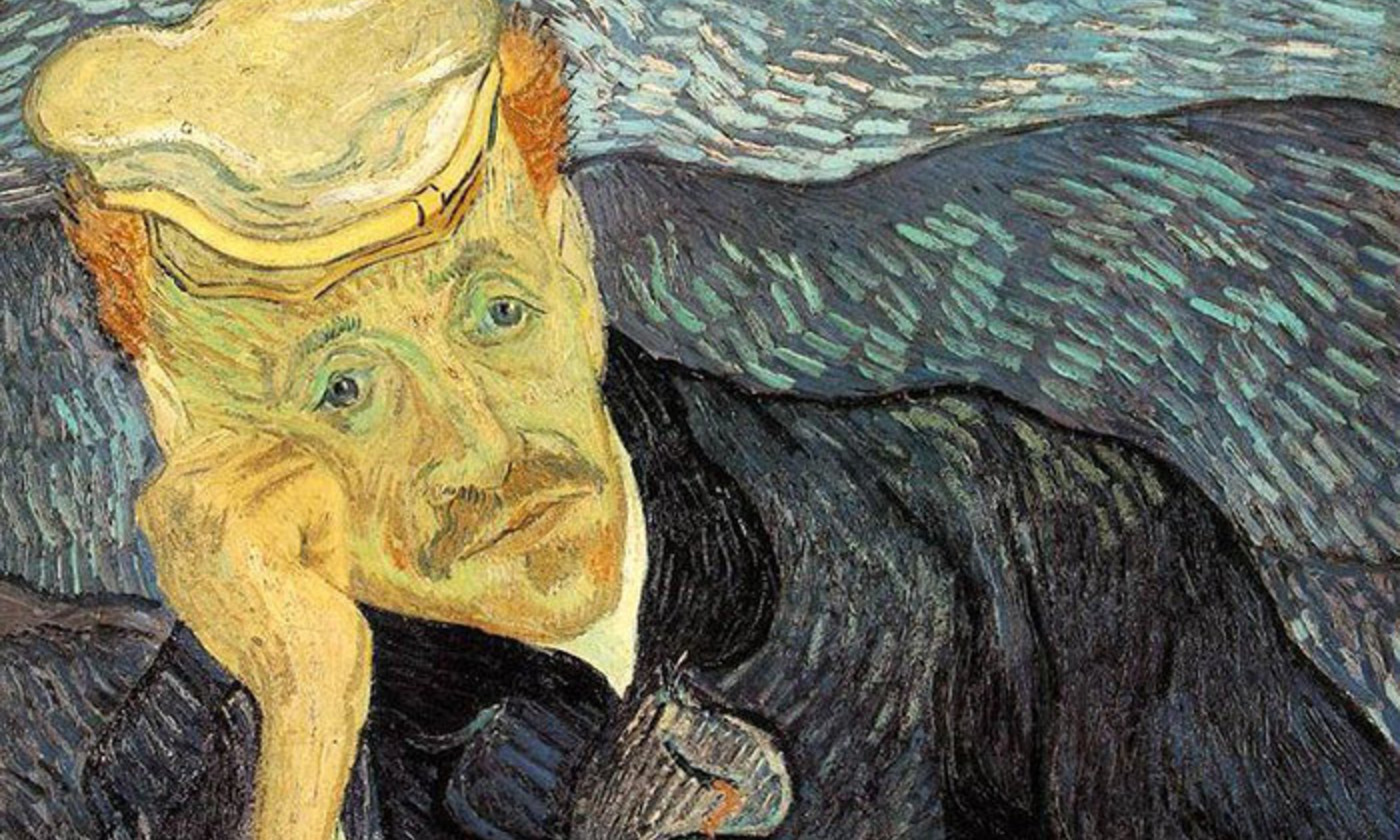
gachet-van-gogh

Detail from Portrait of Dr Gachet (1890), by Vincent van Gogh. Private collection. Photo courtesy Wikipedia

Kieran Setiya | Aeon Ideas

Philosophers ponder the meaning of life. At least, that is the stereotype. When I risk admitting to a stranger that I teach philosophy for a living and face the question ‘What is the meaning of life?’, I have a ready response: we figured that out in the 1980s, but we have to keep it secret or we’d be out of a job; I could tell you, but then I’d have to kill you. In fact, professional philosophers rarely ask the question and, when they do, they often dismiss it as nonsense.

The phrase itself is of relatively recent origin. Its first use in English is in Thomas Carlyle’s parodic novel Sartor Resartus (1836), where it appears in the mouth of a comic German philosopher, Diogenes Teufelsdröckh (‘God-born devil-dung’), noted for his treatise on clothes. The question of life’s meaning remains both easy to mock and paradigmatically obscure.

What is the meaning of ‘meaning’ in ‘the meaning of life’? We talk about the meaning of words, or linguistic meaning, the meaning of an utterance or of writing in a book. When we ask if human life has meaning, are we asking whether it has meaning in this semantic sense? Could human history be a sentence in some cosmic language? The answer is that it could, in principle, but that this isn’t what we want when we search for the meaning of life. If we are unwitting ink in some alien script, it would be interesting to know what we spell out, but the answer would not have authority over us, as befits the meaning of life.

‘Meaning’ could mean purpose or function in a larger system. Could human life play that role? Again, it could, but yet again, this seems irrelevant. In Douglas Adams’s Hitchhiker’s books, the Earth is part of a galactic computer, designed (ironically) to reveal the meaning of life. Whatever that meaning might be, our role in the computer program is not it. To discover that we are cogs in some cosmic machine is not to discover the meaning of life. It leaves our existential maladies untouched.

Seeing no other way to interpret the question, many philosophers conclude that the question is confused. If they go on to talk about meaning in life, they have in mind the meaning of individual lives, the question of whether this life or that life is meaningful for the person who is living it. But the meaning of life is not an individual possession. If life has meaning, it has a meaning that applies to us all. Does this idea make sense?

I think it does. We can make progress if we turn from the words that make up the question – ‘meaning’ in particular – to the contexts in which we feel compelled to ask it. We raise the question ‘Does life have meaning?’ in times of anguish, or despair, or emptiness. We ask it when we confront mortality and loss, the pervasiveness of suffering and injustice, the facts of life from which we recoil and which we cannot accept. Life seems profoundly flawed. Is there meaning to it all? Historically, the question of life’s meaning comes into focus through the anxiety of early existentialist philosophers, such as Søren Kierkegaard and Friedrich Nietzsche, who worried that it has none.

On the interpretation that this context suggests, the meaning of life would be a truth about us and about the world that makes sense of the worst. It would be something we could know about life, the Universe and everything, that should reconcile us to mortality and loss, suffering and injustice. Knowledge of this truth would make it irrational not to affirm life as it is, not to accept things as they are. It would show that despair, or angst, is a mistake.

The idea that life has meaning is the idea that there is a truth of this extraordinary kind. Whether or not there is, the suggestion is not nonsense. It is a hope that animates the great religions. Whatever else they do, religions offer metaphysical pictures whose acceptance is meant to bestow salvation, to reconcile us to the seeming faults of life. Or if they do not supply the truth, if they do not claim to convey the meaning of life, they offer the conviction that there is one, however hard to grasp or articulate it might be.

The meaning of life might be theistic, involving God or gods, or it might be non-theistic, as in one form of Buddhism. What distinguishes Buddhist meditation from mindfulness-based stress-reduction is the aim of ending suffering through metaphysical revelation. The emotional solace of Buddhism is meant to derive from insight into how things are – in particular, into the non-existence of the self – an insight that should move anyone. To come to terms with life through meditation for serenity, or through talk therapy, is not to discover the meaning of life, since it is not to discover any such truth.

Albert Einstein wrote that to know an answer to the question ‘What is the meaning of human life?’ means to be religious. But there is in principle room for non-religious accounts of meaning, ones that do not appeal to anything beyond the given world or the world revealed to us by science. Religion has no monopoly on meaning, even if it is hard to see how a non-transcendent truth could meet our definition: to know the meaning of life is to be reconciled to all that is wrong with the world. At the same time, it is hard to prove a negative, to show that nothing short of religion could play this role.

Philosophers are prone to see confusion in the question ‘What is the meaning of life?’ They have replaced it with questions about meaningful lives. But the search for life’s meaning will not go away and it is perfectly intelligible. I cannot tell you the meaning of life or give assurance that it has one. But I can say that it is not a mistake to ask the question. Does life have meaning? The answer is: it might.Aeon counter – do not remove

Kieran Setiya

This article was originally published at Aeon and has been republished under Creative Commons.

Seven Types of Atheism

But you will have gathered what I am driving at, namely, that it is still a metaphysical faith upon which our faith in science rests—that even we seekers after knowledge today, we godless anti-metaphysicians still take our fire, too, from the flame lit by a faith that is thousands of years old, that Christian faith which was also the faith of Plato, that God is the truth, that truth is divine. —But what if this should become more and more incredible, if nothing should prove to be divine any more unless it were error, blindness, the lie—if God himself should prove to be our most enduring lie?

– Friedrich Nietzsche, The Gay Science (1882)


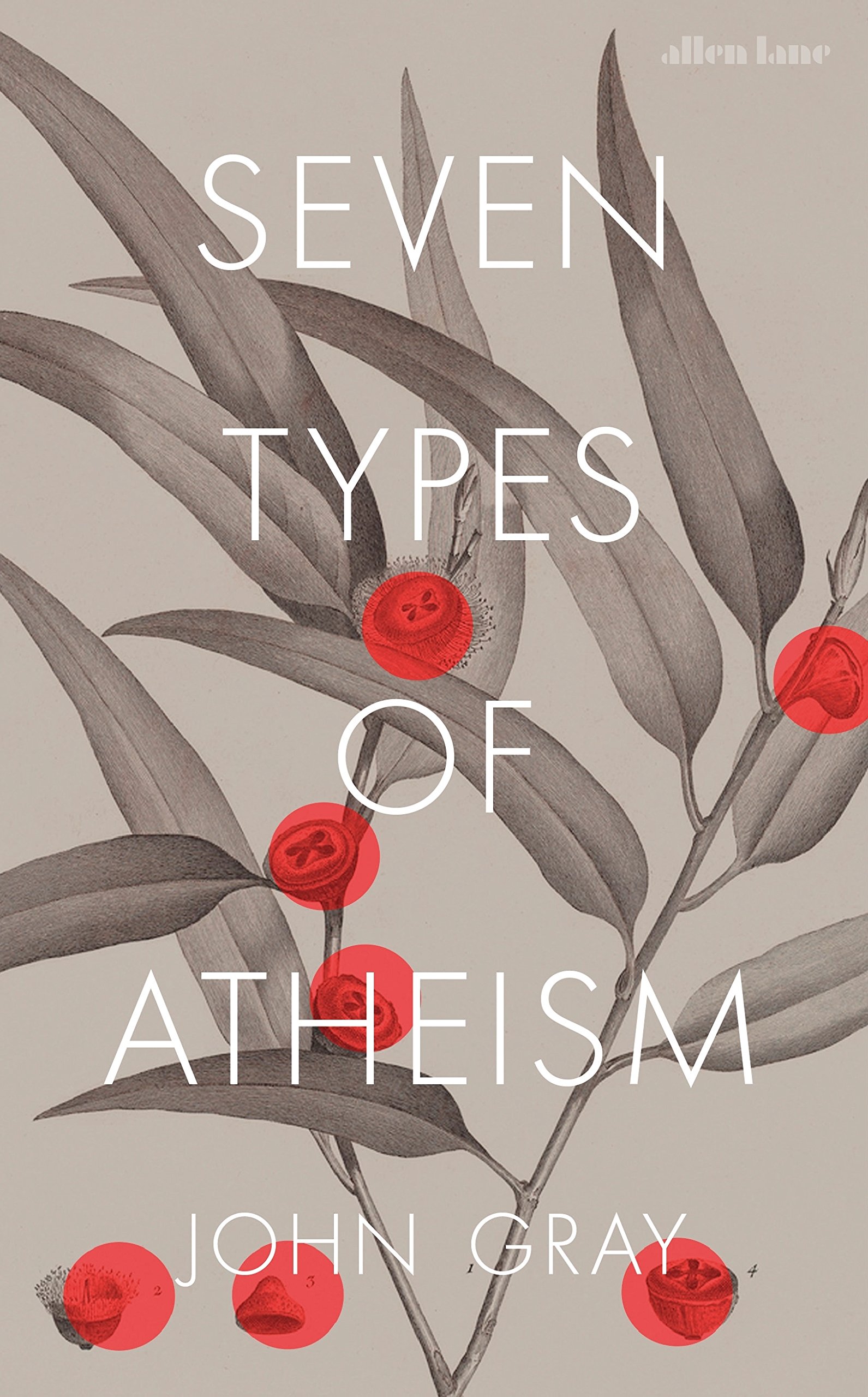
seven-types-atheism


From the provocative author of Straw Dogs comes an incisive, surprising intervention in the political and scientific debate over religion and atheism. A meditation on the importance of atheism in the modern world – and its inadequacies and contradictions – by one of Britain’s leading philosophers.

When you explore older atheisms, you will find that some of your firmest convictions—secular or religious—are highly questionable. If this prospect disturbs you, what you are looking for may be freedom from thought.

For a generation now, public debate has been corroded by a shrill, narrow derision of religion in the name of an often vaguely understood “science.” John Gray’s stimulating and enjoyable new book, Seven Types of Atheism, describes the complex, dynamic world of older atheisms, a tradition that is, he writes, in many ways intertwined with and as rich as religion itself.

Along a spectrum that ranges from the convictions of “God-haters” like the Marquis de Sade to the mysticism of Arthur Schopenhauer, from Bertrand Russell’s search for truth in mathematics to secular political religions like Jacobinism and Nazism, Gray explores the various ways great minds have attempted to understand the questions of salvation, purpose, progress, and evil. The result is a book that sheds an extraordinary light on what it is to be human.


“In former times, one sought to prove that there is no God—today one indicates how the belief that there is a God arose and how this belief acquired its weight and importance: a counter-proof that there is no God thereby becomes superfluous.—When in former times one had refuted the ‘proofs of the existence of God’ put forward, there always remained the doubt whether better proofs might not be adduced than those just refuted: in those days atheists did not know how to make a clean sweep.”

– Friedrich Nietzsche, Daybreak (1881)


See also: VICE Interviews John Gray about Seven Types of Atheism

The Dynamics of Faith

Faith is the state of being ultimately concerned. The content matters infinitely for the life of the believer, but it does not matter for the formal definition of faith. And this is the first step we have to make in order to understand the dynamics of faith.

– Paul Tillich, Dynamics of Faith (1957)

Paul Johannes Tillich (August 20, 1886 – October 22, 1965) was a German-American Christian existentialist philosopher and Lutheran Protestant theologian who is widely regarded as one of the most influential theologians of the twentieth century.

Man, like every living being, is concerned about many things, above all about those which condition his very existence … If [a situation or concern] claims ultimacy it demands the total surrender of him who accepts this claim … it demands that all other concerns … be sacrificed.

Among the general public, he is best known for his works The Courage to Be (1952) and Dynamics of Faith (1957), which introduced issues of theology and modern culture to a general readership. In academic theology, he is best known for his major three-volume work Systematic Theology (1951–63) in which he developed his “method of correlation”, an approach of exploring the symbols of Christian revelation as answers to the problems of human existence raised by contemporary existential philosophical analysis.

Faith as ultimate concern is an act of the total personality. It happens in the center of the personal life and includes all its elements. Faith is the most centered act of the human mind. It is not a movement of a special section or a special function of man’s total being. They all are united in the act of faith. But faith is not the sum total of their impacts. It transcends every special impact as well as the totality of them and it has itself a decisive impact on each of them.

Two of Tillich’s works, The Courage to Be (1952) and Dynamics of Faith (1957), were read widely, including by people who would not normally read religious books. In The Courage to Be, he lists three basic anxieties: anxiety about our biological finitude, i.e. that arising from the knowledge that we will eventually die; anxiety about our moral finitude, linked to guilt; and anxiety about our existential finitude, a sense of aimlessness in life. Tillich related these to three different historical eras: the early centuries of the Christian era; the Reformation; and the 20th century. Tillich’s popular works have influenced psychology as well as theology, having had an influence on Rollo May, whose “The Courage to Create” was inspired by “The Courage to Be”.

[The God of theological theism] deprives me of my subjectivity because he is all-powerful and all-knowing. I revolt and make him into an object, but the revolt fails and becomes desperate. God appears as the invincible tyrant, the being in contrast with whom all other beings are without freedom and subjectivity. He is equated with the recent tyrants who with the help of terror try to transform everything into a mere object, a thing among things, a cog in a machine they control. He becomes the model of everything against which Existentialism revolted. This is the God Nietzsche said had to be killed because nobody can tolerate being made into a mere object of absolute knowledge and absolute control. This is the deepest root of atheism. It is an atheism which is justified as the reaction against theological theism and its disturbing implications.

Today, Tillich’s most observable legacy may well be that of a spiritually-oriented public intellectual and teacher with a broad and continuing range of influence. Tillich‘s chapel sermons (especially at Union) were enthusiastically received (Tillich was known as the only faculty member of his day at Union willing to attend the revivals of Billy Graham) Tillich’s students have commented on Tillich’s approachability as a lecturer and his need for interaction with his audience. When Tillich was University Professor at Harvard, he was chosen as keynote speaker from among an auspicious gathering of many who had appeared on the cover of Time Magazine during its first four decades. Tillich along with his student, psychologist Rollo May, was an early leader at the Esalen Institute. Contemporary New Age catchphrases describing God (spatially) as the “Ground of Being” and (temporally) as the “Eternal Now,” in tandem with the view that God is not an entity among entities but rather is “Being-Itself”—notions which Eckhart Tolle, for example, has invoked repeatedly throughout his career—were paradigmatically renovated by Tillich, although of course these ideas derive from Christian mystical sources as well as from ancient and medieval theologians such as St. Augustine and St. Thomas Aquinas.

The separation of faith and love is always a consequence of a deterioration of religion.

The introductory philosophy course taught by the person Tillich considered to be his best student, John Edwin Smith, “probably turned more undergraduates to the study of philosophy at Yale than all the other philosophy courses put together. His courses in philosophy of religion and American philosophy defined those fields for many years. Perhaps most important of all, he has educated a younger generation in the importance of the public life in philosophy and in how to practice philosophy publicly.” In the 1980s and 1990s the Boston University Institute for Philosophy and Religion, a leading forum dedicated to the revival of the American public tradition of philosophy and religion, flourished under the leadership of Tillich’s student and expositor Leroy S. Rouner.

[Faith] transcends both the drives of the nonrational unconsciousness and the structures of the rational conscious…the ecstatic character of faith does not exclude its rational character although it is not identical with it, and it includes nonrational strivings without being identical with them. ‘Ecstasy’ means ‘standing outside of oneself’ – without ceasing to be oneself – with all the elements which are united in the personal center.

Martin Buber criticized Tillich’s “transtheistic position” as a reduction of God to the impersonal “necessary being” of Thomas Aquinas.

Tillich has been criticized from the Barthian wing of Protestantism for what is alleged to be correlation theory’s tendency to reduce God and his relationship to man to anthropocentric terms. Tillich counters that Barth’s approach to theology denies the “possibility of understanding God’s relation to man in any other way than heteronomously or extrinsically”. Defenders of Tillich claim that critics misunderstand the distinction Tillich makes between God’s essence as the unconditional (“das unbedingte”) “Ground of Being” which is unknowable, and how God reveals himself to mankind in existence. Tillich establishes the distinction in the first chapter of his Systematic Theology Volume One: “But though God in his abysmal nature [footnote: ‘Calvin: in his essence’ ] is in no way dependent on man, God in his self manifestation to man is dependent on the way man receives his manifestation.”

Faith as the state of being ultimately concerned implies love, namely, the desire and urge toward the reunion of the separated.

Some conservative strains of Evangelical Christianity believe Tillich’s thought is too unorthodox to qualify as Christianity at all, but rather as a form of pantheism or atheism. The Evangelical Dictionary of Theology states, “At best Tillich was a pantheist, but his thought borders on atheism.”

In such a state the God of both religious and theological language disappears. But something remains, namely, the seriousness of that doubt in which meaning within meaninglessness is affirmed. The source of this affirmation of meaning within meaninglessness, of certitude within doubt, is not the God of traditional theism but the “God above God,” the power of being, which works through those who have no name for it, not even the name God.


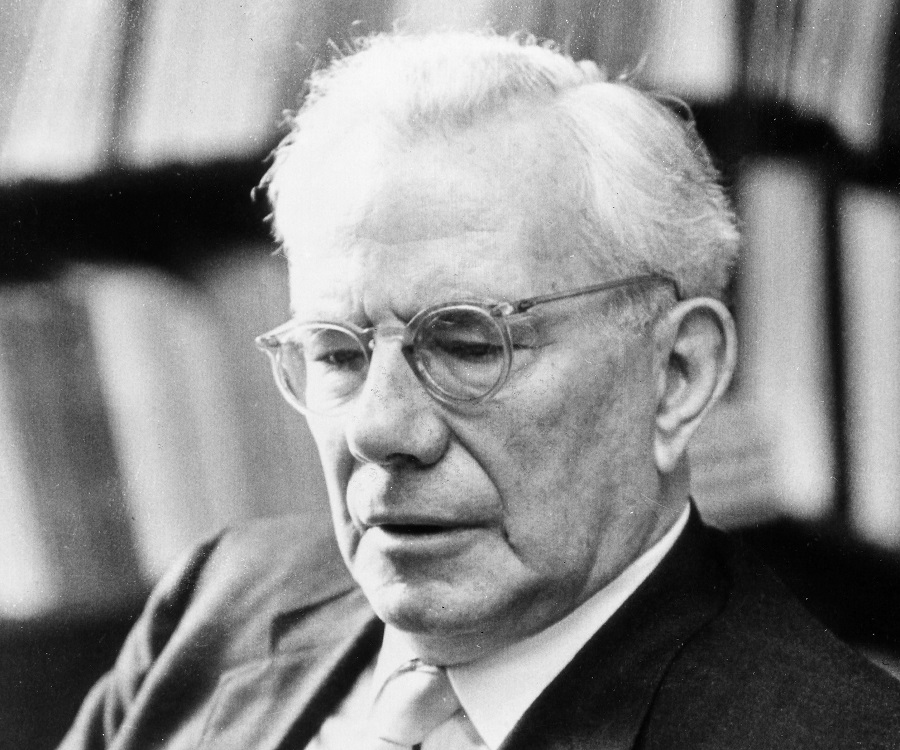
tillich

Marxism and Existentialism

And Since I am to speak of existentialism, let it be understood that I take it to be an “ideology.” It is a parasitical system living on the margin of Knowledge, which at first it opposed but into which today it seeks to be integrated. If we are to understand its present ambitions and its function we must go back to the time of Kierkegaard…

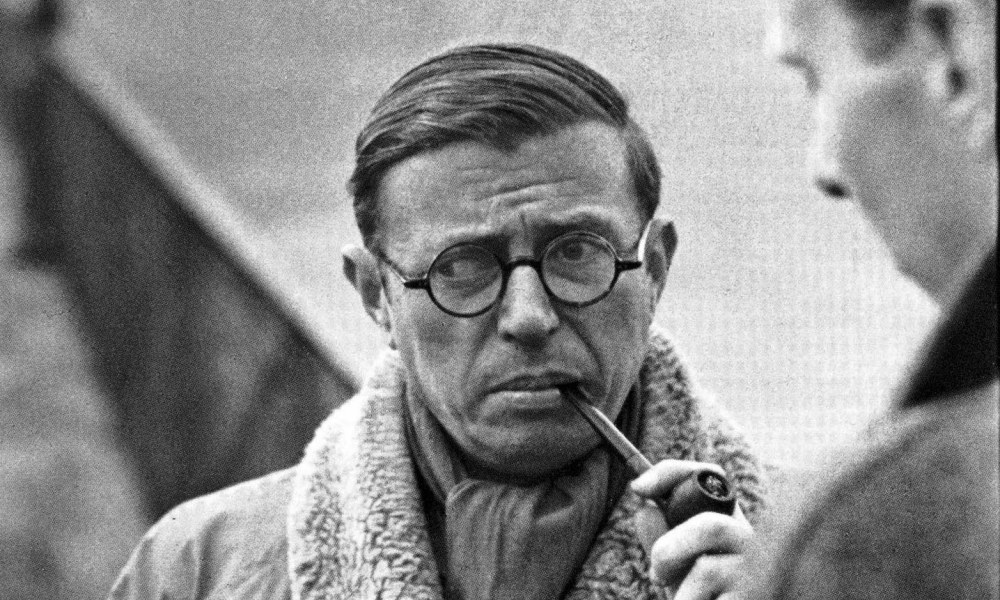
sartre

Compared with Hegel, Kierkegaard scarcely seems to count. He is certainly not a philosopher; moreover, he himself refused this title. In fact he is a Christian who is not willing to let himself be enclosed in the system and who, against Hegel’s “intellectualism,” asserts unrelentingly the irreducibility and the specificity of what is lived. There is no doubt, as Jean Wahl has remarked, that a Hegelian would have assimilated this romantic and obstinate consciousness to the “unhappy consciousness,” a moment which had already been surpassed and known in its essential characteristics. But it is precisely this objective knowledge which Kierkegaard challenges. For him the surpassing of the unhappy consciousness remains purely verbal. The existing man cannot be assimilated by a system of ideas…

We see that Kierkegaard is inseparable from Hegel, and that this vehement negation of every system can arise only within a cultural field entirely dominated by Hegelianism. The Dane feels himself hemmed in by concepts, by History, he fights for his life; it is the reaction of Christian romanticism against the rationalist humanization of faith. It would be too easy to reject this work as simply subjectivism; what we ought rather to point out, in placing it back within the framework of its period, is that Kierkegaard has as much right on his side as Hegel has on his. Hegel is right: unlike the Danish ideologist, who obstinately fixed his stand on poor, frozen paradoxes ultimately referring to an empty subjectivity, the philosopher of Jena aims through his concepts at the veritable concrete; for him, mediation is always presented as an enrichment. Kierkegaard is right: grief, need, passion, the pain of men, are brute realities which can be neither surpassed nor changed by knowledge. To be sure, Kierkegaard’s religious subjectivism can with good reason be taken as the very peak of idealism; but in relation to Hegel, he marks a progress toward realism, since he insists above all on the primacy of the specifically real over thought, that the real cannot be reduced to thought. There are today some psychologists and psychiatrists who consider certain evolutions of our inward life to be the result of a work which it performs upon itself. In this sense Kierkegaardian existence is the work of our inner life – resistances overcome and perpetually reborn, efforts perpetually renewed, despairs surmounted, provisional failures and precarious victories – and this work is directly opposed to intellectual knowing. Kierkegaard was perhaps the first to point out, against Hegel and thanks to him, the incommensurability of the real and knowledge…

Now, in the present phase of our history, productive forces have entered into conflict with relations of production. Creative work is alienated; man does not recognize himself in his own product, and his exhausting labor appears to him as a hostile force. Since alienation comes about as the result of this conflict, it is a historical reality and completely irreducible to an idea. If men are to free themselves from it, and if their work is to become the pure objectification of themselves, it is not enough that “consciousness think itself”; there must be material work and revolutionary praxis. When Marx writes: “Just as we do not judge an individual by his own idea of himself, so we cannot judge a … period of revolutionary upheaval by its own self-consciousness,” he is indicating the priority of action (work and social praxis) over knowledge as well as their heterogeneity. He too asserts that the human fact is irreducible to knowing, that it must be lived and produced; but he is not going to confuse it with the empty subjectivity of a puritanical and mystified petite bourgeoisie. He makes of it the immediate theme of the philosophical totalization, and it is the concrete man whom he puts at the center of his research, that man who is defined simultaneously by his needs, by the material conditions of his existence, and by the nature of his work – that is, by his struggle against things and against men.

Thus Marx, rather than Kierkegaard or Hegel, is right, since he asserts with Kierkegaard the specificity of human existence and, along with Hegel, takes the concrete man in his objective reality. Under these circumstances, it would seem natural if existentialism, this idealist protest against idealism, had lost all usefulness and had not survived the decline of Hegelianism…

Between the two World Wars the appearance of a German existentialism certainly corresponds – at least in the work of Jaspers – to a surreptitious wish to resuscitate the transcendent. Already – as Jean Wahl has pointed out – one could wonder if Kierkegaard did not lure his readers into the depths of subjectivity for the sole purpose of making them discover there the unhappiness of man without God. This trap would be quite in keeping with the “great solitary” who denied communication between human beings and who saw no way to influence his fellow man except by “indirect action.”

Jaspers himself put his cards on the table. He has done nothing except to comment upon his master; his originality consists especially in putting certain themes into relief and in hiding others. The transcendent, for example, appears at first to be absent from his thought, which in fact is haunted by it. We are taught to catch a presentiment of the transcendent in our failures; it is their profound meaning…

Kierkegaard was unwilling to play the role of a concept in the Hegelian system; Jaspers refuses to cooperate as an individual with the history which Marxists are making…

It is one more existentialism which has developed at the margin of Marxism and not against it. It is Marx with whom we claim kinship, and Marx of whom I wish to speak now… It was at about this time [1925] that I read Capital and German Ideology. I found everything perfectly clear, and I really understood absolutely nothing. To understand is to change, to go beyond oneself. This reading did not change me. By contrast, what did begin to change me was the reality of Marxism, the heavy presence on my horizon of the masses of workers, an enormous, somber body which lived Marxism, which practiced it, and which at a distance exercised an irresistible attraction on petit bourgeois intellectuals…

Why then has “existentialism” preserved its autonomy? Why has it not simply dissolved in Marxism?

Lukacs believed that he had answered this question in a small book called Existentialism and Marxism… Lukacs fails absolutely to account for the principal fact: we were convinced at one and the same time that historical materialism furnished the only valid interpretation of history and that existentialism remained the only concrete approach to reality. I do not pretend to deny the contradictions in this attitude. I simply assert that Lukacs does not even suspect it. Many intellectuals, many students, have lived and still live with the tension of this double demand. How does this come about? It is due to a circumstance which Lukacs knew perfectly well but which he could not at that time even mention: Marxism, after drawing us to it as the moon draws the tides, after transforming all our ideas, after liquidating the categories of our bourgeois thought, abruptly left us stranded. It did not satisfy our need to understand. In the particular situation in which we were placed, it no longer had anything new to teach us, because it had come to a stop…

Marxism stopped…

Existentialism has been able to return and to maintain itself because it reaffirmed the reality of men as Kierkegaard asserted his own reality against Hegel. However, the Dane rejected the Hegelian conception of man and of the real. Existentialism and Marxism, on the contrary, aim at the same object…

Far from being exhausted, Marxism is still very young, almost in its infancy; it has scarcely begun to develop. It remains, therefore, the philosophy of our time. We cannot go beyond it because we have not gone beyond the circumstances which engendered it…

Let us go further. We agree with Garaudy when he writes (Humanité, May 17, 1955): “Marxism forms today the system of coordinates which alone permits it to situate and to define a thought in any domain whatsoever – from political economy to physics, from history to ethics.” …

As soon as there will exist for everyone a margin of real freedom beyond the production of life, Marxism will have lived out its span; a philosophy of freedom will take its place. But we have no means, no intellectual instrument, no concrete experience which allows us to conceive of this freedom or of this philosophy…

Why, then, are we not simply Marxists? It is because we take the statements of Engels and Garaudy as guiding principles, as indications of jobs to be done, as problems – not as concrete truths.

– Jean-Paul Sartre (1960)


See Also

Existentialism is Humanism by Jean-Paul Sartre (1946, PDF)

The Self-Overcoming of Nihilism by Keiji Nishitani (1990, PDF)

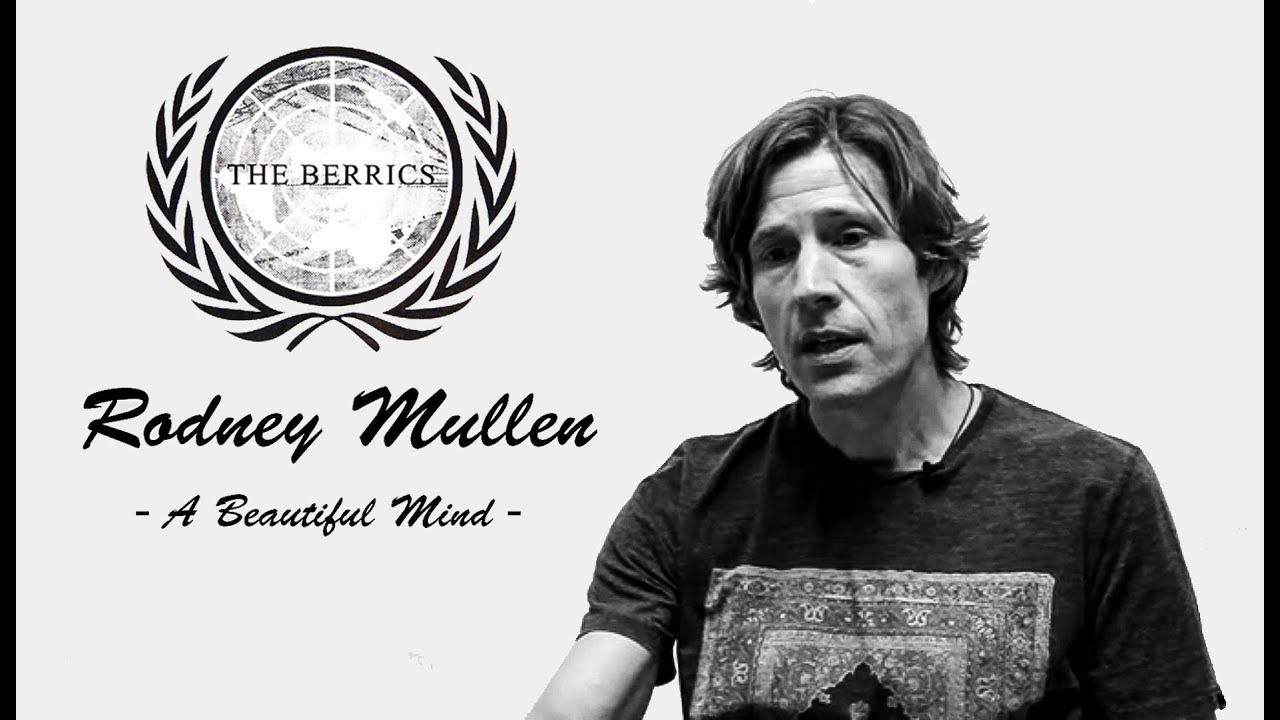
Skateboarding: An Existential Art


Rodney Mullen (born August 17, 1966) is an American professional skateboarder, entrepreneur, inventor, and public speaker who practices freestyle and street skateboarding. He is widely considered the most influential street skater in the history of the sport, being credited for inventing numerous tricks, including the kickflip, heelflip, impossible, and 360-flip. As a result, he has been called the “Godfather of Street Skateboarding.”

Rodney Mullen won his first world skateboard championship at the age of 14; over the following decade, he won 35 out of 36 freestyle contests, thus establishing the most successful competitive run in the history of the sport. Over the following years, he turned from freestyle, translating his accumulated skills to a newer, different form of skateboarding.

Mullen has appeared in over 20 skateboarding videos and has co-authored an autobiography, entitled The Mutt: How to Skateboard and Not Kill Yourself, with writer Sean Mortimer.

– Wikipedia


mullen

I Believe Because it is Absurd

the-incredulity-of-saint-thomas

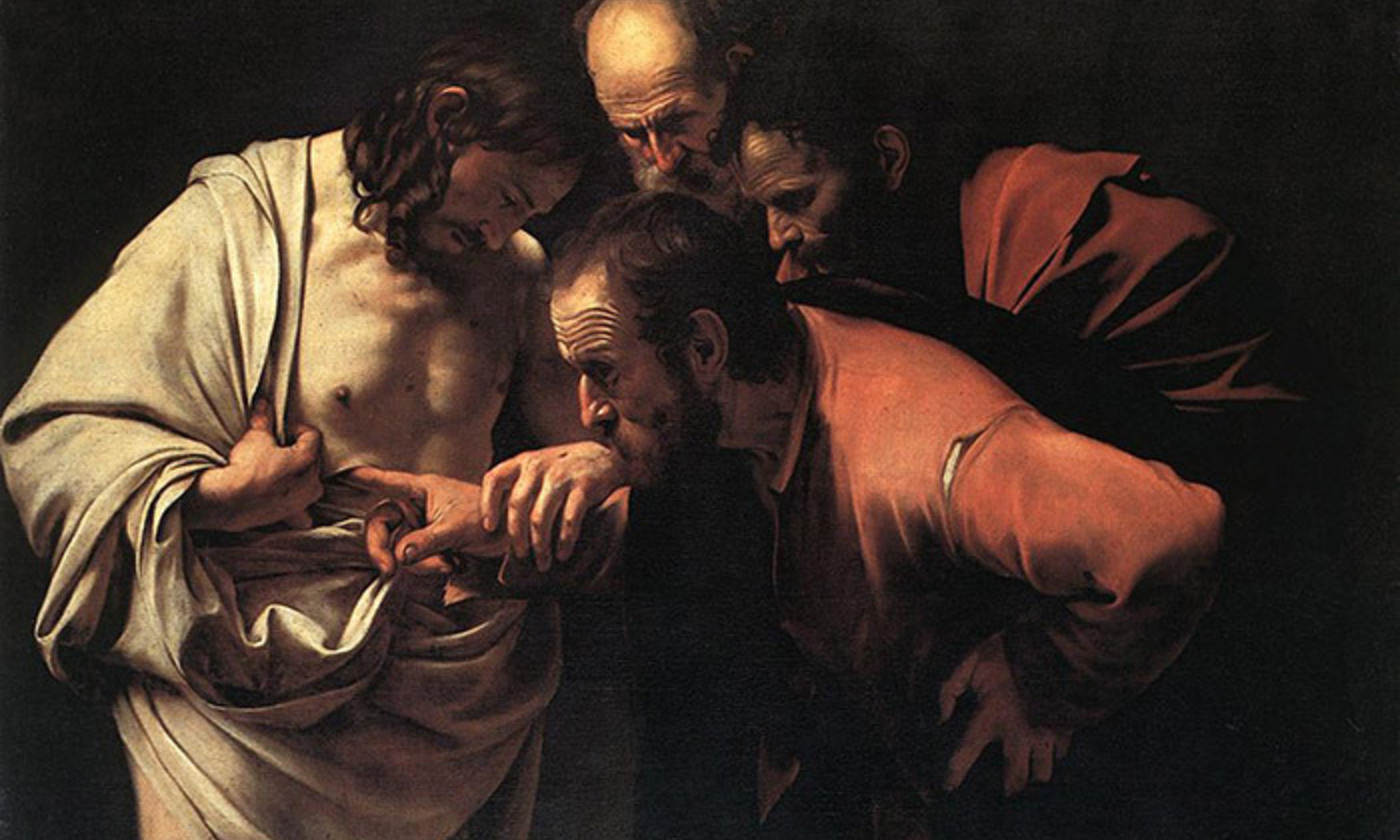
The Incredulity of Saint Thomas (1601-1602), by Caravaggio, Sanssouci Palace, Potsdam, Germany. Courtesy Wikipedia

Peter Harrison | Aeon Ideas


Religious belief is often thought to evince a precarious kind of commitment, in which the degree of conviction is inversely proportional to correspondence with the facts. Exhibit A for this common characterisation of religious belief is the maxim of the third-century Christian writer Tertullian, who is credited with the saying ‘I believe because it is absurd.’ This paradoxical expression makes a routine appearance in philosophical evaluations of the rationality of religious belief, in contemporary polemics addressed to an imagined opposition between science and religion, and in virtually every reputable dictionary of quotations.

Scholars of early Christianity have long known that Tertullian never wrote those words. What he originally said and meant poses intriguing questions, but equally interesting is the story of how the invented expression came to be attributed to him in the first place, what its invention tells us about changing conceptions of ‘faith’, and why, in spite of attempts to correct the record, it stubbornly persists as an irradicable meme about the irrationality of religious commitment.

On the face of it, being committed to something because it is absurd is an unpromising foundation for a belief system. It should not come as a complete surprise, then, that Tertullian did not advocate this principle. He did, however, make this observation, with specific reference to the death and resurrection of Christ: ‘it is entirely credible, because it is unfitting … it is certain, because it is impossible’ (For Latinists out there: prorsus credibile est, quia ineptum est … certum est, quia impossibile). This might seem to be within striking distance of the fideistic phrase commonly attributed to him. Puzzlingly, though, even this original formulation does not fit with Tertullian’s generally positive view of reason and rational justification. Elsewhere, he insists that Christians ‘should believe nothing but that nothing should be rashly believed’. For Tertullian, God is ‘author of Reason’, the natural order of the world is ‘ordained by reason’, and everything is to be ‘understood by reason’.

One likely explanation for this apparent incongruence is that, in his paradoxical juxtaposition of impossibility and certainty, Tertullian is drawing upon a principle set out in Aristotle’s Rhetoric. Addressing himself to the credibility of highly improbable events, Aristotle observes: ‘We may argue that people could not have believed them, if they had not been true or nearly true. And that they are more likely to be true because they are incredible.’ His point seems to be that the apparent incredibility of a reported claim can actually provide a reason for believing it, since a witness seeking to perpetuate a false story would most likely have come up with something that at least seemed plausible. If this connection is on the right track, Tertullian, who almost certainly knew Aristotle’s Rhetoric, is not advocating belief without justification, but suggesting that we sometimes have good reasons to believe the highly improbable.

This leaves us with the question of how Tertullian came to be attributed with authorship of the rather different expression: ‘I believe because it is absurd.’ For this, we need to look to two decisive moments in the early modern period.

In the middle of the 17th century, the physician and polymath Thomas Browne drew attention to Tertullian’s original remarks in his bestselling Religio Medici (1643), or The Religion of a Physician. Crucially, not only did Browne introduce numerous readers to this relatively unnoticed passage in Tertullian, but he lent it an entirely new interpretation, proposing as a general principle that the strength of one’s faith is inversely proportional to the probability of what is believed: ‘Methinks there be not impossibilities enough in Religion for an active faith.’ Before long, numerous sources were quoting Tertullian, albeit disapprovingly, as having said: ‘I believe, because it is impossible’. The philosopher John Locke thus makes reference to this new version of the paradox in his classic An Essay Concerning Human Understanding (1689), summing up the view of most of his contemporaries that this was a ‘very ill Rule for Men to chuse their Opinions, or Religion by’.

A key element of the background to this development was the rise of sectarian disputes in the wake of the Reformation. Protestants chastised Catholics for their overcredulous ‘implicit faith’ – the giving of assent to doctrines promulgated by the Church but without a full comprehension of what was being assented to. A prime case was the doctrine of transubstantiation – a theory, based on Aristotle’s philosophy, of how during the Mass the elements of bread and wine could become the body and blood of Christ. For many Protestants, this was an emblematic instance of believing something that was literally impossible. The maxim ‘I believe because it is impossible’ thus first gained currency because of its deployment in anti-Catholic polemic.

The second phase in the transformation of Tertullian’s original remarks came when the French philosopher Voltaire introduced the ‘absurdity’ condition. In the entry for ‘Faith’ in his Philosophical Dictionary (1764), Voltaire concludes a characteristically entertaining account of the exploits of the notoriously promiscuous Pope Alexander VI by defining faith as ‘believing things because they are impossible’. The first appearance of the phrase ‘I believe because it is absurd’ comes subsequently in one of Voltaire’s 1767 publications, in which Voltaire attributes to the church father Augustine (rather than to Tertullian), the maxim: ‘I believe because it is absurd, I believe because it is impossible.’

Thereafter, ‘I believe because it is absurd’ became the standard form of the credo, and it was increasingly applied indiscriminately to all religious belief. Lending the phrase greater authenticity was its circulation in Latin as credo quia absurdum – a reverse-engineered version of Voltaire’s je le crois parce que cela est absurd. The misattribution of the saying to Augustine serves as a helpful marker of Voltaire’s influence, and for many years Augustine was regarded as the author of the paradox. While attributions to Augustine are rare today, Voltaire’s subtle insinuation of ‘absurdity’ into the new ‘I believe’ version of the paradox has persisted.

Since Voltaire’s time, the maxim ‘I believe because it is absurd’ has continued to serve the purpose intended by its Enlightenment originator – a gesture towards the inherent irrationality of religious belief. Thus in 1928, Sigmund Freud cited the motto as evidence of the infantile nature of religion, which he characterised as always attempting to shield its beliefs from rational scrutiny. The German philosopher Ernst Cassirer similarly maintained that the maxim typified a particular religious psychology that attended both the birth of religion and its regrettable contemporary manifestations: ‘The motto “I believe because it is absurd” exhibits its old force here and everywhere,’ he complained in 1951. Reference works, though generally less partisan, often convey similar sentiments. Typical is the offering in the Oxford Dictionary of Philosophy (1996), where the entry on credo quia absurdum est reads: ‘Also known as Tertullian’s dictum or paradox. Literally (Latin), I believe because it is absurd: that is, the very impossibility of a proposition becomes (mostly in theology) a kind of motivation for belief in it.’

One of the more conspicuous sites for the contemporary deployment of the maxim has been unflattering comparisons of fanciful religious belief with the ‘facts’ of science. In his lecture ‘Science as a Vocation’ (1917), Max Weber invented for himself an even more extreme Latin variant of Tertullian’s saying (Credo non quod, sed quia absurdum est – ‘I believe nothing except that which is absurd’, which Weber attributes to Augustine) in order to illustrate what he thought was an intrinsic tension between science and religion. Contemporary science vs religion warriors such as Richard Dawkins and Jerry Coyne have predictably followed suit, pointing to Tertullian as a personification of the irrationality of religious belief.

Much could be said about the differences and similarities between religious and scientific commitment, but it is worth observing, in brief, that the contemporary sciences afford conspicuous instances of justified belief in both the impossible (quantum mechanics) and the staggeringly improbable (Big Bang cosmology). This brings us back to the original context of Tertullian’s remarks, which were not about belief motivated by the absurdity of its object, but whether is it ever warranted to believe in things we consider to be impossible or extremely improbable. Clearly, that remains a live question.Aeon counter – do not remove

Peter Harrison

This article was originally published at Aeon and has been republished under Creative Commons.


Commentary

This reminds me of Kierkegaard. I wonder why he wasn’t mentioned:

Revelation is marked by mystery, eternal happiness by suffering, the certitude of faith by uncertainty, easiness by difficulty, truth by absurdity; if this is not maintained, then the esthetic and the religious merge in common confusion. … The religious lies in the dialectic of inwardness deepening and therefore, with regard to the conception of God, this means that he himself is moved, is changed. An action in the eternal transforms the individual’s existence.


When the question about truth is asked objectively, truth is reflected upon objectively as an object to which the knower relates himself. What is reflected upon is not the relation but that what he related himself to is the truth, the true. If only that to which he relates himself is the truth, the true, then the subject is in the truth. When the question about truth is asked subjectively, the individual’s relation is reflected upon subjectively. If only the how of this relation is in truth, the individual is in truth, even if he in this way were to relate himself to untruth.


When subjectivity, inwardness, is truth, then truth, objectively defined, is a paradox; and that truth is objectively a paradox shows precisely that subjectivity is truth, since the objectivity does indeed thrust away, and the objectivity’s repulsion, or the expression for the objectivity’s repulsion, is the resilience and dynamometer of inwardness. The paradox is the objective uncertainty that is the expression for the passion of inwardness that is truth. So much for the Socratic. The eternal, essential truth, that is, the truth that is related essentially to the existing person by pertaining essentially to what it means to exist (viewed Socratically, all other knowledge is accidental, its degree and scope indifferent), is a paradox. Nevertheless the eternal, essential truth is itself not at all a paradox, but it is a paradox by being related to an existing person… The Socratic inwardness in existing is an analogue to faith, except that the inwardness of faith, corresponding not to the repulsion exerted by ignorance but to the repulsion exerted by the absurd, is infinitely deeper.

–  Søren Kierkegaard, Concluding Unscientific Postscript to Philosophical Fragments (1846)

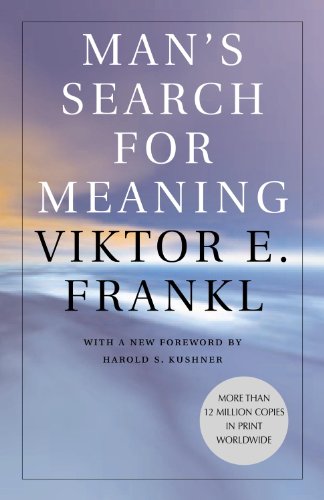
Man’s Search for Meaning


Man’s Search for Meaning is a 1946 book by Viktor Frankl chronicling his experiences as an Auschwitz concentration camp inmate during World War II, and describing his psychotherapeutic method, which involved identifying a purpose in life to feel positively about, and then immersively imagining that outcome. According to Frankl, the way a prisoner imagined the future affected his longevity. The book intends to answer the question “How was everyday life in a concentration camp reflected in the mind of the average prisoner?” Part One constitutes Frankl’s analysis of his experiences in the concentration camps, while Part Two introduces his ideas of meaning and his theory called logotherapy.

According to a survey conducted by the Book-of-the-Month Club and the Library of Congress, Man’s Search for Meaning belongs to a list of “the ten most influential books in the United States.” At the time of the author’s death in 1997, the book had sold over 10 million copies and had been translated into 24 languages.

Frankl identifies three psychological reactions experienced by all inmates to one degree or another: (1) shock during the initial admission phase to the camp, (2) apathy after becoming accustomed to camp existence, in which the inmate values only that which helps himself and his friends survive, and (3) reactions of depersonalization, moral deformity, bitterness, and disillusionment if he survives and is liberated.

Frankl concludes that the meaning of life is found in every moment of living; life never ceases to have meaning, even in suffering and death. In a group therapy session during a mass fast inflicted on the camp’s inmates trying to protect an anonymous fellow inmate from fatal retribution by authorities, Frankl offered the thought that for everyone in a dire condition there is someone looking down, a friend, family member, or even God, who would expect not to be disappointed. Frankl concludes from his experience that a prisoner’s psychological reactions are not solely the result of the conditions of his life, but also from the freedom of choice he always has even in severe suffering. The inner hold a prisoner has on his spiritual self relies on having a hope in the future, and that once a prisoner loses that hope, he is doomed.

An example of Frankl’s idea of finding meaning in the midst of extreme suffering is found in his account of an experience he had while working in the harsh conditions of the Auschwitz concentration camp:

… We stumbled on in the darkness, over big stones and through large puddles, along the one road leading from the camp. The accompanying guards kept shouting at us and driving us with the butts of their rifles. Anyone with very sore feet supported himself on his neighbor’s arm. Hardly a word was spoken; the icy wind did not encourage talk. Hiding his mouth behind his upturned collar, the man marching next to me whispered suddenly: “If our wives could see us now! I do hope they are better off in their camps and don’t know what is happening to us.”

That brought thoughts of my own wife to mind. And as we stumbled on for miles, slipping on icy spots, supporting each other time and again, dragging one another up and onward, nothing was said, but we both knew: each of us was thinking of his wife. Occasionally I looked at the sky, where the stars were fading and the pink light of the morning was beginning to spread behind a dark bank of clouds. But my mind clung to my wife’s image, imagining it with an uncanny acuteness. I heard her answering me, saw her smile, her frank and encouraging look. Real or not, her look was then more luminous than the sun which was beginning to rise.

A thought transfixed me: for the first time in my life I saw the truth as it is set into song by so many poets, proclaimed as the final wisdom by so many thinkers. The truth—that love is the ultimate and the highest goal to which man can aspire. Then I grasped the meaning of the greatest secret that human poetry and human thought and belief have to impart: The salvation of man is through love and in love. I understood how a man who has nothing left in this world still may know bliss, be it only for a brief moment, in the contemplation of his beloved. In a position of utter desolation, when man cannot express himself in positive action, when his only achievement may consist in enduring his sufferings in the right way—an honorable way—in such a position man can, through loving contemplation of the image he carries of his beloved, achieve fulfillment. For the first time in my life I was able to understand the meaning of the words, “The angels are lost in perpetual contemplation of an infinite glory….”

Frankl also concludes that there are only two races of men, decent men and indecent. No society is free of either of them, and thus there were “decent” Nazi guards and “indecent” prisoners, most notably the kapo who would torture and abuse their fellow prisoners for personal gain.

His concluding passage in Part One describes the psychological reaction of the inmates to their liberation, which he separates into three stages. The first is depersonalization—a period of readjustment, in which a prisoner gradually returns to the world. Initially, the liberated prisoners are so numb that they are unable to understand what freedom means, or to emotionally respond to it. Part of them believes that it is an illusion or a dream that will be taken away from them. In their first foray outside their former prison, the prisoners realized that they could not comprehend pleasure. Flowers and the reality of the freedom they had dreamed about for years were all surreal, unable to be grasped in their depersonalization.

The body is the first element to break out of this stage, responding by big appetites of eating and wanting more sleeping. Only after the partial replenishing of the body is the mind finally able to respond, as “feeling suddenly broke through the strange fetters which had restrained it”.

This begins the second stage, in which there is a danger of deformation. As the intense pressure on the mind is released, mental health can be endangered. Frankl uses the analogy of a diver suddenly released from his pressure chamber. He recounts the story of a decent friend who became immediately obsessed with dispensing the same violence in judgment of his abusers that they had inflicted on him.

Upon returning home, the prisoners had to struggle with two fundamental experiences which could also damage their mental health: bitterness and disillusionment. The last stage is bitterness at the lack of responsiveness of the world outside—a “superficiality and lack of feeling… so disgusting that one finally felt like creeping into a hole and neither hearing nor seeing human beings any more”. Worse was disillusionment, which was the discovery that suffering does not end, that the longed-for happiness will not come. This was the experience of those who—like Frankl—returned home to discover that no one awaited them. The hope that had sustained them throughout their time in the concentration camp was now gone. Frankl cites this experience as the most difficult to overcome.

As time passed, however, the prisoner’s experience in a concentration camp finally became nothing but a remembered nightmare. What is more, he comes to believe that he has nothing left to fear any more, “except his God”.


frankl.jpg

Man’s Search for Meaning (PDF)