Cryonics – Toward an Immortality of the Body

Why Freezing Yourself Is a Terrible Way to Achieve Immortality

By Andrew Tarantola – Originally published on Gizmodo.com

futurama

What happens after we die? It’s a question that has plagued the human mind since we first developed the concept of “death.” The search for an answer—and, more importantly, a means of circumventing its effects—has encited organized religion and served to shape one of the foundations of human culture.

We’ve built pyramids to house our dead in the afterlife, constructed terracotta armies to protect them, sacrificed the living in their honor, and even developed preservation techniques to ward off decomposition—all in the effort to somehow defy the permanence of death and resurrect at least a part, however intangible, of the deceased person. Ignoring the mysticism and religious fervor of these practices, they represent little more than elaborate burial techniques, which stubbornly remain a part of modern society.

But unlike the miraculous rebirth of one’s soul at the hands of Osiris, the practice of cryonics promises the rebirth of a younger, fitter, and not-dead you—all through the miracle of future scientific progress.

What Is Cryonics?

Cryonics is the practice of preserving “legally dead” human bodies in extremely cold temperatures with hopes that future advances in medical science can revive their corpses and cure what ails them—or, at least, extract their memories and consciousness.

The basic idea is that by rapidly cooling the body after the heart has stopped, but before the brain begins to die from hypoxia, the body is rapidly cooled to extinguish the metabolism and halt decomposition. However, unlike short-term suspended animation techniques that are currently being developed to aid in cardiac and neural surgery, traumatic injury, and similar life-threatening emergencies, cryonics freezes you for the long haul.

All Dead vs Mostly Dead

Not unlike Miracle Max’s distinction between the stages of death in The Princess Bride, there is a very fine but very important distinction between “legally dead” and “brain dead” as it relates to cryonics. Cryonics cannot be performed on someone who is still alive—regardless of how ill, the cryonic process would kill them and that constitutes murder. Cryonic preservation practitioners therefore rely on the information-theoretic definition of death rather than the standard, legal definition.

The subject must be deemed “legally dead” by a medical professional, which denotes when the person’s heart has stopped beating. Between the time that the heart stops and the brain suffers irreparable damage from oxygen starvation is when the cryonic preservation process must take place, so that the cellular brain function may someday be restarted.

How It Works

There are a number of facilities in the United States that handle cryonic preservation, including the Cryonics Institute in Detroit, the American Cryogenics Society in Sunnyvale, California, and the Alcor Life Extension Foundation in Scottsdale, Arizona. Each charges a hefty annual membership fee as well as upwards of six figures to actually preserve your corpse, though you can save a significant sum by preserving only your head or just the brain itself.

Once you’re declared legally dead, an emergency response team from one of these facilities first will stabilize the oxygen levels in your blood to maintain minimal brain function during your transport to the cryo facility, as well as pack your body in ice and administer the anticoagulant heparin into your bloodstream to keep your juices flowing.

As soon as you reach the facility, a waiting cryonic surgery team will siphon the water out of your circulatory system and replace it with the glycerol-based chemical acryoprotectant, which does not form cell-damaging ice crystals at low temperatures, as water does. Specifically, it acts as an antifreeze, lowering the body’s freezing point and increasing the viscosity of its fluids. Your body is then cooled on a bed of dry ice until it reaches -202 degrees F before being transferred to a tank of liquid nitrogen and further cooled to -320 degrees F.

cryonics

The practice of cryonic preservation got its start in 1964 when Robert Ettinger published The Prospect of Immortality, which put forth the idea of indefinitely freezing subjects for later revival. His idea was inspired by an earlier Amazing Stories science-fiction tale by Neil R. Jones called “The Jameson Satellite.” Between the international instability of the Cold War, with its constant threat of thermonuclear holocaust, and the seemingly limitless technological advancements garnered from the Space Race, cryonics immediately found an enthusiastic following among early transhumanists—the first of whom, James Bedford, was frozen in liquid nitrogen at the Alcor facility in 1967.

Since its inception, the practice has grown into a pseudo-scientific cult that would make L Ron Hubbard proud. Ettinger himself was frozen upon his death in 2011 and, in all, some 270 people worldwide have been preserved in this manner with another 2,000 applicants on the waiting list.

Why It’s Not Going to Work

Even if your preservation procedure goes according to plan, the process itself can ravage your corpse at a cellular level.

  • Vitrification: Because the water in our bodies forms ice crystals when frozen and, in turn, destroys the tissues that contain it, acryoprotectant (essentially antifreeze for humans) is used as a fluid replacement. The process is known as vitrification and causes the body’s cells to freeze as a glass rather than crystals. That is, the glycol turns your fluids into a sort of biological slushie of amorphous ice so instead of undergoing a complete liquid-solid phase change, the slushie exhibits properties of both, known as the glass transition phase. However, acryoprotectant itself is extremely toxic and would have to be completely flushed from your organs and tissues prior to resuscitation—otherwise you’d wake up just in time to die again.
  • Freezer Burn: No matter how much glycol you pump into a corpse, storing it at -320 degrees F for long periods of time is likely to cause a significant amount of damage to organs. Dendrites, the long filaments that connect neurons, are especially susceptible to cold damage. And for an organ as delicate as the brain, where losing even one percent of the neural connections would be tantamount to suffering a severe stroke, anything less than a complete recovery of brain function would be savagely debilitating and negate any benefits garnered from the cryonic suspension.
  • Manipulating Memories: Another issue is our pedestrian understanding of how the brain actually works. We understand, for example, that long-term memories are encoded by accumulating specific proteins at specific synaptic junctions, however, we aren’t really sure if the cryogenic process damages those proteins. Heck, researchers have yet to agree on where long-term memories are even stored. What’s more, the ability to extract that information, even from a room temperature brain, in any sort of meaningful context—much less a potentially cold-damaged cortex—remains firmly in the realm of science fiction.

However, these technical challenges should be easy to overcome in the distant future—at least according to practitioners. As the Cryonics Institute website explains:

The process of cryopreservation involves cooling a legally-dead person to liquid nitrogen temperature where all physical decay essentially stops – with the goal of preserving tissues, organs and especially the brain with its associated memories and personality as perfectly as possible. A person held in this state is termed a “cryopreserved patient,” because we do not consider the legal definition of “death” as a permanently irreversible state. We believe that the incredible advances being made today in biology, medicine, computers, nanotechnology and much more inevitably point to a future where advanced science will be able to revive these patients and restore them to health and even renewed youth.

Unfortunately, the “incredible advances” in technology that practitioners are relying upon to snatch them from death’s doorstep are only about as plausible as the miracles described in the New Testament. These technologies aren’t just currently beyond the current realm of possibility, many of them are little more than concepts derived from popular science fiction tropes. The available batch of conceivable resuscitation techniques won’t be reviving these peoplesicles any time soon.

For example, the notion of tiny, mechanical nanobots flooding every cell in the body, as put forth by Dr. K. Eric Drexler’s Engines of Creation, sound like they’d be the ideal solution for repairing damage generated by the freezing process. Problem is, the computer-controlled “molecular assemblers” that Drexler envisions may not actually conform to the laws of physics as we know them. Consequently, Drexler’s revival proposal has drawn a large amount of skepticism from the mainstream nanotech field.

Of course, even if a currently-unimaginable technology is somehow able to repair your physical structure, you’d still be a corpse. An unfrozen corpse, sure, but still dead. And unless this future techno-utopia has developed a means of reviving people as easily as reviving moss, you’re probably going to stay dead. You’re better off spending $100,000 on a cannon from which to blast your ashes than you are blowing that much on these liquid nitrogen-filled coffins.

Related: How Stuff Works – RationalWiki – American Cryogenics –Cryogenics Institute – Wikipedia – Alcor

Source: Gizmodo.com – Check out this link for a lengthy comments section!

The Filter Bubble

A world constructed from the familiar is a world in which there’s nothing to learn … (since there is) invisible autopropaganda, indoctrinating us with our own ideas.

– Eli Pariser

A filter bubble is a result of a personalized search in which a website algorithm selectively guesses what information a user would like to see based on information about the user (such as location, past click behavior and search history) and, as a result, users become separated from information that disagrees with their viewpoints, effectively isolating them in their own cultural or ideological bubbles. Prime examples are Google Personalized Search results and Facebook’s personalized news stream. The term was coined by internet activist Eli Pariser in his book by the same name; according to Pariser, users get less exposure to conflicting viewpoints and are isolated intellectually in their own informational bubble. Pariser related an example in which one user searched Google for “BP” and got investment news about British Petroleum while another searcher got information about the Deepwater Horizon oil spill and that the two search results pages were “strikingly different”. The bubble effect may have negative implications for civic discourse, according to Pariser, but there are contrasting views suggesting the effect is minimal and addressable.

. . . . .

Consider trying out the DuckDuckGo search engine and the uBlock Origin browser extension.

See Also

How Web Sites Vary Prices Based on Your Information

Is Google Making Us Stupid?

Facebook’s Political Influence Under a Microscope

Don’t Bubble Us

Don’t Track Us

Meta-ethics

Custom represents the experiences of men of earlier times as to what they supposed useful and harmful – but the sense for custom (morality) applies, not to these experiences as such, but to the age, the sanctity, the indiscussability of the custom. And so this feeling is a hindrance to the acquisition of new experiences and the correction of customs: that is to say, morality is a hindrance to the development of new and better customs: it makes stupid.

– Friedrich Nietzsche

ethics-word-cloud

Is what is morally good commanded by God because it is morally good, or is it morally good because it is commanded by God? When you think about morality, what comes to mind? Is it a list of sins to avoid in order to make it into heaven and avoid hellfire? Or perhaps a duty to be fulfilled? A list of virtues to practice in order to develop character? Does it consist of a social contract between men in order to preserve peace and society? Is it as simple as listening to your own conscience? Or maybe it could be a bit of one and the other?

For Kierkegaard, a large part of sin is not wanting to be who you, in fact, are. For Kant, reason alone dictates what is moral: always to treat others as an end and never as a means. For Hume, a descriptive statement about ethics can never lead to a normative statement about ethics. The more I read and the more I think about it, morality seems to me to be nothing more than a social construct. It is the agreed upon correct way of living for a given society, handed down from society at large to parents and their children ad nauseam. Nowadays, the media (including social media) also plays a large role in constructing our ideas about morality. But times change, and so also must morality.

Proceeding from reason alone, I see that any normative moral imperative must by definition be a conditional and teleological statement with regard to consequences, be they physical or mental. That is to say, hypothetical imperatives are meaningful, while categorical imperatives must, at best, be idealistic. In other words, one must place a conditional “if…” at the end of any moral proposition. The logical construction would be as follows:

“Thou shalt (or shalt not) X… if one does (or does not) desire the consequence Y.”

For example, “Thou shalt not [murder, rape, steal, etc.]… if one does desire to live in a peaceful society (or if one does not desire to face the potential consequences).” Any duty to be fulfilled, or any virtue to be developed, or any social contract to be followed must be subject to this type of conditional statement.

To take the ethical ideals of one man and apply them to any other, or to humanity as a whole, is an error (unless we are speaking in the most general sense about laws of nature itself, which Kant thought he was). Morality can be both subjective and intersubjective, but by no means universal (my aversion to the idealization of reason should be clear at this point). That is to say, there are as many moral codes as there are men, and it is not the right of one to judge the other, unless we are assuming some type of social contract.

To be sure, this line of thinking is in direct opposition to “absolute morality” and “divine command theory,” in which “Thou shalt (or shalt not) X” because it is morally right- or wrong-in-itself, or because it is commanded by God. Unless, of course, the statement is formulated as something like, “Thou shalt X, if you wish to enter the kingdom of heaven,” or if one attempts to equate the concepts of God and Good. But this type of moral proposition only serves to raise questions about the value of the consequences (e.g. entering the kingdom of heaven or avoiding hellfire) or the value of the Good itself (cf. Plato). Any notion of an objective right- and wrong-in-itself must be dismissed as meaningless, or at most be taken as a statement of some personal viewpoint attempting to apply itself universally. It is worth mentioning that this opposition includes contemporary secular (atheist) as well as religious moralists.

I realize that I may be oversimplifying such a nuanced topic as ethics, but at a bare-bones (meta-ethical) level I think that this formula (i.e. hypothetical imperatives) must apply to any possible ethical proposition. Yet I still feel in my own heart, quite distinct from reason alone, that certain actions are morally reprehensible and others praiseworthy – and I cannot avoid feeling this way.

Furthermore, I find no evidence of the “equality of men” in nature, neither in value nor in physical or mental ability. But this does not mean that we cannot still pursue an ideal of equality, if such an ideal is our goal. The similarity of men in nature would be enough to get us going toward such an ideal – and perhaps living in an idealized world would not be so bad.

The social pact, far from destroying natural equality, substitutes, on the contrary, a moral and lawful equality for whatever physical inequality that nature may have imposed on mankind; so that however unequal in strength and intelligence, men become equal by covenant and by right.

– Jean-Jacques Rousseau

See Also

Morality is a Culturally Conditioned Response

Beyond Right and Wrong

Irrefutable Ethics

Metaethics (IEP)

Metaethics (SEP)

Reflections on Another World

During the time men live without a common power to keep them all in awe, they are in that condition called war; and such a war is as of every man against every man.

To this war of every man against every man, this also is consequent; that nothing can be unjust. The notions of right and wrong, justice and injustice have there no place. Where there is no common power, there is no law, where no law, no injustice. Force, and fraud, are in war the cardinal virtues.

No arts; no letters; no society; and which is worst of all, continual fear, and danger of violent death: and the life of man, solitary, poor, nasty, brutish and short.

– Thomas Hobbes

tibia map


What is Tibia?

You’ll never forget your first dragon. Tibia is an online fantasy world in which you may escape the mundane realities of your boring life. Thousands of people plug into this Matrix-esque world (it is literally a matrix) every day to mindlessly murder trolls and goblins in the vain effort to increase their skill numbers. Tibia offers a huge world to explore and more ways to die than Dark Souls (“Did you bring a rope?”). If killing the local creatures isn’t enough for you, then you will be pleased to learn that you also have the freedom to murder other players at will and loot their corpses, offering the sweet satisfaction of ruining their day while at the same time improving your own. But beware, for every time you die you will lose a small part of yourself and become that much weaker.

tibia_screenshot_3


If you find yourself being murdered more than you see fit, then you also have the freedom to band together with other adventurers (unless they be secret spies from a foreign land). Tibia is a world in which lost souls bring out the true nature of men (or children? – certainly not women). From political alliances to rogue assassins for hire, this is a land where might makes right. And might is here defined as he who can sit in his computer chair for the most amount of time. The illusory sense of progress is not to be underestimated. The most elite players have transcended the urge to piss for days and may even starve to death while staring at the wall for the sake of increasing their numbers faster than yours seem to decrease.

tibia_screenshot_6


Sure, you may rent a house (if you prefer to throw your things all over the floor), but other lost souls may also threaten to erase you and your entire virtual family from the annals of Tibian history unless you turn over the deed. You may scavenge dungeons and slay dragons for hours, only to be murdered on the way back home, effectively losing your spoils and spirit. You may wander the world for days on end, solving puzzles and catering to NPC’s riddles, only to be rewarded with a worthless virtual achievement. You may innocently offer help to a poor lost Brazilian, only to find that their God-damned cohorts are waiting in ambush to trap and murder you with geometrical precision.

tibia screenshot 9


Of course, there is something to be learned from your time in the fantastical land of Tibia: trust nobody, not even yourself. Each time your health reaches zero, whether it be from the slow tick of poison or the blade of another lost soul, the game reminds you of why you are spending your days sitting in the same chair, in the same clothes, staring at the same screen: “You are dead.” Perhaps your mundane life is not so bad after all.

you_are_dead_rl_by_yuguni-d4f2jf8


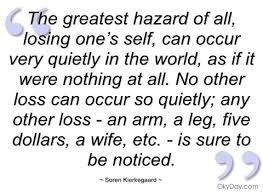
This is what is sad when one contemplates human life, that so many live out their lives in quiet lostness… they live, as it were, away from themselves and vanish like shadows… The most common form of despair is not being who you are… The greatest hazard of all, losing one’s self, can occur very quietly in the world, as if it were nothing at all. No other loss can occur so quietly; any other loss – an arm, a leg, five dollars, a wife, etc. – is sure to be noticed.

– Soren Kierkegaard

Smoking Kills (Your Organs): 6 Major Organs Damaged By Cigarette Smoke

Medical Daily

Jul 29, 2014 11:43 AM By Chris Weller
 cigarettes
As the smoke hits your lungs, the chemicals it contains begin to work their way throughout the rest of your body. włodi, CC BY-SA 2.0

Coughing up heaping globs of mucous isn’t even the half of it. Neither is losing all sense of stamina, or coming home to a stale-smelling house with yellowed walls and furniture. No, the biggest consequences of smoking are, by and large, ones you will never see. These, however, tend to be the deadliest.

As you inhale cigarette smoke, the 7,000 or so carcinogens begin to swirl through the caverns of your body, beginning in your esophagus and winding up in distant locations you wouldn’t give second thought to. The truth is, for all its declining popularity, smoking still emerges as the single greatest preventable cause of death in the United States. Each year, some 480,000 people die from smoking-related causes. Here are six organs that feel the effects in the meantime.

1. Your Lungs

Best to get this one out of the way early. Lung cancer, emphysema, and bronchitis are three of the most common diseases directly associated with smoking. Eighty percent of lung cancer cases are due to smoking.

Columns of harmful smoke pour into the organs, paralyzing the delicate cilia lining the inner walls and irritating them to the point where they overproduce mucous. When these cilia die, and mucous builds, respiration suffers. Once the soft healthy tissue turns hard and black, asthma and cancer tend to follow. While many of the body’s processes stabilize after someone quits smoking, damaged lung tissue can never heal.

2. Your Skin

It’s easy to forget the largest organ in your body is even an organ at all. Smoking damages the skin in more ways than one. On the one hand, you’ll notice some profound cosmetic changes, such as bags under the eyes, a toughening of the skin, wrinkles, and stretch marks — all stemming from the skin’s dying elasticity. But you should also expect major health risks to rise. Among the heavy-hitters: skin cancer, warts, psoriasis, and poorer wound healing.

We don’t think of skin as playing much more than a cosmetic role, but the largest organ in the body is the first line of defense for keeping out invading forces, like bacteria and viruses. Psoriasis, for instance, was found in 2007 to double in risk for people who smoked a pack a day for 20 years. To put it bluntly, when there’s a tear in the sheath of shrink-wrapped flesh draped over the other organs, getting sick becomes a lot easier.

3. Your Uterus

Among smoking’s long cons is its effect on reproductive health. Cigarettes significantly raise a woman’s risk for ectopic pregnancy — the maturation of an embryo outside the walls of the uterus, typically in the fallopian tubes. One 2010 study suggested this was due to an overproduction of the protein PROKR1, making it harder for the fallopian tubes to contract and send the egg all the way to the womb.

In addition to ectopic pregnancies, research has found cigarette smoking to lead to more failures involving in vitro fertilization, adverse reproductive outcomes, and a lower fecundity rates overall. Women have also been having kids later in life, upping their risk even further, as it means they’ll have been smoking longer before pregnancy.

4. Your Penis

The ability to achieve and maintain an erection could suffer drastically if a man smokes. That finding has been repeated over and over throughout the decades, most compellingly in a 2011 study that found men who kicked the habit had quicker, firmer, and most durable erections than men who smoked — achieving that erection up to five times faster than smokers who relapsed.

Important to keep in mind: Nicotine, not smoking, determined men’s physical arousal. They didn’t see full return to health until after they quit nicotine patches or gum. Also, study co-author Christopher Harte, of the VA Boston Healthcare System, pointed out, a man’s success depends on his relationship with his sexual partner.

5. Your Eyes

As previously stated, expect some under-eye droopage after having smoked for a while. More than that, cigarette smoking has been found to lead to a raft of conditions related to vision loss, such as age-related macular degeneration, cataracts, glaucoma, diabetic retinopathy, and dry eye syndrome.

Smoking attacks the eye from two fronts. The first is the smoke itself, which collects in front of your face as you smoke and again after you exhale. The constant exposure to the smoke can dry your eyes out and irritate them. Combine this with smoking’s effects on blood flow, which stops the optic nerve from getting enough antioxidants. As a result, scientists believe, the chemicals in cigarette smoke pollute the blood and starve the ocular organs.

6. Your Liver

The liver isn’t confined to damage from alcohol consumption. Smoking ups people’s risk for liver cancer dramatically, according to a 2011 study that found nearly half of all liver cancer cases were the result of smoking. By contrast, 21 percent were associated with hepatitis C, 16 percent from obesity, 13 percent from hepatitis B, and, all the way at the bottom, 10 percent for alcohol consumption.

The majority of liver cancer deaths are the result of hepatocellular carcinoma, a leading cause of cancer deaths worldwide, among sub-Saharan African and Southeast Asian countries. Cirrhosis — when liver cells turn to scar tissue — is one of the greatest non-cancerous forms of liver damage; in the U.S. cirrhosis is often alcohol-related, which is why the conventional wisdom keeps the two so closely linked.

What Exactly is Wikipedia Doing?

Wikipedia is protesting against SOPA and PIPA by blacking out the English Wikipedia for 24 hours, beginning at midnight January 18, Eastern Time. Readers who come to English Wikipedia during the blackout will not be able to read the encyclopedia: instead, they will see messages intended to raise awareness about SOPA and PIPA, and encouraging them to share their views with their elected representatives, and via social media.

Why is this happening?

Nothing like this has ever happened before on the English Wikipedia. Wikipedians have chosen to black out the English Wikipedia for the first time ever, because we are concerned that SOPA and PIPA will severely inhibit people’s access to online information. This is not a problem that will solely affect people in the United States: it will affect everyone around the world.Why? SOPA and PIPA are badly drafted legislation that won’t be effective in their main goal (to stop copyright infringement), and will cause serious damage to the free and open internet. They put the burden on website owners to police user-contributed material and call for the unnecessary blocking of entire sites. Small sites won’t have sufficient resources to defend themselves. Big media companies may seek to cut off funding sources for their foreign competitors, even if copyright isn’t being infringed. Foreign sites will be blacklisted, which means they won’t show up in major search engines. And, SOPA and PIPA build a framework for future restrictions and suppression.

Isn’t SOPA dead? Wasn’t the bill shelved, and didn’t the White House declare that it won’t sign anything that resembles the current bill?

No, neither SOPA nor PIPA are dead. On January 17th, SOPA’s sponsor said the bill will be discussed in early February. There are signs PIPA may be debated on the Senate floor next week. Moreover, SOPA and PIPA are just indicators of a much broader problem. In many jurisdictions around the world, we’re seeing the development of legislation that prioritizes overly-broad copyright enforcement over the preservation of individual civil liberties. We want the Internet to be free and open, everywhere, for everyone.

Aren’t SOPA/PIPA as they stand not even really a threat to Wikipedia? Won’t the DNS provisions be removed?

SOPA and PIPA are still alive, and they’re still a threat to the free and open web, which means they are a threat to Wikipedia. For example, in its current form, SOPA would require U.S. sites to take on the heavy burden of actively policing third-party links for infringing content. And even with the DNS provisions removed, the bill would give the U.S. government extraordinary and loosely-defined powers to take control over content and information on the free web. Taking one bad provision out doesn’t make the bills okay, and regardless, Internet experts agree they won’t even be effective in their main goal: halting copyright infringement. The Electronic Frontier Foundation has published a really great post about some of the more dangerous SOPA and PIPA provisions.

What can users outside of the U.S. do to support this effort?

Readers who don’t live in the United States can contact their local State Department, Ministry of Foreign Affairs, or similar branch of government. Tell them that you oppose the draft U.S. SOPA and PIPA legislation, and all similar legislation. SOPA and PIPA will have a global effect – websites outside of the U.S. would be impacted by legislation that hurts the free and open web. And, other jurisdictions are grappling with similar issues, and may choose paths similar to SOPA and PIPA.

Is it still possible to access Wikipedia in any way?

The Wikipedia community, as part of their request to the Wikimedia Foundation to carry out this protest, asked us to ensure that we make English Wikipedia accessible in some way during an emergency. The English Wikipedia will be accessible on mobile devices and smart phones. Because the protest message is powered by JavaScript, it’s also possible to view Wikipedia by completely disabling JavaScript in your browser.

I keep hearing that this is a fight between Hollywood and Silicon Valley. Is that true?

No. Some people are characterizing it that way, probably in an effort to imply all the participants are motivated by commercial self-interest. But you can know it’s not that simple, because Wikipedia has no financial self-interest here: we are not trying to monetize your eyeballs or sell your products. We are protesting to raise awareness about SOPA and PIPA solely because we think they will hurt the internet, and your ability to access information. We are doing this for you.

In carrying out this protest, is Wikipedia abandoning neutrality?

We hope you continue to trust Wikipedia to be a neutral informational resource. We are staging this blackout because, although Wikipedia’s articles are neutral, its existence actually is not. For over a decade, Wikipedians have spent millions of hours building the largest encyclopedia in human history. Wikipedia’s existence depends on a free, open and uncensored Internet. We are shutting Wikipedia down for you, our readers. We support your right to freedom of thought and freedom of expression. We think everyone should have access to educational material on a wide range of subjects, even if they can’t pay for it. We believe people should be able to share information without impediment. We believe that new proposed laws like SOPA and PIPA (and other similar laws under discussion inside and outside the United States) don’t advance the interests of the general public. That’s why we’re doing this.


The Crowd is Untruth

And to honour every man, absolutely every man, is the truth, and this is what it is to fear God and love one’s “neighbour.” But from an ethico-religious point of view, to recognize the “crowd” as the court of last resort is to deny God, and it cannot exactly mean to love the “neighbour.” And the “neighbour” is the absolutely true expression for human equality. In case every one were in truth to love his neighbour as himself, complete human equality would be attained. Every one who loves his neighbour in truth, expresses unconditionally human equality. Every one who, like me, admits that his effort is weak and imperfect, yet is aware that the task is to love one’s neighbour, is also aware of what human equality is. But never have I read in Holy Scripture the commandment, Thou shalt love the crowd – and still less, Thou shalt recognize, ethico-religiously, in the crowd the supreme authority in matters of “truth.” But the thing is simple enough: this thing of loving one’s neighbour is self-denial; that of loving the crowd, or of pretending to love it, of making it the authority in matters of truth, is the way to material power, the way to temporal and earthly advantages of all sorts – at the same time it is the untruth, for a crowd is the untruth.

Therefore was Christ crucified, because, although He addressed himself to all, He would have no dealings with the crowd, because He would not permit the crowd to aid him in any way, because in this regard He repelled people absolutely, would not found a party, did not permit balloting, but would be what He is, the Truth, which relates itself to the individual. – And hence every one who truly would serve the truth is eo ipso, in one way or another, a martyr.

For it is not so great a trick to win the crowd. All that is needed is some talent, a certain dose of falsehood, and a little acquaintance with human passions. But no witness for the truth (Aa! and that is what every man should be, including you and me) – no witness for the truth dare become engaged with the crowd.

~ Kierkegaard

Social Contract Theory

Social contract theory, nearly as old as philosophy itself, is the view that persons’ moral and/or political obligations are dependent upon a contract or agreement among them to form the society in which they live. Socrates uses something quite like a social contract argument to explain to Crito why he must remain in prison and accept the death penalty. However, social contract theory is rightly associated with modern moral and political theory and is given its first full exposition and defense by Thomas Hobbes. After Hobbes, John Locke and Jean-Jacques Rousseau are the best known proponents of this enormously influential theory, which has been one of the most dominant theories within moral and political theory throughout the history of the modern West. In the twentieth century, moral and political theory regained philosophical momentum as a result of John Rawls’ Kantian version of social contract theory, and was followed by new analyses of the subject by David Gauthier and others. More recently, philosophers from different perspectives have offered new criticisms of social contract theory. In particular, feminists and race-conscious philosophers have argued that social contract theory is at least an incomplete picture of our moral and political lives, and may in fact camouflage some of the ways in which the contract is itself parasitical upon the subjugations of classes of persons.

Socrates’ Argument

In the early Platonic dialogue, Crito, Socrates makes a compelling argument as to why he must stay in prison and accept the death penalty, rather than escape and go into exile in another Greek city. He personifies the Laws of Athens, and, speaking in their voice, explains that he has acquired an overwhelming obligation to obey the Laws because they have made his entire way of life, and even the fact of his very existence, possible. They made it possible for his mother and father to marry, and therefore to have legitimate children, including himself. Having been born, the city of Athens, through its laws, then required that his father care for and educate him. Socrates’ life and the way in which that life has flourished in Athens are each dependent upon the Laws. Importantly, however, this relationship between citizens and the Laws of the city are not coerced. Citizens, once they have grown up, and have seen how the city conducts itself, can choose whether to leave, taking their property with them, or stay. Staying implies an agreement to abide by the Laws and accept the punishments that they mete out. And, having made an agreement that is itself just, Socrates asserts that he must keep to this agreement that he has made and obey the Laws, in this case, by staying and accepting the death penalty. Importantly, the contract described by Socrates is an implicit one: it is implied by his choice to stay in Athens, even though he is free to leave.

In Plato’s most well-known dialogue, Republic, social contract theory is represented again, although this time less favorably. In Book II, Glaucon offers a candidate for an answer to the question “what is justice?” by representing a social contract explanation for the nature of justice. What men would most want is to be able to commit injustices against others without the fear of reprisal, and what they most want to avoid is being treated unjustly by others without being able to do injustice in return. Justice then, he says, is the conventional result of the laws and covenants that men make in order to avoid these extremes. Being unable to commit injustice with impunity (as those who wear the ring of Gyges would), and fearing becoming victims themselves, men decide that it is in their interests to submit themselves to the convention of justice. Socrates rejects this view, and most of the rest of the dialogue centers on showing that justice is worth having for its own sake, and that the just man is the happy man. So, from Socrates’ point of view, justice has a value that greatly exceeds the prudential value that Glaucon assigns to it.

These views, in the Crito and the Republic, might seem at first glance inconsistent: in the former dialogue Socrates uses a social contract type of argument to show why it is just for him to remain in prison, whereas in the latter he rejects social contract as the source of justice. These two views are, however, reconcilable. From Socrates’ point of view, a just man is one who will, among other things, recognize his obligation to the state by obeying its laws. The state is the morally and politically most fundamental entity, and as such deserves our highest allegiance and deepest respect. Just men know this and act accordingly. Justice, however, is more than simply obeying laws in exchange for others obeying them as well. Justice is the state of a well-regulated soul, and so the just man will also necessarily be the happy man. So, justice is more than the simple reciprocal obedience to law, as Glaucon suggests, but it does nonetheless include obedience to the state and the laws that sustain it. So in the end, although Plato is perhaps the first philosopher to offer a representation of the argument at the heart of social contract theory, Socrates ultimately rejects the idea that social contract is the original source of justice.

Modern Social Contract Theory

Thomas Hobbes

Thomas Hobbes, 1588-1679, lived during the most crucial period of early modern England’s history: the English Civil War, waged from 1642-1648. To describe this conflict in the most general of terms, it was a clash between the King and his supporters, the Monarchists, who preferred the traditional authority of a monarch, and the Parliamentarians, most notably led by Oliver Cromwell, who demanded more power for the quasi-democratic institution of Parliament. Hobbes represents a compromise between these two factions. On the one hand he rejects the theory of the Divine Right of Kings, which is most eloquently expressed by Robert Filmer in his Patriarcha or the Natural Power of Kings, (although it would be left to John Locke to refute Filmer directly). Filmer’s view held that a king’s authority was invested in him (or, presumably, her) by God, that such authority was absolute, and therefore that the basis of political obligation lay in our obligation to obey God absolutely. According to this view, then, political obligation is subsumed under religious obligation. On the other hand, Hobbes also rejects the early democratic view, taken up by the Parliamentarians, that power ought to be shared between Parliament and the King. In rejecting both these views, Hobbes occupies the ground of one is who both radical and conservative. He argues, radically for his times, that political authority and obligation are based on the individual self-interests of members of society who are understood to be equal to one another, with no single individual invested with any essential authority to rule over the rest, while at the same time maintaining the conservative position that the monarch, which he called the Sovereign, must be ceded absolute authority if society is to survive.

Hobbes’ political theory is best understood if taken in two parts: his theory of human motivation,Psychological Egoism, and his theory of the social contract, founded on the hypothetical State of Nature. Hobbes has, first and foremost, a particular theory of human nature, which gives rise to a particular view of morality and politics, as developed in his philosophical masterpiece, Leviathan, published in 1651. The Scientific Revolution, with its important new discoveries that the universe could be both described and predicted in accordance with universal laws of nature, greatly influenced Hobbes. He sought to provide a theory of human nature that would parallel the discoveries being made in the sciences of the inanimate universe. His psychological theory is therefore informed by mechanism, the general view that everything in the universe is produced by nothing other than matter in motion. According to Hobbes, this extends to human behavior. Human macro-behavior can be aptly described as the effect of certain kinds of micro-behavior, even though some of this latter behavior is invisible to us. So, such behaviors as walking, talking, and the like are themselves produced by other actions inside of us. And these other actions are themselves caused by the interaction of our bodies with other bodies, human or otherwise, which create in us certain chains of causes and effects, and which eventually give rise to the human behavior that we can plainly observe. We, including all of our actions and choices, are then, according to this view, as explainable in terms of universal laws of nature as are the motions of heavenly bodies. The gradual disintegration of memory, for example, can be explained by inertia. As we are presented with ever more sensory information, the residue of earlier impressions ‘slows down’ over time. From Hobbes’ point of view, we are essentially very complicated organic machines, responding to the stimuli of the world mechanistically and in accordance with universal laws of human nature.

In Hobbes’ view, this mechanistic quality of human psychology implies the subjective nature of normative claims. ‘Love’ and ‘hate’, for instance, are just words we use to describe the things we are drawn to and repelled by, respectively. So, too, the terms ‘good’ and ‘bad’ have no meaning other than to describe our appetites and aversions. Moral terms do not, therefore, describe some objective state of affairs, but are rather reflections of individual tastes and preferences.

In addition to Subjectivism, Hobbes also infers from his mechanistic theory of human nature that humans are necessarily and exclusively self-interested. All men pursue only what they perceive to be in their own individually considered best interests – they respond mechanistically by being drawn to that which they desire and repelled by that to which they are averse. This is a universal claim: it is meant to cover all human actions under all circumstances – in society or out of it, with regard to strangers and friends alike, with regard to small ends and the most generalized of human desires, such as the desire for power and status. Everything we do is motivated solely by the desire to better our own situations, and satisfy as many of our own, individually considered desires as possible. We are infinitely appetitive and only genuinely concerned with our own selves. According to Hobbes, even the reason that adults care for small children can be explicated in terms of the adults’ own self-interest (he claims that in saving an infant by caring for it, we become the recipient of a strong sense of obligation in one who has been helped to survive rather than allowed to die).

In addition to being exclusively self-interested, Hobbes also argues that human beings are reasonable. They have in them the rational capacity to pursue their desires as efficiently and maximally as possible. Their reason does not, given the subjective nature of value, evaluate their given ends, rather it merely acts as “Scouts, and Spies, to range abroad, and find the way to the things Desired” (139). Rationality is purely instrumental. It can add and subtract, and compare sums one to another, and thereby endows us with the capacity to formulate the best means to whatever ends we might happen to have.

From these premises of human nature, Hobbes goes on to construct a provocative and compelling argument for why we ought to be willing to submit ourselves to political authority. He does this by imagining persons in a situation prior to the establishment of society, the State of Nature.

According to Hobbes, the justification for political obligation is this: given that men are naturally self-interested, yet they are rational, they will choose to submit to the authority of a Sovereign in order to be able to live in a civil society, which is conducive to their own interests. Hobbes argues for this by imagining men in their natural state, or in other words, the State of Nature. In the State of Nature, which is purely hypothetical according to Hobbes, men are naturally and exclusively self-interested, they are more or less equal to one another, (even the strongest man can be killed in his sleep), there are limited resources, and yet there is no power able to force men to cooperate. Given these conditions in the State of Nature, Hobbes concludes that the State of Nature would be unbearably brutal. In the State of Nature, every person is always in fear of losing his life to another. They have no capacity to ensure the long-term satisfaction of their needs or desires. No long-term or complex cooperation is possible because the State of Nature can be aptly described as a state of utter distrust. Given Hobbes’ reasonable assumption that most people want first and foremost to avoid their own deaths, he concludes that the State of Nature is the worst possible situation in which men can find themselves. It is the state of perpetual and unavoidable war.

The situation is not, however, hopeless. Because men are reasonable, they can see their way out of such a state by recognizing the laws of nature, which show them the means by which to escape the State of Nature and create a civil society. The first and most important law of nature commands that each man be willing to pursue peace when others are willing to do the same, all the while retaining the right to continue to pursue war when others do not pursue peace. Being reasonable, and recognizing the rationality of this basic precept of reason, men can be expected to construct a Social Contract that will afford them a life other than that available to them in the State of Nature. This contract is constituted by two distinguishable contracts. First, they must agree to establish society by collectively and reciprocally renouncing the rights they had against one another in the State of Nature. Second, they must imbue some one person or assembly of persons with the authority and power to enforce the initial contract. In other words, to ensure their escape from the State of Nature, they must both agree to live together under common laws, and create an enforcement mechanism for the social contract and the laws that constitute it. Since the sovereign is invested with the authority and power to mete out punishments for breaches of the contract which are worse than not being able to act as one pleases, men have good, albeit self-interested, reason to adjust themselves to the artifice of morality in general, and justice in particular. Society becomes possible because, whereas in the State of Nature there was no power able to “overawe them all”, now there is an artificially and conventionally superior and more powerful person who can force men to cooperate. While living under the authority of a Sovereign can be harsh (Hobbes argues that because men’s passions can be expected to overwhelm their reason, the Sovereign must have absolute authority in order for the contract to be successful) it is at least better than living in the State of Nature. And, no matter how much we may object to how poorly a Sovereign manages the affairs of the state and regulates our own lives, we are never justified in resisting his power because it is the only thing which stands between us and what we most want to avoid, the State of Nature.

According to this argument, morality, politics, society, and everything that comes along with it, all of which Hobbes calls ‘commodious living’ are purely conventional. Prior to the establishment of the basic social contract, according to which men agree to live together and the contract to embody a Sovereign with absolute authority, nothing is immoral or unjust – anything goes. After these contracts are established, however, then society becomes possible, and people can be expected to keep their promises, cooperate with one another, and so on. The Social Contract is the most fundamental source of all that is good and that which we depend upon to live well. Our choice is either to abide by the terms of the contract, or return to the State of Nature, which Hobbes argues no reasonable person could possibly prefer.

Given his rather severe view of human nature, Hobbes nonetheless manages to create an argument that makes civil society, along with all its advantages, possible. Within the context of the political events of his England, he also managed to argue for a continuation of the traditional form of authority that his society had long since enjoyed, while nonetheless placing it on what he saw as a far more acceptable foundation.

John Locke

For Hobbes, the necessity of an absolute authority, in the form of a Sovereign, followed from the utter brutality of the State of Nature. The State of Nature was completely intolerable, and so rational men would be willing to submit themselves even to absolute authority in order to escape it. For John Locke, 1632-1704, the State of Nature is a very different type of place, and so his argument concerning the social contract and the nature of men’s relationship to authority are consequently quite different. While Locke uses Hobbes’ methodological device of the State of Nature, as do virtually all social contract theorists, he uses it to a quite different end. Locke’s arguments for the social contract, and for the right of citizens to revolt against their king were enormously influential on the democratic revolutions that followed, especially on Thomas Jefferson, and the founders of the United States.

Locke’s most important and influential political writings are contained in his Two Treatises on Government. The first treatise is concerned almost exclusively with refuting the argument of Robert Filmer’s Patriarcha, that political authority was derived from religious authority, also known by the description of the Divine Right of Kings, which was a very dominant theory in seventeenth-century England. The second treatise contains Locke’s own constructive view of the aims and justification for civil government, and is titled “An Essay Concerning the True Original Extent and End of Civil Government”.

According to Locke, the State of Nature, the natural condition of mankind, is a state of perfect and complete liberty to conduct one’s life as one best sees fit, free from the interference of others. This does not mean, however, that it is a state of license: one is not free to do anything at all one pleases, or even anything that one judges to be in one’s interest. The State of Nature, although a state wherein there is no civil authority or government to punish people for transgressions against laws, is not a state without morality. The State of Nature is pre-political, but it is not pre-moral. Persons are assumed to be equal to one another in such a state, and therefore equally capable of discovering and being bound by the Law of Nature. The Law of Nature, which is on Locke’s view the basis of all morality, and given to us by God, commands that we not harm others with regards to their “life, health, liberty, or possessions” (par. 6). Because we all belong equally to God, and because we cannot take away that which is rightfully His, we are prohibited from harming one another. So, the State of Nature is a state of liberty where persons are free to pursue their own interests and plans, free from interference, and, because of the Law of Nature and the restrictions that it imposes upon persons, it is relatively peaceful.

The State of Nature therefore, is not the same as the state of war, as it is according to Hobbes. It can, however devolve into a state of war, in particular, a state of war over property disputes. Whereas the State of Nature is the state of liberty where persons recognize the Law of Nature and therefore do not harm one another, the state of war begins between two or more men once one man declares war on another, by stealing from him, or by trying to make him his slave. Since in the State of Nature there is no civil power to whom men can appeal, and since the Law of Nature allows them to defend their own lives, they may then kill those who would bring force against them. Since the State of Nature lacks civil authority, once war begins it is likely to continue. And this is one of the strongest reasons that men have to abandon the State of Nature by contracting together to form civil government.

Property plays an essential role in Locke’s argument for civil government and the contract that establishes it. According to Locke, private property is created when a person mixes his labor with the raw materials of nature. So, for example, when one tills a piece of land in nature, and makes it into a piece of farmland, which produces food, then one has a claim to own that piece of land and the food produced upon it. (This led Locke to conclude that America didn’t really belong to the natives who lived there, because they were, on his view, failing to utilize the basic material of nature. In other words, they didn’t farm it, so they had no legitimate claim to it, and others could therefore justifiably appropriate it.) Given the implications of the Law of Nature, there are limits as to how much property one can own: one is not allowed to take so more from nature than oneself can use, thereby leaving others without enough for themselves. Because nature is given to all of mankind by God for its common subsistence, one cannot take more than his own fair share. Property is the linchpin of Locke’s argument for the social contract and civil government because it is the protection of their property, including their property in their own bodies, that men seek when they decide to abandon the State of Nature.

According to Locke, the State of Nature is not a condition of individuals, as it is for Hobbes. Rather, it is populated by mothers and fathers with their children, or families – what he calls “conjugal society” (par. 78). These societies are based on the voluntary agreements to care for children together, and they are moral but not political. Political society comes into being when individual men, representing their families, come together in the State of Nature and agree to each give up the executive power to punish those who transgress the Law of Nature, and hand over that power to the public power of a government. Having done this, they then become subject to the will of the majority. In other words, by making a compact to leave the State of Nature and form society, they make “one body politic under one government” (par. 97) and submit themselves to the will of that body. One joins such a body, either from its beginnings, or after it has already been established by others, only by explicit consent. Having created a political society and government through their consent, men then gain three things which they lacked in the State of Nature: laws, judges to adjudicate laws, and the executive power necessary to enforce these laws. Each man therefore gives over the power to protect himself and punish transgressors of the Law of Nature to the government that he has created through the compact.

Given that the end of “men’s uniting into common-wealths”( par. 124) is the preservation of their wealth, and preserving their lives, liberty, and well-being in general, Locke can easily imagine the conditions under which the compact with government is destroyed, and men are justified in resisting the authority of a civil government, such as a King. When the executive power of a government devolves into tyranny, such as by dissolving the legislature and therefore denying the people the ability to make laws for their own preservation, then the resulting tyrant puts himself into a State of Nature, and specifically into a state of war with the people, and they then have the same right to self-defense as they had before making a compact to establish society in the first place. In other words, the justification of the authority of the executive component of government is the protection of the people’s property and well-being, so when such protection is no longer present, or when the king becomes a tyrant and acts against the interests of the people, they have a right, if not an outright obligation, to resist his authority. The social compact can be dissolved and the process to create political society begun anew.

Because Locke did not envision the State of Nature as grimly as did Hobbes, he can imagine conditions under which one would be better off rejecting a particular civil government and returning to the State of Nature, with the aim of constructing a better civil government in its place. It is therefore both the view of human nature, and the nature of morality itself, which account for the differences between Hobbes’ and Locke’s views of the social contract.

Jean-Jacques Rousseau

Jean-Jacques Rousseau, 1712-1778, lived and wrote during what was arguably the headiest period in the intellectual history of modern France–the Enlightenment. He was one of the bright lights of that intellectual movement, contributing articles to the Encyclopdie of Diderot, and participating in the salons in Paris, where the great intellectual questions of his day were pursued.

Rousseau has two distinct social contract theories. The first is found in his essay, Discourse on the Origin and Foundations of Inequality Among Men, commonly referred to as the Second Discourse, and is an account of the moral and political evolution of human beings over time, from a State of Nature to modern society. As such it contains his naturalized account of the social contract, which he sees as very problematic. The second is his normative, or idealized theory of the social contract, and is meant to provide the means by which to alleviate the problems that modern society has created for us, as laid out in the Second Discourse.

Rousseau wrote his Second Discourse in response to an essay contest sponsored by the Academy of Dijon. (Rousseau had previously won the same essay contest with an earlier essay, commonly referred to as the First Discourse.) In it he describes the historical process by which man began in a State of Nature and over time ‘progressed’ into civil society. According to Rousseau, the State of Nature was a peaceful and quixotic time. People lived solitary, uncomplicated lives. Their few needs were easily satisfied by nature. Because of the abundance of nature and the small size of the population, competition was non-existent, and persons rarely even saw one another, much less had reason for conflict or fear. Moreover, these simple, morally pure persons were naturally endowed with the capacity for pity, and therefore were not inclined to bring harm to one another.

As time passed, however, humanity faced certain changes. As the overall population increased, the means by which people could satisfy their needs had to change. People slowly began to live together in small families, and then in small communities. Divisions of labor were introduced, both within and between families, and discoveries and inventions made life easier, giving rise to leisure time. Such leisure time inevitably led people to make comparisons between themselves and others, resulting in public values, leading to shame and envy, pride and contempt. Most importantly however, according to Rousseau, was the invention of private property, which constituted the pivotal moment in humanity’s evolution out of a simple, pure state into one characterized by greed, competition, vanity, inequality, and vice. For Rousseau the invention of property constitutes humanity’s ‘fall from grace’ out of the State of Nature.

Having introduced private property, initial conditions of inequality became more pronounced. Some have property and others are forced to work for them, and the development of social classes begins. Eventually, those who have property notice that it would be in their interests to create a government that would protect private property from those who do not have it but can see that they might be able to acquire it by force. So, government gets established, through a contract, which purports to guarantee equality and protection for all, even though its true purpose is to fossilize the very inequalities that private property has produced. In other words, the contract, which claims to be in the interests of everyone equally, is really in the interests of the few who have become stronger and richer as a result of the developments of private property. This is the naturalized social contract, which Rousseau views as responsible for the conflict and competition from which modern society suffers.

The normative social contract, argued for by Rousseau in The Social Contract (1762), is meant to respond to this sorry state of affairs and to remedy the social and moral ills that have been produced by the development of society. The distinction between history and justification, between the factual situation of mankind and how it ought to live together, is of the utmost importance to Rousseau. While we ought not to ignore history, nor ignore the causes of the problems we face, we must resolve those problems through our capacity to choose how we ought to live. Might never makes right, despite how often it pretends that it can.

The Social Contract begins with the most oft-quoted line from Rousseau: “Man was born free, and he is everywhere in chains” (49). This claim is the conceptual bridge between the descriptive work of the Second Discourse, and the prescriptive work that is to come. Humans are essentially free, and were free in the State of Nature, but the ‘progress’ of civilization has substituted subservience to others for that freedom, through dependence, economic and social inequalities, and the extent to which we judge ourselves through comparisons with others. Since a return to the State of Nature is neither feasible nor desirable, the purpose of politics is to restore freedom to us, thereby reconciling who we truly and essentially are with how we live together. So, this is the fundamental philosophical problem that The Social Contract seeks to address: how can we be free and live together? Or, put another way, how can we live together without succumbing to the force and coercion of others? We can do so, Rousseau maintains, by submitting our individual, particular wills to the collective or general will, created through agreement with other free and equal persons. Like Hobbes and Locke before him, and in contrast to the ancient philosophers, all men are made by nature to be equals, therefore no one has a natural right to govern others, and therefore the only justified authority is the authority that is generated out of agreements or covenants.

The most basic covenant, the social pact, is the agreement to come together and form a people, a collectivity, which by definition is more than and different from a mere aggregation of individual interests and wills. This act, where individual persons become a people is “the real foundation of society” (59). Through the collective renunciation of the individual rights and freedom that one has in the State of Nature, and the transfer of these rights to the collective body, a new ‘person’, as it were, is formed. The sovereign is thus formed when free and equal persons come together and agree to create themselves anew as a single body, directed to the good of all considered together. So, just as individual wills are directed towards individual interests, the general will, once formed, is directed towards the common good, understood and agreed to collectively. Included in this version of the social contract is the idea of reciprocated duties: the sovereign is committed to the good of the individuals who constitute it, and each individual is likewise committed to the good of the whole. Given this, individuals cannot be given liberty to decide whether it is in their own interests to fulfill their duties to the Sovereign, while at the same time being allowed to reap the benefits of citizenship. They must be made to conform themselves to the general will, they must be “forced to be free” (64).

For Rousseau, this implies an extremely strong and direct form of democracy. One cannot transfer one’s will to another, to do with as he or she sees fit, as one does in representative democracies. Rather, the general will depends on the coming together periodically of the entire democratic body, each and every citizen, to decide collectively, and with at least near unanimity, how to live together, i.e., what laws to enact. As it is constituted only by individual wills, these private, individual wills must assemble themselves regularly if the general will is to continue. One implication of this is that the strong form of democracy which is consistent with the general will is also only possible in relatively small states. The people must be able to identify with one another, and at least know who each other are. They cannot live in a large area, too spread out to come together regularly, and they cannot live in such different geographic circumstances as to be unable to be united under common laws. (Could the present-day U.S. satisfy Rousseau’s conception of democracy? It could not. ) Although the conditions for true democracy are stringent, they are also the only means by which we can, according to Rousseau, save ourselves, and regain the freedom to which we are naturally entitled.

Rousseau’s social contract theories together form a single, consistent view of our moral and political situation. We are endowed with freedom and equality by nature, but our nature has been corrupted by our contingent social history. We can overcome this corruption, however, by invoking our free will to reconstitute ourselves politically, along strongly democratic principles, which is good for us, both individually and collectively.

More Recent Social Contract Theories

John Rawls’ A Theory of Justice

In 1972, the publication of John Rawls‘ extremely influential A Theory of Justice brought moral and political philosophy back from what had been a long hiatus of philosophical consideration. Rawls’ theory relies on a Kantian understanding of persons and their capacities. For Rawls, as for Kant, persons have the capacity to reason from a universal point of view, which in turn means that they have the particular moral capacity of judging principles from an impartial standpoint. In A Theory of Justice, Rawls argues that the moral and political point of view is discovered via impartiality. (It is important to note that this view, delineated in A Theory of Justice, has undergone substantial revisions by Rawls, and that he described his later view as “political liberalism”.) He invokes this point of view (the general view that Thomas Nagel describes as “the view from nowhere”) by imagining persons in a hypothetical situation, the Original Position, which is characterized by the epistemological limitation of the Veil of Ignorance. Rawls’ original position is his highly abstracted version of the State of Nature. It is the position from which we can discover the nature of justice and what it requires of us as individual persons and of the social institutions through which we will live together cooperatively. In the original position, behind the veil of ignorance, one is denied any particular knowledge of one’s circumstances, such as one’s gender, race, particular talents or disabilities, one’s age, social status, one’s particular conception of what makes for a good life, or the particular state of the society in which one lives. Persons are also assumed to be rational and disinterested in one another’s well-being. These are the conditions under which, Rawls argues, one can choose principles for a just society which are themselves chosen from initial conditions that are inherently fair. Because no one has any of the particular knowledge he or she could use to develop principles that favor his or her own particular circumstances, in other words the knowledge that makes for and sustains prejudices, the principles chosen from such a perspective are necessarily fair. For example, if one does not know whether one is female or male in the society for which one must choose basic principles of justice, it makes no sense, from the point of view of self-interested rationality, to endorse a principle that favors one sex at the expense of another, since, once the veil of ignorance is lifted, one might find oneself on the losing end of such a principle. Hence Rawls describes his theory as “justice as fairness.” Because the conditions under which the principles of justice are discovered are basically fair, justice proceeds out of fairness.

In such a position, behind such a veil, everyone is in the same situation, and everyone is presumed to be equally rational. Since everyone adopts the same method for choosing the basic principles for society, everyone will occupy the same standpoint: that of the disembodied, rational, universal human. Therefore all who consider justice from the point of view of the original position would agree upon the same principles of justice generated out of such a thought experiment. Any one person would reach the same conclusion as any other person concerning the most basic principles that must regulate a just society.

The principles that persons in the Original Position, behind the Veil of Ignorance, would choose to regulate a society at the most basic level (that is, prior even to a Constitution) are called by Rawls, aptly enough, the Two Principles of Justice. These two principles determine the distribution of both civil liberties and social and economic goods. The first principle states that each person in a society is to have as much basic liberty as possible, as long as everyone is granted the same liberties. That is, there is to be as much civil liberty as possible as long as these goods are distributed equally. (This would, for example, preclude a scenario under which there was a greater aggregate of civil liberties than under an alternative scenario, but under which such liberties were not distributed equally amongst citizens.) The second principle states that while social and economic inequalities can be just, they must be available to everyone equally (that is, no one is to be on principle denied access to greater economic advantage) and such inequalities must be to the advantage of everyone. This means that economic inequalities are only justified when the least advantaged member of society is nonetheless better off than she would be under alternative arrangements. So, only if a rising tide truly does carry all boats upward, can economic inequalities be allowed for in a just society. The method of the original position supports this second principle, referred to as the Difference Principle, because when we are behind the veil of ignorance, and therefore do not know what our situation in society will be once the veil of ignorance is lifted, we will only accept principles that will be to our advantage even if we end up in the least advantaged position in society.

These two principles are related to each other by a specific order. The first principle, distributing civil liberties as widely as possible consistent with equality, is prior to the second principle, which distributes social and economic goods. In other words, we cannot decide to forgo some of our civil liberties in favor of greater economic advantage. Rather, we must satisfy the demands of the first principle, before we move on to the second. From Rawls’ point of view, this serial ordering of the principles expresses a basic rational preference for certain kinds of goods, i.e., those embodied in civil liberties, over other kinds of goods, i.e., economic advantage.

Having argued that any rational person inhabiting the original position and placing him or herself behind the veil of ignorance can discover the two principles of justice, Rawls has constructed what is perhaps the most abstract version of a social contract theory. It is highly abstract because rather than demonstrating that we would or even have signed to a contract to establish society, it instead shows us what we must be willing to accept as rational persons in order to be constrained by justice and therefore capable of living in a well ordered society. The principles of justice are more fundamental than the social contract as it has traditionally been conceived. Rather, the principles of justice constrain that contract, and set out the limits of how we can construct society in the first place. If we consider, for example, a constitution as the concrete expression of the social contract, Rawls’ two principles of justice delineate what such a constitution can and cannot require of us. Rawls’ theory of justice constitutes, then, the Kantian limits upon the forms of political and social organization that are permissible within a just society.

David Gauthier

In his 1986 book, Morals by Agreement, David Gauthier set out to renew Hobbesian moral and political philosophy. In that book, he makes a strong argument that Hobbes was right: we can understand both politics and morality as founded upon an agreement between exclusively self-interested yet rational persons. He improves upon Hobbes’ argument, however, by showing that we can establish morality without the external enforcement mechanism of the Sovereign. Hobbes argued that men’s passions were so strong as to make cooperation between them always in danger of breaking down, and thus that a Sovereign was necessary to force compliance. Gauthier, however, believes that rationality alone convinces persons not only to agree to cooperate, but to stick to their agreements as well.

We should understand ourselves as individual Robinson Crusoes, each living on our own island, lucky or unlucky in terms of our talents and the natural provisions of our islands, but able to enter into negotiations and deals with one another to trade goods and services with one another. Entering into such agreements is to our own advantage, and so rationality convinces us to both make such agreements and stick to them as well.

Gauthier has an advantage over Hobbes when it comes to developing the argument that cooperation between purely self-interested agents is possible. He has access to rational choice theory and its sophisticated methodology for showing how such cooperation can arise. In particular, he appeals to the model of the Prisoner’s Dilemma to show that self-interest can be consistent with acting cooperatively. (There is a reasonable argument to be made that we can find in Hobbes a primitive version of the problem of the Prisoner’s Dilemma.)

According to the story of the Prisoner’s Dilemma, two people have been brought in for questioning, conducted separately, about a crime they are suspected to have committed. The police have solid evidence of a lesser crime that they committed, but need confessions in order to convict them on more serious charges. Each prisoner is told that if she cooperates with the police by informing on the other prisoner, then she will be rewarded by receiving a relatively light sentence of one year in prison, whereas her cohort will go to prison for ten years. If they both remain silent, then there will be no such rewards, and they can each expect to receive moderate sentences of two years. And if they both cooperate with police by informing on each other, then the police will have enough to send each to prison for five years. The dilemma then is this: in order to serve her own interests as well as possible, each prisoner reasons that no matter what the other does she is better off cooperating with the police by confessing. Each reasons: “If she confesses, then I should confess, thereby being sentenced to five years instead of ten. And if she does not confess, then I should confess, thereby being sentenced to one year instead of two. So, no matter what she does, I should confess.” The problem is that when each reason this way, they each confess, and each goes to prison for five years. However, had they each remained silent, thereby cooperating with each other rather than with the police, they would have spent only two years in prison.

According to Gauthier, the important lesson of the Prisoner’s Dilemma is that when one is engaged in interaction such that others’ actions can affect one’s own interests, and vice versa, one does better if one acts cooperatively. By acting to further the interests of the other, one serves one’s own interests as well. We should, therefore, insofar as we are rational, develop within ourselves the dispositions to constrain ourselves when interacting with others. We should become “constrained maximizers” (CMs) rather remain the “straightforward maximizers” (SMs) that we would be in a State of Nature (167).

Both SMs and CMs are exclusively self-interested and rational, but they differ with regard to whether they take into account only strategies, or both the strategies and utilities, of whose with whom they interact. To take into account the others’ strategies is to act in accordance with how you expect the others will act. To take into account their utilities is to consider how they will fare as a result of your action and to allow that to affect your own actions. Both SMs and CMs take into account the strategies of the other with whom they interact. But whereas SMs do not take into account the utilities of those with whom they interact, CMs do. And, whereas CMs are afforded the benefits of cooperation with others, SMs are denied such advantage. According to Gauthier, when interacting in Prisoner’s Dilemma-like situations, where the actions of others can affect one’s own outcome, and vice versa, rationality shows that one’s own interest is best pursued by being cooperative, and therefore agents rationally dispose themselves to the constrain the maximization of their own utility by adopting principles of morality. According to Gauthier, rationality is a force strong enough to give persons internal reasons to cooperate. They do not, therefore, need Hobbes’ Sovereign with absolute authority to sustain their cooperation. The enforcement mechanism has been internalized. “Morals by agreement” are therefore created out of the rationality of exclusively self-interested agents.

Contemporary Critiques of Social Contract Theory

Given the longstanding and widespread influence that social contract theory has had, it comes as no surprise that it is also the objects of many critiques from a variety of philosophical perspectives. Feminists and race-conscious philosophers, in particular, have made important arguments concerning the substance and viability of social contract theory.

Feminist Arguments

For the most part, feminism resists any simple or universal definition. In general though, feminists take women’s experiences seriously, as well as the impact that theories and practices have for women’s lives. Given the pervasive influence of contract theory on social, political, and moral philosophy, then, it is not surprising that feminists should have a great deal to say about whether contract theory is adequate or appropriate from the point of view of taking women seriously. To survey all of the feminist responses to social contract theory would carry us well beyond the boundaries of the present article. I will concentrate therefore on just three of those arguments: Carole Pateman’s argument about the relation between the contract and women’s subordination to men, feminist arguments concerning the nature of the liberal individual, and the care argument.

The Sexual Contract

Carole Pateman’s 1988 book, The Sexual Contract, argues that lying beneath the myth of the idealized contract, as described by Hobbes, Locke, and Rousseau, is a more fundamental contract concerning men’s relationship to women. Contract theory represents itself as being opposed to patriarchy and patriarchal right. (Locke’s social contract, for example, is set by him in stark contrast to the work of Robert Filmer who argued in favor of patriarchal power.) Yet the “original pact” (2) that precedes the social contract entered into by equals is the agreement by men to dominate and control women. This ‘original pact’ is made by brothers, literally or metaphorically, who, after overthrowing the rule of the father, then agree to share their domination of the women who were previously under the exclusive control of one man, the father. The change from “classical patriarchalism” (24) to modern patriarchy is a shift, then, in who has power over women. It is not, however, a fundamental change in whether women are dominated by men. Men’s relationships of power to one another change, but women’s relationship to men’s power does not. Modern patriarchy is characterized by a contractual relationship between men, and part of that contract involves power over women. This fact, that one form of patriarchy was not overthrown completely, but rather was replaced with a different form, in which male power was distributed amongst more men, rather than held by one man, is illustrated by Freud’s story of the genesis of civilization. According to that story, a band of brothers, lorded over by a father who maintained exclusive sexual access to the women of the tribe, kill the father, and then establish a contract among themselves to be equal and to share the women. This is the story, whether we understand Freud’s tale to be historically accurate or not, of modern patriarchy and its deep dependence on contract as the means by which men control and dominate women.

Patriarchal control of women is found in at least three paradigmatic contemporary contracts: the marriage contract, the prostitution contract, and the contract for surrogate motherhood. Each of these contracts is concerned with men’s control of women, or a particular man’s control of a particular woman generalized. According to the terms of the marriage contract, in most states in the U.S., a husband is accorded the right to sexual access, prohibiting the legal category of marital rape. Prostitution is a case in point of Pateman’s claim that modern patriarchy requires equal access by men to women, in particular sexual access, access to their bodies. And surrogate motherhood can be understood as more of the same, although in terms of access to women’s reproductive capacities. All these examples demonstrate that contract is the means by which women are dominated and controlled. Contract is not the path to freedom and equality. Rather, it is one means, perhaps the most fundamental means, by which patriarchy is upheld.

The Nature of the Liberal Individual

Following Pateman’s argument, a number of feminists have also called into question the very nature of the person at the heart of contract theory. The Liberal Individual, the contractor, is represented by the Hobbesian man, Locke’s proprietor, Rousseau’s “Noble Savage,” Rawls’s person in the original position, and Gauthier’s Robinson Crusoe. The liberal individual is purported to be universal: raceless, sexless, classless, disembodied, and is taken to represent an abstract, generalized model of humanity writ large. Many philosophers have argued, however, that when we look more closely at the characteristics of the liberal individual, what we find is not a representation of universal humanity, but a historically located, specific type of person. C.B. Macpherson, for example, has argued that Hobbesian man is, in particular, a bourgeois man, with the characteristics we would expect of a person during the nascent capitalism that characterized early modern Europe. Feminists have also argued that the liberal individual is a particular, historical, and embodied person. (As have race-conscious philosophers, such as Charles Mills, to be discussed below.) More specifically, they have argued that the person at the heart of liberal theory, and the social contract, is gendered. Christine Di Stefano, in her 1991 book Configurations of Masculinity, shows that a number of historically important modern philosophers can be understood to develop their theories from within the perspective of masculinity, as conceived of in the modern period. She argues that Hobbes’s conception of the liberal individual, which laid the groundwork for the dominant modern conception of the person, is particularly masculine in that it is conceived as atomistic and solitary and as not owing any of its qualities, or even its very existence, to any other person, in particular its mother. Hobbes’s human, is therefore, radically individual, in a way that is specifically owing to the character of modern masculinity. Virginia Held, in her 1993 book, Feminist Morality, argues that social contract theory implicitly relies on a conception of the person that can be best described as “economic man.” “Economic man” is concerned first and foremost to maximize his own, individually considered interests, and he enters into contracts as a means by which to achieve this end. “Economic man”, however, fails to represent all persons in all times and places. In particular, it fails to adequately represent children and those who provide them with the care they require, who have historically been women. The model of “economic man” cannot, therefore, fairly claim to be a general representation of all persons. Similarly, Annette Baier argues that Gauthier’s conception of the liberal individual who enters into the social contract as a means by which to maximize his own individually considered interests is gendered in that it does not take seriously the position of either children or the women who most usually are responsible for caring for those children.

Arguing from Care

Theorizing from within the emerging tradition of care ethics, feminist philosophers such as Baier and Held argue that social contract theory fails as an adequate account of our moral or political obligations. Social contract theory, in general, only goes so far as to delineate our rights and obligations. But this may not be enough to adequately reveal the full extent of what it means to be a moral person, and how fully to respond to others with whom one interacts through relations of dependence. Baier argues that Gauthier, who conceives of affective bonds between persons as non-essential and voluntary, therefore fails to represent the fullness of human psychology and motivations. She argues that this therefore leads to a crucial flaw in social contract theory. Liberal moral theory is in fact parasitic upon the very relations between persons from which it seeks to liberate us. While Gauthier argues that we are freer the more that we can see affective relations as voluntary, we must nonetheless, in the first place, be in such relationships (e.g., the mother-child relationship) in order to develop the very capacities and qualities lauded by liberal theory. Certain kinds of relationships of dependence, in other words, are necessary in the first place if we are to become the very kinds of persons who are capable of entering into contracts and agreements. In a similar vein, Held has argued that the model of “economic man” fails to capture much of what constitutes meaningful moral relations between people. Understanding human relations in purely contractual terms constitutes, according to her argument “an impoverished view of human aspiration” (194). She therefore suggests that we consider other models of human relationships when looking for insight into morality. In particular, she offers up the paradigm of the mother-child relationship to at least supplement the model of individual self-interested agents negotiating with one another through contracts. Such a model is more likely to match up with many of the moral experiences of most people, especially women.

Feminist critiques of the contractarian approaches to our collective moral and political lives continue to reverberate through social and political philosophy. One such critique, that of Carole Pateman, has influenced philosophers writing outside of feminist traditions.

Race-Conscious Argument

Charles Mills’ 1997 book, The Racial Contract, is a critique not only of the history of Western political thought, institutions, and practices, but, more specifically, of the history of social contract theory. It is inspired by Carole Pateman’s The Sexual Contract, and seeks to show that non-whites have a similar relationship to the social contract as do women. As such, it also calls into question the supposed universality of the liberal individual who is the agent of contract theory.

Mills’ central argument is that there exists a ‘racial contract’ that is even more fundamental to Western society than the social contract. This racial contract determines in the first place who counts as full moral and political persons, and therefore sets the parameters of who can ‘contract in’ to the freedom and equality that the social contract promises. Some persons, in particular white men, are full persons according to the racial contract. As such they are accorded the right to enter into the social contract, and into particular legal contracts. They are seen as fully human and therefore as deserving of equality and freedom. Their status as full persons accords them greater social power. In particular, it accords them the power to make contracts, to be the subjects of the contract, whereas other persons are denied such privilege and are relegated to the status of objects of contracts.

This racial contract is to some extent a meta-contract, which determines the bounds of personhood and parameters of inclusion and exclusion in all the other contracts that come after it. It manifests itself both formally and informally. It is an agreement, originally among European men in the beginning of the modern period, to identify themselves as ‘white’ and therefore as fully human, and to identify all others, in particular the natives with whom they were beginning to come into contact, as ‘other’: non-white and therefore not fully human. So, race is not just a social construct, as others have argued, it is more especially a political construct, created to serve a particular political end, and the political purposes of a specific group. The contract allows some persons to treat other persons, as well as the lands they inhabit, as resources to be exploited. The enslavement of millions of Africans and the appropriation of the Americas from those who inhabited them, are examples of this racial contract at work in history (such as Locke’s claim that Native Americans did not own the land they lived on because they did not farm it and therefore did not own it). This contract is not hypothetical, as Hobbes describes the one argued for in hisLeviathan. This is an actual contract, or series of contracts, made by real men of history. It is found in such documents as Papal Bulls and Locke’s writings on Native Americans, and acted upon in such historical events as the voyages of discovery made by Europeans and the colonization of Africa, Asia, and the Americas. The racial contract makes possible and justifies some people, in virtue of their alleged superiority, exploiting the peoples, lands, and resources of other races.

From Mills’ perspective then, racism is not just an unhappy accident of Western democratic and political ideals. It is not the case that we have a political system that was perfectly conceived and unfortunately imperfectly applied. One of the reasons that we continue to think that the problem of race in the West is relatively superficial, that it does not go all the way down, is the hold that the idealized social contract has on our imagination. We continue to believe, according to Mills, in the myths that social contract theory tells us – that everyone is equal, that all will be treated the same before the law, that the Founding Fathers were committed to equality and freedom for all persons, etc. One of the very purposes of social contract theory, then, is to keep hidden from view the true political reality – some persons will be accorded the rights and freedoms of full persons, and the rest will be treated as sub-persons. The racial contract informs the very structure of our political systems, and lays the basis for the continuing racial oppression of non-whites. We cannot respond to it, therefore, by simply adding more non-whites into the mix of our political institutions, representation, and so on. Rather, we must reexamine our politics in general, from the point of view of the racial contract, and start from where we are, with full knowledge of how our society has been informed by the systematic exclusion of some persons from the realm of politics and contract. This “naturalized” feature of the racial contract, meaning that it tells a story about who we actually are and what is included in our history, is better, according to Mills, because it holds the promise of making it possible for us to someday actually live up to the norms and values that are at the heart of the Western political traditions.

Conclusion

Virginia Held has argued that “Contemporary Western society is in the grip of contractual thinking” (193). Contractual models have come to inform a vast variety of relations and interaction between persons, from students and their teachers, to authors and their readers. Given this, it would be difficult to overestimate the effect that social contract theory has had, both within philosophy, and on the wider culture. Social contract theory is undoubtedly with us for the foreseeable future. But so too are the critiques of such theory, which will continue to compel us to think and rethink the nature of both ourselves and our relations with one another.

Source: Internet Encyclopedia of Philosophy

Self-Transcendence

world-religions

Buddhism begins with a man. In his later years, when India was afire with his message and kings themselves were bowing before him, people came to him even as they were to come to Jesus asking what he was. How many people have provoked this question – not “Who are you?” with respect to name, origin, or ancestry, but “What are you? What order of being do you belong to? What species do you represent?” Not Caesar, certainly. Not Napoleon, or even Socrates. Only two: Jesus and Buddha. When the people carried their puzzlement to the Buddha himself, the answer he gave provided an identity for his entire message.

“Are you a god?” they asked. “No.” “An angel?” “No.” “A saint?” “No.” “Then what are you?”

Buddha answered, “I am awake.”

His answer became his title, for this is what Buddha means. The Sanskrit root budh denotes both to wake up and to know. Buddha, then, means the “Enlightened One,” or the “Awakened One.” While the rest of the world was wrapped in the womb of sleep, dreaming a dream known as the waking state of human life, one of their number roused himself. Buddhism begins with a man who shook off the daze, the doze, the dream-like vagaries of ordinary awareness. It begins with a man who woke up…

To appreciate the force of [the Parable of the Ferryboat] we must remember the role the ferry played in traditional Asian life. In lands laced by rivers and canals, almost every considerable journey required a ferry. This routine fact underlies and inspires every school of Buddhism, as the use of the word yana by all of them attests. Buddhism is a voyage across life’s river, a transport from the common-sense shore of ignorance, grasping, and death, to the further bank of wisdom and enlightenment. Compared with this settled fact, the differences within Buddhism are no more than variations in the kind of vehicle one boards, or the stage one has reached on the journey.

What are these stages?

While we are on the first bank it is in effect the world for us. Its earth underfoot is solid and reassuring. The rewards and disappointments of its social life are vivid and compelling. The opposite shore is barely visible and has no impact on our dealings.

If, however, something prompts us to see what the other side is like, we may decide to attempt a crossing. If we are of independent bent, we may decide to make it on our own. In this case we are Theravadins; we follow the Buddha’s design for a sturdy craft, but we build ours ourself. Most of us, however, have neither the time nor the talent for such a project of such proportions. We are Mahayanists and move down the bank to where a ready-made ferryboat is expected. As the group of explorers clamber aboard at the landing there is an air of excitement. Attention is focused on the distant bank, still indistinct, but the voyagers are still very much like citizens of this side of the river.

The ferry pushes off and moves across the water. The bank we are leaving behind is losing its substance. The shops and streets and ant-like figures are blending together and releasing their hold on us. Meanwhile, the shore toward which we are headed is not in focus either; it seems almost as far away as it ever was. There is an interval in the crossing when the only tangible realities are the water, with its treacherous currents, and the boat, which is stoutly but precariously contending with them. This is the moment for Buddhism’s Three Vows: I take refuge in the Buddha, the fact that there was an explorer who made this trip and proved to us that is can succeed. I take refuge in the dharma, the vehicle of transport, this boat to which we have committed our lives in the conviction that it is seaworthy. I take refuge in the sangha, the order, the crew that is navigating this ship, in whom we have confidence. The shoreline of the world has been left behind. Until we set foot on the further bank, these are the only things in which we can trust.

The further shore draws near, becomes real. The craft jolts onto the sand and we step onto solid ground. The land, which had been misty and unsubstantial as a dream, is now fact. And the shore that we left behind, which was so palpable and real, is now only a slender horizontal line, a visual patch, a memory without substance.

Impatient to explore our new surroundings, we nevertheless remember our gratitude for the splendid ship and crew who have brought us safely to what promises to be a rewarding land. It will not be gratitude, however, to insist on packing the boat with us as we plunge into the woods. “Would he be a clever man,” the Buddha asked, “if out of gratitude for the raft that has carried him across the stream to safety he, having reached the other shore, should cling to it, take it on his back, and walk about with the weight of it? Would not the clever man be the one who left the raft, no longer of use to him, to the current of the stream and walked ahead without turning back to look at it? Is it not simply a tool to be cast away and forsaken once it has served the purpose for which it was made? In the same way the vehicle of the doctrine is to be cast away and forsaken once the other shore of Enlightenment has been attained.”

Here we come to the Prajnaparamita or Perfection of Wisdom sutras, which are widely considered to be the culminating texts of Buddhism. The Five Precepts and the Eightfold Path; the technical terminology of dukkha, karma, nirvana, and their like; the committed order and the person of the Buddha himself – all these are vitally important to the individual in the act of making the crossing. They lose their relevance for those who have arrived. Indeed, to the traveler who has not only reached the promised shore but who keeps moving into its interior, there comes a time when not only the raft but the river itself drops from view. When such a one turns around to look for the land that has been left behind, what appears? What of that land can appear to one who has crossed a horizon beyond which the river dividing this shore from that shore has vanished? One looks, and there is no other shore. There is no separating river: There is no raft, no ferryman. These things are not a part of the new world.

Before the river was crossed the two shores, human and divine, had to appear distinct from each other, different as life and death, as day and night. But once the crossing has been made, no dichotomy remains. The realm of the gods is not a distinct place. It is where the traveler stands; and if that stance happens to be in this world, the world itself is transmuted. It is in this sense that we are to read the avowals in The Perfection of Wisdom that “this our worldly life is an activity of Nirvana itself; not the slightest distinction exists between them.” Introspection having led to a condition described positively as nirvana and negatively as Emptiness because it transcends all forms, the “stream-winner” now finds in the world itself this same Emptiness that he discovered within. “Form is emptiness, emptiness is form. Emptiness is not different from form, form is not different from emptiness.” The noisy disjunction between acceptance and rejection having been stilled, every moment is affirmed for what it actually is. It is Indra’s cosmic net, laced with jewels at every juncture. Each jewel reflects the others, together with all the reflections in the others. In such a vision the categories of good and evil disappear. “That which is sin is also Wisdom” we read; and once again, “the realm of Becoming is Nirvana.”

This earth on which we stand

is the promised Lotus Land,

And this very body

is the body of the Buddha.

This new-found shore throws light on the bodhisattva‘s vow not to enter nirvana “until the grass itself be enlightened.” As grass keeps coming, does this mean that the bodhisattva will never be enlightened? Not exactly. It means, rather, that he (or she) has risen to the point where the distinction between time and eternity has lost its force. That distinction, drawn by the rational mind, is dissolved in the lightning-and-thunder insight that annihilates opposites. Time and eternity are now two aspects of the same experiential whole, two sides of the same coin. “The jewel of eternity is in the lotus of birth and death.”

From the standpoint of normal, worldly consciousness there must always remain an inconsistency between this climactic insight and worldly prudence. This, though, should not surprise us, for it would be flatly contradictory if the world looked exactly the same to those who have crossed the river of ignorance. Only they can dissolve the world’s distinctions – or, perhaps we should say, take them in their stride, for the distinctions persist, but now without difference. Where to eagle vision the river can still be seen, it is seen as connecting the two banks rather than dividing them.

– Huston Smith, The World’s Religions: Our Great Wisdom Traditions

* * * * *
buddha

For ten years, in the different Pavilions of Spring, Autumn and the Rainy Season, the Prince was immersed in rounds of music, dancing and pleasure, but always his thoughts returned to the problem of suffering of human life.

“The luxuries of the palace, this healthy body, this rejoicing youth! What do they mean to me?” he thought. “Some day we may be sick, we shall become aged; from death there is no escape. Pride of youth, pride of health, pride of existence – all thoughtful people should cast them aside.”

“If he looks in the right way he recognizes the true nature of sickness, old age and death, and he searches for meaning in that which transcends all human sufferings. In my life of pleasures I seem to be looking in the wrong way.”

Thus the spiritual struggle went on in the mind of the Prince until his only child, Rahula, was born when he was 29. This seemed to bring things to a climax, for he then decided to leave the palace and look for the solution of his spiritual unrest in the homeless life of a mendicant. He left the castle one night with only his charioteer, Chandaka, and his favorite horse, the snow-white Kanthaka.

His anguish did not end and many devils tempted him saying: “You would do better to return to the castle for the whole world would soon be yours.” But he told the devil that he did not want the whole world. So he shaved his head and turned his steps toward the south, carrying a begging bowl in his hand.

The Prince first visited the hermit Bhagava and watched the ascetic practices. He then went to Arada Kalama and Udraka Ramaputra to learn their methods of attaining Enlightenment through meditation; but after practicing them for a time he became convinced that they would not lead him to Enlightenment. Finally, he went to the land of Magadha and practiced asceticism in the forest of Uruvilva on the banks of the Nairanjana River, which flows by the Gaya Village.

The methods of his practice where unbelievably rigorous. He spurred himself on with the though that “no ascetic in the past, none in the present, and none in the future, ever has practiced or ever will practice more earnestly than I do.”

Still the Prince could not realize his goal. After six years in the forest, he gave up the practice of asceticism. He went bathing in the river and accepted a bowl of milk from the hand of Sujata, a maiden who lived in the neighboring village. The five companions who had been living with the Prince during the six years of his ascetic practice were shocked that he should receive milk from the hand of a maiden; they thought him degraded and left him.

Thus the Prince was left alone. He was still weak, but at the risk of losing his life he attempted yet another period of meditation, saying to himself, “Blood may become exhausted, flesh may decay, bones may fall apart, but I will never leave this place until I find the way to Enlightenment.”

It was an intense and incomparable struggle for him. He was desperate and filled with confusing thoughts, dark shadows overhung his spirit, and he was beleaguered by all the lures of the devils. Carefully and patiently he examined them one by one and rejected them all. It was a hard struggle indeed, making his blood run thin, his flesh fall away, and his bones crack.

But when the morning star appeared in the eastern sky, the struggle was over and the Prince’s mind was as clear and bright as the breaking day. He had, at last, found the path to Enlightenment. It was December eighth, when the Prince became a Buddha at thirty-five years of age.

From this time on the Prince was known by different names: some spoke of him as Buddha, the Perfectly Enlightened One, Tathagata; some spoke of him as Shakyamuni, the Sage of the Shakya clan; others called him the World-Honored One.

He went first to Mrigadava in Varanasi where the five mendicants who had lived with him during the six years of his ascetic life were staying. At first they shunned him, but after they had talked with him, they believed in him and became his first followers. He then went to the Rajagriha Castle and won over King Bimbisara who had always been his friend. From there he went about the country living on alms and teaching men to accept his way of life.

Men responded to him as the thirsty seek water and the hungry food. Two great disciples, Shariputra and Maudgalyayana, and their two thousand followers, came to him.

At first the Buddha’s father, King Shuddhodana, still inwardly suffering because of his son’s decision to leave the palace, remained aloof, but then became his faithful disciple. Mahaprajapati, the Buddha’s foster mother, and Princess Yashodhara, his wife, and all the members of the Shakya clan began to follow him. Multitudes of others also became his devoted and faithful followers.

For forty-five years the Buddha went about the country preaching and persuading men to follow his way of life. But when he was eighty, at Vaisali and on his way from Rajagriha to Shrvasti, he became ill and predicted that after three months he would enter Nirvana. Still he journeyed on until he reached Pava where he fell seriously ill from some food offered by Chundra, a blacksmith. Eventually, in spite of great pain and weakness, he reached the forest that bordered Kusinagara.

Lying between two large sala trees, he continued teaching his disciples until his last moment. Thus, he entered into perfect tranquility after he had completed his work as the world’s greatest teacher.

. . .

Beneath the sala trees at Kusinagara, in his last words to his disciples, the Buddha said: Make of yourself a light. Rely upon yourself: do not depend upon anyone else. Make my teachings your light. Rely upon them: do not depend upon any other teaching.

Consider your body: Think of its impurity. Knowing that both its pain and its delight are alike causes of suffering, how can you indulge in its desires? Consider your ‘self’; think of its transiency; how can you fall into delusion about it and cherish pride and selfishness, knowing that they must all end in inevitable suffering? Consider all substances; can you find among them any enduring ‘self’? Are they not all aggregates that sooner or later will break apart and be scattered? Do not be confused by the universality of suffering, but follow my teaching, even after my death, and you will be rid of pain. Do this and you will indeed be my disciples.

My disciples, the teachings that I have given you are never to be forgotten or abandoned. They are always to be treasured, they are to be thought about, they are to be practiced. If you follow these teachings you will always be happy.
The point of the teachings is to control your own mind. Keep your mind from greed, and you will keep your behavior right, your mind pure and your words faithful. By always thinking about the transience of your life, you will be able to resist green and anger, and will be able to avoid all evils.

If you find your mind tempted and so entangled in greed, you must suppress and control the temptation; be the master of your own mind.

A man’s mind may make him a Buddha, or it may make him a beast. Misled by error, one becomes a demon; enlightened, one becomes a Buddha. Therefore, control your mind and do not let it deviate from the right path.

You should respect each other, follow my teachings, and refrain from disputes; you should not, like water and oil, repel each other, but should, like milk and water, mingle together.

Study together, learn together, practice my teachings together. Do not waste your mind and time in idleness and quarreling. Enjoy the blossoms of Enlightenment in their season and harvest the fruit of the right path.

The teachings which I have given you, I gained by following the path myself… If you neglect them, it means that you have never really met me. It means that you are far from me, even if you are actually with me; but if you accept and practise my teachings, then you are very near to me, even though you are far away.

My disciples, my end is approaching, our parting is near, but do not lament. Life is ever changing; none can escape the dissolution of the body. This I am now to show by my own death, my body falling apart like a dilapidated cart.

Do not vainly lament, but realize that nothing is permanent and learn from it the emptiness of human life. Do not cherish the unworthy desire that the changeable might become unchanging.

The demon of worldly desires is always seeking chances to deceive the mind. If a viper lives in your room and you wish to have a peaceful sleep, you must first chase it out.

You must break the bonds of worldly passions and drive them away as you would a viper. You must positively protect your own mind.

My disciples, my last moment has come, but do not forget that death is only the end of the physical body. The body was born from parents and was nourished by food; just as inevitable are sickness and death.

But the true Buddha is not a human body: — it is Enlightenment. A human body must die, but the Wisdom of Enlightenment will exist forever in the truth of the Dharma, and in the practice of the Dharma. He who sees merely my body does not truly see me. Only he who accepts my teaching truly sees me.

After my death, the Dharma shall be your teacher. Follow the Dharma and you will be true to me.

During the last forty-five years of my life, I have withheld nothing from my teachings. There is no secret teaching, no hidden meaning; everything has been taught openly and clearly.

My dear disciples, this is the end. In a moment, I shall be passing into Nirvana. This is my instruction.

. . .

If one carefully considers all the facts, one must be convinced that at the basis of all suffering lies the principle of craving desire. If avarice can be removed, human suffering will come to an end.

From ignorance and greed there spring impure desires for things that are, in fact, unobtainable, but for which men restlessly and blindly search.

Because of ignorance and greed, people imagine discriminations where, in reality, there are no discriminations. Inherently, there is no discrimination of right and wrong in human behavior; but people, because of ignorance, imagine such distinctions and judge them as right or wrong.

In reality, therefore, it is their own mind that causes the delusions of grief, lamentation, pain and agony.

The whole world of delusion is nothing but a shadow caused by the mind. And yet, it is also from this same mind that the world of Enlightenment appears.

If everything in the last resort is in the hands of an unknowable God, or of blind chance, what hope has humanity except in submission? It is no wonder that people holding these conceptions lose hope and neglect efforts to act wisely and to avoid evil.

There are four truths in this world: first, all living beings rise from ignorance; second, all objects of desire are impermanent, uncertain and suffering; third, all existing things are also impermanent, uncertain and suffering; fourth, there is nothing that can be called an “ego,” and there is no such thing as “mind” in all the world.

Both delusion and Enlightenment originate within the mind, and every existence or phenomenon arises from the functions of the mind, just as different things appear from the sleeve of a magician.

An unenlightened life rises from a mind that is bewildered by its own world or delusion. If we learn that there is no world of delusion outside the mind, the bewildered mind becomes clear; and because we cease to create impure surroundings, we attain Enlightenment.

Since everything in this world is brought about by causes and conditions, there can be no fundamental distinctions among things. The apparent distinctions exist because of people’s absurd and discriminating thoughts.

In the sky there is no distinction of east and west; people create the distinctions out of their own minds and then believe them to be true.

Mathematical numbers from one to infinity are each complete numbers, and each in itself carries no distinction of quantity; but people make the discrimination for their own convenience, so as to be able to indicate varying amounts.

They make arbitrary distinctions between existence and non-existence, good and bad, right and wrong.

The world, indeed, is like a dream and the treasures of the world are an alluring mirage.

The categories of everlasting life and death, and existence and non-existence, do not apply to the essential nature of things, but only to their appearances as they are observed by defiled human eyes.

Yet it can not be said that, apart from this world of change and appearance, there is another world of permanence and truth. It is a mistake to regard this world as either a temporal or as a real one.

To those who choose the path that leads to Enlightenment, there are two extremes that should be carefully avoided. First, there is the extreme of indulgence in the desires of the body. Second, there is the opposite extreme of ascetic discipline, torturing one’s body and mind unreasonably.

If in his search for Enlightenment he does not become contemptuous of delusion, nor fear it, such a person is following the Middle Way.

Enlightenment exists solely because of delusion and ignorance; if they disappear, so will Enlightenment. As long as people desire Enlightenment and grasp at it, it means that delusion is still with them; therefore, those who are following the way to Enlightenment must not grasp at it, and if they reach Enlightenment they must not linger in it.

When people attain Enlightenment in this sense, it means that everything is Enlightenment itself as it is; therefore, people should follow the path to Enlightenment until in their thoughts, worldly passions and Enlightenment become identical as they are.

This concept of universal oneness – that things in their essential nature have no distinguishing marks – is called “??nyat?.” ??nyat? means non-substantiality, the un-born, having no self-nature, no duality. It is because things in themselves have no form or characteristics that we can speak of them as neither being born nor being destroyed.

Nothing ever exists entirely alone; everything is in relation to everything else. People make distinctions between good and evil, but good and evil do not exist separately. Those who are following the path to Enlightenment recognize no such duality, and it leads them to neither praise the good and condemn the evil, nor despise the good and condone the evil.

Therefore, all the words that express relations of duality – such as existence and non-existence, worldly-passions and true-knowledge, purity and impurity, good and evil – none of these terms of contrast in one’s thinking are expressed or recognized in their true nature. When people keep free from such terms and from the emotions engendered by them, they realize ??nyat?’s universal truth.

Buddha teaches the Middle Way transcending these prejudiced concepts, where duality merges into oneness.

. . .

In the search for truth there are certain questions that are unimportant. Of what material is the universe constructed? Is the universe eternal? Are there limits or not to the universe? In what way is this human society put together? What is the ideal form of organization for human society? If a man were to postpone his search and practicing for Enlightenment until such questions were solved, he would die before he found the path.

The question of whether the universe has limits or is eternal can wait until some way is found to extinguish the fires of birth, old age, sickness and death; in the presence of misery, sorrow, suffering and agony, one should first search for a way to solve these problems and devote oneself to the practice of that way.

The Buddha’s teaching contains what is important to know and not what is unimportant. Those who seek the true path to Enlightenment must not expect any offer of respect, honor or devotion. And further, they must not aim with a slight effort, at a trifling advance in calmness or knowledge or insight.

[Upon suffering an injustice a woman shouted,] “Righteousness must have disappeared from the world… Now, we must have a funeral of this ‘righteousness’.” Like a mad woman she went to the cemetery to hold a funeral service.

Righteousness is never lost forever unless one casts it away oneself. Righteousness occasionally may seem to disappear, but, in fact, it never disappears. When it seems to be disappearing, it is because one is losing the righteousness of one’s own mind.

The world has no substance of its own. It is simply a vast concordance of causes and conditions that have had their origin, solely and exclusively, in the activities of the mind that has been stimulated by ignorance, false imagination, desires and infatuation. It is not something external about which the mind has false conceptions; it has no substance whatever. It has come into appearance by the processes of the mind itself, manifesting its own delusions. It is founded and built up out of the desires of the mind, out of its sufferings and struggles incidental to the pain caused by its own greed, anger and foolishness. Men who seek the way to Enlightenment should be ready to fight such a mind to attain their goal.

Those who really seek the path to Enlightenment dictate terms to their mind. Then they proceed with strong determination. Even though they are abused by some and scorned by others, they go forward undisturbed.

Sadaprarudita… [being an earnest seeker of the true path] sometimes… slept where night found him in a lonely field or in the wild mountains. At last Sadaprarudita reached the presence of the teacher himself and then he had a new difficulty. He had no paper on which to take notes and no brush or ink to write with. Then he pricked his wrist with a dagger and took notes in his own blood. In this way he secured the precious Truth.

[My disciples] must not argue with worldly people. The practice of Concentration helps one to control a wandering and futile mind. Offering and keeping Precepts make the foundation necessary to build a great castle on. Endurance and Endeavor are the walls of the castle that protect it against enemies from outside. Concentration and Wisdom are the personal armour that protects one against the assaults of life and death.

An evil mind is as hard to remove as letters carved in stone, and a right mind is as easy to lose as words written in water. Indeed, it is the most difficult thing in life to train oneself for Enlightenment.

If a man possesses a repentant spirit his sins will disappear, but if he has an unrepentant spirit his sins will continue and condemn him forever.

It is only the one who hears the true teaching rightly and realizes its meaning and relation to oneself who can receive and profit by it. If a man merely hears the true teaching but does not acquire it, he will fail in his search for Enlightenment.

Pain is only a reaction of the mind.

Faith is the fire that consumes all the impurities of worldly desires, it removes the burden, and it is the guide that leads one’s way.

Indeed, there is nothing more dreadful than doubt. It is, indeed, hard to be born in this world. It is hard to hear the Dharma; it is harder to awaken faith.

Do not dwell in the past, do not dream of the future, concentrate the mind on the present moment.

If a man lives a pure life nothing can destroy him; if he has conquered greed nothing can limit his freedom.

One should forget oneself for the sake of one’s family; one should forget one’s family for the sake of one’s village; one should forget one’s village for the sake of the nation; and one should forget everything for the sake of Enlightenment.

A man who wishes to become my disciple must be willing to give up all direct relations with his family, the social life of the world and all dependence upon wealth.

The fact is there is only one world, not two worlds, one meaningless and the other full of meaning, or one good and the other bad. People only think there are two worlds, due to their discriminating faculty.

The life of a homeless brother is not an easy one; he ought not to undertake it if he can not keep his mind free from greed and anger or if he can not control his mind or his five senses.

. . .

There are two kinds of worldly passions that defile and cover the purity of Buddha-nature. The first is the passion for analysis and discussion by which people become confused in judgement. The second is the passion for emotional experience by which people’s values become confused.

Both delusions of reasoning and delusions of practice can be thought of as a classification of all human defilements, but really there are two original worldly predicaments in their bases. The first is ignorance, and the second is desire.

The delusions of reasoning are based upon ignorance, and the delusions of practice are based upon desire, so that the two sets are really one set after all, and together they are the source of all unhappiness.

If people are ignorant they cannot reason correctly and safely. As they yield to a desire for existence, graspings, clingings and attachments to everything inevitably follow. It is this constant hunger for every pleasant thing seen and heard that leads people into the delusions of habit. Some people even yield to the desire for the death of the body.

From these primary sources all greed, anger, foolishness, misunderstanding, resentment, jealousy, flattery, deceit, pride, contempt, inebriety, selfishness, have their generations and appearances.

Hatred never ceases by hatred, but by love alone is healed. This is an ancient and eternal law.

Greed rises from wrong ideas of satisfaction; anger rises from wrong ideas concerning the state of one’s affairs and surroundings; foolishness rises from the inability to judge what correct conduct is.

Human desires are endless. It is like the thirst of a man who drinks salt water: he gets no satisfaction and his thirst is only increased.

So it is with a man who seeks to gratify his desires; he only gains increased dissatisfaction and his woes are multiplied.

The gratification of desires never satisfies; it always leaves behind unrest and irritation that can never be allayed, and then, if the gratification of his desires is thwarted, it will often drive him “insane.”

Although the nature of Buddhahood is possessed by all people, it is buried so deeply in the defilements of worldly passion that it long remains unknown. That is why suffering is so universal and why there is this endless recurrence of miserable lives.

There are three other kinds of people. The first are those who are proud, act rashly and are never satisfied; their natures are easy to understand. Then there are those who are courteous and always act after consideration; their natures are hard to understand. Then there are those who have overcome desire completely; it is impossible to understand their natures.

It would be impossible for a son to repay his parents for their gracious kindness, even if he could carry his father on his right shoulder and his mother on his left for one hundred long years.

And even if he could bathe the bodies of his parents in sweet-smelling ointments for a hundred years, serve as an ideal son, gain a throne for them, and give them all the luxuries of the world, still he would not be able to repay them sufficiently for the great indebtedness of gratitude he owes to them.

But if he leads his parents to Buddha and explains the Buddha’s teachings to them, and persuades them to give up a wrong course and follow a right one, leading them to give up all greed and enjoy the practice of offering, then he will be more than repaying them.

A fool who thinks that he is a fool is for that very reason a wise man. The fool who thinks that he is wise is called a fool indeed.

Though he should conquer a thousand men in the battlefield a thousand times, yet he, indeed, who would conquer himself is the noblest victor.

In the spirit of these vows [the bodhisattva seeks to] cast away all worldly attachments and realize the impermanence of this world. And they devote their merits to the emancipation of all sentient life; they integrate their own lives with the lives of all others, sharing their illusions and sufferings but, at the same time, realizing their freedom from the bonds and attachments of this worldly life.

They know the hindrances and difficulties of worldly living but they know, also, the boundless potentialities of Buddha’s compassion. They are free to go or come, they are free to advance or to stop as they wish, but they choose to remain with those upon whom Buddha has compassion.

– The Teaching of Buddha

* * * * *
jesus

Assuredly, I say to you, unless you are changed and become as little children, you will by no means enter the kingdom of heaven.

The kingdom of God does not come with observation; nor will they say, ‘See here!’ or ‘See there!’ For indeed, the kingdom of God is within you.

Blessed are the poor in spirit,
For theirs is the kingdom of heaven.
Blessed are those who mourn,
For they shall be comforted.
Blessed are the meek,
For they shall inherit the earth.
Blessed are those who hunger and thirst for righteousness,
For they shall be filled.
Blessed are the merciful,
For they shall obtain mercy.
Blessed are the pure in heart,
For they shall see God.
Blessed are the peacemakers,
For they shall be called sons of God.
Blessed are those who are persecuted for righteousness’ sake,
For theirs is the kingdom of heaven.

Blessed are you when they revile and persecute you, and say all kinds of evil against you falsely for my sake. Rejoice and be exceedingly glad, for great is your reward in heaven, for so they persecuted the prophets who were before you.

You are the salt of the earth; but if the salt loses its flavor, how shall it be seasoned? It is then good for nothing but to be thrown out and trampled underfoot by men.

You are the light of the world. A city that is set on a hill cannot be hidden. Nor do they light a lamp and put it under a basket, but on a lampstand, and it gives light to all who are in the house. Let your light so shine before men, that they may see your good works and glorify your Father in heaven.

Do not think that I came to destroy the Law or the Prophets. I did not come to destroy but to fulfill. For assuredly, I say to you, till heaven and earth pass away, one jot or one tittle will by no means pass from the law till all is fulfilled. Whoever therefore breaks one of the least of these commandments, and teaches men so, shall be called least in the kingdom of heaven; but whoever does and teaches them, he shall be called great in the kingdom of heaven. For I say to you, that unless your righteousness exceeds the righteousness of the scribes and Pharisees, you will by no means enter the kingdom of heaven.

You have heard that it was said to those of old, ‘You shall not murder, and whoever murders will be in danger of the judgment.’ But I say to you that whoever is angry with his brother without a cause shall be in danger of the judgment. And whoever says to his brother, ‘Raca [worthless]!’ shall be in danger of the council. But whoever says, ‘You fool!’ shall be in danger of hell fire. Therefore if you bring your gift to the altar, and there remember that your brother has something against you, leave your gift there before the altar, and go your way. First be reconciled to your brother, and then come and offer your gift. Agree with your adversary quickly, while you are on the way with him, lest your adversary deliver you to the judge, the judge hand you over to the officer, and you be thrown into prison. Assuredly, I say to you, you will by no means get out of there till you have paid the last penny.

You have heard that it was said to those of old, ‘You shall not commit adultery.’ But I say to you that whoever looks at a woman to lust for her has already committed adultery with her in his heart. If your right eye causes you to sin, pluck it out and cast it from you; for it is more profitable for you that one of your members perish, than for your whole body to be cast into hell. And if your right hand causes you to sin, cut it off and cast it from you; for it is more profitable for you that one of your members perish, than for your whole body to be cast into hell.

Again you have heard that it was said to those of old, ‘You shall not swear falsely, but shall perform your oaths to the Lord.’ But I say to you, do not swear at all: neither by heaven, for it is God’s throne; nor by the earth, for it is His footstool; nor by Jerusalem, for it is the city of the great king. Nor shall you swear by your head, because you cannot make one hair white or black. But let your ‘Yes’ be ‘Yes,’ and your ‘No,’ ‘No.’ For whatever is more than these is from the evil one.

You have heard that it was said, ‘An eye for an eye and a tooth for a tooth.’ But I tell you not to resist an evil person. But whoever slaps you on your right cheek, turn the other to him also. If anyone wants to sue you and take away your tunic, let him have your cloak also. And whoever compels you to go one mile, go with him two. Give to him who asks you, and from him who wants to borrow from you do not turn away.

You have heard that it was said, ‘You shall love your neighbor and hate your enemy.’ But I say to you, love your enemies, bless those who curse you, do good to those who hate you, and pray for those who spitefully use you and persecute you, that you may be sons of your Father in heaven; for He makes His sun rise on the evil and on the good, and sends rain on the just and on the unjust. For if you love those who love you, what reward have you? Do not even the tax collectors do the same? And if you greet your brethren only, what do you do more than others? Do not even the tax collectors do so? Therefore you shall be perfect, just as your Father in heaven is perfect.

Take heed that you do not do your charitable deeds before men, to be seen by them. Otherwise you have no reward from your Father in heaven. Therefore, when you do a charitable deed, do not sound a trumpet before you as the hypocrites do in the synagogues and in the streets, that they may have glory from men. Assuredly, I say to you, they have their reward. But when you do a charitable deed, do not let your left hand know what your right hand is doing, that your charitable deed may be in secret; and your Father who sees in secret will Himself reward you openly.

And when you pray, you shall not be like the hypocrites. For they love to pray standing in the synagogues and on the corners of the streets, that they may be seen by men. Assuredly, I say to you, they have their reward. But you, when you pray, go into your room, and when you have shut your door, pray to your Father who is in the secret place; and your Father who sees in secret will reward you openly. And when you pray, do not use vain repetitions as the heathen do. For they think that they will be heard for their many words.

Therefore I say to you, do not worry about your life, what you will eat or what you will drink; nor about your body, what you will put on. Is not life more than food and the body more than clothing? Look at the birds of the air, for they neither sow nor reap nor gather into barns; yet your heavenly Father feeds them. Are you not of more value than they? Which of you by worrying can add one cubit to his stature?

So why do you worry about clothing? Consider the lilies of the field, how they grow: they neither toil nor spin; and yet I say to you that even Solomon in all his glory was not arrayed like one of these. Now if God so clothes the grass of the field, which today is, and tomorrow is thrown into the oven, will He not much more clothe you, O you of little faith?

Therefore do not worry, saying, ‘What shall we eat?’ or ‘What shall we drink?’ or ‘What shall we wear?’ For after all these things the Gentiles seek. For your heavenly Father knows that you need all these things. But seek first the kingdom of God and His righteousness, and all these things shall be added to you. Therefore do not worry about tomorrow, for tomorrow will worry about its own things. Sufficient for the day is its own trouble.

Do not lay up for yourselves treasures on earth, where moth and rust destroy and where thieves break in and steal; but lay up for yourselves treasures in heaven, where neither moth nor rust destroys and where thieves do not break in and steal. For where your treasure is, there your heart will be also.

No one can serve two masters; for either he will hate the one and love the other, or else he will be loyal to the one and despise the other. You cannot serve God and mammon [material wealth]. It is easier for a camel to go through the eye of a needle than for a rich man to enter the kingdom of God.

If you want to be perfect, go, sell what you have and give to the poor, and you will have treasure in heaven; and come, follow me.

For whoever desires to save his life will lose it, but whoever loses his life for my sake and the gospel’s will save it. For what will it profit a man if he gains the whole world, and loses his own soul? Or what will a man give in exchange for his soul?
For if you forgive men their trespasses, your heavenly Father will also forgive you. But if you do not forgive men their trespasses, neither will your Father forgive your trespasses.

Judge not, that you be not judged. For with what judgment you judge, you will be judged; and with the measure you use, it will be measured back to you. And why do you look at the speck in your brother’s eye, but do not consider the plank in your own eye? Or how can you say to your brother, ‘Let me remove the speck from your eye’; and look, a plank is in your own eye? Hypocrite! First remove the plank from your own eye, and then you will see clearly to remove the speck from your brother’s eye.

Ask, and it will be given to you; seek, and you will find; knock, and it will be opened to you. For everyone who asks receives, and he who seeks finds, and to him who knocks it will be opened. Or what man is there among you who, if his son asks for bread, will give him a stone? Or if he asks for a fish, will he give him a serpent? If you then, being evil, know how to give good gifts to your children, how much more will your Father who is in heaven give good things to those who ask Him! Therefore, whatever you want men to do to you, do also to them, for this is the Law and the Prophets.

A new commandment I give to you, that you love one another; as I have loved you, that you also love one another. By this all will know that you are my disciples, if you have love for one another.

Enter by the narrow gate; for wide is the gate and broad is the way that leads to destruction, and there are many who go in by it. Because narrow is the gate and difficult is the way which leads to life, and there are few who find it.

Beware of false prophets, who come to you in sheep’s clothing, but inwardly they are ravenous wolves. You will know them by their fruits. Do men gather grapes from thornbushes or figs from thistles? Even so, every good tree bears good fruit, but a bad tree bears bad fruit. A good tree cannot bear bad fruit, nor can a bad tree bear good fruit. Every tree that does not bear good fruit is cut down and thrown into the fire. Therefore by their fruits you will know them.

Not everyone who says to me, ‘Lord, Lord,’ shall enter the kingdom of heaven, but he who does the will of my Father in heaven. Many will say to me in that day, ‘Lord, Lord, have we not prophesied in your name, cast out demons in your name, and done many wonders in your name?’ And then I will declare to them, ‘I never knew you; depart from me, you who practice lawlessness!’

Therefore whoever hears these sayings of mine, and does them, I will liken him to a wise man who built his house on the rock: and the rain descended, the floods came, and the winds blew and beat on that house; and it did not fall, for it was founded on the rock.

But everyone who hears these sayings of mine, and does not do them, will be like a foolish man who built his house on the sand: and the rain descended, the floods came, and the winds blew and beat on that house; and it fell. And great was its fall.

Again, the kingdom of heaven is like treasure hidden in a field, which a man found and hid; and for joy over it he goes and sells all that he has and buys that field.

Again, the kingdom of heaven is like a merchant seeking beautiful pearls, who, when he had found one pearl of great price, went and sold all that he had and bought it.

Do you not know that you are the temple of God and that the Spirit of God dwells in you? If anyone defiles the temple of God, God will destroy him. For the temple of God is holy, which temple you are.

If you abide in my word, you are truly my disciples, and you will know the truth, and the truth will set you free.

It is written, ‘Man shall not live by bread alone, but by every word that proceeds from the mouth of God.’

And so it was, when Jesus had ended these sayings, that the people were astonished at his teaching, for he taught them as one having authority, and not as the scribes.

And the disciples came and said to him, “Why do you speak to them in parables?”

He answered and said to them, “Because it has been given to you to know the mysteries of the kingdom of heaven, but to them it has not been given. For whoever has, to him more will be given, and he will have abundance; but whoever does not have, even what he has will be taken away from him. Therefore I speak to them in parables, because seeing they do not see, and hearing they do not hear, nor do they understand.

Now it came to pass, when Jesus had finished these parables, that he departed from there. When he had come to his own country, he taught them in their synagogue, so that they were astonished and said, “Where did this man get this wisdom and these mighty works? Is this not the carpenter’s son? Is not his mother called Mary? And his brothers James, Joses, Simon, and Judas? And his sisters, are they not all with us? Where then did this man get all these things?” So they were offended at him.

But Jesus said to them, “A prophet is not without honor except in his own country and in his own house.” Now he did not do many mighty works there because of their unbelief.

Behold, I send you out as sheep in the midst of wolves. Therefore be wise as serpents and harmless as doves. But beware of men, for they will deliver you up to councils and scourge you in their synagogues. You will be brought before governors and kings for my sake. And you will be hated by all for my name’s sake. But he who endures to the end will be saved. When they persecute you in this city, flee to another.

For even the son of man did not come to be served, but to serve, and to give his life as a ransom for many.

Do not think that I came to bring peace on earth. I did not come to bring peace but a sword. For I have come to ‘set a man against his father, a daughter against her mother, and a daughter-in-law against her mother-in-law’; and ‘a man’s enemies will be those of his own household.’ He who loves father or mother more than me is not worthy of me. And he who loves son or daughter more than me is not worthy of me. And he who does not take his cross and follow after me is not worthy of me. He who finds his life will lose it, and he who loses his life for my sake will find it.

Therefore do not fear them. For there is nothing covered that will not be revealed, and hidden that will not be known. And do not fear those who kill the body but cannot kill the soul. But rather fear Him who is able to destroy both soul and body in hell. Blessed are those who are persecuted for righteousness’ sake, for theirs is the kingdom of heaven.

All authority has been given to me in heaven and on earth. Go therefore and make disciples of all the nations, baptizing them in the name of the Father and of the son and of the holy spirit, teaching them to observe all things that I have commanded you; and lo, I am with you always, even to the end of the age.

. . .

When I was a child, I spoke as a child, I understood as a child, I thought as a child; but when I became a man, I put away childish things. For now we see in a mirror, dimly, but then face to face. Now I know in part, but then I shall know just as I also am known.

Let no one deceive himself. If anyone among you seems to be wise in this age, let him become a fool that he may become wise. For the wisdom of this world is foolishness with God. Beware lest anyone cheat you through philosophy and empty deceit, according to the tradition of men, according to the basic principles of the world, and not according to Christ.

But someone will say, “How are the dead raised up? And with what body do they come?” Foolish one, what you sow is not made alive unless it dies. All flesh is not the same flesh, but there is one kind of flesh of men, another flesh of animals, another of fish, and another of birds. There are also celestial bodies and terrestrial bodies; but the glory of the celestial is one, and the glory of the terrestrial is another. There is one glory of the sun, another glory of the moon, and another glory of the stars; for one star differs from another star in glory.

So also is the resurrection of the dead. The body is sown in corruption, it is raised in incorruption. It is sown in dishonor, it is raised in glory. It is sown in weakness, it is raised in power. It is sown a natural body, it is raised a spiritual body. There is a natural body, and there is a spiritual body. And so it is written, “The first man Adam became a living being.” The last Adam became a life-giving spirit. However, the spiritual is not first, but the natural, and afterward the spiritual. The first man was of the earth, made of dust; the second man is the Lord from heaven. As was the man of dust, so also are those who are made of dust; and as is the heavenly man, so also are those who are heavenly. And as we have borne the image of the man of dust, we shall also bear the image of the heavenly man.

Now this I say, brethren, that flesh and blood cannot inherit the kingdom of God; nor does corruption inherit incorruption. Behold, I tell you a mystery: We shall not all sleep, but we shall all be changed— in a moment, in the twinkling of an eye, at the last trumpet. For the trumpet will sound, and the dead will be raised incorruptible, and we shall be changed. For this corruptible must put on incorruption, and this mortal must put on immortality. So when this corruptible has put on incorruption, and this mortal has put on immortality, then shall be brought to pass the saying that is written: “Death is swallowed up in victory.”

O Death, where is your sting?
O Hades, where is your victory?

The sting of death is sin, and the strength of sin is the law. But thanks be to God, who gives us the victory through our Lord Jesus Christ.

For since by man came death, by man also came the resurrection of the dead. For as in Adam all die, even so in Christ all shall be made alive. I die daily. If, in the manner of men, I have fought with beasts at Ephesus, what advantage is it to me? If the dead do not rise, “Let us eat and drink, for tomorrow we die!”

Now faith is the substance of things hoped for, the evidence of things not seen. Assuredly, I say to you, if you have faith and do not doubt, you will not only do what was done to the fig tree, but also if you say to this mountain, ‘Be removed and be cast into the sea,’ it will be done.

Though I speak with the tongues of men and of angels, but have not love, I have become sounding brass or a clanging cymbal. And though I have the gift of prophecy, and understand all mysteries and all knowledge, and though I have all faith, so that I could remove mountains, but have not love, I am nothing. And though I bestow all my goods to feed the poor, and though I give my body to be burned, but have not love, it profits me nothing.

Love suffers long and is kind; love does not envy; love does not parade itself, is not puffed up; does not behave rudely, does not seek its own, is not provoked, thinks no evil; does not rejoice in iniquity, but rejoices in the truth; bears all things, believes all things, hopes all things, endures all things.

Love never fails. But whether there are prophecies, they will fail; whether there are tongues, they will cease; whether there is knowledge, it will vanish away. For we know in part and we prophesy in part. But when that which is perfect has come, then that which is in part will be done away.

And now abide faith, hope, love, these three; but the greatest of these is love.

– The Teaching of Jesus

Consider also the Gospel of Thomas and other apocryphal writings.

* * * * *

“Understand the nature and purpose of teaching by way of myth and parable and allegory. Blessed are those with ears to hear and eyes to see beyond the literal word to the metaphorical and spiritual and moral meaning. Do not listen as the fool listens, for he hears only the literal word and it profits him not. It would be better for him to hear only the noise of words than to understand only the literal word and not the true teaching.“

– The Teaching of Joshua Synon