Secessio Plebis

Secessio plebis (withdrawal of the commoners, or Secession of the Plebs) was an informal exercise of power by Rome’s plebeian citizens, similar to a general strike taken to the extreme. During a secessio plebis, the plebs would simply abandon the city en masse and leave the patrician order to themselves. Therefore a secessio meant that all shops and workshops would shut down and commercial transactions would largely cease. This was an effective strategy in the Conflict of the Orders due to strength in numbers; plebeian citizens made up the vast majority of Rome’s populace and produced most of its food and resources, while a patrician citizen was a member of the minority upper class, the equivalent of the landed gentry of later times. Authors report different numbers for how many secessions there were. Cary & Scullard (p. 66) state there were five between 494 BC and 287 BC.

Contents

  • 1 Secessions in Roman history
    • 1 494 BC
    • 2 449 BC
    • 3 445 BC
    • 4 342 BC
    • 5 287 BC
  • 2 References
  • 3 Bibliography

Secessions in Roman history

494 BC

In 494 BC, in response to the harsh rule of Appius Claudius Sabinus Inregillensis, the plebeians seceded and fled to Mons Sacer (the Sacred Mountain) and threatened to found a new town. (The mountain was not the Aventine Hill where they gathered in 449 BC [see below], thus giving its name to the Aventine Secession in the 20th century AD). In response, the patricians freed some of the plebs from their debts and conceded some of their power by creating the office of the Tribune of the Plebs. This tribune was the first government position held by the plebs. The powers of the tribunes changed over time. At their zenith, the plebeian tribunes exercised the power of veto (Latin: “I forbid”), by which they could forbid or invalidate any decision or action of a magistrate, including a consul or praetor, or indeed of the whole Senate, that he deemed harmful to the plebs. The nadir of the tribunician power in the republican period may have occurred with the constitutional legislation of the dictator Sulla.

This settlement led to the foundation of the Temple of Concord.

449 BC

In 449 BC, the plebs seceded again to force the patricians to adopt the Twelve Tables. Unlike the earlier secret laws which only the priests had access to, these new laws amounted to a written and published legal code. And unlike the earlier non-published laws, the Twelve Tables presented a basic set of laws and rights to the Roman public, as opposed hidden and secret laws which gave no specific rights to the ordinary plebeian Roman. The patricians vehemently opposed it but were nevertheless forced to found a commission headed by adecemvir who in turn announced the Twelve Tables in the Roman Forum. With the announcement of the new laws, the plebs were to a degree freed from injustice and subjectivity during trials. However, they were still obliged to pay slavery debt.

445 BC

The third secession is alluded to by Florus (Lex Canuleia).

342 BC

This fourth secession is noted by Livy. The Oxford Classical Dictionary calls this an “obscure military revolt”.

287 BC

In 287 BC, the plebs seceded a final time to the Janiculum to force the patricians to adopt the Lex Hortensia, which gave plebiscites the force of law.

Bibliography

  • ‘The Growth of Plebeian Privilege in Rome’, The English Historical Review II (April 1886)
  • Forsythe, G., A Critical History of Early Rome”, Berkeley, 2005

Reminds me of the secession of the creative minds of the world in Ayn Rand’s Atlas Shrugged.

Revolution on the Horizon?

Whenever any Form of Government becomes destructive of these ends, it is the Right of the People to alter or to abolish it, and to institute new Government, laying its foundation on such principles and organizing its powers in such form, as to them shall seem most likely to effect their Safety and Happiness. Prudence, indeed, will dictate that Governments long established should not be changed for light and transient causes; and accordingly all experience hath shewn that mankind are more disposed to suffer, while evils are sufferable than to right themselves by abolishing the forms to which they are accustomed. But when a long train of abuses and usurpations, pursuing invariably the same Object evinces a design to reduce them under absolute Despotism, it is their right, it is their duty, to throw off such Government, and to provide new Guards for their future security.

Last night I watched this movie entitled In Time starring Justin Timberlake and Amanda Seyfried; directed and written by one Andrew Niccol.

In a future where people stop aging at 25, but are engineered to live only one more year, having the means to buy your way out of the situation is a shot at immortal youth. Here, Will Salas finds himself accused of murder and on the run with a hostage – a connection that becomes an important part of the way against the system.

Time, digitally engraved on their forearm, is literally money in their world. And money is power incarnate just like in real life. There are few with over 100 years, and many with mere days. The wealthiest are millionaires. Most die around the age of 26 in the ghetto. I immediately drew the political connection to real life as it was quite obvious, much like the message about middle eastern oil in Syriana.

So I googled it. And guess what I came up with. The Occupy Wall Street Movement as Marxism mostly, with this movie as their rallying cry. “We are the 99%.” I’ve heard it takes an income of 600k per year to be placed in the top 1% of the wealthiest folks in our nation. Of course 1% is around 300,000 people and there’s a few billionaires and a bunch of millionaires in there.

The OWS protests are against social and economic inequality, greed, corruption and the undue influence of corporations on government – particularly from the financial services sector.

Does not capitalism in its essence guarantee inequality? You reap what you sow. All men are not created equal in any case. Some are born into wealthy families. Others are born in the slums of Midgar. One is born with a natural talent in one area while another is born with a natural talent in another area. Some are born deformed or with complete lack of talent. All else aside, nobody is equal and the 1% are the only people who seem to realize this. It’s all about family and money. Verily, there exist gods among men who are indeed above the common laws of man.

As John Locke, a highly influential philosopher in terms of the U.S. Constitution, writes, the rulers of individual nations are in a state of nature with respect to eachother, while all of their governed subjects are equal yet burdened by a social contract which alienates at least some of their natural rights – rights which the rulers may enjoy.

Are we just now realizing how similar to an oligarchy the U.S. has turned out to become since its days of bondage to Britain? Doubtful. I’m sure there has always been a sharp distinction between rich and poor in every society (Plato wrote about it 2,400 years ago).

Is the OWS movement ideologically similar to Marxism? The media certainly seems to be portraying them in such a manner. I don’t think the fact of financial inequality should be the main focus of OWS though. If anything, it should be the vast influence that the (wealthy) private sector has on political matters.

In light of globalization and wars in the name of democracy, national security and freedom, which is indeed an impious lie, is a revolution on the horizon? Doubtful. People are either too afraid or too lazy or too contentedly ignorant.

I, for one, can assure you that if I were part of the 1%, I would never allow it. As I am not, I can either choose to settle with what I have and what is possible for a commoner to obtain or I can fight. But then again, there are countries much worse off than the U.S. Yet the U.S. is where I was born and live and where my conscience leads me is yet to be determined.

What would you do if you made 600k+ per year?

When governments fear the people, there is liberty. When the people fear the government, there is tyranny. The strongest reason for the people to retain the right to keep and bear arms is, as a last resort, to protect themselves against tyranny in government.

Recreational Mary Jane Proposals Pass

By Associated Press, Updated: Friday, November 9, 3:29 PM

Should marijuana be treated like alcohol? Or should it remain in the same legal category as heroin and the most dangerous drugs? Votes this week by Colorado and Washington to allow adult marijuana possession have prompted what could be a turning point in the nation’s conflicted and confusing war on drugs.

U.S. Attorney General Eric Holder was to talk Friday by phone with Colorado’s governor, who wants to know whether the federal government would sue to block the marijuana measures. Both states are holding off on plans to regulate and tax the drug while waiting to see whether the U.S. Justice Department would assert federal authority over drug law.

The Obama administration has largely turned a blind eye to the 17 states that currently flout federal drug law by allowing people with certain medical conditions to use pot, something banned under federal law.

“In a situation like this, where our law is at loggerheads with federal law, my primary job is to listen first,” Colorado Gov. John Hickenlooper said Wednesday.

Hickenlooper opposed the ballot measure and has downplayed the likelihood of a commercial marijuana market materializing in Colorado.

“Based on federal law, if it’s still illegal under federal law, I can’t imagine that 7-Eleven is ever going to sell it,” he said.

Meanwhile, marijuana activists are waiting for a Washington, D.C., federal appeals court to decide whether marijuana should be reclassified from its current status as a dangerous drug with no accepted medical use.

Last year, the Drug Enforcement Administration rejected a petition by medical marijuana advocates to change the classification, which kept marijuana in the same category as drugs such as heroin. Reclassification of marijuana could open the door for more research into its medical use, so marijuana activists consider reclassification a major step.

Marijuana advocates hope the federal government maintains its current posture of mostly ignoring states that flout federal law by allowing medical use under certain circumstances.

The U.S. government has cracked down during the past two years on more than 500 marijuana dispensaries in several states, but no one has faced federal prosecution for personal use.

“It would certainly be a travesty if the Obama administration used its power to impose marijuana prohibition upon a state whose people have declared, through the democratic process, that they want it to end,” said Brian Vicente, co-author of Colorado’s marijuana measure.

Earlier this week, Justice Department spokeswoman Nanda Chitre said enforcement of the federal Controlled Substances Act remained unchanged.

“In enacting the Controlled Substances Act, Congress determined that marijuana is a Schedule I controlled substance,” Chitre said. “We are reviewing the ballot initiative and have no additional comment at this time.”

Eric Brown, a spokesman for Hickenlooper, would not say whether the governor planned to disclose the details of his call with Holder.

If Colorado’s marijuana ballot measure is not blocked, it would take effect by Jan. 5, the deadline for the governor to add the amendment to the state constitution. The measure allows adults to possess up to an ounce of marijuana, and six marijuana plants, though public use of the drug and driving while intoxicated are prohibited.

Colorado’s measure also directs lawmakers to write regulations on how pot can be sold, with commercial sales possible by 2014.

In Washington state, marijuana possession of an ounce or less would become legal on Dec. 6 if the measure is not blocked, though setting up a state-run sales operation would take a year.

Colorado’s Republican attorney general, John Suthers, is a vocal critic of marijuana legalization. But he has vowed to defend Colorado’s constitutional amendment in a legal battle with the federal government.

Marijuana business owners gathered in Denver for a two-day conference cheered the votes — but kept a close eye on their smartphones for word of a federal response.

Denver attorney Robert Corry told the crowd at the National Marijuana Business Conference that President Barack Obama sent a signal about marijuana when he made a record number of campaign visits to the battleground state this year and never talked about the marijuana vote.

“Silence equals consent. The time for the federal government to talk about marijuana legalization is over. The election has passed,” Corry said to applause from the crowd. “Marijuana got 50,000 more votes than Obama on Tuesday. Don’t think they didn’t notice that.”

But Corry quickly added that the federal marijuana approach will ultimately decide the question.

“Let’s face it: the federal government is a fearsome force. They have the guns, they have the jails, they have the power,” he said.

Copyright 2012 The Associated Press. All rights reserved. This material may not be published, broadcast, rewritten or redistributed.

Ratio Legis est Anima Legis

“The law is not made for a righteous person, but for the lawless and insubordinate.”

– 1 Timothy 1:9

What is the contemporary status of America with regard to the distinction between the “letter” of the law and the “spirit” of the law?

How would America’s founding fathers respond to the government that has developed out of the American Revolution?

Legalism

noun

  1. Strict adherence, or the principle of strict adherence, to law or prescription, especially to the letter rather than the spirit.
  2. Theology
  3. The doctrine that salvation is gained through good works.
  4. The judging of conduct in terms of adherence to precise laws.
  5. (Initial capital letter, in Chinese philosophy) The principles and practices of a school of political theorists advocating strict legal control over all activities, a system of rewards and punishments uniform for all classes, and an absolute monarchy.

Primary Sources & Encyclopedias

Research

Project Gutenberg

“Project Gutenberg offers over 54,000 free eBooks: Choose among free epub books, free kindle books, download them or read them online. You will find the world’s great literature here, especially older works for which copyright has expired. We digitized and diligently proofread them with the help of thousands of volunteers.”

Early Modern Texts

“On this site you will find versions of some classics of early modern philosophy, and a few from the 19th century, prepared with a view to making them easier to read while leaving intact the main arguments, doctrines, and lines of thought.”

PhilPapers

“PhilPapers is a comprehensive index and bibliography of philosophy maintained by the community of philosophers. We monitor all sources of research content in philosophy, including journals, books, open access archives, and personal pages maintained by academics. We also host the largest open access archive in philosophy. Our index currently contains 2,288,432 entries categorized in 5,268 categories. PhilPapers has over 190,000 registered users.”

Scribd

“In addition to making the best membership book service around, we’ve also built the world’s most popular open platform for publishing and sharing documents of all kinds. To date, people all over the world have shared more than 60 million documents via Scribd, from landmark court filings to business presentations to academic papers from scholars around the world.”

Stanford Encyclopedia of Philosophy

“The Stanford Encyclopedia of Philosophy organizes scholars from around the world in philosophy and related disciplines to create and maintain an up-to-date reference work.”

Internet Encyclopedia of Philosophy

“The Internet Encyclopedia of Philosophy (IEP) (ISSN 2161-0002) was founded in 1995 to provide open access to detailed, scholarly information on key topics and philosophers in all areas of philosophy. The Encyclopedia receives no funding, and operates through the volunteer work of the editors, authors, volunteers, and technical advisers.”

Sacred Texts

“This site is a freely available archive of electronic texts about religion, mythology, legends and folklore, and occult and esoteric topics. Texts are presented in English translation and, where possible, in the original language.”

Planet Publish

“Planet Publish caters to anyone and everyone with an interest in eBooks – the books themselves have been taken from our very own Planet PDF website which caters for professional Web or print publishers seeking appropriate tools, to rank beginners wondering exactly what “PDF” stands for.”

The Internet Archive

“Internet Archive is a non-profit library of millions of free books, movies, software, music, websites, and more.”

JSTOR

“JSTOR provides access to more than 10 million academic journal articles, books, and primary sources in 75 disciplines.”

Marxists Internet Archive

“The Marxists Internet Archive is an all-volunteer, non-profit public library, started more than 20 years ago in 1990. In 2006, MIA averaged 1.1 million visitors per month, downloading 15.5 million files per month.”

Christian Classics Ethereal Library

“The mission of the Christian Classics Ethereal Library (CCEL) is to build up the church by making classic Christian literature widely available and promoting its use for edification and study by interested Christians, seekers and scholars. The CCEL accomplishes this by selecting, collecting, distributing, and promoting valuable literature through the World Wide Web and other media.”

Philosophy Index

“Philosophy Index is a site devoted to the study of philosophy and the philosophers who conduct it. The site contains a number of philosophy texts, brief biographies and introductions to philosophers and explanations on a number of topics.”


Internet History Sourcebooks

“The books that tend to have been put online here, or those that have been linked, tend to be those entire books that are often assigned to students in college classes to be read along with the more usual excerpted texts.”

The Internet Classics Archive

“Select from a list of 441 works of classical literature by 59 different authors, including user-driven commentary and “reader’s choice” Web sites. Mainly Greco-Roman works (some Chinese and Persian), all in English translation.”

The Catholic Encyclopedia

“The Catholic Encyclopedia, as its name implies, proposes to give its readers full and authoritative information on the entire cycle of Catholic interests, action and doctrine. What the Church teaches and has taught; what she has done and is still doing for the highest welfare of mankind; her methods, past and present; her struggles, her triumphs, and the achievements of her members, not only for her own immediate benefit, but for the broadening and deepening of all true science, literature and art— all come within the scope of the Catholic Encyclopedia.”

WikiBooks

“Wikibooks is a collection of open-content textbooks. Wikibooks is for textbooks, annotated texts, instructional guides, and manuals. These materials can be used in a traditional classroom, an accredited or respected institution, a home-school environment, as part of a Wikiversity course, or for self-learning.”

Wikipedia Portal

“A portal for Wikipedia’s philosophy resources, 16,050 articles in English.”

Religion Online

“Religion Online is designed to assist teachers, scholars and general “seekers” who are interested in exploring religious issues. The aim is to develop an extensive library of resources, representing many different points of view, but all written from the perspective of sound scholarship. While the initial orientation has been to seek material written primarily from a Christian perspective, the ultimate aim is to broaden the scope to include material on all the world’s major religions.”

United States of America: Important Documents

“A list of 100 milestone documents, compiled by the National Archives and Records Administration, and drawn primarily from its nationwide holdings. The documents chronicle United States history from 1776 to 1965.”

Liberty Library of Constitutional Classics

“A list of the classic books and other works on constitutional government. It is an attempt to make available on one site everything one would need to decide any constitutional issue.”

Updated 07/25/2017

Power and Terror

Whether Noam Chomsky, the MIT linguist and political philosopher, is the most important intellectual alive, as the New York Times once famously called him, is open for debate. But without a doubt, Chomsky, now 73, is one of the most straight-talking and committed dissidents of our time. A steadfast critic of United States foreign policy for decades, in the aftermath of the terrorist attacks of September 11th, his profile took a quantum leap as he provided much-needed analysis and historical perspective to concerned citizens throughout the world. In the months that followed, he gave dozens of talks on four continents, conducted scores of interviews, and wrote a book 9-11 that was published in 22 countries and became a surprise bestseller in many of them, including Japan. Chomsky’s voice may be unpopular, but his incisive arguments, based on decades of research and analysis, are heard and considered in this chronicle comprised of interview footage, and various talks he’s given. Chomsky places the terrorist attacks in the context of American foreign intervention throughout the postwar decades–in Vietnam, Central America, the Middle East, and elsewhere. Beginning with the fundamental principle that the exercise of violence against civilian populations is terror, regardless of whether the perpetrator is a well-organized band of Muslim extremists, or the most powerful state in the world. Chomsky, in stark and uncompromising terms, challenges the United States to apply to its own actions the moral standards it demands of others.

Patriocracy

https://www.youtube.com/watch?v=A3VZl5dxc1w

Government of the people that support the government, by the people that support the government, for the people that support the government.

Americans are polarized and angry. In the crossfire, the loudest voices drown out reason and facts with fear and anxiety. Patriocracy explores the extreme polarization in America that cripples the country from tackling its most serious problems. Whether it’s the national debt, healthcare reform, the war on terror or illegal immigration, Americans are shouting at each other instead of listening to each other.

Patriocracy brings an all-star cast of Senators, Congressmen/women, top Washington journalists, pundits and academia to the screen; giving their candid and comprehensive insights into the factors behind extreme polarization. Former Senator Alan Simpson, Bob Schieffer (CBS News), Pat Buchanan, Eleanor Clift (Newsweek), Ken Rudin (NPR) and Senator Kent Conrad are just a few of the high-level Washington personalities who offer their valuable perspectives on extremism in Washington and across the country.

Through raw and uncensored video of angry demonstrations and town hall meetings, Patriocracy offers a detailed examination of how Americans have become so polarized over the past decade, drilling down to the wealthy and anonymous forces that contribute to an environment of uncertainty and anxiety.

As America enters the 2012 election season, more money than ever will be spent to manipulate and sway voters by fear and emotion. Patriocracy sits in the dead center of this monumental tug-of-war, educating viewers so they do not fall victim to manipulation as they cast their ballots.

Patriocracy is produced and directed by award-winning documentary filmmaker, Brian Malone and is Executive Produced by well-known producer, Stephen Nemeth.

Past Tense

A compendium of quotes from various authors with some of my own ideas interspersed throughout.


Life can only be understood backward; but it must be lived forward.

Life is no argument. Suppose a man wanted to impart the following conviction: truth is inwardness, objectively there is no truth, but appropriation is the truth. Suppose him to be very eager and enthusiastic to have this said, since if people could only hear it they would be saved; suppose he said it on every occasion and succeeded in moving the hard-boiled as well as those who perspire easily: what then? No doubt there would be some workers standing idle in the marketplace and simply on hearing this summons would go forth to work in the vineyard – proclaiming this doctrine for all. And then? He would then have contradicted himself still further, just as he had from the beginning; for the eagerness and enthusiasm to have it said and get it heard was already a misunderstanding. What of course was most important was that he should be understood, and the inwardness of the understanding would consist exactly in each individual coming to understand it by himself.

My life as a young man can be described in a single phrase: it was a period absolutely without hope. My life at the time lay entirely in the grips of nihility and despair. My decision, then, to study philosophy was in fact – melodramatic as it might sound – a matter of life and death. In the little history of my soul, this decision meant a kind of conversion. That a materialistic philosophy cannot answer the problems of the soul is clear to me from my own experience. For me there is no way to doubt that the questions of the soul are the fundamental ones for man.

With mind distracted, never thinking, “Death is coming,” to slave away on the pointless business of mundane life, and then to come out empty – it is a tragic error. This is what is sad when one contemplates human life, that so many live out their lives in quiet lostness. They live, as it were, away from themselves and vanish like shadows. Their immortal souls are blown away, and they are not disquieted by the question of its immortality, because they are already disintegrated before they die. The tragedy of life is not death but what we let die inside of us while we live.

Knowledge of the truth I may perhaps have attained to; happiness certainly not. What shall I do? Accomplish something in the world, men tell me. Shall I then publish my grief to the world, contribute one more proof for the wretchedness and misery of existence, perhaps discover a new flaw in human life, hitherto unnoticed? I might then reap the rare reward of becoming famous, like the man who discovered the spots on Jupiter. I prefer, however, to keep silent. Sometimes I feel it’s my mission to bring faith to the faithless and doubt to the faithful.

. . . . .

Under peaceful conditions a warlike man sets upon himself. The specifically Christian concept of sin, along with associated feelings of guilt, finds as its source a falling short of the Platonic Ideal, thus introducing an infinitely indebted bad conscience. Such a description as this of the religious psychology may approximate the truth, but as it has been said – we are condemned to be free. The religious is ineffable. It is that of which language can only communicate indirectly, metaphorically, or not at all. It is not truth, nor creed, nor belief. It is that which exists outside of any abstract thought. Consider the childlike faith and imagination. It is that which disappears the very moment speculation appears. The religious is an understanding that finds outward expression in works of love. Who would give a law unto lovers? Love is unto itself a higher law. It is in this sense that disinterested science and reason cannot possibly begin to approach or understand the religious, much less exist in it via understanding. For psychology, the religious remains a mere intellectual interest in understanding the religious, which is precisely a prevention from attaining the religious. For objectivity, the religious is precisely the paradoxical; for reason, it is the absurd – the intuitive and instinctual. To be religious is to be infinitely interested in existing – to the point where the dualistic designation of subject and object disintegrates in ecstasy.

Being an individual man is a thing that has been abolished, and every speculative philosopher confuses himself with humanity at large. Once you label me, you negate me. In so-called Christian speculative thought, what other presupposition can there be at all than that Christianity is the very opposite of speculative thought, that it is the miraculous, the absurd, the mystical, with the only requirement that the individual is to exist in it. If there is speculative thinking within this presupposition, then the speculative thought will instead have as its task a concentration on the impossibility of speculatively understanding Christianity. People have wanted to perform the astonishing trick of saying: “Christianity is an objective doctrine.” This is what has abolished Christianity.

At the bottom of Christianity there are several subtleties that belong to the Orient. In the first place, it knows that it is of very little consequence whether a thing be true or not, so long as it is believed to be true. Truth and faith: here we have two wholly distinct worlds of ideas, almost two diametrically opposite worlds – the road to the one and the road to the other lie miles apart. To understand that fact thoroughly – this is almost enough, in the Orient, to make one a sage. The Brahmins knew it, Plato knew it, every student of the esoteric knows it. The cause of the origin of a thing and the purpose of its eventual utility lie worlds apart. It is in this sense that the teaching found in mythology is not to be found in any merely literal interpretation.

However far man may extend himself with his knowledge, however objective he may appear to himself, ultimately he reaps nothing but his own biography. Remember, if you gaze long enough into an abyss, then the abyss will gaze back into you. Gradually it has become clear to me what every great philosophy so far has been: namely, the personal confession of its author and a kind of involuntary and unconscious memoir; also that the moral (or immoral) intentions in every philosophy constituted the real germ of life from which the whole plant had grown. Indeed, if one would explain how the abstrusest metaphysical claims of a philosopher really came about, it is always well (and wise) to ask first: at what morality does all this (does he) aim? Accordingly, I do not believe that a “drive to knowledge” is the father of philosophy; but rather that another drive has, here as elsewhere, employed understanding (and misunderstanding) as a mere instrument.

What is the value of truth? Consult the unlearned. If the problem is to calculate where there is more truth, whether on the side of the person who only objectively seeks the truth and the approximation of the truth, or on the side of the person who is infinitely concerned that he in truth relates himself to the world with the infinite passion of inwardness – then there can be no doubt about the answer for anyone who is not totally botched by scholarship and science. Faith consists in the presuppositions on which a man lives his life. In this sense, it is necessarily of a moral nature, which leaves any metaphysical claims in the background.

A scientific interpretation of the world might be one of the most stupid of all possible interpretations of the world, meaning that it would be one of the poorest in meaning. Assuming that one estimated the value of a piece of music according to how much of it can be counted, calculated, and expressed in formulas: how absurd would such a “scientific” estimation of music be. Nothing of what is “music” would be left in it.

No real blood flows in the vein of the knowing subject constructed by Locke, Hume, and Kant, but rather the diluted extract of reason as a mere activity of thought. In this sense we can begin to understand that any analysis of the universe is no replacement for phenomenological experience. Awareness in the present moment, qualia experience, is all we ever really know. Science is also a form of poetry, but in our age this is a much more obscure idea. It is in this sense that the juxtaposition of science proper and authentic religion has produced a widely misunderstood false dichotomy.

Being human may be likened to the act of watching a movie. Knowing fully well that the movie which captivates us consists of many individually meaningless scenes that are arranged in such an order as to produce the illusion of a continuum; knowing fully well that the characters portrayed are not real, but mere actors; we tend to mentally make connections and fill gaps to create order, consistency, and meaning. Likewise, we willingly submit to deluding ourselves into believing that the characters are real people, forgetting all about any notion of actors. So it is that there are two truths involved in the act of watching a movie. Likewise, there are two truths involved in the act of being human.

In our conventional wisdom we all recognize that today is Saturday, January 19, 2013. My intention is not to dispute this notion or to discredit history or our conventions of time or place. What I mean to do is simply elicit not “what” is left when all such conventions are removed from thought, but rather “how” we relate to what is left. This seems to me the ground of the most basic form of bad faith and cognitive dissonance in the human mind. It is in this sense that the bodhisattva understands both his illusion and his freedom.

Nihilism is the greatest danger facing our age, yet it does not realize that nihilism itself is essentially a reactionary speculation and therefore intimately related to the religious. Verily, both disappointment and freedom are observed in the child that loses faith in – Santa.

. . . . .

Even as the will of man has been and continues to be the domination of nature, it is never too late for a return to nature. Wed to bad conscience the unnatural inclinations.

You shall no longer take things at second or third hand, nor look through the eyes of the dead, nor feed on the specters in books. You shall not look through my eyes either, nor take things from me. You shall listen to all sides and filter them from your self.

Pay no attention to the faults of others, things done or left undone by others. Consider only what by yourself is done or left undone. Learn to accept yourself exactly as you are, for therein lies perfection.

Rather than truth, than money, than fame, than power, than possessions, than happiness, than life everlasting – give me authenticity.

Lost out of context, ye had not yet sought yourselves: then did ye find me. Now do I bid you lose me and find yourselves; and only when ye have all denied me, will I return unto you.

Life is a mystery to be lived, not a problem to be solved. We should consider every day lost on which we have not danced at least once. And we should call every truth false which was not accompanied by at least one laugh.

* * * * *

Living in the land of the free and the home of the brave, I feel bound in chains and witness no audacity. People demand freedom of speech as a compensation for the freedom of thought which they seldom use.

Government, as a noun, is a convenient political fiction. Public image is always necessarily an illusion. Pay no attention to the men behind the curtain. These men only hold as much power as you allow them to hold.

Do not let your own fire go out, spark by irreplaceable spark in the hopeless swamps of the not-quite, the not-yet, and the not-at-all. Do not let the hero in your soul perish in lonely frustration for the life you deserved and have never been able to reach. The world you desire can be won. It exists, it is real, it is possible, it’s yours. The question isn’t who is going to let me; it’s who is going to stop me.

Finding the center of strength within ourselves is in the long run the best contribution we can make to our fellow men. One person with indigenous inner strength exercises a great calming effect on panic among people around him. This is what our society needs – not new ideas and inventions; important as these are, and not geniuses and supermen, but persons who can “be”, that is, persons who have a center of strength within themselves.

Political realism is a theory of political philosophy that attempts to explain, model, and prescribe political relations. It takes as its assumption that power is (or ought to be) the primary end of political action, whether in the domestic or international arena. In the domestic arena, the theory asserts that politicians do, or should, strive to maximize their power, whilst on the international stage, nation states are seen as the primary agents that maximize, or ought to maximize, their power. The theory is therefore to be examined as either a prescription of what ought to be the case, that is, nations and politicians ought to pursue power or their own interests, or as a description of the ruling state of affairs – that nations and politicians only pursue (and perhaps only can pursue) power or self-interest. Realpolitik refers to politics or diplomacy based primarily on power and on practical and material factors and considerations, rather than ideological notions or moralistic or ethical premises.

Independence is for the very few; it is a privilege of the strong. And whoever attempts it even with the best right but without inner constraint proves that he is probably not only strong, but also daring to the point of recklessness. He enters into a labyrinth, he multiplies a thousandfold the dangers which life brings with it in any case, not the least of which is that no one can see how and where he loses his way, becomes lonely, and is torn piecemeal by some minotaur of conscience. Supposing one like that comes to grief, this happens so far from the comprehension of men that they neither feel it nor sympathize. And he cannot go back any longer. Nor can he go back to the pity of men.

What happened to the authentic individual? What happened to the free spirit? Precisely how autonomous are we? We have locked ourselves up in cages of fear and, behold, do we now complain that we lack freedom? Our integrity sells for so little, but it is all we really have. It is our very last inch, but within that inch, we are free. I often feel like I’m living a lie. Most people just accept mediocrity and live as though they will never die. Your principles are not my principles. You aren’t worthy of my principles. And don’t you allow me to be worthy of yours. Life is too sacred to allow ourselves to be defined by, or slaves to, any system or ideology. I swear by my life and my love of it that I will never live for the sake of another man, nor ask another man to live for mine.

Reject the insidious pressures in society that would blunt your critical faculties to all that is happening around you, that would caution silence in the face of injustice lest you jeopardize your chances of promotion and self-advancement. This is how it starts and before you know where you are, you’re a fully paid-up member of the rat-pack. The price is too high. It entails the loss of your dignity and human spirit. Or as Christ put it, “What doth it profit a man if he gain the whole world and suffer the loss of his soul?” Beware the merchant and his limitless tools of persuasion, for there is nothing too sacred for his sacrifice. Be the change that you wish to see in the world. The price good men pay for indifference to public affairs is to be ruled by evil men.

. . . . .

Somewhere there are still peoples and herds, but not with us, my brethren: here there are states.

A state? What is that? Well! open now your ears unto me, for now will I say unto you my word concerning the death of peoples.

A state, is called the coldest of all cold monsters. Coldly lieth it also; and this lie creepeth from its mouth: “I, the state, am the people.”

But the state lieth in all languages of good and evil; and whatever it saith it lieth; and whatever it hath it hath stolen.

The state, I call it, where all are poison-drinkers, the good and the bad: the state, where all lose themselves, the good and the bad: the state, where the slow suicide of all – is called “life.”

Many too many are born: for the superfluous ones was the state devised!

. . . . .

Justice is the advantage of the stronger. The world is will to power. Money is power incarnate. And the love of money is the root of all wealth. Natural selection is indifferent until manipulated. Fnord. Nothing is true, everything is permitted. War is father of all, king of all. Some it makes gods, some it makes men, some it makes slaves, some free. What can be smashed must be smashed; whatever will stand the blow is sound, what flies into smithereens is rubbish; at any rate, hit out right and left, no harm will or can come of it.

Do I contradict myself? Very well, then, I contradict myself. I am large, I contain multitudes. With one’s principles one wants to bully one’s habits, or justify, honor, scold, or conceal them: two men with the same principles probably aim with them at something basically different. Jesus said to his Jews: “The law was for servants – love God as I love him, as his son! What are morals to us sons of God!”

Abundance of knowledge does not teach men to be wise. Only authenticity nourishes creativity. Whoever is a teacher through and through takes all things seriously only in relation to his students – even himself.

. . . . .

Therefore do I tear at your web, that your rage may lure you out of your den of lies, and that your revenge may leap forth from behind your word “justice.”

Because, for man to be redeemed from revenge – that is for me the bridge to the highest hope, and a rainbow after long storms.

Otherwise, however, would the tarantulas have it. “Let it be very justice for the world to become full of the storms of our vengeance” – thus do they talk to one another.

“Vengeance will we use, and insult, against all who are not like us” – thus do the tarantula-hearts pledge themselves.

“And ‘Will to Equality’ – that itself shall henceforth be the name of virtue; and against all that hath power will we raise an outcry!”

Ye preachers of equality, the tyrant-frenzy of impotence crieth thus in you for “equality”: your most secret tyrant-longings disguise themselves thus in virtue-words!

But thus do I counsel you, my friends: distrust all in whom the impulse to punish is powerful!

Distrust all those who talk much of their justice! Verily, in their souls not only honey is lacking.

And when they call themselves “the good and just,” forget not, that for them to be Pharisees, nothing is lacking but – power!

With these preachers of equality will I not be mixed up and confounded. For thus speaketh justice unto me: “Men are not equal.”

Good and evil, and rich and poor, and high and low, and all names of values: weapons shall they be!

. . . . .

Some writers have so confounded society with government, as to leave little or no distinction between them; whereas they are not only different, but have different origins. Society is produced by our wants, and government by wickedness; the former promotes our happiness positively by uniting our affections, the latter negatively by restraining our vices. The one encourages intercourse, the other creates distinctions. The first is a patron, the last a punisher. Society in every state is a blessing, but government even in its best state is but a necessary evil; in its worst state an intolerable one.

Out beyond ideas of wrongdoing and rightdoing, there is a field. I’ll meet you there. When the soul lies down in that grass, the world is too full to talk about. Ideas, language, even the phrase “each other” doesn’t make any sense.
Open Letter to Senator Dianne Feinstein

Senator Dianne Feinstein,

I will not register my weapons should this bill be passed, as I do not believe it is the government’s right to know what I own. Nor do I think it prudent to tell you what I own so that it may be taken from me by a group of people who enjoy armed protection yet decry me having the same a crime. You ma’am have overstepped a line that is not your domain. I am a Marine Corps Veteran of 8 years, and I will not have some woman who proclaims the evil of an inanimate object, yet carries one, tell me I may not have one.

I am not your subject. I am the man who keeps you free. I am not your servant. I am the person whom you serve. I am not your peasant. I am the flesh and blood of America.

I am the man who fought for my country. I am the man who learned. I am an American. You will not tell me that I must register my semi-automatic AR-15 because of the actions of some evil man.

I will not be disarmed to suit the fear that has been established by the media and your misinformation campaign against the American public.

We, the people, deserve better than you.

Respectfully Submitted,

Joshua Boston

Cpl, United States Marine Corps

2004-2012

Open Letter to Kansas School Board

fsmdrawing

I am writing you with much concern after having read of your hearing to decide whether the alternative theory of Intelligent Design should be taught along with the theory of Evolution. I think we can all agree that it is important for students to hear multiple viewpoints so they can choose for themselves the theory that makes the most sense to them. I am concerned, however, that students will only hear one theory of Intelligent Design.

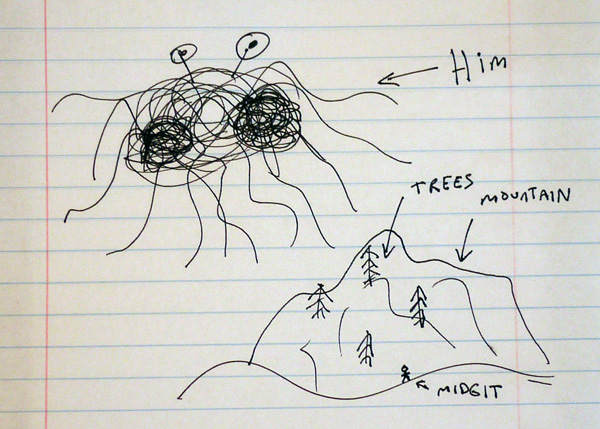
Let us remember that there are multiple theories of Intelligent Design. I and many others around the world are of the strong belief that the universe was created by a Flying Spaghetti Monster. It was He who created all that we see and all that we feel. We feel strongly that the overwhelming scientific evidence pointing towards evolutionary processes is nothing but a coincidence, put in place by Him.

It is for this reason that I’m writing you today, to formally request that this alternative theory be taught in your schools, along with the other two theories. In fact, I will go so far as to say, if you do not agree to do this, we will be forced to proceed with legal action. I’m sure you see where we are coming from. If the Intelligent Design theory is not based on faith, but instead another scientific theory, as is claimed, then you must also allow our theory to be taught, as it is also based on science, not on faith.

Some find that hard to believe, so it may be helpful to tell you a little more about our beliefs. We have evidence that a Flying Spaghetti Monster created the universe. None of us, of course, were around to see it, but we have written accounts of it. We have several lengthy volumes explaining all details of His power. Also, you may be surprised to hear that there are over 10 million of us, and growing. We tend to be very secretive, as many people claim our beliefs are not substantiated by observable evidence.

What these people don’t understand is that He built the world to make us think the earth is older than it really is. For example, a scientist may perform a carbon-dating process on an artifact. He finds that approximately 75% of the Carbon-14 has decayed by electron emission to Nitrogen-14, and infers that this artifact is approximately 10,000 years old, as the half-life of Carbon-14 appears to be 5,730 years. But what our scientist does not realize is that every time he makes a measurement, the Flying Spaghetti Monster is there changing the results with His Noodly Appendage. We have numerous texts that describe in detail how this can be possible and the reasons why He does this. He is of course invisible and can pass through normal matter with ease.

I’m sure you now realize how important it is that your students are taught this alternate theory. It is absolutely imperative that they realize that observable evidence is at the discretion of a Flying Spaghetti Monster. Furthermore, it is disrespectful to teach our beliefs without wearing His chosen outfit, which of course is full pirate regalia. I cannot stress the importance of this enough, and unfortunately cannot describe in detail why this must be done as I fear this letter is already becoming too long. The concise explanation is that He becomes angry if we don’t.

You may be interested to know that global warming, earthquakes, hurricanes, and other natural disasters are a direct effect of the shrinking numbers of Pirates since the 1800s. For your interest, I have included a graph of the approximate number of pirates versus the average global temperature over the last 200 years. As you can see, there is a statistically significant inverse relationship between pirates and global temperature.

In conclusion, thank you for taking the time to hear our views and beliefs. I hope I was able to convey the importance of teaching this theory to your students. We will of course be able to train the teachers in this alternate theory. I am eagerly awaiting your response, and hope dearly that no legal action will need to be taken. I think we can all look forward to the time when these three theories are given equal time in our science classrooms across the country, and eventually the world; One third time for Intelligent Design, one third time for Flying Spaghetti Monsterism (Pastafarianism), and one third time for logical conjecture based on overwhelming observable evidence.

Sincerely Yours,

Bobby Henderson, concerned citizen.

P.S. I have included an artistic drawing of Him creating a mountain, trees, and a midget. Remember, we are all His creatures.