Index Librorum Prohibitorum

Remembrance plaque on the Marktplatz in Neustadt an der Weinstrasse, reading: Where they have burned books, they will end in burning human beings. (Heinrich Heine, 1820) In memory of the book burning by the National Socialists on May 14, 1933

Remembrance plaque on the Marktplatz in Neustadt an der Weinstrasse, reading: Where they have burned books, they will end in burning human beings. (Heinrich Heine, 1820) In memory of the book burning by the National Socialists on May 14, 1933


The Index Librorum Prohibitorum (“List of Prohibited Books”) was a list of publications deemed heretical or contrary to morality by the Sacred Congregation of the Index (a former Dicastery of the Roman Curia); Catholics were forbidden to read them.

There were attempts to ban heretical books before the sixteenth century, notably in the ninth-century Decretum Glasianum; the Index of Prohibited Books of 1560 banned thousands of book titles and blacklisted publications, including the works of Europe’s intellectual elites. The 20th and final edition of the Index appeared in 1948; the Index was formally abolished on 14 June 1966 by Pope Paul VI.

The Index condemned religious and secular texts alike, grading works by the degree to which they were seen to be repugnant to the church. The aim of the list was to protect church members from reading theologically, culturally, or politically disruptive books. Such books included works by astronomers, such as Johannes Kepler’s Epitome astronomiae Copernicanae (published in three volumes from 1618 to 1621), which was on the Index from 1621 to 1835; works by philosophers, such as Immanuel Kant’s Critique of Pure Reason (1781); and editions and translations of the Bible that had not been approved. Editions of the Index also contained the rules of the Church relating to the reading, selling, and preemptive censorship of books.

The canon law of the Latin Church still recommends that works should be submitted to the judgment of the local ordinary if they concern sacred scripture, theology, canon law, or church history, religion or morals. The local ordinary consults someone whom he considers competent to give a judgment and, if that person gives the nihil obstat (“nothing forbids”), the local ordinary grants the imprimatur (“let it be printed”). Members of religious institutes require the imprimi potest (“it can be printed”) of their major superior to publish books on matters of religion or morals.

Some of the scientific theories contained in works in early editions of the Index have long been taught at Catholic universities. For example, the general prohibition of books advocating heliocentrism was removed from the Index in 1758, but two Franciscan mathematicians had published an edition of Isaac Newton’s Principia Mathematica (1687) in 1742, with commentaries and a preface stating that the work assumed heliocentrism and could not be explained without it. A work of the Italian Catholic priest and philosopher Antonio Rosmini-Serbati was on the Index, but he was beatified in 2007. Some have argued that the developments since the abolition of the Index signify “the loss of relevance of the Index in the 21st century.”

J. Martínez de Bujanda’s Index Librorum Prohibitorum, 1600–1966 lists the authors and writings in the successive editions of the Index, while Miguel Carvalho Abrantes’s Why Did The Inquisition Ban Certain Books?: A Case Study from Portugal tries to understand why certain books were forbidden based on a Portuguese edition of the Index Librorum Prohibitorum from 1581.

Emperor Constantine and the Council of Nicaea. The burning of Arian books. (Illustration from a compendium of canon law, ca. 825, MS. in the Capitular Library, Vercelli)

Emperor Constantine and the Council of Nicaea. The burning of Arian books. (Illustration from a compendium of canon law, ca. 825, MS. in the Capitular Library, Vercelli)

European Restrictions on the Right to Print

The historical context in which the Index appeared involved the early restrictions on printing in Europe. The refinement of moveable type and the printing press by Johannes Gutenberg circa 1440 changed the nature of book publishing, and the mechanism by which information could be disseminated to the public. Books, once rare and kept carefully in a small number of libraries, could be mass-produced and widely disseminated.

In the 16th century, both the churches and governments in most European countries attempted to regulate and control printing because it allowed for rapid and widespread circulation of ideas and information. The Protestant Reformation generated large quantities of polemical new writing by and within both the Catholic and Protestant camps, and religious subject-matter was typically the area most subject to control. While governments and church encouraged printing in many ways, which allowed the dissemination of Bibles and government information, works of dissent and criticism could also circulate rapidly. As a consequence, governments established controls over printers across Europe, requiring them to have official licenses to trade and produce books.

The early versions of the Index began to appear from 1529 to 1571. In the same time frame, in 1557 the English Crown aimed to stem the flow of dissent by chartering the Stationers’ Company. The right to print was restricted to the two universities (Oxford and Cambridge) and to the 21 existing printers in the city of London, which had between them 53 printing presses.

The French crown also tightly controlled printing, and the printer and writer Etienne Dolet was burned at the stake for atheism in 1546. The 1551 Edict of Châteaubriant comprehensively summarized censorship positions to date, and included provisions for unpacking and inspecting all books brought into France. The 1557 Edict of Compiègne applied the death penalty to heretics and resulted in the burning of a noblewoman at the stake. Printers were viewed as radical and rebellious, with 800 authors, printers and book dealers being incarcerated in the Bastille. At times, the prohibitions of church and state followed each other, e.g. René Descartes was placed on the Index in the 1660s and the French government prohibited the teaching of Cartesianism in schools in the 1670s.

The Copyright Act 1710 in Britain, and later copyright laws in France, eased this situation. Historian Eckhard Höffner claims that copyright laws and their restrictions acted as a barrier to progress in those countries for over a century, since British publishers could print valuable knowledge in limited quantities for the sake of profit. The German economy prospered in the same time frame since there were no restrictions.

Early Indices (1529–1571)

The first list of the kind was not published in Rome, but in Catholic Netherlands (1529); Venice (1543) and Paris (1551) under the terms of the Edict of Châteaubriant followed this example. By mid-century, in the tense atmosphere of wars of religion in Germany and France, both Protestant and Catholic authorities reasoned that only control of the press, including a catalog of prohibited works, coordinated by ecclesiastic and governmental authorities, could prevent the spread of heresy.

Paul F. Grendler (1975) discusses the religious and political climate in Venice from 1540 to 1605. There were many attempts to censor the Venetian press, which at that time was one of the largest concentrations of printers. Both church and government held to a belief in censorship, but the publishers continually pushed back on the efforts to ban books and shut down printing. More than once the index of banned books in Venice was suppressed or suspended because various people took a stand against it.

The first Roman Index was printed in 1557 under the direction of Pope Paul IV (1555–1559), but then withdrawn for unclear reasons. In 1559, a new index was finally published, banning the entire works of some 550 authors in addition to the individual proscribed titles: “The Pauline Index felt that the religious convictions of an author contaminated all his writing.” The work of the censors was considered too severe and met with much opposition even in Catholic intellectual circles; after the Council of Trent had authorized a revised list prepared under Pope Pius IV, the so-called Tridentine Index was promulgated in 1564; it remained the basis of all later lists until Pope Leo XIII, in 1897, published his Index Leonianus.

The blacklisting of some Protestant scholars even when writing on subjects a modern reader would consider outside the realm of dogma meant that, unless they obtained a dispensation, obedient Catholic thinkers were denied access to works including: botanist Conrad Gesner’s Historiae animalium; the botanical works of Otto Brunfels; those of the medical scholar Janus Cornarius; to Christoph Hegendorff or Johann Oldendorp on the theory of law; Protestant geographers and cosmographers like Jacob Ziegler or Sebastian Münster; as well as anything by Protestant theologians like Martin Luther, John Calvin or Philipp Melanchthon. Among the inclusions was the Libri Carolini, a theological work from the 9th-century court of Charlemagne, which was published in 1549 by Bishop Jean du Tillet and which had already been on two other lists of prohibited books before being inserted into the Tridentine Index.
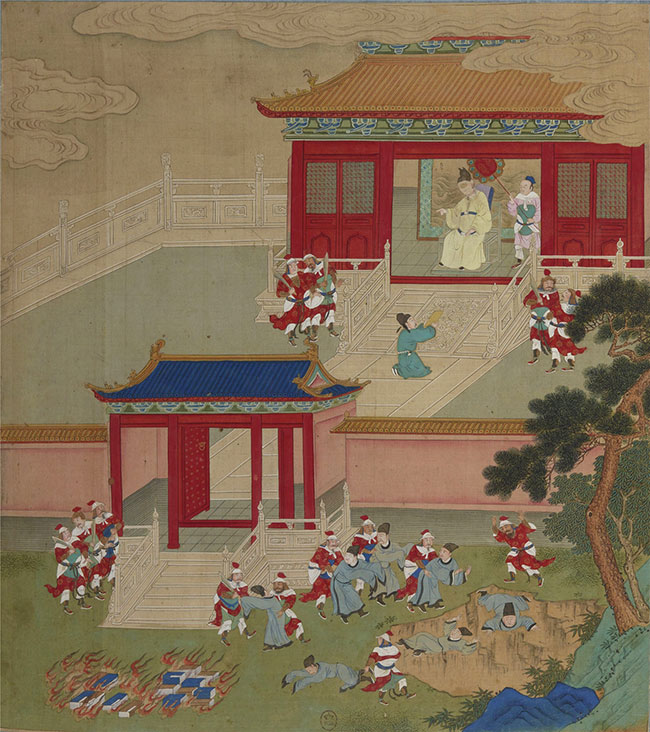
Killing the Scholars and Burning the Books, anonymous 18th century Chinese painted album leaf; Bibliothèque nationale de France, Paris

Killing the Scholars and Burning the Books, anonymous 18th century Chinese painted album leaf; Bibliothèque nationale de France, Paris

Sacred Congregation of the Index (1571–1917)

In 1571, a special congregation was created, the Sacred Congregation of the Index, which had the specific task to investigate those writings that were denounced in Rome as being not exempt of errors, to update the list of Pope Pius IV regularly and also to make lists of required corrections in case a writing was not to be condemned absolutely but only in need of correction; it was then listed with a mitigating clause (e.g., donec corrigatur (forbidden until corrected) or donec expurgetur (forbidden until purged)).

Several times a year, the congregation held meetings. During the meetings, they reviewed various works and documented those discussions. In between the meetings was when the works to be discussed were thoroughly examined, and each work was scrutinized by two people. At the meetings, they collectively decided whether or not the works should be included in the Index. Ultimately, the pope was the one who had to approve of works being added or removed from the Index. It was the documentation from the meetings of the congregation that aided the pope in making his decision.

This sometimes resulted in very long lists of corrections, published in the Index Expurgatorius, which was cited by Thomas James in 1627 as “an invaluable reference work to be used by the curators of the Bodleian Library when listing those works particularly worthy of collecting”. Prohibitions made by other congregations (mostly the Holy Office) were simply passed on to the Congregation of the Index, where the final decrees were drafted and made public, after approval of the Pope (who always had the possibility to condemn an author personally—there are only a few examples of such condemnation, including those of Lamennais and Hermes).

An update to the Index was made by Pope Leo XIII, in the 1897 apostolic constitution Officiorum ac Munerum, known as the “Index Leonianus”. Subsequent editions of the Index were more sophisticated; they graded authors according to their supposed degree of toxicity, and they marked specific passages for expurgation rather than condemning entire books.

The Sacred Congregation of the Inquisition of the Roman Catholic Church later became the Holy Office, and since 1965 has been called the Congregation for the Doctrine of the Faith. The Congregation of the Index was merged with the Holy Office in 1917, by the Motu Proprio “Alloquentes Proxime” of Pope Benedict XV; the rules on the reading of books were again re-elaborated in the new Codex Iuris Canonici. From 1917 onward, the Holy Office (again) took care of the Index.

Holy Office (1917–1966)

While individual books continued to be forbidden, the last edition of the Index to be published appeared in 1948. This 20th edition contained 4,000 titles censored for various reasons: heresy, moral deficiency, sexual explicitness, and so on. That some atheists, such as Schopenhauer and Nietzsche, were not included was due to the general (Tridentine) rule that heretical works (i.e., works that contradict Catholic dogma) are ipso facto forbidden. Some important works are absent simply because nobody bothered to denounce them. Many actions of the congregations were of a definite political content. Among the significant listed works of the period was the Nazi philosopher Alfred Rosenberg’s Myth of the Twentieth Century for scorning and rejecting “all dogmas of the Catholic Church, indeed the very fundamentals of the Christian religion”.

Abolition (1966)

On 7 December 1965, Pope Paul VI issued the Motu Proprio Integrae servandae that reorganized the Holy Office as the Sacred Congregation for the Doctrine of the Faith. The Index was not listed as being a part of the newly constituted congregation’s competence, leading to questioning whether it still was. This question was put to Cardinal Alfredo Ottaviani, pro-prefect of the congregation, who responded in the negative. The Cardinal also indicated in his response that there was going to be a change in the Index soon.

A June 1966 Congregation for the Doctrine of the Faith notification announced that, while the Index maintained its moral force, in that it taught Christians to beware, as required by the natural law itself, of those writings that could endanger faith and morality, it no longer had the force of ecclesiastical positive law with the associated penalties.

Pedro Berruguete: Saint Dominic and the Albigensians

Pedro Berruguete: Saint Dominic and the Albigensians. A dispute between Saint Dominic and the Cathars in which the books of both were thrown on a fire and St. Dominic’s books were miraculously preserved from the flames.

Censorship and Enforcement

The Index was not simply a reactive work. Roman Catholic authors had the opportunity to defend their writings and could prepare a new edition with necessary corrections or deletions, either to avoid or to limit a ban. Pre-publication censorship was encouraged.

The Index was enforceable within the Papal States, but elsewhere only if adopted by the civil powers, as happened in several Italian states. Other areas adopted their own lists of forbidden books. In the Holy Roman Empire book censorship, which preceded publication of the Index, came under control of the Jesuits at the end of the 16th century, but had little effect, since the German princes within the empire set up their own systems. In France it was French officials who decided what books were banned and the Church’s Index was not recognized. Spain had its own Index Librorum Prohibitorum et Expurgatorum, which corresponded largely to the Church’s, but also included a list of books that were allowed once the forbidden part (sometimes a single sentence) was removed or “expurgated”.

Continued Moral Obligation

On 14 June 1966, the Congregation for the Doctrine of the Faith responded to inquiries it had received regarding the continued moral obligation concerning books that had been listed in the Index. The response spoke of the books as examples of books dangerous to faith and morals, all of which, not just those once included in the Index, should be avoided regardless of the absence of any written law against them. The Index, it said, retains its moral force “inasmuch as” (quatenus) it teaches the conscience of Christians to beware, as required by the natural law itself, of writings that can endanger faith and morals, but it (the Index of Forbidden Books) no longer has the force of ecclesiastical law with the associated censures.

The congregation thus placed on the conscience of the individual Christian the responsibility to avoid all writings dangerous to faith and morals, while at the same time abolishing the previously existing ecclesiastical law and the relative censures, without thereby declaring that the books that had once been listed in the various editions of the Index of Prohibited Books had become free of error and danger.

In a letter of 31 January 1985 to Cardinal Giuseppe Siri, regarding the book The Poem of the Man-God, Cardinal Joseph Ratzinger (then Prefect of the Congregation, who later became Pope Benedict XVI), referred to the 1966 notification of the Congregation as follows: “After the dissolution of the Index, when some people thought the printing and distribution of the work was permitted, people were reminded again in L’Osservatore Romano (15 June 1966) that, as was published in the Acta Apostolicae Sedis (1966), the Index retains its moral force despite its dissolution. A decision against distributing and recommending a work, which has not been condemned lightly, may be reversed, but only after profound changes that neutralize the harm which such a publication could bring forth among the ordinary faithful.”

Changing Judgments

The content of the Index Librorum Prohibitorum saw deletions as well as additions over the centuries. Writings by Antonio Rosmini-Serbati were placed on the Index in 1849 but were removed by 1855, and Pope John Paul II mentioned Rosmini’s work as a significant example of “a process of philosophical enquiry which was enriched by engaging the data of faith”. The 1758 edition of the Index removed the general prohibition of works advocating heliocentrism as a fact rather than a hypothesis.

Listed Works and Authors

Noteworthy figures on the Index include Simone de Beauvoir, Nicolas Malebranche, Jean-Paul Sartre, Michel de Montaigne, Voltaire, Denis Diderot, Victor Hugo, Jean-Jacques Rousseau, André Gide, Nikos Kazantzakis, Emanuel Swedenborg, Baruch Spinoza, Desiderius Erasmus, Immanuel Kant, David Hume, René Descartes, Francis Bacon, Thomas Browne, John Milton, John Locke, Nicolaus Copernicus, Galileo Galilei, Blaise Pascal, and Hugo Grotius. The first woman to be placed on the list was Magdalena Haymairus in 1569, who was listed for her children’s book Die sontegliche Episteln über das gantze Jar in gesangsweis gestellt (Sunday Epistles on the whole Year, put into hymns). Other women include Anne Askew, Olympia Fulvia Morata, Ursula of Munsterberg (1491–1534), Veronica Franco, and Paola Antonia Negri (1508–1555). Contrary to a popular misconception, Charles Darwin’s works were never included.

In many cases, an author’s opera omnia (complete works) were forbidden. However, the Index stated that the prohibition of someone’s opera omnia did not preclude works that were not concerned with religion and were not forbidden by the general rules of the Index. This explanation was omitted in the 1929 edition, which was officially interpreted in 1940 as meaning that opera omnia covered all the author’s works without exception.

Cardinal Ottaviani stated in April 1966 that there was too much contemporary literature, and the Sacred Congregation for the Doctrine of the Faith could not keep up with it.

A member of the SA throws confiscated books into the bonfire during the public burning of "un-German" books on the Opernplatz in Berlin. In 1933, Nazis burned works of Jewish authors, and other works considered "un-German", at the library of the Institut für Sexualwissenschaft in Berlin.

A member of the SA throws confiscated books into the bonfire during the public burning of “un-German” books on the Opernplatz in Berlin. In 1933, Nazis burned works of Jewish authors, and other works considered “un-German”, at the library of the Institut für Sexualwissenschaft in Berlin.
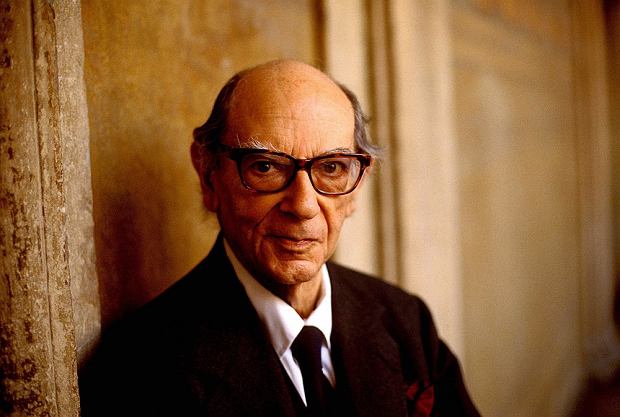

Wikipedia – Index Librorum Prohibitorum

List of Book-Burning Incidents

Book Burning

Internet Archive: Digital Library

Open Library

Project Gutenberg

Tools for Thinking: Isaiah Berlin’s Two Concepts of Freedom

isaiah-berlin

Maria Kasmirli | Aeon Ideas

‘Freedom’ is a powerful word. We all respond positively to it, and under its banner revolutions have been started, wars have been fought, and political campaigns are continually being waged. But what exactly do we mean by ‘freedom’? The fact that politicians of all parties claim to believe in freedom suggests that people don’t always have the same thing in mind when they talk about it. Might there be different kinds of freedom and, if so, could the different kinds conflict with each other? Could the promotion of one kind of freedom limit another kind? Could people even be coerced in the name of freedom?

The 20th-century political philosopher Isaiah Berlin (1909-97) thought that the answer to both these questions was ‘Yes’, and in his essay ‘Two Concepts of Liberty’ (1958) he distinguished two kinds of freedom (or liberty; Berlin used the words interchangeably), which he called negative freedom and positive freedom.

Negative freedom is freedom from interference. You are negatively free to the extent that other people do not restrict what you can do. If other people prevent you from doing something, either directly by what they do, or indirectly by supporting social and economic arrangements that disadvantage you, then to that extent they restrict your negative freedom. Berlin stresses that it is only restrictions imposed by other people that count as limitations of one’s freedom. Restrictions due to natural causes do not count. The fact that I cannot levitate is a physical limitation but not a limitation of my freedom.

Virtually everyone agrees that we must accept some restrictions on our negative freedom if we are to avoid chaos. All states require their citizens to follow laws and regulations designed to help them live together and make society function smoothly. We accept these restrictions on our freedom as a trade-off for other benefits, such as peace, security and prosperity. At the same time, most of us would insist that there are some areas of life that should not be regulated, and where individuals should have considerable, if not complete, freedom. A major debate in political philosophy concerns the boundaries of this area of personal negative freedom. For example, should the state place restrictions on what we may say or read, or on what sexual activities we may engage in?

Whereas negative freedom is freedom from control by others, positive freedom is freedom to control oneself. To be positively free is to be one’s own master, acting rationally and choosing responsibly in line with one’s interests. This might seem to be simply the counterpart of negative freedom; I control myself to the extent that no one else controls me. However, a gap can open between positive and negative freedom, since a person might be lacking in self-control even when he is not restrained by others. Think, for example, of a drug addict who cannot kick the habit that is killing him. He is not positively free (that is, acting rationally in his own best interests) even though his negative freedom is not being limited (no one is forcing him to take the drug).

In such cases, Berlin notes, it is natural to talk of something like two selves: a lower self, which is irrational and impulsive, and a higher self, which is rational and far-sighted. And the suggestion is that a person is positively free only if his higher self is dominant. If this is right, then we might be able to make a person more free by coercing him. If we prevent the addict from taking the drug, we might help his higher self to gain control. By limiting his negative freedom, we would increase his positive freedom. It is easy to see how this view could be abused to justify interventions that are misguided or malign.

Berlin argued that the gap between positive and negative freedom, and the risk of abuse, increases further if we identify the higher, or ‘real’, self, with a social group (‘a tribe, a race, a church, a state’). For we might then conclude that individuals are free only when the group suppresses individual desires (which stem from lower, nonsocial selves) and imposes its will upon them. What particularly worried Berlin about this move was that it justifies the coercion of individuals, not merely as a means of securing social benefits, such as security and cooperation, but as a way of freeing the individuals themselves. The coercion is not seen as coercion at all, but as liberation, and protests against it can be dismissed as expressions of the lower self, like the addict’s craving for his fix. Berlin called this a ‘monstrous impersonation’, which allows those in power ‘to ignore the actual wishes of men or societies, to bully, oppress, torture them in the name, and on behalf, of their “real” selves’. (The reader might be reminded of George Orwell’s novel Nineteen Eighty-Four (1949), which shows how a Stalinist political party imposes its conception of truth on an individual, ‘freeing’ him to love the Party leader.)

Berlin was thinking of how ideas of freedom had been abused by the totalitarian regimes of Nazi Germany and Stalinist Russia, and he was right to highlight the dangers of this kind of thinking. But it does not follow that it is always wrong to promote positive freedom. (Berlin does not claim that it is, and he notes that the notion of negative freedom can be abused in a similar way.) Some people might need help to understand their best interests and achieve their full potential, and we could believe that the state has a responsibility to help them do so. Indeed, this is the main rationale for compulsory education. We require children to attend school (severely limiting their negative freedom) because we believe it is in their own best interests. To leave children free to do whatever they like would, arguably, amount to neglect or abuse. In the case of adults, too, it is arguable that the state has a responsibility to help its citizens live rich and fulfilling lives, through cultural, educational and health programmes. (The need for such help might be especially pressing in freemarket societies, where advertisers continually tempt us to indulge our ‘lower’ appetites.) It might be, too, that some people find meaning and purpose through identification with a wider social or political movement, such as feminism, and that in helping them to do so we are helping to liberate them.

Of course, this raises many further questions. Does our current education system really work in children’s best interests, or does it just mould them into a form that is socially and economically useful? Who decides what counts as a rich and fulfilling life? What means can the state legitimately use to help people live well? Is coercion ever acceptable? These are questions about what kind of society we want to live in, and they have no easy answers. But in giving us the distinction between negative and positive freedom, Berlin has given us a powerful tool for thinking about them.Aeon counter – do not remove

Maria Kasmirli

This article was originally published at Aeon and has been republished under Creative Commons.

Dread & Freedom

Innocence is ignorance. In his innocence man is not determined as spirit but is soulishly determined in immediate unity with his natural condition. Spirit is dreaming in man. This view is in perfect accord with that of the Bible, and by refusing to ascribe to man in the state of innocence a knowledge of the difference between good and evil it condemns all the notions of merit Catholicism has imagined.

In this state there is peace and repose; but at the same time there is something different, which is not dissension and strife, for there is nothing to strive with. What is it then? Nothing. But what effect does nothing produce? It begets dread. This is the profound secret of innocence, that at the same time it is dread. Dreamingly the spirit projects its own reality, but this reality is nothing, but this nothing constantly sees innocence outside of it.

Dread is a qualification of the dreaming spirit, and as such it has its place in psychology. When awake, the difference between myself and my other is posited; sleeping, it is suspended; dreaming, it is a nothing vaguely hinted at. The reality of the spirit constantly shows itself in a form which entices its possibility, but it is away as soon as one grasps after it, and it is a nothing which is able only to alarm. More it cannot do so long as it only shows itself. One almost never sees the concept dread dealt with in psychology, and I must therefore call attention to the fact that it is different from fear and similar concepts which refer to something definite, whereas dread is freedom’s reality as possibility for possibility. One does not therefore find dread in the beast, precisely for the reason that by nature the beast is not qualified by spirit.

When we consider the dialectical determinants in dread, it appears that they have precisely the characteristic ambiguity of psychology. Dread is a sympathetic antipathy and an antipathetic sympathy. One easily sees, I think, that this is much more truly a psychological subject than is the concupiscence of which we have spoken. Language confirms this completely. One speaks of a sweet dread, a sweet feeling of apprehension, one speaks of a strange dread, a shrinking dread. [etc.]

The dread which is posited in innocence is, in the first place, not guilt; in the second place, it is not a heavy burden, not a suffering which cannot be brought into harmony with the felicity of innocence. If we observe children, we find this dread more definitely indicated as a seeking after adventure, a thirst for the prodigious, the mysterious. The fact that there are children in whom this is not found proves nothing, for neither in the beast does it exist, and the less spirit, the less dread. This dread belongs to the child so essentially that it cannot do without it; even though it alarms him, it captivates him nevertheless by its sweet feeling of apprehension. In all nations in which the childish character is preserved as the dreaming of the spirit this dread is found, and the deeper it is, the more profound is the nation. It is only a prosaic stupidity which thinks that this is a disorganization. Dread has here the same significance melancholy has at a far later point where freedom, after having passed through imperfect forms of its history, has to come to itself in a deeper sense.

Just as the relation of dread to its object, to something which is nothing (language in this instance also is pregnant: it speaks of being in dread of nothing), is altogether ambiguous, so will the transition here from innocence to guilt be correspondingly so dialectical that the explanation is and must be psychological. The qualitative leap is outside of ambiguity, but he who through dread becomes guilty is innocent, for it was not he himself but dread, an alien power, which laid hold of him, a power he did not love but dreaded — and yet he is guilty, for he sank in the dread which he loved even while he feared it. There is nothing in the world more ambiguous, and therefore this is the only psychological explanation, although (to repeat what I have said) it never occurs to it to want to be the explanation which explains the qualitative leap. Every theory about the prohibition tempting Adam or the seducer deceiving him has only for a superficial observation sufficient ambiguity, while it perverts ethics, introduces a quantitative determination, and would by the help of psychology pay man a compliment from which everyone who is ethically developed would beg to be excused, regarding it as a new and deeper seduction.

Everything turns upon dread coming into view. Man is a synthesis of the soulish and the bodily. But a synthesis is unthinkable if the two are not united in a third factor. This third factor is the spirit. In the state of innocence man is not merely an animal, for if at any time of his life he was merely an animal, he never would become a man. So then the spirit is present, but in a state of immediacy, a dreaming state. Forasmuch as it is present, it is in one way a hostile power, for it constantly disturbs the relation between soul and body, a relation which endures, and yet does not endure, inasmuch as it has endurance only by means of the spirit. On the other hand, it is a friendly power which has precisely the function of constituting the relationship. What then is man’s relation to this ambiguous power? How is spirit related to itself and to its situation? It is related as dread. The spirit cannot do away with itself; nor can it grasp itself so long as it has itself outside of itself. Neither can man sink down into the vegetative life, for he is determined as spirit. He cannot flee from dread, for he loves it; really he does not love it, for he flees from it. Innocence has now reached its apex. It is ignorance, but not an animal brutality, but an ignorance which is qualified by spirit, but which precisely is dread, because its ignorance is about nothing. Here there is no knowledge of good and evil, etc., but the whole reality of knowledge is projected in dread as the immense nothing of ignorance.

Innocence still is, but one word suffices, and with that ignorance is concentrated. Innocence of course cannot understand this word; but dread has as it were obtained its first prey; instead of nothing, innocence gets an enigmatic word. So when it is related in Genesis that God said to Adam, “Only of the tree of the knowledge of good and evil thou shalt not eat,” it is a matter of course that Adam did not really understand this word. For how could he have understood the difference between good and evil, seeing that this distinction was in fact consequent upon the enjoyment of the fruit?

When one assumes that the prohibition awakens the desire, one posits a knowledge instead of ignorance; for Adam would have had to have a knowledge of freedom, since his desire was to use it. The explanation therefore anticipates what was subsequent. The prohibition alarms Adam [induces a state of dread] because the prohibition awakens in him the possibility of freedom. That which passed innocence by as the nothing of dread has now entered into him, and here again it is a nothing, the alarming possibility of being able. What it is he is able to do, of that he has no conception; to suppose that he had some conception is to presuppose, as commonly is done, what came later, the distinction between good and evil. There is only the possibility of being able, as a higher form of ignorance, as a heightened expression of dread, because this in a more profound sense is and is not, because in a more profound sense he loves it and flees from it.

After the word of prohibition follows the word of judgment: “Thou shalt surely die.” What it means to die, Adam of course cannot conceive; but if one assumes that these words were said to him, there is nothing to prevent his having a notion of the terrible. Indeed even the beast is able to understand the mimic expression and movement in the speaker’s voice, without understanding the word. In case one lets the prohibition awaken desire, one may also let the word about punishment awaken a deterring conception. However, this confuses things. The terrible becomes in this instance merely dread; for Adam has not understood what was said, and here again we have only the ambiguity of dread. The infinite possibility of being able (awakened by the prohibition) draws closer for the fact that this possibility indicates a possibility as its consequence.

Thus innocence is brought to its last extremity. It is in dread in relation to the prohibition and the punishment. It is not guilty, and yet it is in dread, as though it were lost.

Further than this psychology cannot go, but so far it can reach, and moreover it can verify this point again and again in its observation of human life.

The possibility of freedom does not consist in being able to choose the good or the evil. Such thoughtlessness has as little support in the Scripture as in philosophy. Possibility means I can. In a logical system it is convenient enough to say that possibility passes over into actuality. In reality it is not so easy, and an intermediate determinant is necessary. This intermediate determinant is dread, which no more explains the qualitative leap than it justifies it ethically. Dread is not a determinant of necessity, but neither is it of freedom; it is a trammeled freedom, where freedom is not free in itself but trammeled, not by necessity but in itself. If sin has come into the world by necessity (which is a self-contradiction), then there is no dread. If sin has come into the world by an act of abstract liberum arbitrium (which no more existed at the beginning than it does at a later period of the world, for it is a non-sense to thought), neither in this case is there dread. To want to explain logically the entrance of sin into the world is a stupidity which could only occur to people who are comically anxious to get an explanation.

One may liken dread to dizziness. He whose eye chances to look down into the yawning abyss becomes dizzy. But the reason for it is just as much his eye as it is the precipice. For suppose he had not looked down.

Thus dread is the dizziness of freedom which occurs when the spirit would posit the synthesis, and freedom then gazes down into its own possibility, grasping at finiteness to sustain itself. In this dizziness freedom succumbs. Further than this psychology cannot go and will not. That very instant everything is changed, and when freedom rises again it sees that it is guilty. Between these two instants lies the leap, which no science has explained or can explain. He who becomes guilty in dread becomes as ambiguously guilty as it is possible to be. Dread is a womanish debility in which freedom swoons. Psychologically speaking, the fall into sin always occurs in impotence. But dread is at the same time the most egoistic thing, and no concrete expression of freedom is so egoistic as is the possibility of every concretion. This again is the overwhelming experience which determines the individual’s ambiguous relation, both sympathetic and antipathetic. In dread there is the egoistic infinity of possibility, which does not tempt like a definite choice, but alarms and fascinates with its sweet anxiety.

– Søren Kierkegaard