Psychology’s Five Revelations for Finding Your True Calling


Christian Jarrett | Aeon Ideas

Look. You can’t plan out your life. What you have to do is first discover your passion – what you really care about.
Barack Obama

If, like many, you are searching for your calling in life – perhaps you are still unsure which profession aligns with what you most care about – here are five recent research findings worth taking into consideration.

First, there’s a difference between having a harmonious passion and an obsessive passion. If you can find a career path or occupational goal that fires you up, you are more likely to succeed and find happiness through your work – that much we know from the deep research literature. But beware – since a seminal paper published in 2003 by the Canadian psychologist Robert Vallerand and colleagues, researchers have made an important distinction between having a harmonious passion and an obsessive one. If you feel that your passion or calling is out of control, and that your mood and self-esteem depend on it, then this is the obsessive variety, and such passions, while they are energising, are also associated with negative outcomes such as burnout and anxiety. In contrast, if your passion feels in control, reflects qualities that you like about yourself, and complements other important activities in your life, then this is the harmonious version, which is associated with positive outcomes, such as vitality, better work performance, experiencing flow, and positive mood.

Secondly, having an unanswered calling in life is worse than having no calling at all. If you already have a burning ambition or purpose, do not leave it to languish. A few years ago, researchers at the University of South Florida surveyed hundreds of people and grouped them according to whether they felt like they had no calling in life, that they had a calling they’d answered, or they had a calling but had never done anything about it. In terms of their work engagement, career commitment, life satisfaction, health and stress, the stand-out finding was that the participants who had a calling they hadn’t answered scored the worst across all these measures. The researchers said that this puts a different spin on the presumed benefits of having a calling in life. They concluded: ‘having a calling is only a benefit if it is met, but can be a detriment when it is not as compared to having no calling at all’.

The third finding to bear in mind is that, without passion, grit is ‘merely a grind’. The idea that ‘grit’ is vital for career success was advanced by the psychologist Angela Duckworth of the University of Pennsylvania, who argued that highly successful, ‘gritty’ people have impressive persistence. ‘To be gritty,’ Duckworth writes in her 2016 book on the subject, ‘is to fall down seven times, and rise eight.’ Many studies certainly show that being more conscientious – more self-disciplined and industrious – is associated with more career success. But is that all that being gritty means? Duckworth has always emphasised that it has another vital component that brings us back to passion again – alongside persistence, she says that gritty people also have an ‘ultimate concern’ (another way of describing having a passion or calling).

However, according to a paper published last year, the standard measure of grit has failed to assess passion (or more specifically, ‘passion attainment’) – and Jon Jachimowicz at Columbia Business School in New York and colleagues believe this could explain why the research on grit has been so inconsistent (leading to claims that it is an overhyped concept and simply conscientiousness repackaged). Jachimowicz’s team found that when they explicitly measured passion attainment (how much people feel they have adequate passion for their work) and combined this with a measure of perseverance (a consistency of interests and the ability to overcome setbacks), then the two together did predict superior performance among tech-company employees and university students. ‘Our findings suggest that perseverance without passion attainment is mere drudgery, but perseverance with passion attainment propels individuals forward,’ they said.

Another finding is that, when you invest enough effort, you might find that your work becomes your passion. It’s all very well reading about the benefits of having a passion or calling in life but, if you haven’t got one, where to find it? Duckworth says it’s a mistake to think that in a moment of revelation one will land in your lap, or simply occur to you through quiet contemplation – rather, you need to explore different activities and pursuits, and expose yourself to the different challenges and needs confronting society. If you still draw a blank, then perhaps it’s worth heeding the advice of others who say that it is not always the case that energy and determination flow from finding your passion – sometimes it can be the other way around and, if you put enough energy into your work, then passion will follow. Consider, for instance, an eight-week repeated survey of German entrepreneurs published in 2014 that found a clear pattern – their passion for their ventures increased after they’d invested more effort into them the week before. A follow-up study qualified this, suggesting that the energising effect of investing effort arises only when the project is freely chosen and there is a sense of progress. ‘Entrepreneurs increase their passion when they make significant progress in their venture and when they invest effort out of their own free choice,’ the researchers said.

Finally, if you think that passion comes from doing a job you enjoy, you’re likely to be disappointed. Consider where you think passion comes from. In a preprint paper released at PsyArXiv, Jachimowicz and his team draw a distinction between people who believe that passion comes from doing what you enjoy (which they say is encapsulated by Oprah Winfrey’s commencement address in 2008 in which she said passions ‘bloom when we’re doing what we love’), and those who see it as arising from doing what you believe in or value in life (as reflected in the words of former Mexican president Felipe Calderón who in his own commencement address in 2011 said ‘you have to embrace with passion the things that you believe in, and that you are fighting for’).

The researchers found that people who believe that passion comes from pleasurable work were less likely to feel that they had found their passion (and were more likely to want to leave their job) as compared with people who believe that passion comes from doing what you feel matters. Perhaps this is because there is a superficiality and ephemerality to working for sheer pleasure – what fits the bill one month or year might not do so for long – whereas working towards what you care about is a timeless endeavour that is likely to stretch and sustain you indefinitely. The researchers conclude that their results show ‘the extent to which individuals attain their desired level of work passion may have less to do with their actual jobs and more to do with their beliefs about how work passion is pursued’.

This is an adaptation of an article originally published by The British Psychological Society’s Research Digest.Aeon counter – do not remove

Christian Jarrett

This article was originally published at Aeon and has been republished under Creative Commons.
Slaying the Snark: What Nonsense Verse tells us about Reality

hunting-snark

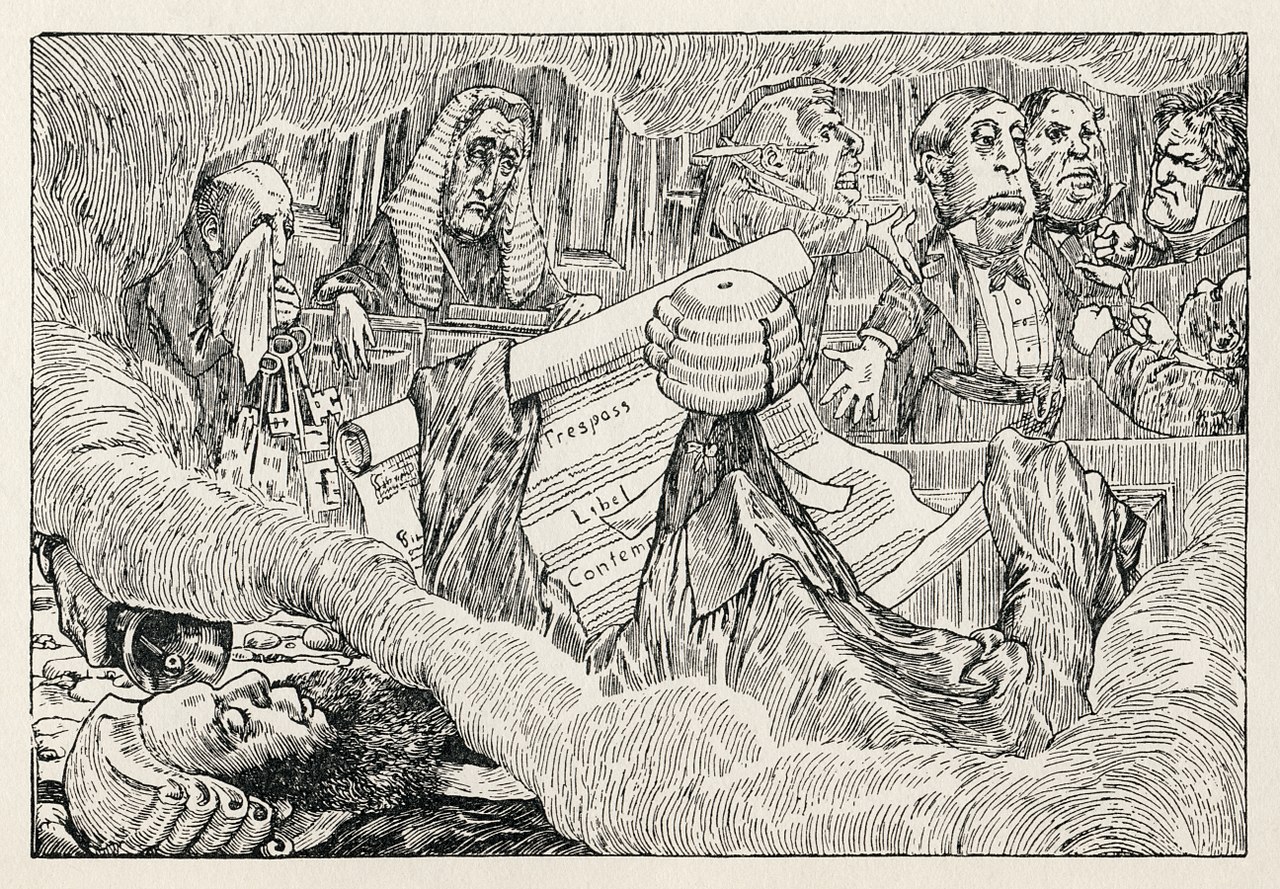
Eighth of Henry Holiday’s original illustrations to “The Hunting of the Snark” by Lewis Carroll, Wikipedia

Nina Lyon | Aeon Ideas

The English writer Lewis Carroll’s nonsense poem The Hunting of the Snark (1876) is an exceptionally difficult read. In it, a crew of improbable characters boards a ship to hunt a Snark, which might sound like a plot were it not for the fact that nobody knows what a Snark actually is. It doesn’t help that any attempt to describe a Snark turns into a pile-up of increasingly incoherent attributes: it is said to taste ‘meagre and hollow, but crisp: / Like a coat that is rather too tight in the waist’.

The only significant piece of information we have about the Snark’s identity is that it might be a Boojum. Unfortunately nobody knows what that is either, apart from the fact that anyone who encounters a Boojum will ‘softly and suddenly vanish away’ into nothingness.

Nothingness also characterises the crew’s map: a ‘perfect and absolute blank!’

‘What’s the good of Mercator’s North Poles and Equators,
Tropics, Zones and Meridian Lines?’
So the Bellman would cry: and the crew would reply,
‘They are merely conventional signs!’

Nonsense such as this might get tiresome to read, but it can make for a useful thought-experiment – particularly about language. In the Snark, as in the Alice books of 1865 and 1871, the commonsense assumptions that usually govern language and meaning are turned upside down. It makes us wonder what all of those assumptions are up to, and how they work. How do we know that this sentence is trying to say something serious, or that where we are now is not a dream?

Language can’t always convey meaning alone – it might need sense, which is the governing context that framed it. We talk about ‘common sense’, or whether something ‘makes sense’, or dismiss things as ‘nonsense’, but we rarely think about what sense itself is, until it goes missing. The German logician Gottlob Frege in 1892 used sense to describe a proposition’s meaning, as something distinct from what it denoted. Sense therefore appears to be a mental entity, resistant to fixed definition.

Shortly after Carroll’s death in 1898, a seismic turn took place in both logic and metaphysics. Building on Frege, logical positivists such as Bertrand Russell sought to deploy logic and mathematics in order to establish unconditional truths. A logical truth was, like mathematics, true whether or not people changed their minds about it. Realism, the belief in a mind-independent reality, began to assert itself afresh after a long spell in the philosophical wilderness.

Sense and nonsense would therefore become landmines in a battle over logic’s ability to untether truth from thought. If an issue over meaning seeks recourse in sense, it seeks recourse in thought too. Carroll anticipated where logic was headed, and the strangest of his creations was more than a game, an experiment conceived, as the English author G K Chesterton once wrote of his work, ‘in order to study that darkest problem of metaphysics’.

In 1901, the pragmatist philosopher and provocateur F C S Schiller created a parody Christmas edition of the philosophical journal Mind called Mind!. The frontispiece was a ‘Portrait of Its Immanence the Absolute’, which, Schiller noted, was ‘very like the Bellman’s map in the Hunting of the Snark’: completely blank.

The Absolute – or the Infinite or Ultimate Reality, among other grand aliases – was the sum of all experience and being, and inconceivable to the human mind. It was monistic, consuming all into the One. If it sounded like something you’d struggle to get your head around, that was pretty much the point. The Absolute was an emblem of metaphysical idealism, the doctrine that truth could exist only within the domain of thought. Idealism had dominated the academy for the entirety of Carroll’s career, and it was beginning to come under attack. The realist mission, headed by Russell, was to clean up philosophy’s act with the sound application of mathematics and objective facts, and it felt like a breath of fresh air.

Schiller delighted in trolling absolute idealists in general and the English idealist philosopher F H Bradley in particular. In Mind!, Schiller claimed that the Snark was a satire on the Absolute, whose notorious ineffability drove its seekers to derangement. But this was disingenuous. Bradley’s major work, Appearance and Reality (1893), mirrors the point, insofar that there is one, of the Snark. When you home in on a thing and try to pin it down by describing its attributes, and then try to pin down what those are too – Bradley uses the example of a lump of sugar – it all begins to crumble, and must be something other instead. What appeared to be there was only ever an idea. Carroll was, contrariwise, in line with idealist thinking.

A passionate logician, Carroll had been working on a three-part book on symbolic logic that remained unfinished at his death. Two logical paradoxes that he posed in Mind and shared privately with friends and colleagues, such as Bradley, hint at a troublemaking sentiment regarding where logic might be headed. ‘A Logical Paradox’ (1894) resulted in two contradictory statements being simultaneously true; ‘What the Tortoise Said to Achilles’ (1895) set up a predicament in which each proposition requires an additional supporting proposition, creating an infinite regress.

A few years after Carroll’s death, Russell began to flex logic as a tool for denoting the world and testing the validity of propositions about it. Carroll’s paradoxes were problematic and demanded a solution. Russell’s response to ‘A Logical Paradox’ was to legislate nonsense away into a ‘null-class’ – a set of nonexistent propositions that, because it had no real members, didn’t exist either.

Russell’s solution to ‘What the Tortoise Said to Achilles’, tucked away in a footnote to the Principles of Mathematics (1903), entailed a recourse to sense in order to determine whether or not a proposition should be asserted in the first place, teetering into the mind-dependent realm of idealism. Mentally determining meaning is a bit like mentally determining reality, and it wasn’t a neat win for logic’s role as objective sword of truth.

In the Snark, the principles of narrative self-immolate, so that the story, rather than describing things and events in the world, undoes them into something other. It ends like this:

In the midst of the word he was trying to say,
In the midst of his laughter and glee,
He had softly and suddenly vanished away –
For the Snark was a Boojum, you see.

Strip the plot down to those eight final words, and it is all there. The thing sought turned out, upon examination, to be something else entirely. Beyond the flimsy veil of appearance, formed from words and riddled with holes, lies an inexpressible reality.

By the late-20th century, when Russell had won the battle of ideas and commonsense realism prevailed, critics such as Martin Gardner, author of The Annotated Hunting of the Snark (2006), were rattled by Carroll’s antirealism. If the reality we perceive is all there is, and it falls apart, we are left with nothing.

Carroll’s attacks on realism might look nihilistic or radical to a postwar mind steeped in atheist scientism, but they were neither. Carroll was a man of his time, taking a philosophically conservative party line on absolute idealism and its theistic implications. But he was also prophetic, seeing conflict at the limits of language, logic and reality, and laying a series of conceptual traps that continue to provoke it.

The Snark is one such trap. Carroll rejected his illustrator Henry Holiday’s image of the Boojum on the basis that it needed to remain unimaginable, for, after all, how can you illustrate the incomprehensible nature of ultimate reality? It is a task as doomed as saying the unsayable – which, paradoxically, was a task Carroll himself couldn’t quite resist.Aeon counter – do not remove

Nina Lyon

This article was originally published at Aeon and has been republished under Creative Commons.

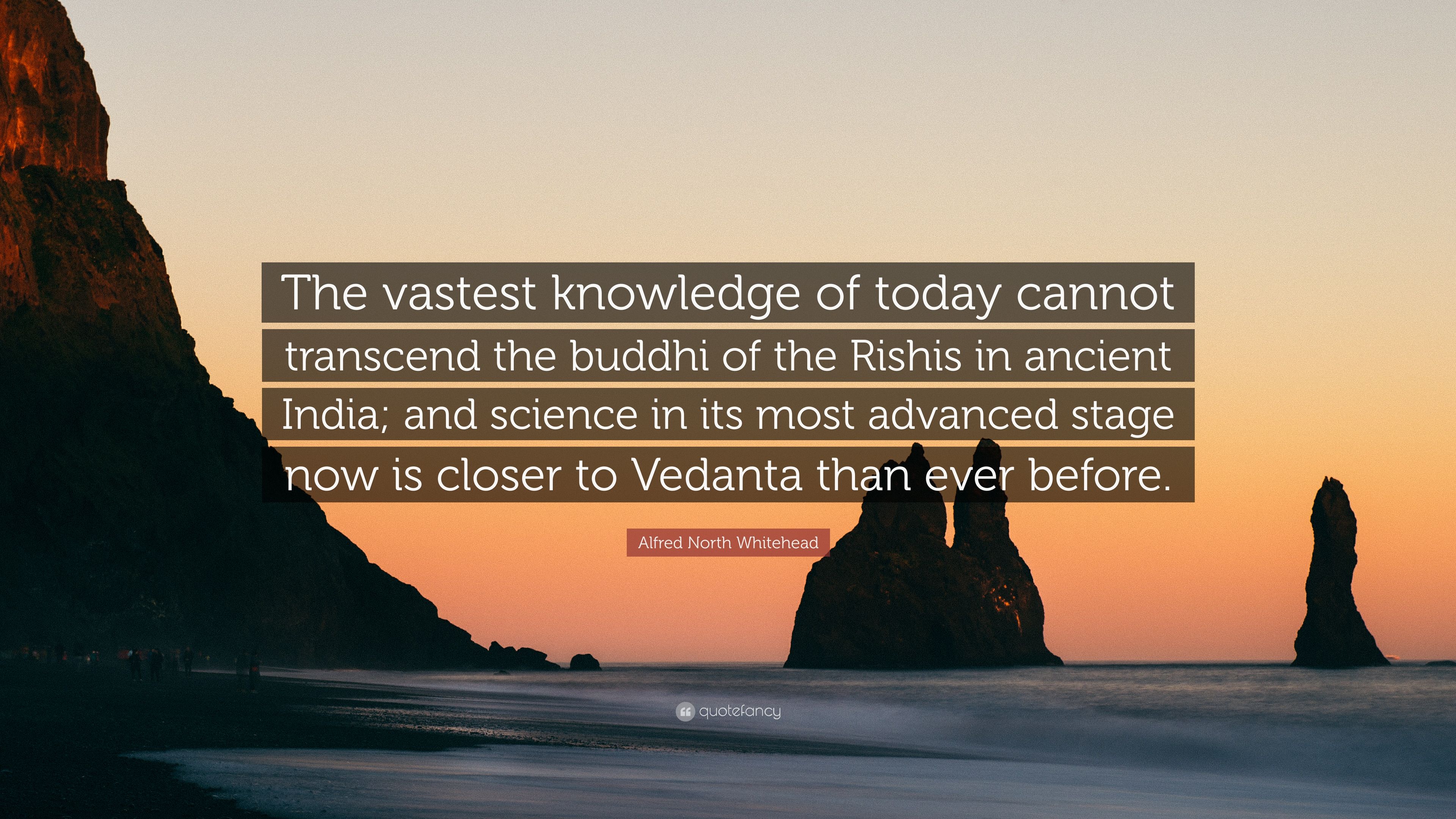
Modern Technology is akin to the Metaphysics of Vedanta

whitehead-vedanta.jpg

Akhandadhi Das | Aeon Ideas

You might think that digital technologies, often considered a product of ‘the West’, would hasten the divergence of Eastern and Western philosophies. But within the study of Vedanta, an ancient Indian school of thought, I see the opposite effect at work. Thanks to our growing familiarity with computing, virtual reality (VR) and artificial intelligence (AI), ‘modern’ societies are now better placed than ever to grasp the insights of this tradition.

Vedanta summarises the metaphysics of the Upanishads, a clutch of Sanskrit religious texts, likely written between 800 and 500 BCE. They form the basis for the many philosophical, spiritual and mystical traditions of the Indian sub-continent. The Upanishads were also a source of inspiration for some modern scientists, including Albert Einstein, Erwin Schrödinger and Werner Heisenberg, as they struggled to comprehend quantum physics of the 20th century.

The Vedantic quest for understanding begins from what it considers the logical starting point: our own consciousness. How can we trust conclusions about what we observe and analyse unless we understand what is doing the observation and analysis? The progress of AI, neural nets and deep learning have inclined some modern observers to claim that the human mind is merely an intricate organic processing machine – and consciousness, if it exists at all, might simply be a property that emerges from information complexity. However, this view fails to explain intractable issues such as the subjective self and our experience of qualia, those aspects of mental content such as ‘redness’ or ‘sweetness’ that we experience during conscious awareness. Figuring out how matter can produce phenomenal consciousness remains the so-called ‘hard problem’.

Vedanta offers a model to integrate subjective consciousness and the information-processing systems of our body and brains. Its theory separates the brain and the senses from the mind. But it also distinguishes the mind from the function of consciousness, which it defines as the ability to experience mental output. We’re familiar with this notion from our digital devices. A camera, microphone or other sensors linked to a computer gather information about the world, and convert the various forms of physical energy – light waves, air pressure-waves and so forth – into digital data, just as our bodily senses do. The central processing unit processes this data and produces relevant outputs. The same is true of our brain. In both contexts, there seems to be little scope for subjective experience to play a role within these mechanisms.

While computers can handle all sorts of processing without our help, we furnish them with a screen as an interface between the machine and ourselves. Similarly, Vedanta postulates that the conscious entity – something it terms the atma – is the observer of the output of the mind. The atma possesses, and is said to be composed of, the fundamental property of consciousness. The concept is explored in many of the meditative practices of Eastern traditions.

You might think of the atma like this. Imagine you’re watching a film in the cinema. It’s a thriller, and you’re anxious about the lead character, trapped in a room. Suddenly, the door in the movie crashes open and there stands… You jump, as if startled. But what is the real threat to you, other than maybe spilling your popcorn? By suspending an awareness of your body in the cinema, and identifying with the character on the screen, we are allowing our emotional state to be manipulated. Vedanta suggests that the atma, the conscious self, identifies with the physical world in a similar fashion.

This idea can also be explored in the all-consuming realm of VR. On entering a game, we might be asked to choose our character or avatar – originally a Sanskrit word, aptly enough, meaning ‘one who descends from a higher dimension’. In older texts, the term often refers to divine incarnations. However, the etymology suits the gamer, as he or she chooses to descend from ‘normal’ reality and enter the VR world. Having specified our avatar’s gender, bodily features, attributes and skills, next we learn how to control its limbs and tools. Soon, our awareness diverts from our physical self to the VR capabilities of the avatar.

In Vedanta psychology, this is akin to the atma adopting the psychological persona-self it calls the ahankara, or the ‘pseudo-ego’. Instead of a detached conscious observer, we choose to define ourselves in terms of our social connections and the physical characteristics of the body. Thus, I come to believe in myself with reference to my gender, race, size, age and so forth, along with the roles and responsibilities of family, work and community. Conditioned by such identification, I indulge in the relevant emotions – some happy, some challenging or distressing – produced by the circumstances I witness myself undergoing.

Within a VR game, our avatar represents a pale imitation of our actual self and its entanglements. In our interactions with the avatar-selves of others, we might reveal little about our true personality or feelings, and know correspondingly little about others’. Indeed, encounters among avatars – particularly when competitive or combative – are often vitriolic, seemingly unrestrained by concern for the feelings of the people behind the avatars. Connections made through online gaming aren’t a substitute for other relationships. Rather, as researchers at Johns Hopkins University have noted, gamers with strong real-world social lives are less likely to fall prey to gaming addiction and depression.

These observations mirror the Vedantic claim that our ability to form meaningful relationships is diminished by absorption in the ahankara, the pseudo-ego. The more I regard myself as a physical entity requiring various forms of sensual gratification, the more likely I am to objectify those who can satisfy my desires, and to forge relationships based on mutual selfishness. But Vedanta suggests that love should emanate from the deepest part of the self, not its assumed persona. Love, it claims, is soul-to-soul experience. Interactions with others on the basis of the ahankara offer only a parody of affection.

As the atma, we remain the same subjective self throughout the whole of our life. Our body, mentality and personality change dramatically – but throughout it all, we know ourselves to be the constant observer. However, seeing everything shift and give way around us, we suspect that we’re also subject to change, ageing and heading for annihilation. Yoga, as systematised by Patanjali – an author or authors, like ‘Homer’, who lived in the 2nd century BCE – is intended to be a practical method for freeing the atma from relentless mental tribulation, and to be properly situated in the reality of pure consciousness.

In VR, we’re often called upon to do battle with evil forces, confronting jeopardy and virtual mortality along the way. Despite our efforts, the inevitable almost always happens: our avatar is killed. Game over. Gamers, especially pathological gamers, are known to become deeply attached to their avatars, and can suffer distress when their avatars are harmed. Fortunately, we’re usually offered another chance: Do you want to play again? Sure enough, we do. Perhaps we create a new avatar, someone more adept, based on the lessons learned last time around. This mirrors the Vedantic concept of reincarnation, specifically in its form of metempsychosis: the transmigration of the conscious self into a new physical vehicle.

Some commentators interpret Vedanta as suggesting that there is no real world, and that all that exists is conscious awareness. However, a broader take on Vedantic texts is more akin to VR. The VR world is wholly data, but it becomes ‘real’ when that information manifests itself to our senses as imagery and sounds on the screen or through a headset. Similarly, for Vedanta, it is the external world’s transitory manifestation as observable objects that makes it less ‘real’ than the perpetual, unchanging nature of the consciousness that observes it.

To the sages of old, immersing ourselves in the ephemeral world means allowing the atma to succumb to an illusion: the illusion that our consciousness is somehow part of an external scene, and must suffer or enjoy along with it. It’s amusing to think what Patanjali and the Vedantic fathers would make of VR: an illusion within an illusion, perhaps, but one that might help us to grasp the potency of their message.Aeon counter – do not remove

Akhandadhi Das

This article was originally published at Aeon and has been republished under Creative Commons.
 

Why Amartya Sen Remains the Century’s Great Critic of Capitalism

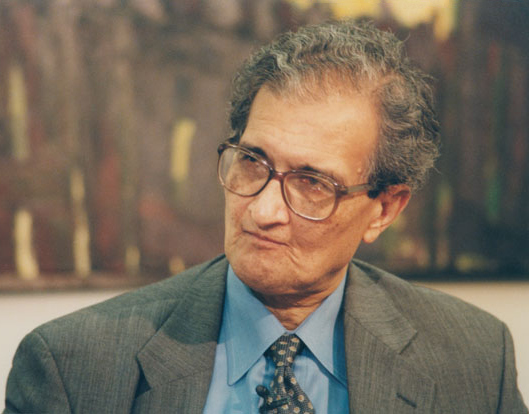
amartya-sen

Nobel laureate Amartya Kumar Sen in 2000, Wikipedia


Tim Rogan | Aeon Ideas

Critiques of capitalism come in two varieties. First, there is the moral or spiritual critique. This critique rejects Homo economicus as the organising heuristic of human affairs. Human beings, it says, need more than material things to prosper. Calculating power is only a small part of what makes us who we are. Moral and spiritual relationships are first-order concerns. Material fixes such as a universal basic income will make no difference to societies in which the basic relationships are felt to be unjust.

Then there is the material critique of capitalism. The economists who lead discussions of inequality now are its leading exponents. Homo economicus is the right starting point for social thought. We are poor calculators and single-minded, failing to see our advantage in the rational distribution of prosperity across societies. Hence inequality, the wages of ungoverned growth. But we are calculators all the same, and what we need above all is material plenty, thus the focus on the redress of material inequality. From good material outcomes, the rest follows.

The first kind of argument for capitalism’s reform seems recessive now. The material critique predominates. Ideas emerge in numbers and figures. Talk of non-material values in political economy is muted. The Christians and Marxists who once made the moral critique of capitalism their own are marginal. Utilitarianism grows ubiquitous and compulsory.

But then there is Amartya Sen.

Every major work on material inequality in the 21st century owes a debt to Sen. But his own writings treat material inequality as though the moral frameworks and social relationships that mediate economic exchanges matter. Famine is the nadir of material deprivation. But it seldom occurs – Sen argues – for lack of food. To understand why a people goes hungry, look not for catastrophic crop failure; look rather for malfunctions of the moral economy that moderates competing demands upon a scarce commodity. Material inequality of the most egregious kind is the problem here. But piecemeal modifications to the machinery of production and distribution will not solve it. The relationships between different members of the economy must be put right. Only then will there be enough to go around.

In Sen’s work, the two critiques of capitalism cooperate. We move from moral concerns to material outcomes and back again with no sense of a threshold separating the two. Sen disentangles moral and material issues without favouring one or the other, keeping both in focus. The separation between the two critiques of capitalism is real, but transcending the divide is possible, and not only at some esoteric remove. Sen’s is a singular mind, but his work has a widespread following, not least in provinces of modern life where the predominance of utilitarian thinking is most pronounced. In economics curricula and in the schools of public policy, in internationalist secretariats and in humanitarian NGOs, there too Sen has created a niche for thinking that crosses boundaries otherwise rigidly observed.

This was no feat of lonely genius or freakish charisma. It was an effort of ordinary human innovation, putting old ideas together in new combinations to tackle emerging problems. Formal training in economics, mathematics and moral philosophy supplied the tools Sen has used to construct his critical system. But the influence of Rabindranath Tagore sensitised Sen to the subtle interrelation between our moral lives and our material needs. And a profound historical sensibility has enabled him to see the sharp separation of the two domains as transient.

Tagore’s school at Santiniketan in West Bengal was Sen’s birthplace. Tagore’s pedagogy emphasised articulate relations between a person’s material and spiritual existences. Both were essential – biological necessity, self-creating freedom – but modern societies tended to confuse the proper relation between them. In Santiniketan, pupils played at unstructured exploration of the natural world between brief forays into the arts, learning to understand their sensory and spiritual selves as at once distinct and unified.

Sen left Santiniketan in the late 1940s as a young adult to study economics in Calcutta and Cambridge. The major contemporary controversy in economics was the theory of welfare, and debate was affected by Cold War contention between market- and state-based models of economic order. Sen’s sympathies were social democratic but anti-authoritarian. Welfare economists of the 1930s and 1940s sought to split the difference, insisting that states could legitimate programmes of redistribution by appeal to rigid utilitarian principles: a pound in a poor man’s pocket adds more to overall utility than the same pound in the rich man’s pile. Here was the material critique of capitalism in its infancy, and here is Sen’s response: maximising utility is not everyone’s abiding concern – saying so and then making policy accordingly is a form of tyranny – and in any case using government to move money around in pursuit of some notional optimum is a flawed means to that end.

Economic rationality harbours a hidden politics whose implementation damaged the moral economies that groups of people built up to govern their own lives, frustrating the achievement of its stated aims. In commercial societies, individuals pursue economic ends within agreed social and moral frameworks. The social and moral frameworks are neither superfluous nor inhibiting. They are the coefficients of durable growth.

Moral economies are not neutral, given, unvarying or universal. They are contested and evolving. Each person is more than a cold calculator of rational utility. Societies aren’t just engines of prosperity. The challenge is to make non-economic norms affecting market conduct legible, to bring the moral economies amid which market economies and administrative states function into focus. Thinking that bifurcates moral on the one hand and material on the other is inhibiting. But such thinking is not natural and inevitable, it is mutable and contingent – learned and apt to be unlearned.

Sen was not alone in seeing this. The American economist Kenneth Arrow was his most important interlocutor, connecting Sen in turn with the tradition of moral critique associated with R H Tawney and Karl Polanyi. Each was determined to re-integrate economics into frameworks of moral relationship and social choice. But Sen saw more clearly than any of them how this could be achieved. He realised that at earlier moments in modern political economy this separation of our moral lives from our material concerns had been inconceivable. Utilitarianism had blown in like a weather front around 1800, trailing extremes of moral fervour and calculating zeal in its wake. Sen sensed this climate of opinion changing, and set about cultivating ameliorative ideas and approaches eradicated by its onset once again.

There have been two critiques of capitalism, but there should be only one. Amartya Sen is the new century’s first great critic of capitalism because he has made that clear.Aeon counter – do not remove

Tim Rogan

This article was originally published at Aeon and has been republished under Creative Commons.

Reach out, listen, be patient. Good arguments can stop extremism

coming-together

Walter Sinnott-Armstrong | Aeon Ideas

Many of my best friends think that some of my deeply held beliefs about important issues are obviously false or even nonsense. Sometimes, they tell me so to my face. How can we still be friends? Part of the answer is that these friends and I are philosophers, and philosophers learn how to deal with positions on the edge of sanity. In addition, I explain and give arguments for my claims, and they patiently listen and reply with arguments of their own against my – and for their – stances. By exchanging reasons in the form of arguments, we show each other respect and come to understand each other better.

Philosophers are weird, so this kind of civil disagreement still might seem impossible among ordinary folk. However, some stories give hope and show how to overcome high barriers.

One famous example involved Ann Atwater and C P Ellis in my home town of Durham, North Carolina; it is described in Osha Gray Davidson’s book The Best of Enemies (1996) and a forthcoming movie. Atwater was a single, poor, black parent who led Operation Breakthrough, which tried to improve local black neighbourhoods. Ellis was an equally poor but white parent who was proud to be Exalted Cyclops of the local Ku Klux Klan. They could not have started further apart. At first, Ellis brought a gun and henchmen to town meetings in black neighbourhoods. Atwater once lurched toward Ellis with a knife and had to be held back by her friends.

Despite their mutual hatred, when courts ordered Durham to integrate their public schools, Atwater and Ellis were pressured into co-chairing a charrette – a series of public discussions that lasted eight hours per day for 10 days in July 1971 – about how to implement integration. To plan their ordeal, they met and began by asking questions, answering with reasons, and listening to each other. Atwater asked Ellis why he opposed integration. He replied that mainly he wanted his children to get a good education, but integration would ruin their schools. Atwater was probably tempted to scream at him, call him a racist, and walk off in a huff. But she didn’t. Instead, she listened and said that she also wanted his children – as well as hers – to get a good education. Then Ellis asked Atwater why she worked so hard to improve housing for blacks. She replied that she wanted her friends to have better homes and better lives. He wanted the same for his friends.

When each listened to the other’s reasons, they realised that they shared the same basic values. Both loved their children and wanted decent lives for their communities. As Ellis later put it: ‘I used to think that Ann Atwater was the meanest black woman I’d ever seen in my life … But, you know, her and I got together one day for an hour or two and talked. And she is trying to help her people like I’m trying to help my people.’ After realising their common ground, they were able to work together to integrate Durham schools peacefully. In large part, they succeeded.

None of this happened quickly or easily. Their heated discussions lasted 10 long days in the charrette. They could not have afforded to leave their jobs for so long if their employers (including Duke University, where Ellis worked in maintenance) had not granted them time off with pay. They were also exceptional individuals who had strong incentives to work together as well as many personal virtues, including intelligence and patience. Still, such cases prove that sometimes sworn enemies can become close friends and can accomplish a great deal for their communities.

Why can’t liberals and conservatives do the same today? Admittedly, extremists on both sides of the current political scene often hide in their echo chambers and homogeneous neighbourhoods. They never listen to the other side. When they do venture out, the level of rhetoric on the internet is abysmal. Trolls resort to slogans, name-calling and jokes. When they do bother to give arguments, their arguments often simply justify what suits their feelings and signals tribal alliances.

The spread of bad arguments is undeniable but not inevitable. Rare but valuable examples such as Atwater and Ellis show us how we can use philosophical tools to reduce political polarisation.

The first step is to reach out. Philosophers go to conferences to find critics who can help them improve their theories. Similarly, Atwater and Ellis arranged meetings with each other in order to figure out how to work together in the charrette. All of us need to recognise the value of listening carefully and charitably to opponents. Then we need to go to the trouble of talking with those opponents, even if it means leaving our comfortable neighbourhoods or favourite websites.

Second, we need to ask questions. Since Socrates, philosophers have been known as much for their questions as for their answers. And if Atwater and Ellis had not asked each other questions, they never would have learned that what they both cared about the most was their children and alleviating the frustrations of poverty. By asking the right questions in the right way, we can often discover shared values or at least avoid misunderstanding opponents.

Third, we need to be patient. Philosophers teach courses for months on a single issue. Similarly, Atwater and Ellis spent 10 days in a public charrette before they finally came to understand and appreciate each other. They also welcomed other members of the community to talk as long as they wanted, just as good teachers include conflicting perspectives and bring all students into the conversation. Today, we need to slow down and fight the tendency to exclude competing views or to interrupt and retort with quick quips and slogans that demean opponents.

Fourth, we need to give arguments. Philosophers typically recognise that they owe reasons for their claims. Similarly, Atwater and Ellis did not simply announce their positions. They referred to the concrete needs of their children and their communities in order to explain why they held their positions. On controversial issues, neither side is obvious enough to escape demands for evidence and reasons, which are presented in the form of arguments.

None of these steps is easy or quick, but books and online courses on reasoning – especially in philosophy – are available to teach us how to appreciate and develop arguments. We can also learn through practice by reaching out, asking questions, being patient, and giving arguments in our everyday lives.

We still cannot reach everyone. Even the best arguments sometimes fall on deaf ears. But we should not generalise hastily to the conclusion that arguments always fail. Moderates are often open to reason on both sides. So are those all-too-rare exemplars who admit that they (like most of us) do not know which position to hold on complex moral and political issues.

Two lessons emerge. First, we should not give up on trying to reach extremists, such as Atwater and Ellis, despite how hard it is. Second, it is easier to reach moderates, so it usually makes sense to try reasoning with them first. Practising on more receptive audiences can help us improve our arguments as well as our skills in presenting arguments. These lessons will enable us to do our part to shrink the polarisation that stunts our societies and our lives.Aeon counter – do not remove

Walter Sinnott-Armstrong

This article was originally published at Aeon and has been republished under Creative Commons.
How Al-Farabi drew on Plato to argue for censorship in Islam

Israel-2013(2)-Jerusalem-Temple_Mount-Dome_of_the_Rock_(SE_exposure)

Andrew Shiva / Wikipedia

Rashmee Roshan Lall | Aeon Ideas

You might not be familiar with the name Al-Farabi, a 10th-century thinker from Baghdad, but you know his work, or at least its results. Al-Farabi was, by all accounts, a man of steadfast Sufi persuasion and unvaryingly simple tastes. As a labourer in a Damascus vineyard before settling in Baghdad, he favoured a frugal diet of lambs’ hearts and water mixed with sweet basil juice. But in his political philosophy, Al-Farabi drew on a rich variety of Hellenic ideas, notably from Plato and Aristotle, adapting and extending them in order to respond to the flux of his times.

The situation in the mighty Abbasid empire in which Al-Farabi lived demanded a delicate balancing of conservatism with radical adaptation. Against the backdrop of growing dysfunction as the empire became a shrunken version of itself, Al-Farabi formulated a political philosophy conducive to civic virtue, justice, human happiness and social order.

But his real legacy might be the philosophical rationale that Al-Farabi provided for controlling creative expression in the Muslim world. In so doing, he completed the aniconism (or antirepresentational) project begun in the late seventh century by a caliph of the Umayyads, the first Muslim dynasty. Caliph Abd al-Malik did it with nonfigurative images on coins and calligraphic inscriptions on the Dome of the Rock in Jerusalem, the first monument of the new Muslim faith. This heralded Islamic art’s break from the Greco-Roman representative tradition. A few centuries later, Al-Farabi took the notion of creative control to new heights by arguing for restrictions on representation through the word. He did it using solidly Platonic concepts, and can justifiably be said to have helped concretise the way Islam understands and responds to creative expression.

Word portrayals of Islam and its prophet can be deemed sacrilegious just as much as representational art. The consequences of Al-Farabi’s rationalisation of representational taboos are apparent in our times. In 1989, Iran’s Ayatollah Khomeini issued a fatwa sentencing Salman Rushdie to death for writing The Satanic Verses (1988). The book outraged Muslims for its fictionalised account of Prophet Muhammad’s life. In 2001, the Taliban blew up the sixth-century Bamiyan Buddhas in Afghanistan. In 2005, controversy erupted over the publication by the Danish newspaper Jyllands-Posten of cartoons depicting the Prophet. The cartoons continued to ignite fury in some way or other for at least a decade. There were protests across the Middle East, attacks on Western embassies after several European papers reprinted the cartoons, and in 2008 Osama bin Laden issued an incendiary warning to Europe of ‘grave punishment’ for its ‘new Crusade’ against Islam. In 2015, the offices of Charlie Hebdo, a satirical magazine in Paris that habitually offended Muslim sensibilities, was attacked by armed gunmen, killing 12. The magazine had featured Michel Houellebecq’s novel Submission (2015), a futuristic vision of France under Islamic rule.

In a sense, the destruction of the Bamiyan Buddhas was no different from the Rushdie fatwa, which was like the Danish cartoons fallout and the violence wreaked on Charlie Hebdo’s editorial staff. All are linked by the desire to control representation, be it through imagery or the word.

Control of the word was something that Al-Farabi appeared to judge necessary if Islam’s biggest project – the multiethnic commonwealth that was the Abbasid empire – was to be preserved. Figural representation was pretty much settled as an issue for Muslims when Al-Farabi would have been pondering some of his key theories. Within 30 years of the Prophet’s death in 632, art and creative expression took two parallel paths depending on the context for which it was intended. There was art for the secular space, such as the palaces and bathhouses of the Umayyads (661-750). And there was the art considered appropriate for religious spaces – mosques and shrines such as the Dome of the Rock (completed in 691). Caliph Abd al-Malik had already engaged in what has been called a ‘polemic of images’ on coinage with his Byzantine counterpart, Emperor Justinian II. Ultimately, Abd al-Malik issued coins inscribed with the phrases ‘ruler of the orthodox’ and ‘representative [caliph] of Allah’ rather than his portrait. And the Dome of the Rock had script rather than representations of living creatures as a decoration. The lack of image had become an image. In fact, the word was now the image. That is why calligraphy became the greatest of Muslim art forms. The importance of the written word – its absorption and its meaning – was also exemplified by the Abbasids’ investment in the Greek-to-Arabic translation movement from the eighth to the 10th centuries.

Consequently, in Al-Farabi’s time, what was most important for Muslims was to control representation through the word. Christian iconophiles made their case for devotional images with the argument that words have the same representative power as paintings. Words are like icons, declared the iconophile Christian priest Theodore Abu Qurrah, who lived in dar-al Islam and wrote in Arabic in the ninth century. And images, he said, are the writing of the illiterate.

Al-Farabi was concerned about the power – for good or ill – of writings at a time when the Abbasid empire was in decline. He held creative individuals responsible for what they produced. Abbasid caliphs increasingly faced a crisis of authority, both moral and political. This led Al-Farabi – one of the Arab world’s most original thinkers – to extrapolate from topical temporal matters the key issues confronting Islam and its expanding and diverse dominions.

Al-Farabi fashioned a political philosophy that naturalised Plato’s imaginary ideal state for the world to which he belonged. He tackled the obvious issue of leadership, reminding Muslim readers of the need for a philosopher-king, a ‘virtuous ruler’ to preside over a ‘virtuous city’, which would be run on the principles of ‘virtuous religion’.

Like Plato, Al-Farabi suggested creative expression should support the ideal ruler, thus shoring up the virtuous city and the status quo. Just as Plato in the Republic demanded that poets in the ideal state tell stories of unvarying good, especially about the gods, Al-Farabi’s treatises mention ‘praiseworthy’ poems, melodies and songs for the virtuous city. Al-Farabi commended as ‘most venerable’ for the virtuous city the sorts of writing ‘used in the service of the supreme ruler and the virtuous king.’

It is this idea of writers following the approved narrative that most clearly joins Al-Farabi’s political philosophy to that of the man he called Plato the ‘Divine’. When Al-Farabi seized on Plato’s argument for ‘a censorship of the writers’ as a social good for Muslim society, he was making a case for managing the narrative by controlling the word. It would be important to the next phase of Islamic image-building.

Some of Al-Farabi’s ideas might have influenced other prominent Muslim thinkers, including the Persian polymath Ibn Sina, or Avicenna, (c980-1037) and the Persian theologian Al-Ghazali (c1058-1111). Certainly, his rationalisation for controlling creative writing enabled a further move to deny legitimacy to new interpretation.Aeon counter – do not remove

Rashmee Roshan Lall

This article was originally published at Aeon and has been republished under Creative Commons.

Attention is Not a Resource but a Way of Being Alive to the World

Original Artistry by Steve Cutts

Dan Nixon | Aeon Ideas

‘We are drowning in information, while starving for wisdom.’ Those were the words of the American biologist E O Wilson at the turn of the century. Fastforward to the smartphone era, and it’s easy to believe that our mental lives are now more fragmentary and scattered than ever. The ‘attention economy’ is a phrase that’s often used to make sense of what’s going on: it puts our attention as a limited resource at the centre of the informational ecosystem, with our various alerts and notifications locked in a constant battle to capture it.

That’s a helpful narrative in a world of information overload, and one in which our devices and apps are intentionally designed to get us hooked. Moreover, besides our own mental wellbeing, the attention economy offers a way of looking at some important social problems: from the worrying declines in measures of empathy through to the ‘weaponisation’ of social media.

The problem, though, is that this narrative assumes a certain kind of attention. An economy, after all, deals with how to allocate resources efficiently in the service of specific objectives (such as maximising profit). Talk of the attention economy relies on the notion of attention-as-resource: our attention is to be applied in the service of some goal, which social media and other ills are bent on diverting us from. Our attention, when we fail to put it to use for our own objectives, becomes a tool to be used and exploited by others.

However, conceiving of attention as a resource misses the fact that attention is not just useful. It’s more fundamental than that: attention is what joins us with the outside world. ‘Instrumentally’ attending is important, sure. But we also have the capacity to attend in a more ‘exploratory’ way: to be truly open to whatever we find before us, without any particular agenda.

During a recent trip to Japan, for example, I found myself with a few unplanned hours to spend in Tokyo. Stepping out into the busy district of Shibuya, I wandered aimlessly amid the neon signs and crowds of people. My senses met the wall of smoke and the cacophony of sound as I passed through a busy pachinko parlour. For the entire morning, my attention was in ‘exploratory’ mode. That stood in contrast to, say, when I had to focus on navigating the metro system later that day.

Treating attention as a resource, as implied by the attention-economy narrative, tells us only half of the overall story – specifically, the left half. According to the British psychiatrist and philosopher Iain McGilchrist, the brain’s left and right hemispheres ‘deliver’ the world to us in two fundamentally different ways. An instrumental mode of attention, McGilchrist contends, is the mainstay of the brain’s left hemisphere, which tends to divide up whatever it’s presented with into component parts: to analyse and categorise things so that it can utilise them towards some ends.

By contrast, the brain’s right hemisphere naturally adopts an exploratory mode of attending: a more embodied awareness, one that is open to whatever makes itself present before us, in all its fullness. This mode of attending comes into play, for instance, when we pay attention to other people, to the natural world and to works of art. None of those fare too well if we attend to them as a means to an end. And it is this mode of paying attention, McGilchrist argues, that offers us the broadest possible experience of the world.

So, as well as attention-as-resource, it’s important that we retain a clear sense of attention-as-experience. I believe that’s what the American philosopher William James had in mind in 1890 when he wrote that ‘what we attend to is reality’: the simple but profound idea that what we pay attention to, and how we pay attention, shapes our reality, moment to moment, day to day, and so on.

It is also the exploratory mode of attention that can connect us to our deepest sense of purpose. Just note how many noninstrumental forms of attention practice lie at the heart of many spiritual traditions. In Awareness Bound and Unbound (2009), the American Zen teacher David Loy characterises an unenlightened existence (samsara) as simply the state in which one’s attention becomes ‘trapped’ as it grasps from one thing to another, always looking for the next thing to latch on to. Nirvana, for Loy, is simply a free and open attention that is completely liberated from such fixations. Meanwhile, Simone Weil, the French Christian mystic, saw prayer as attention ‘in its pure form’; she wrote that the ‘authentic and pure’ values in the activity of a human being, such as truth, beauty and goodness, all result from a particular application of full attention.

The problem, then, is twofold. First, the deluge of stimuli competing to grab our attention almost certainly inclines us towards instant gratification. This crowds out space for the exploratory mode of attention. When I get to the bus stop now, I automatically reach for my phone, rather than stare into space; my fellow commuters (when I do raise my head) seem to be doing the same thing. Second, on top of this, an attention-economy narrative, for all its usefulness, reinforces a conception of attention-as-a-resource, rather than attention-as-experience.

At one extreme, we can imagine a scenario in which we gradually lose touch with attention-as-experience altogether. Attention becomes solely a thing to utilise, a means of getting things done, something from which value can be extracted. This scenario entails, perhaps, the sort of disembodied, inhuman dystopia that the American cultural critic Jonathan Beller talks about in his essay ‘Paying Attention’ (2006) when he describes a world in which ‘humanity has become its own ghost’.

While such an outcome is extreme, there are hints that modern psyches are moving in this direction. One study found, for instance, that most men chose to receive an electric shock rather than be left to their own devices: when, in other words, they had no entertainment on which to fix their attention. Or take the emergence of the ‘quantified self’ movement, in which ‘life loggers’ use smart devices to track thousands of daily movements and behaviours in order to (supposedly) amass self-knowledge. If one adopts such a mindset, data is the only valid input. One’s direct, felt experience of the world simply does not compute.

Thankfully, no society has reached this dystopia – yet. But faced with a stream of claims on our attention, and narratives that invite us to treat it as a resource to mine, we need to work to keep our instrumental and exploratory modes of attention in balance. How might we do this?

To begin with, when we talk about attention, we need to defend framing it as an experience, not a mere means or implement to some other end.

Next, we can reflect on how we spend our time. Besides expert advice on ‘digital hygiene’ (turning off notifications, keeping our phones out of the bedroom, and so on), we can be proactive in making a good amount of time each week for activities that nourish us in an open, receptive, undirected way: taking a stroll, visiting a gallery, listening to a record.

Perhaps most effective of all, though, is simply to return to an embodied, exploratory mode of attention, just for a moment or two, as often as we can throughout the day. Watching our breath, say, with no agenda. In an age of fast-paced technologies and instant hits, that might sound a little … underwhelming. But there can be beauty and wonder in the unadorned act of ‘experiencing’. This might be what Weil had in mind when she said that the correct application of attention can lead us to ‘the gateway to eternity … The infinite in an instant.’Aeon counter – do not remove

Dan Nixon

This article was originally published at Aeon and has been republished under Creative Commons.

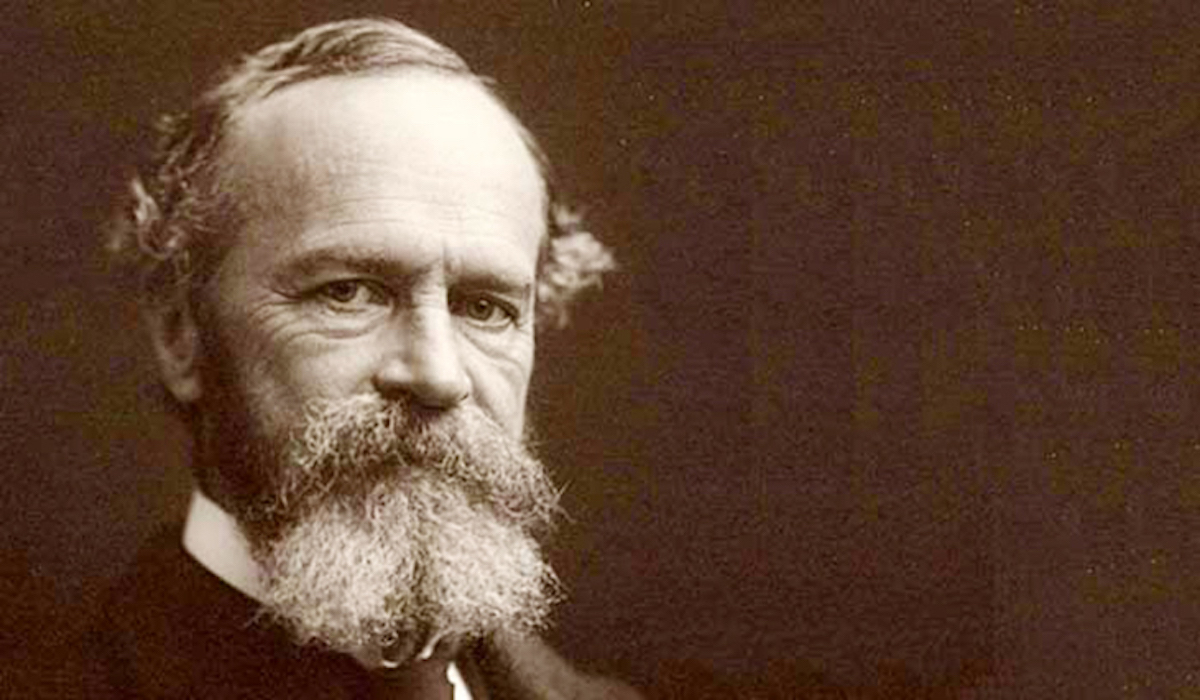
Pragmatism & Postmodernism

william-james

To my best belief: just what is the pragmatic theory of truth?


Cheryl Misak | Aeon Ideas

What is it for something to be true? One might think that the answer is obvious. A true belief gets reality right: our words correspond to objects and relations in the world. But making sense of that idea involves one in ever more difficult workarounds to intractable problems. For instance, how do we account for the statement ‘It did not rain in Toronto on 20 May 2018’? There don’t seem to be negative facts in the world that might correspond to the belief. What about ‘Every human is mortal’? There are more humans – past, present and future – than individual people in the world. (That is, a generalisation like ‘All Fs’ goes beyond the existing world of Fs, because ‘All Fs’ stretches into the future.) What about ‘Torture is wrong’? What are the objects in the world that might correspond to that? And what good is it explaining truth in terms of independently existing objects and facts, since we have access only to our interpretations of them?

Pragmatism can help us with some of these issues. The 19th-century American philosopher Charles Peirce, one of the founders of pragmatism, explained the core of this tradition beautifully: ‘We must not begin by talking of pure ideas, – vagabond thoughts that tramp the public roads without any human habitation, – but must begin with men and their conversation.’ Truth is a property of our beliefs. It is what we aim at, and is essentially connected to our practices of enquiry, action and evaluation. Truth, in other words, is the best that we could do.

The pragmatic theory of truth arose in Cambridge, Massachusetts in the 1870s, in a discussion group that included Peirce and William James. They called themselves the Metaphysical Club, with intentional irony. Though they shared the same broad outlook on truth, there was immediate disagreement about how to unpack the idea of the ‘best belief’. The debate stemmed from the different temperaments of Peirce and James.

Philosophy, James said, ‘is at once the most sublime and the most trivial of human pursuits. It works in the minutest crannies and it opens out the widest vistas.’ He was more a vista than a crannies man, dead set against technical philosophy. At the beginning of his book Pragmatism (1907), he said: ‘the philosophy which is so important to each of us is not a technical matter; it is our more or less dumb sense of what life honestly and deeply means.’ He wanted to write accessible philosophy for the public, and did so admirably. He became the most famous living academic in the United States.

The version of the pragmatist theory of truth made famous (or perhaps infamous) by James held that ‘Any idea upon which we can ride … any idea that will carry us prosperously from any one part of our experience to any other part, linking things satisfactorily, working securely, simplifying, saving labour, is … true INSTRUMENTALLY.’

‘Satisfactorily’ for James meant ‘more satisfactorily to ourselves, and individuals will emphasise their points of satisfaction differently. To a certain degree, therefore, everything here is plastic.’ He argued that if the available evidence underdetermines a matter, and if there are non-epistemic reasons for believing something (my people have always believed it, believing it would make me happier), then it is rational to believe it. He argued that if a belief in God has a positive impact on someone’s life, then it is true for that person. If it does not have a good impact on someone else’s life, it is not true for them.

Peirce, a crackerjack logician, was perfectly happy working in the crannies as well as opening out the vistas. He wrote much, but published little. A cantankerous man, Peirce described the difference in personality with his friend James thus: ‘He so concrete, so living; I a mere table of contents, so abstract, a very snarl of twine.’

Peirce said that James’s version of the pragmatic theory of truth was ‘a very exaggerated utterance, such as injures a serious man very much’. It amounted to: ‘Oh, I could not believe so-and-so, because I should be wretched if I did.’ Peirce’s worries, in these days of fake news, are more pressing than ever.

On Peirce’s account, a belief is true if it would be ‘indefeasible’ or would not in the end be defeated by reasons, argument, evidence and the actions that ensue from it. A true belief is the belief that we would come to, were we to enquire as far as we could on a matter. He added an important rider: a true belief must be put in place in a manner ‘not extraneous to the facts’. We cannot believe something because we would like it to be true. The brute impinging of experience cannot be ignored.

The disagreement continues to this day. James influenced John Dewey (who, when a student at Johns Hopkins, avoided Peirce and his technical philosophy like the plague) and later Richard Rorty. Dewey argued that truth (although he tended to stay away from the word) is nothing more than a resolution of a problematic situation. Rorty, at his most extreme, held that truth is nothing more than what our peers will let us get away with saying. This radically subjective or plastic theory of truth is what is usually thought of as pragmatism.

Peirce, however, managed to influence a few people himself, despite being virtually unknown in his lifetime. One was the Harvard logician and Kant scholar C I Lewis. He argued for a position remarkably similar to what his student W V O Quine would take over (and fail to acknowledge as Lewis’s). Reality cannot be ‘alien’, wrote Lewis – ‘the only reality there for us is one delimited in concepts of the results of our own ways of acting’. We have something given to us in brute experience, which we then interpret. With all pragmatists, Lewis was set against conceptions of truth in which ‘the mind approaches the flux of immediacy with some godlike foreknowledge of principles’. There is no ‘natural light’, no ‘self-illuminating propositions’, no ‘innate ideas’ from which other certainties can be deduced. Our body of knowledge is a pyramid, with the most general beliefs, such as the laws of logic, at the top, and the least general, such as ‘all swans are birds’, at the bottom. When faced with recalcitrant experience, we make adjustments in this complex system of interrelated concepts. ‘The higher up a concept stands in our pyramid, the more reluctant we are to disturb it, because the more radical and far-reaching the results will be…’ But all beliefs are fallible, and we can indeed disturb any of them. A true belief would be one that survives this process of enquiry.

Lewis saw that the pragmatist theory of truth deals nicely with those beliefs that the correspondence theory stumbles over. For instance, there is no automatic bar to ethical beliefs being true. Beliefs about what is right and wrong might well be evaluable in ways similar to how other kinds of beliefs are evaluable – in terms of whether they fit with experience and survive scrutiny.Aeon counter – do not remove

Cheryl Misak

This article was originally published at Aeon and has been republished under Creative Commons.