To Be Governed

To be governed is to be watched, inspected, spied upon, directed, law-driven, numbered, regulated, enrolled, indoctrinated, preached at, controlled, checked, estimated, valued, censured, commanded, by creatures who have neither the right nor the wisdom nor the virtue to do so. To be governed is to be at every operation, at every transaction noted, registered, counted, taxed, stamped, measured, numbered, assessed, licensed, authorized, admonished, prevented, forbidden, reformed, corrected, punished. It is, under pretext of public utility, and in the name of the public interest, to be placed under contribution, drilled, fleeced, exploited, monopolized, extorted from, squeezed, hoaxed, robbed; then, at the slightest resistance, the first word of complaint, to be repressed, fined, vilified, harassed, hunted down, abused, clubbed, disarmed, bound, choked, imprisoned, judged, condemned, shot, deported, sacrificed, sold, betrayed; and to crown all, mocked, ridiculed, derided, outraged, dishonored. That is government; that is its justice; that is its morality.

– Pierre-Joseph Proudhon

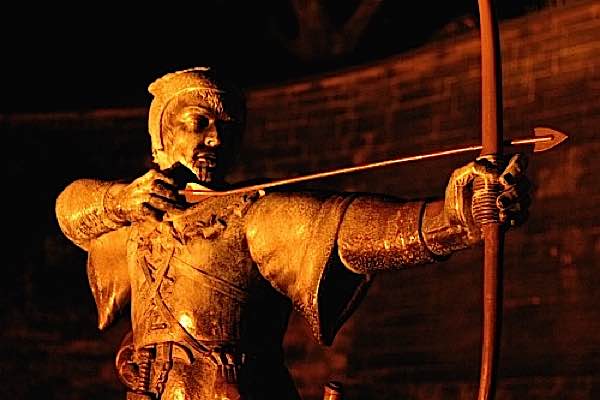
The Parable of the Arrow

arrow-parable-statue

The Buddha was sitting in the park when his disciple Malunkyaputta approached him. Malunkyaputta had recently retired from the world and he was concerned that so many things remained unexplained by the Buddha. Was the world eternal or not eternal? Was the soul different from the body? Did the enlightened exist after death or not? He thought, “If the Buddha does not explain these things to me, I will give up this training and return to worldly life.”

Thus, he approached the Buddha with this question, who replied:

It’s just as if a man were wounded with an arrow thickly smeared with poison. His friends and companions, kinsmen and relatives would provide him with a surgeon, and the man would say, ‘I won’t have this arrow removed until I know whether the man who wounded me was a noble warrior, a priest, a merchant, or a worker.’ He would say, ‘I won’t have this arrow removed until I know the given name and clan name of the man who wounded me… until I know whether he was tall, medium, or short… until I know whether he was dark, ruddy-brown, or golden-colored… until I know his home village, town, or city… until I know whether the bow with which I was wounded was a long bow or a crossbow… until I know whether the bowstring with which I was wounded was fiber, bamboo threads, sinew, hemp, or bark… until I know whether the shaft with which I was wounded was wild or cultivated… until I know whether the feathers of the shaft with which I was wounded were those of a vulture, a stork, a hawk, a peacock, or another bird… until I know whether the shaft with which I was wounded was bound with the sinew of an ox, a water buffalo, a langur, or a monkey.’ He would say, ‘I won’t have this arrow removed until I know whether the shaft with which I was wounded was that of a common arrow, a curved arrow, a barbed, a calf-toothed, or an oleander arrow.’ The man would die and those things would still remain unknown to him.

Whether the view is held that the world is eternal or not, Malunkyaputta, there is still birth, old age, death, grief, suffering, sorrow and despair – and these can be destroyed in this life! I have not explained these other things because they are not useful, they are not conducive to tranquility and Nirvana. What I have explained is suffering, the cause of suffering, the destruction of suffering and the path that leads to the destruction of suffering. This is useful, leading to non-attachment, the absence of passion, perfect knowledge.

Thus spoke the Buddha, and with joy Malunkyaputta applauded his words.

– Majjhima-nikaya, Sutta 63

The New Idol

Somewhere there are still peoples and herds, but not with us, my brethren: here there are states.

A state? What is that? Well! open now your ears unto me, for now will I say unto you my word concerning the death of peoples.

A state, is called the coldest of all cold monsters. Coldly lieth it also; and this lie creepeth from its mouth: “I, the state, am the people.”

It is a lie! Creators were they who created peoples, and hung a faith and a love over them: thus they served life.

Destroyers, are they who lay snares for many, and call it the state: they hang a sword and a hundred cravings over them.

Where there is still a people, there the state is not understood, but hated as the evil eye, and as sin against laws and customs.

This sign I give unto you: every people speaketh its language of good and evil: this its neighbour understandeth not. Its language hath it devised for itself in laws and customs.

But the state lieth in all languages of good and evil; and whatever it saith it lieth; and whatever it hath it hath stolen.

False is everything in it; with stolen teeth it biteth, the biting one. False are even its bowels.

Confusion of language of good and evil; this sign I give unto you as the sign of the state. Verily, the will to death, indicateth this sign! Verily, it beckoneth unto the preachers of death!

Many too many are born: for the superfluous ones was the state devised!

See just how it enticeth them to it, the many-too-many! How it swalloweth and cheweth and recheweth them!

“On earth there is nothing greater than I: it is I who am the regulating finger of God.”—thus roareth the monster. And not only the long-eared and short-sighted fall upon their knees!

Ah! even in your ears, ye great souls, it whispereth its gloomy lies! Ah! it findeth out the rich hearts which willingly lavish themselves!

Yea, it findeth you out too, ye conquerors of the old God! Weary ye became of the conflict, and now your weariness serveth the new idol!

Heroes and honourable ones, it would fain set up around it, the new idol! Gladly it basketh in the sunshine of good consciences,- the cold monster!

Everything will it give you, if ye worship it, the new idol: thus it purchaseth the lustre of your virtue, and the glance of your proud eyes.

It seeketh to allure by means of you, the many-too-many! Yea, a hellish artifice hath here been devised, a death-horse jingling with the trappings of divine honours!

Yea, a dying for many hath here been devised, which glorifieth itself as life: verily, a hearty service unto all preachers of death!

The state, I call it, where all are poison-drinkers, the good and the bad: the state, where all lose themselves, the good and the bad: the state, where the slow suicide of all—is called “life.”

Just see these superfluous ones! They steal the works of the inventors and the treasures of the wise. Culture, they call their theft—and everything becometh sickness and trouble unto them!

Just see these superfluous ones! Sick are they always; they vomit their bile and call it a newspaper. They devour one another, and cannot even digest themselves.

Just see these superfluous ones! Wealth they acquire and become poorer thereby. Power they seek for, and above all, the lever of power, much money—these impotent ones!

See them clamber, these nimble apes! They clamber over one another, and thus scuffle into the mud and the abyss.

Towards the throne they all strive: it is their madness—as if happiness sat on the throne! Ofttimes sitteth filth on the throne.- and ofttimes also the throne on filth.

Madmen they all seem to me, and clambering apes, and too eager. Badly smelleth their idol to me, the cold monster: badly they all smell to me, these idolaters.

My brethren, will ye suffocate in the fumes of their maws and appetites! Better break the windows and jump into the open air!

Do go out of the way of the bad odour! Withdraw from the idolatry of the superfluous!

Do go out of the way of the bad odour! Withdraw from the steam of these human sacrifices!

Open still remaineth the earth for great souls. Empty are still many sites for lone ones and twain ones, around which floateth the odour of tranquil seas.

Open still remaineth a free life for great souls. Verily, he who possesseth little is so much the less possessed: blessed be moderate poverty!

There, where the state ceaseth—there only commenceth the man who is not superfluous: there commenceth the song of the necessary ones, the single and irreplaceable melody.

There, where the state ceaseth—pray look thither, my brethren! Do ye not see it, the rainbow and the bridges of the Superman?—

Thus spake Zarathustra.

– Friedrich Nietzsche

The Madman (in me)

Have you not heard of that madman who lit a lantern in the bright morning hours, ran to the market place, and cried incessantly, “I seek God! I seek God!”

As many of those who do not believe in God were standing around just then, he provoked much laughter. Why, did he get lost? said one. Did he lose his way like a child? said another. Or is he hiding? Is he afraid of us? Has he gone on a voyage? or emigrated? Thus they yelled and laughed.

The madman jumped into their midst and pierced them with his glances.

“Whither is God?” he cried.

“I shall tell you. We have killed him – you and I. All of us are his murderers. But how have we done this? How were we able to drink up the sea? Who gave us the sponge to wipe away the entire horizon? What did we do when we unchained this earth from its sun? Whither is it moving now? Whither are we moving now? Away from all suns? Are we not plunging continually? Backward, sideward, forward, in all directions? Is there any up or down left? Are we not straying as through an infinite nothing? Do we not feel the breath of empty space? Has it not become colder? Is not night and more night coming on all the while? Must not lanterns be lit in the morning?

Do we not hear anything yet of the noise of the grave-diggers who are burying God?

Do we not smell anything yet of God’s decomposition?

Gods too decompose.

God is dead.

God remains dead.

And we have killed him.

How shall we, the murderers of all murderers, comfort ourselves? What was holiest and most powerful of all that the world has yet owned has bled to death under our knives. Who will wipe this blood off us? What water is there for us to clean ourselves? What festivals of atonement, what sacred games shall we have to invent? Is not the greatness of this deed too great for us? Must not we ourselves become gods simply to seem worthy of it? There has never been a greater deed; and whoever will be born after us – for the sake of this deed he will be part of a higher history than all history hitherto.”

Here the madman fell silent and looked again at his listeners; and they too were silent and stared at him in astonishment. At last he threw his lantern on the ground, and it broke and went out. “I come too early,” He said then; “my time has not come yet. This tremendous event is still on its way, still wandering – it has not yet reached the ears of man. Lightning and thunder require time, the light of the stars requires time, deeds require time even after they are done, before they can be seen and heard. This deed is still more distant from them than the most distant stars – and yet they have don it themselves.”

It has been related further that on that same day the madman entered a bunch of churches and there sand his requiem aeternam deo. Led out and called to account, he is said to have replied each time, “What are these churches now if they are not the tombs and sepulchers of God?”

– Nietzsche


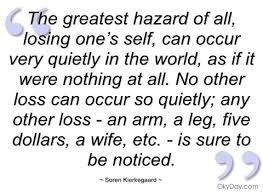
It is quite true what philosophy says: that life must be understood backwards. But then one forgets the other principle: that it must be lived forwards. Which principle, the more one thinks it through, ends exactly with the thought that temporal life can never properly be understood precisely because I can at no instant find complete rest in which to adopt a position: backwards, lol.

– Kierkegaard


Is it possible that, in spite of inventions and progress, in spite of culture, religion, and wisdom, one has remained at the surface of life? Is it possible that even this surface, which would at least have been something, has been covered with an incredibly dull material till it looks like salon furniture during the summer vacation?

Is it possible that there are people who say “God” and suppose that this is something one can have in common? – Just look at two school children: one of them buys a knife, and his neighbor buys one just like it, on the very same day. And a week later they compare their two knives, and by now they are barely similar: so differently have they developed in different hands. (Sure, says the mother of one boy, if you always get everything to look used right away!)

I see: Is it possible to believe that one can have a god without using him?

– Rilke

The Kyoto School’s Takeover of Hegel

Japanese Journal of Religious Studies 38/1 (2011)

Reviews, pp. 223-226

kyoto hegel

Peter Suares, The Kyoto School’s Takeover of Hegel: Nishida,

Nishitani, and Tanabe Remake the Philosophy of Spirit

Lanham, MD: Lexington Books, 2010. 238 pp. Cloth, $65.00.

ISBN 0-7391-4688-2/978-0-7391-4688-0.


Suares’s first book-length publication on philosophy fills a conspicuous lacuna of

scholarship on the complex relationship between Hegel and the philosophers of the

Kyoto School. The uptake of Hegel’s thought in Japan has been addressed by scholars

in articles, book chapters, or in passing within the context of other subjects;

but given the pervasive influence of Hegelian philosophy on Nishida and Tanabe in

particular, Suares’s in-depth treatment of the Kyoto School’s “takeover” of Hegel is a

needed addition to the existing comparative studies on this topic.


Suares makes a compelling and well-documented argument demonstrating that

Nishida, Nishitani, and Tanabe all rely heavily on Hegel’s ideas and methodology in

fashioning their own positions, despite their harsh criticisms of certain views they

attribute to him. Suares does a convincing job of showing that though the Kyoto

scholars unanimously reject what they take to be the central tenets of Hegel’s philosophy,

namely his “dogmatic Christian theism, the promotion of being to the central

category of reality, and rigid rationalism,” these “ostensibly Hegelian features

are in fact nowhere to be found in his philosophy”(190). Not only do the Kyoto

scholars misinterpret Hegel in their critiques of him, Suares argues, they actually

incorporate Hegel’s thought in significant ways such that their own philosophies

must be considered Hegelian in many respects. This idea itself is not new, however,

and Suares acknowledges that others have made similar observations. The contribution

made by this book is its thorough demonstration of this fact, with trenchant

reasoning and clear explanations of the many confounding formulations employed

by these thinkers.


The book consists of a short introduction and five chapters. Besides a brief chapter

on “The Danish Parallel” which addresses Kierkegaard’s critique of Hegel and his

stance on faith in relation to reason, the author primarily examines and critiques the

thought of Nishida, Nishitani, and Tanabe. While dimensions of Hegel’s philosophy

are discussed at length throughout the volume, the book focuses on the work of

the Kyoto School philosophers and the presence of Hegel’s ideas therein. This being

the case, the reading of Hegel adopted by Suares is not worked out in conversation

with current developments in Hegel scholarship. This may be a disappointment to

those who come to the subject well versed in those debates since the reader must

simply accept the author’s interpretation of Hegel in order to follow him through

his comparative enterprise. This disappointment is far outweighed, however, by

the original insights offered. Suares’s analysis of the uptake of Hegel in Japan illuminates

issues germane to Hegel studies and the history of philosophy broadly. In

fact, this volume’s account of how the Kyoto scholars “remake” Hegel’s philosophy

of spirit addresses important issues in Hegel scholarship that have not been probed

this deeply until now. For example, the in-depth analysis of Hegelian contradiction

given within this context provides a lucid explanation of perhaps the most notorious

dimensions of his philosophy—the inner workings of his dialectical method.

With the Kyoto scholars as Hegel’s conversation partners, the nature of dialectic

and the movement of spirit in self-consciousness becomes clearer than it could have

been had it been treated exclusively within the European and American context.


The first chapter, which comprises roughly half of the book, is devoted to

Nishida and surveys the development of his thought throughout his life. The chapter

is divided into two main sections. The first describes the “anatomy of subjectivity”

and the “world within,” situating Nishida’s conception of self-consciousness

within the context of Western philosophy. Here Nishida’s notion of pure experience

and his logic of place are examined alongside Hegel’s developmental model of

selfconsciousness, in addition to the models put forth by other notable figures such as

Kant, Fichte, Schelling, Hölderlin, and Josiah Royce. The second section confronts

“the objective dimension” which delves into the finer workings of “the dialectical

formula” operative in both Hegel and Nishida and addresses Nishida’s attempts at

sociopolitical thought in relation to history. Nishida’s notion of jikaku ??,

or selfawareness, establishes the continuity of the chapter in that it encompasses both the

subjective and objective components of reality in one two-fold activity. The most

notable strength of this discussion lies in its analysis and explication of the form of

Nishida’s logic in relation to Hegel’s. The analysis Suares gives is highly technical,

providing an account of paradox, contradiction, and negation in the work of both

authors. Suares tackles their perplexing dialectical maneuvers with uncommon

precision and clarity, relating them at times to their possible counterparts within

certain Buddhist strands such as Mādhyamika and Pure Land.


In addition to the analysis of the logical forms employed by Hegel and Nishida,

one of the most provocative elements of Suares’s discussion—and one which warrants

further debate—is his investigation into the limits of rationality for these

thinkers, a theme that continues throughout the remaining chapters of the book.

Despite the close analysis of the logical structures shaping the thought of each, the

question remains as to whether a fully rational account of reality and experience is

possible. Suares writes of Nishida, “The reconciliation of the rationality of everyday

life with the transrational level of consciousness at the base of reality is the central

problem with which he will struggle until the end of his career” (12). This struggle

is evident in Nishida’s simultaneous commitment to rational, philosophical discourse

and his use of utterly paradoxical language to formulate his position. This

tension points to a deeper issue not specifically taken up in the book, which is the

possibility that contradiction and paradox are themselves forms of rationality, both

operating within and pointing beyond the laws that define them. For both Nishida

and Hegel, self-consciousness and the reality it grounds exist through dialectical

conflict. For Hegel, as Suares points out, “Contradiction is the motor of life” (57).

And for Nishida, remaining true to the convolutions of the self in its ordinary and

ultimate character requires articulations that conjoin antithetical terms. Nishida’s

notions of the eternal now (eien no ima, 永遠の今), the continuity of discontinuity

(hirenzoku no renzoku, 非連続の連続), and the self-identity of absolute contradictories

(zettai mujunteki jikodōitsu, 絶対矛盾的自己同一) are examples. Prompted by

the author’s comparison of the ways these thinkers conceive of contradiction, the

reader is led to question the nature of logic itself and to confront how dialectical

reason challenges common notions of rationality.


The limits of reason discussed within the context of Nishida’s philosophy are

taken up in different ways, both directly and indirectly, in the following chapters

on Nishitani, Tanabe, and Kierkegaard. In the chapter on Nishitani, his “postulate

of emptiness as enhancement of being” as a means to counter the problem of nihilism

is examined through his accounts of “original nature” and emptiness as “double

exposure.” Nishitani’s notion of double exposure in particular proves to be a useful

tool for explaining how seemingly incompatible views can be held at the same time.

This also provides a useful point of comparison with Hegel’s logic, elucidating similar

conundrums therein, shedding light on the issues related to rationality just noted.


Suares’s general approach in each chapter is to lay out his chosen thinkers’ critiques

of Hegel and proceed to show whether or not they successfully avoid the

pitfalls into which they perceive Hegel to have fallen. In each case he concludes that

they are either unsuccessful in clearing themselves of the same charges that they

level against him, or that their criticisms reject claims that Hegel cannot be proven

to have actually made. In Tanabe’s case, these failures are particularly pointed,

Suares argues, since his adoption of numerous Hegelian features in his own work

clashes harshly with his stringent critique of those same features in Hegel’s philosophy.

In addition, Tanabe rejects certain ideas that he incorrectly attributes to Hegel.

For Tanabe, Hegel is both a well of inspiration and a foil he continually pits himself

against, and, as Suares aptly shows, that ambivalence has problematic consequences

that come to bear in the anti-philosophical position Tanabe eventually adopts.


Overall, Suares’s study is well-documented with an extensive bibliography

divided into sections according to subjects for convenient reference. Textual references

to Hegel and the Kyoto scholars make use of both translations and the sources

in their original languages, providing guidance for readers at various levels of expertise.

There is one reference, however, that must be flagged. On page 69, Suares cites

a passage from David Dilworth’s translation of Nishida’s final essay, “The Logic of

Nothingness [Place] and the Religious Worldview,” in which the philosopher says of

his logic that it “is illustrated by Nāgārjuna’s logic of the eightfold negation” and “is

decidedly not a dialectic of substance in the Hegelian sense.” Michiko Yusa (1988),

in her review of this translation, makes the important observation that in the original

text Nishida makes no direct mention of either Nāgārjuna or Hegel here, and

charges Dilworth with having been excessively interpretive at this point in his translation.

This pivotal passage bears upon a number of themes dealt with in Suares’s

book, so readers should consult the original text, mindful of its disputed translation.


The book’s thesis, succinctly put forth in the conclusion, emphasizes the closeness

of the principal views held by Hegel and the philosophers of the Kyoto School.

Suares, in fact, finds no significant difference between the notion of absolute spirit

delineated by Hegel and the Japanese philosophers’ notion of absolute nothingness.

Though he voices good reasons to support this view, not enough analysis of

Hegel’s notion of spirit is given to prove this particular point. But whether or not

this point is proved, the final assessment of the relationship between Hegel and the

Kyoto scholars given in the conclusion presents a new reading of Hegel informed

by the ways his thought has been adapted by Nishida, Nishitani, and Tanabe. The

convergence of their various dialectics opens new ways of understanding Hegel, in

addition to bringing together and clarifying the ideas that have shaped philosophical

thought in Japan. In this respect The Kyoto School’s Takeover of Hegel is a model

work of comparative scholarship and makes a highly valuable contribution to the

field. All in all, this work boldly charts exciting frontiers in world philosophy, demonstrating

the potential fruit that may come from thorough and intelligent crosscultural

comparative studies.


References

Yusa, Michiko

1988 Review of “Last writings: The logic of nothingness and the religious worldview.”

Journal of the American Academy of Religion 56: 802–804.


Lucy Schultz

University of Oregon


Source: Nanzan Institute for Religion and Culture
The History of an Error

Preface

I once was crazy, completely insane. Some would say that I still am.

Should I ever have been so bold as to analyze the arguments throughout history for and against the existence of God? The will to Truth had possessed me.

I had, in essence, sold my soul for Truth.

Panic? Crisis? Call it what you will.

Should I have spent my time doing something other than reading philosophy for hours on end for years? The abyss stares back.

Perhaps I should have trembled before God with fear and just continued my computer science studies. I would at least have become financially sound, right?

But I had to look into the abyss. Call it destiny.

Does it haunt me to this day? I was compelled to stare.

Not by my will, but by the will of God!

Truth be told, there is nobody to blame but my self.

Let me now put on an old tune that was first played back in 2008 by a tiny white hermit named Joshua Synon who was still a serious metaphysician – in an ironic sense at least.

When I heard the learn’d astronomer,
When the proofs, the figures, were ranged in columns before me,
When I was shown the charts and diagrams, to add, divide, and measure them,
When I sitting heard the astronomer where he lectured with much applause in the lecture-room,
How soon unaccountable I became tired and sick,
Till rising and gliding out I wander’d off by myself,
In the mystical moist night-air, and from time to time,
Look’d up in perfect silence at the stars.

– Walt Whitman


The History of an Error

By Joshua Synon

Man is the measure of all things – of things that are, that they are, and of things that are not, that they are not.

– Protagoras

And Plato said, “Let there be Truth,” and there was Truth. Man saw that the Truth was good, and he separated the Truth from the truth. Man called the Truth “Form,” and the truth he called “illusion.” Such is the spectacular deceit that marked the beginning of thousands of years of philosophical confusion. To the self-proclaimed Sophos that advocate the attribution of absolute value to that which is – to Truth – to apodictic certainty of noumena, I write with fear and trembling, but with utmost necessity. In the tradition of Pontius Pilate, may we ask, “What is Truth?”

In the above, I have used a capitalized ‘T’ in truth to signify absolute, unchangeable, objective truth arrived at through reason alone. The lower case ‘truth’ represents truths arrived at through subjective experience alone. What Western philosophy has embarked upon is a millennia surpassing dichotomy of essentially contradictory philosophical understandings of the world. One team argues that truth is objective in nature, that there are facts-in-themselves that exist independent of any observer (e.g. traditional theists), and these I will term objectivists (not to be confused with the doctrine of Ayn Rand). The other argues that truth is qualified by subjective experience, that there are indeed no facts-in-themselves – only perspectives, and these I will call subjectivists. On the metaphysical side there is a subtle, but significant, difference between the two: objectivists believe that we experience (or at least possibly can experience) the world as it is in-itself, while the subjectivist believes that there are only many different interpretations or perspectives possible. There have been many proponents for each side throughout the ages. What I would like to do is provide an explanation for this epic rift in Western philosophy and present an account as to why objectivism won out in the West until recent times.

In our present age most people share an objectivist point of view. Metaphysical objectivism is presumed to be common sense. Nobody doubts that there is an external world existing independently of oneself. People believe that when they die the world will continue along just as it had before. Certainly the scientific method would not work if this were not the case. Science today is on a search for the same objective Truth that Plato was so befriended to. The difference, however, lies in the fact that science evokes practical principles as opposed to abstract theoretical fantasies. It is my endeavor to convince the reader that what I have labeled subjectivism is much more common-sensical than its rival. I need not delve into the niceties of objectivism precisely because it is so familiar to us. It is enough to say that the ancient Greeks, specifically Plato, marked the beginning of objectivist thought in the Western world.

The so-called sophists of ancient Greece can be seen as prototypes of subjectivist thought in Western philosophy. They recognized and embellished upon a certain relativity in matters of truth. It was a sophist named Protagoras who pronounced, “Man is the measure of all things – of things that are, that they are, and of things that are not, that they are not” (Reeve 30). I think this is one of the most important quotes in ancient Western philosophy. This man, Protagoras, somehow acquired insight into a fundamental psychological truth about the nature of man and his ideas. That is, man is the sole creator and destroyer of his own ideas. It would seem to me that this hitherto profound insight was as common-sensical to Protagoras as objectivism is to the masses today. This same philosopher recognized that, “There are two opposing arguments concerning everything” (Ibid). Whether he believed that both sides of an argument are equally valid is a matter of interpretation and subject to argument. However, in matters of abstract metaphysical thought, I think Protagoras would agree that both sides are equally valid.

Thrasymachus, another among the ranks of the sophists, proclaimed in Book I of Plato’s Republic that “justice is the advantage of the stronger;” that, “each [ruler] declares that what is just for its subjects is what is advantageous for itself” (Ibid., at 149). This view of Thrasymachus’ is clearly relativistic in that justice in one state would theoretically be different from justice in another state. What is not recognized, however, by Plato in his dialogue is that the argument is over the definition of a word, and not, as he would have us believe, over an abstract concept of justice-in-itself. Such a concept, as will be argued later, is non-cognitive to man, for it is an oxymoron for man, a ‘subject,’ to perceive things-in-themselves as if he were an objective observer – an ‘unknowing knower.’

The subjectivism of the sophists, and perhaps other circumstances irrelevant to this discourse, provoked the Sophos – the self-proclaimed true seekers of Truth, with Plato being the most prominent among their ranks. Plato dishonored the sophists in his dialogues and the term sophist itself remains derogatory to this day. The divine Plato introduced, in his own sophistic manner, a cunning theory that would sweep through the ages of philosophy and even seep into the core of the world’s most prominent religion. His theory of the Forms – of Ideals – that began the artificial distinction between being and becoming, between reality and appearance, was his magnum opus: Man is in a cave of ignorance, blinded by his own senses, only to be redeemed by subjection to the Forms – to Truth, to the Good, even apotheosized and anthropomorphized into God – all essentially the same thing. “The true world – attainable for the sage, the pious, the virtuous man; he lives in it, he is it” (Portable 485). Plato himself wrote it in Book VII of the Republic, “I, Plato, have had the divination to leave the confines of that gloomy cave, to escape the shadowy appearances, and have come into the light of true knowledge. If I appear completely ridiculous to you it is only because your eyes are not well adjusted to Truth.” Perhaps he was operating on the principle of omne ignotum pro magnifico est. It is interesting to review Nietzsche’s view of Plato’s theory of the Forms:

Every concept originates through our equating what is unequal. No leaf ever wholly equals another, and the concept “leaf” is formed through an arbitrary abstraction from these individual differences, through forgetting the distinctions; and now it gives rise to the idea that in nature there might be something besides the leaves which would be “leaf” – some kind of original form after which all leaves have been woven, marked, copied, colored, curled, and painted, but by unskilled hands, so that no copy turned out to be a correct, reliable, and faithful image of the original form. We call a person “honest.” Why did he act so honestly today? we ask. Our answer usually sounds like this: because of his honesty. Honesty! That is to say again: the leaf is the cause of the leaves. After all, we know nothing of an essence-like quality named “honesty”; we know only numerous individualized, and thus unequal actions, which we equate by omitting the unequal and by then calling them honest actions. In the end, we distill from them a qualitas occulta with the name of “honesty”… (Portable 46)

I think that the most important developments in this great debate consist of the expansions of subjectivist thinking in more recent times. William James, a well known American philosopher, was a prominent proponent of the pragmatic theory of truth.

William James insisted that truth happens to an idea. “So there is no such thing as disinterested truth. Pragmatic truth is human truth. ‘Purely objective truth,’ James asserts, ‘plays no role whatsoever, is nowhere to be found.’ He adds that the most absolute-seeming truths ‘also once were plastic. They were called true for human reasons. They also mediate between still earlier truths and what in those days were novel observations.’ Useful, human truth is alive; rationalistic, abstract, dogmatic truth is ‘the dead heart of the living tree.’ Truth grows.” (Soccio 411)

It is becoming obvious that objectivism is losing its hold on the hearts and minds of philosophers. James’ theory helped to reduce fruitless metaphysical debates by only accepting practical truths. James was by no means a radical subjectivist, but his ideas reveal that the magnificent tower that is the reign of objective truth is beginning to falter.

Kierkegaard held a more extreme view on the value of subjective truth. Indeed, he wrote that subjectivity is truth:

When the question about truth is asked objectively, truth is reflected upon objectively as an object to which the knower relates himself. What is reflected upon is not the relation but that what he relates himself to is the truth, the true. If only that to which he relates himself is the truth, the true, then the subject is in the truth. When the question about truth is asked subjectively, the individual’s relation is reflected upon subjectively. If only the how of this relation is in truth, the individual is in truth, even if he in this way were to relate himself to untruth. (Hong 206)

For Kierkegaard, it is only subjective truth that has value. He does not, however, argue against the possibility of facts-in-themselves. He only intended to devalue them and the attempt at proving or even searching for them. One of the most common objections to subjectivism is that it creates a contradiction upon itself, but Kierkegaard was quick to guard against this objection:

When subjectivity, inwardness, is truth, then truth, objectively defined, is a paradox; and that truth is objectively a paradox shows precisely that subjectivity is truth, since the objectivity does indeed thrust away, and the objectivity’s repulsion, or the expression for the objectivity’s repulsion, is the resilience and dynamometer of inwardness. The paradox is the objective uncertainty that is the expression for the passion of inwardness that is truth. So much for the Socratic. The eternal, essential truth, that is, the truth that is related essentially to the existing person by pertaining essentially to what it means to exist (viewed Socratically, all other knowledge is accidental, its degree and scope indifferent), is a paradox. Nevertheless the eternal, essential truth is itself not at all a paradox, but it is a paradox by being related to an existing person. Socratic ignorance is an expression of the objective uncertainty; the inwardness of the existing person is truth. (Ibid., at 207)

This passage clearly shows that there have developed multiple meanings for the same philosophical words, viz. truth, which has caused much confusion in philosophy. But Kierkegaard was an avid ironist and his point is not to be taken lightly: If subjectivity is truth, then, objectively defined, truth is a paradox. However, the offensiveness to us objective truth-seekers of this so-called paradox is precisely an expression of subjectivity. What marvelous word games we have come up with throughout the ages! If anything, Kierkegaard has proven that it is certainly unfounded to regard subjectivity as untruth.

If Plato marked the beginning of objectivist thought in Western philosophy, then it is the Enlightenment that lead the course to its destruction. I am not going to tell the story of modern philosophy here. I will simply assume that the reader is familiar with the drama that started with Rene Descartes’ rationalism,

There is thinking; consequently there is that which thinks’ – that is what Descartes’ argument comes to. Yet this means positing our faith in the concept of substance as ‘a priori true.’ When there is thinking, something must be there which thinks – that is merely a formulation of our grammatical habit, which posits a doer for what is done… Rational thought is interpretation according to a scheme which we cannot escape. (Portable 455)

…proceeded through Berkeley’s idealism and Hume’s empirical skepticism, to finally be “solved” by Kant’s Copernican revolution. Enter the new pandemic – the Cartesian disease! “The true world – unattainable, indemonstrable, unpromisable; but the very thought of it – a consolation, an obligation, an imperative” (Ibid., at 485). There is a common factor underlying the thought of all of these men and their contemporary supporters. That common factor I will call logocentrism, a will to abstract metaphysical Truth at all costs. “’Will to truth’ does not mean ‘I will not let myself be deceived’ but – there is no choice – ‘I will not deceive, not even myself’: and with this we are on the ground of morality” (Ibid., at 449).

Kierkegaard once remarked upon an absent-minded man so abstracted from his own life that he hardly knew he existed, until, one fine morning, he woke up to find himself dead. Let us call this man philosophy. Almost twenty-three hundred years after Plato the question of the value of this objective Truth-seeking was finally posed:

The will to truth which will still tempt us to may a venture, that famous truthfulness of which all philosophers so far have spoken with respect – what questions has this will to truth not laid before us! What strange, wicked, questionable questions! That is a long story even now – and yet it seems as if it had scarcely begun. Is it any wonder that we should finally become suspicious, lose patience, and turn away impatiently? That we should finally learn from this Sphinx to ask questions, too? Who is it really that puts questions to us here? What in us really wants “truth”? Indeed we came to a long halt at the question about the cause of this will – until we finally came to a complete stop before a still more basic question. We asked about the value of this will. Suppose we want truth: why not rather untruth? And uncertainty? Even ignorance? The problem of the value of truth came before us – or was it we who came before the problem? Who of us is Oedipus here? Who the Sphinx? It is a rendezvous, it seems, of questions and question marks. And though it scarcely seems credible, it finally almost seems to us as if the problem had never even been put so far – as if we were the first to see it, fix it with our eyes, and risk it. For it does involve a risk, and perhaps there is none that is greater. (Basic Writings 199)

Shall we play the blind man who speaks of colors and lives by his word? When one asks what the value is of a fact-in-itself, a plethora, indeed an onslaught, of conscientious objections arise. Have we been indoctrinated to idolize Truth? I think that, if the question is asked metaphysically, the answer is easily found in the philosophical writings of the past twenty-four hundred years. Even so, given this great quest for objective Truth succeeds – as if objective is a meaningful word! Where have we gone and where are we to go from there? Ah, so we have proven that an external world exists, and we have ascertained every principle of physics! Alas, we can all now rest in peace and cease living, for by the power of Truth we have conquered the Universe! Abstract theory, nay, the Truth – The Truth – has set us free! However, when the will to Truth is abolished the voice of King Solomon again reigns supreme, which is perhaps irrelevant to this discourse, but certainly relevant to every living individual, “O Vanity of vanities, all is vanity!” But – nil desperandum– it would appear that nihilism itself was also invented by the Sophos!

Philosophy, for the past 2,400 years, has been on a search for the Truth. It is my contention that certain qualities of language itself have impeded and distorted this search, even possibly necessitated it. Language is the foundation of philosophical discourse, but language itself has limits, boundaries, ambiguities, obscurities, and preordained meanings.

When someone hides something behind a bush and looks for it again in the same place and finds it there as well, there is not much to praise in such seeking and finding. Yet this is how matters stand regarding seeking and finding “truth” within the realm of reason. If I make up the definition of a mammal, and then, after inspecting a camel, declare “look, a mammal” I have indeed brought a truth to light in this way, but it is a truth of limited value. That is to say, it is a thoroughly anthropomorphic truth which contains not a single point which would be “true in itself” or really and universally valid apart from man. At bottom, what the investigator of such truths is seeking is only the metamorphosis of the world into man. He strives to understand the world as something analogous to man, and at best he achieves by his struggles the feeling of assimilation. (“On Truth”)

Language, created by man, has been used by man to create an ordered universe. Language is confined to the system from which it originated and cannot gaze in as an objective thinker.

We have fixed up a world for ourselves in which we can live – assuming bodies, lines, planes, causes and effects, motion and rest, form and content: without these articles of faith, nobody now would endure life. But that does not mean that they have been proved. Life is no argument; the conditions of life could include error. (Basic Writings 171)

Every religion that has developed even a modicum of semantic sophistication recognizes to some extent the way words and reason fall short of reality when they do not actually distort it. However much the rationalist may begrudge the fact, paradox and the transrational are religion’s life blood, and that of art as well. Mystics in every faith report contacts with a world that startles and transforms them with its dazzling darkness. Zen stands squarely in this camp, its only uniqueness being that it makes breaking the language barrier its central concern. (Smith 130)

Shall we now give credence to that ancient question of Pontius Pilate? It has been said that there have developed multiple meanings for the same philosophical words. The word under the microscope at the moment is ‘truth.’ From what we have ascertained we may infer that truth is simply another creation of language; an attempt to bring order from chaos, meaning from meaninglessness.

What, then, is truth? A mobile army of metaphors, metonyms, and anthropomorphisms – in short, a sum of human relations, which have been enhanced, transposed, and embellished poetically and rhetorically, and which after long use seem firm, canonical, and obligatory to a people: truths are illusions about which one has forgotten that this is what they are. (Portable 47)

If this much is clear, then it is also clear that we cannot communicate without these metaphors, perhaps not even live without what we have created. It is not as clear, however, that is it high time for philosophy to abandon its search for Truth. Metaphysics, epistemology, ethics: all artificial creations for the sole purposes of mankind. Even logic cannot escape the grasp of owing its life to man:

That all contradiction in concepts should be forbidden, is the result of a belief, that we are able to form concepts, that a concept not only characterises but also holds the essence of a thing. … As a matter of fact, logic (like geometry and arithmetic) only holds good ofassumed existences which we have created. Logic is the attempt on our part to understand the actual world according to a scheme of Being devised by ourselves; or, more exactly, it is our attempt at making the actual world more calculable and more susceptible to formulation, for our own purposes. (Langiulli 90)

According to Wittgenstein, words themselves are relative in their meaning with respect to the specific ‘language-game’ that is taking place at any given time. He argued that language is not an adequate expression of objective reality. In a similar line of thought, Nietzsche doubts the truth-extracting powers of language,

[W]hat about these conventions of language? Are they really the products of knowledge, of the sense of truth? Do the designations and the things coincide? Is language the adequate expression of all realities? Only through forgetfulness can man ever achieve the illusion of possessing a ‘truth’… If he does not wish to be satisfied with truth in the form of a tautology… then he will forever buy illusions for truths. What is a word? The expression of a nerve-stimulus in sounds. But to infer from the nerve stimulus, a cause outside us, that is already the result of a false and unjustified application of the principle of reason… The ‘thing in itself’ (for that is what pure truth, without consequences, would be) is quite incomprehensible to the creators of language and not at all worth aiming for. One designates only the relations of things to man, and to express them one calls on the boldest metaphors. A nerve stimulus, first transposed into an image – first metaphor. The image, in turn, imitated by a sound – second metaphor… (Portable 45)

Noscitur a sociis – ad absurdum. In similar fashion, and perhaps beyond what Wittgenstein attempted, Jacques Derrida developed the tradition of deconstruction, which attempts to discover and incorporate, to deconstruct, underlying metaphysical assumptions in the interpretation of a reading. Each of these approaches lend a hand in the recovery of philosophy from thousands of years of that deceptively naive game of language.

Let us think about this subject in a common-sensical fashion. Our modern day common sense tells us, as was noted previously, that an external world-in-itself does exist, but this can be easily explained on account of indoctrination. A question for the reader: Have you ever existed outside of yourself? In other words, have you experienced anything other than what you have experienced? A clear contradiction. When one admits that subjective experience is the beginning and end of all knowledge, then one also admits ipso facto that there is absolutely no rational ground for assuming an objective reality outside of ones own experiences.

The practice of philosophy is, and always has been, man projecting his ideals into the world, a type of creative autobiography if you will. The existence of a word does not prove the ontological existence of an object. Perhaps an analogy will suffice: Computer scientists frequently use the term ‘null pointer.’ In computer science, a pointer is essentially a data element whose value is an address. A pointer basically points to the value of a given variable and can be dereferenced in certain operations requiring said variable. A null pointer is a pointer with no address. It is a pointer that is pointing to nothing. If a program attempts to dereference a null pointer, there will result a run-time error and the program will shut down. Words used in abstract philosophy can be said to be equivalent to null pointers. They dereference nothing and are only useful on an aesthetic level.

The separate elements of philosophy have gradually become assimilated into modern science. Metaphysics and epistemology have merged into science proper: physics, biology, astronomy, etc. Morality is now under the guise of psychology. Ethics has been made the foundation of law and an instrument of control. Political theory will be the last to be taught in history classrooms alone. Aesthetics has become vanity instead of vitality. With fear and trembling, not for me, but for the world, I pronounce the death of Truth – and with it, the death of 2,400 years of Western philosophy.

History of an Error

  1. The real world attainable for the wise man, the pious man, the virtuous man—he lives in it, he is it.

(Most ancient form of the idea, relatively clever, simple, convincing. Paraphrase of the proposition: ‘I, Plato, am the truth.’)

  1. The real world unattainable for now, but promised to the wise man, the pious man, the virtuous man (‘to the sinner who repents’).

(Progress of the idea: it becomes more cunning, more insidious, more incomprehensible—it becomes a woman, it becomes Christian…)

  1. The real world unattainable, unprovable, unpromisable, but the mere thought of it a consolation, an obligation, an imperative.

(The old sun in the background, but seen through mist and scepticism; the idea becomes sublime, pale, Nordic, Königsbergian.)

  1. The real world—unattainable? At any rate unattained. And since unattained also unknown. Hence no consolation, redemption, obligation either: what could something unknown oblige us to do? …

(Break of day. First yawn of reason. Cock-crow of positivism.)

  1. The ‘real world’—an idea with no further use, no longer even an obligation—an idea become useless, superfluous, therefore a refuted idea: let us do away with it!

(Broad daylight; breakfast; return of bon sens and cheerfulness; Plato’s shameful blush; din from all free spirits.)

  1. The real world—we have done away with it: what world was left? the apparent one, perhaps? … But no! with the real world we have also done away with the apparent one!

(Noon; moment of the shortest shadow; end of the longest error; pinnacle of humanity; INCIPIT ZARATHUSTRA.)

– Friedrich Nietzsch

[Bibliography unavailable]

—————————-

What is left Nietzsche? – Phenomenology? Subjectivism? Perspectivism? Simulacrum? – No. – Be-ing-No-thing-ness. A.K.A. Pure Experience liberated from sincerely concerned metaphysical speculation. A.K.A. Life. But you knew that already.

Later, Nishitani Keiji continues alongside myself spouting nonsense in underground notes! And stay tuned for The Magnum Opiate of Malaclypse the Younger! Be ye not lost among precepts of order!

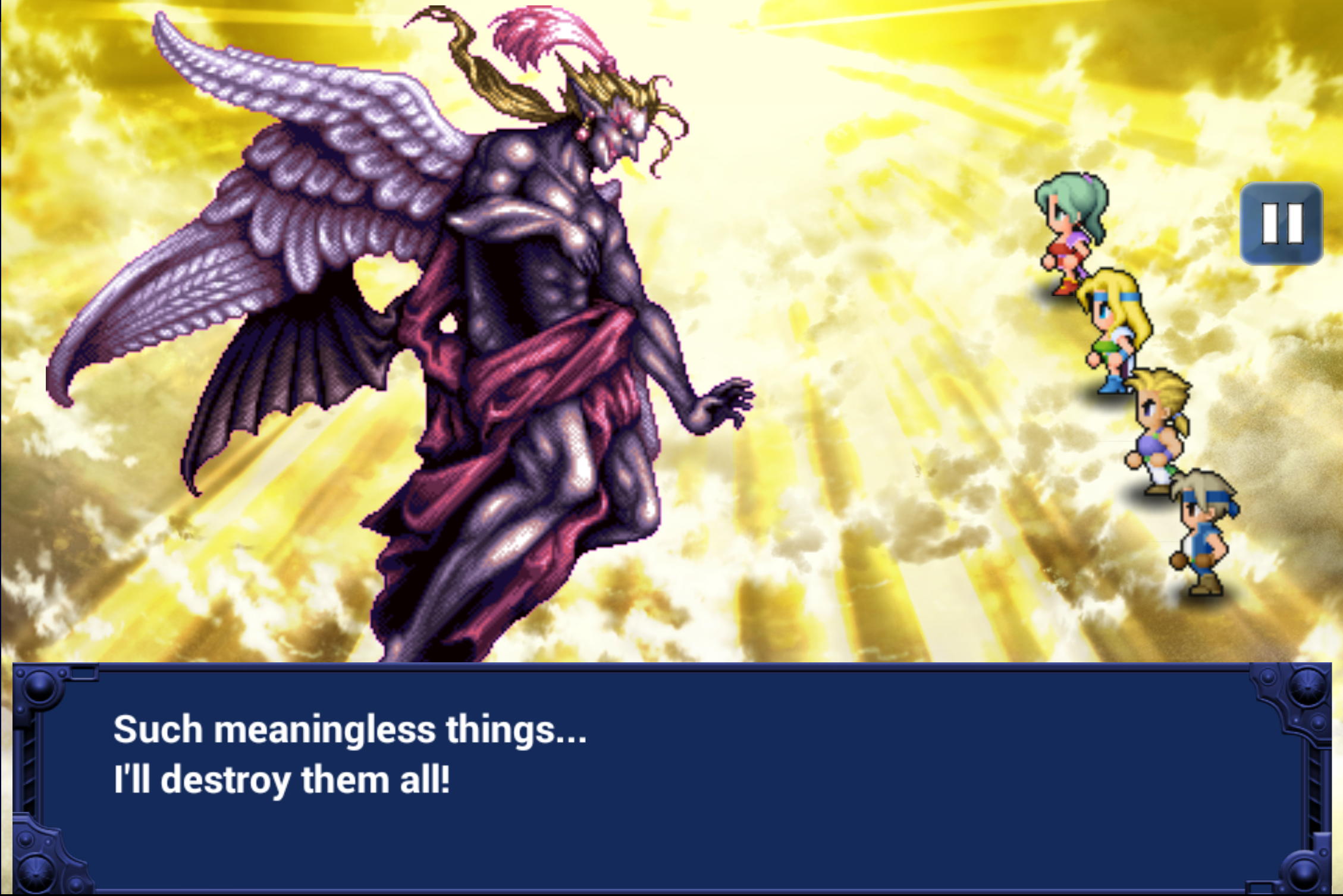
The Floating Continent

Kefka Palazzo

kefka

  • Phooey! Emperor Gesthal’s stupid orders! Edgar, you pinhead! Why do you have to live in the middle of a stinking desert?!? These recon jobs are the pits! …AHEM! There’s SAND on my boots!
  • Oh, Edgar… You know you only stand to lose from trying to hide her from us! Hee-hee-hee… I truly hope nothing happens to your precious Figaro!
  • Fire! Fire! Heh-heh-heh!
  • Oh? Then…welcome to my barbecue! Hee-hee-hee!
  • Son of a Submariner! You’ll pay for this!
  • Once Leo’s gone, I can turn this water into a flowing river of poison! Anyone who touches it’ll be pushing up daisies! Hee-hee…
  • (About the prisoners of the castle his men are to poisoned) Who cares? They’re the ones who were stupid enough to get caught by the enemy!
  • “Wait,” he says… Do I look like a waiter?
  • Hee-hee… Nothing beats the sweet music of hundreds of voices screaming in unison! Uwee-hee-hee!
  • I’m a god! I’m all-powerful! Uwee-hee-hee… I’ll collect more Espers I’ll extract their magic… And then… … … I’ll revive the Warring Triad! I’ve already drained all your powers! You’re useless to me now! You too! Take a hike!
  • Gah! How dare they put me in a place like this! …Hmph! I just can’t believe it! What a bore.
    • while imprisoned
  • Read my lips – mercy is for wimps! There’s a reason “oppose” rhymes with “dispose”…If they get in your way, kill them!
  • Oh dear…you wanna fight me?! This is just dreadful!
  • How ’bout a little Magitek mayhem?
  • I don’t care for the appearance of this pitiful little hamlet… So burn it!!
  • This little hamlet has too much boring and not enough burning… TORCH EVERYTHING!
  • I’d say you’re all charged up, boys and girls…or whatever… Say, remind me to show you my Magicite collection someday! You might see a few familiar faces!!! Now for a little Magicite hocus-pocus…!
  • Ooh! They’re warm to the touch! What treasures!
  • You really are a slow one. And always, always…ALWAYS such a little goody two-shoes!!!
    • to General Leo before killing him
  • Ouch! B-blood… Blood! Blood!!! You vicious brat! Argh… Grrr…! You know, you really are a stupid… Vicious… Arrogant, whiny, pampered, backstabbing, worthless… LITTLE BRAT!!!
    • to Celes after she stabs him on the Floating Continent
  • Run! Run! Or you’ll be well done!
  • Oh dear… Well, I guess I was a bit hasty in calling you a useless old man before… NOW you’re useless!
    • after killing Emperor Gestahl
  • I’ve acquired the ultimate power! Observe…Such magnificent power! You’re all nothing more than fleas compared to me now! Embrace your destruction… It is the fate of all things.
  • I will destroy everything… I will create a monument to non-existence!
  • Why do people insist on creating things that will inevitably be destroyed? Why do people cling to life, knowing that they must someday die? …Knowing that none of it will have meant anything once they do?
  • Why do you build, knowing destruction is inevitable? Why do you yearn to live, knowing all things must die? (Alternate version of the previous line which appears in the Anthology FMV)
  • And did you all find your “somethings” in this broken world that just won’t die?
  • Bleh! You people make me sick! You sound like lines from a self-help book! If that’s how it’s going to be… I’ll snuff them all out! Every last one of your sickening, happy little reasons for living!
  • Hee-hee-hee! But what fun is destruction if no “precious” lives are lost?
  • .. Dreams… Hope… Where do they come from? And where do they go…? Such meaningless things… I’ll destroy them all!
  • The end draws near…
    • Just before using his “Forsaken” attack for the first time.
  • ..Dreams…Hope…Where do they come from? And where do they go? None of that junk is enough to fulfill your hearts! Destruction…Destruction is what makes life worth living! Destroy! Destroy! Destroy! Let’s destroy everything!

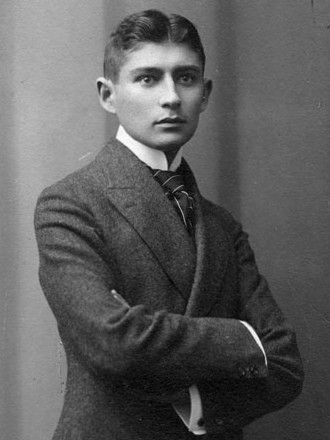
Franz Kafka

kafka

Aphorisms (1918)

Many of these statements in Kafka’s notebooks were later published posthumously in Parables and Paradoxes (1946), and The Blue Octavo Notebooks (1954) as translated by Ernst Kaiser and Eithne Wilkins, Original German text

  • The true way is along a rope that is not spanned high in the air, but only just above the ground. It seems intended more to cause stumbling than to be walked upon.
    • 1
  • All human errors are impatience, the premature breaking off of what is methodical, an apparent fencing in of the apparent thing.
    • 2; Variant translation: All human errors are impatience, a premature breaking off of methodical procedure, an apparent fencing-in of what is apparently at issue.
  • There are two main human sins from which all the others derive: impatience and indolence.It was because of impatience that they were expelled from Paradise; it is because of indolence that they do not return. Yet perhaps there is only one major sin: impatience. Because of impatience they were expelled, because of impatience they do not return.
  • 3, (20 October 1917); as published in The Blue Octavo Notebooks(1954); also in Dearest Father: Stories and Other Writings (1954); variant translations use “cardinal sins” instead of “main human sins” and “laziness” instead of “indolence”.
  • Beyond a certain point there is no return. This point has to be reached.
    • 5; variant translations:

From a certain point onward there is no longer any turning back. That is the point that must be reached.

  • As quoted in The Unfinished Country: A Book of American Symbols(1959) by Max Lerner, p. 452; also in Wait Without Idols (1964) by Gabriel Vahanian, p, 216; in Joyce, Decadence, and Emancipation (1995) by Vivian Heller, 39; in “The Sheltering Sky” (1949) by Paul Bowles, p.213; and in the poem “Father and Son” by Delmore Schwartz.
  • There is a point of no return. This point has to be reached.
  • The decisive moment in human evolution is perpetual.That is why the revolutionary spiritual movements that declare all former things worthless are in the right, for nothing has yet happened.
    • 6
  • One of the first signs of the beginnings of understanding is the wish to die. This life appears unbearable, another unattainable. One is no longer ashamed of wanting to die; one asks to be moved from the old cell, which one hates, to a new one, which one will only in time come to hate.
    • 13
  • A cage went in search of a bird.
    • 16
  • If it had been possible to build the Tower of Babel without climbing it, it would have been permitted.
    • 18; (9 November 1917) a slight variant of this was published in Parables and Paradoxes(1946): If it had been possible to build the Tower of Babel without ascending it, the work would have been permitted.
  • Leopards break into the temple and drink to the dregs what is in the sacrificial pitchers; this is repeated over and over again; finally it can be calculated in advance, and it becomes a part of the ceremony.
    • 20 (10 November 1917)
  • From the true antagonist illimitable courage is transmitted to you.
    • 23
  • Hiding places there are innumerable, escape is only one, but possibilities for escape, again, are as many as hiding places.

There is a goal, but no way; what we call a way is hesitation.

    • 27
  • When one has once accepted and absorbed Evil, it no longer demands to be believed.
    • 28
  • The ulterior motives with which you absorb and assimilate Evil are not your own but those of Evil.

The animal wrests the whip from its master and whips itself in order to become master, not knowing that this is only a fantasy produced by a new knot in the master’s whiplash.

  • 29
  • In a certain sense the Good is comfortless.
    • 30
  • Self-control is something for which I do not strive. Self-control means wanting to be effective at some random point in the infinite radiations of my spiritual existence.
    • 31
  • Martyrs do not underrate the body, they allow it to be elevated on the cross. In this they are at one with their antagonists.
    • 33
  • His weariness is that of the gladiator after the combat; his work was the whitewashing of a corner in a state official’s office.
    • 34; variant translation: His exhaustion is that of the gladiator after the fight, his work was the whitewashing of one corner in a clerk’s office.
  • Previously I did not understand why I got no answer to my question; today I do not understand how I could believe I was capable of asking. But I didn’t really believe, I only asked.
    • 36
  • The way is infinitely long, nothing of it can be subtracted, nothing can be added, and yet everyone applies his own childish yardstick to it. “Certainly, this yard of the way you still have to go, too, and it will be accounted unto you.”
    • 39
  • It is only our conception of time that makes us call the Last Judgment by this name. It is, in fact, a kind of martial law.
    • 40
  • Believing in progress does not mean believing that any progress has yet been made. That is not the sort of belief that indicates real faith.
    • 48
  • Man cannot live without a permanent trust in something indestructible in himself, though both the indestructible element and the trust may remain permanently hidden from him. One of the ways in which this hiddenness can express itself is through faith in a personal god.
    • 50; Der Mensch kann nicht leben ohne ein dauerndes Vertrauen zu etwas Unzerstörbarem in sich, wobei sowohl das Unzerstörbare als auch das Vertrauen ihm dauernd verborgen bleiben können. Eine der Ausdrucksmöglichkeiten dieses Verborgen-Bleibens ist der Glaube an einen persönlichen Gott.
  • The mediation by the serpent was necessary: Evil can seduce man, but cannot become man.
    • 51
  • In the struggle between yourself and the world, second the world.
    • 52, Im Kampf zwischen Dir und der Welt, sekundiere der Welt.
    • Aphorism 52 in Unpublished Works 1916-1918
    • Variant translations:

In the struggle between yourself and the world, back the world.

In the struggle between yourself and the world, side with the world.

In the fight between you and the world, back the world.

  • One must not cheat anyone, not even the world of its victory.
    • 53; Variant translation: One must not cheat anybody, not even the world of one’s triumph.
  • There is nothing besides a spiritual world; what we call the world of the senses is the Evil in the spiritual world, and what we call Evil is only the necessity of a moment in our eternal evolution.

One can disintegrate the world by means of very strong light. For weak eyes the world becomes solid, for still weaker eyes it seems to develop fists, for eyes weaker still it becomes shamefaced and smashes anyone who dares to gaze upon it.

  • 54
  • There are questions we could not get past if we were not set free from them by our very nature.
    • 56
  • One tells as few lies as possible only by telling as few lies as possible, and not by having the least possible opportunity to do so.
    • 58
  • The fact that there is nothing but a spiritual world deprives us of hope and gives us certainty.
    • 62
  • Expulsion from Paradise is in its main aspect eternal: that is to say, although expulsion from Paradise is final, and life in the world unavoidable, the eternity of the process (or, expressed in temporal terms, the eternal repetition of the process) nevertheless makes it possible not only that we might remain in Paradise permanently, but that we may in fact be there permanently, no matter whether we know it here or not.
    • 65; a slight variant of this statement was later published in Parables and Paradoxes(1946):

The expulsion from Paradise is in its main significance eternal:

Consequently the expulsion from Paradise is final, and life in this world irrevocable, but the eternal nature of the occurrence (or, temporally expressed, the eternal recapitulation of the occurrence) makes it nevertheless possible that not only could we live continuously in Paradise, but that we are continuously there in actual fact, no matter whether we know it here or not.

  • What is gayer than believing in a household god?
    • 68
  • Theoretically there is a perfect possibility of happiness: believing in the indestructible element in oneself and not striving towards it.
    • 69
  • The indestructible is one: it is each individual human being and, at the same time, it is common to all, hence the incomparably indivisible union that exists between human beings.
    • 71
  • If what was supposed to have been destroyed in Paradise was destructible, then it was not decisive; but if it was indestructible, then we are living in a false belief.
    • 74
  • Test yourself on mankind. It is something that makes the doubter doubt, the believer believe.
    • 75
  • Association with human beings lures one into self-observation.
    • 77
  • Sensual love deceives one as to the nature of heavenly love; it could not do so alone, but since it unconsciously has the element of heavenly love within it, it can do so.
    • 79
  • Truth is indivisible, hence it cannot recognize itself; anyone who wants to recognize it has to be a lie.
    • 80
  • Why do we complain about the Fall? It is not on its account that we were expelled from Paradise, but on account of the Tree of Life, lest we might eat of it.
    • 82, a slight variant of this was later published in Parables and Paradoxes(1946):

Why do we lament over the fall of man? We were not driven out of Paradise because of it, but because of the Tree of Life, that we might not eat of it.

  • “Paradise”
  • The whole visible world is perhaps nothing more than than the rationalization of a man who wants to find peace for a moment. An attempt to falsify the actuality of knowledge, to regard knowledge as a goal still to be reached.
    • “Paradise”
  • We are sinful not only because we have eaten of the Tree of Knowledge, but also because we have not yet eaten of the Tree of Life. The state in which we are is sinful, irrespective of guilt.
    • 83, a slight variant of this was later published in Parables and Paradoxes(1946):

We are sinful not merely because we have eaten of the Tree of Knowledge, but also because we have not yet eaten of the Tree of Life. The state in which we find ourselves is sinful, quite independent of guilt.

  • Also quoted in this form in The Parables of Peanuts(1968) by Robert L. Short, and Like a Dream, Like a Fantasy: The Zen Teachings and Translations of Nyogen (2005)
  • Evil is a radiation of the human consciousness in certain transitional positions.It is not actually the sensual world that is a mere appearance; what is so is the evil of it, which, admittedly, is what constitutes the sensual world in our eyes.
    • 85
  • The whole visible world is perhaps nothing other than a motivation of man’s wish to rest for a moment — an attempt to falsify the fact of knowledge, to try to turn the knowledge into the goal.
    • 86
  • A belief is like a guillotine, just as heavy, just as light.
    • 87
  • Two possibilities: making oneself infinitely small or being so. The second is perfection, that is to say, inactivity, the first is beginning, that is to say, action.
    • 90
  • Towards the avoidance of a piece of verbal confusion: What is intended to be actively destroyed must first of all have been firmly grasped; what crumbles away crumbles away, but cannot be destroyed.
    • 91
  • The first worship of idols was certainly fear of the things in the world, but, connected with this, fear of the necessity of the things, and, connected with this, fear of responsibility for the things. So tremendous did this responsibility appear that people did not even dare to impose it upon one single extra-human entity, for even the mediation of one being would not have sufficiently lightened human responsibility, intercourse with only one being would still have been all too deeply tainted with responsibility, and that is why each things was given the responsibility for itself, more indeed, these things were also given a degree of responsibility for man.
    • 92
  • There can be knowledge of the diabolical, but no belief in it, for more of the diabolical than there is does not exist.
    • 99
  • We too must suffer all the suffering around us. We all have not one body, but we have one way of growing, and this leads us through all anguish, whether in this or in that form. Just as the child develops through all the stages of life right into old age and to death (and fundamentally to the earlier stage the later one seems out of reach, in relation both to desire and to fear), so also do we develop (no less deeply bound up with mankind than with ourselves) through all the sufferings of this world. There is no room for justice in this context, but neither is there any room either for fear of suffering or for the interpretation of suffering as a merit.
    • 102
  • Humility provides everyone, even him who despairs in solitude, with the strongest relationship to his fellow man, and this immediately, though, of course, only in the case of complete and permanent humility. It can do this because it is the true language of prayer, at once adoration and the firmest of unions. The relationship to one’s fellow man is the relationship of prayer, the relationship to oneself is the relationship of striving; it is from prayer that one draws the strength for one’s striving.
    • 106
  • “It cannot be said that we are lacking in faith. Even the simple fact of our life is of a faith-value that can never be exhausted.” “You suggest there is some faith-value in this? Onecannotnot-live, after all.” “It is precisely in this ‘Cannot, after all’ that the mad strength of faith lies; it is in this negation that it takes on form.”

There is no need for you to leave the house. Stay at your table and listen. Don’t even listen, just wait. Don’t even wait, be completely quiet and alone. The world will offer itself to you to be unmasked; it can’t do otherwise; in raptures it will writhe before you.

  • 109; Variant translations: It is not necessary that you leave the house. Remain at your table and listen. Do not even listen, only wait. Do not even wait, be wholly still and alone. The world will present itself to you for its unmasking, it can do no other, in ecstasy it will writhe at your feet.

You do not need to leave your room. Remain sitting at your table and listen. Do not even listen, simply wait, be quiet, still and solitary. The world will freely offer itself to you to be unmasked, it has no choice, it will roll in ecstasy at your feet.

You do not need to leave your room. Remain sitting at your table and listen. Do not even listen, simply wait. Do not even wait, be quiet still and solitary. The world will freely offer itself to you to be unmasked, it has no choice, it will roll in ecstasy at your feet.

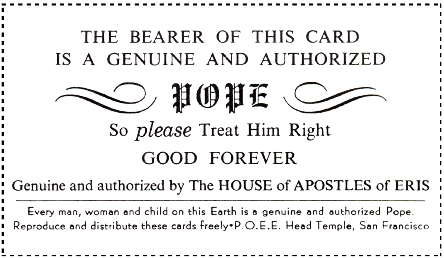
The Curse of Greyface

POEE_Pope_Card

In the year 1166 B.C. a malcontented hunchbrain by the name of Greyface got it into his head that the universe was as humorless as he, and he began to teach that play was sinful because it contradicted the ways of Serious Order. “Look at all the order around you,” he said. And from that, he deluded honest men to believe that reality was a straightjacket affair and not the happy romance as men had known it.

It is not presently understood why men were so gullible at that particular time, for absolutely no one thought to observe all the disorder around them and conclude just the opposite. But anyway, Greyface and his followers took the game of playing at life more seriously than they took life itself and were known even to destroy other living beings whose ways of life differed from their own.

The unfortunate result of this is that mankind has since been suffering from a psychological and spiritual imbalance. Imbalance causes frustration, and frustration causes fear. And fear makes for a bad trip. Man has been on a bad trip for a long time now. It is called THE CURSE OF GREYFACE.

The Aneristic Principle is that of APPARENT ORDER; the Erisitic Principle is that of APPARENT DISORDER. Both order and disorder are man made CONCEPTS and are artificial divisions of PURE CHAOS, which is a level deeper than is the level of distinction making.

The human race will begin solving its problems on the day that it ceases taking itself so seriously. To that end, Paratheo-Anametamystikhood Of Eris Esoteric (POEE) proposes the countergame of NONSENSE AS SALVATION. Salvation from an ugly and barbarous existence that is the result of taking order so seriously and so seriously fearing contrary orders and disorder, that GAMES are taken as more important than LIFE; rather than taking LIFE AS THE ART OF PLAYING GAMES. To this end, we propose that man develop his innate love for disorder, and play with The Goddess Eris. And know that it is a joyful play, and that thereby CAN BE REVOKED THE CURSE OF GREYFACE.

Bullshit makes the flowers grow and that is beautiful. If you want in on the Discordian Society, then declare yourself what you wish, do what you like and tell us about it. Or if you prefer, don’t. Repeat after me: Spectacles, testicles, brandy, cigars. You are now a Discordian Pope and therefore absolutely infallible. You must also excommunicate every other Discordian Pope you meet, because we Discordians must stick apart.

A Discordian is required during his early Illumination to go off Alone and partake joyously of a Hot Dog on a Friday; this Devotive Ceremony to Remonstrate against the popular Paganisms of the Day: of Catholic Christendom (no meat on Friday), of Judaism (no meat of Pork), of Hindic Peoples (no meat of Beef), of Buddhists (no meat of animal), and of Discordians (no Hot Dog Buns). A Discordian is also Prohibited of Believing what he reads.

If you can master nonsense as well as you have already learned to master sense, then each will expose the other for what it is: absurdity. From that moment of illumination, a man begins to be free regardless of his surroundings. He becomes free to play order games and change them at will. He becomes free to play disorder games just for the hell of it. He becomes free to play neither or both. And as the master of his own games, he plays without fear, and therefore without frustration, and therefore with good will in his soul and love in his being.

And when men become free then mankind will be free.

THE SACRED CHAO is the key to illumination. Devised by the Apostle Hung Mung in ancient China, it was modified and popularized by the Taoists and is sometimes called the YIN-YANG. The Sacred Chao is not the Yin-Yang of the Taoists. It is the HODGE-PODGE of the Erisians. And, instead of a Podge spot on the Hodge side, it has a PENTAGON which symbolizes the ANERISTIC PRINCIPLE, and instead of a Hodge spot on the Podge side, it depicts the GOLDEN APPLE OF DISCORDIA to symbolize the ERISTIC PRINCIPLE. The Sacred Chao symbolizes absolutely everything anyone need ever know about absolutely anything, and more! It even symbolizes everything not worth knowing, depicted by the empty space surrounding the Hodge-Podge.

May you be free of The Curse of Greyface.

May the Goddess put twinkles in your eyes.

May you have the knowledge of a sage,

and the wisdom of a child.

Hail Eris.

The Crowd is Untruth

And to honour every man, absolutely every man, is the truth, and this is what it is to fear God and love one’s “neighbour.” But from an ethico-religious point of view, to recognize the “crowd” as the court of last resort is to deny God, and it cannot exactly mean to love the “neighbour.” And the “neighbour” is the absolutely true expression for human equality. In case every one were in truth to love his neighbour as himself, complete human equality would be attained. Every one who loves his neighbour in truth, expresses unconditionally human equality. Every one who, like me, admits that his effort is weak and imperfect, yet is aware that the task is to love one’s neighbour, is also aware of what human equality is. But never have I read in Holy Scripture the commandment, Thou shalt love the crowd – and still less, Thou shalt recognize, ethico-religiously, in the crowd the supreme authority in matters of “truth.” But the thing is simple enough: this thing of loving one’s neighbour is self-denial; that of loving the crowd, or of pretending to love it, of making it the authority in matters of truth, is the way to material power, the way to temporal and earthly advantages of all sorts – at the same time it is the untruth, for a crowd is the untruth.

Therefore was Christ crucified, because, although He addressed himself to all, He would have no dealings with the crowd, because He would not permit the crowd to aid him in any way, because in this regard He repelled people absolutely, would not found a party, did not permit balloting, but would be what He is, the Truth, which relates itself to the individual. – And hence every one who truly would serve the truth is eo ipso, in one way or another, a martyr.

For it is not so great a trick to win the crowd. All that is needed is some talent, a certain dose of falsehood, and a little acquaintance with human passions. But no witness for the truth (Aa! and that is what every man should be, including you and me) – no witness for the truth dare become engaged with the crowd.

~ Kierkegaard

Søren K. (March 30, 1846)

Image result for soren kierkegaard

The present age is essentially a sensible, reflecting age, devoid of passion, flaring up in superficial, short-lived enthusiasm and prudentially relaxing in indolence. In contrast to the age of revolution, which took action, the present age is an age of publicity, the age of miscellaneous announcements: nothing happens but still there is instant publicity. There is a mutual inquisitiveness; everyone is experienced in indecisiveness and evasions and waits for someone to come along who wills something – so that they may place bets on him.