Philosophy via Facebook? Why Not?

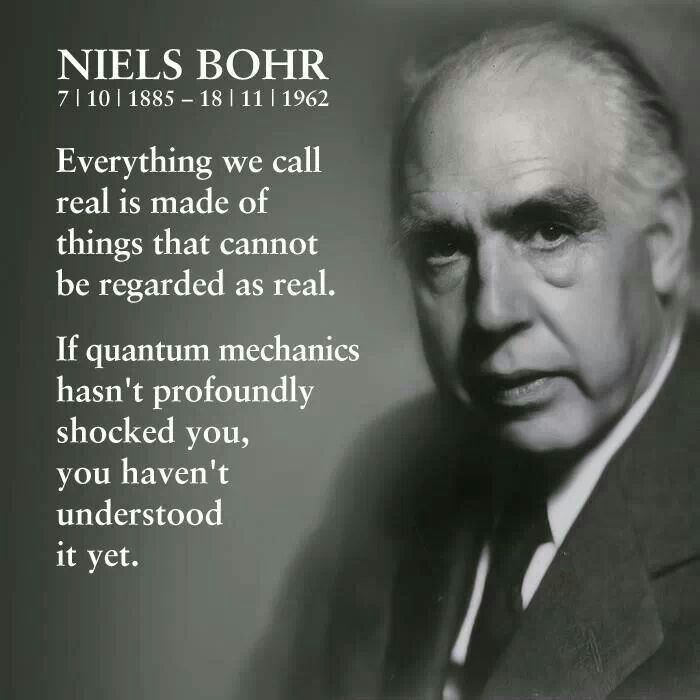
the death of socrates

A portion of Jacques-Louis David’s 1787 painting, “The Death of Socrates.” (Scan by Mark Harden / Metropolitan Museum of Art)

By Eric Schwitzgebel

Academic philosophers tend to have a narrow view of what is valuable philosophical work. Hiring, tenure, promotion and prestige depend mainly on one’s ability to produce journal articles in a particular theoretical, abstract style, mostly in reaction to a small group of canonical and 20th century figures, for a small readership of specialists. We should broaden our vision.

Consider the historical contingency of the journal article, a late-19th century invention. Even as recently as the middle of the 20th century, leading philosophers in Western Europe and North America did important work in a much broader range of genres: the fictions and difficult-to-classify reflections of Sartre, Camus and Unamuno; Wittgenstein’s cryptic fragments; the peace activism and popular writings of Bertrand Russell; John Dewey’s work on educational reform.

Popular essays, fictions, aphorisms, dialogues, autobiographical reflections and personal letters have historically played a central role in philosophy. So also have public acts of direct confrontation with the structures of one’s society: Socrates’ trial and acceptance of the hemlock; Confucius’ inspiring personal correctness.

It was really only with the generation hired to teach the baby boomers in the 1960s and ’70s that academic philosophers’ conception of philosophical work became narrowly focused on the technical journal article.

Consider, too, the emergence of new media. Is there reason to think that journal articles are uniformly better for philosophical reflection than videos, interactive demonstrations, blog posts or multi-party conversations on Facebook?

A conversation in social media, if good participants bring their best to the enterprise, has the potential to be a philosophical creation of the highest order, with a depth and breadth beyond the capacity of any individual philosopher to create. A video game could illuminate, critique and advance a vision of worthwhile living, deploying sight, hearing, emotion and personal narrative as well as (why not?) traditional verbal exposition — and it could potentially do so with all the freshness of thinking, all the transformative power and all the expository rigor of Hume, Kant or Nietzsche.

Academic philosophers are paid to develop expertise in philosophy, to bring that expertise into the classroom and to contribute that expertise to society in part by advancing philosophical knowledge. A wide range of activities fit within that job description.

Every topic of human concern is open to philosophical inquiry. This includes not only subjects well represented in journals, such as the structure of propositional attitudes and the nature of moral facts, but also how one ought to raise children and what makes for a good sports team. And the method of writing and responding to journal-article-length expository arguments by fellow philosophers is only one possible method of inquiry.

Engaging with the world, trying out one’s ideas in action, seeing the reactions of non-academics, exploring ideas in fiction and meditation — in these activities we can not only deploy knowledge but cultivate, expand and propagate that knowledge.

Philosophical expertise is not like scientific expertise. Although academic philosophers know certain literatures very well, on questions about the general human condition and what our fundamental values should be, knowledge of the canon gives academic philosophers no especially privileged wisdom. Non-academics can and should be respected partners in the philosophical dialogue. Too exclusive a focus on technical journal articles excludes non-academics from the dialogue — or maybe, better said, excludes us philosophers from non-academics’ more important dialogue.

The academic journal article as it exists today is thus too limited in format, topic, method and audience to deserve so centrally privileged a place in philosophers’ conception of the discipline.

Research-oriented philosophy departments tend to regard writing for popular media as “service,” which is held in less esteem than “research.” I’m not sure service should be held in less esteem, but I would suggest that popular writing can also qualify as research.

If one approaches popular writing only as a means of “dumbing down” preexisting philosophical ideas for an audience of non-experts whose reactions one doesn’t plan to take seriously, then yes, that writing is not really research. If, however, the popular essay is itself a locus of philosophical creativity, in which ideas are explored in hope of discovering new possibilities, advancing (and not just marketing) one’s own thinking in a way that might strike professionals too as interesting rather than as merely familiar rehashing, then it is every bit as much research as is a standard journal article. Analogously for government consulting, Twitter feeds, TED videos and poetry.

A Philosophical Review article can be an amazing thing. But we should see journal articles in that style, in that type of venue, as only one of many possible forms of important, field-shaping philosophical work.

Eric Schwitzgebel is a professor of philosophy at UC Riverside and the author of “Perplexities of Consciousness.” He blogs at The Splintered Mind.

Source: Los Angeles Times

The Death of Postmodernism And Beyond

Alan Kirby says postmodernism is dead and buried. In its place comes a new paradigm of authority and knowledge formed under the pressure of new technologies and contemporary social forces.

Originally Published in Philosophy Now
digimodernism

I have in front of me a module description downloaded from a British university English department’s website. It includes details of assignments and a week-by-week reading list for the optional module ‘Postmodern Fictions’, and if the university is to remain nameless here it’s not because the module is in any way shameful but that it handily represents modules or module parts which will be taught in virtually every English department in the land this coming academic year. It assumes that postmodernism is alive, thriving and kicking: it says it will introduce “the general topics of ‘postmodernism’ and ‘postmodernity’ by examining their relationship to the contemporary writing of fiction”. This might suggest that postmodernism is contemporary, but the comparison actually shows that it is dead and buried.

Postmodern philosophy emphasises the elusiveness of meaning and knowledge. This is often expressed in postmodern art as a concern with representation and anironic self-awareness. And the argument that postmodernism is over has already been made philosophically. There are people who have essentially asserted that for a while we believed in postmodern ideas, but not any more, and from now on we’re going to believe in critical realism. The weakness in this analysis is that it centres on the academy, on the practices and suppositions of philosophers who may or may not be shifting ground or about to shift – and many academics will simply decide that, finally, they prefer to stay with Foucault [arch postmodernist] than go over to anything else. However, a far more compelling case can be made that postmodernism is dead by looking outside the academy at current cultural production.

Most of the undergraduates who will take ‘Postmodern Fictions’ this year will have been born in 1985 or after, and all but one of the module’s primary texts were written before their lifetime. Far from being ‘contemporary’, these texts were published in another world, before the students were born: The French Lieutenant’s Woman, Nights at the Circus, If on a Winter’s Night a Traveller, Do Androids Dream of Electric Sheep? (and Blade Runner), White Noise: this is Mum and Dad’s culture. Some of the texts (‘The Library of Babel’) were written even before theirparents were born. Replace this cache with other postmodern stalwarts – Beloved,Flaubert’s Parrot, Waterland, The Crying of Lot 49, Pale Fire, Slaughterhouse 5,Lanark, Neuromancer, anything by B.S. Johnson – and the same applies. It’s all about as contemporary as The Smiths, as hip as shoulder pads, as happening as Betamax video recorders. These are texts which are just coming to grips with the existence of rock music and television; they mostly do not dream even of the possibility of the technology and communications media – mobile phones, email, the internet, computers in every house powerful enough to put a man on the moon – which today’s undergraduates take for granted.

The reason why the primary reading on British postmodernism fictions modules is so old, in relative terms, is that it has not been rejuvenated. Just look out into the cultural market-place: buy novels published in the last five years, watch a twenty-first century film, listen to the latest music – above all just sit and watch television for a week – and you will hardly catch a glimpse of postmodernism. Similarly, one can go to literary conferences (as I did in July) and sit through a dozen papers which make no mention of Theory, of Derrida, Foucault, Baudrillard. The sense of superannuation, of the impotence and the irrelevance of so much Theory among academics, also bears testimony to the passing of postmodernism. The people who produce the cultural material which academics and non-academics read, watch and listen to, have simply given up on postmodernism. The occasional metafictional or self-conscious text will appear, to widespread indifference – like Bret Easton Ellis’Lunar Park – but then modernist novels, now long forgotten, were still being written into the 1950s and 60s. The only place where the postmodern is extant is in children’s cartoons like Shrek and The Incredibles, as a sop to parents obliged to sit through them with their toddlers. This is the level to which postmodernism has sunk; a source of marginal gags in pop culture aimed at the under-eights.

What’s Post Postmodernism?

I believe there is more to this shift than a simple change in cultural fashion. The terms by which authority, knowledge, selfhood, reality and time are conceived have been altered, suddenly and forever. There is now a gulf between most lecturers and their students akin to the one which appeared in the late 1960s, but not for the same kind of reason. The shift from modernism to postmodernism did not stem from any profound reformulation in the conditions of cultural production and reception; all that happened, to rhetorically exaggerate, was that the kind of people who had once written Ulysses and To the Lighthousewrote Pale Fire and The Bloody Chamber instead. But somewhere in the late 1990s or early 2000s, the emergence of new technologies re-structured, violently and forever, the nature of the author, the reader and the text, and the relationships between them.

Postmodernism, like modernism and romanticism before it, fetishised [ie placed supreme importance on] the author, even when the author chose to indict or pretended to abolish him or herself. But the culture we have now fetishises the recipient of the text to the degree that they become a partial or whole author of it. Optimists may see this as the democratisation of culture; pessimists will point to the excruciating banality and vacuity of the cultural products thereby generated (at least so far).

Let me explain. Postmodernism conceived of contemporary culture as a spectacle before which the individual sat powerless, and within which questions of the real were problematised. It therefore emphasised the television or the cinema screen. Its successor, which I will call pseudo-modernism, makes the individual’s action the necessary condition of the cultural product. Pseudo-modernism includes all television or radio programmes or parts of programmes, all ‘texts’, whose content and dynamics are invented or directed by the participating viewer or listener (although these latter terms, with their passivity and emphasis on reception, are obsolete: whatever a telephoning Big Brother voter or a telephoning 6-0-6 football fan are doing, they are not simply viewing or listening).

By definition, pseudo-modern cultural products cannot and do not exist unless the individual intervenes physically in them. Great Expectations will exist materially whether anyone reads it or not. Once Dickens had finished writing it and the publisher released it into the world, its ‘material textuality’ – its selection of words – was made and finished, even though its meanings, how people interpret it, would remain largely up for grabs. Its material production and its constitution were decided by its suppliers, that is, its author, publisher, serialiser etc alone – only the meaning was the domain of the reader. Big Brother on the other hand, to take a typical pseudo-modern cultural text, would not exist materially if nobody phoned up to vote its contestants off. Voting is thus part of the material textuality of the programme – the telephoning viewers write the programme themselves. If it were not possible for viewers to write sections of Big Brother, it would then uncannily resemble an Andy Warhol film: neurotic, youthful exhibitionists inertly bitching and talking aimlessly in rooms for hour after hour. This is to say, what makes Big Brother what it is, is the viewer’s act of phoning in.

Pseudo-modernism also encompasses contemporary news programmes, whose content increasingly consists of emails or text messages sent in commenting on the news items. The terminology of ‘interactivity’ is equally inappropriate here, since there is no exchange: instead, the viewer or listener enters – writes a segment of the programme – then departs, returning to a passive role. Pseudo-modernism also includes computer games, which similarly place the individual in a context where they invent the cultural content, within pre-delineated limits. The content of each individual act of playing the game varies according to the particular player.

The pseudo-modern cultural phenomenon par excellence is the internet. Its central act is that of the individual clicking on his/her mouse to move through pages in a way which cannot be duplicated, inventing a pathway through cultural products which has never existed before and never will again. This is a far more intense engagement with the cultural process than anything literature can offer, and gives the undeniable sense (or illusion) of the individual controlling, managing, running, making up his/her involvement with the cultural product. Internet pages are not ‘authored’ in the sense that anyone knows who wrote them, or cares. The majority either require the individual to make them work, like Streetmap or Route Planner, or permit him/her to add to them, like Wikipedia, or through feedback on, for instance, media websites. In all cases, it is intrinsic to the internet that you can easily make up pages yourself (eg blogs).

If the internet and its use define and dominate pseudo-modernism, the new era has also seen the revamping of older forms along its lines. Cinema in the pseudo-modern age looks more and more like a computer game. Its images, which once came from the ‘real’ world – framed, lit, soundtracked and edited together by ingenious directors to guide the viewer’s thoughts or emotions – are now increasingly created through a computer. And they look it. Where once special effects were supposed to make the impossible appear credible, CGI frequently [inadvertently] works to make the possible look artificial, as in much ofLord of the Rings or Gladiator. Battles involving thousands of individuals have really happened; pseudo-modern cinema makes them look as if they have only ever happened in cyberspace. And so cinema has given cultural ground not merely to the computer as a generator of its images, but to the computer game as the model of its relationship with the viewer.

Similarly, television in the pseudo-modern age favours not only reality TV (yet another unapt term), but also shopping channels, and quizzes in which the viewer calls to guess the answer to riddles in the hope of winning money. It also favours phenomena like Ceefax and Teletext. But rather than bemoan the new situation, it is more useful to find ways of making these new conditions conduits for cultural achievements instead of the vacuity currently evident. It is important here to see that whereas the form may change (Big Brother may wither on the vine), the terms by which individuals relate to their television screen and consequently what broadcasters show have incontrovertibly changed. The purely ‘spectacular’ function of television, as with all the arts, has become a marginal one: what is central now is the busy, active, forging work of the individual who would once have been called its recipient. In all of this, the ‘viewer’ feels powerful and is indeed necessary; the ‘author’ as traditionally understood is either relegated to the status of the one who sets the parameters within which others operate, or becomes simply irrelevant, unknown, sidelined; and the ‘text’ is characterised both by its hyper-ephemerality and by its instability. It is made up by the ‘viewer’, if not in its content then in its sequence – you wouldn’t read Middlemarch by going from page 118 to 316 to 401 to 501, but you might well, and justifiably, read Ceefax that way.

A pseudo-modern text lasts an exceptionally brief time. Unlike, say, Fawlty Towers, reality TV programmes cannot be repeated in their original form, since the phone-ins cannot be reproduced, and without the possibility of phoning-in they become a different and far less attractive entity. Ceefax text dies after a few hours. If scholars give the date they referenced an internet page, it is because the pages disappear or get radically re-cast so quickly. Text messages and emails are extremely difficult to keep in their original form; printing out emails does convert them into something more stable, like a letter, but only by destroying their essential, electronic state. Radio phone-ins, computer games – their shelf-life is short, they are very soon obsolete. A culture based on these things can have no memory – certainly not the burdensome sense of a preceding cultural inheritance which informed modernism and postmodernism. Non-reproducible and evanescent, pseudo-modernism is thus also amnesiac: these are cultural actions in the present moment with no sense of either past or future.

The cultural products of pseudo-modernism are also exceptionally banal, as I’ve hinted. The content of pseudo-modern films tends to be solely the acts which beget and which end life. This puerile primitivism of the script stands in stark contrast to the sophistication of contemporary cinema’s technical effects. Much text messaging and emailing is vapid in comparison with what people of all educational levels used to put into letters. A triteness, a shallowness dominates all. The pseudo-modern era, at least so far, is a cultural desert. Although we may grow so used to the new terms that we can adapt them for meaningful artistic expression (and then the pejorative label I have given pseudo-modernism may no longer be appropriate), for now we are confronted by a storm of human activity producing almost nothing of any lasting or even reproducible cultural value – anything which human beings might look at again and appreciate in fifty or two hundred years time.

The roots of pseudo-modernism can be traced back through the years dominated by postmodernism. Dance music and industrial pornography, for instance, products of the late 70s and 80s, tend to the ephemeral, to the vacuous on the level of signification, and to the unauthored (dance much more so than pop or rock). They also foreground the activity of their ‘reception’: dance music is to be danced to, porn is not to be read or watched but used, in a way which generates the pseudo-modern illusion of participation. In music, the pseudo-modern supersedingof the artist-dominated album as monolithic text by the downloading and mix-and-matching of individual tracks on to an iPod, selected by the listener, was certainly prefigured by the music fan’s creation of compilation tapes a generation ago. But a shift has occurred, in that what was a marginal pastime of the fan has become the dominant and definitive way of consuming music, rendering the idea of the album as a coherent work of art, a body of integrated meaning, obsolete.

To a degree, pseudo-modernism is no more than a technologically motivated shift to the cultural centre of something which has always existed (similarly, metafiction has always existed, but was never so fetishised as it was by postmodernism). Television has always used audience participation, just as theatre and other performing arts did before it; but as an option, not as a necessity: pseudo-modern TV programmes have participation built into them. There have long been very ‘active’ cultural forms, too, from carnival to pantomime. But none of these implied a written or otherwise material text, and so they dwelt in the margins of a culture which fetishised such texts – whereas the pseudo-modern text, with all its peculiarities, stands as the central, dominant, paradigmatic form of cultural product today, although culture, in its margins, still knows other kinds. Nor should these other kinds be stigmatised as ‘passive’ against pseudo-modernity’s ‘activity’. Reading, listening, watching always had their kinds of activity; but there is a physicality to the actions of the pseudo-modern text-maker, and a necessity to his or her actions as regards the composition of the text, as well as a domination which has changed the cultural balance of power (note how cinema and TV, yesterday’s giants, have bowed before it). It forms the twenty-first century’s social-historical-cultural hegemony. Moreover, the activity of pseudo-modernism has its own specificity: it is electronic, and textual, but ephemeral.

Clicking In The Changes

In postmodernism, one read, watched, listened, as before. In pseudo-modernism one phones, clicks, presses, surfs, chooses, moves, downloads. There is a generation gap here, roughly separating people born before and after 1980. Those born later might see their peers as free, autonomous, inventive, expressive, dynamic, empowered, independent, their voices unique, raised and heard: postmodernism and everything before it will by contrast seem elitist, dull, a distant and droning monologue which oppresses and occludes them. Those born before 1980 may see, not the people, but contemporary texts which are alternately violent, pornographic, unreal, trite, vapid, conformist, consumerist, meaningless and brainless (see the drivel found, say, on some Wikipedia pages, or the lack of context on Ceefax). To them what came before pseudo-modernism will increasingly seem a golden age of intelligence, creativity, rebellion and authenticity. Hence the name ‘pseudo-modernism’ also connotes the tension between the sophistication of the technological means, and the vapidity or ignorance of the content conveyed by it – a cultural moment summed up by the fatuity of the mobile phone user’s “I’m on the bus”.

Whereas postmodernism called ‘reality’ into question, pseudo-modernism defines the real implicitly as myself, now, ‘interacting’ with its texts. Thus, pseudo-modernism suggests that whatever it does or makes is what is reality, and a pseudo-modern text may flourish the apparently real in an uncomplicated form: the docu-soap with its hand-held cameras (which, by displaying individuals aware of being regarded, give the viewer the illusion of participation); The Office and The Blair Witch Project, interactive pornography and reality TV; the essayistic cinema of Michael Moore or Morgan Spurlock.

Along with this new view of reality, it is clear that the dominant intellectual framework has changed. While postmodernism’s cultural products have been consigned to the same historicised status as modernism and romanticism, its intellectual tendencies (feminism, postcolonialism etc) find themselves isolated in the new philosophical environment. The academy, perhaps especially in Britain, is today so swamped by the assumptions and practices of market economics that it is deeply implausible for academics to tell their students they inhabit a postmodern world where a multiplicity of ideologies, world-views and voices can be heard. Their every step hounded by market economics, academics cannot preach multiplicity when their lives are dominated by what amounts in practice to consumer fanaticism. The world has narrowed intellectually, not broadened, in the last ten years. Where Lyotard saw the eclipse of Grand Narratives, pseudo-modernism sees the ideology of globalised market economics raised to the level of the sole and over-powering regulator of all social activity – monopolistic, all-engulfing, all-explaining, all-structuring, as every academic must disagreeably recognise. Pseudo-modernism is of course consumerist and conformist, a matter of moving around the world as it is given or sold.

Secondly, whereas postmodernism favoured the ironic, the knowing and the playful, with their allusions to knowledge, history and ambivalence, pseudo-modernism’s typical intellectual states are ignorance, fanaticism and anxiety: Bush, Blair, Bin Laden, Le Pen and their like on one side, and the more numerous but less powerful masses on the other. Pseudo-modernism belongs to a world pervaded by the encounter between a religiously fanatical segment of the United States, a largely secular but definitionally hyper-religious Israel, and a fanatical sub-section of Muslims scattered across the planet: pseudo-modernism was not born on 11 September 2001, but postmodernism was interred in its rubble. In this context pseudo-modernism lashes fantastically sophisticated technology to the pursuit of medieval barbarism – as in the uploading of videos of beheadings onto the internet, or the use of mobile phones to film torture in prisons. Beyond this, the destiny of everyone else is to suffer the anxiety of getting hit in the cross-fire. But this fatalistic anxiety extends far beyond geopolitics, into every aspect of contemporary life; from a general fear of social breakdown and identity loss, to a deep unease about diet and health; from anguish about the destructiveness of climate change, to the effects of a new personal ineptitude and helplessness, which yield TV programmes about how to clean your house, bring up your children or remain solvent. This technologised cluelessness is utterly contemporary: the pseudo-modernist communicates constantly with the other side of the planet, yet needs to be told to eat vegetables to be healthy, a fact self-evident in the Bronze Age. He or she can direct the course of national television programmes, but does not know how to make him or herself something to eat – a characteristic fusion of the childish and the advanced, the powerful and the helpless. For varying reasons, these are people incapable of the “disbelief of Grand Narratives” which Lyotard argued typified postmodernists.

This pseudo-modern world, so frightening and seemingly uncontrollable, inevitably feeds a desire to return to the infantile playing with toys which also characterises the pseudo-modern cultural world. Here, the typical emotional state, radically superseding the hyper-consciousness of irony, is the trance – the state of being swallowed up by your activity. In place of the neurosis of modernism and the narcissism of postmodernism, pseudo-modernism takes the world away, by creating a new weightless nowhere of silent autism. You click, you punch the keys, you are ‘involved’, engulfed, deciding. You are the text, there is no-one else, no ‘author’; there is nowhere else, no other time or place. You are free: you are the text: the text is superseded.

© Dr Alan Kirby 2006

Alan Kirby holds a PhD in English Literature from the University of Exeter. He currently lives in Oxford.

Source: Philosophy Now: A Magazine of Ideas, Issue 58
Everything is Broken / A Message of Hope…

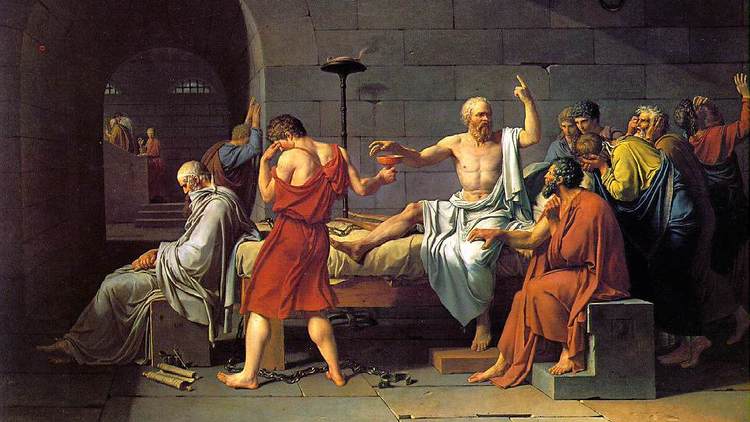
‘Kintsugi’ (or ‘Kintsukuroi’) is the Japanese art of repairing broken objects with gold.  Once repaired, the objects are considered more beautiful for having been broken.

In today’s world, perhaps more than ever before, we are subject to a continual and interminable bombardment of images touting promises of an almost laughably untenable perfection.  Flawless beauty, endless youth, perfect health, white-teeth beach-body relationships and a six-pack smile (‘yours for only $99 or your money back’) and on, and on, and on…

Read the rest at JamesRadcliffe.com.

A beautiful way to view the things that we believe have broken us.

Herd Mentality

In his heart every man knows quite well that, being unique, he will be in the world only once and that no imaginable chance will for a second time gather together into a unity so strangely variegated an assortment as he is: he knows it but he hides it like a bad conscience—why? From fear of his neighbor, who demands conventionality and cloaks himself with it. But what is it that constrains the individual to fear his neighbor, to think and act like a member of a herd, and to have no joy in himself? Modesty, perhaps, in a few rare cases. With the great majority it is indolence, inertia. … Men are even lazier than they are timid, and fear most of all the inconveniences with which unconditional honesty and nakedness would burden them. Artists alone hate this sluggish promenading in borrowed fashions and appropriated opinions and they reveal everyone’s secret bad conscience, the law that every man is a unique miracle.

Parliamentarianism—that is, public permission to choose between five basic political opinions—flatters and wins the favor of all those who would like to seem independent and individual, as if they fought for their opinions. Ultimately, however, it is indifferent whether the herd is commanded to have one opinion or to have five. Whoever deviates from the five public opinions and stands apart will always have the whole herd against him.

No shepherd and one herd! Everybody wants the same, everybody is the same: whoever feels different goes voluntarily into a madhouse. The individual has always had to struggle to keep from being overwhelmed by the tribe. If you try it, you will be lonely often, and sometimes frightened. But no price is too high to pay for the privilege of owning yourself.

There are horrible people who, instead of solving a problem, tangle it up and make it harder to solve for anyone who wants to deal with it. Whoever does not know how to hit the nail on the head should be asked not to hit it at all. The surest way to corrupt a youth is to instruct him to hold in higher esteem those who think alike than those who think differently.

If you have a virtue and she is your virtue, then you have her in common with nobody. But you want to call her by her name and pet her … and behold, now you have her in common with the people and have become one of the herd with your virtue. You would do better to say “Inexpressible and nameless is that which gives my soul agony and sweetness.”… May your virtue be too exalted for the familiarity of names, and if you must speak of her, do not be ashamed to stammer.

– Friedrich Nietzsche


Obama Accepts Nomination On Final Day Of Democratic National Convention

What is Enlightenment?

Enlightenment is man’s emergence from his self-imposed immaturity. Immaturity is the inability to use one’s understanding without guidance from another. This immaturity is self-imposed when its cause lies not in lack of understanding, but in lack of resolve and courage to use it without guidance from another. Sapere Aude! [dare to know] “Have courage to use your own understanding!”–that is the motto of enlightenment.

Laziness and cowardice are the reasons why so great a proportion of men, long after nature has released them from alien guidance (natura-liter maiorennes), nonetheless gladly remain in lifelong immaturity, and why it is so easy for others to establish themselves as their guardians. It is so easy to be immature. If I have a book to serve as my understanding, a pastor to serve as my conscience, a physician to determine my diet for me, and so on, I need not exert myself at all. I need not think, if only I can pay: others will readily undertake the irksome work for me. The guardians who have so benevolently taken over the supervision of men have carefully seen to it that the far greatest part of them (including the entire fair sex) regard taking the step to maturity as very dangerous, not to mention difficult. Having first made their domestic livestock dumb, and having carefully made sure that these docile creatures will not take a single step without the go-cart to which they are harnessed, these guardians then show them the danger that threatens them, should they attempt to walk alone. Now this danger is not actually so great, for after falling a few times they would in the end certainly learn to walk; but an example of this kind makes men timid and usually frightens them out of all further attempts.

Thus, it is difficult for any individual man to work himself out of the immaturity that has all but become his nature. He has even become fond of this state and for the time being is actually incapable of using his own understanding, for no one has ever allowed him to attempt it. Rules and formulas, those mechanical aids to the rational use, or rather misuse, of his natural gifts, are the shackles of a permanent immaturity. Whoever threw them off would still make only an uncertain leap over the smallest ditch, since he is unaccustomed to this kind of free movement. Consequently, only a few have succeeded, by cultivating their own minds, in freeing themselves from immaturity and pursuing a secure course.

But that the public should enlighten itself is more likely; indeed, if it is only allowed freedom, enlightenment is almost inevitable. For even among the entrenched guardians of the great masses a few will always think for themselves, a few who, after having themselves thrown off the yoke of immaturity, will spread the spirit of a rational appreciation for both their own worth and for each person’s calling to think for himself. But it should be particularly noted that if a public that was first placed in this yoke by the guardians is suitably aroused by some of those who are altogether incapable of enlightenment, it may force the guardians themselves to remain under the yoke–so pernicious is it to instill prejudices, for they finally take revenge upon their originators, or on their descendants. Thus a public can only attain enlightenment slowly. Perhaps a revolution can overthrow autocratic despotism and profiteering or power-grabbing oppression, but it can never truly reform a manner of thinking; instead, new prejudices, just like the old ones they replace, will serve as a leash for the great unthinking mass.

Nothing is required for this enlightenment, however, except freedom; and the freedom in question is the least harmful of all, namely, the freedom to use reason publicly in all matters. But on all sides I hear: “Do not argue!” The officer says, “Do not argue, drill!” The tax man says, “Do not argue, pay!” The pastor says, “Do not argue, believe!” (Only one ruler in the World says, “Argue as much as you want and about what you want, but obey!”) In this we have examples of pervasive restrictions on freedom. But which restriction hinders enlightenment and which does not, but instead actually advances it? I reply: The public use of one’s reason must always be free, and it alone can bring about enlightenment among mankind; the private use of reason may, however, often be very narrowly restricted, without otherwise hindering the progress of enlightenment. By the public use of one’s own reason I understand the use that anyone as a scholar makes of reason before the entire literate world. I call the private use of reason that which a person may make in a civic post or office that has been entrusted to him. Now in many affairs conducted in the interests of a community, a certain mechanism is required by means of which some of its members must conduct themselves in an entirely passive manner so that through an artificial unanimity the government may guide them toward public ends, or at least prevent them from destroying such ends. Here one certainly must not argue, instead one must obey. However, insofar as this part of the machine also regards himself as a member of the community as a whole, or even of the world community, and as a consequence addresses the public in the role of a scholar, in the proper sense of that term, he can most certainly argue, without thereby harming the affairs for which as a passive member he is partly responsible. Thus it would be disastrous if an officer on duty who was given a command by his superior were to question the appropriateness or utility of the order. He must obey.

But as a scholar he cannot be justly constrained from making comments about errors in military service, or from placing them before the public for its judgment. The citizen cannot refuse to pay the taxes imposed on him; indeed, impertinent criticism of such levies, when they should be paid by him, can be punished as a scandal (since it can lead to widespread insubordination). But the same person does not act contrary to civic duty when, as a scholar, he publicly expresses his thoughts regarding the impropriety or even injustice of such taxes. Likewise a pastor is bound to instruct his catecumens and congregation in accordance with the symbol of the church he serves, for he was appointed on that condition. But as a scholar he has complete freedom, indeed even the calling, to impart to the public all of his carefully considered and well-intentioned thoughts concerning mistaken aspects of that symbol, as well as his suggestions for the better arrangement of religious and church matters. Nothing in this can weigh on his conscience. What he teaches in consequence of his office as a servant of the church he sets out as something with regard to which he has no discretion to teach in accord with his own lights; rather, he offers it under the direction and in the name of another. He will say, “Our church teaches this or that and these are the demonstrations it uses.” He thereby extracts for his congregation all practical uses from precepts to which he would not himself subscribe with complete conviction, but whose presentation he can nonetheless undertake, since it is not entirely impossible that truth lies hidden in them, and, in any case, nothing contrary to the very nature of religion is to be found in them. If he believed he could find anything of the latter sort in them, he could not in good conscience serve in his position; he would have to resign. Thus an appointed teacher’s use of his reason for the sake of his congregation is merely private, because, however large the congregation is, this use is always only domestic; in this regard, as a priest, he is not free and cannot be such because he is acting under instructions from someone else. By contrast, the cleric–as a scholar who speaks through his writings to the public as such, i.e., the world–enjoys in this public use of reason an unrestricted freedom to use his own rational capacities and to speak his own mind. For that the (spiritual) guardians of a people should themselves be immature is an absurdity that would insure the perpetuation of absurdities.

But would a society of pastors, perhaps a church assembly or venerable presbytery (as those among the Dutch call themselves), not be justified in binding itself by oath to a certain unalterable symbol in order to secure a constant guardianship over each of its members and through them over the people, and this for all time: I say that this is wholly impossible. Such a contract, whose intention is to preclude forever all further enlightenment of the human race, is absolutely null and void, even if it should be ratified by the supreme power, by parliaments, and by the most solemn peace treaties. One age cannot bind itself, and thus conspire, to place a succeeding one in a condition whereby it would be impossible for the later age to expand its knowledge (particularly where it is so very important), to rid itself of errors,and generally to increase its enlightenment. That would be a crime against human nature, whose essential destiny lies precisely in such progress; subsequent generations are thus completely justified in dismissing such agreements as unauthorized and criminal. The criterion of everything that can be agreed upon as a law by a people lies in this question: Can a people impose such a law on itself? Now it might be possible, in anticipation of a better state of affairs, to introduce a provisional order for a specific, short time, all the while giving all citizens, especially clergy, in their role as scholars, the freedom to comment publicly, i.e., in writing, on the present institution’s shortcomings. The provisional order might last until insight into the nature of these matters had become so widespread and obvious that the combined (if not unanimous) voices of the populace could propose to the crown that it take under its protection those congregations that, in accord with their newly gained insight, had organized themselves under altered religious institutions, but without interfering with those wishing to allow matters to remain as before. However, it is absolutely forbidden that they unite into a religious organization that nobody may for the duration of a man’s lifetime publicly question, for so do-ing would deny, render fruitless, and make detrimental to succeeding generations an era in man’s progress toward improvement. A man may put off enlightenment with regard to what he ought to know, though only for a short time and for his own person; but to renounce it for himself, or, even more, for subsequent generations, is to violate and trample man’s divine rights underfoot. And what a people may not decree for itself may still less be imposed on it by a monarch, for his lawgiving authority rests on his unification of the people’s collective will in his own. If he only sees to it that all genuine or purported improvement is consonant with civil order, he can allow his subjects to do what they find necessary to their spiritual well-being, which is not his affair. However, he must prevent anyone from forcibly interfering with another’s working as best he can to determine and promote his well-being. It detracts from his own majesty when he interferes in these matters, since the writings in which his subjects attempt to clarify their insights lend value to his conception of governance. This holds whether he acts from his own highest insight–whereby he calls upon himself the reproach, “Caesar non eat supra grammaticos.”‘–as well as, indeed even more, when he despoils his highest authority by supporting the spiritual despotism of some tyrants in his state over his other subjects.

If it is now asked, “Do we presently live in an enlightened age?” the answer is, “No, but we do live in an age of enlightenment.” As matters now stand, a great deal is still lacking in order for men as a whole to be, or even to put themselves into a position to be able without external guidance to apply understanding confidently to religious issues. But we do have clear indications that the way is now being opened for men to proceed freely in this direction and that the obstacles to general enlightenment–to their release from their self-imposed immaturity–are gradually diminishing. In this regard, this age is the age of enlightenment, the century of Frederick.

A prince who does not find it beneath him to say that he takes it to be his duty to prescribe nothing, but rather to allow men complete freedom in religious matters–who thereby renounces the arrogant title of tolerance–is himself enlightened and deserves to be praised by a grateful present and by posterity as the first, at least where the government is concerned, to release the human race from immaturity and to leave everyone free to use his own reason in all matters of conscience. Under his rule, venerable pastors, in their role as scholars and without prejudice to their official duties, may freely and openly set out for the world’s scrutiny their judgments and views, even where these occasionally differ from the accepted symbol. Still greater freedom is afforded to those who are not restricted by an official post. This spirit of freedom is expanding even where it must struggle against the external obstacles of governments that misunderstand their own function. Such governments are illuminated by the example that the existence of freedom need not give cause for the least concern regarding public order and harmony in the commonwealth. If only they refrain from inventing artifices to keep themselves in it, men will gradually raise themselves from barbarism.

I have focused on religious matters in setting out my main point concerning enlightenment, i.e., man’s emergence from self-imposed immaturity, first because our rulers have no interest in assuming the role of their subjects’ guardians with respect to the arts and sciences, and secondly because that form of immaturity is both the most pernicious and disgraceful of all. But the manner of thinking of a head of state who favors religious enlightenment goes even further, for he realizes that there is no danger to his legislation in allowing his subjects to use reason publicly and to set before the world their thoughts concerning better formulations of his laws, even if this involves frank criticism of legislation currently in effect. We have before us a shining example, with respect to which no monarch surpasses the one whom we honor.

But only a ruler who is himself enlightened and has no dread of shadows, yet who likewise has a well-disciplined, numerous army to guarantee public peace, can say what no republic may dare, namely: “Argue as much as you want and about what you want, but obey!” Here as elsewhere, when things are considered in broad perspective, a strange, unexpected pattern in human affairs reveals itself, one in which almost everything is paradoxical. A greater degree of civil freedom seems advantageous to a people’s spiritual freedom; yet the former established impassable boundaries for the latter; conversely, a lesser degree of civil freedom provides enough room for all fully to expand their abilities. Thus, once nature has removed the hard shell from this kernel for which she has most fondly cared, namely, the inclination to and vocation for free thinking, the kernel gradually reacts on a people’s mentality (whereby they become increasingly able to act freely), and it finally even influences the principles of government, which finds that it can profit by treating men, who are now more than machines, in accord with their dignity.

– Immanuel Kant


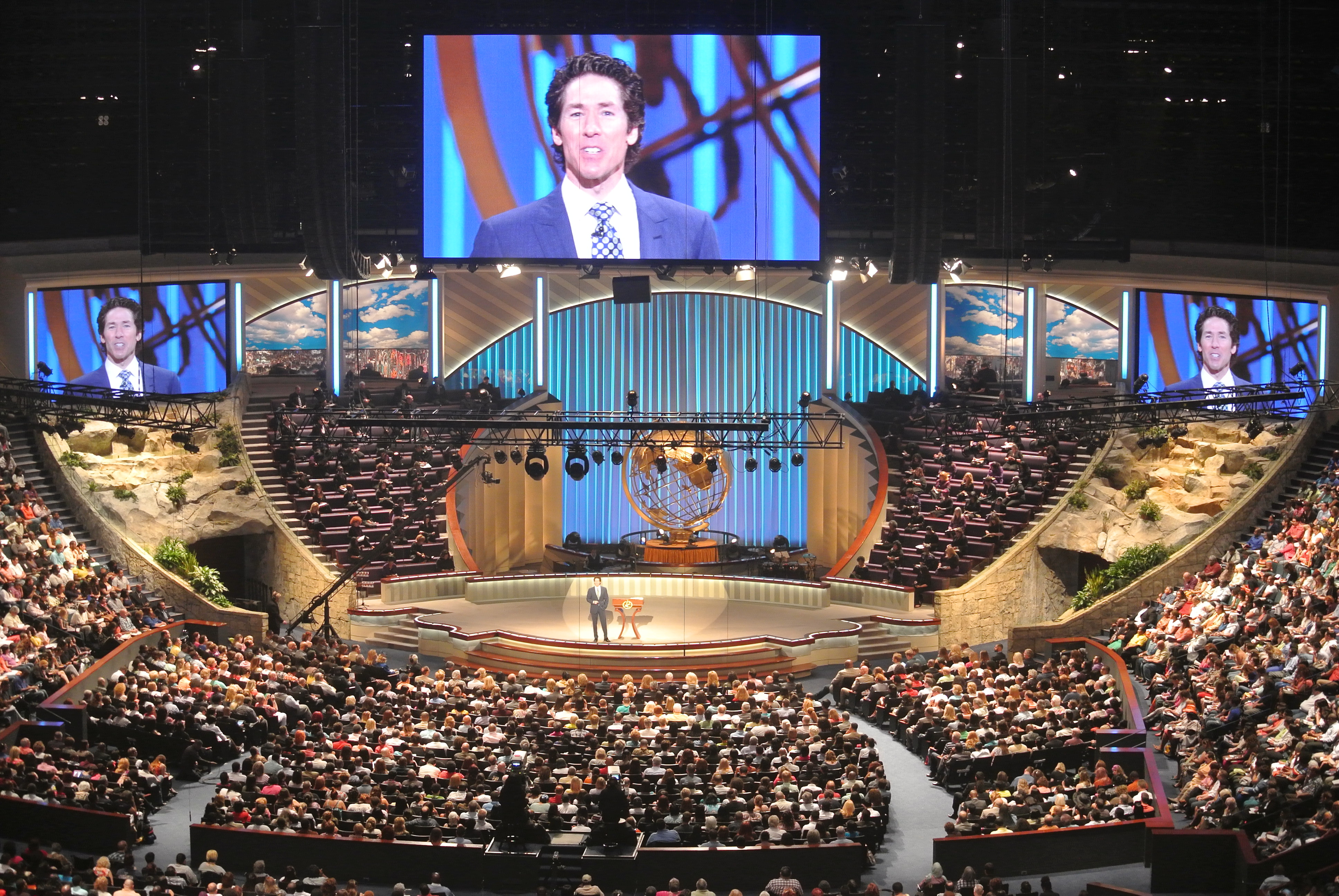
lakewood-church-houstontx-040

The Crowd is Untruth

There is a view of life which holds that where the crowd is, the truth is also, that it is a need in truth itself, that it must have the crowd on its side. There is another view of life; which holds that wherever the crowd is, there is untruth, so that, for a moment to carry the matter out to its farthest conclusion, even if every individual possessed the truth in private, yet if they came together into a crowd (so that “the crowd” received any decisive, voting, noisy, audible importance), untruth would at once be let in.

For “the crowd” is untruth. Eternally, godly, christianly what Paul says is valid: “only one receives the prize,” [I Cor. 9:24] not by way of comparison, for in the comparison “the others” are still present. That is to say, everyone can be that one, with God’s help – but only one receives the prize; again, that is to say, everyone should cautiously have dealings with “the others,” and essentially only talk with God and with himself – for only one receives the prize; again, that is to say, the human being is in kinship with, or to be a human is to be in kinship with the divinity. The worldly, temporal, busy, socially-friendly person says this: “How unreasonable, that only one should receive the prize, it is far more probable that several combined receive the prize; and if we become many, then it becomes more certain and also easier for each individually.” Certainly, it is far more probable; and it is also true in relation to all earthly and sensuous prizes; and it becomes the only truth, if it is allowed to rule, for this point of view abolishes both God and the eternal and “the human being’s” kinship with the divinity; it abolishes it or changes it into a fable, and sets the modern (as a matter of fact, the old heathen) in its place, so that to be a human being is like being a specimen which belongs to a race gifted with reason, so that the race, the species, is higher than the individual, or so that there are only specimens, not individuals. But the eternal, which vaults high over the temporal, quiet as the night sky, and God in heaven, who from this exalted state of bliss, without becoming the least bit dizzy, looks out over these innumerable millions and knows each single individual; he, the great examiner, he says: only one receives the prize; that is to say, everyone can receive it, and everyone ought to become this by oneself, but only one receives the prize. Where the crowd is, therefore, or where a decisive importance is attached to the fact that there is a crowd, there no one is working, living, and striving for the highest end, but only for this or that earthly end; since the eternal, the decisive, can only be worked for where there is one; and to become this by oneself, which all can do, is to will to allow God to help you – “the crowd” is untruth.

A crowd – not this or that, one now living or long dead, a crowd of the lowly or of nobles, of rich or poor, etc., but in its very concept – is untruth, since a crowd either renders the single individual wholly unrepentant and irresponsible, or weakens his responsibility by making it a fraction of his decision. Observe, there was not a single soldier who dared lay a hand on Caius Marius; this was the truth. But given three or four women with the consciousness or idea of being a crowd, with a certain hope in the possibility that no one could definitely say who it was or who started it: then they had the courage for it; what untruth! The untruth is first that it is “the crowd,” which does either what only the single individual in the crowd does, or in every case what each single individual does. For a crowd is an abstraction, which does not have hands; each single individual, on the other hand, normally has two hands, and when he, as a single individual, lays his two hands on Caius Marius, then it is the two hands of this single individual, not after all his neighbor’s, even less – the crowd’s, which has no hands. In the next place, the untruth is that the crowd had “the courage” for it, since never at any time was even the most cowardly of all single individuals so cowardly, as the crowd always is. For every single individual who escapes into the crowd, and thus flees in cowardice from being a single individual (who either had the courage to lay his hand on Caius Marius, or the courage to admit that he did not have it), contributes his share of cowardice to “the cowardice,” which is: the crowd. Take the highest, think of Christ – and the whole human race, all human beings, which were ever born and ever will be born; the situation is the single individual, as an individual, in solitary surroundings alone with him; as a single individual he walks up to him and spits on him: the human being has never been born and never will be, who would have the courage or the impudence for it; this is the truth. But since they remain in a crowd, they have the courage for it – what frightening untruth.

The crowd is untruth. There is therefore no one who has more contempt for what it is to be a human being than those who make it their profession to lead the crowd. Let someone, some individual human being, certainly, approach such a person, what does he care about him; that is much too small a thing; he proudly sends him away; there must be at least a hundred. And if there are thousands, then he bends before the crowd, he bows and scrapes; what untruth! No, when there is an individual human being, then one should express the truth by respecting what it is to be a human being; and if perhaps, as one cruelly says, it was a poor, needy human being, then especially should one invite him into the best room, and if one has several voices, he should use the kindest and friendliest; that is the truth. When on the other hand it was an assembly of thousands or more, and “the truth” became the object of balloting, then especially one should godfearingly – if one prefers not to repeat in silence the Our Father: deliver us from evil – one should godfearingly express, that a crowd, as the court of last resort, ethically and religiously, is the untruth, whereas it is eternally true, that everyone can be the one. This is the truth.

The crowd is untruth. Therefore was Christ crucified, because he, even though he addressed himself to all, would not have to do with the crowd, because he would not in any way let a crowd help him, because he in this respect absolutely pushed away, would not found a party, or allow balloting, but would be what he was, the truth, which relates itself to the single individual. And therefore everyone who in truth will serve the truth, is eo ipso in some way or other a martyr; if it were possible that a human being in his mother’s womb could make a decision to will to serve “the truth” in truth, so he also is eo ipso a martyr, however his martyrdom comes about, even while in his mother’s womb. For to win a crowd is not so great a trick; one only needs some talent, a certain dose of untruth and a little acquaintance with the human passions. But no witness for the truth – alas, and every human being, you and I, should be one – dares have dealings with a crowd. The witness for the truth – who naturally will have nothing to do with politics, and to the utmost of his ability is careful not to be confused with a politician – the godfearing work of the witness to the truth is to have dealings with all, if possible, but always individually, to talk with each privately, on the streets and lanes – to split up the crowd, or to talk to it, not to form a crowd, but so that one or another individual might go home from the assembly and become a single individual. “A crowd,” on the other hand, when it is treated as the court of last resort in relation to “the truth,” its judgment as the judgment, is detested by the witness to the truth, more than a virtuous young woman detests the dance hall. And they who address the “crowd” as the court of last resort, he considers to be instruments of untruth. For to repeat: that which in politics and similar domains has its validity, sometimes wholly, sometimes in part, becomes untruth, when it is transferred to the intellectual, spiritual, and religious domains. And at the risk of a possibly exaggerated caution, I add just this: by “truth” I always understand “eternal truth.” But politics and the like has nothing to do with “eternal truth.” A politics, which in the real sense of “eternal truth” made a serious effort to bring “eternal truth” into real life, would in the same second show itself to be in the highest degree the most “impolitic” thing imaginable.

The crowd is untruth. And I could weep, in every case I can learn to long for the eternal, whenever I think about our age’s misery, even compared with the ancient world’s greatest misery, in that the daily press and anonymity make our age even more insane with help from “the public,” which is really an abstraction, which makes a claim to be the court of last resort in relation to “the truth”; for assemblies which make this claim surely do not take place. That an anonymous person, with help from the press, day in and day out can speak however he pleases (even with respect to the intellectual, the ethical, the religious), things which he perhaps did not in the least have the courage to say personally in a particular situation; every time he opens up his gullet – one cannot call it a mouth – he can all at once address himself to thousands upon thousands; he can get ten thousand times ten thousand to repeat after him – and no one has to answer for it; in ancient times the relatively unrepentant crowd was the almighty, but now there is the absolutely unrepentant thing: No One, an anonymous person: the Author, an anonymous person: the Public, sometimes even anonymous subscribers, therefore: No One. No One! God in heaven, such states even call themselves Christian states. One cannot say that, again with the help of the press, “the truth” can overcome the lie and the error. O, you who say this, ask yourself: Do you dare to claim that human beings, in a crowd, are just as quick to reach for truth, which is not always palatable, as for untruth, which is always deliciously prepared, when in addition this must be combined with an admission that one has let oneself be deceived! Or do you dare to claim that “the truth” is just as quick to let itself be understood as is untruth, which requires no previous knowledge, no schooling, no discipline, no abstinence, no self-denial, no honest self-concern, no patient labor! No, “the truth,” which detests this untruth, the only goal of which is to desire its increase, is not so quick on its feet. Firstly, it cannot work through the fantastical, which is the untruth; its communicator is only a single individual. And its communication relates itself once again to the single individual; for in this view of life the single individual is precisely the truth. The truth can neither be communicated nor be received without being as it were before the eyes of God, nor without God’s help, nor without God being involved as the middle term, since he is the truth. It can therefore only be communicated by and received by “the single individual,” which, for that matter, every single human being who lives could be: this is the determination of the truth in contrast to the abstract, the fantastical, impersonal, “the crowd” – “the public,” which excludes God as the middle term (for the personal God cannot be the middle term in an impersonal relation), and also thereby the truth, for God is the truth and its middle term.

And to honor every individual human being, unconditionally every human being, that is the truth and fear of God and love of “the neighbor”; but ethico-religiously viewed, to recognize “the crowd” as the court of last resort in relation to “the truth,” that is to deny God and cannot possibly be to love “the neighbor.” And “the neighbor” is the absolutely true expression for human equality; if everyone in truth loved the neighbor as himself, then would perfect human equality be unconditionally attained; every one who in truth loves the neighbor, expresses unconditional human equality; every one who is really aware (even if he admits, like I, that his effort is weak and imperfect) that the task is to love the neighbor, he is also aware of what human equality is. But never have I read in the Holy Scriptures this command: You shall love the crowd; even less: You shall, ethico-religiously, recognize in the crowd the court of last resort in relation to “the truth.” It is clear that to love the neighbor is self-denial, that to love the crowd or to act as if one loved it, to make it the court of last resort for “the truth,” that is the way to truly gain power, the way to all sorts of temporal and worldly advantage – yet it is untruth; for the crowd is untruth.

But he who acknowledges this view, which is seldom presented (for it often happens, that a man believes that the crowd is in untruth, but when it, the crowd, merely accepts his opinion en masse, then everything is all right), he admits to himself that he is the weak and powerless one; how would a single individual be able to stand against the many, who have the power! And he could not then want to get the crowd on his side to carry through the view that the crowd, ethico-religiously, as the court of last resort, is untruth; that would be to mock himself. But although this view was from the first an admission of weakness and powerlessness, and since it seems therefore so uninviting, and is therefore heard so seldom: yet it has the good feature, that it is fair, that it offends no one, not a single one, that it does not distinguish between persons, not a single one. A crowd is indeed made up of single individuals; it must therefore be in everyone’s power to become what he is, a single individual; no one is prevented from being a single individual, no one, unless he prevents himself by becoming many. To become a crowd, to gather a crowd around oneself, is on the contrary to distinguish life from life; even the most well-meaning one who talks about that, can easily offend a single individual. But it is the crowd which has power, influence, reputation, and domination – this is the distinction of life from life, which tyrannically overlooks the single individual as the weak and powerless one, in a temporal-worldly way overlooks the eternal truth: the single individual.

– Søren Kierkegaard


anonymous-internet-turkey-protest

For the amoral herd that fears boredom above all else, everything becomes entertainment. Sex and sport, politics and the arts are transformed into entertainment. … Nothing is immune from the demand that boredom be relieved (but without personal involvement, for mass society is a spectator society).

– Merold Westphal

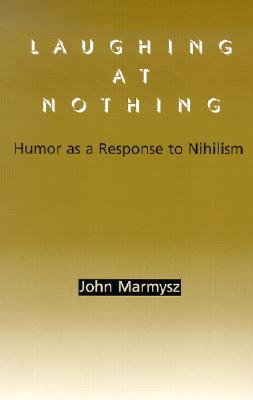
Laughing at Nothing

It seems so important as you do what you do,
But in times to come no one remembers you.
Your actions are forgotten and your feelings destroyed.
You’ve become one with the nihilist void.

– John Marmysz

Absurdity is often humorous. If life is absurd, then perhaps it may be quite humorous as well.

Disputing the common misconception that nihilism is wholly negative and necessarily damaging to the human spirit, John Marmysz offers a clear and complete definition to argue that it is compatible, and indeed preferably responded to, with an attitude of good humor. He carefully scrutinizes the phenomenon of nihilism as it appears in the works, lives, and actions of key figures in the history of philosophy, literature, politics, and theology, including Nietzsche, Heidegger, Camus, and Mishima. While suggesting that there ultimately is no solution to the problem of nihilism, Marmysz proposes a way of utilizing the anxiety and despair that is associated with the problem as a spur toward liveliness, activity, and the celebration of life.

If, as the nihilist claims, nothing that we do is ultimately very important, then it makes little sense to take things too seriously, even our own frustrations and failures. The humorous response to nihilism brings this insight forth and challenges nihilists to take their own world view to heart.

John Marmysz holds a Ph.D. in philosophy from State University of New York at Buffalo. His primary research interests focus on issues of nihilism and its cultural manifestations. Marmysz is the author of The Nihilist’s Notebook (Moralinefree Publishing, 1996), Laughing at Nothing: Humor as a Response to Nihilism (SUNY Press, 2003), The Path of Philosophy: Truth, Wonder and Distress (Wadsworth, 2011), and The Nihilist: A Philosophical Novel (No Frills Buffalo, 2015). He is coeditor (with Scott Lukas) of Fear, Cultural Anxiety and Transformation: Horror, Science Fiction and Fantasy Films Remade (Lexington Books, 2009). Marmysz has also written articles and reviews for various journals including Film and Philosophy, Consciousness, Literature and the Arts, Film-Philosophy, The Journal of Popular Culture and The Journal of Aesthetics and Art Criticism.

“Writing about and researching the topic of nihilism helps me to remember how meaningless life really is. Running, motorcycling and listening to punk rock music helps me to forget,” says Marmysz.

Marmysz is the recipient of the SUNY Chancellor’s Award For Excellence in Scholarship and Creativity and has served as an NEH fellow. He currently teaches philosophy at the College of Marin in Kentfield, CA.

Though nihilism has been relentlessly criticized for overemphasizing the dark side of human experience, it might be equally true that this overemphasis represents a needed counterbalance to shallow optimism and arrogant confidence in human power. Nihilism reminds us that we are not gods, and that despite all of the accomplishments and wonders of civilization, humans cannot alter the fact that they possess only a finite amount of mastery and control over their own destinies.

– Laughing at Nothing: Humor as a Response to Nihilism


Further Reading: In Defense of Humorous Nihilism

Meta-ethics

Custom represents the experiences of men of earlier times as to what they supposed useful and harmful – but the sense for custom (morality) applies, not to these experiences as such, but to the age, the sanctity, the indiscussability of the custom. And so this feeling is a hindrance to the acquisition of new experiences and the correction of customs: that is to say, morality is a hindrance to the development of new and better customs: it makes stupid.

– Friedrich Nietzsche

ethics-word-cloud

Is what is morally good commanded by God because it is morally good, or is it morally good because it is commanded by God? When you think about morality, what comes to mind? Is it a list of sins to avoid in order to make it into heaven and avoid hellfire? Or perhaps a duty to be fulfilled? A list of virtues to practice in order to develop character? Does it consist of a social contract between men in order to preserve peace and society? Is it as simple as listening to your own conscience? Or maybe it could be a bit of one and the other?

For Kierkegaard, a large part of sin is not wanting to be who you, in fact, are. For Kant, reason alone dictates what is moral: always to treat others as an end and never as a means. For Hume, a descriptive statement about ethics can never lead to a normative statement about ethics. The more I read and the more I think about it, morality seems to me to be nothing more than a social construct. It is the agreed upon correct way of living for a given society, handed down from society at large to parents and their children ad nauseam. Nowadays, the media (including social media) also plays a large role in constructing our ideas about morality. But times change, and so also must morality.

Proceeding from reason alone, I see that any normative moral imperative must by definition be a conditional and teleological statement with regard to consequences, be they physical or mental. That is to say, hypothetical imperatives are meaningful, while categorical imperatives must, at best, be idealistic. In other words, one must place a conditional “if…” at the end of any moral proposition. The logical construction would be as follows:

“Thou shalt (or shalt not) X… if one does (or does not) desire the consequence Y.”

For example, “Thou shalt not [murder, rape, steal, etc.]… if one does desire to live in a peaceful society (or if one does not desire to face the potential consequences).” Any duty to be fulfilled, or any virtue to be developed, or any social contract to be followed must be subject to this type of conditional statement.

To take the ethical ideals of one man and apply them to any other, or to humanity as a whole, is an error (unless we are speaking in the most general sense about laws of nature itself, which Kant thought he was). Morality can be both subjective and intersubjective, but by no means universal (my aversion to the idealization of reason should be clear at this point). That is to say, there are as many moral codes as there are men, and it is not the right of one to judge the other, unless we are assuming some type of social contract.

To be sure, this line of thinking is in direct opposition to “absolute morality” and “divine command theory,” in which “Thou shalt (or shalt not) X” because it is morally right- or wrong-in-itself, or because it is commanded by God. Unless, of course, the statement is formulated as something like, “Thou shalt X, if you wish to enter the kingdom of heaven,” or if one attempts to equate the concepts of God and Good. But this type of moral proposition only serves to raise questions about the value of the consequences (e.g. entering the kingdom of heaven or avoiding hellfire) or the value of the Good itself (cf. Plato). Any notion of an objective right- and wrong-in-itself must be dismissed as meaningless, or at most be taken as a statement of some personal viewpoint attempting to apply itself universally. It is worth mentioning that this opposition includes contemporary secular (atheist) as well as religious moralists.

I realize that I may be oversimplifying such a nuanced topic as ethics, but at a bare-bones (meta-ethical) level I think that this formula (i.e. hypothetical imperatives) must apply to any possible ethical proposition. Yet I still feel in my own heart, quite distinct from reason alone, that certain actions are morally reprehensible and others praiseworthy – and I cannot avoid feeling this way.

Furthermore, I find no evidence of the “equality of men” in nature, neither in value nor in physical or mental ability. But this does not mean that we cannot still pursue an ideal of equality, if such an ideal is our goal. The similarity of men in nature would be enough to get us going toward such an ideal – and perhaps living in an idealized world would not be so bad.

The social pact, far from destroying natural equality, substitutes, on the contrary, a moral and lawful equality for whatever physical inequality that nature may have imposed on mankind; so that however unequal in strength and intelligence, men become equal by covenant and by right.

– Jean-Jacques Rousseau

See Also

Morality is a Culturally Conditioned Response

Beyond Right and Wrong

Irrefutable Ethics

Metaethics (IEP)

Metaethics (SEP)

Science as Mythology

For is it not possible that science as we know it today, or a “search for the truth” in the style of traditional philosophy, will create a monster? Is it not possible that an objective approach that frowns upon personal connections between the entities examined will harm people, turn them into miserable, unfriendly, self-righteous mechanisms without charm or humour? “Is it not possible,” asks Kierkegaard, “that my activity as an objective [or critico-rational] observer of nature will weaken my strength as a human being?” I suspect the answer to many of these questions is affirmative and I believe that a reform of the sciences that makes them more anarchic and more subjective (in Kierkegaard’s sense) is urgently needed.

– Paul Feyerabend

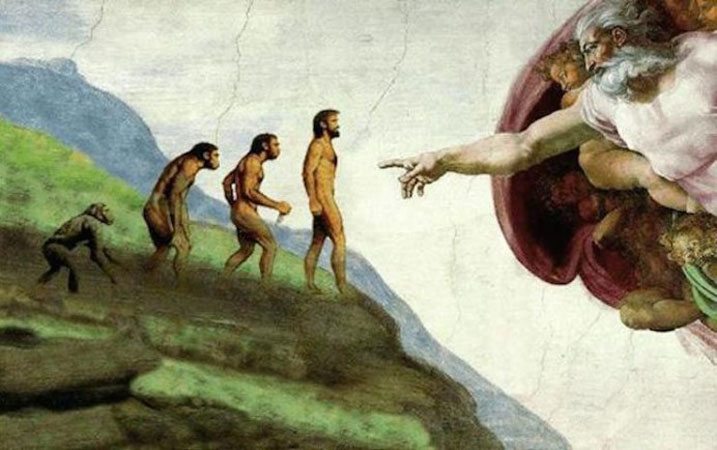
evolution touches god

Epistemological anarchism is an epistemological theory advanced by Austrian philosopher of science Paul Feyerabend which holds that there are no useful and exception-free methodological rules governing the progress of science or the growth of knowledge. It holds that the idea that science can or should operate according to universal and fixed rules is unrealistic, pernicious, and detrimental to science itself.

The use of the term anarchism in the name reflected the methodological pluralism prescription of the theory, as the purported scientific method does not have a monopoly on truth or useful results. Feyerabend once famously said that because there is no fixed scientific method, it is best to have an “anything goes” attitude toward methodologies. Feyerabend felt that science started as a liberating movement, but over time it had become increasingly dogmatic and rigid, and therefore had become increasingly an ideology, and, despite its successes, science had started to attain some oppressive features, and it was not possible to come up with an unambiguous way to distinguish science from religion, magic, or mythology. He felt the exclusive dominance of science as a means of directing society was authoritarian and ungrounded. Promulgation of the theory earned Feyerabend the title of “the worst enemy of science” from his detractors.

The theory draws on the observation that there is no identifiable fixed scientific method that is consistent with the practices of the paradigm of scientific progress – the scientific revolution. It is a radical critique of rationalist and empiricist historiography which tend to represent the heroes of the scientific revolution as scrupulous researchers reliant on empirical research, whereas Feyerabend countered that Galileo for example, relied on rhetoric, propaganda and epistemological tricks to support his doctrine of heliocentrism, and that aesthetic criteria, personal whims and social factors were far more prevalent than the dominant historiographies allowed.

Scientific laws such as those posited by Aristotelian or Newtonian physics that assumed the stance of objective models of the universe have been found to come short in describing the entirety of the universe. The movement of universal models from Aristotelian to Newtonian physics to Einstein’s relativity theory, where each preceding theory has been refuted as entirely universal model of reality, illustrates for the epistemological anarchist that scientific theories do not correspond to truth, as they are in part cultural manifestations, and ergo not objective. Feyerabend drew a comparison between one scientific paradigm triumphing over or superseding another, in the same manner a given myth is adapted and appropriated by a new, triumphant successor myth in comparative mythology. Feyerabend contended, with Imre Lakatos, that the demarcation problem of distinguishing on objective grounds science from pseudoscience was irresolvable and thus fatal to the notion of science run according to fixed, universal rules.

Feyerabend also notes that science’s success is not solely due to its own methods, but also to its having taken in knowledge from unscientific sources. In turn the notion that there is no knowledge outside science is a ‘convenient fairy-tale’ held only by dogmatists who distort history for the convenience of scientific institutions. For instance, Copernicus was heavily influenced by Pythagoras, whose view of the world had previously been rejected as mystical and irrational. Hermetic writings played an important role in the works of Copernicus as well as Newton. There exists fairly accurate astronomical knowledge that reaches back even to the Stone Age, measured in stone observatories in England and the South Pacific. Pre-Modern inventions such as crop rotation, hybrid plants, chemical inventions and architectural achievements not yet understood like that of the pyramids are all examples which threaten the notion that science is the only means of attaining knowledge.

Feyerabend also criticized science for not having evidence for its own philosophical precepts, particularly the notions of Uniformity of Law and of Uniformity of Process across time and space. “We have to realize that a unified theory of the physical world simply does not exist,” said Feyerabend; “we have theories that work in restricted regions, we have purely formal attempts to condense them into a single formula, we have lots of unfounded claims (such as the claim that all of chemistry can be reduced to physics), phenomena that do not fit into the accepted framework are suppressed; in physics, which many scientists regard as the one really basic science, we have now at least three different points of view… without a promise of conceptual (and not only formal) unification”.

Furthermore, Feyerabend held that deciding between competing scientific accounts was complicated by the incommensurability of scientific theories. Incommensurability means that scientific theories cannot be reconciled or synthesized because the interpretation and practice of science is always informed by theoretical assumptions, which leads to proponents of competing theories using different terms, engaged in different language-games and thus talking past each other. This for Feyerabend was another reason why the idea of science as proceeding according to universal, fixed laws was both historically inaccurate and prescriptively useless.

Physical objects are conceptually imported into the situation as convenient intermediaries not by definition in terms of experience, but simply as irreducible posits comparable, epistemologically, to the gods of Homer … For my part I do, qua lay physicist, believe in physical objects and not in Homer’s gods; and I consider it a scientific error to believe otherwise. But in point of epistemological footing, the physical objects and the gods differ only in degree and not in kind. Both sorts of entities enter our conceptions only as cultural posits.

– W. V. Quine

It appears that, in single instances of the operation of bodies, we never can, by our utmost scrutiny, discover any thing but one event following another, without being able to comprehend any force or power by which the cause operates, or any connexion between it and its supposed effect. The same difficulty occurs in contemplating the operations of mind on body- where we observe the motion of the latter to follow upon the volition of the former, but are not able to observe or conceive the tie which binds together the motion and volition, or the energy by which the mind produces this effect. The authority of the will over its own faculties and ideas is not a whit more comprehensible: So that, upon the whole, there appears not, throughout all nature, any one instance of connexion which is conceivable by us. All events seem entirely loose and separate. One event follows another; but we never can observe any tie between them. They seemed conjoined, but never connected. And as we can have no idea of any thing which never appeared to our outward sense or inward sentiment, the necessary conclusion seems to be that we have no idea of connexion or force at all, and that these words are absolutely without meaning, when employed either in philosophical reasonings or common life.

– David Hume

We see that science also rests on a faith; there simply is no science “without presuppositions.” The question whether truth is needed must not only have been affirmed in advance, but affirmed to such a degree that the principle, the faith, the conviction finds expression: “Nothing is needed more than truth, and in relation to it everything else has only second-rate value.”

Thus the question “Why science?” leads back to the moral problem: Why have morality at all when life, nature, and history are “not moral”? No doubt, those who are truthful in that audacious and ultimate sense that is presupposed by the faith in science thus affirm another world than the world of life, nature, and history; and insofar as they affirm this “other world”—look, must they not by the same token negate its counterpart, this world, our world?—But you will have gathered what I am driving at, namely, that it is still a metaphysical faith upon which our faith in science rests—that even we seekers after knowledge today, we godless anti-metaphysicians still take our fire, too, from the flame lit by a faith that is thousands of years old, that Christian faith which was also the faith of Plato, that God is the truth, that truth is divine.

A “scientific” interpretation of the world, as you understand it, might therefore still be one of the most stupid of all possible interpretations of the world, meaning that it be one of the poorest in meaning. This thought is intended for the ears and consciences of our mechanists who nowadays like to pass as philosophers and insist that mechanics is the doctrine of the first and last laws on which all existence must be based as on a ground floor. But an essentially mechanical world would be an essentially meaningless world. Assuming that one estimated the value of a piece of music according to how much of it could be counted, calculated, and expressed in formulas: how absurd would such a “scientific” estimation of music be! What would one have comprehended, understood, grasped of it? Nothing, really nothing of what is “music” in it!

– Friedrich Nietzsche

The man who is striving to solve a problem defined by existing knowledge and technique is not, however, just looking around. He knows what he wants to achieve, and he designs his instruments and directs his thoughts accordingly. Unanticipated novelty, the new discovery, can emerge only to the extent that his anticipations about nature and his instruments prove wrong… There is no other effective way in which discoveries might be generated.

If these out-of date beliefs are to be called myths, then myths can be produced by the same sorts of methods and held for the same sorts of reasons that now lead to scientific knowledge.

– Thomas Kuhn

Long before quantum mechanics, the German philosopher, Husserl, said that “All perception is gamble.”

Every type of bigotry, every type of racism, sexism, prejudice, every dogmatic ideology that allows people to kill other people with a clear conscience, every stupid cult, every superstition, written religion, every kind of ignorance in the world all results from not realizing that our perceptions are gambles.

We believe what we see and then we believe our interpretation of it, we don’t even know we are making an interpretation most of the time. We think that this is reality. In philosophy that is called naïve realism. “What I perceive is reality.” And philosophers have refuted naïve realism every century for the last twenty-five hundred years starting with Buddha & Plato, and yet most people still act on the basis of naive realism.

Now the argument is maybe my perceptions are inaccurate but somewhere there is accuracy. The scientists have it with their instruments. That’s how we can find out what’s really real. But relativity and quantum mechanics have demonstrated clearly that what you find out with instruments is true relative only to the instrument you are using and where that instrument is located in space-time.

So there is no vantage point from which real reality can be seen, we are all looking from the point of our own reality tunnels. And when we begin to realize that we are all looking from the point of view of our own reality tunnels, we find it is much easier to understand where other people are coming from. Or, the ones who don’t have the same reality tunnels as us do not seem ignorant or deliberately perverse or lying or hypnotized by some mad ideology. They just have a different reality tunnel, and every reality tunnel might tell us something interesting about our world, if we are willing to listen.

– Robert Anton Wilson

Science manipulates things and gives up living in them. It makes its own limited models of things; operating upon these indices or variables to effect whatever transformations are permitted by their definition, it comes face to face with the real world only at rare intervals. Science is and always will be that admirably active, ingenious, and bold way of thinking whose fundamental bias is to treat everything as though it were an object-in-general – as though it meant nothing to us and yet was predestined for our own use.

– Maurice Merleau-Ponty

See Also

Darwin’s Dangerous Idea

The Limits of Science

Doing Away with Scientism

Quantum Mysticism

Our bodies are like a radio device. They have the unique ability to serve as the suitable instrument to allow the soul to flow through us, animate us, and receive expression through us. Each of our distinct bodies possesses a unique frequency which is perfectly set to ‘pick up’ the waves of only our soul. My body is set to a frequency to serve as the home to my soul, and your body is set to a frequency to serve as the home to your soul.

This concept contains profound meaning when we consider death. When someone dies, we all ask the question, “Where did the soul go?” The real answer to this is that the soul didn’t go anywhere. It already exists everywhere. The only thing that ‘went somewhere’ was the body.

But in addition to teaching a lesson about death, this concept teaches an even greater lesson about life. Our life’s perfection can only be accomplished if and when our bodies are precisely in sync with the frequency of our soul. Only then can our soul be fully integrated within us, and can our bodies serve as perfect conduits to give expression to our soul’s desires, passions and destiny. Only then can we exist completely ‘in our element’, in perfect harmony and inner peace.

– Rabbi Eliezer Wolf

niels bohr quote

Quantum Mysticism

Quantum mysticism is a set of metaphysical beliefs and associated practices that seek to relate consciousness, intelligence, spirituality, or mystical world-views to the ideas of quantum mechanics and its interpretations. Quantum mysticism is considered by most scientists and philosophers to be pseudoscience or “quackery”.

Early Controversy and Resolution

Quantum mysticism in the sense of consciousness playing a role in quantum theory first appeared in Germany during the 1920s when some of the leading quantum physicists, such as Erwin Schrödinger and Werner Heisenberg, leaned toward such interpretations of their theories. Others, such as Albert Einstein and Max Planck, objected to these interpretations. Despite the accusation of mysticism from Einstein, Niels Bohr denied the charge, attributing it to misunderstandings. By the second half of the twentieth century the controversy had run its course—Schrödinger’s 1958 lectures are said to “mark the last of a generation that lived with the mysticism controversy”—and today most physicists are realists who do not believe that quantum theory is involved with consciousness.

Wigner

In 1961 Eugene Wigner wrote a paper, titled Remarks on the mind–body question, suggesting that a conscious observer played a fundamental role in quantum mechanics. A part of the Von Neumann–Wigner interpretation. While his paper would serve as inspiration for later mystical works by others, Wigner’s ideas were primarily philosophical in nature and are not considered “in the same ballpark” as the mysticism that would follow.

Appropriation by New Age Thought

In the early 1970s New Age culture began to incorporate ideas from quantum physics, beginning with books by Arthur Koestler, Lawrence LeShan and others which suggested that purported parapsychological phenomena could be explained by quantum mechanics. In this decade the Fundamental Fysiks Group emerged, a group of physicists who embraced quantum mysticism while engaging in parapsychology, Transcendental Meditation, and various New Age and Eastern mystical practices. Inspired in part by Wigner, Fritjof Capra, a member of the Fundamental Fysiks Group, wrote The Tao of Physics: An Exploration of the Parallels Between Modern Physics and Eastern Mysticism (1975), a book espousing New Age quantum physics that gained popularity among the non-scientific public. In 1979 came the publication of The Dancing Wu Li Masters by Gary Zukav, a non-scientist and “the most successful of Capra’s followers”. The Fundamental Fysiks Group is said to be one of the agents responsible for the “huge amount of pseudoscientific nonsense” surrounding interpretations of quantum mechanics.

Modern Usage and Examples

In contrast to the mysticism of Schrödinger and Heisenberg, today quantum mysticism typically refers to its New Age incarnation that combines ancient mysticism with quantum mechanics. Called a pseudoscience and a “hijacking” of quantum physics, it draws upon “coincidental similarities of language rather than genuine connections” to quantum mechanics. Physicist Murray Gell-Mann coined the phrase “quantum flapdoodle” to refer to the misuse and misapplication of quantum physics to other topics.

An example of such misuse is New Age guru Deepak Chopra’s “quantum theory” that aging is caused by the mind, expounded in his books Quantum Healing (1989) and Ageless Body, Timeless Mind (1993). In 1998 Chopra was awarded the parody Ig Nobel Prize in the physics category for “his unique interpretation of quantum physics as it applies to life, liberty, and the pursuit of economic happiness”.

The 2004 film What the Bleep Do We Know!? dealt with a range of New Age ideas in relation to physics. It was produced by the Ramtha School of Enlightenment which was founded by J.Z. Knight, a channeler who said that her teachings were based on a discourse with a 35,000-year-old disembodied entity named Ramtha. Featuring Fundamental Fysiks Group member Fred Alan Wolf, the film misused some aspects of quantum mechanics—including the Heisenberg Uncertainty Principle and the observer effect—as well as biology and medicine. Numerous critics dismissed the film for its use of pseudoscience.

I love that in quantum physics for some reason it’s become an excuse to mock all of science. See it’s nothing real, nothing true and whatever you think, that’s how the world is. So if you think positively you remake the world positively according to this pseudo scientist explanation.

 – Barbara Ehrenreich, Royal Society of Arts


Source: https://en.wikipedia.org/wiki/Quantum_mysticism

Further reading: Quantum Approaches to Consciousness

Reflections on Another World

During the time men live without a common power to keep them all in awe, they are in that condition called war; and such a war is as of every man against every man.

To this war of every man against every man, this also is consequent; that nothing can be unjust. The notions of right and wrong, justice and injustice have there no place. Where there is no common power, there is no law, where no law, no injustice. Force, and fraud, are in war the cardinal virtues.

No arts; no letters; no society; and which is worst of all, continual fear, and danger of violent death: and the life of man, solitary, poor, nasty, brutish and short.

– Thomas Hobbes

tibia map


What is Tibia?

You’ll never forget your first dragon. Tibia is an online fantasy world in which you may escape the mundane realities of your boring life. Thousands of people plug into this Matrix-esque world (it is literally a matrix) every day to mindlessly murder trolls and goblins in the vain effort to increase their skill numbers. Tibia offers a huge world to explore and more ways to die than Dark Souls (“Did you bring a rope?”). If killing the local creatures isn’t enough for you, then you will be pleased to learn that you also have the freedom to murder other players at will and loot their corpses, offering the sweet satisfaction of ruining their day while at the same time improving your own. But beware, for every time you die you will lose a small part of yourself and become that much weaker.

tibia_screenshot_3


If you find yourself being murdered more than you see fit, then you also have the freedom to band together with other adventurers (unless they be secret spies from a foreign land). Tibia is a world in which lost souls bring out the true nature of men (or children? – certainly not women). From political alliances to rogue assassins for hire, this is a land where might makes right. And might is here defined as he who can sit in his computer chair for the most amount of time. The illusory sense of progress is not to be underestimated. The most elite players have transcended the urge to piss for days and may even starve to death while staring at the wall for the sake of increasing their numbers faster than yours seem to decrease.

tibia_screenshot_6


Sure, you may rent a house (if you prefer to throw your things all over the floor), but other lost souls may also threaten to erase you and your entire virtual family from the annals of Tibian history unless you turn over the deed. You may scavenge dungeons and slay dragons for hours, only to be murdered on the way back home, effectively losing your spoils and spirit. You may wander the world for days on end, solving puzzles and catering to NPC’s riddles, only to be rewarded with a worthless virtual achievement. You may innocently offer help to a poor lost Brazilian, only to find that their God-damned cohorts are waiting in ambush to trap and murder you with geometrical precision.

tibia screenshot 9


Of course, there is something to be learned from your time in the fantastical land of Tibia: trust nobody, not even yourself. Each time your health reaches zero, whether it be from the slow tick of poison or the blade of another lost soul, the game reminds you of why you are spending your days sitting in the same chair, in the same clothes, staring at the same screen: “You are dead.” Perhaps your mundane life is not so bad after all.

you_are_dead_rl_by_yuguni-d4f2jf8


This is what is sad when one contemplates human life, that so many live out their lives in quiet lostness… they live, as it were, away from themselves and vanish like shadows… The most common form of despair is not being who you are… The greatest hazard of all, losing one’s self, can occur very quietly in the world, as if it were nothing at all. No other loss can occur so quietly; any other loss – an arm, a leg, five dollars, a wife, etc. – is sure to be noticed.

– Soren Kierkegaard