This documentary examines the flaws in our systems, and the mechanisms that work against democracy and the environment. From conflicts of interests in politics and unregulated corporate power, to a news media that serves the interests of powerful elites; ETHOS explores the systems that lead us into over consumption and warfare. Too often the media celebrates aspects of our society that belong in the dark ages, while at the same time ignoring or ridiculing progressive thinking or ideas. Many aspects of the way our systems work almost guarantee our destruction as a society and that’s what this film is about. Fractured societies, poverty, disparity, pollution, warfare. Is there something inherently wrong with the human race? Is that what we should think of ourselves? We have tried to set up forms of law and government that safeguard the public good. But, if the majority of people want to live in peace and justice in a clean environment and we look around at the world and see that isn’t the case, then is our democracy broken? Every time we turn on the TV there is another environmental catastrophe. Our water, our air, poisoned. Why do we allow this? The news shows endless reels of starving refugees fleeing to escape war zones. Why are we still fighting endless wars? Why do we live like this? If these things are happening then they are the logical outcomes to the way our systems work. So, what is wrong with the system? And more importantly, how can we fix it? These are the questions Ethos attempts to answer.
Category Archives: 2012
End of Watch (2012)
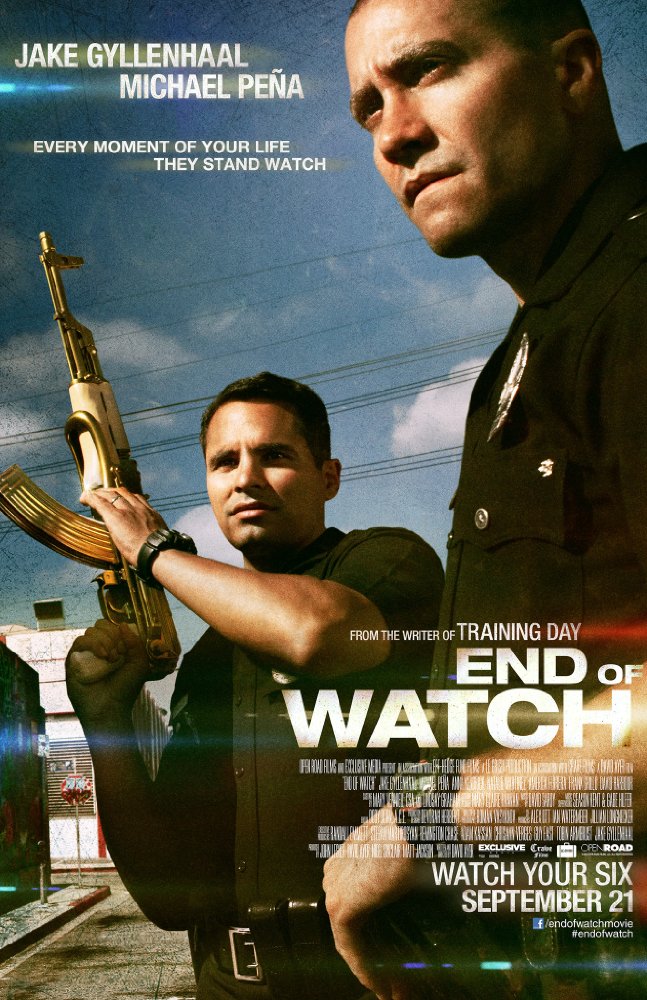
“I am the police, and I’m here to arrest you. You’ve broken the law. I did not write the law. I may disagree with the law but I will enforce it. No matter how you plead, cajole, beg or attempt to stir my sympathy. Nothing you do will stop me from placing you in a steel cage with gray bars. If you run away I will chase you. If you fight me I will fight back. If you shoot at me I will shoot back. By law I am unable to walk away. I am a consequence. I am the unpaid bill. I am fate with a badge and a gun. Behind my badge is a heart like yours. I bleed, I think, I love, and yes I can be killed. And although I am but one man, I have thousands of brothers and sisters who are the same as me. They will lay down their lives for me and I them. We stand watch together. The thin-blue-line, protecting the prey from the predators, the good from the bad. We are the police.”
End of Watch is probably my favorite movie released this year. I would describe it as a real, true to life movie version of the television series Cops. I typically view law enforcement officials as members of just another large group of armed “gangsters,” working under a pretense of “justice,” deluded into enforcing unjust laws and believing that they are somehow superior to the “criminals” they incarcerate, and also responsible for quite literally holding me prisoner and stealing my car. But, alas, they are a necessary evil if we wish to live civilized lives. However, the two police officers depicted in this movie managed to gain my respect as individuals, which, by that fact alone is a testimony to it’s greatness.
Enable Dislike Button (2011)
‘Enable Dislike Button’ scam spreading on Facebook
By Dancho Danchev | May 16, 2011, 4:46am PDT
Researchers from Sophos have spotted a currently circulating “Enable Dislike Button” Facebook scam.
Upon clicking on the what looks like a recently added genuine Facebook feature, users are exposed to a “Follow the steps below to get the Dislike button” instructions page similar to the one seen in the Osama Execution video scam.
Spamvertised as:
Facebook now has a dislike button! Click ‘Enable Dislike Button’ to turn on the new feature!
Once the users copy and paste the obfuscated javascript in their browsers, all of their friends will be spamvertised with a wall post about the non-existent Dislike feature. The campaigners appear to be monetizing the campaign through a survey scam.
For the time being, Facebook doesn’t offer a dislike button.
Synon: Brilliant!
Doomsday Profiteering
HOLY FUCKING SHIT! I JUST SAW A FUCKING ZOMBIE! WHAT THE FUCK!?
“The group most vulnerable to doomsday claims is children. Teachers report that many of their students are frightened and some are even considering suicide. This is the most tragic consequence of the 2012 hoax.”
– NASA.gov
Domestic Drones
Congress Wants to See Obama’s “License to Kill”
But if they get it, they won’t be allowed to show it to you.
Congress is finally standing up to President Barack Obama on targeted killing. Almost a year after three American citizens were killed in US drone strikes, legislators are pushing the administration to explain why it believes it’s legal to kill American terror suspects overseas.
Congress is considering two measures that would compel the Obama administration to show members of Congress what Sen. Chuck Grassley (R-Iowa) calls Obama’s “license to kill”: internal memos outlining the legal justification for killing Americans overseas without charge or trial. Legislators have been asking administration officials to release the documents for nearly a year, raising the issue multiple times in hearings and letters. But the new proposals, including one from Sen. John Cornyn (R-Texas) first flagged by blogger Marcy Wheeler and another in a separate intelligence bill, aren’t requests—they would mandate disclosure. That shift shows both Republicans and Democrats are growing impatient with the lack of transparency on targeted killings.
After radical American-born cleric Anwar al-Awlaki, alleged American Al Qaeda propagandist Samir Khan, and Awlaki’s 16-year-old son, Abdulrahman, were killed by drone strikes in Yemen in September and October of last year, Republican and Democratic members of Congress sent letters asking the Obama administration to explain the legal justification for targeted killing of American citizens. “We got a license to kill Americans, and we don’t know the legal basis for the license to kill Americans…because our letters haven’t been answered,” Grassley complained during a Senate Judiciary Committee hearing last week.
The New York Times has confirmed the existence of a secret memo from the Justice Department’s Office of Legal Counsel (OLC)—the branch of the government that tells the president whether what he wants to do is legal—outlining the legal basis for the targeted killing program. But the Obama administration has yet to acknowledge that any such memo exists, despite defending the targeted killing policy in speeches and public appearances, and is currently fighting an American Civil Liberties Union lawsuit that seeks to force the government to reveal the legal justification for targeted killing. Now Congress seems to be moving towards the ACLU’s position.
Cornyn’s amendment would require the Obama administration to provide the Office of Legal Counsel memo justifying the killing program to legislators on several congressional committees. Democrats on the Judiciary Committee voted to shelve Cornyn’s proposal, but that doesn’t mean the effort is dead. Cornyn could propose his amendment again later this year, and there’s also a section of a separate intelligence bill that would compel the administration to share all of the Justice Department’s legal opinions on intelligence matters with the congressional intelligence committees—unless the White House invokes executive privilege.
“We’re not mere supplicants to the executive branch, we are a coequal branch of government,” Cornyn said during discussion of his amendment in the Senate committee hearing last week. “So it is insufficient to say pretty please, Mr. President, pretty please, Mr. Attorney General, will you please tell us the legal authority by which you claim the authority to kill American citizens abroad?” (Cornyn also noted that just because he wants to see the memo doesn’t mean he’d necessarily disagree with its contents.)
Neither Cornyn’s proposal nor the intelligence bill would require the administration have to share the OLC memo with the media or the public, even in redacted form. But releasing the memo to legislators would at least allow Congress to perform more effective oversight of the targeted killing program, argues Chris Anders, legislative counsel for the ACLU. The Los Angeles Times reported in June that at the initiative of Sen. Dianne Feinstein (D-Calif.), who chairs the Senate Select Committee on Intelligence, Congress has been keeping a closer eye on the use of drone strikes. But critics like Anders argue that it’s hard for oversight to be effective if legislators don’t know what standard the Obama administration is using to determine whom to kill. “The key committees of Congress don’t even know what the legal standard is or how they’re applying it, so how can they do meaningful oversight?” Anders asks. The intelligence bill and Cornyn’s proposal could fix that problem.
More oversight, though, is not enough, Anders says—regular Americans should know what kind of conduct could lead to them being blown up by a deadly flying robot. “There’s a fundamental due process right to know what it is you can’t do in order to avoid getting killed by the order of the president,” he says. Grassley, at least, seems to be on board with that idea—a Grassley aide said the senator would “support making a redacted analysis public if possible.” A Feinstein aide also suggested a push for public disclosure could follow Congress getting access to the legal analysis of targeted killing. And even if the OLC memo is only shared with Congress, broadening access to the document makes it more likely that it could be leaked to the press.
Now that legislators on both sides of the aisle are pushing for more disclosure, the chances the public will learn about the contents of the targeted killing memos has increased dramatically. Still, Anders says, it’s easy to see a difference between how hard Congress pushed for George W. Bush-era memos authorizing torture and the deferential stance Congress adopted during the first three and a half years of the Obama administration.
“When it was Bush, it was much easier to get [legislators] to demand public disclosure,” Anders says.
The Dawning of Domestic Drones
The drones are coming to a neighborhood near you.
The unmanned aircraft that most people associate with hunting terrorists and striking targets in Pakistan are on the brink of evolving into a big domestic industry. It is not a question of whether drones will appear in the skies above the United States but how soon.
Congress has ordered the Federal Aviation Administration to quickly select six domestic sites to test the safety of drones, which can vary in size from remote-controlled planes as big as jetliners to camera-toting hoverers called Nano Hummingbirds that weigh 19 grams.
The drone go-ahead, signed in February by President Obama in the F.A.A. reauthorization law, envisions a $5 billion-plus industry of camera drones being used for all sorts of purposes from real estate advertising to crop dusting to environmental monitoring and police work.
Responding to growing concern as the public discovers drones are on the horizon, the agency recently and quite sensibly added the issue of citizens’ privacy to its agenda. Setting regulations under the Fourth Amendment guarantee against unlawful search is of the utmost importance. But since the F.A.A.’s primary mission is safety, Congress should take the matter in hand by writing privacy safeguards for the booming drone industry.
The anticipated market includes tens of thousands of police, fire and other government agencies able to afford drones lighter than traditional aircraft and costing as little as $300. Several surveillance drones are already used for border patrol, and the F.A.A. has allowed a few police departments to experiment narrowly, as in a ceiling of 400 feet for surveillance flights over the Everglades by the Miami Police Department.
Privacy worries in California prompted Alameda County officials to postpone drone plans for further study. The local sheriff insisted that what he had in mind was disaster response, not random snooping, but the local American Civil Liberties Union office claimed the plan would have permitted extensive intelligence gathering.
The A.C.L.U.’s national office is warning that while drones could have many benefits like search-and-rescue work and tracking dangerous criminal situations, the law’s lack of privacy mandates will inevitably invite “pervasive surveillance” of the public.
The idea of watchful drones buzzing overhead like Orwellian gnats may seem far-fetched to some. But Congress, in its enthusiasm for a new industry, should guarantee the strongest protection of privacy under what promises to be a galaxy of new eyes in the sky.
Civil Liberties Organizations Launch Protests Against CISPA
Without the support of Wikipedia or Google, protests will rely on grassroots movement
By JASON KOEBLER
April 16, 2012 RSS Feed Print
On January 17, some of the most popular websites locked their doors, blacking out for hours at a time to protest the Stop Online Piracy Act, a Congressional bill that would have censored certain websites if they were found to host pirated content. Three months later, the Internet is at war with Congress again, this time over the Cyber Intelligence Sharing and Protection Act, which critics say would allow the government to snoop on private files.
They might have more of an uphill battle this time around—while some of the largest digital companies supported the SOPA protests, many of those have switched sides for CISPA, including Facebook. So while Wikipedia and Reddit are using blackouts to protest SOPA, organizations are trying to create a grassroots movement of Internet users to protest CISPA.
The bill would allow private companies to access classified government information to help protect them from cyber attacks that bring down their networks. In return, those companies would be allowed to share users’ private information with the government, as long as it constitutes a “cyber threat” or relates to homeland security.
Jim Dempsey, vice president for public policy at the Center for Democracy and Technology, says that with CISPA, Congress is trying to “fundamentally change how Americans use the Internet.”
Organizations such as the American Civil Liberties Union, the Electronic Frontier Foundation, and Tech Freedom have set up a “week of action” against CISPA, starting Monday. A site set up by the EFF allows users to tweet directly at their Congressional representative using the hashtags #CongressTMI and #CISPA.
The EFF keeps an eye on most legislation that could affect Internet users, but Rainey Reitman, who leads the organization’s activist team, says they have to be careful about which bills they protest.
“We have to make sure they have a decent shot of passing,” she says. As soon as they recognize a bill they find threatening, the organization might blog about it, but “a protest requires all our resources,” she adds. “It didn’t become apparent that [CISPA] was going to move forward until about a week ago.”
There have already been some indications that the bill, sponsored by Reps. Mike Rogers and Dutch Ruppersberger, might be weakened before it comes to a vote. On Friday, the House Committee on Intelligence circulated a version of the bill that narrowed the language of the bill, limiting the amount of data that could be shared with the Federal Government.
Reitman says this week is an important one for the bill—next week is “Cybersecurity week” on Capitol Hill, so the bill is likely to be put to a vote.
“We knew this would gain steam next week,” she says. “So we wanted to make sure Internet users got a chance to have their say before Congress did.”
Books Should Be Free
Books Should Be Free is a website that offers over 3,000 free public domain audio books and eBooks available for PC, Mac, iPhone, Android, Kindle, and MP3 players.
Also, for the exceedingly lazy, there currently exist 117,673 Wikipedia articles available in full audio on YouTube.
– https://www.youtube.com/user/WikiPlays
Best Undergrad College Degrees by Salary (2008)
Best Undergrad College Degrees By Salary (2008)
FORMAT:
Degree Type
Starting Median Salary
Mid-Career Median Salary
Chemical Engineering
$63,200
$107,000
Computer Engineering
$61,400
$105,000
Electrical Engineering
$60,900
$103,000
Aerospace Engineering
$57,700
$101,000
Economics
$50,100
$98,600
Physics
$50,300
$97,300
Computer Science
$55,900
$95,500
Industrial Engineering
$57,700
$94,700
Mechanical Engineering
$57,900
$93,600
Math
$45,400
$92,400
Physician Assistant
$74,300
$91,700
Civil Engineering
$53,900
$90,500
Construction
$53,700
$88,900
Finance
$47,900
$88,300
Management Information Systems (MIS)
$49,200
$82,300
Philosophy
$39,900
$81,200
International Relations
$40,900
$80,900
Chemistry
$42,600
$79,900
Marketing
$40,800
$79,600
Geology
$43,500
$79,500
Political Science
$40,800
$78,200
Accounting
$46,000
$77,100
Architecture
$41,600
$76,800
Information Technology (IT)
$49,100
$74,800
Business Management
$43,000
$72,100
Agriculture
$42,600
$71,900
History
$39,200
$71,000
Communications
$38,100
$70,000
Film
$37,900
$68,500
Nursing
$54,200
$67,000
Journalism
$35,600
$66,700
Geography
$41,200
$65,500
Art History
$35,800
$64,900
Biology
$38,800
$64,800
English
$38,000
$64,700
Forestry
$39,100
$62,600
Anthropology
$36,800
$61,500
Health Care Administration
$38,800
$60,600
Psychology
$35,900
$60,400
Graphic Design
$35,700
$59,800
Sociology
$36,500
$58,200
Hospitality & Tourism
$37,800
$57,500
Drama
$35,900
$56,900
Criminal Justice
$35,000
$56,300
Nutrition
$39,900
$55,300
Music
$35,900
$55,000
Interior Design
$36,100
$53,200
Spanish
$34,000
$53,100
Education
$34,900
$52,000
Religion
$34,100
$52,000
Source: http://www.payscale.com/2008-best-colleges/degrees.asp
Behold the Man
Now I go alone, my disciples, You, too, go now, alone. Thus I want it.
Go away from me and resist Zarathustra! And even better: be ashamed of him! Perhaps he deceived you.
The man of knowledge must not only love his enemies, he must also be able to hate his friends.
One repays a teacher badly if one always remains nothing but a pupil. And why do you not want to pluck at my wreath?
You revere me; but what if your reverence tumbles one day? Beware lest a statue slay you.
You say that you believe in Zarathustra? But what matters Zarathustra? You are my believers – but what matter all believers?
You had not yet sought yourselves; and you found me. Thus do all believers; therefore all faith amounts to so little.
Now I bid you lose me and find yourselves; and only when you have all denied me will I return to you.
America, the Great
There is nothing which I dread so much as a division of the republic into two great parties, each arranged under its leader, and concerting measures in opposition to each other. This, in my humble apprehension, is to be dreaded as the greatest political evil under our Constitution.
– John Adams
Professional politicians? An exploited and broken system of representation? Propaganda of scare tactics? News as entertainment? Voting as the illusion of freedom? Private sector in bed with Big Brother? War in the name of “democracy” and “freedom”? Privately owned Federal Reserve? Privately owned for-profit prisons!? WHAT THE FUCK! America, the Great?
First, let me point out that in no other industrialized, democratic country, are there only two strong political parties. In each and every one of these countries, there are at least three political parties that are on an equal footing. I find it incomprehensible that in a country such as ours, which demands choices in every other aspect of life (i. e. – 150 station cable/satellite TV systems), we still limit ourselves to only two options when it comes to politics.
It should be further noted that there is nothing in the Constitution that specifies a two party system. There are even clues in this document that suggest the Founding Fathers assumed that there would always be more than two strong candidates. In fact, if you look at the first several Presidential elections in this country, you would see that there were always at least three Presidential candidates who received electoral votes.
We have been deluded in this country into thinking that a Third Party won’t work. How? Well, first we’re told that if we vote for a third party, we’d be wasting our vote. This is, of course, looking at it from their perspective. In their view, any time you don’t vote for their candidate, the vote is wasted. If that doesn’t work, we’re told that our vote won’t count. Translated, this means that your vote will count, just not for their party. Next, we’re told that we are splitting the vote, helping the other candidate win. I have two comments on that. The first is that this is certainly an egotistical viewpoint. After all, why should you drop your candidate in order to help get their candidate elected? My second comment is that this argument is nothing more than the “voting for the lesser of two evils” logic. We people who vote third party, however, have our own logic. And that is, why should we vote for the lesser of two evils when the lesser evil is still evil? Finally, we’re told that we are being presented with two clear choices, so we don’t need to clog up the field with any more. In reality, this makes no sense. Even if it were true that we are always being presented with two candidates who are at opposite ends of the political spectrum, where does that leave the voters who are in the middle? As an example, how about a voter who has liberal social ideas but conservative fiscal views? Why should these types of voters have to give up fifty percent of their values in order to choose between the conservative and liberal candidates? This is another example, and there are many more, where the two party system is a failure in delivering representational elections.
The present two party system has led to gridlock in the country, which has extended into the general population as well. Essentially, we have become an “us” versus “them” society. There is no middle ground. If you are not with “us”, then you are with “them”, and that makes you the enemy. Moderates who try to compromise with opposing moderates, and who go against the party’s wishes, are branded as traitors. As a result, the serious problems that we are facing in this country are not being addressed. A strong third party could blunt this attitude, and therefore open up a dialogue, since people might realize that it’s no longer just “them” anymore with their diametrically opposing viewpoints.
Vote third party or don’t vote at all! Or vote for the good looking one. Fuck it.
– November, 2012